Sustainable Systems

Sustainable systems examine how social, economic, and environmental processes can be organized to support long-term stability and human well-being. Rather than treating environmental protection, economic development, and social equity as separate challenges, sustainable systems research emphasizes their deep interdependence.

The field integrates insights from sustainability science, systems theory, ecological economics, and public policy. Researchers analyze how resource use, technological development, governance structures, and social behavior interact within complex systems.

Designing sustainable systems requires understanding feedback loops, institutional incentives, and long-term environmental constraints. Effective systems must balance efficiency with resilience, innovation with stewardship, and economic opportunity with ecological limits.

By integrating interdisciplinary knowledge, sustainable systems approaches aim to create development pathways that maintain ecological integrity while supporting inclusive and resilient societies.

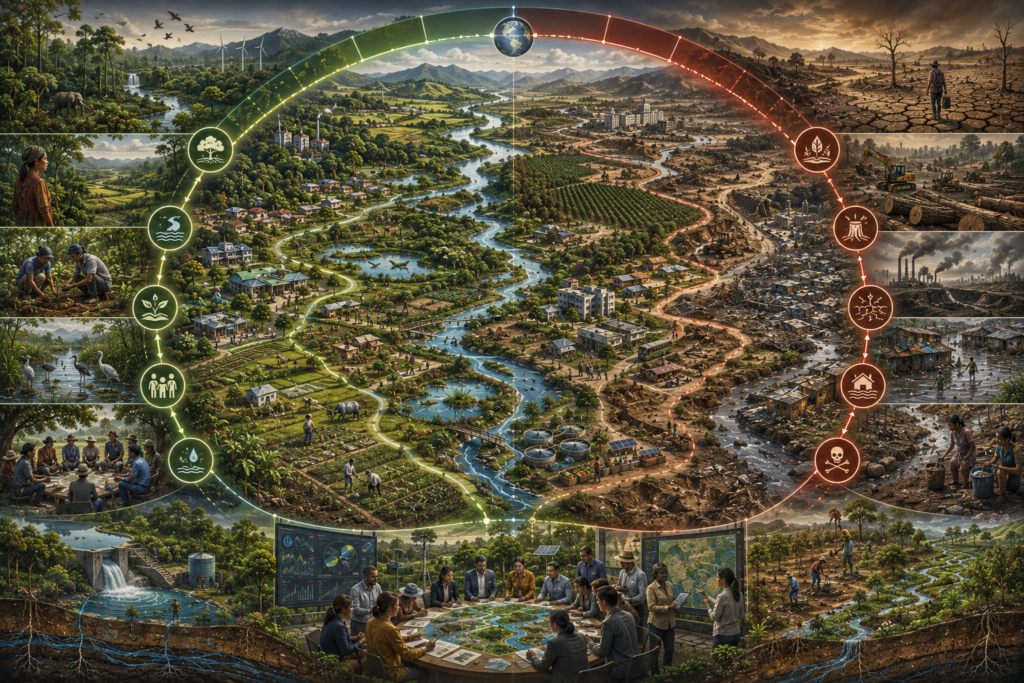
Abstract sustainability illustration of state capacity, public administration, and delivery systems, showing implementation, local service delivery, public trust, accountability, coordination, administrative justice, equal access, resilience, and sustainable development.

State Capacity, Public Administration, and Delivery Systems

State Capacity, Public Administration, and Delivery Systems examines why sustainable development depends not only on ambitious goals or policy vision, but on whether public institutions can actually implement priorities, coordinate action, deliver services, and sustain legitimacy over time. The article argues that development is experienced through the everyday state: clinics that function, benefits that arrive, permits that are processed fairly, infrastructure that is maintained, and public systems that remain reachable and credible under pressure. It explores implementation capacity, coordination, trust, accountability, institutional learning, delivery reliability, and administrative justice, while also emphasizing the risks posed by fragmentation, capture, and weak state coherence. The core claim is that sustainable development succeeds or fails in large part through the strength, legitimacy, and practical reach of state capacity and delivery systems.

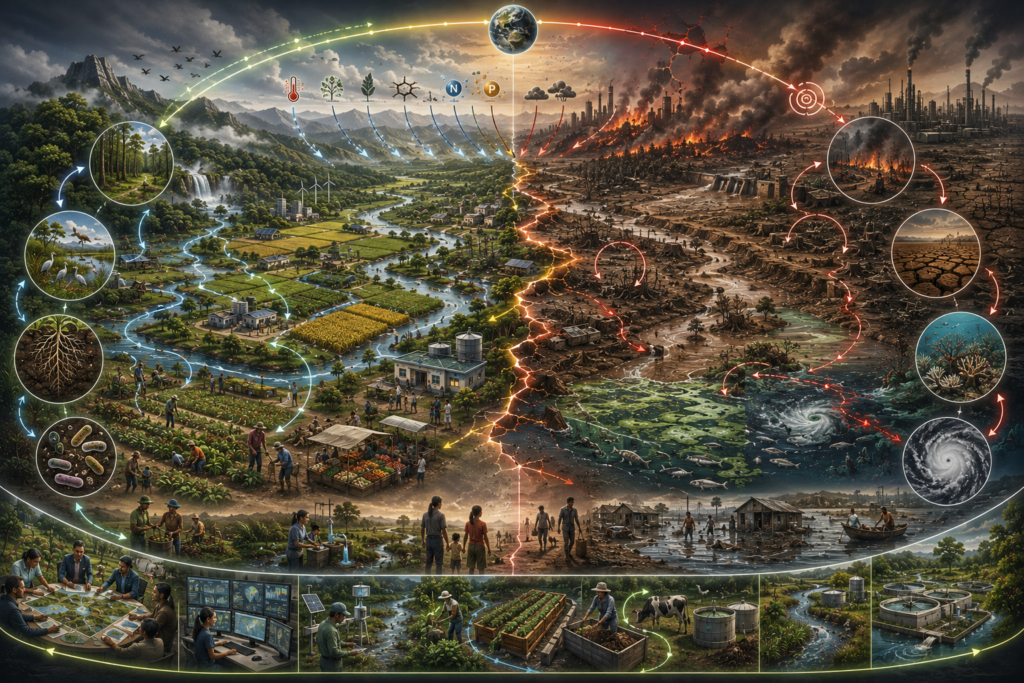
Abstract sustainability illustration of institutions and sustainable development, showing governance, coordination, accountability, public trust, justice, implementation capacity, resilience, policy coherence, and long-horizon development.

Why Institutions Matter for Sustainable Development

Why Institutions Matter for Sustainable Development examines why development depends not only on goals, technologies, or resources, but on the institutional architecture that makes collective action durable across time. The article argues that sustainable development succeeds or fails through the quality of rules, organizations, administrative systems, and public norms that allow societies to coordinate action, implement policy, manage trade-offs, protect rights, and sustain legitimacy under pressure. It explores implementation capacity, collective-action problems, policy coherence, accountability, trust, resilience, inclusion, state learning, and institutional lock-in, showing that institutions are not background machinery but part of development’s core conditions of possibility. The central claim is that sustainable development becomes durable only when institutions are capable, adaptive, and publicly legitimate enough to carry collective purpose across political cycles and generations.

Abstract sustainability illustration of ecological thresholds, nonlinearity, and systemic risk, showing tipping points, feedback loops, cascading instability, planetary boundaries, uncertainty, justice, and development planning under nonlinear ecological change.

Ecological Thresholds, Nonlinearity, and Systemic Risk

Ecological Thresholds, Nonlinearity, and Systemic Risk examines why sustainable development must account for the possibility that environmental systems can shift abruptly rather than decline smoothly. The article argues that forests, reefs, hydrological systems, cryospheric processes, and other coupled ecological systems may absorb stress for a time and then reorganize rapidly once critical thresholds are crossed, producing consequences that are disproportionate, cascading, and sometimes hard to reverse. It explores threshold dynamics, tipping points, feedbacks, hysteresis, systemic interdependence, precaution under uncertainty, and the justice implications of uneven exposure to abrupt ecological disruption. The core claim is that sustainable development cannot be judged only by present gains or gradual averages, but by whether development pathways avoid pushing life-supporting systems toward nonlinear shifts that can destabilize future human wellbeing, resilience, and institutional continuity.

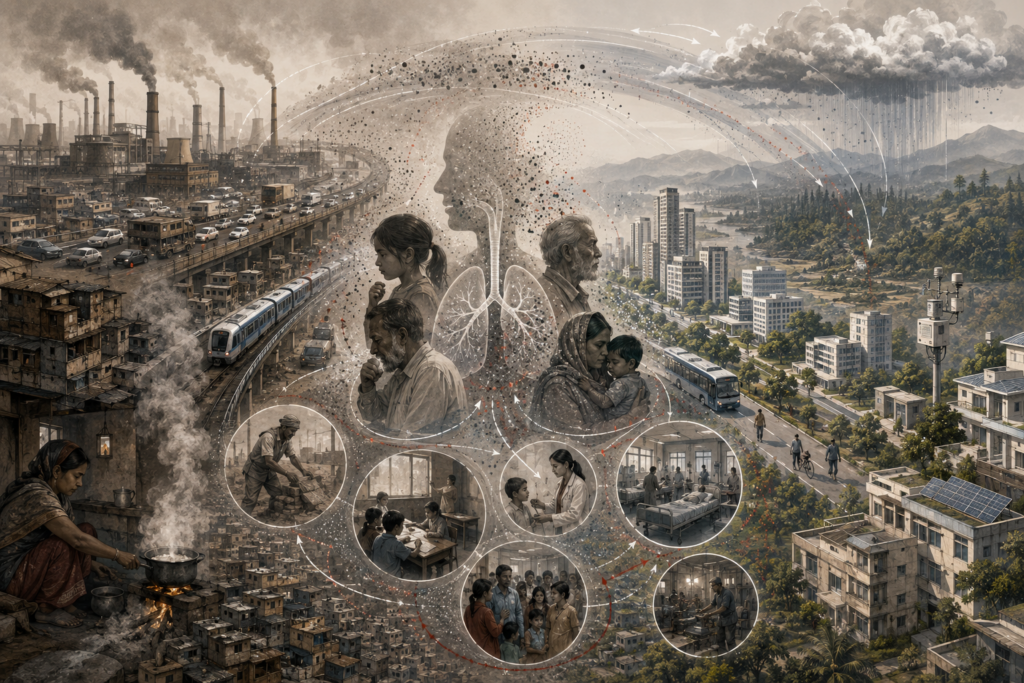
Editorial sustainability illustration showing atmospheric aerosols and air pollution linking industry, traffic, household fuel use, urban inequality, public transit, health impacts, monitoring systems, and cleaner development pathways.

Atmospheric Aerosols, Air Quality, and Public Health

Atmospheric Aerosols, Air Quality, and Public Health examines why breathable air is not a peripheral environmental concern but one of the background conditions of human development itself. The article argues that aerosols and particulate pollution shape health, labour capacity, urban livability, learning, and public-system resilience by structuring the atmospheric conditions through which daily life is lived. It explores particulate matter, unequal exposure, household and industrial sources, the links between aerosols, climate, and regional instability, and the reasons clean air must be treated as a pathway question rather than a downstream cleanup issue. The core claim is that sustainable development depends not only on expanding infrastructure and productivity, but on ensuring that the air people breathe remains compatible with health, habitability, and long-run social resilience.

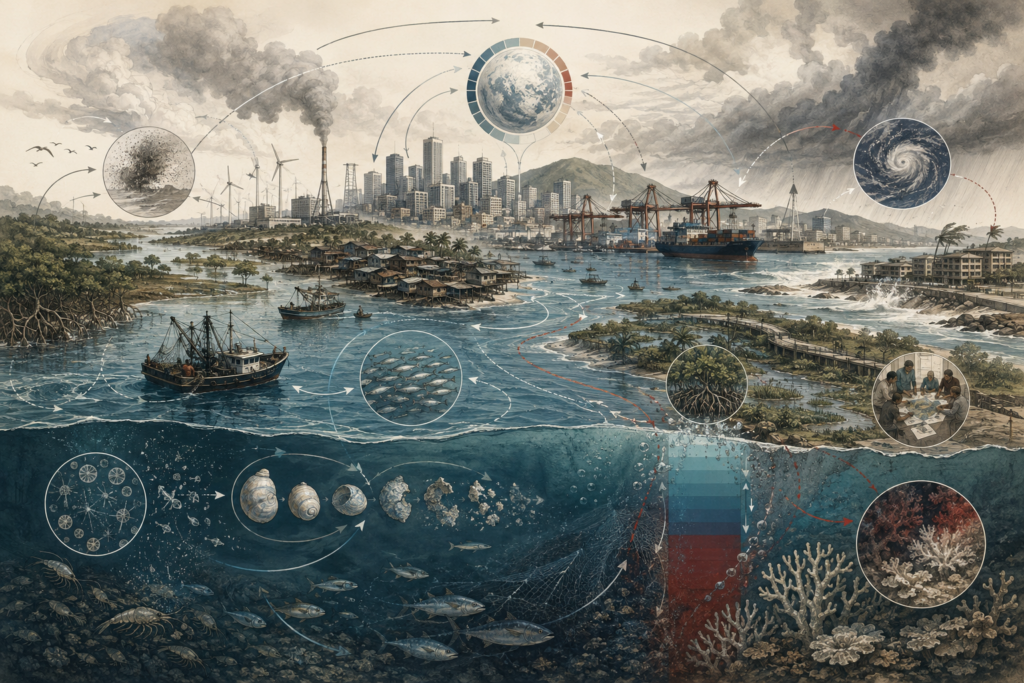
Editorial sustainability illustration showing ocean systems and coastal development as an interconnected landscape of cities, ports, fisheries, wetlands, marine food webs, coral reefs, acidification, storms, and coastal risk.

Ocean Systems, Acidification, and Coastal Development

Ocean Systems, Acidification, and Coastal Development examines why coastal development depends not only on ports, fisheries, infrastructure, and urban growth, but on marine systems whose chemistry and ecological resilience are being altered at planetary scale. The article argues that ocean acidification is not a narrow marine-science issue but a long-run development risk for coastal societies, because changing ocean chemistry affects marine habitability, fisheries, food systems, coastal protection, and the viability of economies concentrated along the sea. It explores ocean acidification as a planetary-boundary issue, the compounding effects of warming and sea-level rise, the uneven justice burdens borne by coastal and island communities, and the governance challenges of planning under accelerating ocean change. The core claim is that sustainable coastal development depends on preserving the marine conditions that keep coasts livable, productive, and resilient across time.

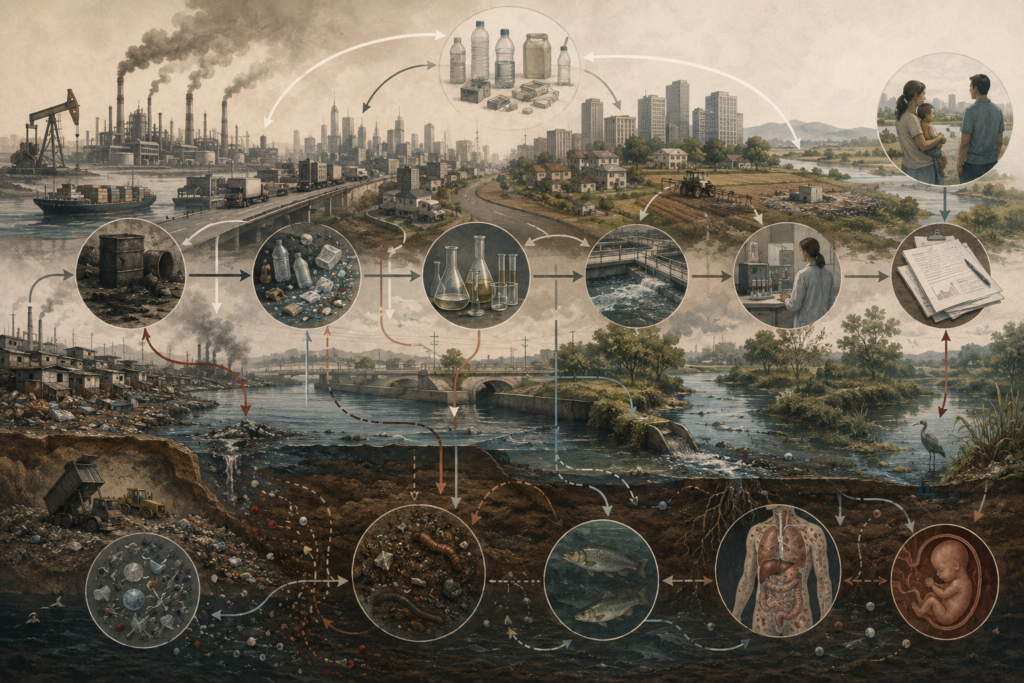
Editorial sustainability illustration showing pollution and novel entities as an interconnected system linking industry, waste, chemicals, waterways, soil contamination, ecosystems, public health, regulation, and long-run development risk.

Pollution, Novel Entities, and Long-Run Development

Pollution, Novel Entities, and Long-Run Development examines why development must be judged not only by what it produces, but by the chemical residues, wastes, and synthetic substances it leaves circulating through bodies, ecosystems, and public systems over time. The article argues that pollution is not a marginal side effect of progress but a structural constraint on long-run development, because persistent contaminants, unmanaged waste, and proliferating novel entities can outpace scientific assessment, regulatory capacity, and remediation systems. It explores toxicity, habitability, inequality, ecological slow violence, and the governance problems created when innovation moves faster than institutional control. The core claim is that sustainable development depends not only on expanding production and consumption, but on governing material complexity in ways that keep future societies healthy, habitable, and ecologically resilient.

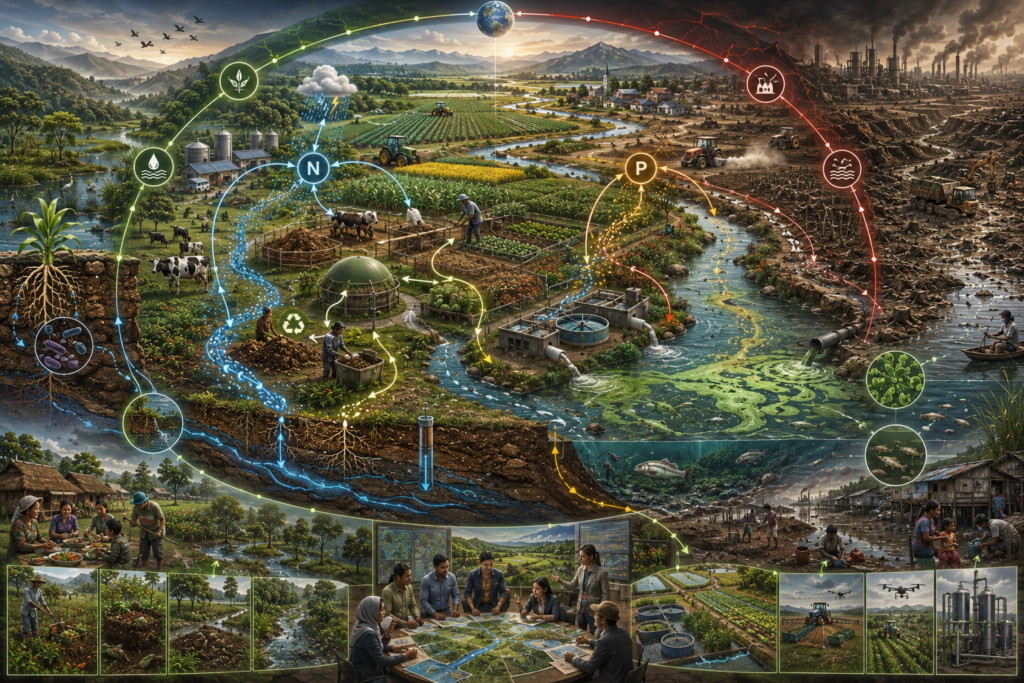
Abstract sustainability illustration of nutrient cycles, agriculture, and ecological stress, showing nitrogen, phosphorus, soil fertility, crop production, runoff, eutrophication, water quality, planetary boundaries, nutrient governance, and sustainable agriculture.

Nutrient Cycles, Agriculture, and Ecological Stress

Nutrient Cycles, Agriculture, and Ecological Stress examines why sustainable development depends on nutrients that make agriculture possible but also on keeping those nutrients within ecological limits. The article argues that nitrogen and phosphorus are not merely farm inputs but part of the biophysical infrastructure of development itself, because they connect food production, soil fertility, water quality, ecosystem resilience, and long-run human wellbeing. It explores agricultural intensification, altered biogeochemical flows, eutrophication, multi-pathway ecological stress, and the governance challenge of balancing productivity with ecological restraint. The core claim is that sustainable development depends not only on feeding populations today, but on governing nutrient systems in ways that keep agriculture productive without progressively degrading the soils, waters, and ecosystems on which future development depends.

Abstract sustainability illustration of land-system change and development pathways, showing forests, agriculture, settlements, infrastructure, land degradation, biodiversity, soil function, restoration, planetary boundaries, justice, and long-run resilience.

Land-System Change and Development Pathways

Land-System Change and Development Pathways examines why development is always written into land through the transformation of forests, wetlands, grasslands, farms, settlements, and infrastructure corridors. The article argues that land-system change is not simply a matter of land-cover conversion, but a broader reorganization of ecological function, social opportunity, territorial habitability, and long-run resilience. It explores land degradation, biodiversity loss, fragmentation, food production, settlement expansion, justice, and governance, showing how different development pathways can either stabilize or erode the ecological conditions on which future development depends. The core claim is that sustainable development requires governing land not only for immediate output and expansion, but for habitability, resilience, rights, and the enduring viability of the landscapes through which human futures are built.

Abstract sustainability illustration of freshwater change and development risk, showing blue water, green water, hydrological instability, water quality, sanitation, food systems, freshwater ecosystems, planetary boundaries, governance, and unequal exposure.

Freshwater Change and Development Risk

Freshwater Change and Development Risk examines why water must be understood not simply as a sector or service, but as one of the material conditions through which health, food production, sanitation, ecosystems, settlement, and economic life become possible. The article argues that freshwater risk is broader than scarcity alone, because development is threatened not only by low supply but by wider hydrological instability across streamflow, groundwater, soil moisture, wastewater treatment, water quality, and freshwater ecosystems. It explores blue water and green water, human capability, food systems, public health, ecological decline, and uneven governance capacity, showing how freshwater change can narrow the conditions of habitability and resilience. The core claim is that sustainable development depends not only on expanding water services, but on sustaining the hydrological conditions that make human life, public systems, and long-run resilience possible across time.

Scroll to Top