Sustainable Systems

Sustainable systems examine how social, economic, and environmental processes can be organized to support long-term stability and human well-being. Rather than treating environmental protection, economic development, and social equity as separate challenges, sustainable systems research emphasizes their deep interdependence.

The field integrates insights from sustainability science, systems theory, ecological economics, and public policy. Researchers analyze how resource use, technological development, governance structures, and social behavior interact within complex systems.

Designing sustainable systems requires understanding feedback loops, institutional incentives, and long-term environmental constraints. Effective systems must balance efficiency with resilience, innovation with stewardship, and economic opportunity with ecological limits.

By integrating interdisciplinary knowledge, sustainable systems approaches aim to create development pathways that maintain ecological integrity while supporting inclusive and resilient societies.

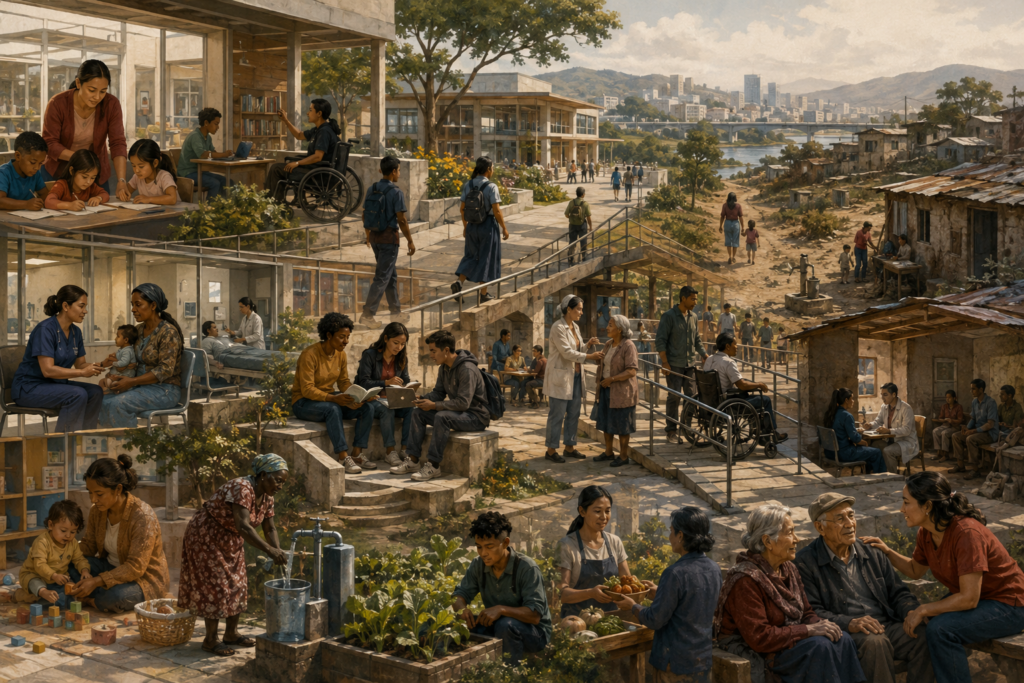
Editorial sustainability illustration showing schools, clinics, care spaces, accessible public systems, intergenerational learning, community health, and unequal access to human capability across a layered landscape.

Health, Education, and Human Capability Expansion

Health, Education, and Human Capability Expansion examines why health and education must be understood not as secondary social sectors but as foundational conditions of human freedom and development. The article argues that development cannot be judged by economic growth alone when people remain unable to live healthy lives, gain meaningful knowledge, or convert formal access into real opportunity. It explores capability expansion, universal access, quality, life-course formation, public systems, and unequal capability formation, showing how health and education shape the real range of lives people are able to live. The core claim is that sustainable development requires institutions capable of making health and education genuinely accessible, equitable, durable, and transformative, so that human possibility expands not only in principle but in lived reality.
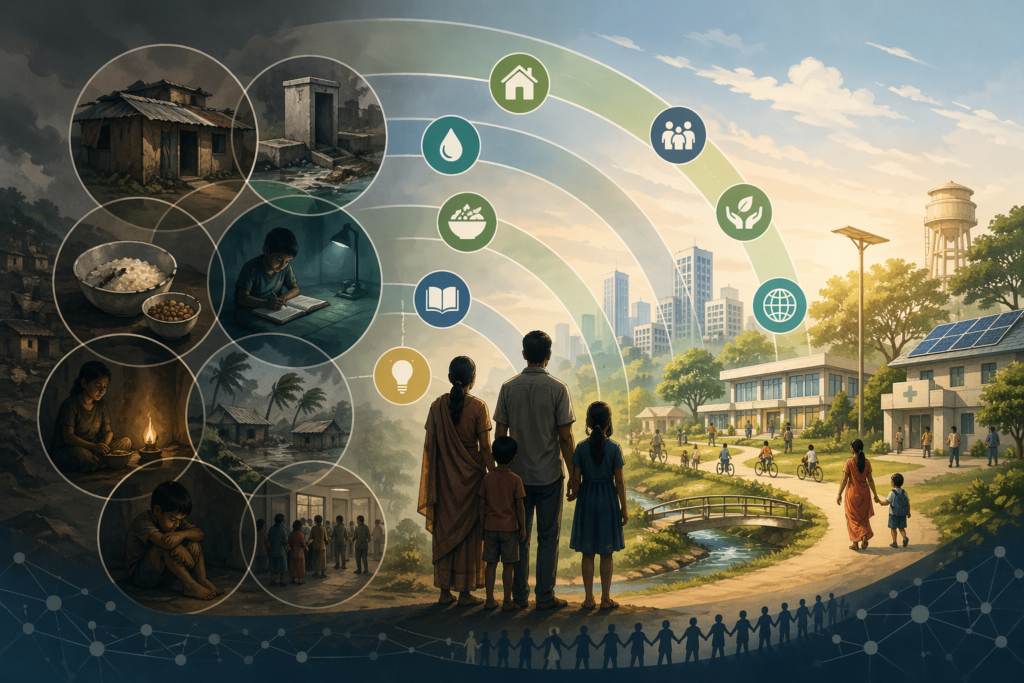
Editorial illustration of a family standing between overlapping zones of deprivation and a more supportive public-goods landscape, with visual cues for housing, sanitation, food, education, energy access, social inclusion, and human capability.

Poverty, Deprivation, and Multidimensional Development

Poverty, Deprivation, and Multidimensional Development examines why poverty cannot be understood as low income alone when human lives are shaped by overlapping deficits in health, education, nutrition, housing, sanitation, energy, security, and access to public goods. The article argues that poverty is best understood as a multidimensional condition of constrained human possibility rather than a single monetary shortfall. It explores capability constraint, clustered deprivation, the Multidimensional Poverty Index, child vulnerability, spatial inequality, institutional failure, and climate exposure, showing how disadvantages accumulate and reproduce one another over time. The core claim is that sustainable development requires more than raising incomes: it requires institutions capable of reducing layered deprivation, expanding real human capability, and interrupting the structural reproduction of poverty across households, places, and generations.

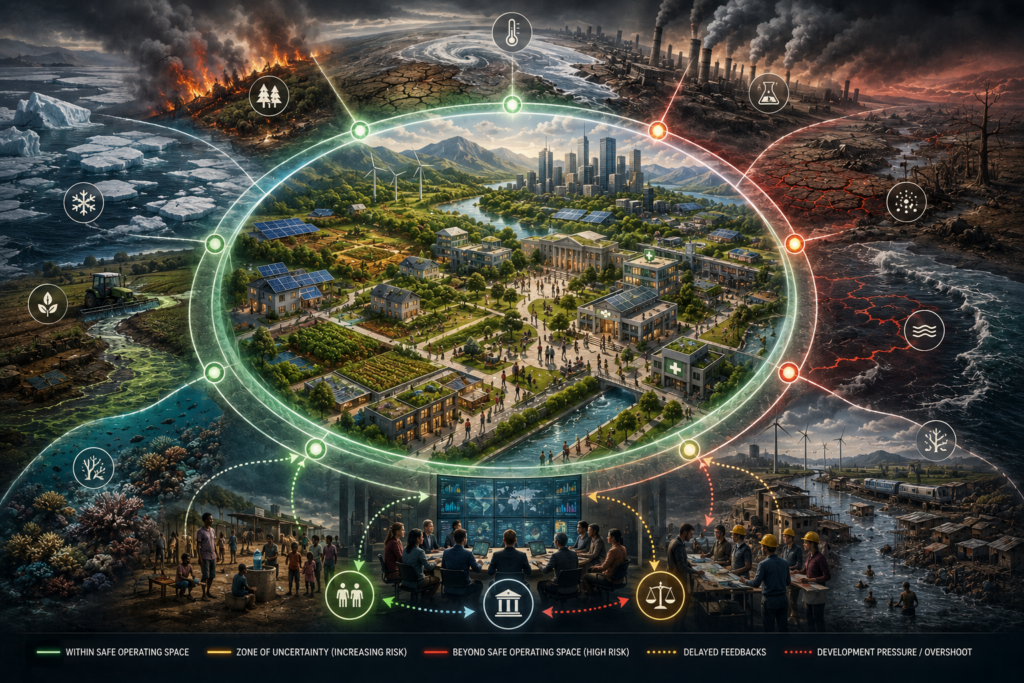
Cinematic sustainability illustration of a safe operating space for long-run development, showing a resilient human settlement within a planetary boundary surrounded by climate stress, pollution, biodiversity loss, water pressure, ecological degradation, governance planning, and uneven exposure.

Safe Operating Space and the Conditions of Long-Run Development

Safe Operating Space and the Conditions of Long-Run Development examines why sustainable development must be judged not only by present welfare gains but by whether those gains are achieved within ecological conditions compatible with Earth-system stability and resilience. The article argues that a safe operating space is not a peripheral environmental concern but one of the core background conditions of durable human development. It explores planetary boundaries, resilience, overshoot, governability, justice, and long-horizon coordination, showing how development can advance materially while undermining the systems on which its own future depends. The core claim is that long-run development requires more than growth, infrastructure, or social improvement in the present; it requires preserving the ecological stability and institutional capacity needed for human flourishing to remain viable over time.

Editorial illustration of multiple generations looking across a restored landscape with wetlands, public institutions, renewable infrastructure, transit, trees, water systems, and future-oriented stewardship.

Intergenerational Justice and Long-Term Stewardship

Intergenerational Justice and Long-Term Stewardship examines why sustainable development must be judged not only by present welfare gains but by what current societies preserve, transfer, or foreclose for those who come after. The article argues that intergenerational justice gives sustainable development its long-range moral force by requiring present generations to account for delayed, cumulative, and sometimes irreversible consequences imposed on future people who cannot yet represent themselves. It explores stewardship, temporal asymmetry, planetary stability, institutional trusteeship, burden transfer, and uneven responsibility, showing how present prosperity can become morally compromised when it consumes future stability as a hidden subsidy. The core claim is that sustainable development requires institutions capable of protecting ecological resilience, social continuity, and future possibility, so that development remains legitimate across time rather than only in the present.

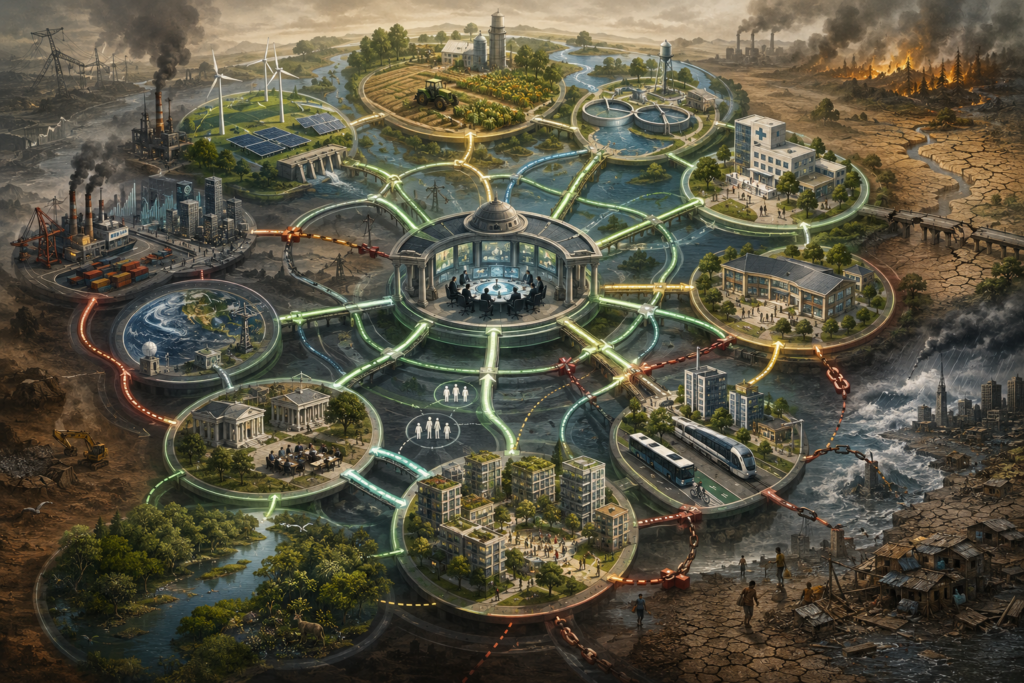
Editorial sustainability illustration showing an interconnected policy-governance system linking energy, food, water, health, education, transport, housing, ecosystems, and institutions, with both reinforcing synergies and damaging trade-offs across a stressed development landscape.

Trade-Offs, Synergies, and Policy Coherence

Trade-Offs, Synergies, and Policy Coherence examines why sustainable development cannot be governed as a collection of isolated goals when policy choices generate spillovers across sectors, borders, and time. The article argues that trade-offs are not policy failures in themselves but structural features of governing interdependent systems under constraint, while synergies are real but rarely automatic. It explores policy interaction, spillovers, whole-of-government capacity, indicator systems, political conflict, sequencing, and institutional design, showing how sustainable development succeeds or fails through the management of relationships among goals rather than through goal-setting alone. The core claim is that policy coherence is the institutional capacity to recognize interdependence, govern conflict among objectives, and align decisions across domains so that progress in one area does not quietly undermine long-run viability elsewhere.

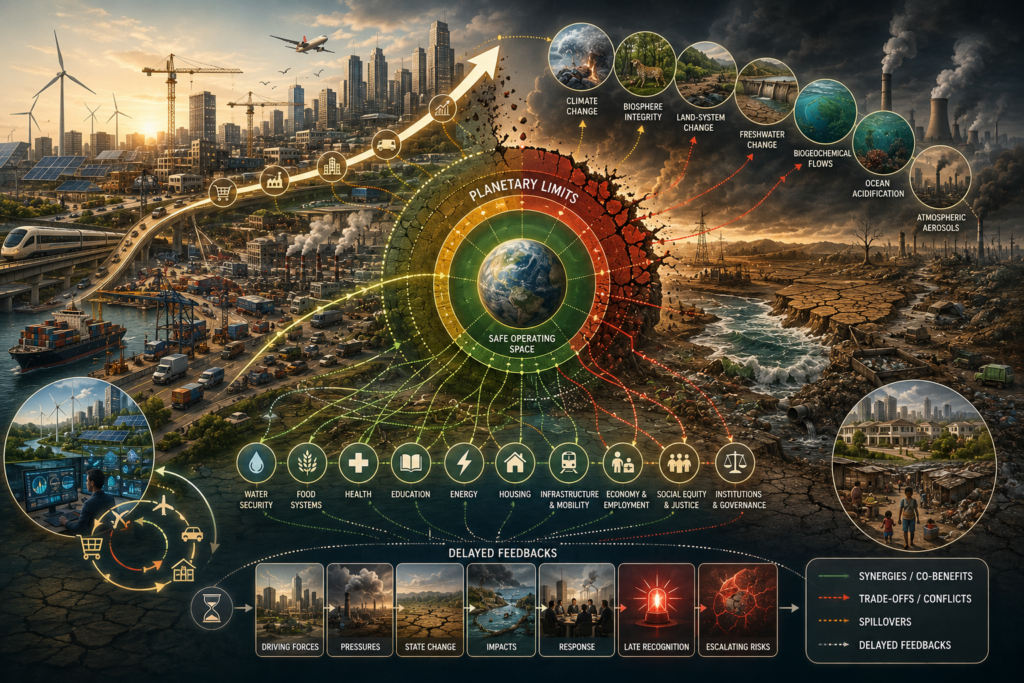
Cinematic sustainability illustration of growth, limits, and overshoot, showing economic expansion, infrastructure, material throughput, planetary boundaries, delayed feedbacks, ecological degradation, technology, governance, and long-run viability risk.

Growth, Limits, and the Problem of Overshoot

Growth, Limits, and the Problem of Overshoot examines why development can become self-undermining when expansion outruns the ecological, institutional, and planetary conditions that make long-run stability possible. The article argues that overshoot is not simply a sudden catastrophe or an apocalyptic slogan, but a structural condition in which visible growth continues while the support systems of continuity are being quietly eroded. It explores growth, throughput, welfare, systems dynamics, delayed feedback, planetary boundaries, development justice, and governance failure, showing how present prosperity can be financed through hidden future instability. The core claim is that sustainable development requires more than growth with better intentions; it requires development pathways that expand human possibility without consuming the ecological and institutional basis of their own continuity.

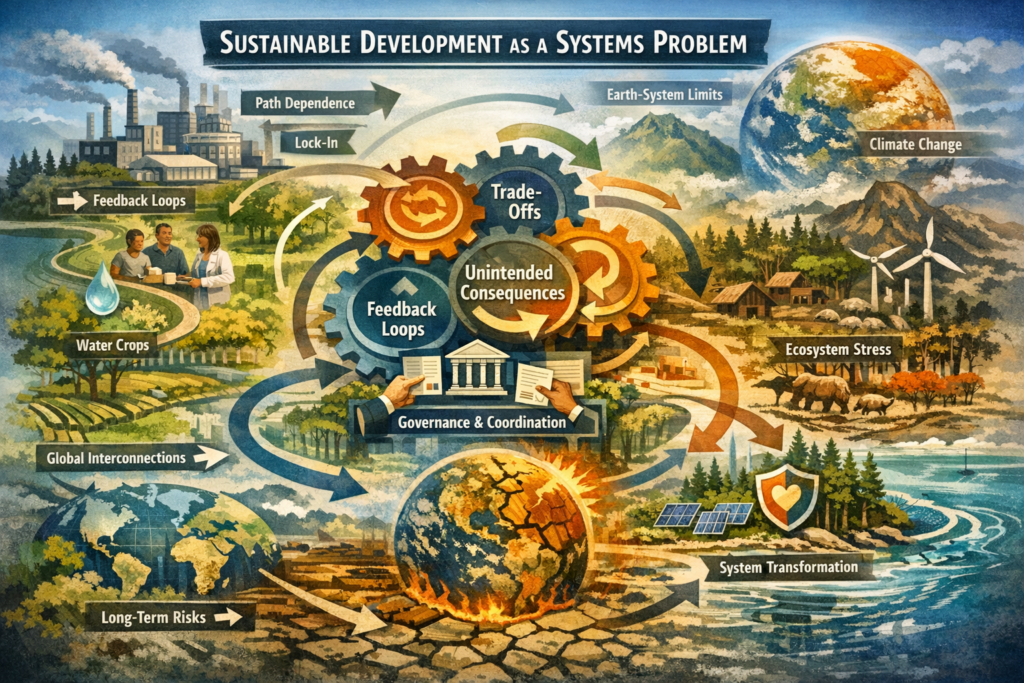
Conceptual illustration of sustainable development as a systems problem, showing feedback loops, interdependence, governance, infrastructure, ecological limits, and long-run resilience.

Sustainable Development as a Systems Problem

Sustainable Development as a Systems Problem examines why development cannot be governed effectively as a set of isolated sectors when its core challenges arise through interaction, delay, feedback, and cross-scale dependence. The article argues that sustainable development is systemic in structure because poverty, health, infrastructure, institutions, and ecological stability co-produce one another rather than operating independently. It explores interdependence, unintended consequences, path dependence, Earth-system pressures, governance fragmentation, and leverage points, showing how short-term gains can coexist with long-term fragility when wider interactions are ignored. The core claim is that sustainable development requires more than broad moral aspiration or sectoral policy success; it requires systemic reasoning about how present interventions reshape the future conditions of social and ecological possibility.

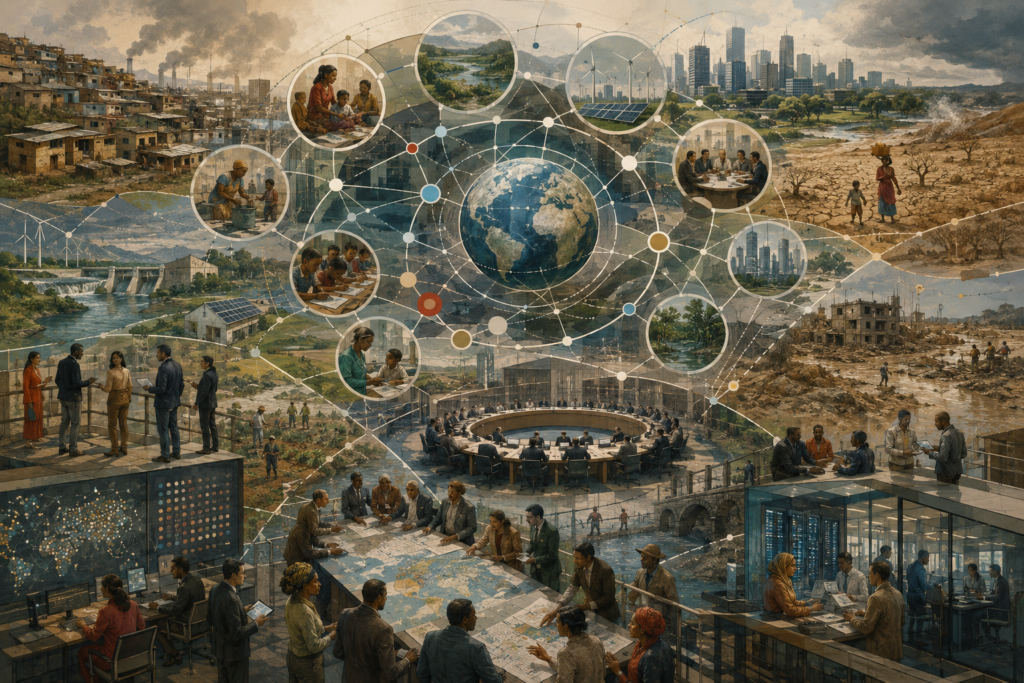
Abstract sustainability illustration of planetary boundaries and sustainable development, showing safe operating space, Earth-system stability, climate change, biosphere integrity, freshwater change, land systems, nutrient flows, ocean stress, pollution, governance, justice, and long-run human viability.

The 2030 Agenda and the Logic of the SDGs

The 2030 Agenda and the Logic of the SDGs examines why the Agenda matters not only as a list of 17 goals but as a distinct model of development governance built around universality, integration, indivisibility, implementation, measurement, and partnership. The article argues that the SDGs are best understood as an attempt to transform sustainable development from a broad moral aspiration into a common global framework for priority-setting, coordination, review, and accountability. It explores universality, interdependence, means of implementation, indicator systems, and structural tensions, showing how the Agenda seeks to govern development as a shared, measurable, and politically reviewable project in a fragmented world. The core claim is that the historical importance of the SDGs lies less in their colorful visibility than in their effort to make sustainable development legible, monitorable, and governable across social, economic, environmental, and institutional domains.

Editorial illustration of the shift from economic growth to human development, showing industrial output, infrastructure, public health, education, community wellbeing, ecological restoration, capability, freedom, and long-run human flourishing.

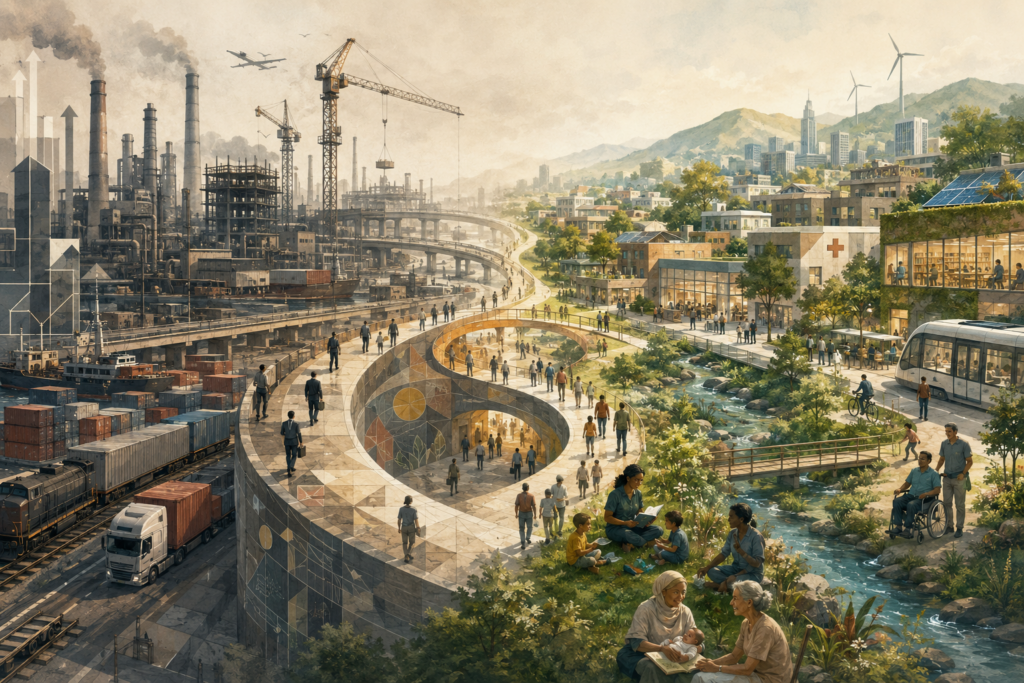
From Economic Growth to Human Development

From Economic Growth to Human Development examines why one of the most important shifts in development thought was the move from treating output growth as the measure of progress to treating human capability, freedom, and lived possibility as the real test of development. The article argues that growth remains materially indispensable but becomes analytically inadequate when it is mistaken for development itself. It explores capability, freedom, HDI measurement, public-goods conversion, ecological durability, and institutional support, showing how richer economies can still fail to enlarge meaningful human life. The core claim is that development should be judged not only by what economies produce, but by whether social, institutional, and ecological conditions allow people to become healthier, more educated, more secure, and more genuinely free.

Scroll to Top