
Last Updated May 6, 2026
Urbanization matters for development because cities and settlements are not only places where people live; they are environments that shape access to housing, water, sanitation, energy, mobility, safety, work, public space, and the institutions that make social life viable. Urban development is therefore not just a question of physical expansion. It is a question of whether urban life is organized in ways that widen or narrow human capability. Housing and basic services are central to this question because they determine whether urbanization becomes a source of security, opportunity, and inclusion or a generator of precarity, exclusion, and unequal exposure to risk.
Urbanization is often celebrated as a driver of productivity, innovation, cultural exchange, and economic transformation. But urban growth is not automatically inclusive or sustainable. A city can grow while leaving many residents without secure housing, affordable rent, safe water, sanitation, electricity, transport, legal recognition, drainage, waste management, public space, or protection from climate risk. The developmental quality of urbanization depends on whether cities become habitable, governable, equitable, and resilient human settlements rather than simply larger concentrations of people and capital.
Main Library
Publications
Article Map
Sustainable Development
Related Topic
Risk & Resilience
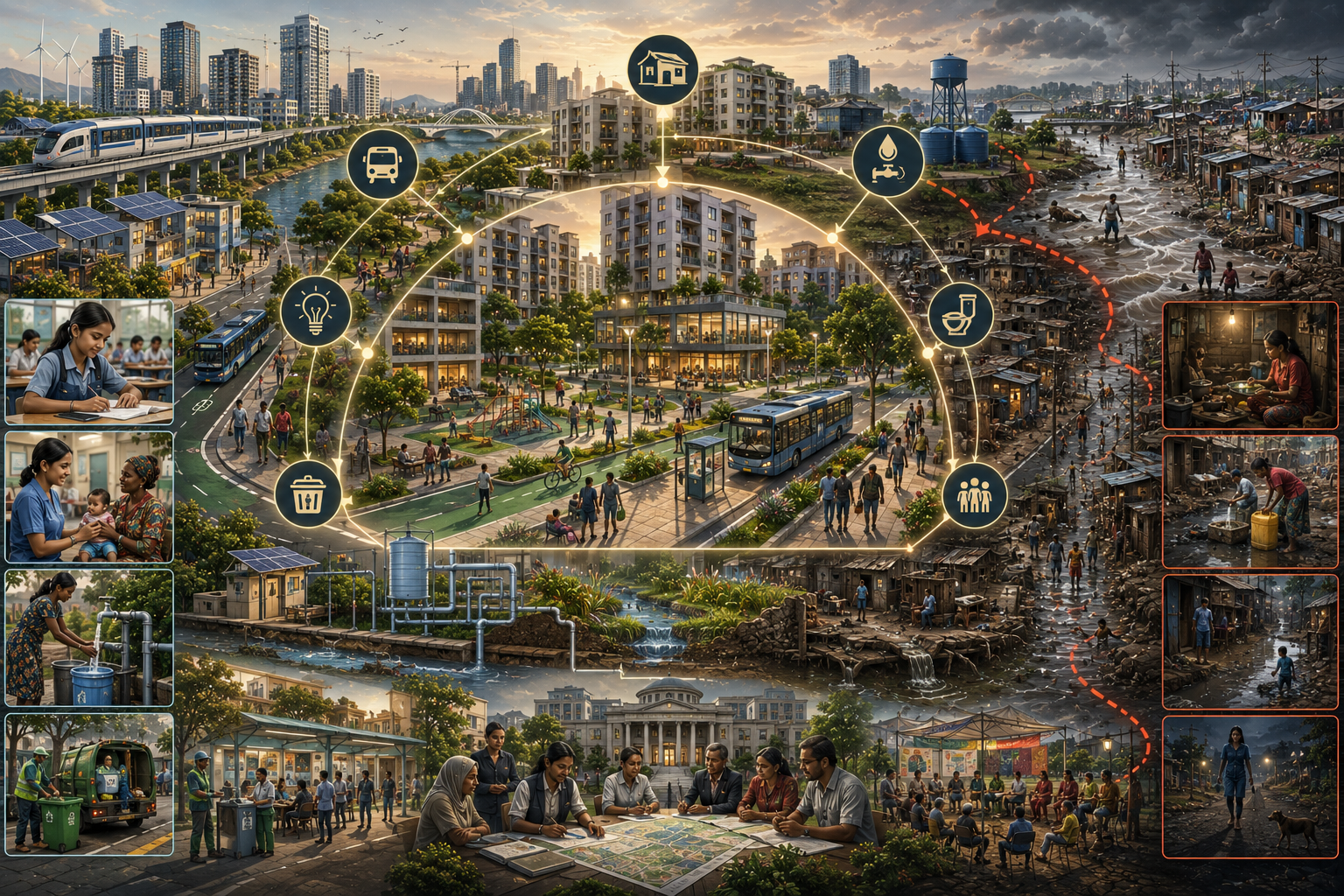
The 2030 Agenda places this issue at the center of sustainable development. Goal 11 commits the international community to make cities and human settlements inclusive, safe, resilient, and sustainable, and target 11.1 calls for ensuring access for all to adequate, safe, and affordable housing and basic services and upgrading slums. This is a significant formulation because it treats housing and services not as secondary urban amenities, but as foundational conditions of inclusive development. Urbanization, in this view, is not successful simply because cities grow. It is successful only if urban growth is translated into livable, equitable, and governable human settlements.
Recent UN and UN-Habitat materials reinforce the urgency of this perspective. Goal 11 review materials for the 2026 High-Level Political Forum warn that SDG 11 is significantly off track, with housing, slums, air quality, inclusive governance, informal settlements, data gaps, finance, multilevel governance, and climate resilience among the central concerns. WHO/UNICEF Joint Monitoring Programme reporting continues to show major inequalities in household drinking water, sanitation, hygiene, and menstrual health access. This article argues that urbanization, housing, and basic services should be understood as core conditions of human development rather than as technical urban-management topics alone.
What Urbanization Means for Development
Urbanization is often described as a demographic process: the increasing concentration of populations in towns and cities. But developmentally it is much more than population movement. Urbanization changes the environments through which people access work, housing, health services, schools, markets, transport, public space, and public institutions. It reshapes how opportunity is distributed and how risks are encountered. That is why urbanization should be understood not only as spatial concentration, but as a reorganization of the social conditions of life.
Urbanization can support development when it concentrates employment, learning, infrastructure, markets, culture, public services, and civic participation in ways that expand capability. Cities can reduce the cost of service provision, support economic specialization, widen access to education and healthcare, and generate dense networks of innovation and social exchange. But those advantages are not automatic. They depend on planning, public investment, land governance, affordability, mobility, service access, and institutional inclusion.
Urbanization can also intensify deprivation when growth outpaces public capacity. Housing shortages, informal settlements, insecure tenure, long commutes, weak sanitation, unsafe water, unaffordable rent, traffic congestion, pollution, heat exposure, and flood risk can turn urban growth into a structure of unequal vulnerability. A person may live inside a dynamic city while remaining excluded from the systems that make urban life secure and dignified. Urbanization therefore has to be evaluated by the actual conditions it creates for residents, not by urban population growth alone.
From a human-development perspective, urbanization matters because cities can widen capability when they provide dense access to services, employment, learning, and public life. But they can also intensify deprivation when housing is insecure, services are fragmented, and inequality is spatially concentrated. Urbanization is therefore not inherently developmental. Its developmental quality depends on how urban life is organized.
This places the article in direct continuity with Inequality and Inclusive Development and Sustainable Development as a Systems Problem. Cities are systems of opportunity and risk. The question is whether those systems are designed for broad human flourishing or sorted by wealth, land value, legal recognition, and infrastructure access.
Urbanization and the Conditions of Urban Citizenship
One of the deepest questions in urban development is who gets to inhabit the city as a full social member rather than as a tolerated but precarious resident. Housing and basic services are central here because they shape what might be called urban citizenship: the practical ability to dwell, move, connect, participate, and claim protection within urban life. A person without secure housing, safe water, sanitation, energy, mobility, or legal recognition may live in the city physically while remaining only partially included in its institutions and protections.
Urban citizenship is not only a legal status. It is also a material condition. It depends on whether residents can access a safe home, drink clean water, use sanitation, travel to work or school, avoid preventable disease, receive public services, participate in planning, and remain visible to institutions. When large populations inhabit informal or underserved settlements without secure tenure or adequate services, the city becomes stratified. Some residents live within capable urban systems; others live in urban space without the full developmental conditions of city life.
This is why urbanization must be judged not only by density or economic dynamism, but by the degree to which cities make life materially habitable and institutionally legible for all residents. If public systems recognize only formal property, registered addresses, planned neighborhoods, and serviceable districts, then residents outside those arrangements can become administratively invisible. That invisibility can block access to schools, clinics, sanitation, disaster protection, voting, documentation, and public investment.
Seen this way, housing and basic services are not simply welfare provisions. They are among the infrastructures through which membership in urban society is made real. Inclusive urbanization depends on whether that membership is widened or withheld. A city that depends on the labor, care, commerce, and informal economy of precarious residents while denying them secure habitation is not inclusive. It is extracting urban value from people whom it does not fully protect.
Urban citizenship therefore provides an ethical and institutional lens for the whole article. The issue is not only whether cities grow, but whether they expand the conditions of belonging, dignity, safety, and public recognition for those who make urban life possible.
Housing as More Than Shelter
Housing matters because it is not merely a physical roof over one’s head. It is one of the basic infrastructures through which security, privacy, health, dignity, family life, learning, rest, and social belonging are made possible. A dwelling shapes exposure to heat, cold, flood, crowding, pollution, violence, fire, and disease. It affects whether children can study, whether households can sleep, whether older people can age safely, whether care work can be sustained, and whether people can access employment and public systems from a secure base.
To treat housing seriously in development terms is therefore to move beyond the minimal idea of shelter. Adequate housing is about habitability, affordability, location, tenure security, service connections, accessibility, safety, and the capacity of a dwelling to support life with dignity. A household may have a roof but still live in overcrowded, unsafe, unaffordable, unhealthy, or insecure conditions. Such housing may technically count as shelter while failing as a foundation of human development.
Housing is also deeply connected to health. Overcrowding can increase disease transmission. Poor ventilation can worsen respiratory illness. Unsafe structures can expose residents to injury or disaster. Lack of cooling or insulation can intensify heat and cold stress. Inadequate sanitation, water, or drainage can turn housing into a site of preventable illness. Housing conditions therefore shape bodily capability in everyday ways.
Housing is also connected to education and work. Children need space, light, safety, and stability to learn. Workers need rest, proximity, mobility, and a reliable address. Families need tenure security to plan. Households under severe rent pressure may sacrifice food, healthcare, schooling, transport, or savings. Housing affordability is therefore not a narrow real-estate issue. It is a household-security issue.
Where housing is precarious, overcrowded, unsafe, unaffordable, or disconnected from services, urban development is materially weakened from the ground up. This section also complements Health, Education, and Human Capability Expansion, because housing is one of the environments through which health and learning become possible.
Basic Services as Capability Conditions
Basic services matter because they are among the practical conditions that make capability possible. Water, sanitation, hygiene, electricity, waste management, drainage, transport, communication, and related urban services are often treated as technical sectors, but developmentally they are much more than that. They shape whether households can remain healthy, children can learn, work can be sustained, care can be provided, and public space can remain usable and safe.
A household without reliable water spends time and labor securing it. A household without sanitation faces health risks, dignity harms, safety concerns, and environmental exposure. A household without electricity may struggle with lighting, refrigeration, cooling, communication, study, work, and health needs. A household without affordable transport may be cut off from jobs, schools, clinics, markets, and public life. Basic services are therefore not conveniences; they are capability-enabling systems.
The WHO/UNICEF Joint Monitoring Programme’s 2025 household report highlights persistent inequalities across regions, income groups, demographic characteristics, and menstrual health access. This is crucial because it shows that basic services are not simply networked utilities; they are unevenly distributed social conditions of life. Where these services are absent, unreliable, unsafe, or unaffordable, human development narrows materially and immediately.
Basic services also interact. Water and sanitation affect public health. Electricity affects water pumping, refrigeration, lighting, communication, and cooling. Transport affects access to schools, clinics, and work. Waste management affects disease exposure and environmental quality. Drainage affects flood risk and settlement habitability. When several services are weak at once, households experience a compressed and riskier version of urban life.
Basic services should therefore be understood as capability conditions. They enable people to convert urban residence into real opportunity. Without them, even nominally urban households may remain excluded from the benefits cities are supposed to offer. This places the article in clear continuity with Poverty, Deprivation, and Multidimensional Development.
Adequacy, Affordability, and Real Access
One of the most important distinctions in development analysis is the difference between nominal availability and real access. A city may contain hospitals, schools, transit systems, piped water, electricity networks, or housing stock, yet many residents may still be unable to use them reliably because of distance, insecurity, price, legal informality, discrimination, poor quality, or weak infrastructure. Urban development should not therefore be judged by the presence of facilities alone. It must be judged by whether people can actually access them under real conditions.
This is why target 11.1’s language of adequate, safe, and affordable housing and basic services is so important. Adequacy refers to whether housing and services are sufficient for healthy and dignified life. Safety refers to protection from physical danger, disease, exposure, and environmental harm. Affordability refers to whether access destroys household security or pushes residents into chronic financial strain. Real access depends on all three.
A service that exists but is too costly, too irregular, too unsafe, or too socially inaccessible is not fully capability-expanding. A bus route that is unaffordable or unsafe does not provide meaningful mobility. A water connection that is intermittent, contaminated, or too expensive does not provide secure water access. A rental unit that consumes most household income may formally provide shelter while undermining nutrition, health, schooling, and savings. Real access requires usability, reliability, affordability, safety, and institutional recognition.
This distinction is especially important for low-income urban households. The poor often pay more for worse services when formal systems do not reach them: water from vendors, informal electricity, long commutes, insecure rentals, unsafe sanitation, or higher costs due to lack of legal connection. Exclusion from formal networks can create a poverty penalty inside the city itself.
From this perspective, urban inclusion requires more than provision in principle. It requires service systems that are reachable, usable, reliable, and economically sustainable for households. Development justice begins where urban access becomes real rather than merely formal.
Informality, Slums, and Urban Exclusion
Informality is central to urban development because a large share of urban life in many regions is organized outside fully formalized housing, tenure, and service systems. Informal settlements often emerge where cities grow faster than affordable housing, serviced land, and inclusive planning can keep pace. The result is not simply a planning challenge, but a developmental condition in which large populations inhabit urban space without secure tenure, adequate housing, or reliable basic services.
Current Goal 11 review materials underscore this sharply. The 2026 SDG 11 Expert Group Meeting summary warns that SDG 11 is significantly off track and that the number of new slum dwellers is growing faster than existing informal settlements are being upgraded. This matters because informal settlement growth is not only a symptom of urban poverty; it is a sign that land, housing, finance, planning, and service-delivery systems are failing to absorb urbanization inclusively.
Informality is often a form of unequal urban citizenship. Residents may live physically inside the city while remaining only partially included in its protections, infrastructures, and legal recognition. They may work in the city, care for its households, build its structures, transport its goods, and sustain its informal economies while lacking secure rights to stay, improve homes, connect services, or claim protection.
Inclusive development must therefore address informality not simply by policing it, erasing it, or treating it as an abnormality. It must upgrade living conditions, extend services, secure tenure where possible, prevent forced displacement, improve drainage and safety, and integrate informal settlements into urban planning. The goal is not to punish the urban poor for solving housing problems that formal systems failed to solve. The goal is to repair the systems that made informality necessary.
This section aligns naturally with Inequality and Inclusive Development. Urban exclusion is not only a matter of low income. It is produced through land markets, planning systems, service networks, legal recognition, and public investment.
Water, Sanitation, Energy, and Mobility
Urban basic services should be understood as interdependent rather than isolated. Water and sanitation affect public health, household care, time burdens, dignity, and safety. Electricity affects cooling, lighting, communication, education, refrigeration, health, and economic activity. Public transport affects access to jobs, schools, healthcare, markets, and social participation. Waste management and drainage affect disease exposure, flood vulnerability, environmental quality, and neighborhood habitability. These are not separate conveniences. Together they structure whether urban life is livable.
The latest JMP reporting highlights persistent inequalities in drinking water, sanitation, hygiene, and menstrual health. WHO and UNICEF also report that billions still lack safely managed drinking water, sanitation, and basic hygiene services, with disparities concentrated among low-income countries, fragile contexts, rural communities, children, and minority ethnic and Indigenous groups. These findings matter for urban development because they show that access to basic services remains deeply unequal even in a world where technical solutions are well known.
Mobility is equally central. A household may have housing but remain developmentally isolated if transport is unaffordable, unsafe, unreliable, or too time-consuming. Long commutes can consume income and time, increase exposure to pollution and harassment, and reduce access to education, healthcare, care work, and civic life. Transport access is therefore not just an infrastructure matter. It is a capability matter.
Energy access is also changing in importance under climate stress. Urban households increasingly need reliable energy for cooling, communication, health equipment, refrigeration, lighting, and adaptation to heat. Yet energy systems must also become cleaner and more resilient. Energy access and climate responsibility therefore have to be planned together, especially in fast-growing urban regions.
A development framework centered on capability must see basic services as mutually reinforcing. Deficits in one often intensify deficits in others. A household lacking safe water, sanitation, reliable electricity, waste services, drainage, and affordable transport is not simply missing several separate utilities. It is navigating an urban environment that restricts health, work, learning, safety, and dignity at once. This section also links directly to Trade-Offs, Synergies, and Policy Coherence.
Urban Inequality and Unequal Developmental Environments
Urbanization is often associated with opportunity, but cities can also intensify inequality by concentrating advantage and deprivation side by side. Some residents inhabit neighborhoods with secure tenure, quality schools, dependable utilities, public transit, safe streets, green space, and political visibility. Others inhabit areas marked by overcrowding, insecure housing, inadequate drainage, service exclusion, long commutes, pollution, heat stress, eviction risk, or violence. Urban inequality is therefore not only about income. It is about unequal developmental environments.
This matters because environment shapes capability. Two households with similar incomes may experience sharply different urban life depending on neighborhood infrastructure, public service quality, legal recognition, environmental exposure, and mobility access. One household may live near functioning schools, clinics, transit, parks, and drainage. Another may live in an area where flooding, overcrowding, poor sanitation, long travel times, and weak public presence structure daily life. Both are urban, but their development environments are not equal.
Cities therefore do not simply reveal inequality; they spatialize it. Inequality becomes embedded in land value, transport routes, housing markets, zoning, infrastructure investment, policing, environmental exposure, and service quality. Wealthier residents may buy distance from risk through private housing, security, cars, insurance, generators, water storage, or private schooling. Poorer residents often remain exposed to the failures of public systems while having fewer private substitutes.
Inclusive urban development requires confronting this spatialized inequality directly. It is not enough to build infrastructure somewhere in the city. Public investment must reach places where exclusion is concentrated. It is not enough to expand housing supply if affordable and adequate housing remains inaccessible to low-income residents. It is not enough to improve average service coverage if informal settlements, peripheral districts, renters, migrants, and marginalized groups remain under-served.
The World Bank’s urban development work links urban investment to resilient infrastructure and services, safe and adequate housing, local economies, and stronger local governments. This reinforces the point that inclusive urban development requires coordinated public systems rather than growth alone.
Resilience, Governability, and Long-Run Urban Development
Urbanization must also be judged by whether cities remain governable and resilient over time. Housing and services are central here because they shape how cities absorb shocks, respond to disasters, and maintain social order under stress. Settlements lacking safe housing, drainage, water systems, waste management, energy resilience, or secure land arrangements are often less resilient to climate shocks, disease outbreaks, fires, economic disruption, and displacement.
Resilience is not only a technical matter of infrastructure. It is also a question of social inclusion and institutional capacity. A city cannot protect residents effectively if large areas are invisible to planning systems, if households lack secure tenure, if service networks bypass informal settlements, if drainage fails in low-income districts, or if disaster planning ignores those most exposed. Urban resilience depends on whether public systems reach the people and places most likely to be harmed.
Recent Goal 11 review materials emphasize persistent gaps not only in housing and services, but also in climate resilience, public space, data systems, financing, and territorial governance. The broader UN progress framing notes that SDG 11 faces significant acceleration challenges, with many targets showing stagnation or regression. This is developmentally important because it links habitability to governability. A city cannot easily plan, coordinate, and protect its residents when large portions of its housing and service systems are fragile or exclusionary.
Long-run urban development also requires fiscal capacity. Cities need resources to build, maintain, upgrade, and regulate infrastructure. Housing and service systems do not remain adequate automatically. Pipes break, roads degrade, drainage clogs, schools overcrowd, and public transport systems require maintenance. Urban governance therefore involves not only building new systems, but sustaining them across time.
Sustainable development requires cities that are not only economically active but materially durable and institutionally capable. This section connects clearly to Safe Operating Space and the Conditions of Long-Run Development, because urban systems must support human flourishing without generating future fragility.
Institutions, Public Action, and Urban Governance
Urban development is ultimately institutional. Markets influence housing and services, but public action remains central in determining how land is managed, infrastructure is financed, slums are upgraded, services are extended, transport is organized, climate risk is reduced, and exclusion is addressed. Housing and service deficits are rarely just technical accidents. They reflect planning choices, governance capacities, fiscal constraints, legal frameworks, and political priorities.
Urban governance has to coordinate many systems at once: land use, housing supply, tenure security, transportation, water, sanitation, energy, waste, drainage, schools, clinics, public safety, environmental protection, disaster risk reduction, and social protection. Fragmented governance can make each system weaker. Housing built far from jobs without transport may deepen exclusion. Water systems without sanitation may fail public health. Drainage without land-use planning may fail under extreme rainfall. Urban inclusion requires policy coherence.
Localization matters because global goals become real in particular cities, settlements, neighborhoods, and districts. Current UN-Habitat strategy language emphasizes empowering cities, local authorities, and communities to translate global commitments into tangible local action. This is crucial. Progress on housing and basic services depends not only on high-level commitment, but on whether urban institutions have the authority, capacity, finance, data, legitimacy, and public trust to govern growth inclusively.
Community participation is also essential. Residents of informal settlements, renters, public-housing tenants, street vendors, workers, women, disabled people, older people, migrants, youth, and marginalized communities often know where service systems fail most clearly. A development process that excludes this knowledge is less likely to produce just or workable solutions. Participation should therefore be treated as governance capacity, not as a symbolic add-on.
For sustainable development, urban inclusion cannot be achieved through rhetoric alone. It requires governance systems able to align housing, land, services, mobility, resilience, public finance, and social protection in ways that make city life materially habitable for all. Housing justice and service equity are therefore inseparable from urban governance itself. This also aligns with The 2030 Agenda and the Logic of the SDGs.
Climate Risk, Disasters, and Urban Vulnerability
Climate risk is reshaping the development meaning of urbanization. Cities face heat waves, flooding, sea-level rise, storms, water stress, air pollution, infrastructure failure, disease risks, and displacement pressures. But these risks are not distributed evenly. Low-income neighborhoods, informal settlements, coastal communities, floodplains, heat islands, poorly drained areas, and places lacking green space or resilient infrastructure often face the greatest exposure and the weakest protection.
Housing and basic services determine how climate risk is experienced. A household in durable, well-located, insulated housing with safe water, sanitation, drainage, electricity, transport, and public information is better positioned to withstand shocks. A household in overcrowded, insecure, poorly serviced housing is more exposed to heat, flooding, disease, displacement, and economic loss. Urban climate adaptation therefore cannot be separated from housing justice and service equity.
Disaster risk also exposes the difference between formal and informal urbanization. Informal settlements may be located on steep slopes, flood-prone land, unstable riverbanks, coastal edges, or contaminated land because safer serviced land is inaccessible or unaffordable. When disasters occur, residents may face not only physical harm but eviction, loss of documents, loss of livelihoods, and exclusion from formal recovery systems. Risk becomes cumulative because vulnerability is already built into land and service systems.
Climate-resilient urban development must therefore be inclusive by design. Drainage, cooling, water systems, early warning, public shelters, green infrastructure, safe housing, transit, disaster planning, and insurance or social protection must reach those most exposed. Adaptation that protects high-value districts while leaving informal settlements and low-income neighborhoods exposed deepens inequality.
Urban resilience is strongest when climate adaptation, housing, services, land governance, public health, and social protection are planned together. Otherwise, cities may invest in visible resilience projects while leaving the underlying geography of vulnerability intact.
Measurement, Data Gaps, and Urban Visibility
Urban measurement shapes what policy can see. Housing adequacy, slum conditions, tenure security, service coverage, affordability, transport access, air quality, disaster exposure, public space, waste management, and participatory planning all require evidence. Without reliable and disaggregated data, urban exclusion can remain hidden behind averages. A city may report high service coverage while informal settlements, peri-urban districts, migrants, renters, disabled residents, or low-income households remain underserved.
The 2026 SDG 11 Expert Group Meeting summary emphasizes data gaps, disaggregation, and the problem that slums, informal settlements, and peri-urban areas can become “data deserts.” This is a serious development issue. Populations that are poorly measured are easier to neglect. If informal settlements are missing from official maps, if renters are invisible in housing policy, if disabled residents are not counted, or if service quality is not disaggregated by income and territory, exclusion becomes administratively reinforced.
Good urban data must therefore be local, disaggregated, rights-sensitive, and usable for action. It should show not only whether services exist, but whether they are safe, affordable, reliable, and accessible. It should identify which neighborhoods face flood risk, heat stress, service gaps, eviction risk, or transport exclusion. It should also include community knowledge, because residents often know the lived geography of service failure more clearly than official systems do.
Measurement should not become surveillance or displacement. Data on informal settlements can be used to upgrade services and protect rights, but it can also be misused to justify eviction, policing, or land clearance. Urban data systems therefore need ethical governance. The goal should be visibility for inclusion, not visibility for removal.
Urban development becomes more accountable when data makes exclusion undeniable. The purpose of measurement is not only to report progress; it is to enable public action where urban systems are failing people most severely.
Why This Matters for Sustainable Development
Urbanization, housing, and basic services matter for sustainable development because cities are not only engines of growth; they are environments through which development is materially lived. A serious development framework must therefore ask not only whether cities expand, but whether people can inhabit them securely, affordably, and with meaningful access to the services that make urban life viable. Housing is more than shelter, and basic services are more than utilities. Together they form part of the infrastructure of human capability.
This is why Goal 11 is so central to sustainable development. Adequate housing, basic services, inclusive transport, resilience, public space, and urban inclusion are not peripheral urban amenities. They are conditions under which development becomes livable, equitable, and governable. Where these conditions are absent, urbanization may advance in scale while remaining exclusionary in substance. Current UN and UN-Habitat materials reinforce that many of these targets remain under severe pressure.
Urbanization also matters because it concentrates both opportunity and risk. Cities can expand access to work, learning, services, culture, and public life. But they can also concentrate housing unaffordability, informal settlement growth, pollution, service gaps, heat stress, disaster exposure, and social fragmentation. Whether cities become capability systems or exclusion systems depends on governance, investment, land policy, service provision, and public accountability.
To take urbanization seriously is therefore to take housing and basic services seriously. It is to recognize that sustainable development is not finally about urban growth alone, but about whether cities widen the real terms of safety, dignity, participation, and human possibility for those who live in them now and in the future.
Development becomes credible when urban residents are not merely counted as city dwellers, but supported as full members of livable, serviced, resilient, and inclusive human settlements.
Mathematical Lens
Urban-development burden can be clarified by thinking in terms of housing adequacy, service access, affordability pressure, and governance capacity rather than urban growth alone. Let \(D_u\) represent developmentally relevant urban stress, \(H\) housing adequacy, \(S\) service reliability and reach, \(A\) affordability pressure, and \(G\) governance and infrastructure capacity:
D_u = -\alpha H – \beta S + \gamma A – \delta G
\]
Interpretation: Urban-development stress falls when housing, services, and governance capacity improve, and rises when affordability pressure makes urban life insecure.
This captures the article’s core point: the developmental quality of urbanization depends not merely on city expansion, but on whether housing and services make urban life secure, affordable, and governable.
We can also express urban fragility as a weighted function of informality, service deficit, and exposure:
R_u = w_1 I + w_2 B + w_3 E
\]
Interpretation: Urban fragility rises when insecure tenure, basic-service deficits, and environmental or infrastructural exposure reinforce one another.
Here, \(I\) is informality and insecure tenure, \(B\) is basic-service deficit, and \(E\) is environmental and infrastructural exposure. Higher \(R_u\) means a city contains more fragile developmental environments.
Finally, urban capability can be represented as a function of housing quality, service access, and mobility:
C_u = \lambda Q + \mu S_a + \nu M
\]
Interpretation: Urban capability rises when housing quality, actual service access, and mobility connect residents to the wider city.
Here, \(Q\) is housing quality and security, \(S_a\) is actual service access, and \(M\) is mobility and connection to employment, schools, healthcare, markets, and public life. This helps show why similar urban population growth can produce very different developmental outcomes across places.
| Term | Meaning | Interpretive role |
|---|---|---|
| \(D_u\) | Urban-development stress | Represents the degree to which urban systems generate insecurity, exclusion, or service-related burden. |
| \(H\) | Housing adequacy | Represents safe, habitable, secure, affordable, and well-located housing. |
| \(S\) | Service reliability and reach | Represents access to water, sanitation, energy, transport, waste, drainage, and related basic services. |
| \(A\) | Affordability pressure | Represents rent, service, transport, and household-cost burdens that weaken urban security. |
| \(G\) | Governance and infrastructure capacity | Represents the ability of public institutions to plan, finance, regulate, maintain, and upgrade urban systems. |
| \(R_u\) | Urban fragility | Represents the combined risk from insecure tenure, service deficits, and environmental exposure. |
| \(C_u\) | Urban capability | Represents whether urban residents can convert city life into real access, safety, mobility, and opportunity. |
The equations are conceptual rather than predictive. Their value is to make visible the structure of the problem: urban development depends on housing, services, affordability, mobility, governance, resilience, and real access working together.
Advanced Python Workflow: Urbanization, Housing, and Basic Services Risk Scoring
This Python workflow translates the article’s core argument into a structured urban-development model. Rather than treating urbanization as a single demographic trend, it scores territories across housing adequacy, affordability pressure, basic-service access, informality, mobility, resilience, environmental exposure, and governance readiness. That makes it possible to compare not only where cities are growing, but where urban growth is becoming most developmentally exclusionary.
from __future__ import annotations

import pandas as pd
import numpy as np

INPUT_FILE = "urbanization_housing_services_panel.csv"
OUTPUT_FILE = "urbanization_housing_services_scores.csv"


def load_data(path: str) -> pd.DataFrame:
    """
    Load a territory-level urbanization, housing, and basic services dataset.

    All *_index columns should be normalized to [0, 1].
    Higher values should mean more of the named property.

    Examples:
      - housing_adequacy_index: higher = more adequate housing
      - housing_affordability_stress_index: higher = stronger affordability pressure
      - basic_services_access_index: higher = stronger access to services
      - informality_exclusion_index: higher = more exclusion linked to informality
    """
    df = pd.read_csv(path)

    required_columns = [
        "territory_name",
        "country_or_region",
        "territory_type",
        "housing_adequacy_index",
        "housing_affordability_stress_index",
        "basic_services_access_index",
        "informality_exclusion_index",
        "mobility_access_index",
        "resilience_weakness_index",
        "environmental_exposure_index",
        "governance_capacity_index",
        "urban_transition_readiness_index",
        "participatory_planning_index",
        "public_finance_capacity_index",
        "tenure_security_index",
    ]

    missing = [col for col in required_columns if col not in df.columns]

    if missing:
        raise ValueError(f"Missing required columns: {missing}")

    return df


def validate_indices(df: pd.DataFrame) -> pd.DataFrame:
    """Validate that all *_index fields are complete and normalized to [0, 1]."""
    index_columns = [col for col in df.columns if col.endswith("_index")]

    for col in index_columns:
        if df[col].isna().any():
            raise ValueError(f"Column '{col}' contains missing values.")

        if ((df[col] < 0) | (df[col] > 1)).any():
            raise ValueError(f"Column '{col}' contains values outside [0, 1].")

    return df


def compute_scores(df: pd.DataFrame) -> pd.DataFrame:
    """
    Compute urban capability, urban fragility,
    governance readiness, and urban-development risk.

    Urban capability rises with housing adequacy, services, mobility,
    tenure security, governance, public finance, and participatory planning.

    Urban fragility rises with affordability stress, informality,
    resilience weakness, environmental exposure, weak service access,
    weak tenure security, and weak governance capacity.
    """
    df = df.copy()

    df["urban_capability_score"] = (
        0.18 * df["housing_adequacy_index"] +
        0.17 * df["basic_services_access_index"] +
        0.14 * df["mobility_access_index"] +
        0.13 * df["tenure_security_index"] +
        0.12 * df["governance_capacity_index"] +
        0.10 * df["urban_transition_readiness_index"] +
        0.08 * df["participatory_planning_index"] +
        0.08 * df["public_finance_capacity_index"]
    ).clip(lower=0, upper=1)

    df["urban_fragility_score"] = (
        0.17 * df["housing_affordability_stress_index"] +
        0.16 * df["informality_exclusion_index"] +
        0.15 * df["resilience_weakness_index"] +
        0.14 * df["environmental_exposure_index"] +
        0.13 * (1 - df["basic_services_access_index"]) +
        0.10 * (1 - df["tenure_security_index"]) +
        0.08 * (1 - df["mobility_access_index"]) +
        0.07 * (1 - df["governance_capacity_index"])
    ).clip(lower=0, upper=1)

    df["governance_readiness_score"] = (
        0.28 * df["governance_capacity_index"] +
        0.22 * df["urban_transition_readiness_index"] +
        0.20 * df["public_finance_capacity_index"] +
        0.16 * df["participatory_planning_index"] +
        0.14 * df["tenure_security_index"]
    ).clip(lower=0, upper=1)

    df["urban_development_risk_score"] = (
        0.40 * df["urban_fragility_score"] +
        0.24 * (1 - df["urban_capability_score"]) +
        0.14 * df["housing_affordability_stress_index"] +
        0.10 * df["environmental_exposure_index"] +
        0.07 * df["informality_exclusion_index"] +
        0.05 * (1 - df["governance_readiness_score"])
    ).clip(lower=0, upper=1)

    df["risk_band"] = np.select(
        [
            df["urban_development_risk_score"] >= 0.80,
            df["urban_development_risk_score"] >= 0.60,
            df["urban_development_risk_score"] >= 0.40,
        ],
        [
            "Extreme urban-development risk",
            "High urban-development risk",
            "Moderate urban-development risk",
        ],
        default="Lower urban-development risk",
    )

    df["urban_inclusion_gap"] = (
        df["urban_fragility_score"] -
        df["urban_capability_score"]
    )

    df["urban_warning"] = np.select(
        [
            df["urban_inclusion_gap"] >= 0.35,
            df["urban_inclusion_gap"] >= 0.20,
            df["urban_inclusion_gap"] >= 0.05,
        ],
        [
            "Severe urban inclusion gap",
            "High urban inclusion gap",
            "Moderate urban inclusion gap",
        ],
        default="Lower urban inclusion gap or stronger urban capability",
    )

    return df


def build_summary(df: pd.DataFrame) -> pd.DataFrame:
    """Return a ranked summary table for review or reporting."""
    columns = [
        "territory_name",
        "country_or_region",
        "territory_type",
        "urban_capability_score",
        "urban_fragility_score",
        "governance_readiness_score",
        "urban_development_risk_score",
        "risk_band",
        "urban_inclusion_gap",
        "urban_warning",
    ]

    summary = df[columns].copy()

    summary = summary.sort_values(
        by=[
            "urban_development_risk_score",
            "urban_fragility_score",
            "urban_capability_score",
        ],
        ascending=[False, False, True],
    ).reset_index(drop=True)

    return summary


def main() -> None:
    df = load_data(INPUT_FILE)
    df = validate_indices(df)
    scored = compute_scores(df)
    summary = build_summary(scored)

    summary.to_csv(OUTPUT_FILE, index=False)

    print("Urbanization, housing, and basic services scoring complete.")
    print(summary.to_string(index=False))


if __name__ == "__main__":
    main()
This workflow is intentionally transparent. It does not claim that urban development can be reduced to one objective score. Instead, it makes assumptions visible: housing adequacy, affordability stress, basic services, informality, mobility, resilience, environmental exposure, governance, public finance, participatory planning, and tenure security are treated as distinct components. The value of the model is diagnostic. It helps identify where headline urban growth may be masking deeper settlement fragility and exclusion.
Advanced R Workflow: Housing Gaps, Service Inequality, and Urban Governance Risk
This R workflow is designed for the part of the article that emphasizes uneven housing quality, service access, affordability pressure, informality, resilience, and urban governance. It compares settings across adequacy, affordability, service access, tenure, mobility, environmental exposure, participatory planning, and governance capacity, then builds grouped summaries that help show where urban growth masks deeper settlement fragility.
library(readr)
library(dplyr)

input_file <- "urbanization_housing_services_country_panel.csv"
region_output_file <- "cross_region_urban_summary.csv"
territory_output_file <- "cross_territory_urban_summary.csv"

urban_df <- read_csv(input_file, show_col_types = FALSE)

required_cols <- c(
  "territory_name",
  "country_or_region",
  "territory_type",
  "housing_adequacy_index",
  "housing_affordability_stress_index",
  "basic_services_access_index",
  "informality_exclusion_index",
  "mobility_access_index",
  "resilience_weakness_index",
  "environmental_exposure_index",
  "governance_capacity_index",
  "urban_transition_readiness_index",
  "participatory_planning_index",
  "public_finance_capacity_index",
  "tenure_security_index"
)

missing_cols <- setdiff(required_cols, names(urban_df))

if (length(missing_cols) > 0) {
  stop(paste("Missing required columns:", paste(missing_cols, collapse = ", ")))
}

index_cols <- names(urban_df)[grepl("_index$", names(urban_df))]

invalid_index_cols <- index_cols[
  vapply(
    urban_df[index_cols],
    function(x) any(is.na(x) | x < 0 | x > 1),
    logical(1)
  )
]

if (length(invalid_index_cols) > 0) {
  stop(
    paste(
      "Index columns must be complete and normalized to [0, 1]:",
      paste(invalid_index_cols, collapse = ", ")
    )
  )
}

urban_df <- urban_df %>%
  mutate(
    urban_capability_proxy = (
      housing_adequacy_index +
      basic_services_access_index +
      mobility_access_index +
      tenure_security_index +
      governance_capacity_index +
      urban_transition_readiness_index +
      participatory_planning_index +
      public_finance_capacity_index
    ) / 8,
    urban_fragility_proxy = (
      (1 - housing_adequacy_index) +
      housing_affordability_stress_index +
      (1 - basic_services_access_index) +
      informality_exclusion_index +
      resilience_weakness_index +
      environmental_exposure_index +
      (1 - mobility_access_index) +
      (1 - tenure_security_index)
    ) / 8,
    urban_development_risk_proxy = (
      urban_fragility_proxy +
      (1 - urban_capability_proxy) +
      housing_affordability_stress_index +
      informality_exclusion_index +
      environmental_exposure_index
    ) / 5,
    urban_inclusion_gap = urban_fragility_proxy - urban_capability_proxy,
    risk_band = case_when(
      urban_development_risk_proxy >= 0.75 ~ "Extreme urban-development risk",
      urban_development_risk_proxy >= 0.55 ~ "High urban-development risk",
      urban_development_risk_proxy >= 0.35 ~ "Moderate urban-development risk",
      TRUE ~ "Lower urban-development risk"
    )
  )

region_summary <- urban_df %>%
  group_by(country_or_region) %>%
  summarise(
    avg_urban_development_risk_proxy = mean(urban_development_risk_proxy, na.rm = TRUE),
    avg_urban_capability_proxy = mean(urban_capability_proxy, na.rm = TRUE),
    avg_urban_fragility_proxy = mean(urban_fragility_proxy, na.rm = TRUE),
    avg_housing_adequacy = mean(housing_adequacy_index, na.rm = TRUE),
    avg_housing_affordability_stress = mean(housing_affordability_stress_index, na.rm = TRUE),
    avg_basic_services_access = mean(basic_services_access_index, na.rm = TRUE),
    avg_informality_exclusion = mean(informality_exclusion_index, na.rm = TRUE),
    avg_mobility_access = mean(mobility_access_index, na.rm = TRUE),
    avg_resilience_weakness = mean(resilience_weakness_index, na.rm = TRUE),
    avg_environmental_exposure = mean(environmental_exposure_index, na.rm = TRUE),
    avg_governance_capacity = mean(governance_capacity_index, na.rm = TRUE),
    avg_tenure_security = mean(tenure_security_index, na.rm = TRUE),
    avg_urban_inclusion_gap = mean(urban_inclusion_gap, na.rm = TRUE),
    observations = n(),
    .groups = "drop"
  ) %>%
  mutate(
    regional_risk_band = case_when(
      avg_urban_development_risk_proxy >= 0.75 ~ "Extreme urban-development risk",
      avg_urban_development_risk_proxy >= 0.55 ~ "High urban-development risk",
      avg_urban_development_risk_proxy >= 0.35 ~ "Moderate urban-development risk",
      TRUE ~ "Lower urban-development risk"
    )
  ) %>%
  arrange(desc(avg_urban_development_risk_proxy))

territory_summary <- urban_df %>%
  group_by(territory_type) %>%
  summarise(
    avg_urban_development_risk_proxy = mean(urban_development_risk_proxy, na.rm = TRUE),
    avg_urban_capability_proxy = mean(urban_capability_proxy, na.rm = TRUE),
    avg_urban_fragility_proxy = mean(urban_fragility_proxy, na.rm = TRUE),
    avg_housing_adequacy = mean(housing_adequacy_index, na.rm = TRUE),
    avg_housing_affordability_stress = mean(housing_affordability_stress_index, na.rm = TRUE),
    avg_basic_services_access = mean(basic_services_access_index, na.rm = TRUE),
    avg_informality_exclusion = mean(informality_exclusion_index, na.rm = TRUE),
    avg_mobility_access = mean(mobility_access_index, na.rm = TRUE),
    avg_resilience_weakness = mean(resilience_weakness_index, na.rm = TRUE),
    avg_environmental_exposure = mean(environmental_exposure_index, na.rm = TRUE),
    avg_governance_capacity = mean(governance_capacity_index, na.rm = TRUE),
    avg_tenure_security = mean(tenure_security_index, na.rm = TRUE),
    avg_urban_inclusion_gap = mean(urban_inclusion_gap, na.rm = TRUE),
    observations = n(),
    .groups = "drop"
  ) %>%
  arrange(desc(avg_urban_development_risk_proxy))

write_csv(region_summary, region_output_file)
write_csv(territory_summary, territory_output_file)

cat("Cross-region urban summary exported to:", region_output_file, "\n")
print(region_summary)

cat("\nCross-territory urban summary exported to:", territory_output_file, "\n")
print(territory_summary)
This workflow helps distinguish urban growth from inclusive urban development. A territory may show rapid urbanization while still facing housing unaffordability, service gaps, informality, weak tenure security, environmental exposure, and poor mobility. Conversely, strong governance, public finance, service reach, secure housing, and participatory planning can help convert urbanization into human capability rather than settlement fragility.
GitHub Repository
Complete Code Repository
The full code distribution for this article, including urban-risk scoring workflows, housing-gap diagnostics, SQL materials, optional monitoring support tooling, supporting documentation, and repository structure, is available on GitHub.
Related Articles
- Inequality and Inclusive Development
- Sustainable Development as a Systems Problem
- Health, Education, and Human Capability Expansion
- Poverty, Deprivation, and Multidimensional Development
- Trade-Offs, Synergies, and Policy Coherence
- Safe Operating Space and the Conditions of Long-Run Development
- Risk, Shock, and Fragility in Development Systems
- The 2030 Agenda and the Logic of the SDGs
- Work, Livelihoods, and Decent Employment
- Climate Change as a Development Constraint
Further Reading
- United Nations (2015) Transforming our world: the 2030 Agenda for Sustainable Development. New York: United Nations. Available at: https://sdgs.un.org/2030agenda
- United Nations (n.d.) Goal 11: Make cities and human settlements inclusive, safe, resilient and sustainable. New York: United Nations. Available at: https://sdgs.un.org/goals/goal11
- United Nations (n.d.) Sustainable cities and human settlements. New York: United Nations. Available at: https://sdgs.un.org/topics/sustainable-cities-and-human-settlements
- United Nations (2026) Expert Group Meeting on SDG 11 in preparation for HLPF 2026. New York: United Nations. Available at: https://sdgs.un.org/HLPF/2026/ThematicReviewEGMs/SDG11
- United Nations Department of Economic and Social Affairs and UN-Habitat (2026) 2026 HLPF Thematic Review Expert Group Meeting: Sustainable Development Goal 11 Summary. New York: United Nations. Available at: https://sdgs.un.org/sites/default/files/2026-04/HLPF%20EGM%20Summary%20SDG11_January2026_FINAL_0.pdf
- UN-Habitat (2025) United Nations Human Settlements Programme system profile and Strategic Plan 2026–2029 summary. Nairobi: UN-Habitat. Available at: https://sdgs.un.org/un-system-sdg-implementation/united-nations-human-settlements-programme-un-habitat-60377
- WHO/UNICEF Joint Monitoring Programme (2025) Progress on household drinking water, sanitation and hygiene 2000–2024: Special focus on inequalities. Geneva and New York: WHO and UNICEF. Available at: https://washdata.org/reports/jmp-2025-wash-households
- World Health Organization and United Nations Children’s Fund (2025) Progress on household drinking-water, sanitation and hygiene 2000–2024: Special focus on inequalities. Geneva: WHO. Available at: https://www.who.int/publications/m/item/progress-on-household-drinking-water–sanitation-and-hygiene-2000-2024–special-focus-on-inequalities
- World Health Organization and United Nations Children’s Fund (2025) 1 in 4 people globally still lack access to safe drinking water. Geneva: WHO. Available at: https://www.who.int/news/item/26-08-2025-1-in-4-people-globally-still-lack-access-to-safe-drinking-water—who–unicef
- World Bank Group (n.d.) Urban development. Washington, DC: World Bank. Available at: https://www.worldbank.org/ext/en/topic/urban-development
References
- United Nations (2015) Transforming our world: the 2030 Agenda for Sustainable Development. New York: United Nations. Available at: https://sdgs.un.org/2030agenda
- United Nations (n.d.) Goal 11: Make cities and human settlements inclusive, safe, resilient and sustainable. New York: United Nations. Available at: https://sdgs.un.org/goals/goal11
- United Nations (n.d.) Sustainable cities and human settlements. New York: United Nations. Available at: https://sdgs.un.org/topics/sustainable-cities-and-human-settlements
- United Nations (2026) Expert Group Meeting on SDG 11 in preparation for HLPF 2026. New York: United Nations. Available at: https://sdgs.un.org/HLPF/2026/ThematicReviewEGMs/SDG11
- United Nations Department of Economic and Social Affairs and UN-Habitat (2026) 2026 HLPF Thematic Review Expert Group Meeting: Sustainable Development Goal 11 Summary. New York: United Nations. Available at: https://sdgs.un.org/sites/default/files/2026-04/HLPF%20EGM%20Summary%20SDG11_January2026_FINAL_0.pdf
- UN-Habitat (2025) United Nations Human Settlements Programme system profile and Strategic Plan 2026–2029 summary. Nairobi: UN-Habitat. Available at: https://sdgs.un.org/un-system-sdg-implementation/united-nations-human-settlements-programme-un-habitat-60377
- UN-Habitat (2025) High-level dialogue on adequate housing: Media advisory. Nairobi: UN-Habitat. Available at: https://unhabitat.org/sites/default/files/2025/07/07_2025_un-habitat-media_advisory_housing_dialogue.pdf
- WHO/UNICEF Joint Monitoring Programme (2025) Progress on household drinking water, sanitation and hygiene 2000–2024: Special focus on inequalities. Geneva and New York: WHO and UNICEF. Available at: https://washdata.org/reports/jmp-2025-wash-households
- World Health Organization and United Nations Children’s Fund (2025) Progress on household drinking-water, sanitation and hygiene 2000–2024: Special focus on inequalities. Geneva: WHO. Available at: https://www.who.int/publications/m/item/progress-on-household-drinking-water–sanitation-and-hygiene-2000-2024–special-focus-on-inequalities
- World Health Organization and United Nations Children’s Fund (2025) 1 in 4 people globally still lack access to safe drinking water. Geneva: WHO. Available at: https://www.who.int/news/item/26-08-2025-1-in-4-people-globally-still-lack-access-to-safe-drinking-water—who–unicef
- World Bank Group (n.d.) Urban development. Washington, DC: World Bank. Available at: https://www.worldbank.org/ext/en/topic/urban-development