
Last Updated May 6, 2026
Biosphere integrity matters for human development because human societies do not flourish apart from the living systems that sustain food production, water regulation, climate stability, disease control, soil fertility, pollination, and ecological resilience. Development is often narrated through infrastructure, output, institutions, services, finance, and technology. Yet beneath those visible systems lies a less visible foundation: the integrity of the biosphere itself. When ecological systems become simplified, degraded, fragmented, or biologically impoverished, the conditions that support human wellbeing also become more fragile.
Biosphere integrity is therefore not an external environmental luxury. It is part of the material basis of long-run human development. A society may expand income, infrastructure, and service provision while still weakening the living systems that make food, water, health, livelihoods, and resilience possible. Sustainable development must therefore ask not only how human systems grow, but whether the living foundations beneath them remain viable.
Main Library
Publications
Article Map
Sustainable Development
Related Topic
Planetary Boundaries
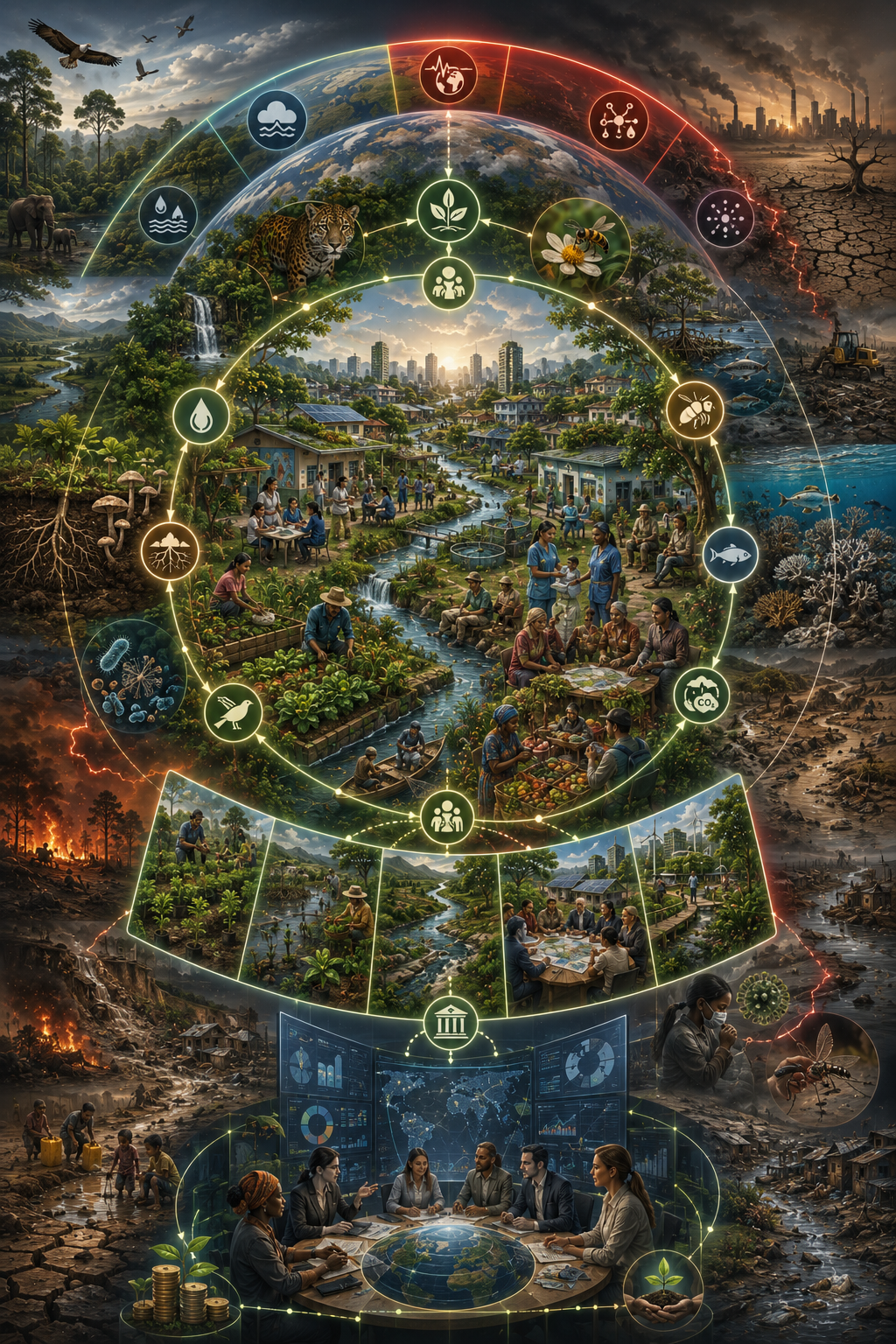
The planetary-boundaries framework gives this issue a particularly strong developmental meaning. Stockholm Resilience Centre defines planetary boundaries as critical global processes that regulate Earth-system stability and resilience, and it identifies biosphere integrity as one of those core processes. The significance of that move is profound. Biodiversity loss is not treated merely as scenic loss, moral regret, or a specialized conservation issue. It is treated as a destabilizing force within the Earth system itself.
Stockholm Resilience Centre’s current planetary-boundaries materials state that both the loss of genetic diversity and the decline in the functional integrity of the biosphere are outside safe levels, and its 2025 update reports that seven of nine planetary boundaries are now breached. The development implications are direct. When the living systems that regulate soils, water, pollination, carbon, disease dynamics, and ecological resilience weaken, human systems become more exposed, more brittle, and more expensive to sustain.
The relevance to development is equally clear in the wider biodiversity literature. The IPBES global assessment states that biodiversity and ecosystem services are fundamental to human well-being, while the Convention on Biological Diversity’s biodiversity-and-2030-Agenda policy brief argues that biodiversity contributes directly to development priorities including food, water, health, livelihoods, disaster risk reduction, and poverty reduction. The 2030 Agenda reinforces this through Goal 15, which calls on states to protect, restore, and promote the sustainable use of terrestrial ecosystems and to halt biodiversity loss.
What Biosphere Integrity Means
Biosphere integrity refers to the wholeness, functioning, and resilience of the living systems that make Earth habitable. It is not merely a count of species, though species richness matters. It also concerns the structure of ecosystems, the abundance and interactions of organisms, the continuity of ecological processes, and the capacity of living systems to maintain their functions under stress. In this sense, integrity is a stronger concept than biodiversity alone. It points not only to variety, but to viability.
This broader understanding matters because ecosystems can be damaged long before they disappear entirely. Forests may remain standing while being ecologically simplified. Wetlands may persist while losing species and regulatory function. Agricultural landscapes may remain productive in the short term while becoming more brittle, chemically dependent, and biologically depleted. Coral reefs, grasslands, rivers, soils, and coastal systems can retain visible form while losing ecological depth. Biosphere integrity therefore asks not only whether ecosystems exist in name, but whether they remain capable of performing the life-supporting functions on which human societies depend.
The distinction between presence and integrity is developmentally important. A landscape may be productive by immediate economic measures while losing pollinator diversity, soil organic matter, species interactions, watershed buffering, genetic diversity, and long-run resilience. Such a system may still produce outputs, but it becomes less able to absorb shock, less capable of self-renewal, and more dependent on expensive external inputs. Development built on such ecological thinning is vulnerable even if it appears successful in the short term.
Biosphere integrity also includes functional relationships. Species do not exist as isolated units. They interact through predation, pollination, decomposition, symbiosis, competition, seed dispersal, nutrient cycling, and habitat formation. When these relationships weaken, ecosystem function can decline even before all species disappear. A development lens focused only on visible land cover or aggregate output can miss this deeper ecological weakening.
In development terms, ecological decline is therefore not important only when it becomes dramatic or irreversible. It matters whenever the living systems that support human life become thinner, weaker, and less resilient. Development begins to lose one of its deepest foundations when that happens.
Why Biosphere Integrity Matters for Human Development
Biosphere integrity matters for development because development is not only a social or economic process. It is a biophysical process unfolding within living systems. The 2030 Agenda presents itself as a plan of action for people, planet, and prosperity, and this wording is more than rhetorical. It signals that prosperity cannot be secured apart from the ecological systems that support life. The CBD’s biodiversity-and-development materials make the connection especially explicit by linking biodiversity and ecosystems to human wellbeing and development priorities.
This point is easy to miss in conventional development narratives because ecological functions often remain in the background. Pollination, nutrient cycling, water filtration, disease regulation, carbon storage, soil formation, coastal buffering, genetic diversity, and ecosystem resilience are usually not counted as development outputs. Yet without them many visible outputs become harder or more expensive to sustain. Food systems weaken, water systems degrade, public-health risks rise, disaster exposure increases, and adaptation burdens intensify.
Biosphere integrity therefore matters not because development should be balanced aesthetically with nature, but because living systems are part of what development relies upon materially. Food security depends on functioning soils, crop diversity, pollinators, fisheries, and stable ecological interactions. Water security depends on watersheds, wetlands, forests, groundwater recharge, and flow regulation. Public health depends partly on ecological conditions that shape nutrition, disease, air quality, water quality, and exposure to environmental hazards. Livelihoods depend on forests, fisheries, agriculture, rangelands, coasts, and ecosystem-based work in both rural and urban settings.
To frame biosphere integrity as a development issue is therefore to recognize that ecological decline is also developmental decline when it undermines the conditions of health, security, and long-run capability. This does not reduce living systems only to human use. It recognizes that human life is embedded within them. Development that treats ecological integrity as external to human wellbeing misunderstands the material structure of human flourishing.
This places the article in direct continuity with Planetary Boundaries and Sustainable Development. Planetary boundaries make clear that development cannot be separated from Earth-system stability, and biosphere integrity is one of the clearest places where that connection becomes visible.
Habitability and Living Systems
One of the strongest ways to understand biosphere integrity is through the idea of habitability. Human development depends on more than institutions, income, and technology. It also depends on whether the world remains materially habitable in the first place. Functional ecosystems, fertile soils, pollinated landscapes, regulated water flows, resilient forests, productive fisheries, biodiverse agricultural systems, and robust food webs are not optional advantages. They are part of the background structure that makes health, settlement, food production, and social coordination possible.
This matters because development discourse often focuses on visible social outputs while taking ecological conditions for granted. But if those conditions are destabilized, then the field within which development occurs becomes more volatile, less predictable, and harder to govern. Agricultural systems become more fragile, public-health burdens intensify, water security weakens, disaster exposure rises, and adaptation costs increase. Habitability therefore belongs inside development analysis rather than outside it.
Habitability also requires ecological redundancy. A resilient living system often contains multiple species and pathways that can perform similar functions under stress. When biodiversity declines, systems may lose that redundancy. The result is not always immediate collapse, but a narrowing of the ecological margin that allows systems to absorb disturbance. A landscape may remain outwardly productive while becoming more vulnerable to drought, pests, disease, fire, erosion, or invasive species. That vulnerability is developmentally significant because human systems often depend on ecological resilience without fully seeing it.
Living systems also shape the quality of place. Forests regulate local climate, wetlands buffer floods, soils store water and nutrients, vegetation moderates heat, and coastal ecosystems reduce storm impacts. These are not only environmental services; they are conditions of habitation. Where ecological systems are degraded, settlements become more exposed, livelihoods less secure, and public systems more burdened.
Biosphere integrity becomes a development condition in the deepest sense when it is understood not merely as nature protection, but as part of the material setting within which any enduring human development must unfold. This section aligns naturally with Safe Operating Space and the Conditions of Long-Run Development.
Living Systems and Human Capability
Human capability depends on more than rights, income, and formal institutions. It also depends on whether material conditions exist that allow people to live, eat, remain healthy, work, learn, move safely, avoid chronic ecological insecurity, and participate in social life. Living systems matter because they shape those material conditions. A degraded biosphere can narrow capability by weakening food access, increasing water stress, intensifying disease exposure, reducing livelihood resilience, raising disaster exposure, and making settlement more hazardous.
From a capability perspective, the issue is not only whether ecosystems are valuable in themselves, though they are. It is also whether ecological degradation narrows what people are actually able to do and be. A farming household facing soil decline, pollinator loss, declining rainfall buffering, and rising pest pressure may not lose all formal opportunity at once, but its real freedom can shrink substantially. Its members may work harder for lower yields, incur more debt, reduce diet quality, delay schooling, migrate under pressure, or become more vulnerable to shocks.
The same is true for fishing communities facing ecosystem decline, forest-dependent communities facing degradation, pastoral communities facing rangeland stress, or urban populations facing heat, flood, air-quality, and water-system pressures worsened by ecological loss. Living systems shape the ordinary conditions under which people convert formal rights and resources into actual functioning. Where those systems weaken, human freedom often becomes more conditional, expensive, and fragile.
This also helps explain why ecological decline is often underestimated in development planning. Its effects may not appear immediately as dramatic crisis. They may appear as rising costs, declining yields, longer work burdens, reduced dietary diversity, weaker health, greater exposure, or lower resilience after repeated shocks. These are capability losses even when they do not appear as sudden collapse.
Biosphere integrity therefore belongs inside human-development thinking because it shapes the practical field within which capability can be secured. This section complements From Economic Growth to Human Development, where development is understood as the expansion of real human possibility rather than output alone.
Ecosystem Services and Development Systems
One of the clearest ways to understand the development relevance of biosphere integrity is through ecosystem services. IPBES emphasizes that biodiversity and ecosystem services are fundamental to human well-being. The CBD’s SDG brief similarly explains that biodiversity is central to many economic activities, particularly agriculture, forestry, and fisheries, and that many vulnerable populations depend directly on biodiversity for daily subsistence. These statements matter because they show that development systems are ecologically embedded rather than ecologically separate.
Ecosystem services are sometimes described too mechanically, as if nature were merely a set of inputs to be extracted. A more adequate framing recognizes that ecosystem functions are part of the wider architecture of resilience. They help regulate water flows, maintain soils, support pollination, buffer hazards, store carbon, sustain fisheries, regulate disease dynamics, support cultural landscapes, and preserve broader ecological stability. Development systems do not simply sit next to these functions. They depend on them.
This means ecological loss can appear at first as an environmental issue while in practice becoming an economic, social, and public-health issue. Pollinator decline affects agriculture and nutrition. Soil degradation affects food security and rural livelihoods. Wetland loss affects flood risk and water quality. Forest loss affects rainfall patterns, carbon storage, biodiversity, and local economies. Fisheries decline affects food systems, coastal livelihoods, and nutrition. These linkages show why biosphere integrity belongs inside development planning.
The ecosystem-services frame is useful, but it should be used carefully. Living systems should not be valued only when they can be converted into service categories. Ecosystems also contain intrinsic, cultural, spiritual, relational, and ethical values that exceed economic function. Still, ecosystem services provide a practical bridge between ecological integrity and public policy because they make visible the dependence of human systems on living processes.
The more development is understood through systems, the clearer this interdependence becomes. This section fits closely with Sustainable Development as a Systems Problem. Biosphere integrity is not a single sector; it is a cross-cutting condition that shapes food, water, health, risk, infrastructure, livelihoods, and long-run resilience.
Food, Water, Health, and Livelihoods
Biosphere integrity matters especially through food, water, health, and livelihoods. Biodiversity supports crop diversity, pollination, soil fertility, pest regulation, fisheries productivity, genetic resources, and the resilience of food systems under stress. It also supports hydrological functions that influence water quality, flow regulation, groundwater recharge, erosion control, and ecosystem stability. These are not peripheral benefits. They are part of the living infrastructure through which societies feed populations and sustain livelihoods.
Food systems are especially dependent on ecological function. Modern agriculture often appears technological and industrial, but it remains deeply biological. Soil organisms, pollinators, beneficial insects, genetic diversity, water cycles, and landscape structure all shape agricultural productivity and resilience. When farming systems become biologically simplified, they may require more chemical inputs and become more vulnerable to pest outbreaks, disease, drought, and climate stress. Food security therefore depends not only on yield, but on the ecological systems that sustain yield over time.
Water systems are similarly ecological. Forests, wetlands, soils, rivers, floodplains, and watersheds influence water storage, filtration, flow timing, and flood buffering. When these systems are degraded, societies may face higher treatment costs, greater flood exposure, reduced groundwater recharge, and weaker drought resilience. Water security cannot be separated from living systems.
Health is equally implicated. Ecological degradation can intensify nutritional insecurity, increase vulnerability to disease, reduce access to medicinal resources, worsen environmental exposure, and reduce the resilience of local systems that buffer shock. Human health depends not only on hospitals and medicine, but on environmental conditions that shape food, water, disease ecology, air quality, heat exposure, and disaster risk.
Livelihoods are affected where households depend directly or indirectly on agriculture, forests, rangelands, inland waters, or coastal systems. In many lower-income regions, this dependence is especially pronounced, which means biosphere decline can function as a direct development constraint rather than as a distant ecological concern. This section links directly to Food Security, Nutrition, and Human Development and Freshwater Change and Development Risk.
Biosphere Integrity as a Planetary Boundary
The planetary-boundaries framework gives biosphere integrity a particularly powerful role by treating it as one of the key Earth-system processes regulating stability and resilience. Stockholm Resilience Centre’s framework materials describe biosphere integrity in this systemic way, and the 2025 update keeps it among the breached boundaries. This means biodiversity loss is not framed only as a local or sectoral issue. It is treated as a global systems issue with implications for the Earth’s overall safe operating space.
This matters for development because it widens the meaning of ecological risk. The concern is not simply that species disappear or landscapes degrade, but that the biosphere’s regulatory and resilience functions are weakened at scales relevant to human civilization. Once biosphere integrity is understood this way, biodiversity loss becomes a question about the long-run conditions of human development itself.
The framework also distinguishes between genetic diversity and functional integrity. Genetic diversity reflects the variety of life and the evolutionary capacity of living systems, while functional integrity concerns the ability of ecosystems to maintain the functions that regulate Earth-system processes. This distinction is developmentally important because human societies depend on both. Genetic diversity supports adaptability, crop resilience, wild relatives, ecological recovery, and long-run evolutionary capacity. Functional integrity supports the processes that make ecosystems work in the present.
In this sense, biosphere integrity is not just one environmental objective among many. It is part of the background operating system within which development remains viable. If the biosphere loses diversity and function, development becomes more exposed to instability in food, water, climate, disease, livelihoods, and hazard buffering.
This section aligns directly with Planetary Boundaries and Sustainable Development. Biosphere integrity is one of the clearest examples of why development must be understood within Earth-system conditions rather than above or outside them.
Degradation, Fragmentation, and Developmental Risk
Biosphere decline often proceeds not only through total destruction, but through degradation and fragmentation. Habitats become smaller, more isolated, and less functionally robust. Species interactions become weaker. Ecological redundancy declines. Genetic diversity narrows. Systems may continue to appear intact while becoming much less resilient to disturbance. This is developmentally significant because risk rises before collapse becomes obvious.
That delayed visibility makes biosphere loss politically difficult. Development may appear to succeed in the short run through agricultural expansion, extraction, settlement growth, or infrastructure development, while the underlying ecological systems that support water, soils, pollination, and climatic buffering are being weakened. In such cases, gains can be real yet increasingly fragile. This is a classic pattern of overshoot and delayed consequence.
Fragmentation is especially important because ecological systems depend on connection. Species need corridors for migration, genetic exchange, seasonal movement, and climate adaptation. Rivers need connected flows. Forests and wetlands need landscape continuity. When habitats are split into isolated pieces, ecological function can decline even if total area appears partly preserved. Fragmentation therefore weakens both biodiversity and the capacity of ecosystems to support human systems.
Degradation can also create hidden infrastructure costs. When wetlands are destroyed, flood-control costs rise. When forests are removed, water regulation weakens. When soils degrade, farmers may require more inputs for lower resilience. When coastal ecosystems decline, storm exposure increases. These costs may not appear immediately in development accounts, but they reappear later as disaster losses, public-health burdens, infrastructure spending, livelihood instability, and reduced adaptive capacity.
Biosphere degradation therefore becomes a development risk not only when disaster strikes, but whenever ecological resilience is being quietly eroded beneath apparently successful growth. This section pairs naturally with Growth, Limits, and the Problem of Overshoot.
Justice, Inequality, and Uneven Ecological Dependence
Biosphere integrity raises questions of justice because ecological dependence and ecological power are unevenly distributed. The CBD’s development brief notes that many vulnerable populations depend directly on biodiversity for daily subsistence, while broader biodiversity assessments emphasize that changes in nature’s contributions to people are distributed unevenly across regions and societies. Ecological degradation does not strike all groups equally. Those with fewer buffers, weaker public systems, and greater direct dependence on ecosystems often face the greatest risks.
At the same time, the pressures driving ecological decline are often linked to larger political and economic systems: intensive extraction, land conversion, industrial agriculture, infrastructure expansion, pollution, illegal exploitation, and patterns of consumption that distribute benefits and burdens unevenly. This creates a sharp moral tension. Those most dependent on biosphere integrity are often least responsible for its degradation and least equipped to absorb its loss.
Indigenous peoples and local communities are especially important in this discussion. Many live in close relationship with forests, rivers, coasts, grasslands, and biodiverse territories. Their knowledge systems often sustain forms of stewardship that are poorly recognized by centralized development models. Yet these communities may also face dispossession, conservation exclusion, extractive pressure, and weak recognition of land and resource rights. Biosphere governance that ignores such realities can reproduce injustice even when it claims ecological purpose.
For sustainable development, biosphere integrity cannot be separated from equity, land use, rights, and the claims of Indigenous peoples and local communities. Ecological protection that ignores justice will be incomplete, but development that ignores biosphere dependence will also be unjust in practice. The key question is not only how to protect living systems, but how to do so in ways that respect rights, livelihoods, knowledge, cultural continuity, and local agency.
This section complements Inequality and Inclusive Development. Ecological decline becomes development injustice when its burdens fall most heavily on those with the least power, least responsibility, and greatest dependence.
Governance, Restoration, and Sustainable Development
If biosphere integrity is foundational to development, then governance must be concerned not only with protecting what remains, but with restoring ecological function where it has been degraded. Goal 15’s language of protecting, restoring, and sustainably using terrestrial ecosystems is important for exactly this reason. It recognizes that development cannot simply conserve fragments of ecological value while leaving broader system decline unaddressed.
Governance here must be broader than conservation policy narrowly conceived. It involves land use, agricultural systems, water governance, fisheries, forest policy, infrastructure planning, urban development, pollution control, climate adaptation, disaster risk reduction, and social inclusion. The CBD’s biodiversity-and-SDG materials point toward integrated approaches across planning, food security, nutrition, climate adaptation, poverty reduction, and ecosystem management. These are development questions as much as biodiversity questions.
Restoration is central because many landscapes are already degraded. Restoration can rebuild soil health, recover watershed function, reconnect habitats, improve flood buffering, support pollinators, enhance carbon storage, and strengthen local livelihoods. But restoration must be ecologically serious and socially just. It should not become a superficial offset, a monoculture planting exercise, or a pretext for excluding communities from land. Restoration works best when it strengthens ecological function and local agency together.
Protection also requires careful design. Protected areas, community-based conservation, Indigenous territorial rights, sustainable-use systems, ecological corridors, agroecology, regenerative practices, and landscape planning can all contribute to biosphere integrity. But governance must avoid separating ecological goals from people’s lived realities. Development pathways need institutions that can hold biodiversity, livelihoods, rights, and resilience together.
Sustainable development therefore requires institutions capable of governing with ecological dependence in view. Restoration and resilience are not optional supplements to development. They are among the conditions under which development can remain viable across time. This section connects clearly to Trade-Offs, Synergies, and Policy Coherence.
Strengths, Critiques, and Open Questions
The strength of the biosphere-integrity framing is that it connects biodiversity to development, resilience, and Earth-system stability rather than leaving it in a separate environmental silo. It clarifies that biodiversity loss is not merely a matter of scenic loss or moral concern, but a structural issue affecting the viability of human systems. It also helps show why development built on ecological simplification can become more fragile over time even if it produces short-term gains.
But there are important cautions. The language of ecosystem services can become too instrumental if it treats living systems only as resources for human use. Global ecological frameworks can also obscure local variation, political economy, and questions of rights if they are interpreted too abstractly. Biodiversity governance can become exclusionary if protection is pursued without regard to communities whose lives are entangled with ecosystems. These are not reasons to abandon the concept of biosphere integrity, but reasons to interpret it carefully and justly.
There is also a tension between urgency and complexity. Biosphere decline requires rapid action, but ecological systems are local, relational, and historically specific. A single global target may be useful for mobilization, but implementation must account for landscapes, cultures, rights, livelihoods, and different forms of ecological dependence. Development policy must resist both inaction and oversimplification.
Another open question concerns measurement. Species richness, extinction risk, abundance, habitat extent, functional diversity, ecosystem integrity, and nature’s contributions to people all capture different dimensions of the biosphere. No single indicator can fully represent living-system integrity. This means biosphere governance requires multiple forms of evidence, including ecological science, local knowledge, long-term monitoring, and community participation.
The open question is therefore not whether biosphere integrity matters for development. It clearly does. The harder question is how to build development pathways that preserve and restore living systems while also meeting urgent human needs under conditions of inequality, ecological pressure, and institutional constraint.
Why This Matters for Sustainable Development
Biosphere integrity and human development belong together because the living systems of the Earth are not external to development. They are among the conditions that make development possible. Food security, water stability, health, livelihoods, disaster resilience, climate regulation, and long-run habitability all depend in part on whether ecosystems remain diverse, functional, and capable of sustaining life-support processes over time.
This is why biosphere integrity matters so much for sustainable development. It names a basic truth that development theory has often neglected: human prosperity cannot be secured indefinitely through the degradation of the living systems on which it depends. In a world where biosphere integrity remains one of the transgressed planetary boundaries, this is not a distant concern. It is part of the present structure of development risk.
The issue is also one of justice. Ecological degradation often harms those who contributed least to it and who depend most directly on living systems for food, water, livelihoods, culture, and security. Sustainable development cannot therefore treat biosphere protection as separate from poverty reduction, rights, local governance, Indigenous stewardship, food systems, and public resilience. The social and ecological dimensions of development are inseparable.
To take biosphere integrity seriously is to take long-run human development seriously. It is to recognize that sustainable development is not only about expanding income, services, or infrastructure, but about preserving and restoring the ecological foundations that allow any of those achievements to remain livable, resilient, and just across generations.
Development becomes credible when it can improve human wellbeing without weakening the living systems that make wellbeing possible.
Mathematical Lens
Biosphere-related development burden can be clarified by thinking in terms of ecological function loss, social dependence, fragmentation, and governance capacity rather than biodiversity counts alone. Let \(D_b\) represent long-run biosphere-development risk, \(B\) biosphere degradation, \(E\) ecological dependence, \(F\) fragmentation and functional decline, and \(G\) governance and restoration capacity:
D_b = \alpha B + \beta E + \gamma F – \delta G
\]
Interpretation: Biosphere-development risk rises when degradation, ecological dependence, and fragmentation intensify, and falls when governance and restoration capacity improve.
This captures the article’s core claim: the danger comes not only from species loss itself, but from how living-system decline interacts with human dependence, weak governance, and the erosion of ecological functions that support development.
We can also express ecological fragility as a weighted function of abundance decline, habitat fragmentation, and service erosion:
R_b = w_1 A + w_2 H + w_3 S
\]
Interpretation: Ecological fragility rises when abundance decline, habitat fragmentation, and ecosystem-service erosion reinforce one another.
Here, \(A\) is abundance decline, \(H\) is habitat rupture and fragmentation, and \(S\) is the erosion of ecosystem services such as pollination, soil fertility, water regulation, and hazard buffering. Higher \(R_b\) means a society faces greater risk that ecological thinning will translate into developmental vulnerability.
Finally, resilience can be represented as a function of restoration, protection, and inclusive governance:
P_b = \lambda R_t + \mu P_r + \nu I
\]
Interpretation: Biosphere resilience improves when restoration capacity, protection and stewardship, and inclusive governance strengthen together.
Here, \(R_t\) is restoration capacity, \(P_r\) is protection and landscape stewardship, and \(I\) is inclusive governance and rights security. This helps show why similar levels of ecological stress can produce very different human outcomes across places.
| Term | Meaning | Interpretive role |
|---|---|---|
| \(D_b\) | Biosphere-development risk | Represents long-run development risk created by ecological degradation, dependence, fragmentation, and weak response capacity. |
| \(B\) | Biosphere degradation | Represents loss of ecological diversity, integrity, abundance, and living-system function. |
| \(E\) | Ecological dependence | Represents the degree to which food, water, health, livelihoods, and settlement systems depend on vulnerable ecosystems. |
| \(F\) | Fragmentation and functional decline | Represents habitat rupture, weakened species interactions, and loss of ecological resilience. |
| \(G\) | Governance and restoration capacity | Represents the ability of institutions and communities to protect, restore, steward, and govern living systems. |
| \(R_b\) | Ecological fragility | Represents interacting fragility from abundance decline, habitat fragmentation, and ecosystem-service erosion. |
| \(P_b\) | Biosphere resilience | Represents the strength of restoration, protection, stewardship, and inclusive governance. |
The equations are conceptual rather than predictive. Their value is to make visible the structure of the problem: biosphere-development risk depends on ecological degradation, dependence, fragmentation, governance capacity, restoration, protection, and rights-based stewardship working together.
Advanced Python Workflow: Biosphere Integrity and Human Development Risk Scoring
This Python workflow translates the article’s core argument into a structured biosphere-risk model. Rather than treating biodiversity loss as a single ecological variable, it scores territories across ecosystem degradation, fragmentation, ecological-service erosion, food-water-health dependence, livelihood dependence, justice exposure, governance capacity, restoration readiness, biosphere function loss, protection capacity, and inclusive stewardship. That makes it possible to compare not only where biosphere integrity is under stress, but where ecological decline is becoming most developmentally consequential.
from __future__ import annotations

import pandas as pd
import numpy as np

INPUT_FILE = "biosphere_integrity_panel.csv"
OUTPUT_FILE = "biosphere_integrity_human_development_scores.csv"


def load_data(path: str) -> pd.DataFrame:
    """
    Load a territory-level biosphere integrity and human development dataset.

    All *_index columns should be normalized to [0, 1].
    Higher values should mean more of the named property.

    Examples:
      - ecosystem_degradation_index: higher = greater ecosystem degradation
      - fragmentation_risk_index: higher = greater habitat rupture and fragmentation
      - governance_capacity_index: higher = stronger governance capacity
      - restoration_readiness_index: higher = stronger restoration readiness
    """
    df = pd.read_csv(path)

    required_columns = [
        "territory_name",
        "country_or_region",
        "territory_type",
        "ecosystem_degradation_index",
        "fragmentation_risk_index",
        "ecological_service_erosion_index",
        "food_water_health_dependence_index",
        "livelihood_ecological_dependence_index",
        "justice_exposure_index",
        "governance_capacity_index",
        "restoration_readiness_index",
        "biosphere_function_loss_index",
        "protection_capacity_index",
        "inclusive_stewardship_index",
    ]

    missing = [col for col in required_columns if col not in df.columns]

    if missing:
        raise ValueError(f"Missing required columns: {missing}")

    return df


def validate_indices(df: pd.DataFrame) -> pd.DataFrame:
    """Validate that all *_index fields are complete and normalized to [0, 1]."""
    index_columns = [col for col in df.columns if col.endswith("_index")]

    for col in index_columns:
        if df[col].isna().any():
            raise ValueError(f"Column '{col}' contains missing values.")

        if ((df[col] < 0) | (df[col] > 1)).any():
            raise ValueError(f"Column '{col}' contains values outside [0, 1].")

    return df


def compute_scores(df: pd.DataFrame) -> pd.DataFrame:
    """
    Compute biosphere stress, development dependence,
    governance readiness, and constrained biosphere-development risk.

    Biosphere stress rises with ecosystem degradation, fragmentation,
    ecological-service erosion, biosphere function loss, and justice exposure.

    Governance readiness rises with governance capacity, restoration readiness,
    protection capacity, and inclusive stewardship.
    """
    df = df.copy()

    df["biosphere_stress_score"] = (
        0.22 * df["ecosystem_degradation_index"] +
        0.18 * df["fragmentation_risk_index"] +
        0.20 * df["ecological_service_erosion_index"] +
        0.22 * df["biosphere_function_loss_index"] +
        0.18 * df["justice_exposure_index"]
    ).clip(lower=0, upper=1)

    df["development_dependence_score"] = (
        0.40 * df["food_water_health_dependence_index"] +
        0.25 * df["livelihood_ecological_dependence_index"] +
        0.20 * df["ecological_service_erosion_index"] +
        0.15 * df["justice_exposure_index"]
    ).clip(lower=0, upper=1)

    df["governance_readiness_score"] = (
        0.30 * df["governance_capacity_index"] +
        0.26 * df["restoration_readiness_index"] +
        0.22 * df["protection_capacity_index"] +
        0.22 * df["inclusive_stewardship_index"]
    ).clip(lower=0, upper=1)

    df["constrained_biosphere_development_score"] = (
        0.40 * df["biosphere_stress_score"] +
        0.26 * df["development_dependence_score"] +
        0.14 * df["justice_exposure_index"] +
        0.12 * (1 - df["governance_readiness_score"]) +
        0.08 * (1 - df["inclusive_stewardship_index"])
    ).clip(lower=0, upper=1)

    df["risk_band"] = np.select(
        [
            df["constrained_biosphere_development_score"] >= 0.80,
            df["constrained_biosphere_development_score"] >= 0.60,
            df["constrained_biosphere_development_score"] >= 0.40,
        ],
        [
            "Extreme biosphere-development risk",
            "High biosphere-development risk",
            "Moderate biosphere-development risk",
        ],
        default="Lower biosphere-development risk",
    )

    df["biosphere_governance_gap"] = (
        df["biosphere_stress_score"] -
        df["governance_readiness_score"]
    )

    df["biosphere_warning"] = np.select(
        [
            df["biosphere_governance_gap"] >= 0.35,
            df["biosphere_governance_gap"] >= 0.20,
            df["biosphere_governance_gap"] >= 0.05,
        ],
        [
            "Severe biosphere governance gap",
            "High biosphere governance gap",
            "Moderate biosphere governance gap",
        ],
        default="Lower governance gap or stronger biosphere readiness",
    )

    return df


def build_summary(df: pd.DataFrame) -> pd.DataFrame:
    """Return a ranked summary table for review or reporting."""
    columns = [
        "territory_name",
        "country_or_region",
        "territory_type",
        "biosphere_stress_score",
        "development_dependence_score",
        "governance_readiness_score",
        "constrained_biosphere_development_score",
        "risk_band",
        "biosphere_governance_gap",
        "biosphere_warning",
    ]

    summary = df[columns].copy()

    summary = summary.sort_values(
        by=[
            "constrained_biosphere_development_score",
            "biosphere_stress_score",
            "development_dependence_score",
        ],
        ascending=[False, False, False],
    ).reset_index(drop=True)

    return summary


def main() -> None:
    df = load_data(INPUT_FILE)
    df = validate_indices(df)
    scored = compute_scores(df)
    summary = build_summary(scored)

    summary.to_csv(OUTPUT_FILE, index=False)

    print("Biosphere integrity and human development scoring complete.")
    print(summary.to_string(index=False))


if __name__ == "__main__":
    main()
This workflow is intentionally transparent. It does not claim that biosphere-development risk can be reduced to one objective score. Instead, it makes assumptions visible: ecosystem degradation, fragmentation, ecological-service erosion, food-water-health dependence, livelihood dependence, justice exposure, governance capacity, restoration readiness, biosphere function loss, protection capacity, and inclusive stewardship are treated as distinct components. The value of the model is diagnostic. It helps identify where ecological decline is most likely to become a development constraint.
Advanced R Workflow: Ecological Dependence, Biodiversity Burden, and Governance Gap Analysis
This R workflow is designed for the part of the article that emphasizes variation across territories, communities, and ecological dependence. It compares settings across ecosystem degradation, fragmentation, service erosion, food-water-health dependence, livelihood dependence, justice exposure, governance capacity, restoration readiness, protection capacity, and inclusive stewardship, then builds grouped summaries that help show where biosphere stress is strongest and where unequal ecological burden remains developmentally costly.
library(readr)
library(dplyr)

input_file <- "biosphere_integrity_country_panel.csv"
region_output_file <- "cross_region_biosphere_summary.csv"
territory_output_file <- "cross_territory_biosphere_summary.csv"

bio_df <- read_csv(input_file, show_col_types = FALSE)

required_cols <- c(
  "territory_name",
  "country_or_region",
  "territory_type",
  "ecosystem_degradation_index",
  "fragmentation_risk_index",
  "ecological_service_erosion_index",
  "food_water_health_dependence_index",
  "livelihood_ecological_dependence_index",
  "justice_exposure_index",
  "governance_capacity_index",
  "restoration_readiness_index",
  "biosphere_function_loss_index",
  "protection_capacity_index",
  "inclusive_stewardship_index"
)

missing_cols <- setdiff(required_cols, names(bio_df))

if (length(missing_cols) > 0) {
  stop(paste("Missing required columns:", paste(missing_cols, collapse = ", ")))
}

index_cols <- names(bio_df)[grepl("_index$", names(bio_df))]

invalid_index_cols <- index_cols[
  vapply(
    bio_df[index_cols],
    function(x) any(is.na(x) | x < 0 | x > 1),
    logical(1)
  )
]

if (length(invalid_index_cols) > 0) {
  stop(
    paste(
      "Index columns must be complete and normalized to [0, 1]:",
      paste(invalid_index_cols, collapse = ", ")
    )
  )
}

bio_df <- bio_df %>%
  mutate(
    biosphere_stress_proxy = (
      ecosystem_degradation_index +
      fragmentation_risk_index +
      ecological_service_erosion_index +
      biosphere_function_loss_index +
      justice_exposure_index
    ) / 5,
    development_dependence_proxy = (
      food_water_health_dependence_index +
      livelihood_ecological_dependence_index +
      ecological_service_erosion_index +
      justice_exposure_index
    ) / 4,
    governance_readiness_proxy = (
      governance_capacity_index +
      restoration_readiness_index +
      protection_capacity_index +
      inclusive_stewardship_index
    ) / 4,
    biosphere_development_risk_proxy = (
      biosphere_stress_proxy +
      development_dependence_proxy +
      justice_exposure_index +
      (1 - governance_readiness_proxy) +
      (1 - inclusive_stewardship_index)
    ) / 5,
    biosphere_governance_gap = biosphere_stress_proxy - governance_readiness_proxy,
    risk_band = case_when(
      biosphere_development_risk_proxy >= 0.75 ~ "Extreme biosphere-development risk",
      biosphere_development_risk_proxy >= 0.55 ~ "High biosphere-development risk",
      biosphere_development_risk_proxy >= 0.35 ~ "Moderate biosphere-development risk",
      TRUE ~ "Lower biosphere-development risk"
    )
  )

region_summary <- bio_df %>%
  group_by(country_or_region) %>%
  summarise(
    avg_biosphere_development_risk_proxy = mean(biosphere_development_risk_proxy, na.rm = TRUE),
    avg_biosphere_stress_proxy = mean(biosphere_stress_proxy, na.rm = TRUE),
    avg_development_dependence_proxy = mean(development_dependence_proxy, na.rm = TRUE),
    avg_governance_readiness_proxy = mean(governance_readiness_proxy, na.rm = TRUE),
    avg_ecosystem_degradation = mean(ecosystem_degradation_index, na.rm = TRUE),
    avg_fragmentation_risk = mean(fragmentation_risk_index, na.rm = TRUE),
    avg_ecological_service_erosion = mean(ecological_service_erosion_index, na.rm = TRUE),
    avg_food_water_health_dependence = mean(food_water_health_dependence_index, na.rm = TRUE),
    avg_livelihood_ecological_dependence = mean(livelihood_ecological_dependence_index, na.rm = TRUE),
    avg_justice_exposure = mean(justice_exposure_index, na.rm = TRUE),
    avg_governance_capacity = mean(governance_capacity_index, na.rm = TRUE),
    avg_restoration_readiness = mean(restoration_readiness_index, na.rm = TRUE),
    avg_protection_capacity = mean(protection_capacity_index, na.rm = TRUE),
    avg_inclusive_stewardship = mean(inclusive_stewardship_index, na.rm = TRUE),
    avg_biosphere_governance_gap = mean(biosphere_governance_gap, na.rm = TRUE),
    observations = n(),
    .groups = "drop"
  ) %>%
  mutate(
    regional_risk_band = case_when(
      avg_biosphere_development_risk_proxy >= 0.75 ~ "Extreme biosphere-development risk",
      avg_biosphere_development_risk_proxy >= 0.55 ~ "High biosphere-development risk",
      avg_biosphere_development_risk_proxy >= 0.35 ~ "Moderate biosphere-development risk",
      TRUE ~ "Lower biosphere-development risk"
    )
  ) %>%
  arrange(desc(avg_biosphere_development_risk_proxy))

territory_summary <- bio_df %>%
  group_by(territory_type) %>%
  summarise(
    avg_biosphere_development_risk_proxy = mean(biosphere_development_risk_proxy, na.rm = TRUE),
    avg_biosphere_stress_proxy = mean(biosphere_stress_proxy, na.rm = TRUE),
    avg_development_dependence_proxy = mean(development_dependence_proxy, na.rm = TRUE),
    avg_governance_readiness_proxy = mean(governance_readiness_proxy, na.rm = TRUE),
    avg_ecosystem_degradation = mean(ecosystem_degradation_index, na.rm = TRUE),
    avg_fragmentation_risk = mean(fragmentation_risk_index, na.rm = TRUE),
    avg_ecological_service_erosion = mean(ecological_service_erosion_index, na.rm = TRUE),
    avg_food_water_health_dependence = mean(food_water_health_dependence_index, na.rm = TRUE),
    avg_livelihood_ecological_dependence = mean(livelihood_ecological_dependence_index, na.rm = TRUE),
    avg_justice_exposure = mean(justice_exposure_index, na.rm = TRUE),
    avg_governance_capacity = mean(governance_capacity_index, na.rm = TRUE),
    avg_restoration_readiness = mean(restoration_readiness_index, na.rm = TRUE),
    avg_protection_capacity = mean(protection_capacity_index, na.rm = TRUE),
    avg_inclusive_stewardship = mean(inclusive_stewardship_index, na.rm = TRUE),
    avg_biosphere_governance_gap = mean(biosphere_governance_gap, na.rm = TRUE),
    observations = n(),
    .groups = "drop"
  ) %>%
  arrange(desc(avg_biosphere_development_risk_proxy))

write_csv(region_summary, region_output_file)
write_csv(territory_summary, territory_output_file)

cat("Cross-region biosphere summary exported to:", region_output_file, "\n")
print(region_summary)

cat("\nCross-territory biosphere summary exported to:", territory_output_file, "\n")
print(territory_summary)
This workflow helps distinguish ecological stress from developmentally consequential biosphere risk. A territory may face high ecological pressure but stronger governance, restoration capacity, protection systems, and inclusive stewardship. Another may face moderate ecological stress but severe food-water-health dependence, weak public systems, and high justice exposure. The workflow therefore treats biosphere integrity as a development condition, not as an isolated conservation variable.
GitHub Repository
Complete Code Repository
The full code distribution for this article, including biosphere-risk scoring workflows, ecological-dependence diagnostics, SQL materials, optional monitoring support tooling, supporting documentation, and repository structure, is available on GitHub.
Related Articles
- Planetary Boundaries and Sustainable Development
- Safe Operating Space and the Conditions of Long-Run Development
- From Economic Growth to Human Development
- Food Security, Nutrition, and Human Development
- Freshwater Change and Development Risk
- Inequality and Inclusive Development
- Trade-Offs, Synergies, and Policy Coherence
- Land-System Change and Development Pathways
- Climate Change as a Development Constraint
- Growth, Limits, and the Problem of Overshoot
Further Reading
- Intergovernmental Science-Policy Platform on Biodiversity and Ecosystem Services (2019) Global Assessment Report on Biodiversity and Ecosystem Services. Bonn: IPBES. Available at: https://ipbes.net/global-assessment
- Intergovernmental Science-Policy Platform on Biodiversity and Ecosystem Services (2019) Summary for policymakers of the Global Assessment Report on Biodiversity and Ecosystem Services. Bonn: IPBES. Available at: https://ipbes.net/sites/default/files/inline/files/ipbes_global_assessment_report_summary_for_policymakers.pdf
- Stockholm Resilience Centre (n.d.) Planetary boundaries. Stockholm: Stockholm Resilience Centre. Available at: https://www.stockholmresilience.org/research/planetary-boundaries.html
- Stockholm Resilience Centre (2025) Seven of nine planetary boundaries now breached. Stockholm: Stockholm Resilience Centre. Available at: https://www.stockholmresilience.org/news–events/general-news/2025-09-24-seven-of-nine-planetary-boundaries-now-breached.html
- Convention on Biological Diversity (2016) Biodiversity and the 2030 Agenda for Sustainable Development. Montreal: Convention on Biological Diversity. Available at: https://www.cbd.int/development/doc/biodiversity-2030-agenda-policy-brief-en.pdf
- Convention on Biological Diversity (2018) Biodiversity and the Sustainable Development Goals. Montreal: Convention on Biological Diversity. Available at: https://www.cbd.int/cop/cop-14/media/briefs/en/cop14-press-brief-sdgs.pdf
- United Nations (2015) Transforming our world: the 2030 Agenda for Sustainable Development. New York: United Nations. Available at: https://sdgs.un.org/2030agenda
- United Nations (n.d.) Goal 15: Life on land. New York: United Nations. Available at: https://sdgs.un.org/goals/goal15
References
- Intergovernmental Science-Policy Platform on Biodiversity and Ecosystem Services (2019) Global Assessment Report on Biodiversity and Ecosystem Services. Bonn: IPBES. Available at: https://ipbes.net/global-assessment
- Intergovernmental Science-Policy Platform on Biodiversity and Ecosystem Services (2019) Summary for policymakers of the Global Assessment Report on Biodiversity and Ecosystem Services. Bonn: IPBES. Available at: https://ipbes.net/sites/default/files/inline/files/ipbes_global_assessment_report_summary_for_policymakers.pdf
- Stockholm Resilience Centre (n.d.) Planetary boundaries. Stockholm: Stockholm Resilience Centre. Available at: https://www.stockholmresilience.org/research/planetary-boundaries.html
- Stockholm Resilience Centre (n.d.) Table of the nine planetary boundaries. Stockholm: Stockholm Resilience Centre. Available at: https://www.stockholmresilience.org/research/planetary-boundaries/quantitative-evolution-of-boundaries.html
- Stockholm Resilience Centre (2025) Seven of nine planetary boundaries now breached. Stockholm: Stockholm Resilience Centre. Available at: https://www.stockholmresilience.org/news–events/general-news/2025-09-24-seven-of-nine-planetary-boundaries-now-breached.html
- Stockholm Resilience Centre (2025) Planetary Health Check 2025. Stockholm: Stockholm Resilience Centre. Available at: https://www.stockholmresilience.org/publications/publications/2025-11-29-planetary-health-check-2025.html
- Convention on Biological Diversity (2016) Biodiversity and the 2030 Agenda for Sustainable Development. Montreal: Convention on Biological Diversity. Available at: https://www.cbd.int/development/doc/biodiversity-2030-agenda-policy-brief-en.pdf
- Convention on Biological Diversity (2018) Biodiversity and the Sustainable Development Goals. Montreal: Convention on Biological Diversity. Available at: https://www.cbd.int/cop/cop-14/media/briefs/en/cop14-press-brief-sdgs.pdf
- United Nations (2015) Transforming our world: the 2030 Agenda for Sustainable Development. New York: United Nations. Available at: https://sdgs.un.org/2030agenda
- United Nations (n.d.) Goal 15: Protect, restore and promote sustainable use of terrestrial ecosystems, sustainably manage forests, combat desertification, and halt and reverse land degradation and halt biodiversity loss. New York: United Nations. Available at: https://sdgs.un.org/goals/goal15
- United Nations Department of Economic and Social Affairs (n.d.) Biodiversity and ecosystems. New York: United Nations. Available at: https://sdgs.un.org/topics/biodiversity-and-ecosystems