
Last Updated May 6, 2026
Climate change matters for development because it is not only an environmental disturbance. It is a structural constraint on whether societies can reduce poverty, protect health, secure food and water, build reliable infrastructure, sustain livelihoods, and govern long-term change under increasingly unstable conditions. Development does not occur outside climate. It occurs within climatic systems that shape agriculture, disease burdens, settlement patterns, energy demand, disaster risk, productivity, migration, public finance, and the everyday material conditions of human wellbeing.
When those systems become more volatile, development itself becomes harder, costlier, and more unequal to sustain. Climate change therefore belongs at the center of sustainable development, not as a separate environmental topic but as one of the background conditions that determines whether development gains can endure.
Main Library
Publications
Article Map
Sustainable Development
Related Topic
Planetary Boundaries
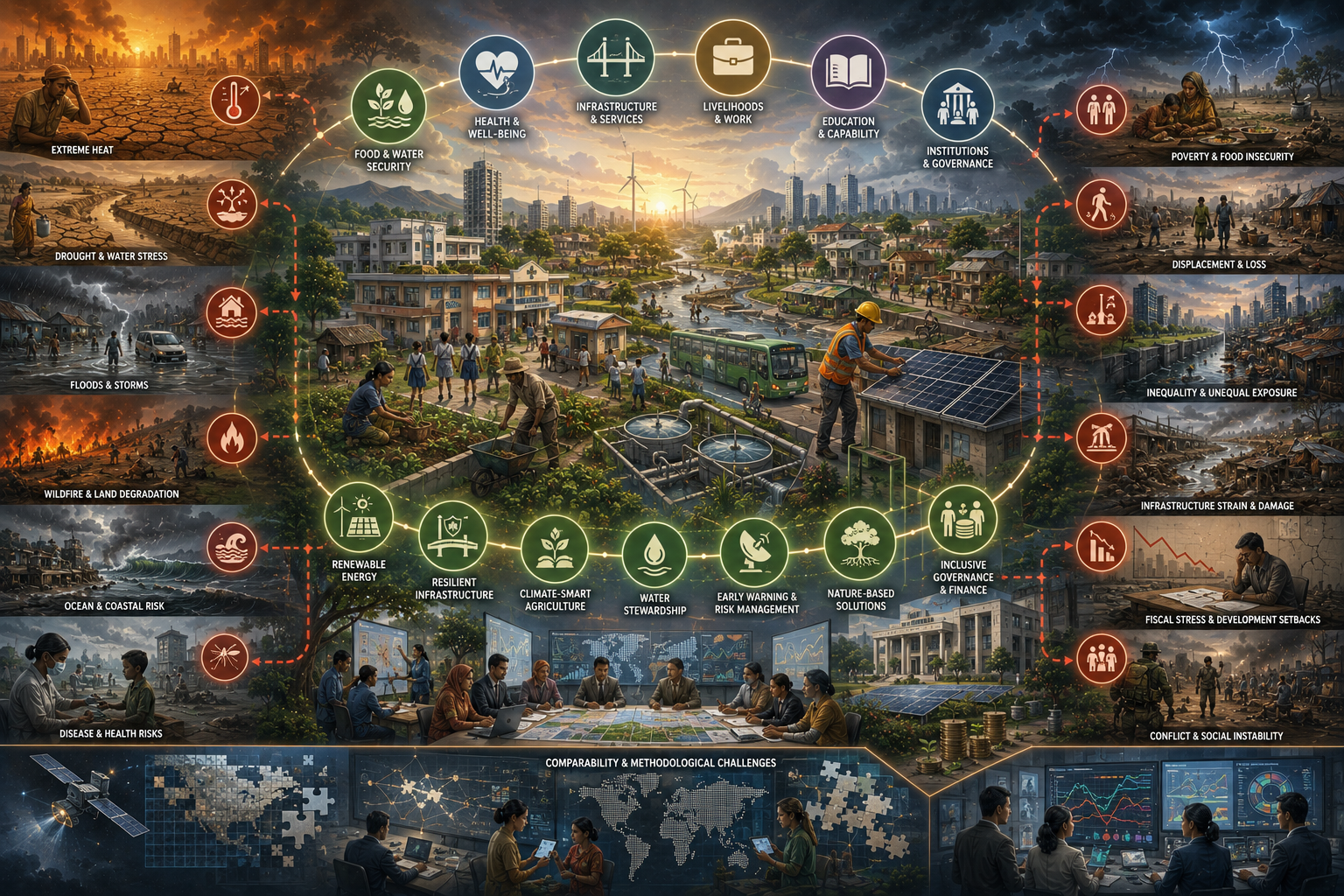
The 2030 Agenda places climate change near the center of sustainable development. It presents the global agenda as a plan of action for people, planet, and prosperity, and explicitly warns that climate change is one of the greatest challenges of our time whose adverse impacts undermine the ability of all countries to achieve sustainable development. That formulation matters because climate is not treated as a peripheral environmental concern. It is treated as part of the wider conditions under which poverty eradication, resilience, and long-run development must be pursued.
The IPCC has made this connection equally clear. Its Special Report on 1.5°C states that climate change and sustainable development are fundamentally connected, and that climate change can undermine sustainable development while well-designed mitigation and adaptation responses can support poverty alleviation, food security, healthy ecosystems, equality, and other development goals. The AR6 Synthesis Report goes further, stating that climate change is a threat to human well-being and planetary health and that there is a rapidly closing window of opportunity to secure a liveable and sustainable future for all.
Recent UN reporting sharpens the urgency of this developmental framing. Goal 13 materials note that human-induced climate change reached alarming new levels in 2024, that some impacts are already irreversible for centuries, and that extreme weather events contributed to the highest number of new displacements in 16 years while worsening food crises, economic losses, and social instability. These are not isolated environmental events. They are development shocks that affect whether societies can preserve gains already made and whether poorer populations can avoid further deprivation.
Why Climate Change Is a Development Issue
Climate change is a development issue because development depends on relatively stable environmental conditions. Food systems require workable seasons, soil moisture, rainfall reliability, and water availability. Public-health systems depend on manageable disease burdens, tolerable heat conditions, functioning sanitation, and resilient emergency capacity. Infrastructure depends on climatic assumptions about flood, storm, heat, and temperature ranges. Urban systems depend on drainage, cooling, transport, water networks, electricity systems, and housing that remain functional under stress. When those conditions shift, development becomes more difficult to secure and more expensive to maintain.
This means climate change cannot be treated simply as a background environmental concern to be addressed after social and economic development have been achieved. It directly affects whether such development can occur at all, and whether it can endure. In this sense, climate change is not external to development. It is one of the conditions through which development is enabled or constrained.
The development implications are especially clear when climate shocks interact with existing deprivation. A flood is not only a flood when it destroys housing, interrupts schooling, contaminates water, damages roads, reduces income, and forces households into debt. A heat wave is not only a weather event when it reduces labor productivity, worsens illness, strains electricity systems, and increases mortality among people without cooling, safe housing, or healthcare access. A drought is not only an agricultural event when it affects food prices, migration, livelihoods, conflict risk, and public budgets.
That is why the climate question belongs inside the architecture of sustainable development rather than alongside it. A society cannot realistically claim durable progress if its core systems are being made more unstable by the changing climatic conditions within which they operate. This places the article in direct continuity with The 2030 Agenda and the Logic of the SDGs and Sustainable Development as a Systems Problem.
Climate change is therefore not only a threat to nature. It is a constraint on the institutions, infrastructures, livelihoods, and capabilities through which human development becomes possible.
From Environmental Problem to Structural Constraint
One of the most important conceptual shifts in recent decades has been the move from treating climate change as a discrete environmental problem to understanding it as a structural development constraint. A discrete problem can be managed at the margins while the core development model continues unchanged. A structural constraint is different. It shapes the viability of agriculture, infrastructure, health, housing, work, migration, public finance, insurance, trade, energy systems, and institutional capacity across the system as a whole.
This distinction matters because many development models were built on climatic assumptions that no longer hold securely. Settlement patterns, irrigation systems, transport corridors, coastal infrastructure, energy demand, labor productivity, flood defenses, crop calendars, and disaster planning often depend on historical climate patterns. As those patterns shift, climate change ceases to be a side condition and becomes a destabilizing force within the foundations of development itself.
To call climate change a development constraint is therefore not to say that development is impossible. It is to say that climate increasingly enters the practical terms under which development can proceed. It changes the cost, risk, timing, location, distribution, and feasibility of core development goals. It makes some infrastructure less reliable, some agricultural practices less viable, some settlements more exposed, some livelihoods more fragile, and some public budgets more strained.
This structural character also explains why climate change cannot be governed only through isolated environmental ministries or narrow emissions accounting. Those tools matter, but the constraint reaches into land use, housing, health systems, food systems, finance, trade, social protection, urban planning, industrial policy, and energy transition. Climate change becomes a development constraint when ordinary development systems must be redesigned around a warming, more volatile world.
The deeper implication is that climate policy and development policy can no longer be separated. Climate risk shapes development outcomes, and development choices shape future climate risk. The two systems are now mutually constitutive.
Habitability and the Material Conditions of Development
Climate change should also be understood through the idea of habitability. Human development depends on more than institutions, income, and technology. It depends on whether the world remains materially inhabitable in the first place. Climatic stability, functional hydrological systems, manageable heat exposure, productive ecosystems, and ecologically viable food systems are not optional advantages. They are part of the background structure that makes health, settlement, labor, infrastructure, and social coordination possible.
This matters because development discourse often focuses on visible social outputs while taking climatic conditions for granted. But if those conditions are destabilized, the field within which development occurs becomes more volatile, less predictable, and harder to govern. Agricultural systems become more fragile, public-health burdens intensify, infrastructure becomes harder to maintain, and adaptation costs rise. Habitability therefore belongs inside development analysis rather than outside it.
Habitability is also unequal. Wealthier households and countries may be able to buffer heat, flood risk, water stress, or food-price shocks through air conditioning, insurance, stronger infrastructure, savings, relocation options, and public services. Poorer households and communities may face the same hazards with far weaker protection. Climate change therefore does not simply reduce habitability in general. It redistributes habitable conditions unequally.
Climate change becomes a development constraint in the deepest sense when it begins to erode not merely assets or sectors, but the basic conditions under which human beings can live securely enough for development to proceed at all. Heat, water stress, crop instability, coastal loss, storms, wildfire smoke, disease shifts, and displacement pressures are not only environmental indicators. They are direct pressures on the lived possibility of health, work, shelter, education, and community continuity.
This section aligns naturally with Safe Operating Space and the Conditions of Long-Run Development. A safe operating space is not abstract. It is the condition under which human settlements, livelihoods, and institutions remain viable enough for development to be more than a temporary achievement.
Climate Change and Human Capability
Climate change constrains development because it constrains human capability. Human development depends on the real ability of people to live healthy lives, secure food and water, learn, work, move safely, care for others, participate in society, and plan for the future. Climate disruption weakens these conditions through direct and indirect pathways: heat stress, food insecurity, water scarcity, disease, displacement, infrastructure failure, livelihood disruption, school interruption, household debt, and rising insecurity.
From a capability perspective, the issue is not only whether climatic events cause visible damage, but whether they narrow the substantive freedoms people can actually exercise. A household repeatedly exposed to crop loss, flood damage, water stress, heat stress, or storm disruption may retain formal rights yet lose practical freedom. Its capacity to plan, save, invest in education, sustain health, maintain housing, avoid debt, or participate in community life may steadily shrink.
This is one reason climate change belongs so naturally within a human-development framework. Climate risk is not merely about physical exposure. It is about the conversion of physical exposure into lost capabilities. A student who misses school repeatedly because of flooding, illness, displacement, or heat is not only experiencing an environmental disruption. They are experiencing a developmental loss. A worker whose outdoor labor becomes dangerous under heat stress is not only facing weather. They are facing a constraint on livelihood and bodily security.
Climate change therefore matters not only because it harms environments, but because it narrows the human possibilities that sustainable development is supposed to widen. It is a capability constraint as much as a physical one. That means climate analysis should be connected to health, education, housing, work, gender, food, water, infrastructure, and institutional protection.
This section also complements Health, Education, and Human Capability Expansion. Capability is never formed in a vacuum. It is formed within environmental, social, and institutional conditions that climate change is now actively reshaping.
Poverty, Vulnerability, and Developmental Risk
Climate change is especially destructive where poverty and vulnerability are already present. Poorer households, communities, and countries often have fewer buffers against climate shocks, less adaptive capacity, weaker infrastructure, higher exposure, and more direct dependence on climate-sensitive livelihoods. This means that the same drought, storm, flood, heat wave, wildfire, or crop failure can have sharply unequal developmental effects across social groups and regions.
This is one reason climate change and poverty reduction are so deeply linked. Development gains among poorer populations are often more fragile because they are secured with fewer reserves of wealth, insurance, public protection, or institutional support. A climate shock can therefore reverse years of progress in food security, schooling, health, housing, livelihoods, and household stability in a short period of time. The World Bank’s climate-and-development framing reflects this by centering resilience and development together rather than treating them as separable agendas.
Vulnerability is not simply exposure to hazard. It is exposure under unequal conditions of protection. A well-insured household in resilient housing with savings, transport, healthcare, and public support experiences a storm differently from a household in informal housing with unstable income, no insurance, weak drainage, and limited access to emergency response. The physical event may be similar, but the developmental consequences are unequal.
This also means that climate change can intensify existing poverty traps. Repeated shocks can force households to sell assets, withdraw children from school, migrate under distress, take on high-interest debt, reduce diet quality, or delay healthcare. These coping strategies may help survival in the short term while weakening future capability. Climate stress therefore turns vulnerability into cumulative developmental risk.
Climate change is thus not only a source of new harm. It is also a force that magnifies existing vulnerability and raises the likelihood that development gains will be lost, delayed, or unevenly distributed. This section aligns naturally with Poverty, Deprivation, and Multidimensional Development.
Food, Water, and Livelihood Systems Under Climate Stress
Climate change constrains development most visibly through food, water, and livelihood systems. Agriculture depends heavily on temperature, precipitation, soil moisture, seasonal predictability, pollination, hydrological stability, and the timing of planting and harvesting. Fisheries and marine livelihoods are affected by warming, ocean acidification, changing currents, and ecosystem disruption. Pastoral and rural livelihoods are vulnerable to drought, land degradation, heat stress, and shifting rainfall patterns. Urban food systems are also affected through supply shocks, price volatility, storage disruption, transport failure, and infrastructure damage.
Water systems are equally central. Climate change alters rainfall patterns, snowmelt, river regimes, groundwater recharge, flood frequency, drought intensity, and seasonal availability. These changes affect household consumption, sanitation, energy systems, irrigation, industry, ecosystems, and settlement viability. Where water becomes less reliable or more unevenly distributed, development becomes harder to sustain across multiple sectors simultaneously.
Food and water pressures are also social pressures. A crop failure can become a food-price shock. A drought can become a debt crisis. A flood can become a public-health emergency. Water scarcity can become a gendered labor burden when households must spend more time obtaining water. Fisheries decline can become a livelihood crisis. These pressures move across systems because food and water are not isolated sectors; they are foundations of social reproduction.
Climate stress on livelihoods is especially severe where households depend on agriculture, fisheries, informal work, outdoor labor, tourism, forestry, or climate-sensitive small enterprises. Workers may face income volatility, heat-related illness, reduced productivity, damaged assets, migration pressure, or loss of local livelihood systems. Climate change therefore constrains development by weakening the material basis of work and income.
This is why climate change should not be read as a sectoral problem. It affects the basic material systems through which life is reproduced and economies function. Food and water insecurity are among the clearest ways climate becomes a development constraint. This section connects clearly to Food Security, Nutrition, and Human Development and Freshwater Change and Development Risk.
Health, Heat, Disease, and Human Development
Climate change also constrains development through health. Rising heat affects mortality, morbidity, pregnancy risk, mental health, labor productivity, and the viability of outdoor work. Flooding and storm damage can disrupt health systems, sanitation, drinking water, medicine supply, and emergency access. Changes in temperature and precipitation can shift disease burdens and disease vectors. Smoke, air-quality degradation, malnutrition, and mental stress linked to repeated climate shocks further compound the problem.
This matters because health is one of the foundational dimensions of human development. When climate change increases illness, weakens nutrition, intensifies heat exposure, or overwhelms public-health systems, it narrows one of the most basic conditions of capability. The developmental cost is therefore not only in emergency response or mortality figures, but in the weakening of long-run human functioning and resilience.
Health effects also reveal how climate hazards cascade. A heat wave may strain energy systems, increase cooling costs, reduce work hours, worsen cardiovascular and respiratory stress, and deepen risks for older people, infants, outdoor workers, people with disabilities, and those in poor housing. A flood may damage clinics, contaminate water, spread disease, disrupt schooling, destroy documents, and create trauma. Health burdens rarely remain confined to health systems.
Climate stress on health systems also reveals a broader lesson: the developmental effects of climate change are cumulative. They cascade through households, clinics, schools, labor markets, food systems, and public budgets over time. A society with stronger healthcare, housing, sanitation, social protection, emergency response, and public trust is better able to absorb these pressures. A society with weaker systems experiences climate as a harsher development constraint.
This section aligns with the article’s wider human-development perspective. Climate change is not only a future environmental risk. It is already a health and capability issue that shapes who can live, work, learn, care, and participate under changing conditions.
Infrastructure, Cities, and Governability
Climate change is also a constraint on infrastructure and urban development. Roads, bridges, housing, drainage, ports, energy systems, water networks, schools, clinics, public transport, and communication systems are all designed around assumptions about weather, flood risk, temperature, rainfall, sea levels, and hazard frequency. As climate conditions shift, infrastructure becomes more expensive to build, more difficult to maintain, and more vulnerable to failure.
Cities are especially important in this regard. They concentrate people, assets, heat exposure, infrastructure, energy demand, housing pressure, public-health risk, and governance burdens. Climate risk in cities affects housing security, transport reliability, public health, water systems, electricity demand, drainage capacity, waste systems, and disaster-response capacity. Because urban inequality often places poorer settlements in more exposed or underserved areas, climate stress also becomes a force that deepens unequal urban development.
This means climate change is not only a physical challenge to infrastructure. It is a challenge to governability. A society facing repeated infrastructure breakdown, recurrent disaster recovery costs, rising adaptation burdens, displacement pressures, and uneven service failures faces a harder task of planning, coordination, and long-horizon development. Climate change increases the governance load precisely when many institutions are already under pressure.
Infrastructure also has a double role. It is vulnerable to climate change, but it also shapes future emissions and resilience. Energy systems, transport corridors, buildings, water networks, and urban form can either lock societies into higher-carbon and higher-risk pathways or support lower-emissions, more resilient development. Infrastructure planning is therefore one of the places where climate mitigation, adaptation, and development strategy must meet.
This section pairs naturally with Urbanization, Housing, and Basic Services. Climate-resilient development requires cities and settlements that are not only economically dynamic, but habitable, serviced, inclusive, and resilient under stress.
Inequality, Justice, and Uneven Exposure
Climate change is inseparable from justice because both responsibility and exposure are unevenly distributed. Higher-emitting development pathways, historically carbon-intensive economies, and high-consuming populations have contributed disproportionately to the accumulation of climate risk. Yet poorer countries and poorer communities often face greater exposure to losses, lower adaptive capacity, and more immediate threats to livelihoods and survival. The IPCC’s 1.5°C report explicitly emphasizes that issues of equity and fairness are central to climate change and sustainable development.
This creates one of the central moral tensions of sustainable development. Those who contributed least to the problem are often those for whom the developmental costs are highest. At the same time, many lower-income countries still require major expansions in energy access, housing, infrastructure, food security, healthcare, education, and industrial capacity. Climate action cannot therefore be reduced to a universal call for restraint without attention to historical responsibility and unequal developmental starting points.
Loss and damage make this issue especially sharp. Some climate impacts can be adapted to; others involve irreversible losses of land, culture, livelihoods, ecosystems, heritage, safety, or community continuity. When climate change destroys a home, a fishing ground, a farming system, a coastal settlement, or a sacred landscape, the harm is not captured only by financial damages. It is also a loss of social meaning, security, memory, and place.
Climate change as a development constraint must therefore be read through the lens of justice. Otherwise, the language of resilience and adaptation risks concealing who is forced to adapt, to what, and under what unequal conditions. Adaptation cannot mean asking the most vulnerable to absorb harms produced disproportionately by others. Mitigation cannot mean constraining the basic development claims of poorer societies while high-consuming systems continue to externalize costs.
This section complements Inequality and Inclusive Development. Climate justice is not separate from development justice. It is one of the forms development justice must now take.
Adaptation, Mitigation, and Development Pathways
Although climate change constrains development, responses to climate change can also reshape development pathways in more resilient and inclusive directions. The IPCC has emphasized that mitigation and adaptation, when well designed, can support sustainable development objectives including poverty reduction, food security, health, ecosystem protection, and equality. This is a crucial point because it shows that the response to climate change is not only defensive. It can also be developmental.
Adaptation matters because existing and near-term climate impacts are already shaping development conditions. Countries and communities need strategies that reduce exposure, strengthen resilience, protect infrastructure, support food and water security, reduce heat risk, strengthen health systems, protect livelihoods, and lower the vulnerability of poorer households. Mitigation matters because unchecked warming will intensify the developmental constraints already visible and push adaptation burdens far higher over time. The IPCC’s AR6 synthesis identifies climate resilient development as the integration of adaptation and mitigation to advance sustainable development for all.
This means the real challenge is not whether to choose climate policy or development policy. It is how to pursue development through pathways that are greener, more resilient, and more inclusive rather than more fragile, unequal, and carbon-intensive. The World Bank CCDRs are built around this same premise by seeking to integrate climate change and development and identify pathways that reduce emissions while boosting resilience.
Climate-resilient development requires attention to co-benefits and trade-offs. Clean energy can reduce pollution and expand energy access, but transitions must protect workers and communities. Urban adaptation can reduce heat and flood risk, but poorly designed projects can displace vulnerable residents. Climate-smart agriculture can improve resilience, but only if smallholders and local communities have voice, resources, and secure rights. Mitigation and adaptation must therefore be shaped by justice, not only efficiency.
The best climate-development pathways are those that reduce emissions, protect ecosystems, build resilience, expand basic services, strengthen public capacity, and widen human capability at the same time. They do not treat climate action as a cost imposed on development. They treat climate action as part of the redesign of development for a changing world.
Institutions, Finance, and Long-Horizon Planning
Climate change becomes a development constraint partly because institutions are often not designed to plan across the timescales and system linkages that climate disruption requires. Development ministries, infrastructure planners, social-protection systems, agricultural agencies, health departments, finance ministries, and local governments often operate within short budget cycles and sectoral mandates. Climate risks, by contrast, are cumulative, cross-sectoral, and long-horizon. The IPCC synthesis emphasizes that inclusive governance and coordinated policies are enabling conditions for climate-resilient development.
This creates a planning mismatch. Development remains difficult to align with climate realities unless institutions can integrate resilience, mitigation, adaptation, and social inclusion into a coherent planning framework. This is one reason the World Bank’s Country Climate and Development Reports are important: they explicitly seek to integrate climate change and development, identify main pathways to reduce emissions and boost resilience, and outline concrete priority actions.
Finance is equally central. Climate-resilient infrastructure, adaptation systems, social protection, clean energy, ecosystem restoration, disaster preparedness, relocation planning, early warning, and loss reduction all require fiscal capacity and long-term investment. Climate change therefore constrains development partly by increasing the financial burdens of maintaining development under more unstable conditions.
The financing problem is also unequal. Countries facing high debt burdens, low fiscal capacity, high climate exposure, and urgent development needs often have the least room to invest in adaptation and transition. This creates a structural dilemma: those who need climate-resilient development investment most may have the least access to affordable finance. Climate finance, debt relief, concessional lending, grants, technology transfer, and public investment therefore become development issues, not only environmental finance topics.
Long-horizon planning must also be institutionally credible. Climate plans need implementation capacity, public trust, transparent budgeting, local participation, science-based risk assessment, and mechanisms for learning as conditions change. A plan that is not financed, governed, monitored, or socially legitimate is not yet a development pathway.
Strengths, Tensions, and Open Questions
The strength of treating climate change as a development constraint is that it brings climate into the core of poverty, infrastructure, health, food, water, work, finance, and institutional analysis rather than leaving it at the periphery. It forces development thinking to confront the physical conditions under which social goals are pursued. It also helps explain why development strategies that ignore climate risk may become more expensive, fragile, and unequal over time.
But there are tensions. Climate framing can sometimes become so global or technocratic that it obscures differences in responsibility, capacity, local political economy, or lived vulnerability. It can also be used to justify narrow policy prescriptions without sufficient attention to labor, inequality, sovereignty, public participation, Indigenous rights, or the immediate needs of poorer populations. A serious development approach must avoid both ecological denial and technocratic oversimplification.
The IPCC’s repeated emphasis on equity, justice, and inclusive governance is important precisely because it guards against that simplification. Climate-resilient development cannot be imposed as a purely technical package. It must be politically legitimate, socially inclusive, locally grounded, and attentive to distributional consequences. Otherwise, climate policy can reproduce some of the exclusions that sustainable development is supposed to overcome.
There are also open questions about speed, sequencing, and institutional capacity. How quickly can energy systems transform without deepening inequality? How can cities adapt without displacing vulnerable residents? How can agricultural systems become more resilient while protecting smallholders? How can countries expand energy access and industrial capacity without locking in high-emissions systems? How can climate finance reach those most exposed rather than those most attractive to investors?
The open question is therefore not whether climate matters for development. It clearly does. The harder question is how to build development pathways that are simultaneously low-carbon, resilient, inclusive, just, and politically feasible under conditions of widening climate stress.
Why This Matters for Sustainable Development
Climate change matters for sustainable development because it alters the environmental, economic, and institutional conditions under which human wellbeing can be expanded and sustained. It affects food systems, water security, health, infrastructure, housing, work, migration, public finance, social protection, and the governability of change itself. A serious development framework must therefore treat climate not as a background environmental issue, but as part of the structure of development reality.
This is why climate belongs at the center of sustainable development. A society cannot claim durable progress if its gains depend on climatic conditions that are becoming more hostile, volatile, and unequal in their effects. Development that ignores climate risk may still look successful in the short run, but it becomes increasingly fragile in substance. It may raise output while increasing exposure, expand infrastructure while locking in vulnerability, or reduce poverty temporarily while leaving households exposed to repeated shocks.
At the same time, climate action must be understood as a development opportunity when it is designed around justice and capability. Adaptation can protect lives, food systems, infrastructure, and health. Mitigation can reduce future risk while improving air quality, energy systems, and technological capacity. Resilient infrastructure can support public services. Social protection can prevent shocks from becoming long-term deprivation. Clean development pathways can reduce dependence on fragile, high-risk systems.
The central claim is therefore direct: climate change is not one development issue among many. It is a condition that now shapes nearly all development issues. It changes the meaning of poverty reduction, infrastructure planning, urbanization, food security, health, water governance, labor policy, fiscal stability, and intergenerational responsibility.
To take climate change seriously is to take long-run development seriously. It is to recognize that sustainable development is not only about expanding output or reducing deprivation today, but about whether societies can preserve and widen human possibility under the changing conditions of a warming world. That is one of the defining developmental questions of the twenty-first century.
Mathematical Lens
Climate-related development burden can be clarified by thinking in terms of hazard intensity, exposure, vulnerability, and institutional readiness rather than emissions or damages alone. Let \(D_c\) represent long-run climate-development risk, \(H\) climate hazard intensity, \(E\) social and infrastructural exposure, \(V\) vulnerability, and \(A\) adaptive and institutional capacity:
D_c = \alpha H + \beta E + \gamma V – \delta A
\]
Interpretation: Climate-development risk rises when hazards, exposure, and vulnerability intensify, and falls when adaptive and institutional capacity improve.
This captures the article’s core point: the danger comes not only from climate change itself, but from how climatic instability interacts with human exposure, inequality, weak infrastructure, and limited institutional buffering.
We can also express climate fragility as a weighted function of heat stress, hydrological disruption, and disaster recurrence:
R_c = w_1 T + w_2 W + w_3 S
\]
Interpretation: Climate fragility rises when heat stress, water-system disruption, and recurring shocks become persistent features of development planning.
Here, \(T\) is heat stress, \(W\) is water-system disruption, and \(S\) is storm or shock recurrence. Higher \(R_c\) means a society faces a more persistent climate constraint on ordinary development planning.
Finally, pathway resilience can be represented as a function of adaptation investment, mitigation transition, and governance coherence:
P_r = \lambda I + \mu M + \nu G
\]
Interpretation: Pathway resilience improves when adaptation investment, low-emissions transition, and governance coherence strengthen together.
Here, \(I\) is adaptation investment, \(M\) is mitigation and low-emissions transition, and \(G\) is governance coherence across sectors and timescales. This helps show why similar hazard levels can produce very different developmental outcomes across places.
| Term | Meaning | Interpretive role |
|---|---|---|
| \(D_c\) | Climate-development risk | Represents long-run development risk created by climate hazards, exposure, vulnerability, and weak response capacity. |
| \(H\) | Climate hazard intensity | Represents the severity of heat, drought, flood, storm, wildfire, sea-level, and other climate-related hazards. |
| \(E\) | Social and infrastructural exposure | Represents people, assets, settlements, infrastructure, and livelihoods located in harm’s way. |
| \(V\) | Vulnerability | Represents poverty, weak services, insecure housing, fragile livelihoods, health burdens, and limited buffers. |
| \(A\) | Adaptive and institutional capacity | Represents public capacity, finance, infrastructure, planning, social protection, and resilience readiness. |
| \(R_c\) | Climate fragility | Represents recurring climate pressure on ordinary development systems. |
| \(P_r\) | Pathway resilience | Represents the strength of adaptation, mitigation, and governance coherence in sustaining development under climate stress. |
The equations are conceptual rather than predictive. Their value is to make visible the structure of the problem: climate-development risk depends on hazards, exposure, vulnerability, institutional capacity, adaptation, mitigation, and governance coherence working together.
Advanced Python Workflow: Climate Constraint and Development Risk Scoring
This Python workflow translates the article’s core argument into a structured climate-development risk model. Rather than treating climate change as a single emissions or disaster variable, it scores territories across heat stress, hydrological disruption, livelihood exposure, health burden, infrastructure vulnerability, justice exposure, governance capacity, resilience readiness, disaster recurrence, adaptation investment, mitigation transition, and social protection strength. That makes it possible to compare not only where climate stress is high, but where climate change is becoming most developmentally consequential.
from __future__ import annotations

import pandas as pd
import numpy as np

INPUT_FILE = "climate_constraint_panel.csv"
OUTPUT_FILE = "climate_constraint_development_scores.csv"


def load_data(path: str) -> pd.DataFrame:
    """
    Load a territory-level climate constraint and development risk dataset.

    All *_index columns should be normalized to [0, 1].
    Higher values should mean more of the named property.

    Examples:
      - heat_stress_index: higher = greater heat stress
      - hydrological_disruption_index: higher = greater water-system disruption
      - governance_capacity_index: higher = stronger public governance capacity
      - resilience_readiness_index: higher = stronger resilience readiness
    """
    df = pd.read_csv(path)

    required_columns = [
        "territory_name",
        "country_or_region",
        "territory_type",
        "heat_stress_index",
        "hydrological_disruption_index",
        "food_livelihood_exposure_index",
        "health_burden_index",
        "infrastructure_vulnerability_index",
        "justice_exposure_index",
        "governance_capacity_index",
        "resilience_readiness_index",
        "disaster_recurrence_index",
        "adaptation_investment_index",
        "mitigation_transition_index",
        "social_protection_strength_index",
    ]

    missing = [col for col in required_columns if col not in df.columns]

    if missing:
        raise ValueError(f"Missing required columns: {missing}")

    return df


def validate_indices(df: pd.DataFrame) -> pd.DataFrame:
    """Validate that all *_index fields are complete and normalized to [0, 1]."""
    index_columns = [col for col in df.columns if col.endswith("_index")]

    for col in index_columns:
        if df[col].isna().any():
            raise ValueError(f"Column '{col}' contains missing values.")

        if ((df[col] < 0) | (df[col] > 1)).any():
            raise ValueError(f"Column '{col}' contains values outside [0, 1].")

    return df


def compute_scores(df: pd.DataFrame) -> pd.DataFrame:
    """
    Compute climate stress, development exposure,
    governance readiness, and constrained climate-development risk.

    Climate stress rises with heat stress, water disruption,
    disaster recurrence, infrastructure vulnerability, and health burden.

    Governance readiness rises with governance capacity,
    resilience readiness, adaptation investment, mitigation transition,
    and social protection strength.
    """
    df = df.copy()

    df["climate_stress_score"] = (
        0.20 * df["heat_stress_index"] +
        0.18 * df["hydrological_disruption_index"] +
        0.18 * df["disaster_recurrence_index"] +
        0.22 * df["infrastructure_vulnerability_index"] +
        0.22 * df["health_burden_index"]
    ).clip(lower=0, upper=1)

    df["development_exposure_score"] = (
        0.32 * df["food_livelihood_exposure_index"] +
        0.22 * df["justice_exposure_index"] +
        0.18 * df["health_burden_index"] +
        0.16 * df["infrastructure_vulnerability_index"] +
        0.12 * df["hydrological_disruption_index"]
    ).clip(lower=0, upper=1)

    df["governance_readiness_score"] = (
        0.25 * df["governance_capacity_index"] +
        0.22 * df["resilience_readiness_index"] +
        0.20 * df["adaptation_investment_index"] +
        0.18 * df["mitigation_transition_index"] +
        0.15 * df["social_protection_strength_index"]
    ).clip(lower=0, upper=1)

    df["constrained_climate_development_score"] = (
        0.40 * df["climate_stress_score"] +
        0.26 * df["development_exposure_score"] +
        0.14 * df["justice_exposure_index"] +
        0.12 * (1 - df["governance_readiness_score"]) +
        0.08 * (1 - df["social_protection_strength_index"])
    ).clip(lower=0, upper=1)

    df["risk_band"] = np.select(
        [
            df["constrained_climate_development_score"] >= 0.80,
            df["constrained_climate_development_score"] >= 0.60,
            df["constrained_climate_development_score"] >= 0.40,
        ],
        [
            "Extreme climate-development risk",
            "High climate-development risk",
            "Moderate climate-development risk",
        ],
        default="Lower climate-development risk",
    )

    df["climate_governance_gap"] = (
        df["climate_stress_score"] -
        df["governance_readiness_score"]
    )

    df["climate_warning"] = np.select(
        [
            df["climate_governance_gap"] >= 0.35,
            df["climate_governance_gap"] >= 0.20,
            df["climate_governance_gap"] >= 0.05,
        ],
        [
            "Severe climate governance gap",
            "High climate governance gap",
            "Moderate climate governance gap",
        ],
        default="Lower governance gap or stronger climate readiness",
    )

    return df


def build_summary(df: pd.DataFrame) -> pd.DataFrame:
    """Return a ranked summary table for review or reporting."""
    columns = [
        "territory_name",
        "country_or_region",
        "territory_type",
        "climate_stress_score",
        "development_exposure_score",
        "governance_readiness_score",
        "constrained_climate_development_score",
        "risk_band",
        "climate_governance_gap",
        "climate_warning",
    ]

    summary = df[columns].copy()

    summary = summary.sort_values(
        by=[
            "constrained_climate_development_score",
            "climate_stress_score",
            "development_exposure_score",
        ],
        ascending=[False, False, False],
    ).reset_index(drop=True)

    return summary


def main() -> None:
    df = load_data(INPUT_FILE)
    df = validate_indices(df)
    scored = compute_scores(df)
    summary = build_summary(scored)

    summary.to_csv(OUTPUT_FILE, index=False)

    print("Climate constraint and development risk scoring complete.")
    print(summary.to_string(index=False))


if __name__ == "__main__":
    main()
This workflow is intentionally transparent. It does not claim that climate-development risk can be reduced to one objective score. Instead, it makes assumptions visible: heat stress, hydrological disruption, food and livelihood exposure, health burden, infrastructure vulnerability, justice exposure, governance capacity, resilience readiness, disaster recurrence, adaptation investment, mitigation transition, and social protection are treated as distinct components. The value of the model is diagnostic. It helps identify where climate change is most likely to become a development constraint.
Advanced R Workflow: Climate Exposure, Development Burden, and Governance Gap Analysis
This R workflow is designed for the part of the article that emphasizes variation across territories, groups, and structural exposure. It compares settings across heat stress, hydrological disruption, livelihood exposure, health burden, infrastructure vulnerability, justice exposure, governance capacity, resilience readiness, adaptation investment, mitigation transition, and social protection, then builds grouped summaries that help show where climate-development stress is strongest and where unequal burden remains developmentally costly.
library(readr)
library(dplyr)

input_file <- "climate_constraint_country_panel.csv"
region_output_file <- "cross_region_climate_summary.csv"
territory_output_file <- "cross_territory_climate_summary.csv"

climate_df <- read_csv(input_file, show_col_types = FALSE)

required_cols <- c(
  "territory_name",
  "country_or_region",
  "territory_type",
  "heat_stress_index",
  "hydrological_disruption_index",
  "food_livelihood_exposure_index",
  "health_burden_index",
  "infrastructure_vulnerability_index",
  "justice_exposure_index",
  "governance_capacity_index",
  "resilience_readiness_index",
  "disaster_recurrence_index",
  "adaptation_investment_index",
  "mitigation_transition_index",
  "social_protection_strength_index"
)

missing_cols <- setdiff(required_cols, names(climate_df))

if (length(missing_cols) > 0) {
  stop(paste("Missing required columns:", paste(missing_cols, collapse = ", ")))
}

index_cols <- names(climate_df)[grepl("_index$", names(climate_df))]

invalid_index_cols <- index_cols[
  vapply(
    climate_df[index_cols],
    function(x) any(is.na(x) | x < 0 | x > 1),
    logical(1)
  )
]

if (length(invalid_index_cols) > 0) {
  stop(
    paste(
      "Index columns must be complete and normalized to [0, 1]:",
      paste(invalid_index_cols, collapse = ", ")
    )
  )
}

climate_df <- climate_df %>%
  mutate(
    climate_stress_proxy = (
      heat_stress_index +
      hydrological_disruption_index +
      disaster_recurrence_index +
      health_burden_index +
      infrastructure_vulnerability_index
    ) / 5,
    governance_readiness_proxy = (
      governance_capacity_index +
      resilience_readiness_index +
      adaptation_investment_index +
      mitigation_transition_index +
      social_protection_strength_index
    ) / 5,
    climate_development_risk_proxy = (
      climate_stress_proxy +
      food_livelihood_exposure_index +
      justice_exposure_index +
      (1 - governance_readiness_proxy) +
      (1 - social_protection_strength_index)
    ) / 5,
    climate_governance_gap = climate_stress_proxy - governance_readiness_proxy,
    risk_band = case_when(
      climate_development_risk_proxy >= 0.75 ~ "Extreme climate-development risk",
      climate_development_risk_proxy >= 0.55 ~ "High climate-development risk",
      climate_development_risk_proxy >= 0.35 ~ "Moderate climate-development risk",
      TRUE ~ "Lower climate-development risk"
    )
  )

region_summary <- climate_df %>%
  group_by(country_or_region) %>%
  summarise(
    avg_climate_development_risk_proxy = mean(climate_development_risk_proxy, na.rm = TRUE),
    avg_climate_stress_proxy = mean(climate_stress_proxy, na.rm = TRUE),
    avg_governance_readiness_proxy = mean(governance_readiness_proxy, na.rm = TRUE),
    avg_heat_stress = mean(heat_stress_index, na.rm = TRUE),
    avg_hydrological_disruption = mean(hydrological_disruption_index, na.rm = TRUE),
    avg_food_livelihood_exposure = mean(food_livelihood_exposure_index, na.rm = TRUE),
    avg_health_burden = mean(health_burden_index, na.rm = TRUE),
    avg_infrastructure_vulnerability = mean(infrastructure_vulnerability_index, na.rm = TRUE),
    avg_justice_exposure = mean(justice_exposure_index, na.rm = TRUE),
    avg_governance_capacity = mean(governance_capacity_index, na.rm = TRUE),
    avg_resilience_readiness = mean(resilience_readiness_index, na.rm = TRUE),
    avg_adaptation_investment = mean(adaptation_investment_index, na.rm = TRUE),
    avg_mitigation_transition = mean(mitigation_transition_index, na.rm = TRUE),
    avg_social_protection_strength = mean(social_protection_strength_index, na.rm = TRUE),
    avg_climate_governance_gap = mean(climate_governance_gap, na.rm = TRUE),
    observations = n(),
    .groups = "drop"
  ) %>%
  mutate(
    regional_risk_band = case_when(
      avg_climate_development_risk_proxy >= 0.75 ~ "Extreme climate-development risk",
      avg_climate_development_risk_proxy >= 0.55 ~ "High climate-development risk",
      avg_climate_development_risk_proxy >= 0.35 ~ "Moderate climate-development risk",
      TRUE ~ "Lower climate-development risk"
    )
  ) %>%
  arrange(desc(avg_climate_development_risk_proxy))

territory_summary <- climate_df %>%
  group_by(territory_type) %>%
  summarise(
    avg_climate_development_risk_proxy = mean(climate_development_risk_proxy, na.rm = TRUE),
    avg_climate_stress_proxy = mean(climate_stress_proxy, na.rm = TRUE),
    avg_governance_readiness_proxy = mean(governance_readiness_proxy, na.rm = TRUE),
    avg_heat_stress = mean(heat_stress_index, na.rm = TRUE),
    avg_hydrological_disruption = mean(hydrological_disruption_index, na.rm = TRUE),
    avg_food_livelihood_exposure = mean(food_livelihood_exposure_index, na.rm = TRUE),
    avg_health_burden = mean(health_burden_index, na.rm = TRUE),
    avg_infrastructure_vulnerability = mean(infrastructure_vulnerability_index, na.rm = TRUE),
    avg_justice_exposure = mean(justice_exposure_index, na.rm = TRUE),
    avg_governance_capacity = mean(governance_capacity_index, na.rm = TRUE),
    avg_resilience_readiness = mean(resilience_readiness_index, na.rm = TRUE),
    avg_adaptation_investment = mean(adaptation_investment_index, na.rm = TRUE),
    avg_mitigation_transition = mean(mitigation_transition_index, na.rm = TRUE),
    avg_social_protection_strength = mean(social_protection_strength_index, na.rm = TRUE),
    avg_climate_governance_gap = mean(climate_governance_gap, na.rm = TRUE),
    observations = n(),
    .groups = "drop"
  ) %>%
  arrange(desc(avg_climate_development_risk_proxy))

write_csv(region_summary, region_output_file)
write_csv(territory_summary, territory_output_file)

cat("Cross-region climate summary exported to:", region_output_file, "\n")
print(region_summary)

cat("\nCross-territory climate summary exported to:", territory_output_file, "\n")
print(territory_summary)
This workflow helps distinguish climate exposure from developmentally consequential climate risk. A territory may face high hazards but stronger governance, adaptation investment, and social protection. Another may face moderate hazards but severe livelihood exposure, weak public systems, and high justice exposure. The workflow therefore treats climate change as a development condition, not as an isolated environmental variable.
GitHub Repository
Complete Code Repository
The full code distribution for this article, including climate-risk scoring workflows, development-exposure diagnostics, SQL materials, optional monitoring support tooling, supporting documentation, and repository structure, is available on GitHub.
Related Articles
- The 2030 Agenda and the Logic of the SDGs
- Sustainable Development as a Systems Problem
- Safe Operating Space and the Conditions of Long-Run Development
- Planetary Boundaries and Sustainable Development
- Health, Education, and Human Capability Expansion
- Poverty, Deprivation, and Multidimensional Development
- Food Security, Nutrition, and Human Development
- Freshwater Change and Development Risk
- Urbanization, Housing, and Basic Services
- Inequality and Inclusive Development
Further Reading
- IPCC (2023) AR6 Synthesis Report: Climate Change 2023. Geneva: Intergovernmental Panel on Climate Change. Available at: https://www.ipcc.ch/report/ar6/syr/
- IPCC (2022) Climate Change 2022: Impacts, Adaptation and Vulnerability. Geneva: Intergovernmental Panel on Climate Change. Available at: https://www.ipcc.ch/report/ar6/wg2/
- IPCC (2018) Global Warming of 1.5°C. Geneva: Intergovernmental Panel on Climate Change. Available at: https://www.ipcc.ch/sr15/
- United Nations (n.d.) Goal 13: Take urgent action to combat climate change and its impacts. New York: United Nations. Available at: https://sdgs.un.org/goals/goal13
- United Nations Statistics Division (2025) Goal 13: Climate Action. New York: United Nations. Available at: https://unstats.un.org/sdgs/report/2025/goal-13/
- UNDP (n.d.) Climate Change and Human Development. New York: United Nations Development Programme. Available at: https://hdr.undp.org/content/climate-change-and-human-development
- World Bank Group (n.d.) Country Climate and Development Reports. Washington, DC: World Bank. Available at: https://www.worldbank.org/en/publication/country-climate-development-reports
- World Bank Group (2021) Climate Change Action Plan 2021–2025: Supporting Green, Resilient, and Inclusive Development. Washington, DC: World Bank. Available at: https://documents1.worldbank.org/curated/en/705731624380363785/pdf/World-Bank-Group-Climate-Change-Action-Plan-2021-2025-Supporting-Green-Resilient-and-Inclusive-Development.pdf
References
- United Nations (2015) Transforming our world: the 2030 Agenda for Sustainable Development. New York: United Nations. Available at: https://sdgs.un.org/2030agenda
- United Nations (n.d.) Goal 13: Take urgent action to combat climate change and its impacts. New York: United Nations. Available at: https://sdgs.un.org/goals/goal13
- United Nations (n.d.) Climate action and synergies. New York: United Nations. Available at: https://sdgs.un.org/topics/climate-action-synergies
- United Nations Statistics Division (2025) Goal 13: Climate Action. New York: United Nations. Available at: https://unstats.un.org/sdgs/report/2025/goal-13/
- IPCC (2018) Global Warming of 1.5°C. Geneva: Intergovernmental Panel on Climate Change. Available at: https://www.ipcc.ch/sr15/
- IPCC (2022) Climate Change 2022: Impacts, Adaptation and Vulnerability. Geneva: Intergovernmental Panel on Climate Change. Available at: https://www.ipcc.ch/report/ar6/wg2/
- IPCC (2023) AR6 Synthesis Report: Climate Change 2023. Geneva: Intergovernmental Panel on Climate Change. Available at: https://www.ipcc.ch/report/ar6/syr/
- UNDP (n.d.) Climate Change and Human Development. New York: United Nations Development Programme. Available at: https://hdr.undp.org/content/climate-change-and-human-development
- World Bank Group (n.d.) Country Climate and Development Reports. Washington, DC: World Bank. Available at: https://www.worldbank.org/en/publication/country-climate-development-reports
- World Bank Group (2021) Climate Change Action Plan 2021–2025: Supporting Green, Resilient, and Inclusive Development. Washington, DC: World Bank. Available at: https://documents1.worldbank.org/curated/en/705731624380363785/pdf/World-Bank-Group-Climate-Change-Action-Plan-2021-2025-Supporting-Green-Resilient-and-Inclusive-Development.pdf