Sustainable Systems

Sustainable systems examine how social, economic, and environmental processes can be organized to support long-term stability and human well-being. Rather than treating environmental protection, economic development, and social equity as separate challenges, sustainable systems research emphasizes their deep interdependence.

The field integrates insights from sustainability science, systems theory, ecological economics, and public policy. Researchers analyze how resource use, technological development, governance structures, and social behavior interact within complex systems.

Designing sustainable systems requires understanding feedback loops, institutional incentives, and long-term environmental constraints. Effective systems must balance efficiency with resilience, innovation with stewardship, and economic opportunity with ecological limits.

By integrating interdisciplinary knowledge, sustainable systems approaches aim to create development pathways that maintain ecological integrity while supporting inclusive and resilient societies.

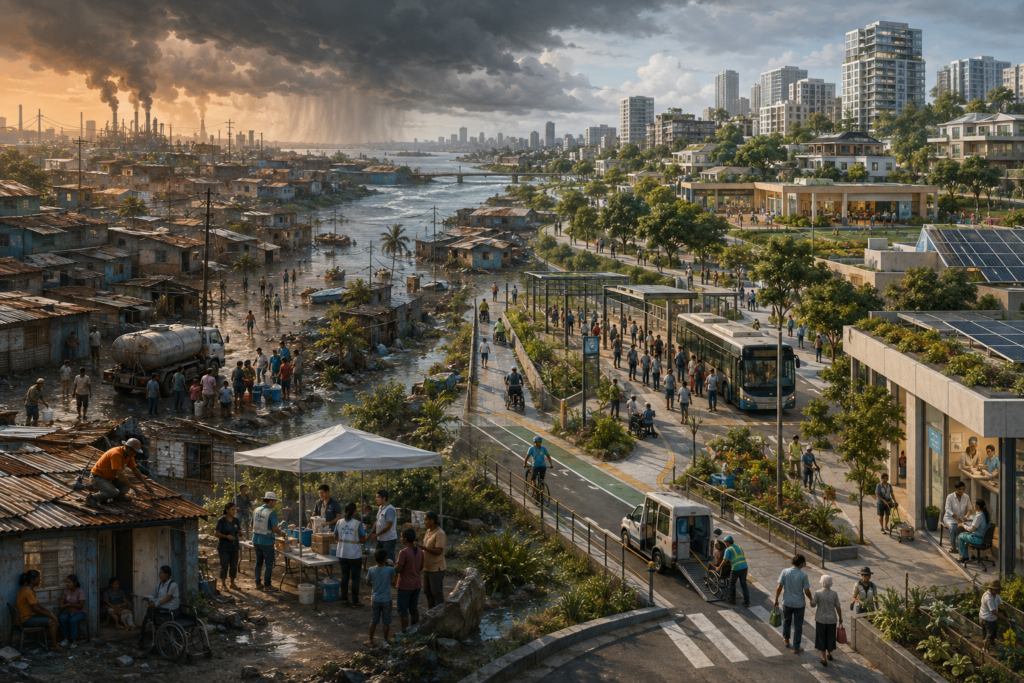
Editorial sustainability illustration showing a divided urban landscape where flood-prone, under-resourced neighborhoods contrast with better-protected districts connected by transit, public services, and recovery infrastructure.

Social Vulnerability and Risk Distribution

Social vulnerability and risk distribution are central to resilience because hazards do not become disasters evenly. Floods, heatwaves, droughts, storms, fires, disease outbreaks, infrastructure failures, food shocks, and economic disruptions move through societies already structured by unequal housing, income, health, mobility, political power, public services, exposure, recovery capacity, environmental burdens, and historical injustice. This article explains why vulnerability is not weakness in people, but a condition produced by systems that distribute harm and protection unequally. It examines exposure, capacity, poverty, housing, disability, language access, legal status, environmental justice, recovery inequality, vulnerability measurement, and justice-centered resilience. True resilience requires reducing unequal harm, repairing cumulative vulnerability, and ensuring that recovery systems protect those most often asked to absorb risk.
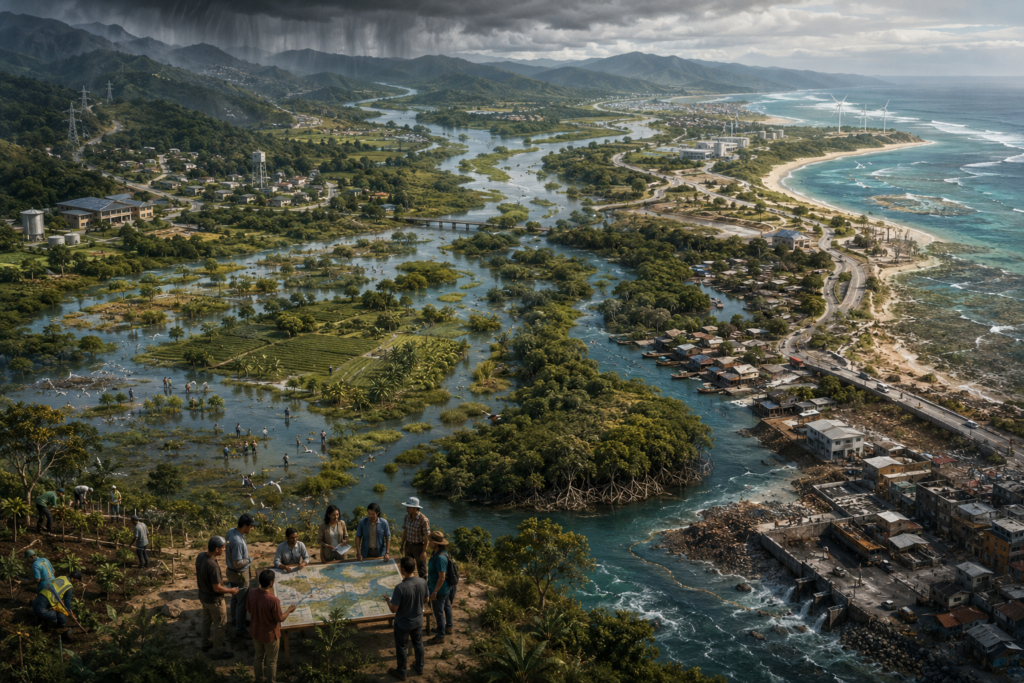

Editorial sustainability illustration showing wetlands, floodplains, mangroves, reefs, restored landscapes, community planning, and vulnerable coastal settlements within a connected resilience landscape.

Nature-Based Solutions, Ecosystem Buffers, and Resilience

Nature-based solutions, ecosystem buffers, and resilience belong together because living systems can reduce risk while supporting biodiversity, livelihoods, water security, food systems, public health, climate adaptation, and social wellbeing. Wetlands, floodplains, forests, mangroves, reefs, dunes, soils, watersheds, riparian corridors, grasslands, peatlands, urban tree canopy, and restored habitats can absorb floodwater, reduce heat, stabilize slopes, buffer storm surge, filter water, store carbon, support pollination, and create adaptive capacity. This article explains how credible nature-based solutions differ from superficial greening, why ecosystem buffers must be governed and maintained as serious resilience infrastructure, and how ecological integrity, community rights, public accountability, social legitimacy, biodiversity, and long-term stewardship determine whether nature-based approaches actually reduce vulnerability.

Editorial sustainability illustration showing wetlands, floodplains, forests, mangroves, reefs, soils, rivers, and urban green space protecting nearby communities and infrastructure through connected natural-buffer systems.

Ecosystem Resilience and Natural Buffers

Ecosystem resilience and natural buffers are foundational to sustainable risk reduction. Wetlands, floodplains, forests, mangroves, reefs, soils, watersheds, urban tree canopy, and coastal ecosystems reduce flood peaks, buffer storm surge, stabilize slopes, moderate heat, filter water, support biodiversity, and protect food and water systems. This article explains why ecological systems should be understood as living resilience infrastructure, while also recognizing that they are more than infrastructure. It examines wetlands, floodplains, watersheds, forests, soils, mangroves, reefs, biodiversity, governance, justice, ecological maintenance, and the limits of nature-based approaches. Resilience depends not only on restoration, but on protecting intact ecosystems, reconnecting habitats, maintaining ecological function, respecting community rights, and integrating natural buffers with public institutions, engineered systems, social protection, and long-term stewardship.

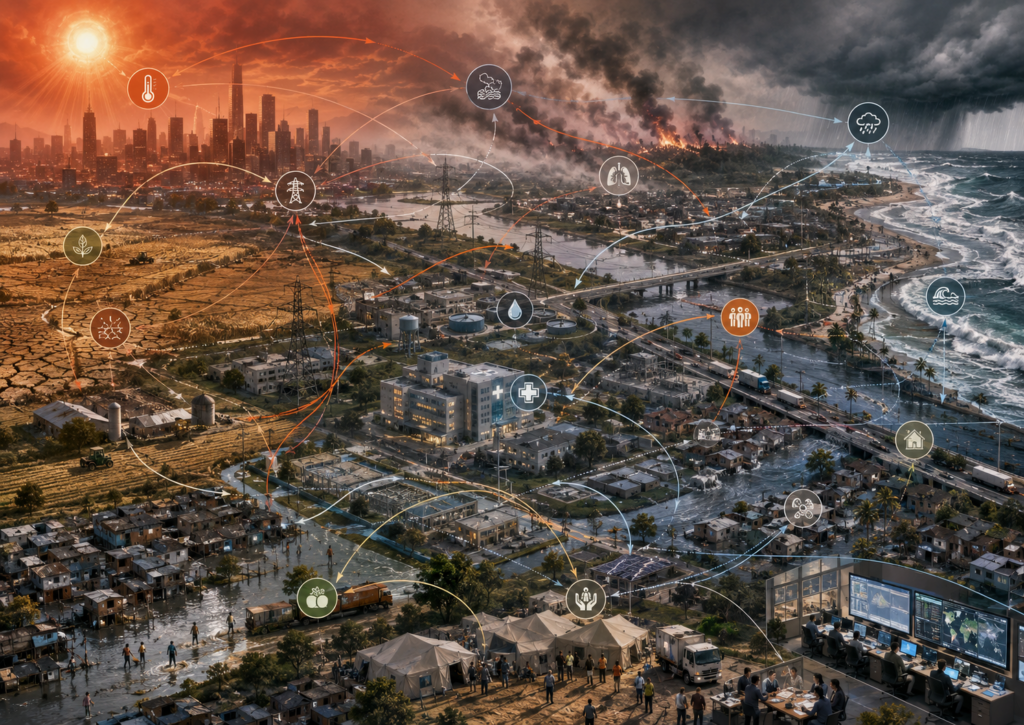
Editorial illustration of overlapping climate hazards, infrastructure systems, vulnerable communities, emergency response, and ecological buffers connected by cascading risk pathways.

Compound Climate Events and Cascading Social Risk

Compound climate events reveal why climate risk cannot be understood one hazard at a time. Heat, drought, flood, wildfire, storm surge, smoke, food stress, water scarcity, power instability, and disease risk often overlap or occur in close sequence, creating pressures that move through infrastructure, health systems, households, ecosystems, public agencies, and local economies. This article explains how compound events become cascading social risk when hazards interact with exposure, vulnerability, infrastructure fragility, food-water-energy stress, weak governance, recovery deficits, inequality, degraded ecological buffers, and unreliable communication. It also examines why single-hazard planning is inadequate, how social harm spreads beyond direct physical damage, and why resilience requires multi-hazard preparedness, cross-sector dependency mapping, public-health capacity, social protection, ecological restoration, and justice-centered climate governance.

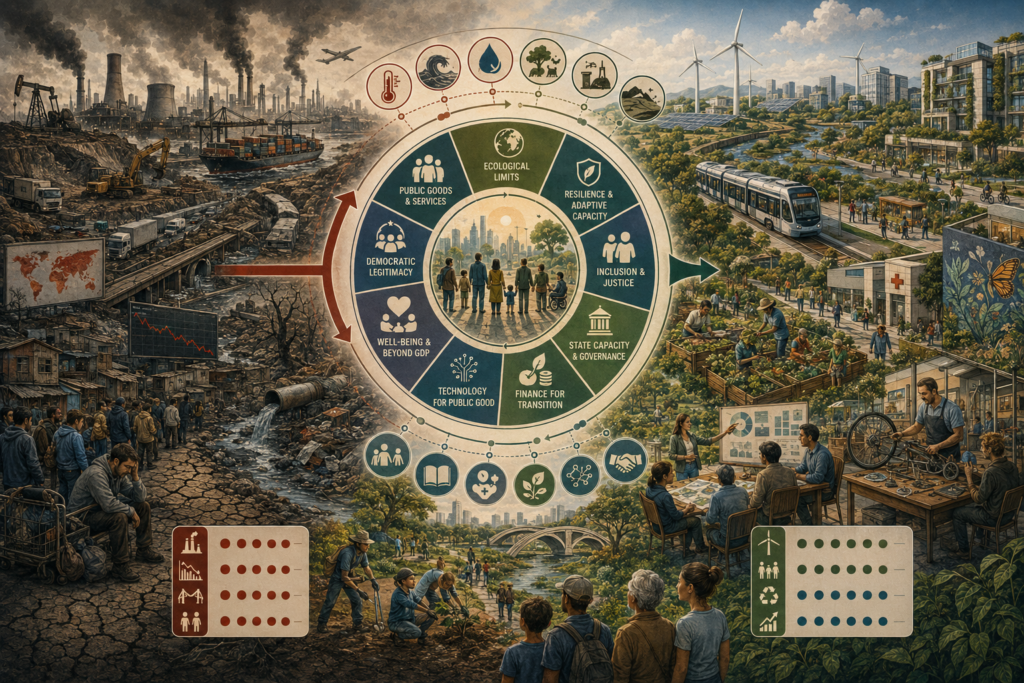
Editorial systems illustration showing the future of economic systems under ecological limits, with old expansionary assumptions contrasted against resilient, inclusive, boundary-aware, regenerative economic redesign.

The Future of Economic Systems in an Age of Limits

The future of economic systems in an age of limits examines how economies must adapt to a world shaped by ecological ceilings, material pressure, climate risk, inequality, and institutional strain. This article explores how the old assumptions of cheap fossil energy, expanding throughput, and growth-first governance are being challenged by planetary boundaries, resource constraints, fragility, and the need for broader measures of progress. It addresses energy transition, material redesign, public goods, state capacity, finance, resilience, post-growth debate, technology, global inequality, democratic legitimacy, and regenerative economic models. Within sustainable systems, the deeper issue is whether economic life can be reorganized to remain compatible with Earth-system stability, human dignity, and long-run collective flourishing at the same time.

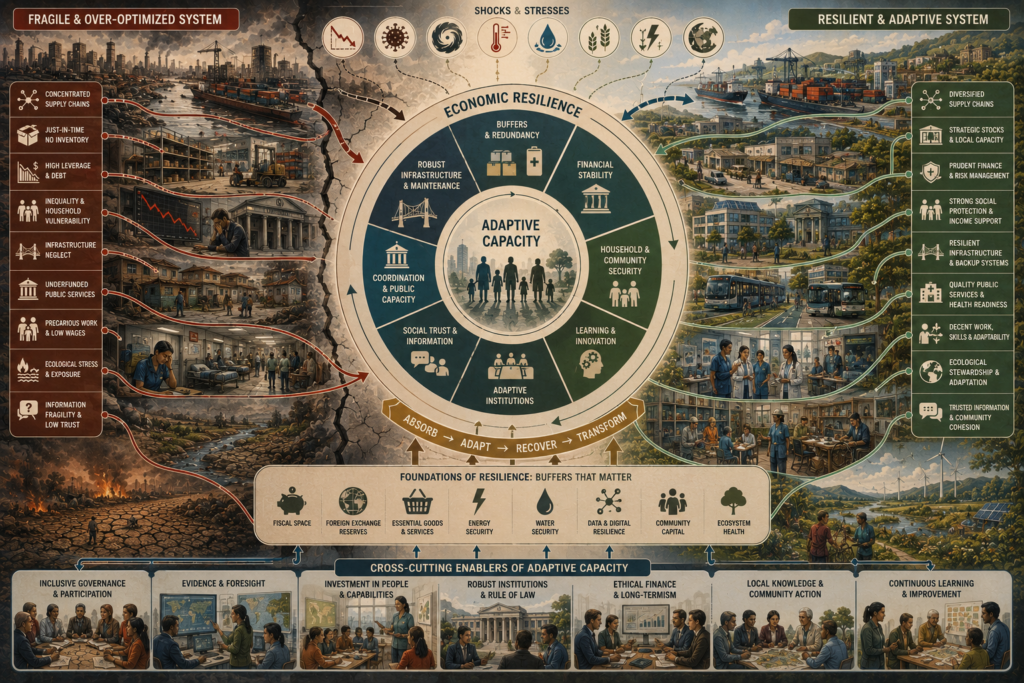
Editorial systems illustration showing economic resilience, fragility, adaptive capacity, shocks, buffers, redundancy, public institutions, supply chains, household security, infrastructure, finance, and ecological risk.

Economic Resilience, Fragility, and Adaptive Capacity

Economic resilience, fragility, and adaptive capacity examine how economies absorb disruption, endure stress, and reorganize under pressure. This article explores resilience as the ability of economic systems to withstand disturbance while maintaining core functions; fragility as the structural condition that makes systems vulnerable to breakdown, contagion, and cascading failure; and adaptive capacity as the institutional, social, financial, and technical ability to learn, coordinate, and change in response to crisis. It addresses shock exposure, over-optimization, buffers, public institutions, unequal household and firm resilience, infrastructure interdependence, debt, labor adaptation, ecological stress, trust, and transformational recovery. Within sustainable systems, the deeper issue is whether economic life is being organized for genuine durability and intelligent adaptation or for short-term performance that leaves societies increasingly brittle when disruption arrives.

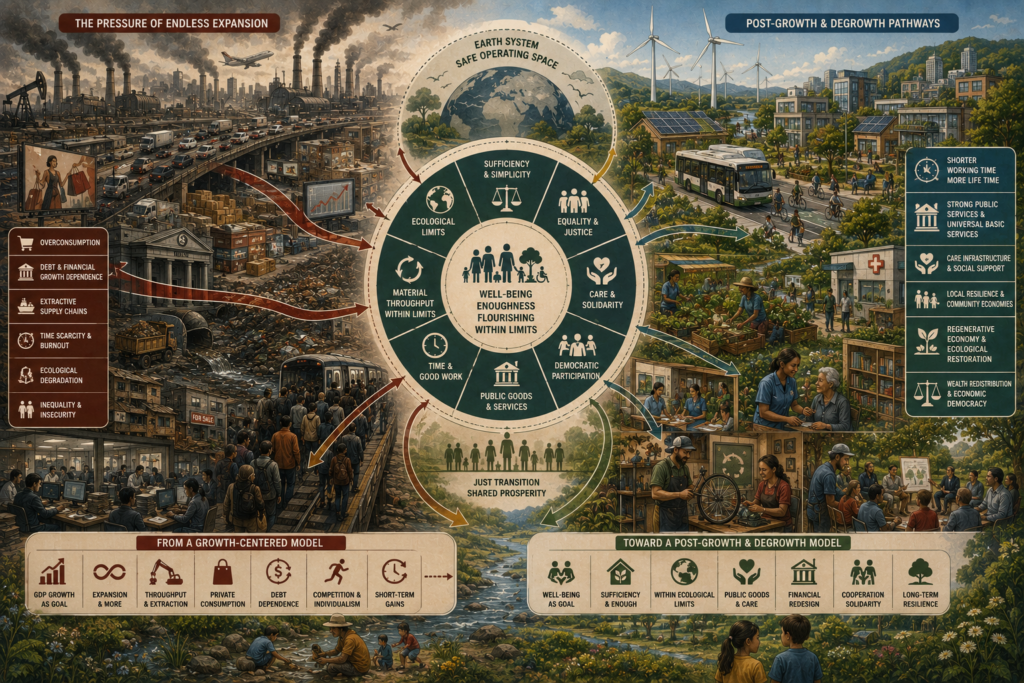
Editorial systems illustration showing post-growth and degrowth as alternatives to endless expansion, with sufficiency, care, public goods, ecological limits, shorter working time, repair economies, and democratic transition.

Post-Growth, Degrowth, and the Critique of Endless Expansion

Post-growth, degrowth, and the critique of endless expansion examine whether modern societies can remain organized around perpetual GDP growth under conditions of ecological strain, inequality, and institutional fragility. This article explores post-growth as a broad family of approaches that seek to organize economic life around wellbeing, sufficiency, resilience, and ecological stability rather than output expansion as an end in itself; degrowth as a more explicit argument for planned reductions in resource and energy throughput in high-income economies alongside stronger equality, care, public goods, and democratic capacity; and the wider critique of endless expansion as a challenge to the idea that rising output is the master solution to social problems. It addresses wellbeing beyond output, material throughput, distribution, care, productivity, debt, finance, decoupling, sufficiency, global justice, and the institutional dependence of modern systems on continuous growth.

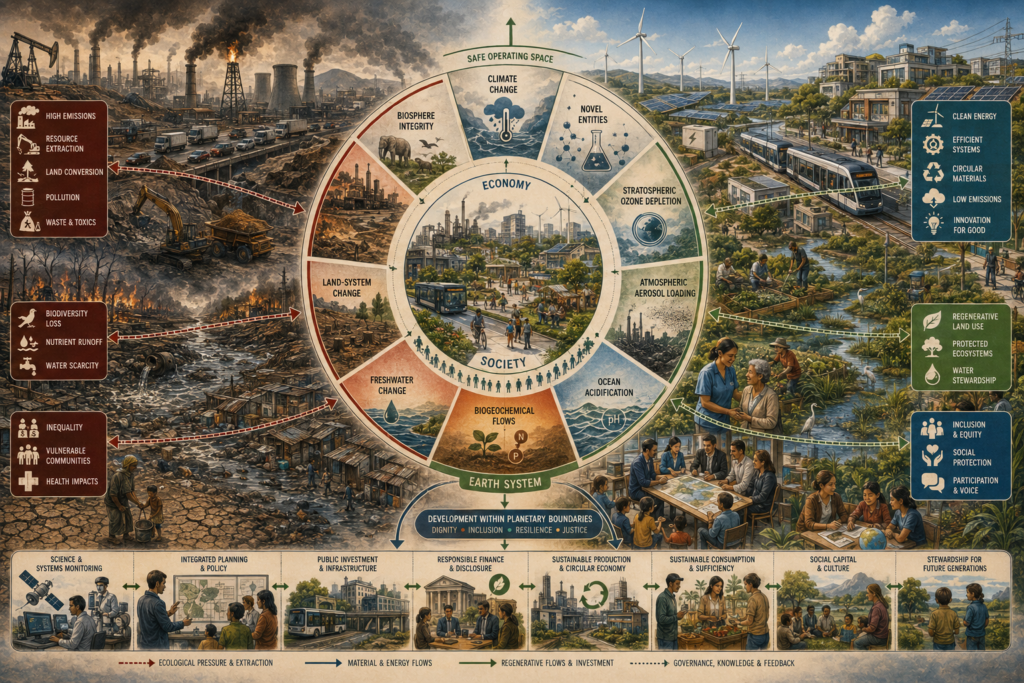
Editorial systems illustration showing the economy nested within society and Earth-system limits, with planetary boundaries, safe operating space, overshoot, resource use, ecological pressure, and boundary-aware governance.

Economic Systems Within Planetary Boundaries

Economic systems within planetary boundaries examines how economies must be governed as subsystems of the Earth system rather than as autonomous engines of unlimited expansion. This article explores the planetary boundaries framework as a way of identifying the safe operating space within which human societies can preserve the ecological conditions that support civilization, and it considers what that means for production, infrastructure, finance, public policy, development, and resource use. It addresses growth, material throughput, overshoot, energy-food-land-water interdependence, justice, state capacity, transition institutions, finance, and boundary-aware measurement. Within sustainable systems, the deeper issue is whether economic life can be reorganized to remain compatible with Earth-system resilience while still supporting dignity, inclusion, and long-run collective flourishing.

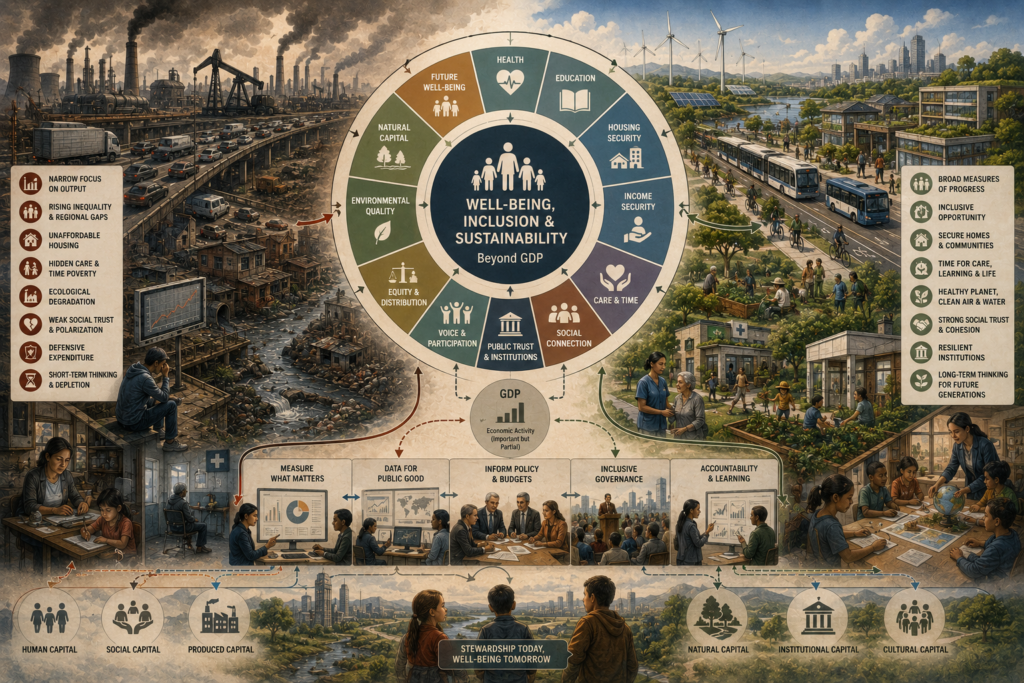
Editorial systems illustration showing a beyond-GDP framework for measuring well-being, inclusion, sustainability, health, education, housing security, care, public trust, natural capital, and future well-being.

Beyond GDP: Measuring Well-Being, Inclusion, and Sustainability

Beyond GDP: measuring well-being, inclusion, and sustainability is central to contemporary political economy because gross domestic product was never designed to capture the full quality of collective life. This article examines GDP as a measure of aggregate economic activity, while showing why it cannot adequately register health, security, care, inequality, ecological stability, social trust, or the long-term conditions of future wellbeing. It explores well-being, inclusion, distribution, sustainability, capability, subjective experience, households and care, natural capital, composite indices, human development, inclusive wealth, the SDGs, and the politics of measurement. Within sustainable systems, the deeper issue is whether societies can build richer frameworks of public evaluation that measure what they genuinely value rather than allowing market output alone to dominate how progress is understood and governed.

Scroll to Top