
Last Updated May 8, 2026
Compound climate events and cascading social risk reveal why climate disruption cannot be understood one hazard at a time. Heat, drought, flood, wildfire, storm surge, crop stress, water scarcity, energy strain, smoke exposure, disease risk, transport disruption, and food-price instability increasingly interact across social, ecological, infrastructural, and institutional systems. A heatwave may coincide with drought and grid stress. Wildfire may be followed by flooding and water contamination. Heavy rainfall may combine with storm surge and river flooding. Drought may interact with crop failure, debt, migration pressure, and public-health strain. These are not separate crises lined up neatly in sequence. They are interacting pressures moving through vulnerable systems.
Compound climate events matter because they expose the limits of single-hazard planning. A community may be prepared for flooding but not for flooding during a heatwave. A health system may manage seasonal respiratory illness but not wildfire smoke during a power outage. A food system may absorb a local crop loss but not simultaneous drought, logistics disruption, price volatility, and household income loss. The social consequences of compound events are therefore shaped not only by the physical hazards themselves, but by exposure, vulnerability, infrastructure fragility, cross-sector dependency, public capacity, ecological buffers, and inequality.
Main Library
Publications
Article Map
Risk & Resilience
Related Topic
Sustainable Development
Related Topic
Planetary Boundaries
Related Topic
Systems Thinking
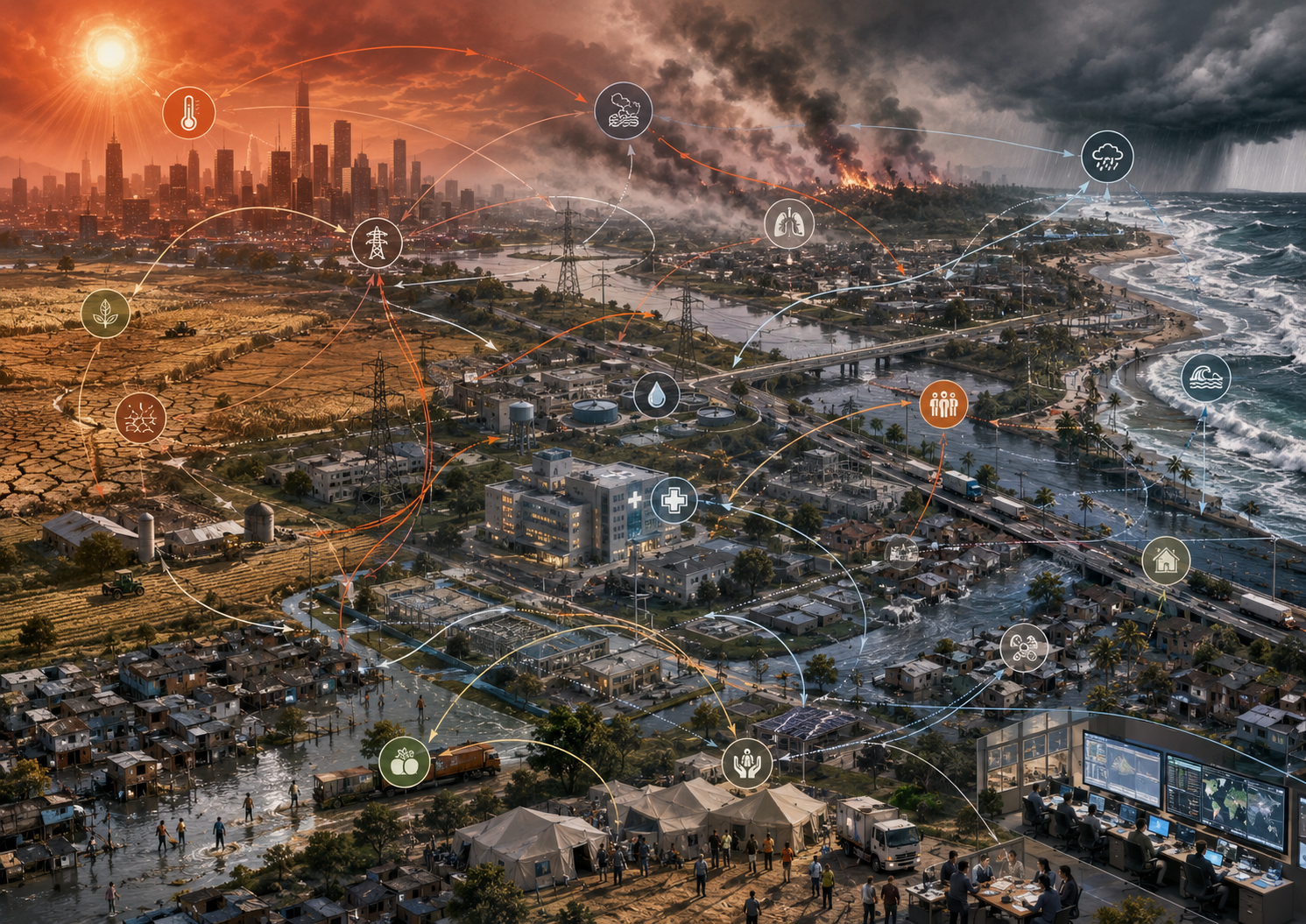
This article builds on Climate Risk and Systemic Vulnerability by examining what happens when climate hazards overlap, interact, or occur in close sequence. It also connects closely with Cascading Failures in Interdependent Systems, because compound climate events become socially dangerous when they move through interdependent systems that transmit harm across infrastructure, health, food, water, energy, finance, governance, and household life.
The central argument is that compound climate events are not simply “more bad weather.” They are multi-system stress tests. Their danger lies in interaction: one hazard weakens the capacity to respond to another; one sector’s disruption becomes another sector’s crisis; one community’s exposure becomes a broader social, fiscal, health, or governance problem. Cascading social risk emerges when compound hazards encounter systems already shaped by inequality, fragile infrastructure, underfunded public services, degraded ecosystems, weak recovery capacity, and uneven political voice.
Why Compound Climate Events Matter
Compound climate events matter because many of the most serious climate risks emerge from interaction rather than from isolated hazard intensity alone. A single hazard can be damaging, but multiple hazards occurring together, in sequence, or across connected regions can overwhelm systems that might otherwise cope. Heat during drought affects water demand, soil moisture, labor capacity, wildfire risk, electricity demand, and public health at once. Flooding after wildfire can destabilize slopes, contaminate water, and damage already weakened communities. Storm surge combined with heavy rainfall can overwhelm drainage systems designed for one hazard but not both.
This changes the meaning of preparedness. Emergency plans built around one event type may fail when several hazards overlap. Heat shelters may be inaccessible if transport is disrupted. Evacuation may become dangerous if flooding blocks routes. Hospitals may face heat illness, smoke exposure, power instability, and supply disruption simultaneously. Food assistance may become more difficult if crop failure, price spikes, road damage, and household income loss occur together.
Compound events also matter because they compress time. Recovery from one hazard may not be complete before the next arrives. A community recovering from flood damage may face heat, disease risk, debt, mold exposure, school disruption, and lost work before housing and infrastructure are restored. When events arrive in close sequence, resilience is not simply about whether a system can recover eventually. It is about whether it has enough reserve capacity to respond while still recovering from previous stress.
The deeper issue is that compound climate events reveal hidden fragility. They show whether social protection systems can scale, whether public-health systems have surge capacity, whether infrastructure can fail safely, whether ecological buffers still work, whether communication systems reach vulnerable groups, and whether recovery programs protect people rather than merely restore assets.
What Compound Climate Events Are
Compound climate events occur when multiple climate-related hazards or drivers combine in ways that produce impacts greater than, different from, or harder to manage than the impacts of each hazard alone. They may happen at the same time, such as heat and drought; in close sequence, such as wildfire followed by flooding; or across connected locations, such as simultaneous crop failures in multiple breadbasket regions. They may also emerge when a climate hazard interacts with non-climate stressors such as poverty, conflict, debt, public-health strain, cyber disruption, supply-chain failure, or institutional instability.
The concept is important because it moves climate-risk analysis beyond one-hazard-at-a-time thinking. A flood model may be useful, but flood risk changes when heavy rainfall coincides with storm surge, saturated soils, failed drainage, disrupted evacuation, and limited shelter. A drought model may be useful, but drought risk changes when it interacts with heat, hydropower loss, food prices, groundwater depletion, labor precarity, and household debt. Compound risk is relational.
Compound events are not merely additive. Their effects can be nonlinear because hazards and social systems interact. Heat can worsen drought impacts by increasing water demand and plant stress. Drought can worsen wildfire risk. Wildfire can worsen flood risk by damaging vegetation and soils. Flooding can worsen disease risk. Power outages can worsen heat mortality. Food price shocks can worsen malnutrition and social instability. In each case, one pressure changes the conditions under which the next pressure is experienced.
This is why compound climate events are especially important for sustainable systems. They reveal whether systems have enough redundancy, modularity, public capacity, ecological buffering, and social protection to withstand multiple stresses. A system designed for average conditions may appear resilient until interacting hazards expose the narrowness of its margin.
What Cascading Social Risk Means
Cascading social risk refers to the spread of harm from an initial climate event or compound hazard into wider social systems. The initial stress may be physical, such as heat, flood, drought, wildfire, or storm. But the consequences can move through employment, health, housing, food access, education, migration, debt, public finance, social trust, and governance.
A drought may begin as a hydrological event, but it can cascade into crop loss, income decline, food insecurity, debt, migration, school withdrawal, nutritional stress, and conflict over scarce resources. A flood may begin as a water event, but it can cascade into housing loss, disease exposure, transport failure, missed wages, interrupted healthcare, public-budget strain, and long-term displacement. A heatwave may begin as a temperature event, but it can cascade into power instability, health emergencies, outdoor labor losses, school closures, water demand spikes, and mortality among people without cooling access.
Cascading social risk is not automatic. It depends on vulnerability, infrastructure, governance, and social protection. If institutions anticipate risk, warnings are trusted, infrastructure has redundancy, ecosystems buffer hazards, households have income support, and recovery systems are accessible, cascading social harm can be reduced. If those capacities are weak, the same physical event can become a much larger social crisis.
This concept matters because disasters are often measured too narrowly. Direct physical damage is only one part of harm. Social cascades may continue long after the event: debt, displacement, trauma, illness, educational interruption, lost livelihoods, degraded trust, and weakened local economies. A risk framework that ignores these social pathways will underestimate the true consequences of compound climate events.
Concurrent, Sequential, and Spatially Connected Hazards
Compound climate events can take several forms. Concurrent hazards occur at the same time. Heat and drought are a common example because they reinforce one another through soil moisture loss, water demand, plant stress, fire weather, hydropower strain, and health risk. Heavy rainfall and storm surge can combine to produce compound flooding. Heat, wildfire smoke, and power outages can converge into a public-health emergency.
Sequential hazards occur in close succession. A drought may be followed by wildfire. Wildfire may be followed by heavy rain and landslide risk. Flooding may be followed by heat, mold, disease exposure, and displacement. A storm may damage infrastructure just before another hazard arrives. Sequential events are dangerous because recovery from the first event may be incomplete when the second arrives.
Spatially connected hazards occur across multiple places whose systems are linked. Simultaneous drought in several agricultural regions can affect global food prices. Flooding in a logistics hub can affect supply chains far away. Heat stress across interconnected energy markets can strain electricity systems beyond one locality. Climate hazards increasingly travel through economic, infrastructural, and political networks.
There are also compound socio-climatic events, where climate hazards interact with non-climate crises. A flood during conflict, a heatwave during a pandemic, a drought during debt crisis, or wildfire smoke during hospital staffing shortages can create risks that cannot be understood from climate data alone. The social context changes the hazard’s consequences.
A serious resilience framework must therefore ask not only what hazard is likely, but what hazards may overlap, what systems may already be weakened, what recovery is still unfinished, and what dependencies might carry harm outward.
How Compound Events Become Social Crises
Compound events become social crises when physical hazards interact with unequal vulnerability and weak continuity capacity. The same compound hazard may produce very different outcomes depending on housing, public health, infrastructure, income, mobility, trust, legal status, ecological buffers, and institutional readiness.
The pathway often begins with direct disruption. Heat affects bodies, buildings, power demand, water demand, and labor. Flooding affects homes, roads, sanitation, schools, hospitals, and businesses. Drought affects crops, livestock, water systems, energy, and household income. Wildfire affects air quality, housing, insurance, forests, health, and evacuation. These direct effects then travel through systems that people depend on daily.
The next pathway is functional loss. When transport fails, people lose access to work, food, healthcare, school, and emergency services. When power fails, cooling, refrigeration, communications, water pumping, medical devices, and digital payments may fail. When water systems fail, sanitation, hygiene, food preparation, healthcare, and industry are affected. When health systems are strained, routine care and emergency response both weaken.
The third pathway is social amplification. Households with savings can absorb temporary disruption more easily than households living paycheck to paycheck. People with secure housing can recover differently from renters, informal settlers, unhoused people, or people without legal protection. Communities with strong public services can recover differently from communities already experiencing neglect. Compound events therefore widen existing inequalities unless public systems deliberately counteract that tendency.
The final pathway is institutional strain. Public agencies may face multiple emergencies at once, with limited staff, budget, data, communication capacity, and political trust. When institutions cannot coordinate across hazards and sectors, risk moves faster than response. Cascading social risk is therefore not simply a failure of physical systems. It is a failure of continuity, coordination, and protection.
Infrastructure, Health, Food, Water, and Energy
Compound climate events are especially dangerous where critical systems are tightly connected. Infrastructure, health, food, water, and energy do not operate independently. They support one another continuously, which means stress in one system can quickly become stress in others.
Energy systems are central. Heat increases electricity demand for cooling, while drought can reduce hydropower, constrain thermal power cooling, or increase wildfire risk to transmission infrastructure. Power outages during heatwaves can become lethal. Water systems depend on electricity for pumping, treatment, and distribution. Hospitals depend on electricity, water, staff, transport, communications, and supply chains. Food systems depend on water, energy, labor, transport, storage, and markets.
Public health is also central. Compound events create overlapping health burdens: heat illness, respiratory effects from smoke, waterborne disease after flooding, mental-health stress after displacement, malnutrition after food shocks, injury during storms, and interrupted care for chronic illness. Health systems may be expected to absorb these burdens while facing their own infrastructure and staffing disruptions.
Food-water-energy systems are particularly vulnerable to compounding. Drought can reduce crop yields and water availability. Heat can reduce labor productivity and increase energy demand. Floods can destroy stored food or disrupt transport. Energy costs can affect irrigation, refrigeration, fertilizer, and household food access. A climate event that begins in one domain can therefore create a chain of affordability, availability, health, and livelihood problems.
The resilience challenge is not simply to strengthen each sector separately. It is to understand how continuity depends on relationships among sectors. Compound-risk planning must identify critical interdependencies, preserve backup capacity, strengthen ecological buffers, protect vulnerable households, and ensure that health, food, water, energy, and transport systems can still support one another under stress.
Inequality and the Geography of Compounding Risk
Compound climate events do not affect all communities equally. They often concentrate harm where exposure, vulnerability, and weak recovery capacity already overlap. Low-income communities, informal settlements, racialized communities, Indigenous communities, migrants, outdoor workers, older adults, children, people with disabilities, people with chronic illness, and people without secure housing may experience compound events as layered crises rather than temporary disruptions.
Inequality shapes both exposure and recovery. Some communities live in hotter neighborhoods with less tree canopy, weaker housing, fewer cooling options, and greater outdoor labor exposure. Some live in flood-prone areas because housing markets and historical exclusion leave few alternatives. Some lack insurance, savings, legal documentation, political voice, or access to recovery programs. Some are repeatedly exposed to hazards because relocation, adaptation, and public investment are unequally distributed.
The geography of compounding risk is therefore not natural. It is produced by land-use decisions, infrastructure investment, historical exclusion, labor systems, housing markets, colonial and racialized geographies, fiscal capacity, and political priorities. Climate hazards intensify these patterns, but they do not create them from nothing.
Recovery can also deepen inequality. After disasters, property values, insurance access, debt burdens, displacement, rebuilding rules, and public investment can reshape communities. If recovery is not justice-centered, compound events can become engines of displacement and dispossession. A neighborhood may be physically rebuilt while its former residents cannot return. A region may recover economically while vulnerable households remain indebted, displaced, or unhealthy.
A serious resilience framework must therefore evaluate compound events through distributional questions. Who is exposed to multiple hazards? Who lacks backup options? Who receives warnings? Who can evacuate? Who can shelter safely? Who can miss work? Who can recover losses? Who participates in adaptation decisions? Who is protected by resilience investments, and who is left outside them?
Governance, Early Warning, and Continuity
Governance is one of the main differences between a compound event and a cascading social crisis. The same physical hazards can produce less harm when institutions are prepared, warnings are trusted, communication is accessible, public agencies coordinate, social protection reaches exposed people, and recovery systems are ready before the event.
Early warning systems must be multi-hazard. Warning people about heat while ignoring smoke, power outages, water stress, transportation barriers, or medical vulnerability is not enough. A good warning system tells people what is happening, what may happen next, who is at risk, what services are available, how to act, and how to receive help. It must reach people across language, disability, age, legal status, digital access, and social trust barriers.
Continuity planning must also be multi-sector. Public agencies need to know how health, food, water, energy, transport, communications, schools, shelters, and social services depend on one another. They need backup plans for staffing, fuel, medical supplies, water distribution, cooling centers, evacuation routes, emergency cash, food access, and communication channels. They need protocols for compound events that do not fit single-agency responsibilities.
Governance must also be adaptive. Compound risk evolves as hazards interact and as systems weaken or recover. Static plans may fail when conditions change. Institutions need monitoring, scenario planning, decision triggers, public communication, and mechanisms for learning after events. They also need legitimacy. People are more likely to follow guidance when institutions are trusted, transparent, responsive, and accountable.
The goal is not simply emergency response. It is continuity of essential functions under compound stress. That includes keeping people alive, housed, fed, cooled, hydrated, informed, cared for, connected, and protected from long-term harm.
Toward Compound-Risk Resilience
Compound-risk resilience requires moving beyond single-hazard adaptation. It requires planning for overlapping hazards, interacting systems, uneven vulnerability, and cascading consequences. The question is not only whether a community can withstand a flood, heatwave, drought, or wildfire. It is whether it can preserve essential functions when hazards combine, when systems are already strained, and when recovery from previous events is incomplete.
First, compound-risk resilience requires multi-hazard analysis. Planners need to examine which hazards are likely to co-occur, follow one another, or interact through shared drivers. Heat and drought, wildfire and flood, storm surge and rainfall, drought and food insecurity, heat and power outages, and flood and disease risk should be analyzed as connected patterns rather than separate files.
Second, it requires dependency mapping. Critical systems should be mapped not only as assets, but as relationships. Which services depend on power? Which depend on roads? Which depend on water? Which depend on digital systems? Which depend on staff who may themselves be affected by the hazard? Dependency mapping helps reveal where compound events could become cascades.
Third, it requires justice-centered social protection. Cash assistance, cooling access, food support, housing protection, healthcare continuity, worker protections, and recovery support are not secondary welfare concerns. They are part of resilience infrastructure. Without them, compound climate events push vulnerable households into long-term crisis.
Fourth, compound-risk resilience requires ecological restoration. Wetlands, forests, soils, watersheds, mangroves, reefs, tree canopy, and floodplains can reduce the severity of some compound impacts. Ecosystem buffers do not replace social protection or infrastructure, but they reduce pressure on both.
Finally, compound-risk resilience requires institutions capable of learning. Every event should improve understanding of dependencies, vulnerability, communication, recovery gaps, and adaptation limits. Resilience is not only about returning to normal. It is about refusing to reproduce the conditions that made the compound event socially catastrophic.
Mathematical Lens: Compound Climate Events and Cascading Social Risk
Compound climate events can be represented as relationships among concurrent hazards, sequential hazards, exposure, social vulnerability, infrastructure fragility, cross-sector dependency, governance readiness, ecological buffering, social protection, and recovery capacity. Let \(H_c\) represent concurrent hazard intensity, \(H_s\) represent sequential hazard pressure, \(E\) represent exposure, \(V\) represent social vulnerability, \(F\) represent infrastructure fragility, \(D\) represent cross-sector dependency, \(G\) represent governance readiness, \(B\) represent ecological buffer condition, \(P\) represent social protection capacity, \(R\) represent recovery deficit, and \(I\) represent inequality pressure.
A compound-event severity index can be written as:
C_r = c_1H_{c,r} + c_2H_{s,r} + c_3E_r
\]
Interpretation: Compound event severity rises when concurrent hazards, sequential hazard pressure, and exposure reinforce one another.
A social sensitivity index can be written as:
S_r = s_1V_r + s_2M_r + s_3W_r + s_4R_r + s_5I_r
\]
Interpretation: Social sensitivity rises when vulnerability, health-system strain, food-water-energy stress, recovery deficits, and inequality increase the likelihood of harm.
A system fragility index can be written as:
F^{sys}_r = f_1F_r + f_2D_r + f_3W_r + f_4R_r + f_5(1 – L_r)
\]
Interpretation: System fragility rises when infrastructure fragility, dependency, food-water-energy stress, recovery deficits, and weak communication make cascades more likely.
Cascade potential can then be represented as:
K_r = C_r(1 + \alpha F^{sys}_r)(1 + \beta D_r)(1 – \gamma Z_r)
\]
Interpretation: Cascade potential rises when compound event severity moves through fragile, dependent systems faster than resilience capacity can contain it.
Justice-weighted social risk can be written as:
J_r = \left(j_1K_r + j_2S_r + j_3R_r + j_4I_r\right)(1 + \theta I_r)
\]
Interpretation: Social risk becomes more urgent when cascade potential, sensitivity, recovery deficits, and inequality combine.
A continuity capacity score can be represented as:
Q_r = q_1G_r + q_2P_r + q_3L_r + q_4B_r + q_5(1 – F_r)
\]
Interpretation: Continuity capacity improves when governance, social protection, communication reliability, ecological buffers, and lower infrastructure fragility preserve essential functions.
The compound resilience gap can then be written as:
\Delta_r = \max(0, J_r – Q_r)
\]
Interpretation: A resilience gap appears when justice-weighted social risk exceeds the system’s capacity to preserve essential functions during compound events.
| Term | Meaning | Interpretive role |
|---|---|---|
| \(C_r\) | Compound event severity | Represents overlapping or sequential hazard pressure and exposure. |
| \(S_r\) | Social sensitivity | Represents vulnerability, health strain, food-water-energy stress, recovery deficit, and inequality. |
| \(F^{sys}_r\) | System fragility | Represents infrastructure fragility, dependency, resource stress, recovery deficits, and weak communication. |
| \(K_r\) | Cascade potential | Represents the likelihood that compound events spread across connected systems. |
| \(J_r\) | Justice-weighted social risk | Represents cascading harm adjusted for inequality and uneven recovery capacity. |
| \(Q_r\) | Continuity capacity | Represents governance, social protection, communication, ecological buffers, and infrastructure resilience. |
| \(\Delta_r\) | Compound resilience gap | Identifies where compound social risk exceeds continuity capacity. |
This mathematical lens is not meant to predict every compound event precisely. It clarifies the structure of analysis: compound events become socially dangerous when overlapping hazards interact with exposure, vulnerability, fragile infrastructure, system dependency, weak communication, poor recovery capacity, inequality, and insufficient continuity planning.
Advanced Python Workflow: Compound Climate Risk Diagnostics
The accompanying GitHub workflow models compound climate risk as an interaction among concurrent hazard intensity, sequential hazard pressure, exposure, social vulnerability, infrastructure fragility, health-system strain, food-water-energy stress, governance readiness, cross-sector dependency, recovery deficit, inequality pressure, ecological buffer condition, social protection capacity, and communication reliability.
from pathlib import Path
import numpy as np
import pandas as pd

BASE_DIR = Path("articles/compound-climate-events-cascading-social-risk")
DATA_FILE = BASE_DIR / "data" / "compound_climate_social_risk_panel.csv"
OUTPUT_DIR = BASE_DIR / "outputs"


def load_data():
    df = pd.read_csv(DATA_FILE)
    numeric_cols = [
        col for col in df.columns
        if col not in {"system_id", "system_name", "region", "event_type"}
    ]

    for col in numeric_cols:
        if ((df[col] < 0) | (df[col] > 1)).any():
            raise ValueError(f"{col} must be scaled between 0 and 1.")

    return df


def score_systems(df):
    s = df.copy()

    s["compound_event_severity"] = (
        0.42 * s["concurrent_hazard_intensity"]
        + 0.34 * s["sequential_hazard_pressure"]
        + 0.24 * s["exposure"]
    )

    s["social_sensitivity_index"] = (
        0.30 * s["social_vulnerability"]
        + 0.22 * s["health_system_strain"]
        + 0.20 * s["food_water_energy_stress"]
        + 0.16 * s["recovery_deficit"]
        + 0.12 * s["inequality_pressure"]
    )

    s["system_fragility_index"] = (
        0.30 * s["infrastructure_fragility"]
        + 0.28 * s["cross_sector_dependency"]
        + 0.18 * s["food_water_energy_stress"]
        + 0.14 * s["recovery_deficit"]
        + 0.10 * (1 - s["communication_reliability"])
    )

    s["resilience_capacity"] = (
        0.24 * s["governance_readiness"]
        + 0.22 * s["ecological_buffer_condition"]
        + 0.22 * s["social_protection_capacity"]
        + 0.18 * s["communication_reliability"]
        + 0.14 * (1 - s["recovery_deficit"])
    )

    s["cascade_potential"] = (
        s["compound_event_severity"]
        * (1 + 0.45 * s["system_fragility_index"])
        * (1 + 0.35 * s["cross_sector_dependency"])
        * (1 - 0.30 * s["resilience_capacity"])
    )

    s["justice_weighted_social_risk"] = (
        (
            0.38 * s["cascade_potential"]
            + 0.30 * s["social_sensitivity_index"]
            + 0.18 * s["recovery_deficit"]
            + 0.14 * s["inequality_pressure"]
        )
        * (1 + 0.35 * s["inequality_pressure"])
    )

    s["continuity_capacity"] = (
        0.28 * s["governance_readiness"]
        + 0.22 * s["social_protection_capacity"]
        + 0.20 * s["communication_reliability"]
        + 0.18 * s["ecological_buffer_condition"]
        + 0.12 * (1 - s["infrastructure_fragility"])
    )

    s["compound_resilience_gap"] = np.maximum(
        0,
        s["justice_weighted_social_risk"] - s["continuity_capacity"],
    )

    s["diagnostic_priority"] = np.select(
        [
            s["compound_event_severity"] > 0.76,
            s["cross_sector_dependency"] > 0.76,
            s["social_sensitivity_index"] > 0.72,
            s["governance_readiness"] < 0.45,
            s["ecological_buffer_condition"] < 0.40,
            s["compound_resilience_gap"] > 0.22,
        ],
        [
            "multi_hazard_preparedness",
            "cross_sector_dependency_mapping",
            "public_health_and_social_protection",
            "governance_and_warning_capacity",
            "restore_ecological_buffers",
            "close_compound_resilience_gap",
        ],
        default="monitor_and_strengthen_compound_resilience",
    )

    return s.sort_values(
        ["compound_resilience_gap", "justice_weighted_social_risk"],
        ascending=False,
    )


def main():
    OUTPUT_DIR.mkdir(parents=True, exist_ok=True)
    raw = load_data()
    scored = score_systems(raw)

    region_summary = (
        scored.groupby("region")
        .agg(
            systems=("system_id", "count"),
            mean_compound_event_severity=("compound_event_severity", "mean"),
            mean_cascade_potential=("cascade_potential", "mean"),
            mean_social_risk=("justice_weighted_social_risk", "mean"),
            mean_continuity_capacity=("continuity_capacity", "mean"),
            mean_resilience_gap=("compound_resilience_gap", "mean"),
        )
        .reset_index()
        .sort_values("mean_resilience_gap", ascending=False)
    )

    scored.to_csv(OUTPUT_DIR / "compound_climate_social_risk_scores.csv", index=False)
    region_summary.to_csv(OUTPUT_DIR / "compound_climate_social_risk_region_summary.csv", index=False)

    print(scored.round(3).to_string(index=False))
    print(region_summary.round(3).to_string(index=False))


if __name__ == "__main__":
    main()
This workflow operationalizes the article’s central claim: compound climate events become cascading social risk when overlapping hazards interact with social vulnerability, infrastructure fragility, health-system strain, food-water-energy stress, weak governance, dependency, recovery deficits, inequality, degraded ecological buffers, weak social protection, and unreliable communication.
Advanced R Workflow: Compound Risk Dashboarding
The accompanying R workflow creates dashboard-ready outputs for comparing compound event severity, social sensitivity, system fragility, cascade potential, justice-weighted social risk, continuity capacity, compound resilience gaps, regional summaries, event summaries, and long-format visualization data.
library(readr)
library(dplyr)
library(tidyr)

base_dir <- "articles/compound-climate-events-cascading-social-risk"
data_file <- file.path(base_dir, "data", "compound_climate_social_risk_panel.csv")
output_dir <- file.path(base_dir, "outputs")

dir.create(output_dir, recursive = TRUE, showWarnings = FALSE)

systems <- read_csv(data_file, show_col_types = FALSE)

score_systems <- function(df) {
  df %>%
    mutate(
      compound_event_severity =
        0.42 * concurrent_hazard_intensity +
        0.34 * sequential_hazard_pressure +
        0.24 * exposure,

      social_sensitivity_index =
        0.30 * social_vulnerability +
        0.22 * health_system_strain +
        0.20 * food_water_energy_stress +
        0.16 * recovery_deficit +
        0.12 * inequality_pressure,

      system_fragility_index =
        0.30 * infrastructure_fragility +
        0.28 * cross_sector_dependency +
        0.18 * food_water_energy_stress +
        0.14 * recovery_deficit +
        0.10 * (1 - communication_reliability),

      resilience_capacity =
        0.24 * governance_readiness +
        0.22 * ecological_buffer_condition +
        0.22 * social_protection_capacity +
        0.18 * communication_reliability +
        0.14 * (1 - recovery_deficit),

      cascade_potential =
        compound_event_severity *
        (1 + 0.45 * system_fragility_index) *
        (1 + 0.35 * cross_sector_dependency) *
        (1 - 0.30 * resilience_capacity),

      justice_weighted_social_risk =
        (
          0.38 * cascade_potential +
          0.30 * social_sensitivity_index +
          0.18 * recovery_deficit +
          0.14 * inequality_pressure
        ) *
        (1 + 0.35 * inequality_pressure),

      continuity_capacity =
        0.28 * governance_readiness +
        0.22 * social_protection_capacity +
        0.20 * communication_reliability +
        0.18 * ecological_buffer_condition +
        0.12 * (1 - infrastructure_fragility),

      compound_resilience_gap =
        pmax(0, justice_weighted_social_risk - continuity_capacity)
    ) %>%
    arrange(desc(compound_resilience_gap), desc(justice_weighted_social_risk))
}

scored <- score_systems(systems)

region_summary <- scored %>%
  group_by(region) %>%
  summarise(
    systems = n(),
    mean_compound_event_severity = mean(compound_event_severity),
    mean_cascade_potential = mean(cascade_potential),
    mean_social_risk = mean(justice_weighted_social_risk),
    mean_continuity_capacity = mean(continuity_capacity),
    mean_resilience_gap = mean(compound_resilience_gap),
    .groups = "drop"
  ) %>%
  arrange(desc(mean_resilience_gap))

event_summary <- scored %>%
  group_by(event_type) %>%
  summarise(
    systems = n(),
    mean_compound_event_severity = mean(compound_event_severity),
    mean_system_fragility = mean(system_fragility_index),
    mean_cascade_potential = mean(cascade_potential),
    mean_resilience_gap = mean(compound_resilience_gap),
    .groups = "drop"
  ) %>%
  arrange(desc(mean_resilience_gap))

dashboard_long <- scored %>%
  select(
    system_id,
    system_name,
    region,
    event_type,
    compound_event_severity,
    social_sensitivity_index,
    system_fragility_index,
    cascade_potential,
    justice_weighted_social_risk,
    continuity_capacity,
    compound_resilience_gap
  ) %>%
  pivot_longer(
    cols = c(
      compound_event_severity,
      social_sensitivity_index,
      system_fragility_index,
      cascade_potential,
      justice_weighted_social_risk,
      continuity_capacity,
      compound_resilience_gap
    ),
    names_to = "metric",
    values_to = "value"
  )

write_csv(scored, file.path(output_dir, "r_compound_climate_social_risk_scores.csv"))
write_csv(region_summary, file.path(output_dir, "r_region_summary.csv"))
write_csv(event_summary, file.path(output_dir, "r_event_summary.csv"))
write_csv(dashboard_long, file.path(output_dir, "r_dashboard_long.csv"))

print(scored)
print(region_summary)
print(event_summary)
The R workflow complements the Python workflow by producing dashboard-oriented outputs. It is especially useful for comparing regional compound-risk conditions, event-type profiles, cross-sector fragility, cascading social risk, and continuity gaps. A production version could connect to hazard layers, public-health records, outage data, food-price indicators, water-system stress, wildfire smoke exposure, floodplain maps, emergency response records, social vulnerability data, and recovery program outcomes.
Engineering Extensions in the GitHub Repository
The accompanying repository extends the article beyond conceptual explanation into reproducible systems analysis. The article folder is designed around a synthetic compound-risk indicator panel, advanced Python diagnostics, advanced R dashboarding, SQL schema scaffolding, scenario outputs, uncertainty analysis, documentation, and extensible scoring logic.
The article body foregrounds Python and R because they are accessible languages for data analysis, scenario modeling, uncertainty analysis, and dashboard preparation. Additional languages can strengthen the repository where they serve a real analytical purpose. SQL can support structured compound-event records, hazard metadata, exposure indicators, vulnerability attributes, cascade pathways, source provenance, and auditability. Go can support lightweight scoring services. Rust can support reliable command-line validation tools. C and C++ can support compact numerical kernels for compound event severity and cascading social risk. Fortran can support numerical continuity-gap calculations and legacy scientific-computing workflows where useful.
The deeper purpose of the repository is not to turn compound social risk into false precision. It is to make assumptions visible. By separating concurrent hazards, sequential hazard pressure, exposure, social vulnerability, infrastructure fragility, health-system strain, food-water-energy stress, governance readiness, dependency, recovery deficit, inequality, ecological buffers, social protection, and communication reliability, the workflow allows users to inspect how final interpretations are produced.
GitHub Repository
Complete Code Repository
The full code directory for this article, including advanced Python diagnostics, advanced R dashboard workflow, synthetic compound-climate-event data, SQL schema, scenario outputs, uncertainty analysis, documentation, and systems-level extensions, is available on GitHub.
Common Misunderstandings
A common misunderstanding is that compound events are simply multiple hazards listed together. The issue is interaction: hazards can reinforce one another, weaken response capacity, and produce consequences greater than separate analysis would suggest.
Another misunderstanding is that cascading social risk is secondary to physical hazard. In many disasters, social cascades such as displacement, debt, illness, food insecurity, interrupted schooling, lost wages, and weakened trust become the long-term harm.
A third misunderstanding is that single-hazard preparedness is enough. Compound events can overwhelm plans designed for one hazard at a time.
A fourth misunderstanding is that infrastructure resilience alone solves compound risk. Infrastructure matters, but public health, social protection, communication, ecological buffers, and governance determine whether physical disruption becomes social crisis.
A fifth misunderstanding is that compound climate risk is rare. Compound risk is increasingly central to climate adaptation because hazards, infrastructure dependencies, and social vulnerabilities interact across sectors and scales.
A final misunderstanding is that resilience means returning to normal. If normal conditions produced exposure, vulnerability, and weak recovery capacity, returning to normal reproduces the next cascade.
Conclusion
Compound climate events and cascading social risk show why climate resilience cannot be built one hazard, one sector, or one emergency plan at a time. Heat, drought, flood, wildfire, storm surge, smoke, food stress, water scarcity, power instability, disease risk, and infrastructure disruption increasingly interact. Their social consequences depend on the systems they encounter: housing, health, transport, food, energy, water, communications, public finance, ecological buffers, social protection, and institutional trust.
The central lesson is that climate hazards become most dangerous when they overlap with pre-existing vulnerability and interdependence. Compound events expose whether public institutions can coordinate, whether warnings reach people, whether infrastructure can preserve essential functions, whether health systems can absorb surge, whether ecosystems buffer stress, whether households have recovery support, and whether adaptation protects those most exposed.
The computational workflows attached to this article extend that argument into practice. They separate compound event severity, social sensitivity, system fragility, cascade potential, justice-weighted social risk, continuity capacity, and compound resilience gaps. They show why some systems require multi-hazard preparedness, some require cross-sector dependency mapping, some require public-health and social-protection capacity, some require ecological restoration, and some require justice-centered climate resilience.
Climate resilience in a compound-risk world means preserving essential functions under overlapping stress while reducing the structural conditions that allow one hazard to become many forms of social harm.
Return to the Risk & Resilience knowledge series.
Related Reading
- Risk & Resilience
- Climate Risk and Systemic Vulnerability
- Cascading Failures in Interdependent Systems
- Vulnerability, Exposure, and Sensitivity
- Water Security, Drought, Flood, and Resilience
- Food System Fragility and Resilience
- Ecosystem Resilience and Natural Buffers
- Nature-Based Solutions, Ecosystem Buffers, and Resilience
- Planetary Boundaries and Earth System Resilience
- Sustainable Development
- Planetary Boundaries
- Systems Thinking
Further Reading
- Intergovernmental Panel on Climate Change (2021) Climate Change 2021: The Physical Science Basis. Available at: https://www.ipcc.ch/report/ar6/wg1/.
- Intergovernmental Panel on Climate Change (2022) Climate Change 2022: Impacts, Adaptation and Vulnerability. Available at: https://www.ipcc.ch/report/ar6/wg2/.
- Intergovernmental Panel on Climate Change (2022) Annex II: Glossary. Available at: https://www.ipcc.ch/report/ar6/wg2/downloads/report/IPCC_AR6_WGII_Annex-II.pdf.
- National Academies of Sciences, Engineering, and Medicine (2022) Resilience for Compounding and Cascading Events. Available at: https://www.nationalacademies.org/read/26659/chapter/3.
- United Nations Office for Disaster Risk Reduction (2022) Scoping Study on Compound, Cascading and Systemic Risks in Asia-Pacific. Available at: https://www.undrr.org/publication/scoping-study-compound-cascading-and-systemic-risks-asia-pacific.
- United Nations Office for Disaster Risk Reduction (2022) Briefing Note on Systemic Risk. Available at: https://www.undrr.org/publication/briefing-note-systemic-risk.
- United Nations Office for Disaster Risk Reduction (2019) Global Assessment Report on Disaster Risk Reduction 2019. Available at: https://gar.undrr.org/.
References
- Intergovernmental Panel on Climate Change (2021) Climate Change 2021: The Physical Science Basis. Available at: https://www.ipcc.ch/report/ar6/wg1/.
- Intergovernmental Panel on Climate Change (2022) Climate Change 2022: Impacts, Adaptation and Vulnerability. Available at: https://www.ipcc.ch/report/ar6/wg2/.
- Intergovernmental Panel on Climate Change (2022) Annex II: Glossary. Available at: https://www.ipcc.ch/report/ar6/wg2/downloads/report/IPCC_AR6_WGII_Annex-II.pdf.
- National Academies of Sciences, Engineering, and Medicine (2022) Resilience for Compounding and Cascading Events. Washington, DC: National Academies Press. Available at: https://www.nationalacademies.org/read/26659/chapter/3.
- United Nations Office for Disaster Risk Reduction (2022) Scoping Study on Compound, Cascading and Systemic Risks in Asia-Pacific. Available at: https://www.undrr.org/publication/scoping-study-compound-cascading-and-systemic-risks-asia-pacific.
- United Nations Office for Disaster Risk Reduction (2022) Briefing Note on Systemic Risk. Available at: https://www.undrr.org/publication/briefing-note-systemic-risk.
- United Nations Office for Disaster Risk Reduction (2019) Global Assessment Report on Disaster Risk Reduction 2019. Available at: https://gar.undrr.org/.