
Last Updated May 8, 2026
Social vulnerability and risk distribution are central to resilience because hazards do not become disasters evenly. Floods, heatwaves, droughts, storms, fires, disease outbreaks, infrastructure failures, food shocks, and economic disruptions move through societies that are already structured by unequal housing, income, health, mobility, political power, public services, exposure, recovery capacity, environmental burdens, and historical injustice. Risk is not simply where a hazard occurs. It is also who is exposed, who is protected, who can leave, who can recover, who is believed, who receives public investment, and who is repeatedly asked to absorb loss.
Social vulnerability is therefore not a label for weakness in people. It is a way of describing the social, economic, political, spatial, environmental, and institutional conditions that make some people and communities more likely to be harmed by hazards and less able to recover afterward. Vulnerability is produced through systems: housing markets, labor markets, infrastructure decisions, healthcare access, environmental racism, disability exclusion, language barriers, age, legal status, debt, segregation, land dispossession, underinvestment, insurance access, and unequal political voice.
Main Library
Publications
Article Map
Risk & Resilience
Related Topic
Sustainable Development
Related Topic
Planetary Boundaries
Related Topic
Systems Thinking
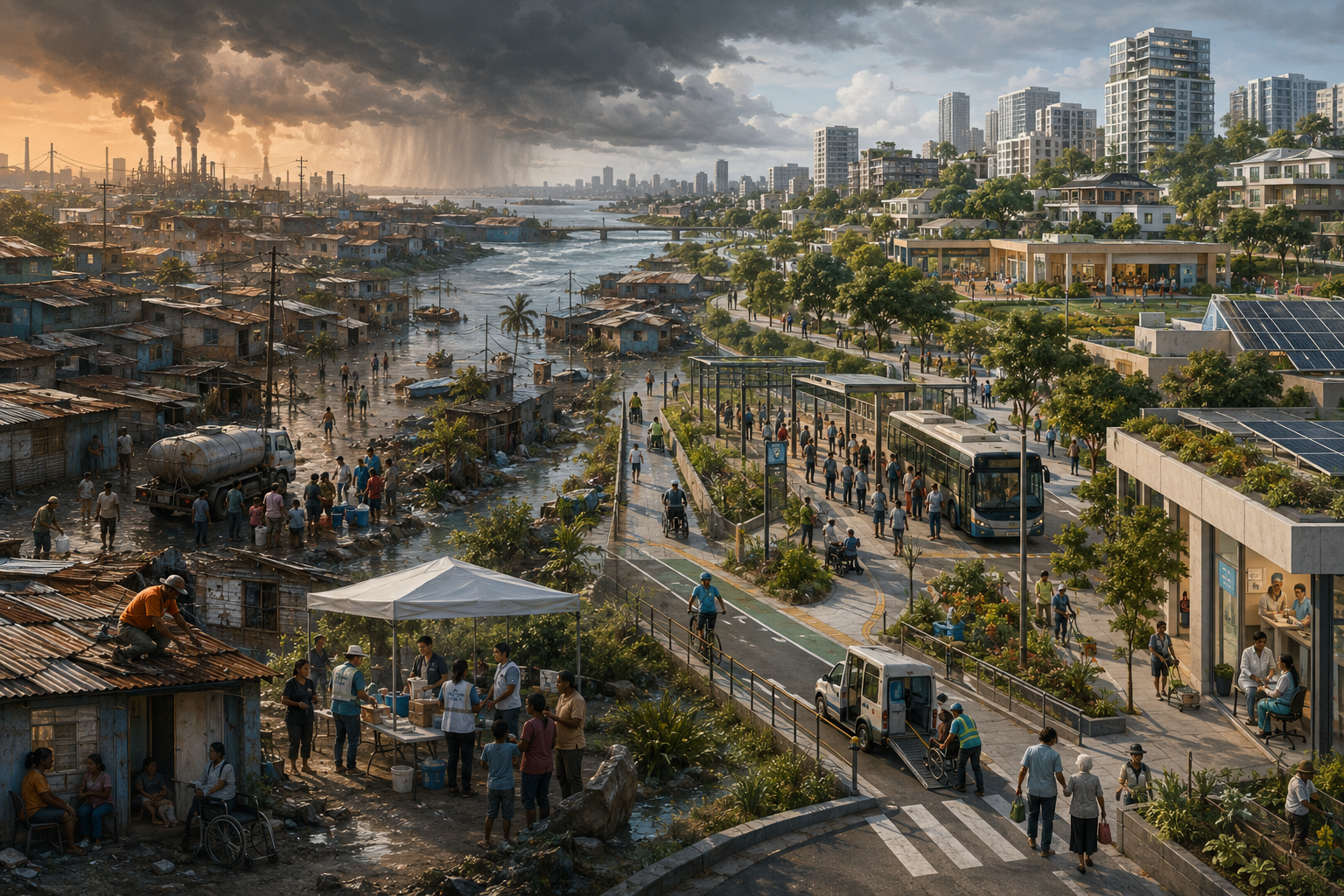
This article builds on What Is Risk and Resilience in Sustainable Systems? by focusing on the unequal distribution of risk across people, places, institutions, and lifelines. It connects closely with Climate Risk and Systemic Vulnerability, Compound Climate Events and Cascading Social Risk, Water Security, Drought, Flood, and Resilience, and Food System Fragility and Resilience, because climate, water, food, health, infrastructure, and ecological risks are distributed through social systems rather than experienced uniformly.
The central argument is that resilience cannot be understood without distribution. A city may be “resilient” in aggregate while certain neighborhoods repeatedly flood, overheat, lose power, experience higher mortality, receive slower recovery assistance, or face displacement after rebuilding. A region may recover economically while households with fewer resources remain indebted, sick, displaced, uninsured, or excluded. A serious resilience framework must therefore ask not only how much risk exists, but where it is concentrated, who carries it, who benefits from protection, and how institutions decide whose safety matters.
Why Social Vulnerability Matters
Social vulnerability matters because disasters reveal social structure. A hazard may be physical, but the pattern of harm is social. Heat does not affect all bodies and households equally. Flooding does not damage all neighborhoods equally. Wildfire smoke does not create the same exposure for people who can seal, filter, relocate, or work indoors as it does for outdoor workers, unhoused people, older adults, children, and people with respiratory illness. A power outage is not the same event for someone with savings, transportation, backup cooling, and medical stability as it is for someone dependent on electrically powered medical equipment, refrigeration for medication, or public transit.
This does not mean hazards are unimportant. It means hazards become disasters through interaction with exposure, vulnerability, and capacity. A storm, fire, drought, or heatwave becomes more dangerous where people are located in harm’s way, where infrastructure is weak, where housing is insecure, where health burdens are high, where services are inaccessible, and where recovery resources are unequal. The same hazard can produce different outcomes because social systems distribute protection unevenly.
Social vulnerability also matters because it exposes the limits of aggregate metrics. A region’s average income, average recovery rate, or average infrastructure condition can hide deep inequalities. A city may report restored power while medically vulnerable residents remain unsafe. A recovery program may show large total spending while renters, informal workers, undocumented residents, unhoused people, disabled residents, or low-income households receive little support. A flood map may identify physical exposure while missing who lacks insurance, transportation, savings, political power, or legal protection.
Resilience that ignores social vulnerability can unintentionally deepen inequality. Infrastructure investment may protect high-value property while leaving vulnerable communities exposed. Buyout programs may enable relocation for some while displacing others from social networks and cultural ties. Green infrastructure may reduce heat while accelerating gentrification. Insurance and rebuilding policies may reward property ownership while excluding renters. Disaster recovery may rebuild assets without repairing social harm.
A serious resilience framework must therefore evaluate risk as distributed. It asks who is harmed first, who is harmed most, who recovers last, who pays repeatedly, and who participates in decisions about protection. Social vulnerability is not a side issue. It is one of the main determinants of whether stress becomes catastrophe.
What Social Vulnerability Means
Social vulnerability refers to the conditions that increase the susceptibility of people, communities, assets, or systems to harm from hazards. These conditions may be economic, social, political, institutional, environmental, spatial, physical, or cultural. They include poverty, income instability, insecure housing, disability exclusion, age, chronic illness, lack of transportation, language barriers, discrimination, social isolation, legal precarity, inadequate healthcare, weak infrastructure, environmental exposure, and limited access to recovery resources.
The term should be used carefully. Vulnerability does not mean that people are inherently fragile, passive, or incapable. Communities described as vulnerable often possess deep knowledge, mutual aid networks, cultural strength, local leadership, and survival practices developed under conditions of neglect or exclusion. The vulnerability lies not in the dignity or capacity of people, but in the unequal conditions that expose them to harm and restrict their options.
Social vulnerability is also relational. A person may be more vulnerable to one hazard than another depending on context. An older adult living alone without cooling access may be highly vulnerable to heat, but not necessarily to every risk. A household without a car may face evacuation barriers during wildfire or flood, but those barriers depend on transit availability, shelter location, warning systems, and public support. Vulnerability is therefore not a fixed identity. It is produced by the relationship between people, hazards, infrastructure, institutions, and resources.
Vulnerability is also dynamic. It can change over time. A household can become more vulnerable after job loss, illness, rent increase, displacement, debt, or repeated disasters. A neighborhood can become more vulnerable after infrastructure disinvestment, insurance withdrawal, hospital closure, heat-island intensification, or loss of affordable housing. Conversely, vulnerability can be reduced through social protection, housing security, healthcare access, transportation, public investment, anti-displacement policy, inclusive planning, and community-led resilience.
This makes social vulnerability both analytical and ethical. Analytically, it helps explain why risk is distributed unequally. Ethically, it challenges institutions to reduce the conditions that produce unequal harm. It is not enough to map vulnerability. The purpose of mapping should be to change decisions.
Risk Is Distributed, Not Universal
Risk is often described as if it belongs to a whole city, region, sector, or country. But risk is distributed across space, class, race, disability, gender, age, housing status, labor status, citizenship status, health status, and political power. Two neighborhoods facing the same storm may experience different damage and recovery trajectories. Two households facing the same heatwave may face different mortality risk. Two workers facing the same smoke event may have different ability to stay indoors, use protective equipment, or avoid income loss.
Risk distribution has several dimensions. Physical distribution concerns where hazards occur: floodplains, heat islands, wildfire zones, coastal areas, industrial corridors, drought-prone regions, or poorly drained neighborhoods. Social distribution concerns who lives or works there and what resources they have. Institutional distribution concerns who receives protection, warning, services, insurance, evacuation support, rebuilding aid, and political attention. Temporal distribution concerns who experiences long-term harm after the visible emergency ends.
This is why resilience cannot be evaluated only by system restoration. A power grid may be restored at the system level, but households that lose refrigerated medicine, income, cooling, or medical equipment support may suffer lasting harm. A road may reopen, but workers who missed wages may still face debt. A school may resume, but displaced children may lose stability. A flood may recede, but mold, trauma, insurance denial, and housing instability may continue.
Risk distribution also reveals the difference between exposure and vulnerability. A wealthy coastal homeowner and a low-income renter may both be exposed to storm surge, but their recovery options differ. A city bus rider and a car owner may both receive an evacuation warning, but their ability to act differs. A homeowner and an informal resident may both experience flood damage, but one may be recognized by recovery systems while the other is excluded.
A justice-centered resilience framework therefore asks distributional questions at every stage: before, during, and after disaster. Who is exposed? Who is warned? Who can act? Who is protected? Who is displaced? Who receives aid? Who is denied? Who returns? Who accumulates debt? Who benefits from rebuilding? Who is expected to bear risk for the convenience or profit of others?
Exposure, Vulnerability, and Capacity
Risk emerges from interactions among hazard, exposure, vulnerability, and capacity. A hazard is a potentially damaging event or process. Exposure describes people, assets, infrastructure, ecosystems, or services located in harm’s way. Vulnerability describes the conditions that increase susceptibility to harm. Capacity describes the strengths, resources, institutions, networks, and abilities that help people anticipate, cope, adapt, respond, and recover.
These terms are sometimes blurred, but the distinctions matter. Exposure is about being in the path of harm. Vulnerability is about susceptibility once exposed. Capacity is about the ability to reduce harm or recover. A community can be highly exposed but less vulnerable if it has strong housing, services, warnings, transportation, public trust, savings, insurance, social protection, and inclusive planning. A community can be moderately exposed but highly vulnerable if it lacks those supports.
The interaction is crucial. A hazard without exposure may not produce disaster. Exposure without vulnerability may produce manageable disruption. Vulnerability without hazard may remain latent until stress arrives. Capacity can reduce risk, but only if it is accessible and legitimate. A cooling center does not reduce heat mortality for people who cannot reach it, do not know about it, fear authorities, cannot leave dependents, or cannot miss work. A flood warning does not reduce risk if people lack transportation, shelter, or trust in the warning system.
Social vulnerability analysis helps identify where exposure and weak capacity overlap. It can reveal neighborhoods where heat exposure, disability, age, poverty, language barriers, and low tree canopy combine. It can identify flood-exposed areas where renters, uninsured households, low-income workers, and people without vehicles face recovery barriers. It can show where healthcare access, transportation, housing quality, and infrastructure reliability shape disaster outcomes.
But vulnerability analysis must not become a technocratic exercise detached from lived reality. Communities are not variables alone. Local knowledge, mutual aid, faith institutions, neighborhood networks, cultural practices, and informal support systems often provide capacities that official indicators miss. Good vulnerability analysis combines data with participation, interpretation, and accountability.
Poverty, Housing, Health, and Mobility
Poverty is one of the most important drivers of vulnerability because it reduces options before, during, and after stress. Low-income households may have less savings, less insurance, less ability to relocate, less flexibility at work, poorer housing conditions, higher debt burdens, and fewer recovery resources. They may also spend a higher share of income on food, rent, energy, healthcare, and transportation, making shocks harder to absorb.
Housing is equally central. People living in older, poorly insulated, overcrowded, flood-prone, or substandard housing face greater risk during heat, cold, storms, floods, smoke, and disease outbreaks. Renters may lack control over repairs, cooling, weatherization, mold remediation, or relocation decisions. Unhoused people face extreme exposure to heat, cold, air pollution, flooding, violence, policing, and disease. Informal settlements may lack legal recognition, drainage, sanitation, water, electricity, and emergency access.
Health shapes vulnerability because hazards act on bodies. Chronic illness, disability, pregnancy, age, respiratory disease, cardiovascular conditions, mental-health burdens, medication dependence, and limited healthcare access all affect risk. A heatwave is more dangerous for people with certain medical conditions, people taking certain medications, people without cooling, and people who work outdoors. Flooding can interrupt dialysis, oxygen, refrigeration for medication, mobility support, and mental-health care.
Mobility is another critical factor. The ability to evacuate, reach cooling centers, access food, obtain medical care, or return after disaster depends on transportation, physical ability, money, documentation, caregiving responsibilities, language access, and trust. Lack of a vehicle is not a personal failure; it becomes vulnerability when public systems assume car ownership. Disability becomes vulnerability when shelters, transportation, warnings, and recovery systems are inaccessible. Language becomes vulnerability when official communication is not multilingual or culturally trusted.
These dimensions often overlap. A low-income renter with asthma, no car, limited English proficiency, and insecure work faces layered risk that cannot be captured by any one factor alone. Social vulnerability is cumulative, relational, and spatial.
Race, Disability, Language, Age, and Legal Status
Social vulnerability is shaped by histories of exclusion and discrimination. Race and ethnicity matter not because identity itself produces vulnerability, but because racialized communities have often been subjected to segregation, environmental racism, housing exclusion, labor exploitation, policing, infrastructure neglect, discriminatory lending, unequal healthcare, underinvestment, and political marginalization. These histories shape where people live, what hazards they face, what services they receive, and how institutions respond.
Disability is central to risk distribution. Emergency warnings, evacuation routes, shelters, transportation, healthcare continuity, benefit systems, and recovery programs often assume able-bodied people. People with mobility, sensory, cognitive, medical, psychiatric, or developmental disabilities may face barriers that are not caused by disability alone, but by inaccessible systems. Disability justice reframes resilience: protection must be designed with disabled people, not merely for them after plans are already made.
Language access also shapes risk. Warnings, evacuation orders, public-health guidance, insurance documents, legal forms, shelter rules, aid applications, and recovery programs can exclude people who do not receive information in a language or format they understand. Translation alone may not be enough if communication does not travel through trusted channels or account for culture, literacy, disability, and fear of authorities.
Age matters in different ways. Children depend on adults, schools, childcare, healthcare, nutrition, and stable housing. Older adults may face greater health risks during heat, cold, disease outbreaks, power outages, flooding, and displacement. But age alone does not determine vulnerability. Social isolation, income, health, housing, mobility, caregiving, and service access shape how age interacts with hazard.
Legal status and citizenship can also shape risk. Undocumented people, refugees, migrants, formerly incarcerated people, and people without formal housing documentation may avoid shelters, hospitals, aid programs, or public agencies because of fear, exclusion, surveillance, or prior harm. If recovery systems require documentation people do not have, vulnerability is produced institutionally.
A justice-centered resilience framework does not treat these categories as checkboxes. It asks how power, policy, infrastructure, and institutional design convert difference into unequal exposure and unequal recovery.
Environmental Justice and Historical Risk Production
Risk is produced historically. Communities do not simply “end up” in hazard-prone, polluted, underprotected, or underinvested places by accident. Industrial zoning, redlining, segregation, highway construction, flood-control decisions, landfill siting, port expansion, fossil infrastructure, military contamination, colonial land seizure, extractive development, and exclusionary planning have shaped the geography of exposure.
Environmental justice is therefore central to social vulnerability. Communities that face higher pollution burdens often also face heat exposure, flood risk, poor housing, limited healthcare, weak infrastructure, and lower political influence. These burdens accumulate. A neighborhood near industrial facilities may also have fewer trees, older housing, higher asthma rates, lower insurance coverage, and less access to recovery resources. When a storm, heatwave, or power outage arrives, the disaster interacts with pre-existing harm.
Historical risk production also helps explain why neutral-looking policies can reproduce inequality. A flood protection project based only on property value may prioritize wealthy areas. Insurance markets may withdraw from high-risk areas while offering little protection to renters. Buyout programs may favor homeowners over tenants. Cost-benefit analysis may undervalue low-income communities because their assets have lower market value. Recovery grants may require documentation, internet access, time, or legal status that vulnerable residents lack.
This is why resilience must be tied to justice, not only efficiency. If risk was produced through unequal decisions, then reducing risk requires changing decision-making power. Communities facing cumulative burdens should not merely be mapped as vulnerable; they should have authority in planning, investment, monitoring, and accountability.
Environmental justice also widens the meaning of harm. Disaster loss is not only property damage. It includes illness, lost wages, displacement, cultural loss, trauma, school interruption, debt, family separation, environmental contamination, and the erosion of trust. Risk distribution must account for harms that conventional damage assessments often ignore.
Recovery Inequality and Cumulative Harm
Recovery is one of the most unequal phases of disaster. The visible hazard may pass quickly, but the recovery system determines who returns, who rebuilds, who receives aid, who accumulates debt, who is displaced, and who remains in danger. Recovery is not a neutral process. It can repair inequality, reproduce inequality, or intensify it.
Households with savings, insurance, secure employment, legal support, internet access, property ownership, documentation, and political connections often navigate recovery more easily. Households without these resources may face denied claims, delayed aid, unaffordable repairs, mold exposure, eviction, debt, job loss, displacement, or exclusion from programs. Renters may be left out of homeowner-centered recovery. Informal residents may be invisible to official systems. Small businesses may lack access to capital. Public housing residents may face delayed repairs or relocation.
Recovery inequality also creates cumulative harm. A household hit by one flood may recover slowly. A second flood, heatwave, illness, job loss, or rent increase before recovery is complete can create a downward spiral. Repeated disasters can produce chronic insecurity, mental-health stress, educational disruption, asset depletion, and forced migration. Vulnerability is therefore not only pre-disaster condition; it is also produced by unequal recovery.
Cumulative harm is often undercounted. Official loss estimates may include damaged buildings but exclude long-term health costs, unpaid care work, lost schooling, mental-health impacts, displacement, neighborhood fragmentation, cultural loss, and debt. If these harms are not counted, policies will underestimate the burden carried by vulnerable communities.
A justice-centered recovery system should be fast, accessible, multilingual, disability-inclusive, renter-inclusive, worker-inclusive, and designed around actual need rather than only property ownership. It should reduce future vulnerability through safe housing, infrastructure repair, social protection, environmental cleanup, mental-health support, anti-displacement safeguards, and community-led rebuilding. Recovery should not simply restore the conditions that made the disaster unequal.
Measuring Social Vulnerability
Social vulnerability can be measured through indicators, indexes, maps, surveys, participatory assessment, qualitative research, and administrative data. Common indicators include income, poverty, unemployment, housing cost burden, education, age, disability, language, vehicle access, crowded housing, race and ethnicity, health insurance, housing type, internet access, medical vulnerability, social isolation, and access to services.
Indexes can be useful because they reveal patterns that might otherwise remain hidden. Social vulnerability mapping can help emergency managers identify communities that may need support before, during, and after hazard events. It can guide outreach, shelter planning, transportation, cooling centers, flood mitigation, public-health response, recovery support, and infrastructure investment.
But indexes also have limits. They can flatten lived experience into scores. They may miss local knowledge, informal networks, undocumented residents, institutional distrust, cultural ties, historical trauma, disability-specific needs, or rapidly changing conditions. They may be misused to label communities as deficient rather than to identify institutional obligations. They may also obscure differences within communities.
Measurement should therefore be interpreted carefully. A vulnerability index is not a final truth. It is a starting point for deeper analysis and public accountability. It should be combined with community engagement, local organizations, public-health data, infrastructure data, environmental exposure, service access, and historical context. It should be updated as conditions change.
Most importantly, measurement should lead to action. Mapping vulnerability without shifting resources can become extractive. Communities may be studied repeatedly while remaining underprotected. A serious resilience framework uses vulnerability data to change planning, funding, service delivery, warnings, transportation, infrastructure, housing policy, and recovery programs.
The purpose of measurement is not to rank suffering. It is to reduce unequal harm.
Toward Justice-Centered Resilience
Justice-centered resilience begins with the recognition that risk is distributed through power. It asks who has been exposed, who has been protected, who has been ignored, who has benefited from past decisions, and who has paid the cost. It moves beyond resilience as system persistence and asks whether the system deserves to persist in its current form.
First, justice-centered resilience reduces exposure where possible. This includes safer housing, land-use reform, flood protection, heat reduction, environmental cleanup, infrastructure repair, and relocation support where communities choose it. Reducing exposure should not become forced displacement. It must protect community agency, cultural ties, livelihoods, and housing rights.
Second, it reduces vulnerability through social investment. Healthcare access, affordable housing, worker protections, income support, disability services, language access, public transportation, food security, cooling access, legal aid, and education are resilience infrastructure. They reduce the likelihood that hazards become social crises.
Third, it strengthens capacity through community power. Local organizations, mutual aid networks, faith institutions, neighborhood leaders, disability advocates, tenant groups, Indigenous governments, worker organizations, and environmental justice groups often understand risk before official institutions do. Resilience planning should share power with these actors, not only consult them after decisions are made.
Fourth, it reforms recovery. Disaster aid should be accessible, fast, fair, transparent, and designed around need. It should protect renters, informal workers, undocumented residents, disabled people, small businesses, and communities with historical distrust of institutions. Recovery should reduce future vulnerability rather than reproduce prior exposure.
Finally, justice-centered resilience requires accountability. Agencies should track who receives protection, who receives aid, who is displaced, who remains exposed, and who benefits from investment. Equity should not be a mission statement alone. It should be measured in outcomes and enforced through governance.
Resilience without justice can protect systems that distribute harm unfairly. Justice-centered resilience asks whether risk reduction also repairs the social conditions that made some communities vulnerable in the first place.
Mathematical Lens: Social Vulnerability and Risk Distribution
Social vulnerability and risk distribution can be represented as relationships among hazard pressure, exposure, susceptibility, adaptive capacity, social protection, infrastructure reliability, recovery capacity, and inequality. Let \(H_i\) represent hazard pressure for community or spatial unit \(i\), \(E_i\) exposure, \(S_i\) social susceptibility, \(A_i\) adaptive capacity, \(P_i\) social protection, \(I_i\) infrastructure reliability, \(R_i\) recovery capacity, and \(U_i\) inequality or cumulative disadvantage.
A basic risk interaction can be written as:
K_i = H_iE_iS_i
\]
Interpretation: Risk rises when hazard pressure, exposure, and social susceptibility reinforce one another.
A social vulnerability index can be represented as:
V_i = v_1Q_i + v_2B_i + v_3D_i + v_4L_i + v_5M_i + v_6Z_i
\]
Interpretation: Vulnerability may reflect poverty or income insecurity, housing burden, disability and health needs, language or communication barriers, mobility constraints, and institutional exclusion.
A capacity score can be written as:
C_i = c_1A_i + c_2P_i + c_3I_i + c_4R_i + c_5T_i
\]
Interpretation: Capacity rises when adaptive capacity, social protection, infrastructure reliability, recovery support, and public trust are strong and accessible.
A justice-weighted distributed risk score can be represented as:
J_i = K_i(1 + \alpha V_i)(1 + \theta U_i)(1 – \beta C_i)
\]
Interpretation: Distributed risk increases when vulnerability and inequality amplify hazard-exposure risk, and decreases when capacity is strong enough to reduce harm.
A recovery inequity score can be written as:
G_i = \max(0, D_i^{loss} – R_i^{support})
\]
Interpretation: A recovery gap appears when loss and disruption exceed accessible recovery support.
A cumulative vulnerability update can be represented as:
V_{i,t+1} = V_{i,t} + \lambda G_{i,t} – \mu P_{i,t}
\]
Interpretation: Vulnerability can increase after unequal recovery gaps and decline when protection, investment, and repair reduce future susceptibility.
| Term | Meaning | Interpretive role |
|---|---|---|
| \(K_i\) | Hazard-exposure-susceptibility risk | Represents the interaction among hazard pressure, exposure, and susceptibility. |
| \(V_i\) | Social vulnerability | Represents social, economic, health, housing, mobility, communication, and institutional factors that increase harm. |
| \(C_i\) | Capacity | Represents adaptive capacity, social protection, infrastructure reliability, recovery support, and trust. |
| \(J_i\) | Justice-weighted distributed risk | Represents risk adjusted for vulnerability, inequality, and capacity. |
| \(G_i\) | Recovery gap | Represents unmet need after loss and disruption. |
| \(V_{i,t+1}\) | Updated vulnerability | Represents how vulnerability changes over time depending on recovery gaps and protective investment. |
This mathematical lens is not meant to reduce social vulnerability to a single number. It clarifies the structure of analysis: risk distribution depends on hazard, exposure, susceptibility, capacity, inequality, recovery support, and cumulative harm. The purpose is to make unequal risk visible so that decisions can change.
Advanced Python Workflow: Social Vulnerability and Risk Distribution Diagnostics
The following Python workflow models distributed risk as an interaction among hazard pressure, exposure, poverty pressure, housing burden, health and disability needs, mobility barriers, language access barriers, institutional exclusion, adaptive capacity, social protection, infrastructure reliability, recovery support, public trust, inequality pressure, and recovery gaps.
from pathlib import Path
import numpy as np
import pandas as pd

BASE_DIR = Path("articles/social-vulnerability-and-risk-distribution")
DATA_FILE = BASE_DIR / "data" / "social_vulnerability_risk_distribution_panel.csv"
OUTPUT_DIR = BASE_DIR / "outputs"


def load_data():
    df = pd.read_csv(DATA_FILE)

    numeric_cols = [
        col for col in df.columns
        if col not in {"community_id", "community_name", "region", "hazard_context"}
    ]

    for col in numeric_cols:
        if ((df[col] < 0) | (df[col] > 1)).any():
            raise ValueError(f"{col} must be scaled between 0 and 1.")

    return df


def score_communities(df):
    scored = df.copy()

    scored["social_vulnerability"] = (
        0.20 * scored["poverty_pressure"]
        + 0.18 * scored["housing_burden"]
        + 0.16 * scored["health_disability_needs"]
        + 0.14 * scored["mobility_barriers"]
        + 0.14 * scored["language_access_barriers"]
        + 0.18 * scored["institutional_exclusion"]
    )

    scored["capacity"] = (
        0.20 * scored["adaptive_capacity"]
        + 0.20 * scored["social_protection_access"]
        + 0.18 * scored["infrastructure_reliability"]
        + 0.18 * scored["recovery_support_access"]
        + 0.14 * scored["public_trust"]
        + 0.10 * scored["community_network_strength"]
    )

    scored["hazard_exposure_risk"] = (
        scored["hazard_pressure"]
        * scored["exposure"]
        * (1 + 0.40 * scored["social_vulnerability"])
    )

    scored["justice_weighted_distributed_risk"] = (
        scored["hazard_exposure_risk"]
        * (1 + 0.35 * scored["inequality_pressure"])
        * (1 - 0.35 * scored["capacity"])
    )

    scored["recovery_gap"] = np.maximum(
        0,
        scored["expected_disruption"] - scored["recovery_support_access"],
    )

    scored["cumulative_vulnerability_pressure"] = (
        scored["social_vulnerability"]
        + 0.35 * scored["recovery_gap"]
        + 0.25 * scored["repeated_loss_pressure"]
        - 0.25 * scored["social_protection_access"]
    ).clip(0, 1.5)

    scored["distributional_resilience_gap"] = np.maximum(
        0,
        scored["justice_weighted_distributed_risk"]
        + scored["cumulative_vulnerability_pressure"]
        - scored["capacity"],
    )

    scored["diagnostic_priority"] = np.select(
        [
            scored["poverty_pressure"] > 0.72,
            scored["housing_burden"] > 0.72,
            scored["health_disability_needs"] > 0.70,
            scored["mobility_barriers"] > 0.70,
            scored["institutional_exclusion"] > 0.70,
            scored["distributional_resilience_gap"] > 0.75,
        ],
        [
            "income_and_social_protection",
            "housing_security_and_anti_displacement",
            "health_disability_and_care_continuity",
            "transportation_and_evacuation_access",
            "institutional_access_and_rights_repair",
            "close_distributional_resilience_gap",
        ],
        default="monitor_and_strengthen_equitable_resilience",
    )

    return scored.sort_values(
        ["distributional_resilience_gap", "justice_weighted_distributed_risk"],
        ascending=False,
    ).reset_index(drop=True)


def main():
    OUTPUT_DIR.mkdir(parents=True, exist_ok=True)

    raw = load_data()
    scored = score_communities(raw)

    region_summary = (
        scored.groupby("region")
        .agg(
            communities=("community_id", "count"),
            mean_social_vulnerability=("social_vulnerability", "mean"),
            mean_capacity=("capacity", "mean"),
            mean_distributed_risk=("justice_weighted_distributed_risk", "mean"),
            mean_recovery_gap=("recovery_gap", "mean"),
            mean_resilience_gap=("distributional_resilience_gap", "mean"),
        )
        .reset_index()
        .sort_values("mean_resilience_gap", ascending=False)
    )

    scored.to_csv(OUTPUT_DIR / "social_vulnerability_distribution_scores.csv", index=False)
    region_summary.to_csv(OUTPUT_DIR / "social_vulnerability_region_summary.csv", index=False)

    print(scored.round(3).to_string(index=False))
    print(region_summary.round(3).to_string(index=False))


if __name__ == "__main__":
    main()
This workflow operationalizes the article’s central claim: risk becomes socially distributed when hazard pressure and exposure interact with poverty, housing burden, disability and health needs, mobility barriers, language access barriers, institutional exclusion, inequality, weak recovery support, and repeated loss. It also separates vulnerability from capacity so that communities are not reduced to deficits.
Advanced R Workflow: Vulnerability and Distribution Dashboarding
The following R workflow creates dashboard-ready outputs for comparing social vulnerability, capacity, hazard-exposure risk, justice-weighted distributed risk, recovery gaps, cumulative vulnerability pressure, distributional resilience gaps, regional summaries, hazard-context summaries, and long-format visualization data.
library(readr)
library(dplyr)
library(tidyr)

base_dir <- "articles/social-vulnerability-and-risk-distribution"
data_file <- file.path(base_dir, "data", "social_vulnerability_risk_distribution_panel.csv")
output_dir <- file.path(base_dir, "outputs")

dir.create(output_dir, recursive = TRUE, showWarnings = FALSE)

communities <- read_csv(data_file, show_col_types = FALSE)

score_communities <- function(df) {
  df %>%
    mutate(
      social_vulnerability =
        0.20 * poverty_pressure +
        0.18 * housing_burden +
        0.16 * health_disability_needs +
        0.14 * mobility_barriers +
        0.14 * language_access_barriers +
        0.18 * institutional_exclusion,

      capacity =
        0.20 * adaptive_capacity +
        0.20 * social_protection_access +
        0.18 * infrastructure_reliability +
        0.18 * recovery_support_access +
        0.14 * public_trust +
        0.10 * community_network_strength,

      hazard_exposure_risk =
        hazard_pressure *
        exposure *
        (1 + 0.40 * social_vulnerability),

      justice_weighted_distributed_risk =
        hazard_exposure_risk *
        (1 + 0.35 * inequality_pressure) *
        (1 - 0.35 * capacity),

      recovery_gap =
        pmax(0, expected_disruption - recovery_support_access),

      cumulative_vulnerability_pressure =
        pmin(
          1.5,
          pmax(
            0,
            social_vulnerability +
            0.35 * recovery_gap +
            0.25 * repeated_loss_pressure -
            0.25 * social_protection_access
          )
        ),

      distributional_resilience_gap =
        pmax(
          0,
          justice_weighted_distributed_risk +
          cumulative_vulnerability_pressure -
          capacity
        ),

      diagnostic_priority = case_when(
        poverty_pressure > 0.72 ~
          "income_and_social_protection",
        housing_burden > 0.72 ~
          "housing_security_and_anti_displacement",
        health_disability_needs > 0.70 ~
          "health_disability_and_care_continuity",
        mobility_barriers > 0.70 ~
          "transportation_and_evacuation_access",
        institutional_exclusion > 0.70 ~
          "institutional_access_and_rights_repair",
        distributional_resilience_gap > 0.75 ~
          "close_distributional_resilience_gap",
        TRUE ~
          "monitor_and_strengthen_equitable_resilience"
      )
    ) %>%
    arrange(desc(distributional_resilience_gap), desc(justice_weighted_distributed_risk))
}

scored <- score_communities(communities)

region_summary <- scored %>%
  group_by(region) %>%
  summarise(
    communities = n(),
    mean_social_vulnerability = mean(social_vulnerability),
    mean_capacity = mean(capacity),
    mean_distributed_risk = mean(justice_weighted_distributed_risk),
    mean_recovery_gap = mean(recovery_gap),
    mean_resilience_gap = mean(distributional_resilience_gap),
    .groups = "drop"
  ) %>%
  arrange(desc(mean_resilience_gap))

hazard_summary <- scored %>%
  group_by(hazard_context) %>%
  summarise(
    communities = n(),
    mean_hazard_pressure = mean(hazard_pressure),
    mean_exposure = mean(exposure),
    mean_social_vulnerability = mean(social_vulnerability),
    mean_capacity = mean(capacity),
    mean_resilience_gap = mean(distributional_resilience_gap),
    .groups = "drop"
  ) %>%
  arrange(desc(mean_resilience_gap))

dashboard_long <- scored %>%
  select(
    community_id,
    community_name,
    region,
    hazard_context,
    social_vulnerability,
    capacity,
    hazard_exposure_risk,
    justice_weighted_distributed_risk,
    recovery_gap,
    cumulative_vulnerability_pressure,
    distributional_resilience_gap
  ) %>%
  pivot_longer(
    cols = c(
      social_vulnerability,
      capacity,
      hazard_exposure_risk,
      justice_weighted_distributed_risk,
      recovery_gap,
      cumulative_vulnerability_pressure,
      distributional_resilience_gap
    ),
    names_to = "metric",
    values_to = "value"
  )

write_csv(scored, file.path(output_dir, "r_social_vulnerability_distribution_scores.csv"))
write_csv(region_summary, file.path(output_dir, "r_region_summary.csv"))
write_csv(hazard_summary, file.path(output_dir, "r_hazard_summary.csv"))
write_csv(dashboard_long, file.path(output_dir, "r_dashboard_long.csv"))

print(scored)
print(region_summary)
print(hazard_summary)
The R workflow complements the Python workflow by producing dashboard-oriented outputs. It is especially useful for comparing risk distribution across regions, neighborhoods, counties, watersheds, hazard contexts, and public-service areas. A production version could connect to census data, CDC/ATSDR SVI variables, FEMA National Risk Index components, public-health data, housing data, infrastructure exposure, insurance access, transportation access, disaster-loss records, and recovery-program outcomes.
Engineering Extensions in the GitHub Repository
The accompanying repository can extend the article beyond conceptual explanation into reproducible social-vulnerability and risk-distribution analysis. The article folder is designed around a synthetic vulnerability indicator panel, advanced Python diagnostics, advanced R dashboarding, SQL schema scaffolding, scenario outputs, uncertainty analysis, documentation, and extensible scoring logic.
The article body foregrounds Python and R because they are accessible languages for data analysis, scenario modeling, uncertainty analysis, and dashboard preparation. Additional languages can strengthen the repository where they serve a real analytical purpose. SQL can support structured records for communities, hazards, vulnerability indicators, capacity measures, recovery support, source provenance, and auditability. Go can support lightweight scoring services. Rust can support reliable command-line validation tools. C and C++ can support compact numerical kernels for distributed-risk scoring. Fortran can support numerical resilience-gap calculations and legacy scientific-computing workflows where useful.
The deeper purpose of the repository is not to turn social vulnerability into false precision. It is to make assumptions visible. By separating exposure, poverty pressure, housing burden, disability and health needs, mobility barriers, language access barriers, institutional exclusion, social protection, infrastructure reliability, public trust, recovery support, and repeated loss, the workflow allows users to inspect how final interpretations are produced.
GitHub Repository
Complete Code Repository
The full code directory for this article, including advanced Python diagnostics, advanced R dashboard workflow, synthetic social-vulnerability data, SQL schema, scenario outputs, uncertainty analysis, documentation, and systems-level extensions, is available on GitHub.
Common Misunderstandings
A common misunderstanding is that social vulnerability means people are weak. The stronger interpretation is that vulnerability is produced by unequal social, economic, spatial, institutional, and environmental conditions.
Another misunderstanding is that hazards affect everyone equally. Hazards may be physical, but harm is distributed through exposure, vulnerability, capacity, and recovery systems.
A third misunderstanding is that vulnerability mapping is enough. Mapping should guide action, investment, service delivery, and accountability. Otherwise it risks documenting inequality without changing it.
A fourth misunderstanding is that resilience means returning to normal. If normal conditions produced unequal exposure and recovery, returning to normal reproduces risk.
A fifth misunderstanding is that vulnerability and capacity are opposites. Communities can face high vulnerability and also possess strong knowledge, networks, leadership, and mutual aid. A good framework measures both.
A final misunderstanding is that disaster recovery is neutral. Recovery often determines whether inequality is repaired, reproduced, or intensified.
Conclusion
Social vulnerability and risk distribution show why resilience cannot be measured only at the system level. A system may continue functioning while certain communities absorb disproportionate harm. A city may recover economically while some neighborhoods remain displaced, indebted, overheated, polluted, uninsured, or excluded from aid. A disaster may appear temporary while cumulative vulnerability deepens for those with the least protection.
The central lesson is that risk is produced through relationships among hazard, exposure, vulnerability, capacity, inequality, and recovery. Vulnerability is not a flaw in people. It is the result of social conditions that make harm more likely and recovery more difficult. Those conditions can be changed.
The computational workflows attached to this article extend that argument into practice. They separate social vulnerability, capacity, hazard-exposure risk, justice-weighted distributed risk, recovery gaps, cumulative vulnerability pressure, and distributional resilience gaps. They show why some communities require income and social protection, some require housing security, some require health and disability continuity, some require transportation and evacuation access, some require institutional rights repair, and some require major investment to close distributional resilience gaps.
Resilience becomes meaningful only when it reduces unequal harm. The goal is not merely to make systems bounce back. It is to make systems less likely to sacrifice the same people again.
Return to the Risk & Resilience knowledge series.
Related Reading
- Risk & Resilience
- What Is Risk and Resilience in Sustainable Systems?
- Climate Risk and Systemic Vulnerability
- Compound Climate Events and Cascading Social Risk
- Water Security, Drought, Flood, and Resilience
- Food System Fragility and Resilience
- Ecosystem Resilience and Natural Buffers
- Nature-Based Solutions, Ecosystem Buffers, and Resilience
- Sustainable Development
- Planetary Boundaries
- Systems Thinking
Further Reading
- Centers for Disease Control and Prevention / Agency for Toxic Substances and Disease Registry (n.d.) CDC/ATSDR Social Vulnerability Index. Available at: https://www.atsdr.cdc.gov/place-health/php/svi/index.html.
- Centers for Disease Control and Prevention / Agency for Toxic Substances and Disease Registry (2024) SVI Data & Documentation Download. Available at: https://www.atsdr.cdc.gov/place-health/php/svi/svi-data-documentation-download.html.
- Cutter, S.L., Boruff, B.J. and Shirley, W.L. (2003) ‘Social Vulnerability to Environmental Hazards’, Social Science Quarterly, 84(2), pp. 242–261. Available at: https://doi.org/10.1111/1540-6237.8402002.
- Federal Emergency Management Agency (2026) National Risk Index for Natural Hazards. Available at: https://www.fema.gov/flood-maps/products-tools/national-risk-index.
- Federal Emergency Management Agency (2025) National Risk Index Technical Documentation. Available at: https://www.fema.gov/sites/default/files/documents/fema_national-risk-index_technical-documentation.pdf.
- Intergovernmental Panel on Climate Change (2022) Climate Change 2022: Impacts, Adaptation and Vulnerability. Available at: https://www.ipcc.ch/report/ar6/wg2/.
- United Nations Office for Disaster Risk Reduction (n.d.) Definition: Vulnerability. Available at: https://www.undrr.org/terminology/vulnerability.
- United Nations Office for Disaster Risk Reduction (n.d.) Definition: Exposure. Available at: https://www.undrr.org/terminology/exposure.
- United Nations Office for Disaster Risk Reduction (n.d.) Definition: Disaster Risk. Available at: https://www.undrr.org/terminology/disaster-risk.
References
- Centers for Disease Control and Prevention / Agency for Toxic Substances and Disease Registry (n.d.) CDC/ATSDR Social Vulnerability Index. Available at: https://www.atsdr.cdc.gov/place-health/php/svi/index.html.
- Centers for Disease Control and Prevention / Agency for Toxic Substances and Disease Registry (2024) SVI Data & Documentation Download. Available at: https://www.atsdr.cdc.gov/place-health/php/svi/svi-data-documentation-download.html.
- Cutter, S.L., Boruff, B.J. and Shirley, W.L. (2003) ‘Social Vulnerability to Environmental Hazards’, Social Science Quarterly, 84(2), pp. 242–261. Available at: https://doi.org/10.1111/1540-6237.8402002.
- Federal Emergency Management Agency (2026) National Risk Index for Natural Hazards. Available at: https://www.fema.gov/flood-maps/products-tools/national-risk-index.
- Federal Emergency Management Agency (2025) National Risk Index Technical Documentation. Available at: https://www.fema.gov/sites/default/files/documents/fema_national-risk-index_technical-documentation.pdf.
- Intergovernmental Panel on Climate Change (2022) Climate Change 2022: Impacts, Adaptation and Vulnerability. Available at: https://www.ipcc.ch/report/ar6/wg2/.
- United Nations Office for Disaster Risk Reduction (n.d.) Definition: Vulnerability. Available at: https://www.undrr.org/terminology/vulnerability.
- United Nations Office for Disaster Risk Reduction (n.d.) Definition: Exposure. Available at: https://www.undrr.org/terminology/exposure.
- United Nations Office for Disaster Risk Reduction (n.d.) Definition: Disaster Risk. Available at: https://www.undrr.org/terminology/disaster-risk.