
Last Updated May 10, 2026
Economic resilience, fragility, and adaptive capacity belong together because they address how economies absorb shock, endure disruption, and reorganize under pressure. Resilience refers to the ability of economic systems to withstand disturbance without collapsing into prolonged breakdown. Fragility refers to the structural conditions that make systems vulnerable to disruption, contagion, and cascading failure. Adaptive capacity refers to the ability of institutions, households, firms, workers, regions, infrastructures, and public systems to learn, adjust, coordinate, and transform in response to changing conditions. Taken together, these concepts shift attention from static efficiency toward the deeper question of whether an economy can remain livable, governable, and functional under stress.
These themes matter because modern economies are exposed to multiple kinds of disruption at once: financial crises, inflation shocks, supply-chain breakdowns, energy volatility, climate hazards, infrastructure failure, labor-market dislocation, cyber disruption, public-health emergencies, geopolitical conflict, and ecological degradation. In each case, the key issue is not only the size of the shock, but the condition of the system it strikes. A robust economy may absorb substantial disturbance and recover with limited long-term damage. A fragile economy may be pushed into deeper instability by comparatively modest disruption because underlying institutions, buffers, and capacities are already weak.
Resilience is especially important because it forces a distinction between systems that are merely optimized and systems that are genuinely durable. Highly optimized systems often reduce slack, redundancy, inventories, public buffers, and maintenance in the name of efficiency. That may improve short-run performance while quietly weakening the capacity to absorb disruption. Fragility is important because it reveals that crises are often not purely external events. They expose accumulated dependence, inequality, concentration, underinvestment, and weak coordination already built into the system. Adaptive capacity is important because survival alone is not enough. A resilient economy must also be able to learn, reorganize, and evolve rather than simply endure damage passively.
Main Library
Publications
Article Map
Economic Systems
Related Topic
Risk & Resilience
Related Topic
Institutions & Governance
Related Topic
Sustainable Development
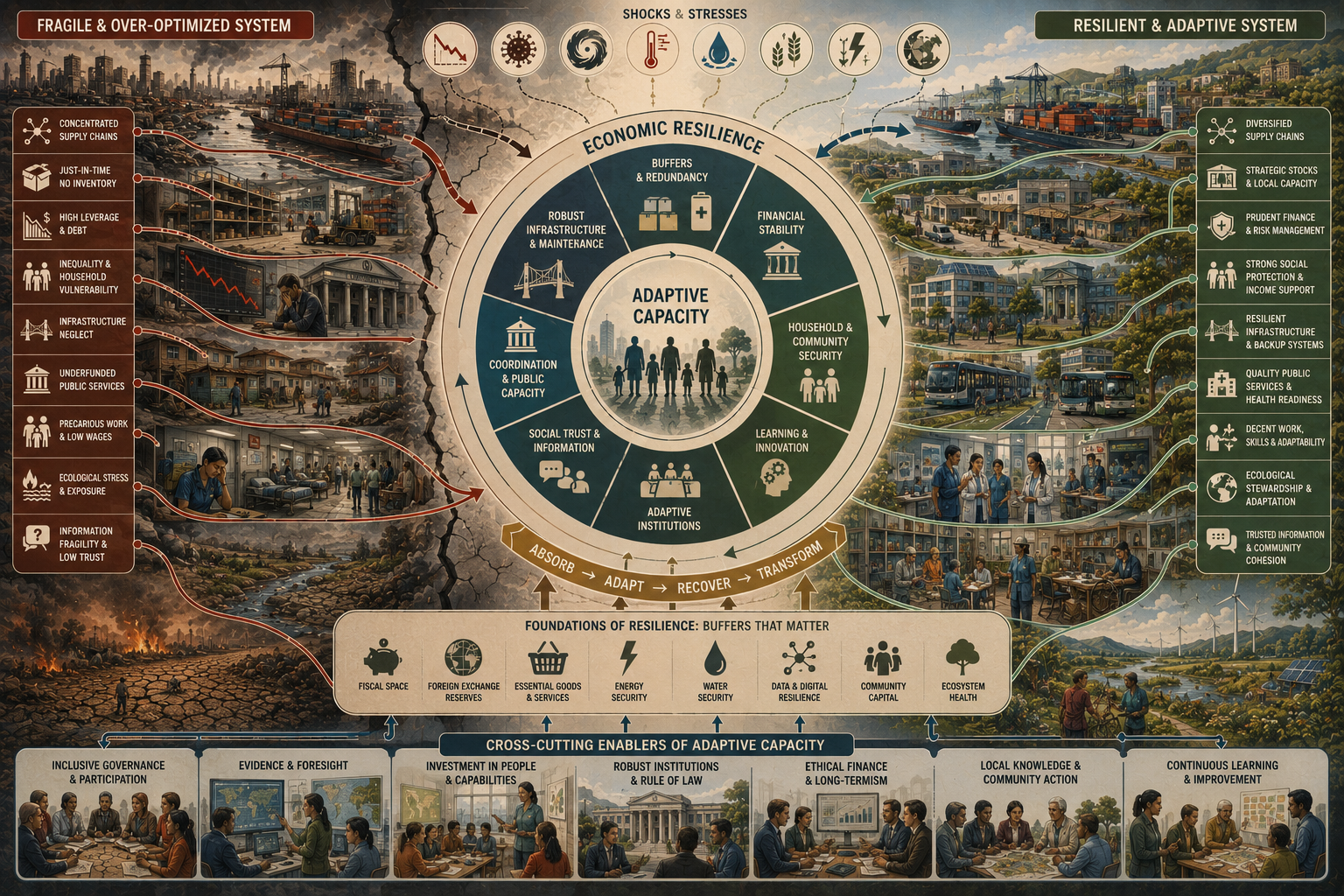
Within a sustainable systems framework, economic resilience, fragility, and adaptive capacity should be examined not only in relation to crisis response, but in relation to public goods, infrastructure, distribution, ecological risk, labor systems, institutional trust, and long-run capability. The deeper question is whether economies are being organized for genuine durability or for short-term performance that leaves them increasingly exposed to breakdown when shocks arrive.
Why This Topic Matters
Economic systems are often judged by growth, productivity, profitability, employment, and efficiency. Yet these measures tell us very little about how systems behave when conditions deteriorate. A model that performs well in stable times may prove brittle under inflation, flood, cyberattack, supply shortage, financial stress, pandemic, infrastructure failure, or institutional breakdown. Resilience matters because real economies do not operate in perfectly controlled environments. They operate in a world of uncertainty, interdependence, conflict, ecological disruption, and repeated disturbance.
This matters because fragility is often hidden during periods of calm. Low inventories may appear efficient until supply chains fail. Weak public-health systems may seem fiscally manageable until a pandemic arrives. Financial leverage may raise returns until refinancing becomes difficult. Underinvestment in maintenance may remain invisible until infrastructure begins to fail. Crises often reveal not simply bad luck, but the cumulative consequences of systems built without enough buffers, redundancy, public capacity, or institutional depth.
Adaptive capacity matters because a resilient system is not one that never changes. It is one that can change intelligently under pressure. That requires knowledge, coordination, flexibility, trust, financial room, skilled labor, credible public institutions, and the ability to direct resources where they are needed most. Adaptation is not improvisation alone; it is the ability to reorganize without abandoning the people and systems most exposed to loss.
For that reason, resilience, fragility, and adaptive capacity belong near the center of serious economic thought. They clarify that economic strength is not only about speed or output. It is also about endurance, recoverability, distribution, and the ability to reorganize without collapsing.
A society that cannot absorb disturbance or adapt under strain is not truly prosperous, however impressive its ordinary performance may appear.
Resilience also forces a moral question. If a system recovers statistically while vulnerable households, workers, regions, or communities are left permanently damaged, the recovery is not socially complete. Durability must be judged by what happens to people, institutions, and ecological foundations—not only by what happens to aggregate output.
Economic resilience therefore asks whether the economy can protect the conditions of life under pressure, not merely whether the headline indicators eventually improve.
What Economic Resilience Means
Economic resilience refers to the capacity of an economy to absorb disturbance, maintain core functions, recover from disruption, and continue supporting social life under changing conditions. It includes the resilience of institutions, firms, households, infrastructures, labor markets, public systems, financial systems, and ecological foundations rather than only the resilience of aggregate output.
This matters because resilience is not identical to rapid return to a previous equilibrium. Sometimes resilience means restoring prior function. In other cases it means reorganizing into a more viable form after a shock reveals that the previous arrangement was itself unstable or unsustainable. An economy can therefore be resilient through recovery, adaptation, or transformation depending on the nature of the disruption.
Resilience also includes distribution. A system is not meaningfully resilient if aggregate indicators recover while large parts of the population remain in prolonged insecurity, debt stress, displacement, unemployment, ill health, or loss of capability. Resilience that protects asset values while allowing social damage to persist is a narrow and incomplete form of resilience.
A serious account therefore treats resilience as a multidimensional property of economic life rather than as a narrow macroeconomic rebound metric.
The key question is whether a society can preserve the conditions of collective functioning when exposed to stress, not merely whether headline growth eventually returns.
Economic resilience includes absorption, continuity, recovery, learning, and transformation. Absorption concerns the ability to take a shock without immediate collapse. Continuity concerns the maintenance of essential services. Recovery concerns the restoration of lost capacity. Learning concerns the identification of weaknesses revealed by disruption. Transformation concerns the redesign of systems that should not simply be rebuilt as they were.
The strongest economies are therefore not merely those that move fastest in stable times. They are those that can preserve life, capability, and legitimacy when stability disappears.
What Fragility Means
Fragility refers to structural vulnerability: the condition in which systems are exposed to disruption in ways that make breakdown more likely and recovery more difficult. Fragility can arise from concentration, debt dependence, weak public institutions, ecological degradation, infrastructural neglect, narrow supply chains, political polarization, low household buffers, or over-optimized systems with little slack.
This matters because fragility is often mistaken for strength during periods of expansion. A highly leveraged firm may appear efficient. A city dependent on a single water source may appear manageable. A national economy with concentrated imports may appear cost-effective. A just-in-time logistics system may appear lean. Yet such arrangements can fail quickly once stress arrives.
Fragility also tends to be cumulative. Small weaknesses interact. Weak labor protections, expensive housing, low savings, poor healthcare access, and precarious employment can combine to make households deeply vulnerable even if none of these pressures alone would be catastrophic. Likewise, infrastructure neglect, supply concentration, fiscal weakness, and political distrust can interact across institutions.
A serious framework therefore treats fragility as embedded in system design rather than as a matter of occasional bad outcomes.
Crises do not create all fragility; they reveal how much fragility had already been built into ordinary life.
Fragility also explains why the same shock can produce very different outcomes across places. A storm, rate increase, supply interruption, or energy shock does not strike a blank surface. It strikes households with different savings, firms with different credit access, governments with different fiscal space, and infrastructures with different maintenance histories.
Economic fragility is therefore not only exposure to danger. It is the absence of sufficient capacity to prevent exposure from becoming cascading damage.
What Adaptive Capacity Means
Adaptive capacity refers to the ability of a system to respond intelligently to change. It includes the institutional, social, informational, financial, and technical capacities needed to adjust behavior, reallocate resources, change rules, redesign infrastructures, and reorganize production when existing arrangements are under strain.
This matters because resilience without adaptation can become stagnation. A society may preserve stability in the short run yet fail to learn from repeated stress, leaving the same vulnerabilities in place. Adaptive capacity allows systems not only to survive shocks but to improve their future position by incorporating lessons, redesigning institutions, and building stronger foundations.
Adaptive capacity also depends on who has room to move. Wealthier households and firms often adapt more easily because they have buffers, information, mobility, credit access, and institutional voice. Poorer households, underfunded local governments, and fragile communities often face higher exposure with fewer adaptive options.
A serious account therefore treats adaptive capacity as both a technical and distributive question.
The ability to change under pressure is unevenly distributed, and that inequality shapes how resilient a society really is.
Adaptive capacity also requires legitimate authority. Systems can possess information and resources but still fail if people distrust public institutions, if agencies cannot coordinate, or if political polarization blocks action. Adaptation is therefore not only about flexibility in markets; it is about institutional credibility and collective learning.
An adaptive economy is one that can change direction without abandoning its social foundations.
Shock Exposure and System Condition
Economic outcomes during crisis depend on two things at once: the character of the shock and the condition of the system receiving it. A severe shock can strain even robust systems. But a moderate shock can also become devastating when it hits institutions already weakened by inequality, debt, infrastructural decay, supply concentration, ecological stress, or political distrust.
This matters because it changes the way crises should be interpreted. Analysts often focus on the immediate trigger, such as a banking failure, drought, pandemic, cyberattack, or energy spike. Yet deeper explanation usually lies in why the trigger produced such wide damage. Exposure alone does not explain collapse; system condition does.
This perspective also clarifies why repeated smaller disruptions deserve attention. Frequent minor failures may indicate that resilience has already been eroded even before a larger crisis arrives. A port delay, rolling blackout, local flood, hospital overload, school disruption, or small bank failure can serve as a warning that hidden fragility is accumulating.
A serious framework therefore evaluates both stressor and substrate.
Shocks matter, but the vulnerability of the structure they strike often matters just as much.
This also means that prevention is not only about predicting shocks. Many shocks are uncertain or compound in unexpected ways. Prevention is also about strengthening the system so that when disruption occurs, it has fewer channels through which to become catastrophe.
Resilience policy therefore asks how much damage can be avoided by improving the receiving system before the next shock arrives.
Efficiency, Redundancy, and the Problem of Over-Optimization
Modern economic systems often celebrate efficiency by eliminating spare capacity, reducing inventory, narrowing supplier networks, cutting maintenance budgets, and minimizing labor slack. These practices can improve short-run margins and performance metrics, but they can also produce fragility by stripping away the redundancy that supports resilience.
This matters because redundancy is often treated as waste until crisis reveals its value. Backup systems, reserve capacity, alternative suppliers, public stockpiles, surplus staffing, maintenance crews, local production networks, and institutional memory can look expensive in stable times yet become indispensable under stress.
The problem is not efficiency itself. It is over-optimization: the design of systems so tightly around ordinary conditions that they fail disproportionately when conditions change. An economy organized only for the cheapest normal-day operation may be poorly organized for a world of abnormal days.
A serious account therefore treats redundancy as a form of resilience investment rather than as mere inefficiency.
What looks like slack from the standpoint of short-run optimization may be exactly what allows a system to keep functioning when normality breaks down.
This is particularly important in healthcare, logistics, food systems, energy systems, public administration, and emergency services. The cost of spare capacity may be visible every year, while the value of avoided catastrophe may appear only when crisis does not become collapse.
Resilience therefore requires a wider understanding of efficiency: not the minimization of cost under ideal conditions, but the ability to sustain essential function across variable and stressful conditions.
Buffers, Stabilizers, and the Role of Slack
Resilient systems rely on buffers. In public finance these may include automatic stabilizers, emergency funds, borrowing capacity, and countercyclical spending tools. In households they may include savings, social support, housing stability, healthcare access, and care networks. In infrastructure they may include reserve margins, maintenance capacity, backup systems, and spare parts. In labor markets they may include training systems and social protection that allow workers to move without collapse.
This matters because slack is not the opposite of performance. It is part of performance under uncertainty. A system with no margin for error may perform well only under unusually favorable conditions. Once conditions change, the absence of buffers can convert temporary disruption into irreversible loss.
Buffers also support political stability. Households with no reserves face sharper crises and weaker adaptive room. Governments without fiscal space face harsher tradeoffs. Firms dependent on uninterrupted revenue streams become more brittle under volatility. Communities without local institutions often have fewer ways to organize response.
A serious framework therefore treats buffers as part of institutional design rather than as emergency luxuries.
Resilience requires spare capacity somewhere in the system, because uncertainty cannot be managed by precision alone.
Automatic stabilizers are especially important because they act quickly without requiring new political decisions at the moment of crisis. Unemployment insurance, income support, food assistance, public healthcare, and social protection can prevent household shocks from cascading into broader demand collapse and social instability.
Slack is therefore not waste when the alternative is fragility. It is a social technology for absorbing uncertainty.
Public Institutions and the Capacity to Coordinate
Public institutions are central to economic resilience because many crises require coordination beyond the capacity of individual firms or households. Disaster response, public health, infrastructure repair, financial stabilization, food distribution, labor-market adjustment, energy management, and supply-chain protection all depend on states, local governments, and public agencies with real administrative capacity.
This matters because resilience is often narrated too privately, as though households and firms should bear the main burden of preparation. Yet systemic risks require public coordination, public information, and public goods. Weak institutions force more risk downward onto actors least able to absorb it.
Public institutions also matter because they shape expectations. Trust in emergency response, regulatory credibility, and competent administration can reduce panic and increase collective compliance under stress. In contrast, institutional failure can turn a technical problem into a legitimacy crisis.
A serious account therefore treats state capacity as one of the foundations of resilience.
When public coordination is weak, even otherwise manageable disturbances can spread into wider social and economic disruption.
Public capacity also includes data systems, procurement, local knowledge, fiscal tools, infrastructure planning, regulatory enforcement, and the ability to learn from failure. Resilience is not only what governments do after the shock; it is what they have built before the shock.
Institutional capacity is therefore not an administrative detail. It is part of the economy’s operating system.
Households, Firms, and Unequal Resilience
Resilience is unevenly distributed. Wealthier households often have savings, insurance, flexible work, mobility, and better access to care. Larger firms may have diversified revenue, easier credit access, stronger bargaining power, legal capacity, and more leverage over suppliers. Poorer households and smaller firms typically face tighter constraints and thinner buffers.
This matters because aggregate resilience can conceal deep insecurity beneath the surface. A national economy may recover statistically while many households remain indebted, evicted, displaced, unemployed, or chronically exposed to further shocks. The same holds for small businesses in relation to large corporations.
Unequal resilience also affects long-run opportunity. Those with stronger buffers can adapt, retrain, relocate, rebuild, and invest in recovery. Those without them may be pushed into cumulative disadvantage. A temporary crisis can become a permanent class, regional, or racialized loss when adaptive options are unequally distributed.
A serious framework therefore treats resilience as a distributive question as well as a systems question.
An economy is only as socially resilient as its most exposed populations are protected from irreversible loss.
This is why resilience policy must include income security, housing stability, care access, healthcare, consumer protection, small-business support, and public services. Otherwise, “resilience” becomes a property of capital and institutions rather than of society as a whole.
Distributional resilience asks whether ordinary people can survive disruption without being forced into debt, displacement, illness, or permanent insecurity.
Infrastructure, Supply Chains, and Systemic Interdependence
Modern economies depend on tightly coupled infrastructures: electricity, transport, water, telecommunications, payments, logistics, healthcare, food distribution, and digital systems. Supply chains link regions and sectors across large distances. These interdependencies can increase productivity, but they can also create channels through which failure propagates rapidly.
This matters because resilience cannot be assessed one sector at a time. A port disruption can affect manufacturing, food supply, inflation, and retail availability. A power failure can disable communications, water treatment, transit, healthcare, and payments. A cyberattack can halt logistics and public administration simultaneously. A shortage in one critical component can interrupt production far from the original site of disruption.
Interdependence means that local disruptions may have nonlocal consequences, and apparently minor failures can cascade across networks. The same connections that support efficiency and specialization can transmit instability under stress.
A serious account therefore treats resilience as a systems property rather than a sectoral checklist.
What matters is not only whether each component functions alone, but whether the whole network can continue under strain without cascading breakdown.
Supply-chain resilience does not always mean domestic self-sufficiency or complete reshoring. It may mean diversification, transparency, critical-stock management, interoperable standards, alternative routes, supplier mapping, strategic reserves, and international cooperation. The goal is to avoid both brittle dependence and inefficient isolation.
Resilience requires knowing where critical dependencies are, how failure might travel, and which forms of redundancy matter most.
Finance, Debt, and the Amplification of Fragility
Financial systems can either buffer shocks or amplify them. Credit can help households, firms, and governments smooth disruption, preserve employment, and invest in recovery. But high leverage, short-term refinancing dependence, asset bubbles, and poorly regulated financial interconnection can turn localized stress into systemic crisis.
This matters because fragility is often magnified through balance sheets. A decline in revenue becomes a liquidity problem, then a solvency problem, then a wider credit contraction. Debt that seems manageable under stable conditions can become a mechanism of rapid destabilization when rates rise, collateral values fall, or cash flow weakens.
Finance also shapes inequality of resilience. Those with collateral and access to cheaper credit adapt more easily. Those without it face harsher adjustment, higher borrowing costs, or exclusion from recovery finance. Financial systems therefore allocate adaptive capacity as well as capital.
A serious framework therefore treats debt and finance as central to resilience analysis rather than as separate from the real economy.
The way a system is financed affects how much shock it can absorb before strain becomes crisis.
Macroprudential regulation, public credit facilities, emergency lending, consumer protections, debt restructuring, and liquidity backstops can all support resilience when designed well. But finance can also encourage fragility when speculative gain is rewarded and systemic risk is socialized after failure.
Economic resilience therefore requires asking not only how much finance exists, but whether finance stabilizes or destabilizes the real foundations of social life.
Labor Markets, Skills, and Adaptive Workforce Capacity
Adaptive capacity depends heavily on labor systems. Workers need not only jobs, but transferable skills, retraining pathways, income support during transition, and institutions that make movement between sectors possible without collapse. Labor markets that are highly precarious may appear flexible, yet that very precarity can undermine resilience by weakening household buffers and reducing capacity for planned transition.
This matters because many shocks arrive through work: layoffs, automation, relocation, sectoral contraction, energy transition, ecological damage to regional industries, and changes in trade or technology. A workforce with strong training and social protection can adapt more effectively than one facing abrupt loss with little public support.
Labor resilience also has a geographic dimension. Regions tied to a narrow industrial base may require place-based investment, not just abstract labor mobility advice. A worker cannot always relocate without losing housing, family support, identity, care networks, or community roots.
A serious account therefore treats workforce adaptation as central to economic resilience.
An economy cannot be genuinely adaptive if workers are expected to absorb structural change without the institutions needed to survive and reorient.
Labor-market resilience also requires decent work. Low-wage, insecure employment may allow firms to adjust costs quickly, but it often transfers volatility onto households. That weakens the social base of resilience.
The question is not whether labor markets can change. They must. The question is whether change is governed through capability, dignity, and protection rather than abandonment.
Ecological Risk, Energy Stress, and Material Vulnerability
Economic fragility increasingly intersects with ecological and material stress. Drought, flood, wildfire, biodiversity decline, energy dependence, heat stress, water scarcity, and resource bottlenecks all affect production, food systems, infrastructure, insurance, migration, and public budgets. Ecological disruption is not external to resilience. It is part of it.
This matters because economies built on unstable ecological foundations become harder to govern over time. Water stress affects agriculture, urban life, energy production, and industry. Energy volatility reshapes household budgets and industrial competitiveness. Repeated climate damage weakens fiscal space, insurance systems, infrastructure reliability, and public confidence.
Resilience therefore requires more than financial prudence or supply diversification. It also requires ecological stewardship, climate adaptation, energy security, resilient infrastructure, and reduced dependence on systems that generate repeating stress.
A serious framework therefore treats ecological integrity as part of economic resilience rather than as a separate environmental concern.
Systems that undermine their own material foundations eventually convert ecological strain into economic fragility.
Ecological resilience and economic resilience are therefore connected. Restored wetlands, diversified energy systems, healthy soils, urban shade, distributed water systems, and well-maintained infrastructure can all function as economic stabilizers.
Environmental policy is not only about reducing harm. It is also about preserving the operating conditions that make economies less fragile.
Social Trust, Information, and the Politics of Response
Resilience depends on more than material assets. It also depends on trust, information quality, and legitimacy. During crisis, people must often rely on public communication, collective rules, and institutional coordination under uncertainty. Mistrust, misinformation, and political fragmentation can weaken compliance and slow effective response.
This matters because response capacity is partly relational. A technically sound policy may fail if people do not trust the institution issuing it or cannot access reliable information. Conversely, stronger trust can improve coordination even when resources are constrained.
Information systems matter as well. Early warning, statistical visibility, public records, transparent communication, supply-chain mapping, health surveillance, infrastructure monitoring, and risk dashboards shape whether systems can respond in time.
A serious account therefore treats trust and information as part of resilience infrastructure.
Economic systems endure stress more effectively when people believe institutions are competent enough to justify coordinated response.
This does not mean trust should be demanded without accountability. Durable trust grows from performance, transparency, fairness, and the visible protection of ordinary people. Trust weakens when crisis response protects powerful actors while leaving exposed communities to bear the losses.
The politics of resilience is therefore also the politics of legitimacy.
Recovery, Learning, and Transformational Adaptation
Recovery is often treated as a return to baseline, but crises sometimes reveal that the baseline itself was unsustainable. In such cases, resilience requires not only restoration but transformation. Systems may need to change land use, infrastructure design, energy dependence, supply architecture, fiscal priorities, labor policy, public-health systems, or social protections rather than simply rebuilding what existed before.
This matters because learning is one of the clearest tests of adaptive capacity. Repeated failure without redesign is not resilience. It is persistent vulnerability. Transformational adaptation becomes necessary when old structures repeatedly reproduce the same losses.
Recovery therefore has a normative dimension. What exactly is being recovered, and should it be? Rebuilding flood-prone housing without changing land use may restore assets while preserving danger. Restoring a brittle supply chain may recover output while retaining dependence. Returning to precarious labor markets may restore employment statistics while leaving household fragility intact.
A serious framework therefore distinguishes between rebound, adaptation, and transformation.
Economic resilience is strongest when systems can use disruption as a moment to build back with more intelligence rather than only with speed.
Transformation does not mean using crisis to impose technocratic plans without democratic consent. It means learning publicly from failure, protecting people through transition, and redesigning systems whose ordinary functioning has been shown to be unsafe or unjust.
The best recoveries reduce the probability that the same crisis will produce the same losses again.
Measuring Resilience Without Oversimplifying It
Resilience is difficult to measure because it is partly visible only under stress. Analysts often use proxies such as diversification, fiscal space, infrastructure quality, household savings, inequality, public-health capacity, institutional trust, recovery speed, social protection, and environmental exposure. These measures can be useful, but none captures the whole picture.
This matters because oversimplified resilience metrics can create false confidence. A system may score well on diversification and poorly on trust, or well on fiscal space and poorly on household security. A country may appear resilient in financial terms but fragile in ecological, infrastructural, or social terms. What matters is the interaction of capacities rather than any single indicator.
Measurement should therefore support diagnosis rather than produce a comforting ranking detached from actual vulnerability. A resilience dashboard should show where buffers are thin, where exposure is concentrated, where public systems are weak, where households lack adaptive room, and where cascading dependencies exist.
A serious account treats resilience assessment as multidimensional and conditional.
The goal is not to reduce complexity prematurely, but to see where weakness is accumulating before it becomes crisis.
Good measurement also distinguishes resilience from mere survival. A household may survive a shock by taking on debt, skipping care, or moving into unsafe housing. A firm may survive by cutting workers. A government may stabilize markets while underfunding public services. These are not all equivalent forms of resilience.
Resilience measurement should ask who absorbs the shock, who pays for recovery, and whether adaptive capacity is strengthened or depleted afterward.
Historical Lessons from Crisis and Reconstruction
History repeatedly shows that crises expose prior fragility. Financial collapses reveal leverage and regulatory weakness. Famine reveals food-system dependence and political neglect. Public-health crises reveal institutional underinvestment. Infrastructure disasters reveal maintenance failures. Energy shocks reveal dependence. Reconstruction periods then reveal whether societies merely restore prior arrangements or use disruption to build stronger foundations.
This matters because resilience is historically made. It grows out of institutions, public goods, social compacts, infrastructure choices, labor systems, ecological stewardship, and political learning accumulated across time. Likewise, fragility is often the product of long periods of privatization, underinvestment, exclusion, speculative excess, or short-term optimization.
History also shows that recovery can widen inequality if public intervention is selective or if losses are socialized upward rather than downward. Crisis response can protect banks while households lose homes, rebuild profitable zones while neglected regions decline, or restore market confidence while public capacity remains weak.
A serious historical perspective therefore treats resilience as a political achievement rather than a natural condition.
What survives crisis most effectively is usually what had already been institutionally built before the crisis began.
Historical lessons also warn against memory loss. Societies often learn after crisis, then slowly dismantle the protections that made the next crisis less dangerous. Resilience requires institutional memory, not only emergency improvisation.
The question after crisis should not be how quickly normal returns, but whether normal itself has been made safer, fairer, and more durable.
Economic Resilience, Fragility, and Sustainable Systems
Within sustainable systems, resilience means more than bouncing back after disruption. It means building economies that can continue supporting collective life under ecological, financial, social, and infrastructural stress without requiring repeated sacrifice by the most vulnerable. Fragility means more than exposure to rare crisis. It means carrying structural weaknesses that make breakdown more likely under ordinary uncertainty. Adaptive capacity means more than improvisation. It means having institutions strong enough to learn, coordinate, and redesign systems before repeated disruption hardens into long-term decline.
This changes the policy frame. Sustainability is not only about lowering harm. It is also about increasing the capacity of systems to endure and adapt without disintegrating socially or ecologically. A growth model that weakens buffers, hollows out infrastructure, intensifies inequality, concentrates supply chains, overextends finance, and erodes trust may be unsustainable even before ecological thresholds are crossed.
Sustainable systems therefore require redundancy, public goods, social protection, ecological stewardship, distributed capability, and institutions able to coordinate under stress.
In this sense, resilience becomes a systems question.
It asks whether economic life is being organized for durability under uncertainty or for short-run performance under assumptions of stability that no longer hold.
This also means that resilience should not be treated as a niche concern for emergencies. It is part of the core architecture of an economy that expects to remain viable across time.
A sustainable economy is not simply one that produces more with less harm. It is one that can withstand disturbance, protect people, learn from failure, and reorganize before fragility becomes collapse.
How Resilience, Fragility, and Adaptive Capacity Should Be Judged
Economic resilience, fragility, and adaptive capacity should not be judged only by recovery speed or aggregate output. A broader economic systems framework asks whether economies preserve core functions, protect vulnerable people, reduce cascading risk, maintain public trust, and learn from disruption.
| Dimension | Narrow Question | Systems Question |
|---|---|---|
| Resilience | Does output recover? | Can the economy absorb shock while preserving essential functions, social stability, and human capability? |
| Fragility | Did a crisis occur? | What leverage, concentration, exposure, underinvestment, inequality, or distrust made the crisis worse? |
| Adaptive Capacity | Can systems adjust? | Do institutions, workers, firms, households, and regions have the resources and legitimacy needed to learn and reorganize? |
| Efficiency | Are costs minimized? | Has over-optimization removed the redundancy and slack needed to endure disruption? |
| Buffers | Are reserves available? | Are financial, infrastructural, institutional, household, and ecological buffers distributed where risk is greatest? |
| Public Capacity | Can government respond? | Can public institutions coordinate, communicate, finance, regulate, and deliver under stress? |
| Households | Are aggregate incomes stable? | Do households have income security, savings, care access, housing stability, and social protection? |
| Firms and Supply Chains | Are businesses efficient? | Are critical suppliers, logistics, inventories, finance, and digital systems resilient to disruption? |
| Finance | Is credit available? | Does finance buffer shocks or amplify fragility through leverage, liquidity stress, and contagion? |
| Transformation | How fast is recovery? | Does recovery reduce the vulnerabilities that made the shock damaging in the first place? |
This framework prevents a common mistake: treating resilience as a general virtue without asking who is protected, what functions are preserved, and whether the system is learning. A system can appear resilient by transferring harm onto households, workers, ecosystems, or future public budgets. That is not real resilience. It is displacement of fragility.
The central issue is therefore not only whether the economy can bounce back. The deeper question is whether it can absorb stress, prevent avoidable loss, adapt intelligently, and become less fragile over time.
Mathematical Lens
Mathematics can clarify resilience, fragility, and adaptive capacity by making buffers, vulnerability, shock impact, recovery, and distributional resilience explicit. These equations do not determine policy by themselves, but they help show what must be examined.
1. Resilience Relation
ER = f(Buffers,\ Redundancy,\ Coordination,\ Trust,\ Learning)
\]
Interpretation: Economic resilience \(ER\) depends on spare capacity, institutional coordination, social trust, and learning. Resilience is not only speed of recovery; it is the capacity to preserve function under stress.
2. Fragility Relation
FG = f(Leverage,\ Concentration,\ Exposure,\ Underinvestment,\ Inequality)
\]
Interpretation: Fragility \(FG\) often builds through structural dependence and weak capacity rather than through single events alone. Leverage, concentration, exposure, underinvestment, and inequality increase the chance that shocks cascade.
3. Adaptive Capacity Relation
AC = f(Information,\ Fiscal\ Space,\ Skills,\ Flexibility,\ Legitimacy)
\]
Interpretation: Adaptive capacity \(AC\) depends on knowledge, fiscal room, workforce capability, institutional flexibility, and public legitimacy. Systems cannot adapt well when they cannot see, finance, coordinate, or justify change.
4. Shock Impact Relation
SI = Shock\ Magnitude \times Vulnerability
\]
Interpretation: Shock impact \(SI\) depends not only on the event itself, but on the vulnerability of the system it strikes. A moderate shock can do severe damage in a fragile system.
5. Recovery Relation
RC = f(Response\ Speed,\ Public\ Capacity,\ Household\ Stability,\ Infrastructure\ Integrity)
\]
Interpretation: Recovery capacity \(RC\) is shaped by institutional and social depth, not only by market adjustment. Public capacity, household stability, and infrastructure condition determine how quickly and fairly recovery occurs.
6. Distributional Resilience Relation
DR = f(Income\ Security,\ Savings,\ Care\ Access,\ Housing\ Stability,\ Social\ Protection)
\]
Interpretation: Distributional resilience \(DR\) shows why resilience is uneven across populations. Households with income security, savings, care, stable housing, and social protection can adapt more effectively.
7. Practical Interpretation
The mathematical lens clarifies several structural points. Resilience depends on buffers, redundancy, and institutional coordination. Fragility often rises through leverage, concentration, and underinvestment. Adaptive capacity depends on information, legitimacy, and room to maneuver. Shock outcomes reflect vulnerability as well as event magnitude. Recovery is social and institutional, not merely financial or technical.
Formalization helps clarify mechanism, but it does not determine how much redundancy is enough, what level of fragility is tolerable, or how societies should trade off short-run efficiency against long-run durability. Those remain institutional, ethical, ecological, and political questions.
Python Workflow: Economic Resilience, Fragility, and Adaptive Capacity
Python is useful for turning resilience concepts into reproducible indicators. The following compact workflow models a resilience score, fragility score, adaptive-capacity score, shock-impact index, recovery-capacity score, and distributional-resilience score.
# Economic Resilience, Fragility, and Adaptive Capacity
# Simple Python workflow

import pandas as pd

# Resilience score
buffers = 0.63
redundancy = 0.58
coordination = 0.67
trust = 0.55
learning = 0.61
recovery_capacity = 0.59

resilience_score = (
    0.18 * buffers
    + 0.18 * redundancy
    + 0.18 * coordination
    + 0.14 * trust
    + 0.16 * learning
    + 0.16 * recovery_capacity
)

print("Resilience score:", round(resilience_score, 3))

# Fragility score
leverage = 0.69
concentration = 0.64
exposure = 0.71
underinvestment = 0.60
inequality = 0.66
political_fragmentation = 0.54

fragility_score = (
    0.20 * leverage
    + 0.18 * concentration
    + 0.20 * exposure
    + 0.18 * underinvestment
    + 0.14 * inequality
    + 0.10 * political_fragmentation
)

print("Fragility score:", round(fragility_score, 3))

# Adaptive capacity
information = 0.68
fiscal_space = 0.57
skills = 0.62
flexibility = 0.60
legitimacy = 0.54
implementation_capacity = 0.58

adaptive_capacity = (
    0.18 * information
    + 0.18 * fiscal_space
    + 0.16 * skills
    + 0.16 * flexibility
    + 0.16 * legitimacy
    + 0.16 * implementation_capacity
)

print("Adaptive capacity score:", round(adaptive_capacity, 3))

# Shock impact
shock_magnitude = 0.75
vulnerability = fragility_score
shock_impact = shock_magnitude * vulnerability

print("Shock impact index:", round(shock_impact, 3))

# Recovery capacity
response_speed = 0.60
public_capacity = 0.57
household_stability = 0.52
infrastructure_integrity = 0.56

recovery_score = (
    0.28 * response_speed
    + 0.28 * public_capacity
    + 0.22 * household_stability
    + 0.22 * infrastructure_integrity
)

print("Recovery capacity score:", round(recovery_score, 3))

# Distributional resilience
income_security = 0.56
savings = 0.42
care_access = 0.50
housing_stability = 0.48
social_protection = 0.62

distributional_resilience = (
    0.24 * income_security
    + 0.18 * savings
    + 0.18 * care_access
    + 0.20 * housing_stability
    + 0.20 * social_protection
)

print("Distributional resilience:", round(distributional_resilience, 3))

df = pd.DataFrame({
    "Metric": [
        "Resilience Score",
        "Fragility Score",
        "Adaptive Capacity Score",
        "Shock Impact Index",
        "Recovery Capacity Score",
        "Distributional Resilience"
    ],
    "Value": [
        resilience_score,
        fragility_score,
        adaptive_capacity,
        shock_impact,
        recovery_score,
        distributional_resilience
    ]
})

print(df)
This workflow is useful because it links buffers, vulnerability, adaptation, recovery, and distribution within one simplified resilience frame. It helps show why a shock is not just an external event; its impact depends on the fragility and capacity of the system it enters.
The full GitHub repository expands this example into resilience scenarios, fragility scoring, adaptive-capacity indicators, shock-impact modeling, household-resilience comparisons, firm and supply-chain resilience, financial-fragility scoring, labor-market adaptation, ecological and energy vulnerability, recovery-learning indicators, SQL queries, R and Stata replication workflows, Julia simulations, and article-ready figures.
R Workflow: Economic Resilience, Fragility, and Adaptive Capacity
R is useful for resilience dashboards, fragility summaries, shock-impact tables, and article-ready graphics. The following compact workflow performs the same resilience, fragility, adaptive-capacity, shock-impact, recovery-capacity, and distributional-resilience calculations in R.
# Economic Resilience, Fragility, and Adaptive Capacity
# Simple R workflow

# Resilience score
buffers <- 0.63
redundancy <- 0.58
coordination <- 0.67
trust <- 0.55
learning <- 0.61
recovery_capacity <- 0.59

resilience_score <- (
  0.18 * buffers +
  0.18 * redundancy +
  0.18 * coordination +
  0.14 * trust +
  0.16 * learning +
  0.16 * recovery_capacity
)

cat("Resilience score:", round(resilience_score, 3), "\n")

# Fragility score
leverage <- 0.69
concentration <- 0.64
exposure <- 0.71
underinvestment <- 0.60
inequality <- 0.66
political_fragmentation <- 0.54

fragility_score <- (
  0.20 * leverage +
  0.18 * concentration +
  0.20 * exposure +
  0.18 * underinvestment +
  0.14 * inequality +
  0.10 * political_fragmentation
)

cat("Fragility score:", round(fragility_score, 3), "\n")

# Adaptive capacity
information <- 0.68
fiscal_space <- 0.57
skills <- 0.62
flexibility <- 0.60
legitimacy <- 0.54
implementation_capacity <- 0.58

adaptive_capacity <- (
  0.18 * information +
  0.18 * fiscal_space +
  0.16 * skills +
  0.16 * flexibility +
  0.16 * legitimacy +
  0.16 * implementation_capacity
)

cat("Adaptive capacity score:", round(adaptive_capacity, 3), "\n")

# Shock impact
shock_magnitude <- 0.75
vulnerability <- fragility_score
shock_impact <- shock_magnitude * vulnerability

cat("Shock impact index:", round(shock_impact, 3), "\n")

# Recovery capacity
response_speed <- 0.60
public_capacity <- 0.57
household_stability <- 0.52
infrastructure_integrity <- 0.56

recovery_score <- (
  0.28 * response_speed +
  0.28 * public_capacity +
  0.22 * household_stability +
  0.22 * infrastructure_integrity
)

cat("Recovery capacity score:", round(recovery_score, 3), "\n")

# Distributional resilience
income_security <- 0.56
savings <- 0.42
care_access <- 0.50
housing_stability <- 0.48
social_protection <- 0.62

distributional_resilience <- (
  0.24 * income_security +
  0.18 * savings +
  0.18 * care_access +
  0.20 * housing_stability +
  0.20 * social_protection
)

cat("Distributional resilience:", round(distributional_resilience, 3), "\n")

summary_df <- data.frame(
  Metric = c(
    "Resilience Score",
    "Fragility Score",
    "Adaptive Capacity Score",
    "Shock Impact Index",
    "Recovery Capacity Score",
    "Distributional Resilience"
  ),
  Value = c(
    resilience_score,
    fragility_score,
    adaptive_capacity,
    shock_impact,
    recovery_score,
    distributional_resilience
  )
)

print(summary_df)
This R workflow is deliberately compact for article readability. In the full repository, R reads structured resilience, fragility, adaptive-capacity, shock, household, firm, supply-chain, finance, labor, ecological, and recovery-learning scenarios; calculates composite resilience scores, fragility scores, adaptive-capacity scores, shock-impact indices, and article-ready graphics.
Future Economic Systems articles can extend this foundation with national accounts, disaster-loss data, household balance sheets, firm financials, supply-chain data, infrastructure data, labor-force data, public-health capacity, fiscal data, climate-risk indicators, insurance data, and regional resilience metrics.
GitHub Repository
The article body includes selected computational examples so the conceptual, institutional, and mathematical argument remains readable. The full repository contains the expanded research infrastructure: Python resilience analysis, R shock-impact dashboards, Stata applied indicator replication workflows, SQL resilience and fragility scenario tables, Julia shock-propagation simulations, resilience scoring, fragility scoring, adaptive-capacity indicators, shock-impact modeling, household resilience, firm and supply-chain resilience, financial fragility, labor-market adaptation, ecological and energy vulnerability, recovery learning, documentation, reproducible sample data, and article-ready figures and tables.
Complete Code Repository
The full code distribution for this article, including selected article examples and advanced research-style computational scaffolding for resilience scoring, fragility analysis, adaptive capacity, shock exposure, system vulnerability, buffers, redundancy, household stability, firm and supply-chain resilience, financial fragility, labor-market adaptation, ecological risk, recovery learning, transformational adaptation, reproducibility documentation, and cross-language economic analysis, is available on GitHub.
Conclusion
Economic resilience, fragility, and adaptive capacity are central to economic analysis because they show that prosperity depends not only on growth and efficiency, but on whether systems can absorb disruption, protect people under stress, and reorganize intelligently when conditions change. A society may look strong in ordinary times while carrying hidden brittleness that crisis later exposes.
To understand an economy seriously, one must therefore ask not only how much it produces, but how much slack it preserves, how evenly resilience is distributed, how dependent it is on vulnerable infrastructures and debts, whether public institutions can coordinate under stress, and whether ecological and social conditions are being maintained well enough to support future adaptation. These questions reveal whether an economy is durable in any meaningful sense or merely fast until something goes wrong.
The serious study of resilience also requires moving beyond the language of individual preparedness. Households and firms matter, but systemic shocks require public capacity, infrastructure, social protection, financial regulation, labor-market institutions, ecological stewardship, and trusted information systems. Without those, resilience becomes privatized burden rather than collective capability.
In a sustainable economic system, resilience is not a slogan for enduring harm. It is the capacity to prevent avoidable damage, protect the vulnerable, learn from disruption, and redesign systems before fragility hardens into repeated crisis. The goal is not simply to bounce back. It is to become less brittle, more just, and more capable of sustaining life under uncertainty.
Related Reading
- Economic Systems
- Risk & Resilience
- Public Finance, State Capacity, and Collective Goods
- Climate Economics, Transition Policy, and Decarbonization
- Political Economy, Power, and Distributional Conflict
- Natural Capital, Resource Use, and Environmental Constraint
- Economic Systems Within Planetary Boundaries
- Post-Growth, Degrowth, and the Critique of Endless Expansion
- Institutions & Governance
- Sustainable Development
Further Reading
- Hallegatte, S. (2014). Economic Resilience: Definition and Measurement. Washington, DC: World Bank. Available at: https://openknowledge.worldbank.org/entities/publication/a0878972-07ce-5642-8e8a-ad16d1ec2749
- International Labour Organization (ILO) (2026). Universal social protection in changing labour markets: Protecting workers in all forms of employment. Available at: https://www.ilo.org/publications/universal-social-protection-changing-labour-markets-protecting-workers-all
- Organisation for Economic Co-operation and Development (OECD) (2025). OECD Supply Chain Resilience Review. Available at: https://www.oecd.org/en/publications/2025/06/oecd-supply-chain-resilience-review_9930d256.html
- Organisation for Economic Co-operation and Development (OECD) (n.d.). Resilient supply chains. Available at: https://www.oecd.org/en/topics/sub-issues/resilient-supply-chains.html
- United Nations Office for Disaster Risk Reduction (UNDRR) (2022). Briefing note on systemic risk. Available at: https://www.undrr.org/publication/briefing-note-systemic-risk
- United Nations Office for Disaster Risk Reduction (UNDRR) (2024). A systems approach for disaster risk reduction. Available at: https://www.undrr.org/publication/white-paper-systems-approach-disaster-risk-reduction-exploring-nexus-energy-food-and
- World Bank (n.d.). Resilience and Disaster Management. Available at: https://www.worldbank.org/ext/en/topic/resilience-and-disaster-management
- World Bank (2025). Building Resilience: World Bank Group Experience in Climate and Disaster Resilient Development. Available at: https://www.worldbank.org/en/country/switzerland/publication/building-resilience-world-bank-group-experience-in-climate-and-dsaster-rsilient
References
- Hallegatte, S. (2014). Economic Resilience: Definition and Measurement. Washington, DC: World Bank. Available at: https://openknowledge.worldbank.org/entities/publication/a0878972-07ce-5642-8e8a-ad16d1ec2749
- International Labour Organization (ILO) (2026). Universal social protection in changing labour markets: Protecting workers in all forms of employment. Available at: https://www.ilo.org/publications/universal-social-protection-changing-labour-markets-protecting-workers-all
- Organisation for Economic Co-operation and Development (OECD) (2012). Structural Policies and Economic Resilience to Shocks. Available at: https://www.oecd.org/en/publications/structural-policies-and-economic-resilience-to-shocks_140152385131.html
- Organisation for Economic Co-operation and Development (OECD) (2025). OECD Supply Chain Resilience Review. Available at: https://www.oecd.org/en/publications/2025/06/oecd-supply-chain-resilience-review_9930d256.html
- Organisation for Economic Co-operation and Development (OECD) (n.d.). Resilient supply chains. Available at: https://www.oecd.org/en/topics/sub-issues/resilient-supply-chains.html
- United Nations Office for Disaster Risk Reduction (UNDRR) (2022). Briefing note on systemic risk. Available at: https://www.undrr.org/publication/briefing-note-systemic-risk
- United Nations Office for Disaster Risk Reduction (UNDRR) (2024). A systems approach for disaster risk reduction. Available at: https://www.undrr.org/publication/white-paper-systems-approach-disaster-risk-reduction-exploring-nexus-energy-food-and
- World Bank (n.d.). Resilience and Disaster Management. Available at: https://www.worldbank.org/ext/en/topic/resilience-and-disaster-management
- World Bank (2025). Building Resilience: World Bank Group Experience in Climate and Disaster Resilient Development. Available at: https://www.worldbank.org/en/country/switzerland/publication/building-resilience-world-bank-group-experience-in-climate-and-dsaster-rsilient