
Last Updated May 10, 2026
Economic systems within planetary boundaries begins from a simple but demanding proposition: economies must be understood and governed as subsystems of the Earth system rather than as autonomous engines of endless expansion. The planetary boundaries framework identifies critical Earth-system processes that help maintain a relatively stable and resilient biosphere. It argues that human societies need to remain within a safe operating space if they are to preserve the planetary conditions that support civilization, development, public health, food systems, water security, ecological stability, and long-run human flourishing.
These themes matter because conventional economic success can coincide with ecological destabilization. Economies may expand measured output while intensifying climate change, biosphere degradation, land-system transformation, freshwater stress, nutrient overload, chemical proliferation, and waste accumulation. A society can grow in GDP terms while eroding the biophysical foundations on which future production, health, security, and social stability depend. If economic systems are materially embedded in the biosphere, then growth, production, finance, infrastructure, consumption, and trade must be evaluated in relation to ecological ceilings rather than only in relation to market output.
The question is therefore not whether economies should care about environmental constraint in the abstract. It is whether economic systems can be reorganized so that production, distribution, infrastructure, finance, consumption, and public institutions operate within Earth-system thresholds while still supporting human dignity, development, inclusion, and long-run resilience. That makes economic organization itself a central site of ecological governance.
Main Library
Publications
Article Map
Economic Systems
Related Topic
Sustainable Development
Related Topic
Environmental Systems
Related Topic
Risk & Resilience
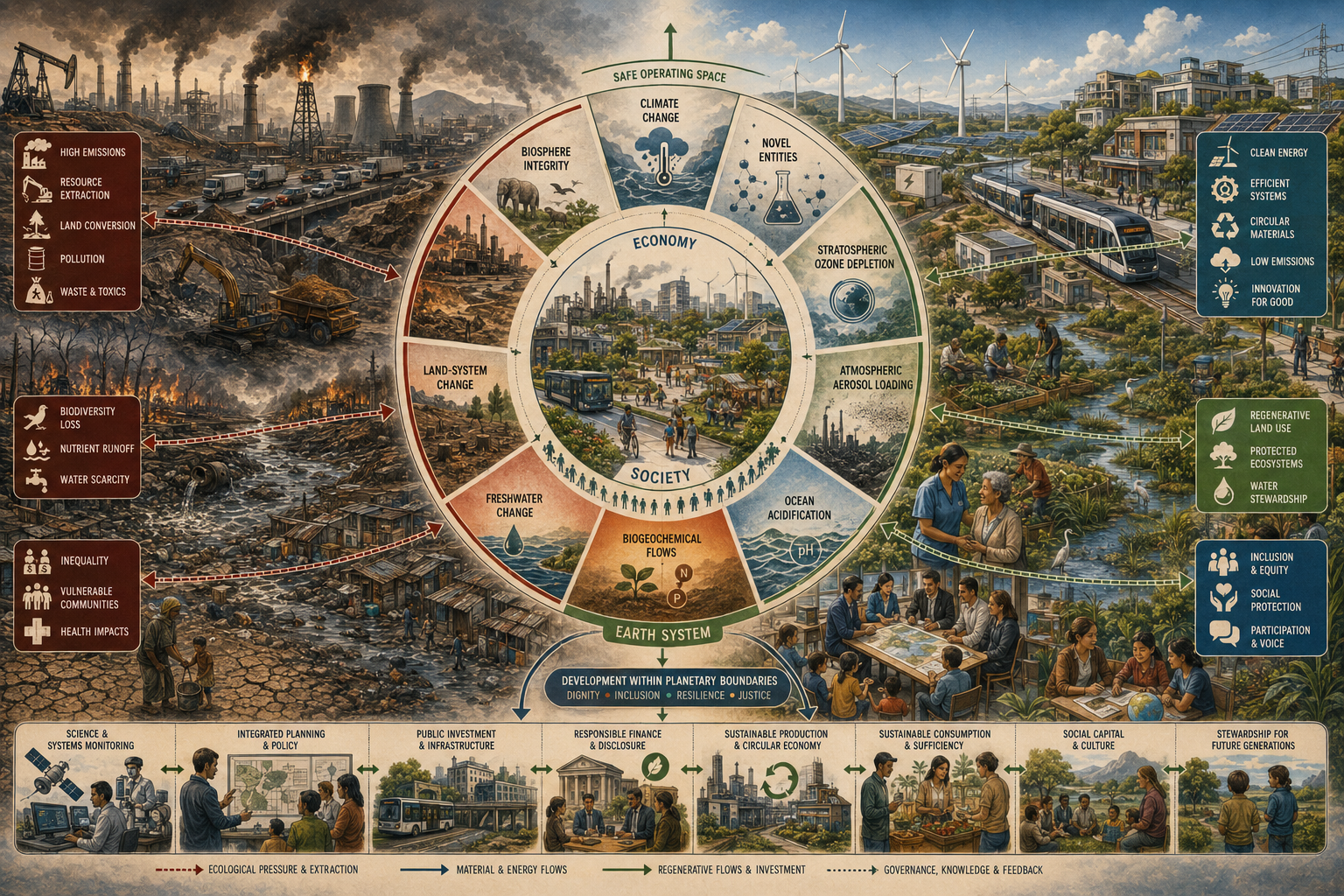
Within a sustainable systems framework, economic systems within planetary boundaries should be examined not only in relation to environmental performance, but in relation to scale, justice, adaptation, institutional redesign, and the long-run viability of collective life. The deeper question is whether economies can be governed as materially embedded systems that preserve the biophysical foundations of future flourishing rather than consuming them in pursuit of short-horizon growth.
Why This Topic Matters
Economic systems shape how land is used, how energy is produced, how materials are extracted, how waste is managed, and how benefits and burdens are distributed. Because of that, they also shape pressure on climate, biodiversity, freshwater, nutrient cycles, chemical pollution, land systems, and other Earth-system processes. The planetary boundaries framework matters because it provides a way of thinking about the scale of human activity in relation to the resilience of the planet rather than only in relation to prices, profits, growth rates, or national output.
This matters politically as well as scientifically. Once ecological destabilization is understood as systemic rather than marginal, economic governance can no longer be framed as a choice between growth now and environment later. Energy systems, materials, food systems, housing, infrastructure, transport, industrial policy, public finance, and development strategy all become part of the same problem: how to organize material life within biophysical limits while preserving dignity and inclusion.
The issue is therefore not whether there are environmental side effects to otherwise normal development. It is whether prevailing economic systems are compatible with a safe operating space at all, and if not, what kinds of transition can realign them with the conditions required for durable human development.
A boundary-aware economic system would not treat ecological limits as external constraints added after growth has been planned. It would treat them as constitutive conditions of economic possibility.
The deeper challenge is to build institutions that can recognize Earth-system limits before crisis forces recognition through damage, scarcity, instability, or social conflict.
What the Planetary Boundaries Framework Is
The planetary boundaries framework identifies major Earth-system processes that regulate planetary stability and resilience. It was developed to define a safe operating space for humanity by marking thresholds or zones beyond which the risk of destabilizing Earth systems rises. The framework does not treat environmental problems as isolated issues. It treats them as interacting parts of a complex Earth system whose stability cannot be assumed indefinitely.
The framework is important because it moves ecological thinking from separate environmental categories toward an integrated systems view. Climate change, biosphere integrity, freshwater change, land-system change, biogeochemical flows, ocean acidification, stratospheric ozone depletion, atmospheric aerosol loading, and novel entities are not separate in practice. Economic systems interact with them simultaneously through energy use, agriculture, industry, urbanization, extraction, transport, waste, and consumption.
For economic thought, the significance is profound. The relevant question is not simply whether individual sectors can become cleaner, but whether the aggregate scale and structure of economic life remain compatible with Earth-system resilience.
The planetary boundaries framework therefore challenges the idea that environmental policy is a specialized sector outside the economy.
It suggests that economic systems must be evaluated by whether they remain within a safe operating space, not only by whether they generate income, employment, investment, or consumption.
The framework also helps clarify why delayed action becomes dangerous. Boundary transgression can increase the probability of nonlinear change, feedbacks, and damage that is difficult to reverse. Economic systems that depend on stable climate, freshwater, soils, biodiversity, and ecosystem function cannot treat these risks as distant or secondary.
A boundary-aware economy is therefore an economy that governs itself in relation to planetary stability.
The Economy as a Subsystem of the Earth System
The planetary boundaries perspective reinforces a broader ecological-economic insight: the economy is a subsystem of the biosphere. It depends on material throughput, stable climate conditions, ecological regeneration, freshwater availability, nutrient cycling, functioning living systems, and waste-absorbing capacities. That means economic activity must be evaluated in relation to the Earth systems that sustain it rather than as though it were self-grounding.
This framing changes the meaning of economic possibility. Growth, industrialization, and development remain important, but they cannot be treated as abstract processes detached from finite sinks, vulnerable ecologies, and cumulative emissions. An economy can expand within statistics while degrading the physical conditions that make future economic life possible.
Seeing the economy as a subsystem also changes the meaning of efficiency. Efficiency within one production process is not enough if total system pressure continues to rise. A system can become more efficient per unit while still exceeding ecological capacity because scale, rebound effects, and throughput overwhelm technical gains.
A serious framework therefore treats the economy as materially embedded rather than institutionally autonomous.
Economic systems do not float above Earth systems; they transform them, depend on them, and are constrained by them.
This is not an argument against development. It is an argument for development that recognizes its physical basis. Human capability, public health, education, housing, food security, and infrastructure all require material support. The question is whether that support can be organized without destabilizing the systems on which future capability depends.
Boundary-aware economics therefore asks how societies can meet human needs while respecting ecological ceilings and social foundations together.
Safe Operating Space and Economic Governance
A safe operating space is not merely a scientific warning zone. It is a governance concept. It asks whether institutions can organize production, distribution, infrastructure, investment, and consumption so that human development stays within tolerable ecological pressure. Once several boundaries are already under severe pressure or transgressed, governance becomes a problem of returning toward safer conditions while managing adaptation, justice, and development needs in the present.
This implies that economic policy cannot focus only on efficiency within existing systems. It also has to ask what those systems are doing to planetary stability, how quickly they can be changed, and whose claims on development, resources, and public goods must be protected during the transition.
Safe operating space therefore connects ecological ceilings with institutional capacity. It requires public systems capable of setting rules, enforcing limits, investing in alternatives, protecting vulnerable groups, coordinating infrastructure, and measuring progress in boundary-aware terms.
A serious account therefore treats safe operating space as a problem of political economy.
The question is whether institutions can govern scale, direction, distribution, and time horizon together.
Safe operating space also requires precaution. Waiting for absolute certainty before acting can be dangerous where Earth-system thresholds, cumulative pressure, and delayed feedbacks are involved. Economic institutions often discount the future; boundary governance must counter that tendency.
In this sense, planetary boundaries demand not only new indicators, but new forms of public reasoning capable of treating ecological stability as a shared condition of freedom and development.
Growth, Resource Use, and Earth-System Pressure
One of the central tensions in boundary-aware economics is the relationship between economic growth and physical throughput. Resource use is deeply implicated in climate change, biodiversity loss, land conversion, water stress, pollution, and waste. This does not mean all growth is identical, nor that every improvement in human welfare requires proportionate ecological damage. It does mean that growth cannot be treated as automatically benign if it remains linked to escalating extraction, land transformation, emissions, and waste.
Boundary-aware economics therefore asks not only how fast economies grow, but how materially intensive that growth remains and whether it is compatible with ecological ceilings. A society can increase output through cleaner systems, better public services, maintenance, care, repair, education, health, and digital or institutional improvement. But if growth depends on rising material throughput beyond safe limits, it becomes ecologically unstable.
This distinction matters because the political debate often collapses into a false binary between growth and decline. The deeper issue is composition, distribution, purpose, and scale. What is growing? Who benefits? What material pressures are rising or falling? Are natural systems recovering or weakening?
A serious framework therefore treats growth as a variable to be evaluated, not as an unquestioned goal.
Economic expansion must be judged by whether it improves human capability within ecological limits.
Resource use also raises distributional questions. High-income, high-throughput lifestyles often occupy disproportionate ecological space, while lower-income populations may still need expanded access to energy, housing, nutrition, sanitation, transport, health, and education. Boundary-aware economics must therefore distinguish luxury excess from development need.
The challenge is not simply to reduce resource use everywhere equally. It is to reduce destructive excess where pressure is highest while securing decent lives where deprivation remains real.
Production Systems, Material Throughput, and Overshoot
Production systems translate extraction into infrastructure, goods, services, and waste. When those systems are organized around high-volume throughput and short-horizon disposal, they intensify boundary pressure even if individual processes become more efficient. Overshoot can persist under cleaner technology if total scale keeps rising faster than ecological pressure falls.
This matters because many modern production systems are designed around rapid turnover: extract, manufacture, sell, discard, and replace. Such systems can generate profits and output while accelerating material depletion, pollution, waste, and land transformation. Efficiency gains may lower cost and increase total demand, reducing or erasing ecological benefits.
A boundary-aware production system would place greater emphasis on sufficiency, durability, circularity, repair, remanufacturing, maintenance, and reduced total pressure. It would not treat recycling as the sole solution after linear production has already generated waste. It would redesign products, supply chains, ownership models, and public procurement around long-term material stewardship.
A serious framework therefore treats production as a metabolic system rather than merely a value chain.
The economy takes in matter and energy, transforms them, and returns residuals to the biosphere. That metabolism must remain within Earth-system capacity.
Overshoot is not only an environmental failure. It is an economic design failure. It means the material organization of production has exceeded the conditions that support its own durability.
The goal is therefore not merely cleaner throughput, but a different relationship between production, use, maintenance, and ecological regeneration.
Energy, Food, Land, and Water as Coupled Systems
Economic systems within planetary boundaries have to be governed as coupled systems. Energy transition affects land and mineral demand. Food systems affect climate, biodiversity, nutrient cycles, freshwater, soil health, and land use. Urbanization affects land systems, infrastructure demand, water flows, heat exposure, and mobility patterns. These are not separate policy boxes. They interact materially and institutionally.
This matters because transitions can shift pressure from one domain to another if governance remains fragmented. A climate policy that lowers direct emissions but intensifies land degradation, mineral extraction injustice, or water stress has not solved the broader systems problem. A food policy that increases production while degrading soil, biodiversity, and water systems may secure calories in the short run while undermining future food resilience.
Boundary-aware economics therefore requires integrated governance rather than one-target optimization. It must ask how energy, land, water, food, materials, infrastructure, and social needs interact across time.
A serious framework treats coupled systems as the practical terrain of sustainability.
Real economies do not transition one boundary at a time.
Coupled systems also require institutional coordination. Energy ministries, agricultural agencies, water authorities, urban planners, finance institutions, environmental regulators, public-health systems, and local governments often operate through separate mandates. Boundary-aware governance requires them to see interdependence.
The strongest transitions will therefore be those that reduce pressure across multiple systems while improving resilience, equity, and public capacity at the same time.
Distribution, Justice, and Unequal Ecological Space
Planetary boundaries raise justice questions immediately. Ecological pressure is not produced equally, nor are ecological burdens experienced equally. Wealthier countries, sectors, and households often command greater shares of material throughput, energy, land, and emissions, while climate and environmental harms often fall hardest on populations with the least historical responsibility and the least adaptive capacity.
This means that operating within planetary boundaries cannot be reduced to aggregate restraint alone. It also requires confronting unequal claims on ecological space, uneven exposure to damage, and the development needs of poorer societies. A just boundary-aware economy would reduce excess throughput where it is highest while protecting the capabilities and dignity of populations still seeking material security.
Justice also matters within countries. Polluting infrastructure, extractive industries, waste sites, heat exposure, flood risk, food insecurity, and poor housing are often distributed unequally across communities. Boundary-aware economics must therefore examine both global and local patterns of burden.
A serious account treats ecological space as a distributive question.
The planet has limits, but people do not occupy those limits equally.
This distinction is crucial. A universal call for reduction can become unjust if it ignores unequal starting points, historic responsibility, and basic needs. At the same time, development claims cannot be used to justify unlimited ecological pressure.
The political task is to define pathways where high-consuming systems contract destructive excess while underprovided communities gain the material foundations of dignity.
Innovation, Efficiency, and the Limits of Decoupling Alone
Innovation matters. Energy efficiency, clean technology, circular materials, precision agriculture, low-carbon industry, better public infrastructure, and ecological restoration all have roles to play. Yet innovation alone does not resolve the question of total scale, rebound effects, or irreversibility in damaged Earth systems. The issue is not whether efficiency is useful, but whether efficiency without deeper structural change is enough.
Boundary-aware economics therefore treats innovation as necessary but not sufficient. Technological improvement has to be joined to governance, public investment, demand-side change, and in some cases absolute reductions in pressure if societies are to move back toward safer operating conditions.
Decoupling is central to this debate. Relative decoupling occurs when environmental pressure per unit of output falls. Absolute decoupling occurs when total pressure falls. Boundary-aware economics is concerned with the latter, because Earth systems respond to total pressure, not only pressure per dollar of GDP.
A serious framework therefore welcomes innovation while refusing technological determinism.
The existence of cleaner tools does not guarantee that systems will use them at sufficient speed, scale, and justice.
Efficiency can be captured by growth in total consumption. Clean production can coexist with expanded extraction. Digitalization can reduce some material flows while increasing energy and mineral demand elsewhere.
The test is not whether innovation exists. The test is whether innovation reduces absolute pressure while preserving or improving human wellbeing and ecological resilience.
State Capacity, Public Goods, and Transition Institutions
Staying within planetary boundaries is not something markets achieve by themselves. It requires public institutions capable of coordinating infrastructure, regulating materials and emissions, supporting adaptation, protecting vulnerable groups, and building the public goods that transitions depend on. Boundary-aware economics therefore places state capacity and public coordination at the center of ecological transition.
This does not mean that states act alone or that markets are irrelevant. Firms, households, civil society, local governments, public agencies, financial institutions, and international organizations all matter. But without public authority and institutional coordination, transitions often remain fragmented, underfunded, inequitable, or delayed.
State capacity includes the ability to plan, invest, regulate, enforce, coordinate, gather data, communicate honestly, protect vulnerable groups, and revise policy as conditions change. Weak institutions can leave societies with ambitious targets but inadequate implementation. Stronger public systems can help translate ecological knowledge into durable change across energy, land, transport, housing, food, and industrial systems.
A serious framework therefore treats state capacity as ecological infrastructure.
Public institutions are part of how societies remain within planetary limits.
This is especially important because many necessary investments have long horizons and public-good characteristics: grids, transit, watershed restoration, public health, data systems, adaptation, research, and regional transition planning. Markets alone often underprovide them.
Boundary-aware economic governance therefore requires public purpose, administrative competence, democratic legitimacy, and durable institutions capable of acting before crisis becomes irreversible.
Finance, Investment, and the Direction of Development
Economic systems within planetary boundaries require redirection of investment, not merely marginal greening at the edges. Capital allocation determines whether material systems continue to deepen overshoot or begin to move toward restoration, resilience, and lower throughput intensity. Finance is therefore not neutral. It builds futures.
The issue is directional. Finance can reinforce legacy infrastructures and extraction-heavy models, or it can support cleaner energy, circular material systems, ecosystem restoration, resilient housing, public transit, regenerative agriculture, adaptation, and public infrastructure. Boundary-aware economics is concerned less with finance in the abstract than with what kind of material world it is building.
Short-term return pressure can conflict with long-run ecological stability. Projects that generate immediate revenue may deepen boundary transgression, while investments that preserve safe operating space may require patient capital, public guarantees, development finance, or regulatory support.
A serious framework therefore treats finance as a steering mechanism within Earth-system limits.
Capital markets cannot be assumed to allocate toward planetary stability unless rules, institutions, risk frameworks, and public investment make that direction credible.
Finance also raises questions of justice. Low-income countries and vulnerable regions often face higher costs of capital even where transition and adaptation needs are greatest. Boundary-aware finance must therefore address debt, risk, public finance, technology access, and development capacity.
The transition requires not only more green finance, but less finance for systems that continue to expand ecological overshoot.
Measurement Beyond GDP and Boundary-Aware Accounting
If economic systems are to operate within planetary boundaries, measurement has to change as well. Output alone does not reveal whether societies are depleting natural capital, overusing material resources, damaging ecological systems, or shifting burdens onto future generations. GDP can rise while ecological resilience falls.
Boundary-aware accounting would include material throughput, ecological pressure, resource intensity, natural-capital condition, emissions, land conversion, freshwater stress, nutrient flows, waste, and distributional burden alongside more traditional economic indicators. The aim is not to abandon macroeconomic measurement, but to stop treating GDP as though it were a sufficient proxy for durable progress.
This measurement shift also connects to beyond-GDP thinking. Wellbeing, inclusion, and sustainability need to be assessed together. A society cannot claim durable progress if it grows through ecological liquidation, nor can it claim sustainability if ecological restraint is achieved through deprivation, exclusion, or authoritarian austerity.
A serious framework therefore treats boundary-aware accounting as both technical and political.
Measurement determines what societies can see, and what they can see shapes what they can govern.
Boundary-aware measurement should help distinguish real progress from throughput disguised as prosperity. It should also reveal tradeoffs clearly: where ecological pressure falls, where wellbeing improves, where burdens shift, and where future resilience is being strengthened or weakened.
Good accounting will not solve the transition by itself, but bad accounting can keep societies blind to the scale of the problem.
Planetary Boundaries and Climate-Resilient Development
The climate question is central, but boundary-aware development is wider than climate alone. Climate mitigation, adaptation, biodiversity, food systems, water security, land use, public health, and infrastructure resilience all interact. A development pathway that reduces carbon emissions while degrading water systems, biodiversity, soils, or community resilience remains incomplete.
Climate-resilient development requires aligning mitigation, adaptation, and sustainable development. That logic maps naturally onto the planetary boundaries perspective, which treats climate as one Earth-system process among several that must be governed together rather than in isolation.
For economic systems, this means development must be evaluated not only by its carbon profile, but also by its implications for land, water, biodiversity, materials, waste, and institutional resilience. A transition that solves one boundary problem while worsening several others remains fragile.
A serious framework therefore treats climate policy as part of Earth-system governance.
Decarbonization must be integrated with biodiversity protection, water governance, food-system transformation, material circularity, and public adaptation capacity.
This integration is especially important in developing contexts. Low-carbon development must still provide energy access, infrastructure, housing, nutrition, education, health, and public services. Boundary-aware development is therefore not simply restraint; it is a disciplined effort to meet human needs through systems that do not undermine the planetary conditions of future life.
The goal is a development pathway that is both socially adequate and ecologically viable.
From Efficiency to Sufficiency, Stewardship, and System Redesign
A boundary-aware economy requires more than making existing systems more efficient. It also requires questions of sufficiency, scale, stewardship, and redesign. Efficiency asks how to produce more output with fewer inputs per unit. Sufficiency asks how much is enough, which uses are necessary, and where high-throughput systems serve status, waste, or convenience rather than genuine wellbeing.
Stewardship adds another dimension. It asks how societies maintain soils, forests, watersheds, biodiversity, public infrastructure, social trust, and institutional capability over time. System redesign asks how production, consumption, ownership, public investment, and infrastructure can be reorganized around durability, repair, care, restoration, and resilience.
This wider shift matters because societies may need to reduce unnecessary throughput, redesign consumption systems, and strengthen maintenance and restoration rather than relying only on cleaner versions of high-volume extraction.
A serious framework therefore moves from efficiency alone toward sufficiency and stewardship.
Efficiency improves the means; sufficiency and stewardship clarify the ends.
This does not imply deprivation or stagnation. It implies distinguishing between forms of economic activity that improve life and forms that merely accelerate material pressure. Better housing, health, education, public transit, food security, care, and ecological restoration can all improve wellbeing without requiring endless expansion of destructive throughput.
Boundary-aware economics therefore asks what kinds of prosperity can flourish inside ecological ceilings.
Historical Lessons from Disembedded Economic Orders
Historical industrial development often treated nature as an effectively open frontier. Energy abundance, extractive expansion, land conversion, and waste disposal were institutionalized as though ecological buffering capacity were far larger and more forgiving than it is. The planetary boundaries perspective makes clear that those assumptions no longer hold.
The lesson is not that development itself was a mistake. Industrialization, public health, education, electrification, housing, and infrastructure contributed to major improvements in human capability where they were distributed and governed well. The lesson is that development premised on disembedded ecological assumptions now confronts limits that demand new institutional forms.
Economic systems built around extraction, expansion, and externalization often failed to account for the ecological systems that made their own success possible. Climate stability, fertile soils, freshwater systems, biodiversity, and waste sinks were treated as background rather than as conditions to be actively preserved.
A serious historical perspective therefore treats boundary-aware economics as a response to a historic model of disembedding.
It asks how economic systems can be re-embedded in the Earth systems they depend on.
History also warns that transition will be contested. Incumbent assets, habits, infrastructures, and political coalitions defend inherited systems. But history also shows that institutions can change, public goods can be built, and new developmental models can emerge.
The task is to build an economic order capable of learning from ecological limits before collapse teaches the lesson more violently.
Economic Systems Within Planetary Boundaries and Sustainable Systems
Within sustainable systems, the planetary boundaries perspective sharpens the central question of economic governance: can societies organize production, distribution, infrastructure, finance, and public life in ways that remain compatible with Earth-system resilience while still supporting dignity, security, and development?
This means sustainable systems are not merely greener versions of current arrangements. They are institutional projects aimed at fitting economic life back inside ecological ceilings without abandoning social inclusion, public goods, or developmental justice. The challenge is no longer whether economies have limits. It is whether institutions can govern as if that fact were real.
Economic systems within planetary boundaries require more than environmental compliance. They require boundary-aware accounting, public investment, industrial redesign, circular material systems, energy transition, land stewardship, food-system transformation, finance reform, and social protection.
A serious sustainable systems framework therefore treats ecological ceilings and social foundations together.
Human dignity and planetary stability are not competing abstractions; they are interdependent conditions of durable development.
A society that stays within ecological limits by imposing deprivation on the vulnerable is not sustainable. A society that expands consumption by destabilizing Earth systems is not sustainable either. The task is to organize economies so that human capability rises while ecological pressure falls toward safer levels.
That is the meaning of bringing economic systems within planetary boundaries.
How Boundary-Aware Economic Systems Should Be Judged
Boundary-aware economic systems should not be judged only by GDP growth, emissions reductions, resource efficiency, or environmental targets in isolation. A broader economic systems framework asks whether production, distribution, infrastructure, finance, public policy, and social protection are being reorganized to preserve Earth-system resilience while supporting human dignity.
| Dimension | Narrow Question | Systems Question |
|---|---|---|
| Boundary Pressure | Is environmental performance improving? | Is total pressure moving back within safe operating space across multiple Earth-system processes? |
| Resource Use | Is resource intensity falling? | Is absolute material throughput falling where it exceeds ecological capacity? |
| Production | Are firms becoming more efficient? | Are production systems being redesigned around durability, circularity, repair, restoration, and lower pressure? |
| Coupled Systems | Is one target improving? | Are climate, biodiversity, land, water, food, energy, materials, and waste governed together? |
| Justice | Are aggregate pressures falling? | Are ecological burdens, development needs, adaptive capacity, and historic responsibility addressed fairly? |
| Innovation | Are cleaner technologies available? | Do innovation, public investment, demand change, and governance reduce absolute pressure at scale? |
| State Capacity | Are targets announced? | Can institutions plan, finance, regulate, coordinate, enforce, adapt, and protect vulnerable groups? |
| Finance | Is green investment increasing? | Is capital allocation shifting from overshoot-reinforcing systems toward resilience, restoration, and public goods? |
| Measurement | Is GDP growing? | Are GDP, wellbeing, material throughput, natural capital, inclusion, and ecological pressure assessed together? |
| Sustainability | Are systems less harmful? | Are economic systems becoming compatible with long-run Earth-system resilience and social foundations? |
This framework prevents a common mistake: treating planetary boundaries as a technical environmental checklist rather than a transformation in how economic systems are governed. The boundaries matter because they challenge the assumed autonomy of the economy itself.
The central issue is therefore not whether economies can add environmental targets to existing growth models. The deeper question is whether economic systems can be redesigned so that human development occurs inside ecological ceilings rather than by exceeding them.
Mathematical Lens
Mathematics can clarify economic systems within planetary boundaries by making boundary pressure, resource use, transition capacity, justice-adjusted sustainability, and boundary-aware progress explicit. These equations do not settle ethical or political choices, but they help show what must be examined.
1. Boundary Pressure Ratio
BPR = \frac{Economic\ Pressure}{Earth\text{-}System\ Capacity}
\]
Interpretation: The boundary pressure ratio \(BPR\) compares economic pressure with Earth-system capacity. When this ratio remains persistently above one, overshoot becomes more likely.
2. Resource Use Identity
RU = Population \times Affluence \times Resource\ Intensity
\]
Interpretation: Resource use \(RU\) depends on population, affluence, and resource intensity. This helps clarify why total pressure depends not only on technology, but also on scale, consumption patterns, and distribution.
3. Transition Capacity
TC = f(State\ Capacity, Public\ Investment, Social\ Legitimacy, Technological\ Capability)
\]
Interpretation: Transition capacity \(TC\) depends on institutions and enabling conditions. Safe operating space cannot be achieved through price signals or innovation alone.
4. Justice-Adjusted Sustainability
JS = f(Ecological\ Stability, Inclusion, Development\ Capability)
\]
Interpretation: Justice-adjusted sustainability \(JS\) reflects the idea that remaining within planetary boundaries is not enough unless the resulting order is also livable, inclusive, and developmentally fair.
5. Finance Direction
FD = f(Resilience\ Investment, Restoration, Circularity, Public\ Goods, Fossil\ Exposure)
\]
Interpretation: Finance direction \(FD\) shows whether capital allocation is building resilience and safe-operating-space capacity or reinforcing overshoot through legacy extraction and short-termism.
6. Boundary-Aware Progress
BAP = Wellbeing – Ecological\ Overshoot – Exclusion\ Risk
\]
Interpretation: Boundary-aware progress \(BAP\) recognizes that wellbeing gains must be interpreted alongside ecological overshoot and social exclusion. Progress that undermines future viability is incomplete.
7. Practical Interpretation
The mathematical lens clarifies several structural points. Economic pressure must be compared with Earth-system capacity. Resource use depends on scale and intensity together. Transition depends on institutional capability, not only technical feasibility. Sustainability must be justice-adjusted. Finance must be evaluated by what kind of material future it builds. Progress must be assessed by wellbeing, inclusion, and ecological viability together.
Formalization helps clarify structure, but it does not determine how ecological space should be distributed, what level of risk is ethically acceptable, or how quickly high-throughput economies must contract destructive pressure. Those remain institutional, ecological, ethical, and political questions.
Python Workflow: Economic Systems Within Planetary Boundaries
Python is useful for turning planetary-boundary concepts into reproducible indicators. The following compact workflow models boundary pressure, resource use, transition capacity, justice-adjusted sustainability, finance direction, and boundary-aware progress.
# Economic Systems Within Planetary Boundaries
# Simple Python workflow

import pandas as pd

# Boundary pressure ratio
economic_pressure = 1.18
earth_system_capacity = 1.00

boundary_pressure_ratio = economic_pressure / earth_system_capacity
overshoot_gap = max(boundary_pressure_ratio - 1, 0)

print("Boundary pressure ratio:", round(boundary_pressure_ratio, 3))
print("Overshoot gap:", round(overshoot_gap, 3))

# Resource use identity
population = 100
affluence = 1.4
resource_intensity = 0.62

resource_use = population * affluence * resource_intensity

print("Resource use index:", round(resource_use, 2))

# Transition capacity score
state_capacity = 0.68
public_investment = 0.64
social_legitimacy = 0.57
technological_capability = 0.71
coordination = 0.60
adaptive_governance = 0.62

transition_capacity = (
    0.20 * state_capacity
    + 0.18 * public_investment
    + 0.18 * social_legitimacy
    + 0.16 * technological_capability
    + 0.14 * coordination
    + 0.14 * adaptive_governance
)

print("Transition capacity score:", round(transition_capacity, 3))

# Justice-adjusted sustainability
ecological_stability = 0.58
inclusion = 0.64
development_capability = 0.70
harm_exposure = 0.42

justice_adjusted_sustainability = (
    0.34 * ecological_stability
    + 0.28 * inclusion
    + 0.26 * development_capability
    + 0.12 * (1 - harm_exposure)
)

print("Justice-adjusted sustainability:", round(justice_adjusted_sustainability, 3))

# Finance direction
fossil_exposure = 0.30
restoration_investment = 0.62
resilience_investment = 0.68
circular_materials = 0.58
public_goods_alignment = 0.72
short_term_return_pressure = 0.40

finance_direction = (
    0.18 * (1 - fossil_exposure)
    + 0.20 * restoration_investment
    + 0.20 * resilience_investment
    + 0.16 * circular_materials
    + 0.16 * public_goods_alignment
    + 0.10 * (1 - short_term_return_pressure)
)

print("Finance direction score:", round(finance_direction, 3))

# Boundary-aware progress
wellbeing = 0.74
ecological_overshoot = 0.46
exclusion_risk = 0.32

boundary_aware_progress = wellbeing - (0.35 * ecological_overshoot) - (0.25 * exclusion_risk)

print("Boundary-aware progress:", round(boundary_aware_progress, 3))

df = pd.DataFrame({
    "Metric": [
        "Boundary Pressure Ratio",
        "Overshoot Gap",
        "Resource Use Index",
        "Transition Capacity Score",
        "Justice-Adjusted Sustainability",
        "Finance Direction Score",
        "Boundary-Aware Progress"
    ],
    "Value": [
        boundary_pressure_ratio,
        overshoot_gap,
        resource_use,
        transition_capacity,
        justice_adjusted_sustainability,
        finance_direction,
        boundary_aware_progress
    ]
})

print(df)
This workflow is useful because it places economic activity inside an ecological-capacity frame. It shows why resource use, transition capacity, justice, finance, and wellbeing must be evaluated together rather than treated as separate policy domains.
The full GitHub repository expands this example into boundary-pressure scenarios, resource-use identities, sector pressure, coupled-system analysis, ecological-space justice metrics, transition-capacity scoring, finance-direction analysis, boundary-aware accounting, SQL queries, R and Stata replication workflows, Julia simulations, and article-ready figures.
R Workflow: Economic Systems Within Planetary Boundaries
R is useful for boundary-pressure summaries, resource-use dashboards, transition-capacity comparisons, and article-ready graphics. The following compact workflow performs the same boundary-pressure, resource-use, transition-capacity, justice-adjusted-sustainability, finance-direction, and boundary-aware-progress calculations in R.
# Economic Systems Within Planetary Boundaries
# Simple R workflow

# Boundary pressure ratio
economic_pressure <- 1.18
earth_system_capacity <- 1.00

boundary_pressure_ratio <- economic_pressure / earth_system_capacity
overshoot_gap <- max(boundary_pressure_ratio - 1, 0)

cat("Boundary pressure ratio:", round(boundary_pressure_ratio, 3), "\n")
cat("Overshoot gap:", round(overshoot_gap, 3), "\n")

# Resource use identity
population <- 100
affluence <- 1.4
resource_intensity <- 0.62

resource_use <- population * affluence * resource_intensity

cat("Resource use index:", round(resource_use, 2), "\n")

# Transition capacity score
state_capacity <- 0.68
public_investment <- 0.64
social_legitimacy <- 0.57
technological_capability <- 0.71
coordination <- 0.60
adaptive_governance <- 0.62

transition_capacity <- (
  0.20 * state_capacity +
  0.18 * public_investment +
  0.18 * social_legitimacy +
  0.16 * technological_capability +
  0.14 * coordination +
  0.14 * adaptive_governance
)

cat("Transition capacity score:", round(transition_capacity, 3), "\n")

# Justice-adjusted sustainability
ecological_stability <- 0.58
inclusion <- 0.64
development_capability <- 0.70
harm_exposure <- 0.42

justice_adjusted_sustainability <- (
  0.34 * ecological_stability +
  0.28 * inclusion +
  0.26 * development_capability +
  0.12 * (1 - harm_exposure)
)

cat("Justice-adjusted sustainability:", round(justice_adjusted_sustainability, 3), "\n")

# Finance direction
fossil_exposure <- 0.30
restoration_investment <- 0.62
resilience_investment <- 0.68
circular_materials <- 0.58
public_goods_alignment <- 0.72
short_term_return_pressure <- 0.40

finance_direction <- (
  0.18 * (1 - fossil_exposure) +
  0.20 * restoration_investment +
  0.20 * resilience_investment +
  0.16 * circular_materials +
  0.16 * public_goods_alignment +
  0.10 * (1 - short_term_return_pressure)
)

cat("Finance direction score:", round(finance_direction, 3), "\n")

# Boundary-aware progress
wellbeing <- 0.74
ecological_overshoot <- 0.46
exclusion_risk <- 0.32

boundary_aware_progress <- wellbeing - (0.35 * ecological_overshoot) - (0.25 * exclusion_risk)

cat("Boundary-aware progress:", round(boundary_aware_progress, 3), "\n")

summary_df <- data.frame(
  Metric = c(
    "Boundary Pressure Ratio",
    "Overshoot Gap",
    "Resource Use Index",
    "Transition Capacity Score",
    "Justice-Adjusted Sustainability",
    "Finance Direction Score",
    "Boundary-Aware Progress"
  ),
  Value = c(
    boundary_pressure_ratio,
    overshoot_gap,
    resource_use,
    transition_capacity,
    justice_adjusted_sustainability,
    finance_direction,
    boundary_aware_progress
  )
)

print(summary_df)
This R workflow is deliberately compact for article readability. In the full repository, R reads structured boundary-pressure, resource-use, sector-pressure, coupled-system, ecological-space, transition-capacity, finance-direction, and boundary-accounting scenarios; calculates boundary pressure ratios, resource use, transition capacity, finance alignment, and article-ready graphics.
Future Economic Systems articles can extend this foundation with planetary-boundary datasets, material-flow accounts, energy balances, land-use data, freshwater data, nutrient-flow data, emissions inventories, ecological-footprint data, national accounts, household distribution data, environmental justice data, and transition-investment data.
GitHub Repository
The article body includes selected computational examples so the conceptual, ecological, institutional, and mathematical argument remains readable. The full repository contains the expanded research infrastructure: Python planetary-boundary analysis, R boundary-pressure summaries, Stata applied indicator replication workflows, SQL boundary-aware scenario tables, Julia safe-operating-space simulations, boundary pressure ratios, resource-use identities, sector pressure, coupled energy-food-land-water systems, ecological-space justice, transition capacity, finance direction, boundary-aware accounting, documentation, reproducible sample data, and article-ready figures and tables.
Complete Code Repository
The full code distribution for this article, including selected article examples and advanced research-style computational scaffolding for planetary-boundary pressure, resource-use identities, material throughput, overshoot, sector pressure, coupled-system governance, ecological-space justice, transition capacity, public investment, finance direction, boundary-aware accounting, sufficiency, stewardship, reproducibility documentation, and cross-language economic analysis, is available on GitHub.
Conclusion
Economic systems within planetary boundaries is a necessary frame because it recognizes that economic life depends on Earth-system stability that cannot be taken for granted. Once multiple boundaries are under severe pressure or already transgressed, the challenge is no longer only environmental mitigation in a narrow sense. It is the redesign of economic systems so that they operate inside ecological ceilings while preserving development, inclusion, and institutional legitimacy.
To understand an economy seriously under contemporary conditions, one must ask not only how much it produces, but how much pressure it places on climate, water, land, biosphere integrity, materials, and waste sinks; who benefits from that pressure; who bears the losses; and whether institutions are capable of steering a transition toward a safer operating space. Those questions reveal whether economic order is being treated as if it were above the planet, or as if it must finally learn to live within it.
The serious study of planetary boundaries also requires moving beyond narrow efficiency thinking. Efficiency matters, but safe operating space depends on scale, justice, public capacity, finance, measurement, sufficiency, stewardship, and system redesign. Technologies can help, but they do not replace the need for institutions capable of governing material life under ecological constraint.
In a sustainable economic system, planetary boundaries should not appear as external warnings at the edge of policy. They should shape the center of economic governance. The goal is not simply to reduce harm while maintaining the same underlying logic of overshoot. It is to build economies that support human dignity, shared capability, and public resilience within the Earth-system conditions that make any durable prosperity possible.
Related Reading
- Economic Systems
- Planetary Boundaries
- Ecological Economics and the Embedded Economy
- Natural Capital, Resource Use, and Environmental Constraint
- Circular Economy and Regenerative Production
- Climate Economics, Transition Policy, and Decarbonization
- Beyond GDP: Measuring Well-Being, Inclusion, and Sustainability
- Sustainable Development
- Environmental Systems
- Risk & Resilience
Further Reading
- Intergovernmental Panel on Climate Change (IPCC) (2022). Climate Change 2022: Mitigation of Climate Change. Available at: https://www.ipcc.ch/report/ar6/wg3/
- Intergovernmental Panel on Climate Change (IPCC) (2023). Synthesis Report: Summary for Policymakers headline statements. Available at: https://www.ipcc.ch/report/ar6/syr/resources/spm-headline-statements/
- International Resource Panel (2024). Global Resources Outlook 2024. Available at: https://www.resourcepanel.org/reports/global-resources-outlook-2024
- Stockholm Resilience Centre (n.d.). Planetary Boundaries. Available at: https://www.stockholmresilience.org/research/planetary-boundaries.html
- Stockholm Resilience Centre (2023). All planetary boundaries mapped out for the first time, six of nine crossed. Available at: https://www.stockholmresilience.org/research/research-news/2023-09-13-all-planetary-boundaries-mapped-out-for-the-first-time-six-of-nine-crossed.html
- United Nations Environment Programme (UNEP) (2024). Global Resources Outlook 2024. Available at: https://www.unep.org/resources/Global-Resource-Outlook-2024
- United Nations Environment Programme (UNEP) (2024). Rich countries use six times more resources, generate 10 times more climate impacts than low-income countries. Available at: https://www.unep.org/news-and-stories/press-release/rich-countries-use-six-times-more-resources-generate-10-times
- United Nations Environment Programme SDGs (n.d.). Goal 12: Responsible Consumption and Production. Available at: https://sdgs.unep.org/article/goal-12
References
- Intergovernmental Panel on Climate Change (IPCC) (2022). Climate Change 2022: Mitigation of Climate Change. Available at: https://www.ipcc.ch/report/ar6/wg3/
- Intergovernmental Panel on Climate Change (IPCC) (2022). Mitigation and development pathways in the near- to mid-term. Available at: https://www.ipcc.ch/report/ar6/wg3/chapter/chapter-4/
- Intergovernmental Panel on Climate Change (IPCC) (2023). Synthesis Report: Summary for Policymakers headline statements. Available at: https://www.ipcc.ch/report/ar6/syr/resources/spm-headline-statements/
- Stockholm Resilience Centre (2023). All planetary boundaries mapped out for the first time, six of nine crossed. Available at: https://www.stockholmresilience.org/research/research-news/2023-09-13-all-planetary-boundaries-mapped-out-for-the-first-time-six-of-nine-crossed.html
- Stockholm Resilience Centre (2024). Earth beyond six of nine planetary boundaries. Available at: https://www.stockholmresilience.org/publications/publications/2024-10-12-earth-beyond-six-of-nine-planetary-boundaries.html
- Stockholm Resilience Centre (n.d.). Planetary Boundaries. Available at: https://www.stockholmresilience.org/research/planetary-boundaries.html
- United Nations Environment Programme (UNEP) (2016). Quantifying environmental limits – a new approach. Available at: https://www.unep.org/news-and-stories/story/quantifying-environmental-limits-new-approach
- United Nations Environment Programme (UNEP) (2024). Global Resources Outlook 2024. Available at: https://www.unep.org/resources/Global-Resource-Outlook-2024
- United Nations Environment Programme (UNEP) (2024). Rich countries use six times more resources, generate 10 times more climate impacts than low-income countries. Available at: https://www.unep.org/news-and-stories/press-release/rich-countries-use-six-times-more-resources-generate-10-times
- United Nations Environment Programme SDGs (n.d.). Goal 12: Responsible Consumption and Production. Available at: https://sdgs.unep.org/article/goal-12