
Last Updated May 10, 2026
Beyond GDP: measuring well-being, inclusion, and sustainability belongs at the center of contemporary political economy because gross domestic product was never designed to capture the full quality of collective life. GDP measures the monetary value of final goods and services produced within an economy over a given period. It remains useful for tracking aggregate economic activity, identifying recession and expansion, and supporting fiscal and monetary analysis. But it does not tell us whether people are healthy, secure, educated, housed, socially connected, environmentally protected, politically included, or able to live with dignity across time. It does not distinguish clearly between defensive expenditure and genuine improvement, between unequal growth and shared prosperity, or between current output and the depletion of the systems on which future well-being depends.
These themes matter because societies increasingly confront problems that GDP alone cannot diagnose well. Output may rise while loneliness spreads, housing becomes unaffordable, ecological systems degrade, public trust weakens, care burdens intensify, and life expectancy stalls or diverges across regions and classes. An economy can grow while distributing insecurity more widely. It can register higher production while consuming natural wealth, exhausting institutions, and deepening inequalities that undermine long-run resilience. If measurement guides governance, then narrow measurement can reinforce narrow policy.
Well-being matters because human flourishing involves more than income. Inclusion matters because aggregate progress that excludes large groups is politically brittle and ethically thin. Sustainability matters because present gains can be purchased by eroding ecological, social, and institutional foundations that future generations will need. The challenge is therefore not simply to replace GDP with a single new number, but to build a richer framework for assessing whether societies are actually becoming more livable, more just, and more durable across time.
Main Library
Publications
Article Map
Economic Systems
Related Topic
Sustainable Development
Related Topic
Institutions & Governance
Related Topic
Risk & Resilience
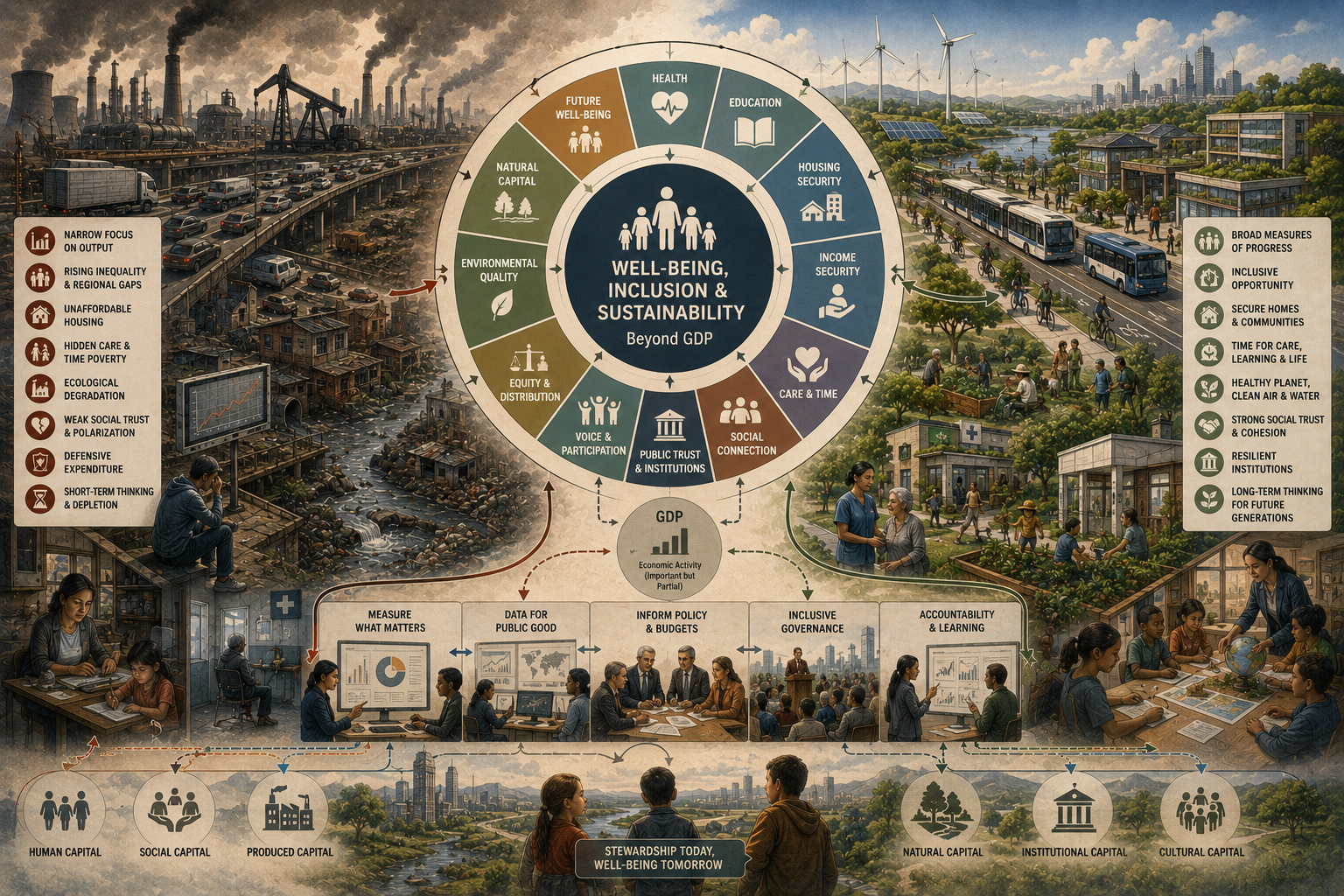
Within a sustainable systems framework, going beyond GDP means asking whether economic life supports broad capability, shared security, ecological stability, and institutional trust rather than treating market output as the final proxy for progress. The deeper question is whether societies can measure what they genuinely value and govern accordingly, instead of allowing a partial indicator to dominate public imagination and policy design.
Why This Topic Matters
Modern societies are often governed through indicators, and indicators shape what becomes visible. When GDP dominates public discussion, policy tends to focus on growth rates, productivity, investment, and output while treating health, care, ecological integrity, social cohesion, time balance, and lived security as secondary or derivative. Yet many of the conditions that make a life go well are weakly captured by output alone.
This matters because a society can become richer in measured production while becoming more strained in ordinary life. Housing costs can rise faster than incomes. Time scarcity can intensify. Care responsibilities can become harder to sustain. Public trust can weaken even in periods of economic expansion. Environmental decline can continue beneath a surface of rising market activity. If these changes do not register in the main narrative of progress, they are easier to discount institutionally.
Going beyond GDP matters because policy needs a wider field of vision. It is not enough to know that the economy is larger than it was. We also need to know whether people are able to convert resources into secure and meaningful lives, whether opportunities are widely shared, and whether current gains are being achieved by undermining future viability.
For that reason, measuring well-being, inclusion, and sustainability is not an optional supplement to economics. It is part of the effort to make public reasoning correspond more closely to the realities societies are actually trying to govern.
What gets measured shapes what gets defended, and what is left unmeasured is often left vulnerable.
The stakes are therefore institutional as well as statistical. A measurement system that privileges market output above all else can make public life less capable of seeing the conditions that actually sustain human flourishing.
Beyond-GDP measurement is not a rejection of economic activity. It is a demand that economic activity be evaluated in relation to life, capability, justice, ecological continuity, and public trust.
What GDP Measures and What It Does Not
GDP measures the monetary value of final goods and services produced within an economy over a specified period. It is useful for summarizing aggregate economic activity and for tracking expansion or contraction across time. It helps governments, firms, and institutions monitor macroeconomic performance and has become a central reference point in national and international economic comparison.
This matters because GDP performs an important but limited task. It is an activity measure, not a comprehensive welfare measure. It records market production, but it does not directly measure whether that production improves life quality, how benefits are distributed, or whether the process of generating output undermines ecological and social systems.
GDP also includes many activities that are not unambiguously signs of progress. Reconstruction after disaster, treatment of pollution-related illness, security spending driven by insecurity, and cleanup after preventable harm can all contribute to GDP while reflecting underlying damage rather than flourishing. At the same time, unpaid care work, community trust, ecological maintenance, and household labor often remain largely invisible within it.
A serious account therefore treats GDP as a useful national accounting tool with clear boundaries.
Its problem is not that it measures nothing important, but that it is too often treated as if it measured everything important.
This distinction is essential. GDP can help answer questions about economic scale and activity, but it cannot answer by itself whether a society is becoming healthier, fairer, more secure, more capable, or more sustainable.
When a measure of production becomes a proxy for progress, the means and ends of economic life become confused.
Why Well-Being Cannot Be Reduced to Output
Well-being includes dimensions of life that exceed market production. Health, education, safety, time balance, social connection, housing security, environmental quality, dignity, political voice, and freedom from chronic stress all contribute to whether life is going well. Income matters, but it is only one part of a wider human picture.
This matters because the relationship between output and well-being is mediated by institutions and distribution. A richer economy may produce better outcomes when public systems are strong and gains are broadly shared. It may also produce stagnating or divergent outcomes if insecurity, inequality, housing pressure, weak public goods, or social fragmentation dominate how resources are lived.
Well-being also has experiential and relational dimensions. People may value belonging, purpose, trust, autonomy, and meaningful time in ways that do not scale directly with consumption. A society organized around rising output but chronic anxiety, loneliness, or exhaustion cannot easily be described as advancing simply because more goods are passing through markets.
A serious framework therefore treats well-being as multidimensional rather than as a byproduct of growth alone.
The question is not merely how much an economy produces, but what kinds of lives its institutions make more or less possible.
Well-being also requires attention to thresholds. Additional income may matter enormously where basic needs are unmet, but beyond certain points social conditions, health, housing, time, trust, ecological quality, and public goods may matter more for lived flourishing.
Beyond-GDP measurement therefore asks whether economic systems are translating resources into human capability, not merely whether resources are increasing in the aggregate.
Inclusion, Distribution, and the Problem of Averages
Aggregate indicators conceal distribution. Average income can rise while particular regions, classes, racial groups, age cohorts, genders, household types, or communities face worsening conditions. Economic growth can coexist with stalled mobility, weakened labor bargaining power, unequal exposure to inflation, concentrated wealth, or deep disparities in access to care, housing, education, and safety.
This matters because averages are politically seductive. They simplify communication, but they can also suppress the visibility of exclusion. A society that is progressing for the top or even the median may not be progressing for those most exposed to instability. Inclusion requires asking who benefits, who lags, who is systematically exposed to loss, and who is able to convert social resources into secure life chances.
Distribution also shapes legitimacy. Public narratives of national success become brittle when lived experience diverges sharply from aggregate claims. Exclusion is not only a social problem; it is also a problem of institutional credibility.
A serious account therefore treats inclusion as essential to any meaningful definition of progress.
Progress that remains narrow in who it reaches will eventually be narrow in what it can sustain politically.
Inclusion also requires more than income distribution. It includes access to institutions, public services, infrastructure, political voice, safety, health, education, mobility, digital systems, and the ability to participate in shared life without humiliation or exclusion.
A beyond-GDP framework therefore asks not only whether the economy is growing, but whether social membership is becoming more secure, more equal, and more practically real.
Sustainability and the Time Problem in Economic Measurement
One of the biggest limitations of GDP is temporal. It records current production, but it does not tell us whether present output is being achieved by drawing down ecological systems, public institutions, social cohesion, care capacity, or other forms of capital that future generations will need. It is good at measuring current flow, but weak at measuring whether the stocks that support future life are being maintained.
This matters because unsustainable systems can look successful in the short term. An economy can expand while eroding soils, depleting aquifers, exhausting workers, widening inequality, undermaintaining infrastructure, and neglecting institutions. In such cases, current output may be partly financed by the liquidation of future capacity.
Sustainability therefore requires a wider accounting frame. We need indicators that register whether natural capital, human capability, public trust, produced infrastructure, and social foundations are strengthening or weakening over time.
A serious framework therefore places time at the center of economic evaluation.
The key question is not only how much is being produced now, but whether the conditions of future flourishing are being preserved, strengthened, or quietly consumed.
This time problem is also ethical. Future generations cannot participate in present markets, but present decisions shape the world they inherit. Measurement systems that ignore depletion and long-run risk make that inheritance less visible.
Sustainability indicators therefore help public institutions distinguish genuine progress from temporary extraction disguised as prosperity.
The Strengths and Limits of GDP
GDP became central for good reasons. It provides a standardized way to monitor economic activity, identify recession or expansion, compare broad macroeconomic performance, and support fiscal and monetary analysis. Policymakers need aggregate measures, and GDP remains a powerful one.
This matters because criticism of GDP should not collapse into dismissal. The problem is misuse, not mere existence. GDP helps answer some questions well: how large is the measured economy, how quickly is it growing, how has aggregate production changed over time, and how severe is a downturn in formal activity. It is much less suited to answering whether growth is inclusive, whether life is better in multidimensional terms, or whether ecological and social systems are being sustained.
The challenge is therefore institutional discipline. GDP should remain part of the measurement system, but not the sovereign indicator that eclipses all others.
A serious account treats GDP as one important instrument within a larger dashboard.
The mistake begins when a measure of activity becomes the dominant measure of social success.
Better measurement does not require abandoning national accounts. It requires placing national accounts inside a broader evaluative architecture that includes distribution, capabilities, care, sustainability, resilience, and public trust.
GDP should be treated as a speedometer, not as the destination.
Health, Education, Security, and Lived Capability
Some of the most important dimensions of progress concern capabilities: whether people are healthy enough to live fully, educated enough to participate meaningfully, secure enough to plan ahead, and supported enough to develop their abilities across the life course. These dimensions shape what people are actually able to be and do.
This matters because income is not identical to capability. Two households with similar income may face very different health burdens, educational access, local safety conditions, environmental quality, disability-related costs, transport access, or care responsibilities. Capabilities are mediated through institutions, infrastructures, and social conditions as much as through money.
Health and education also matter because they shape both present well-being and future possibility. A society that expands output while tolerating deteriorating health, weak schooling, or unequal life chances is not converting its resources into human flourishing as effectively as it could.
A serious framework therefore treats capability as a central bridge between economic means and lived ends.
Well-being is not only about resources possessed, but about the real freedoms those resources make possible in actual social conditions.
This is why public goods matter. Health systems, schools, parks, libraries, transit, safe streets, clean air, and public institutions all shape how people convert income and time into lives they can value.
Beyond-GDP measurement therefore asks whether societies are building capability, not merely circulating money.
Subjective Well-Being and the Value of Lived Experience
Measures of subjective well-being ask people directly about their life satisfaction, emotional balance, sense of meaning, stress, or loneliness. These measures do not replace objective indicators, but they add an important layer of knowledge: how life is experienced from the inside.
This matters because social systems can appear successful institutionally while people feel chronically insecure, lonely, overburdened, or without control over their lives. Conversely, some communities may show forms of resilience and life satisfaction that are not obvious from income data alone.
Subjective well-being also helps remind policy that progress is lived, not only counted. A statistical improvement that leaves everyday life feeling more pressured or less dignified deserves scrutiny rather than automatic celebration.
A serious account therefore treats subjective measures as complements to objective indicators.
They do not settle all questions, but they help keep economic evaluation connected to human experience rather than abstract aggregates alone.
Subjective indicators must be used carefully. Culture, expectations, adaptation, survey design, and social comparison all influence responses. But these complications do not make lived experience irrelevant.
A mature beyond-GDP framework uses subjective and objective evidence together, recognizing that neither income nor self-report alone can fully capture the complexity of human life.
Households, Care, and the Hidden Economy
Much of what sustains life happens outside formal markets. Households raise children, care for elders, manage illness, maintain homes, provide emotional support, coordinate appointments, cook meals, and organize daily reproduction in ways that make paid work and formal production possible. Yet much of this labor remains weakly counted in conventional economic indicators.
This matters because the hidden economy of care is not peripheral. It is part of the substrate on which visible economic life depends. When care systems are strained, the effects spill into labor markets, health systems, education, gender equality, demographic stability, and public finances.
Ignoring care can therefore distort policy. A rise in market activity may partly reflect the monetization of tasks once performed unpaid, or it may coexist with unbearable pressure on households whose work remains invisible in public accounting.
A serious framework therefore treats care as part of real economic life rather than as private background.
Any serious attempt to measure progress must include the conditions under which social reproduction is actually sustained.
Care measurement also reveals power. Unpaid and underpaid care has often been gendered, racialized, privatized, and treated as naturally available. When economic systems depend on this work while failing to value it, their accounts of productivity are incomplete.
Beyond-GDP measurement should therefore include time use, care burdens, public care infrastructure, household stress, and the distribution of reproductive labor.
Inequality, Social Mobility, and Shared Progress
Well-being is shaped not only by average income levels, but by how sharply resources and opportunities are stratified. High inequality can weaken cohesion, reduce mobility, intensify stress, distort political power, and make access to housing, education, health, and security increasingly dependent on inherited position.
This matters because an economy can be rich in aggregate while becoming socially narrow in practice. If income gains concentrate heavily at the top while the median stagnates and the bottom remains precarious, the language of progress becomes harder to defend. Mobility matters because it indicates whether people can realistically improve their life circumstances across time rather than remaining locked into structural disadvantage.
Shared progress therefore requires looking beyond totals toward distributional pathways: wages, wealth, housing access, inheritance, regional inequality, public goods, and social mobility all matter.
A serious account treats inclusion as inseparable from distribution.
Prosperity that becomes increasingly positional is not the same thing as broadly lived improvement.
Inequality also changes how other indicators are experienced. A high average income may coexist with severe housing stress. A strong national education score may conceal deep school segregation. A national health indicator may hide sharp class, racial, or regional gaps.
Beyond-GDP measurement therefore requires disaggregation. Progress must be visible not only at the national level, but across the groups and places where life is actually lived.
Natural Capital, Ecological Pressure, and Future Well-Being
Measures of progress that ignore ecological systems risk confusing current output with lasting welfare. Clean air, stable climate, fertile soils, freshwater systems, biodiversity, and resilient landscapes support life directly and also underpin production, health, and security across time. If these systems weaken, future well-being weakens with them.
This matters because GDP records many market activities associated with resource use and environmental degradation, but does not deduct ecological loss in any comprehensive way. A society may therefore appear to advance while consuming the natural foundations of future capability.
Going beyond GDP means recognizing that sustainability requires more than maintaining income. It requires preserving the ecological stocks and regenerative processes that make continued flourishing possible.
A serious framework therefore treats natural capital and ecological pressure as central to progress measurement rather than as external topics for separate environmental reports.
Future well-being depends on whether present prosperity is being built on stewardship or liquidation.
Ecological measurement also requires caution. Not all ecological values can be fully monetized, and not all natural systems are substitutable. Still, measurement can make depletion, risk, and dependency more visible to public institutions.
The goal is not to reduce nature to a price, but to prevent economic measurement from pretending that ecological loss has no cost.
Composite Indices, Dashboards, and the Problem of Summary Measures
Once the limits of GDP are recognized, a measurement problem follows: should societies use a single alternative index or a dashboard of multiple indicators? Composite indices offer simplicity and communication power. Dashboards preserve nuance and make tradeoffs more visible. Both approaches have strengths and weaknesses.
This matters because summary measures can clarify priorities but also hide internal tensions. A country might improve strongly in one dimension while worsening in another, and an aggregate index may smooth over that conflict. Dashboards avoid some of this, but they can become unwieldy and harder to translate into political attention.
The problem is not purely technical. It concerns what kind of public reasoning measurement should support. A single number is tempting, but social reality is multidimensional.
A serious account therefore treats composite indices and dashboards as tools with different purposes.
The relevant question is whether the chosen framework helps institutions see tradeoffs clearly without losing coherence or public traction.
Composite indices are useful when they communicate a broad direction of progress. Dashboards are useful when they preserve the plurality of values and reveal where progress is uneven. The strongest systems often use both: a public-facing summary plus transparent component indicators.
Measurement design therefore becomes a question of democratic legibility: how to make complex social conditions visible without pretending they can be reduced without remainder.
Human Development, Capabilities, and Multidimensional Progress
One of the most influential efforts to go beyond GDP has been the human development tradition, which emphasizes health, education, and material living standards as core dimensions of progress. The broader capability approach deepens this by asking what real freedoms people have to live the kinds of lives they value.
This matters because it moves the focus from output to people. Development is no longer treated mainly as growth in national production, but as the expansion of substantive human possibility. That shift has influenced global and national debates by making multidimensional progress more legible institutionally.
Human development thinking also helps clarify that the economy is a means rather than the end. Production matters because it can support healthier, freer, more secure lives, not because expansion is inherently valuable in itself.
A serious framework therefore treats multidimensional development as one of the clearest alternatives to growth-centered evaluation.
Its strength lies in reconnecting economic assessment with human ends rather than stopping at national output.
The capability lens also helps explain why equal resources do not automatically produce equal freedom. Disability, discrimination, geography, public services, household structure, health conditions, and local institutions all shape what people can actually do with the resources available to them.
Beyond-GDP measurement therefore should not only count goods; it should examine conversion conditions—the social and institutional arrangements that turn resources into real opportunities.
Inclusive Wealth, Adjusted Savings, and Intergenerational Accounting
Another response to GDP’s limits has focused on wealth across time rather than output in the present. Inclusive wealth, adjusted savings, and related measures attempt to account for whether produced capital, human capital, natural capital, and institutional foundations are being maintained or depleted. These approaches ask whether a society is passing on a stronger or weaker foundation to the future.
This matters because current income can coexist with declining wealth once ecological depletion, pollution damage, underinvestment, or erosion of capabilities is considered. A society may therefore appear successful in flow terms while becoming poorer in a deeper intergenerational sense.
Intergenerational accounting also raises difficult questions of valuation and uncertainty. Not all future losses are easily priced, and not all forms of natural or social capital are substitutable. Even so, these approaches improve public reasoning by forcing time and stock maintenance into the frame.
A serious account therefore treats wealth-based sustainability measures as an important counterweight to output-only thinking.
They help reveal whether present prosperity is being achieved by strengthening or weakening the inheritance future generations will receive.
Inclusive wealth also changes the meaning of fiscal and development policy. Investment in education, health, ecosystem restoration, public infrastructure, and institutional trust becomes part of maintaining society’s long-term productive and human foundation.
In that sense, beyond-GDP measurement asks whether societies are building durable wealth, not merely recording current throughput.
The SDGs, National Statistics, and Policy Governance
Efforts to go beyond GDP have taken institutional form through broader statistical systems and policy frameworks. National well-being dashboards, sustainable development indicators, human development metrics, inclusive-wealth approaches, and multidimensional reporting systems attempt to connect measurement with practical governance across health, education, inequality, environment, gender, infrastructure, and institutional quality.
This matters because measurement only matters politically when it is connected to institutions. Indicators that remain decorative rarely change policy. Indicators linked to budgeting, planning, public reporting, procurement, regulation, and evaluation have a better chance of influencing how priorities are set.
Broader frameworks also help reveal interdependence. Housing, health, transport, care, education, ecological quality, and public trust are not isolated domains. Better measurement can help institutions see where progress in one field depends on investment in another.
A serious framework therefore treats beyond-GDP measurement as a governance project rather than a purely academic exercise.
The issue is whether richer indicators can become part of how states actually reason about progress, not merely how they describe it rhetorically.
This requires statistical capacity, institutional independence, public communication, open data, and clear links between indicators and policy decisions. Without those connections, even excellent dashboards can become symbolic reports with little consequence.
Measurement reform succeeds when it changes what public institutions are able and expected to see.
Local Context, Public Trust, and the Politics of Measurement
Measures of well-being are never entirely neutral. They reflect choices about what counts, whose experiences matter, and which dimensions of life deserve public visibility. Local context matters because priorities differ across places, histories, ecologies, institutions, and lived conditions.
This matters because people are more likely to trust measurement systems that connect with lived reality. A community facing polluted water, insecure housing, weak transit, or hospital closures may find national claims of progress unconvincing if the metrics ignore those pressures. Statistical legitimacy depends partly on whether indicators resonate with how people actually experience their conditions.
The politics of measurement also concerns voice. Who defines progress? Technocrats, governments, international institutions, communities, or some combination of them? These choices influence both legitimacy and usefulness.
A serious account therefore treats measurement as part of democratic governance rather than as a purely technical matter.
Indicators shape public imagination, and public trust depends on whether that imagination feels recognizably grounded.
Local measurement can also surface problems hidden by national averages. Regional deprivation, rural service gaps, urban pollution corridors, housing pressure, climate vulnerability, and unequal access to care may all disappear inside aggregate success stories.
Beyond-GDP measurement therefore should combine national coherence with local relevance, allowing communities to see themselves in the indicators used to govern them.
Measurement, Rankings, and the Risk of Perverse Incentives
Indicators can improve governance, but they can also distort it. Once measures become tied to rankings, funding, prestige, or electoral narratives, institutions may optimize for what is counted rather than for what is substantively needed. Narrow targets can produce gaming, symbolic compliance, or neglect of harder-to-measure goods.
This matters because going beyond GDP does not solve the politics of metrics automatically. A broader measurement system can still become reductive if institutions chase the index instead of the underlying reality. Composite scores may reward cosmetic improvement while masking deeper fragility.
The solution is not to abandon indicators, but to use them with institutional humility. Measures should inform judgment, not replace it.
A serious framework therefore treats metrics as aids to public reasoning rather than mechanical substitutes for it.
Good measurement expands visibility; it should not narrow reality into whatever is easiest to rank.
Perverse incentives are especially likely when indicators are detached from local knowledge or when institutions are punished for revealing real problems. A good measurement system should reward truthfulness, learning, and correction rather than image management.
Beyond-GDP measurement therefore requires governance safeguards: transparent methods, public participation, qualitative context, auditability, and a willingness to revise indicators when they distort behavior.
Historical Lessons from Growth-Centered Development
Twentieth-century development strategies often treated growth as the master variable. In many contexts this made sense: industrialization, mass education, public health, electrification, housing, and infrastructure required expanded productive capacity. Yet history also shows that growth-centered development often tolerated ecological damage, gendered care burdens, authoritarian exclusion, regional neglect, and inequality so long as output expanded.
This matters because it reveals both the achievements and the blind spots of growth-first policy. Growth can support major gains in life expectancy, literacy, public health, and basic welfare when paired with strong institutions and redistribution. It can also entrench damage when distribution, care, environment, and political voice remain secondary.
The historical lesson is not that growth never matters. It is that growth alone is too blunt an indicator of what societies are becoming.
A serious historical perspective therefore treats beyond-GDP thinking as an attempt to correct a long pattern of partial vision rather than as a rejection of material development itself.
The aim is not to stop measuring production, but to stop mistaking production for the whole meaning of progress.
History also shows that measurement regimes often reflect political priorities. When states prioritize industrial output, they build systems that see industrial output clearly. When they prioritize welfare, sustainability, and capability, they need systems that can see those conditions clearly too.
Beyond-GDP measurement is therefore part of a broader institutional shift: from growth as the dominant public story to progress as multidimensional, distributive, ecological, and intergenerational.
Beyond GDP and Sustainable Systems
Within sustainable systems, going beyond GDP is essential because sustainability is ultimately a question of whether societies can maintain and improve life conditions across time without eroding the ecological, social, and institutional systems on which those conditions depend. Output matters, but it cannot answer that question alone.
This changes the evaluative frame. Progress must be assessed in terms of capability, distribution, ecological stewardship, public trust, care, resilience, and long-run viability. A system that grows while hollowing out those foundations is not succeeding in a durable sense, even if conventional macroeconomic indicators look strong.
Sustainable systems therefore require plural measurement. They require indicators capable of showing whether present gains are inclusive, whether future conditions are being protected, and whether institutions are supporting lives people can actually flourish within.
In this sense, beyond GDP becomes a systems question. It asks whether societies can align what they measure with what they genuinely need to sustain.
This also means that measurement reform is not peripheral. It is part of the architecture of better governance in a world where output alone no longer provides an adequate map of collective reality.
A sustainable measurement system would preserve GDP as one useful indicator while placing it alongside well-being, distribution, care, ecological pressure, subjective experience, public trust, and intergenerational wealth.
The central challenge is to build public institutions that can see the whole economy of life, not only the portion that passes through markets.
How Beyond-GDP Systems Should Be Judged
Beyond-GDP measurement systems should not be judged only by whether they produce a better headline number. A broader economic systems framework asks whether measurement makes well-being, inclusion, sustainability, care, capability, ecological pressure, and institutional trust visible enough to improve public reasoning and policy design.
| Dimension | Narrow Question | Systems Question |
|---|---|---|
| GDP | Is output rising? | Is output being translated into broadly shared, durable, and meaningful improvement? |
| Well-Being | Are people richer? | Are people healthier, safer, housed, educated, connected, and able to live with dignity? |
| Inclusion | Is the average improving? | Who benefits, who is excluded, and how are gains distributed across groups and places? |
| Capability | Do people have resources? | Can people actually convert resources into real freedoms under existing social conditions? |
| Care | Is paid work growing? | Are unpaid care, household labor, time stress, and social reproduction being recognized and supported? |
| Sustainability | Is current income high? | Are natural, human, institutional, and produced capital being maintained for future generations? |
| Ecology | Is environmental damage reported separately? | Are ecological pressures treated as central to future well-being and economic viability? |
| Subjective Experience | Do objective indicators look strong? | Do people experience their lives as secure, meaningful, connected, and dignified? |
| Dashboard Design | Is there a composite score? | Does the framework preserve tradeoffs, disaggregation, uncertainty, and public legibility? |
| Governance | Are indicators published? | Are indicators linked to budgeting, planning, accountability, public trust, and institutional learning? |
This framework prevents a common mistake: treating beyond-GDP measurement as a purely statistical exercise. The point is not simply to create more indicators. The point is to make public reasoning more truthful about what societies are trying to sustain.
The central issue is therefore not whether GDP should disappear. The deeper question is whether GDP can be placed in proper relation to the fuller conditions of human and ecological flourishing.
Mathematical Lens
Mathematics can clarify beyond-GDP measurement by separating activity, well-being, inclusion, sustainability, adjusted progress, and capability. These equations do not determine how society should weigh each dimension, but they help show what GDP alone leaves out.
1. GDP Relation
GDP = C + I + G + (X – M)
\]
Interpretation: GDP equals consumption \(C\), investment \(I\), government spending \(G\), and net exports \(X – M\). This is useful for measuring aggregate activity, but it says little directly about well-being, inclusion, or sustainability.
2. Well-Being Dashboard
WB = f(Health, Education, Income\ Security, Housing, Safety, Social\ Connection, Environment)
\]
Interpretation: Well-being \(WB\) is multidimensional. It depends on multiple interacting conditions, not only output or income.
3. Inclusion Relation
IN = f(Distribution, Mobility, Access, Voice)
\]
Interpretation: Inclusion \(IN\) depends on distribution, social mobility, access to goods and services, and meaningful voice. Average prosperity does not automatically imply shared progress.
4. Sustainability Relation
SW = f(Natural\ Capital, Human\ Capital, Institutional\ Trust, Produced\ Capital)
\]
Interpretation: Sustainable well-being \(SW\) depends on maintaining the stocks that support future life, including natural, human, institutional, and produced capital.
5. Adjusted Progress
AP = Current\ Benefits – Social\ Costs – Ecological\ Costs
\]
Interpretation: Adjusted progress \(AP\) interprets current gains alongside harm, depletion, exclusion, and defensive costs. It prevents all activity from being treated as improvement.
6. Capability Relation
CA = f(Resources, Public\ Goods, Conversion\ Conditions)
\]
Interpretation: Capability \(CA\) depends on resources, public goods, and conversion conditions. Income becomes well-being only under supportive social and institutional arrangements.
7. Care Visibility
CV = f(Unpaid\ Care, Time\ Balance, Formal\ Recognition, Support\ Services)
\]
Interpretation: Care visibility \(CV\) makes household labor, time stress, and social reproduction part of economic evaluation rather than leaving them outside the formal picture of progress.
8. Practical Interpretation
The mathematical lens clarifies several structural points. GDP measures activity, not the whole of social progress. Well-being is multidimensional rather than reducible to output. Inclusion depends on distribution, access, mobility, and voice. Sustainability depends on the maintenance of future-supporting stocks. Capabilities depend on institutions and public goods as well as income.
Formalization helps clarify structure, but it does not determine which dimensions deserve the most weight, how tradeoffs should be governed, or what threshold of inequality or ecological loss is unacceptable. Those remain institutional, ethical, ecological, and political questions.
Python Workflow: Beyond GDP, Well-Being, Inclusion, and Sustainability
Python is useful for turning beyond-GDP concepts into reproducible dashboards. The following compact workflow models GDP, well-being, inclusion, sustainability, adjusted progress, and capability conversion.
# Beyond GDP: Measuring Well-Being, Inclusion, and Sustainability
# Simple Python workflow

import pandas as pd

# GDP identity
consumption = 620
investment = 180
government = 150
net_exports = -20

gdp = consumption + investment + government + net_exports

print("GDP:", gdp)

# Well-being dashboard
health = 0.74
education = 0.71
income_security = 0.63
housing = 0.58
safety = 0.69
social_connection = 0.61
environment = 0.57
time_balance = 0.55

wellbeing_score = sum([
    health,
    education,
    income_security,
    housing,
    safety,
    social_connection,
    environment,
    time_balance
]) / 8

print("Well-being score:", round(wellbeing_score, 3))

# Inclusion score
distribution = 0.55
mobility = 0.52
access = 0.64
voice = 0.59
regional_equity = 0.50
service_reach = 0.62

inclusion_score = (
    0.22 * distribution
    + 0.18 * mobility
    + 0.20 * access
    + 0.18 * voice
    + 0.12 * regional_equity
    + 0.10 * service_reach
)

print("Inclusion score:", round(inclusion_score, 3))

# Sustainability score
natural_capital = 0.54
human_capital = 0.72
institutional_trust = 0.56
produced_capital = 0.68
maintenance_gap = 0.42
ecological_pressure = 0.58

sustainability_score = (
    0.26 * natural_capital
    + 0.22 * human_capital
    + 0.20 * institutional_trust
    + 0.16 * produced_capital
    + 0.08 * (1 - maintenance_gap)
    + 0.08 * (1 - ecological_pressure)
)

print("Sustainability score:", round(sustainability_score, 3))

# Adjusted progress
current_benefits = 930
social_costs = 120
ecological_costs = 150
defensive_expenditure = 60
unpaid_care_value = 190
public_goods_value = 160

adjusted_progress = (
    current_benefits
    - social_costs
    - ecological_costs
    - defensive_expenditure
    + unpaid_care_value
    + public_goods_value
)

adjusted_progress_ratio = adjusted_progress / current_benefits

print("Adjusted progress:", adjusted_progress)
print("Adjusted progress ratio:", round(adjusted_progress_ratio, 3))

# Capability conversion
resources = 0.56
public_goods = 0.68
conversion_conditions = 0.62
discrimination_barrier = 0.24

capability_score = (
    0.30 * resources
    + 0.32 * public_goods
    + 0.26 * conversion_conditions
    + 0.12 * (1 - discrimination_barrier)
)

print("Capability score:", round(capability_score, 3))

df = pd.DataFrame({
    "Metric": [
        "GDP",
        "Well-Being Score",
        "Inclusion Score",
        "Sustainability Score",
        "Adjusted Progress",
        "Adjusted Progress Ratio",
        "Capability Score"
    ],
    "Value": [
        gdp,
        wellbeing_score,
        inclusion_score,
        sustainability_score,
        adjusted_progress,
        adjusted_progress_ratio,
        capability_score
    ]
})

print(df)
This workflow is useful because it places GDP inside a wider evaluative dashboard rather than allowing output to dominate the whole interpretation of progress. It helps show why economic activity, well-being, inclusion, sustainability, and capability can diverge.
The full GitHub repository expands this example into GDP dashboard scenarios, inclusion scoring, sustainability-stock analysis, adjusted-progress calculations, care and time-use metrics, subjective well-being comparisons, capability conversion, indicator governance, SQL queries, R and Stata replication workflows, Julia simulations, and article-ready figures.
R Workflow: Beyond GDP, Well-Being, Inclusion, and Sustainability
R is useful for well-being dashboards, indicator summaries, inclusion comparisons, sustainability-stock tables, and publication-ready graphics. The following compact workflow performs the same GDP, well-being, inclusion, sustainability, adjusted-progress, and capability calculations in R.
# Beyond GDP: Measuring Well-Being, Inclusion, and Sustainability
# Simple R workflow

# GDP identity
consumption <- 620
investment <- 180
government <- 150
net_exports <- -20

gdp <- consumption + investment + government + net_exports

cat("GDP:", gdp, "\n")

# Well-being dashboard
health <- 0.74
education <- 0.71
income_security <- 0.63
housing <- 0.58
safety <- 0.69
social_connection <- 0.61
environment <- 0.57
time_balance <- 0.55

wellbeing_score <- mean(c(
  health,
  education,
  income_security,
  housing,
  safety,
  social_connection,
  environment,
  time_balance
))

cat("Well-being score:", round(wellbeing_score, 3), "\n")

# Inclusion score
distribution <- 0.55
mobility <- 0.52
access <- 0.64
voice <- 0.59
regional_equity <- 0.50
service_reach <- 0.62

inclusion_score <- (
  0.22 * distribution +
  0.18 * mobility +
  0.20 * access +
  0.18 * voice +
  0.12 * regional_equity +
  0.10 * service_reach
)

cat("Inclusion score:", round(inclusion_score, 3), "\n")

# Sustainability score
natural_capital <- 0.54
human_capital <- 0.72
institutional_trust <- 0.56
produced_capital <- 0.68
maintenance_gap <- 0.42
ecological_pressure <- 0.58

sustainability_score <- (
  0.26 * natural_capital +
  0.22 * human_capital +
  0.20 * institutional_trust +
  0.16 * produced_capital +
  0.08 * (1 - maintenance_gap) +
  0.08 * (1 - ecological_pressure)
)

cat("Sustainability score:", round(sustainability_score, 3), "\n")

# Adjusted progress
current_benefits <- 930
social_costs <- 120
ecological_costs <- 150
defensive_expenditure <- 60
unpaid_care_value <- 190
public_goods_value <- 160

adjusted_progress <- (
  current_benefits -
  social_costs -
  ecological_costs -
  defensive_expenditure +
  unpaid_care_value +
  public_goods_value
)

adjusted_progress_ratio <- adjusted_progress / current_benefits

cat("Adjusted progress:", adjusted_progress, "\n")
cat("Adjusted progress ratio:", round(adjusted_progress_ratio, 3), "\n")

# Capability conversion
resources <- 0.56
public_goods <- 0.68
conversion_conditions <- 0.62
discrimination_barrier <- 0.24

capability_score <- (
  0.30 * resources +
  0.32 * public_goods +
  0.26 * conversion_conditions +
  0.12 * (1 - discrimination_barrier)
)

cat("Capability score:", round(capability_score, 3), "\n")

summary_df <- data.frame(
  Metric = c(
    "GDP",
    "Well-Being Score",
    "Inclusion Score",
    "Sustainability Score",
    "Adjusted Progress",
    "Adjusted Progress Ratio",
    "Capability Score"
  ),
  Value = c(
    gdp,
    wellbeing_score,
    inclusion_score,
    sustainability_score,
    adjusted_progress,
    adjusted_progress_ratio,
    capability_score
  )
)

print(summary_df)
This R workflow is deliberately compact for article readability. In the full repository, R reads structured GDP-dashboard, inclusion, sustainability-stock, adjusted-progress, capability, care, subjective-well-being, and indicator-governance scenarios; calculates GDP, well-being scores, inclusion scores, sustainability scores, adjusted progress, capability scores, and article-ready graphics.
Future Economic Systems articles can extend this foundation with national accounts, household surveys, labor-force data, time-use data, subjective well-being surveys, health and education data, environmental accounts, natural-capital accounts, fiscal data, regional inequality indicators, social mobility data, and administrative service-access data.
GitHub Repository
The article body includes selected computational examples so the conceptual, institutional, and mathematical argument remains readable. The full repository contains the expanded research infrastructure: Python beyond-GDP analysis, R well-being dashboards, Stata applied indicator replication workflows, SQL measurement-system scenario tables, Julia dashboard and sustainability-stock simulations, GDP identities, inclusion scoring, capability conversion, adjusted progress, care and time-use metrics, subjective well-being, indicator-governance analysis, documentation, reproducible sample data, and article-ready figures and tables.
Complete Code Repository
The full code distribution for this article, including selected article examples and advanced research-style computational scaffolding for GDP identities, well-being dashboards, inclusion scoring, sustainability stocks, natural capital, capability conversion, care and unpaid work, subjective well-being, adjusted progress, inclusive wealth logic, indicator governance, ranking risk, reproducibility documentation, and cross-language economic analysis, is available on GitHub.
Conclusion
Beyond GDP: measuring well-being, inclusion, and sustainability is central to economic analysis because it shows that aggregate output is too narrow to stand for the full quality of collective life. A society can produce more while becoming less secure, less equal, less healthy, less trusting, or less ecologically durable, and no serious account of progress can afford to ignore that possibility.
To understand a social system seriously, one must therefore ask not only how much it produces, but whether people can convert resources into meaningful lives, whether gains are shared, whether care and public goods are strong, and whether the ecological and institutional foundations of future well-being are being preserved. These questions reveal whether growth is being translated into durable flourishing or whether a partial indicator is being mistaken for the whole reality of progress.
The serious study of progress also requires humility about metrics. No single number can capture all dimensions of human and ecological life. But better measurement can improve what societies notice, what institutions prioritize, and what public reasoning is able to defend.
In a sustainable economic system, GDP should remain visible but bounded. It should be surrounded by measures of health, education, housing, care, time, distribution, ecological stability, subjective experience, public trust, and intergenerational wealth. The goal is not to count everything mechanically. It is to govern with a fuller understanding of what makes life livable, just, and durable across time.
Related Reading
- Economic Systems
- Climate Economics, Transition Policy, and Decarbonization
- Ecological Economics and the Embedded Economy
- Natural Capital, Resource Use, and Environmental Constraint
- Public Finance, State Capacity, and Collective Goods
- Inequality, Redistribution, and Social Mobility
- Political Economy, Power, and Distributional Conflict
- Sustainable Development
- Institutions & Governance
- Risk & Resilience
Further Reading
- Organisation for Economic Co-operation and Development (OECD) (2024). How’s Life? 2024: Well-being and Resilience in Times of Crisis. Available at: https://www.oecd.org/en/publications/how-s-life-2024_90ba854a-en.html
- Organisation for Economic Co-operation and Development (OECD) (n.d.). Well-being Data Monitor. Available at: https://www.oecd.org/en/data/tools/well-being-data-monitor.html
- Sen, A. (1999). Development as Freedom. Oxford: Oxford University Press. Available at: https://global.oup.com/academic/product/development-as-freedom-9780192893307
- Stiglitz, J.E., Sen, A. and Fitoussi, J.-P. (2009). Report by the Commission on the Measurement of Economic Performance and Social Progress. Available at: https://ec.europa.eu/eurostat/documents/118025/118123/Fitoussi+Commission+report
- United Nations Development Programme (UNDP) (n.d.). Human Development Reports Data Center. Available at: https://hdr.undp.org/data-center
- United Nations (n.d.). Sustainable Development Goals. Available at: https://sdgs.un.org/
- United Nations System of Environmental-Economic Accounting (SEEA) (n.d.). Natural capital and ecosystem accounting. Available at: https://seea.un.org/
- World Bank (n.d.). Adjusted Net Savings and Genuine Saving Indicators. Available at: https://databank.worldbank.org/source/adjusted-net-savings/preview/on
References
- Organisation for Economic Co-operation and Development (OECD) (2024). How’s Life? 2024: Well-being and Resilience in Times of Crisis. Available at: https://www.oecd.org/en/publications/how-s-life-2024_90ba854a-en.html
- Organisation for Economic Co-operation and Development (OECD) (n.d.). Well-being Data Monitor. Available at: https://www.oecd.org/en/data/tools/well-being-data-monitor.html
- Sen, A. (1999). Development as Freedom. Oxford: Oxford University Press. Available at: https://global.oup.com/academic/product/development-as-freedom-9780192893307
- Stiglitz, J.E., Sen, A. and Fitoussi, J.-P. (2009). Report by the Commission on the Measurement of Economic Performance and Social Progress. Available at: https://ec.europa.eu/eurostat/documents/118025/118123/Fitoussi+Commission+report
- United Nations (n.d.). Sustainable Development Goals. Available at: https://sdgs.un.org/
- United Nations Development Programme (UNDP) (n.d.). Human Development Reports Data Center. Available at: https://hdr.undp.org/data-center
- United Nations System of Environmental-Economic Accounting (SEEA) (n.d.). Natural capital and ecosystem accounting. Available at: https://seea.un.org/
- World Bank (n.d.). Adjusted Net Savings and Genuine Saving Indicators. Available at: https://databank.worldbank.org/source/adjusted-net-savings/preview/on