
Last Updated May 10, 2026
The future of economic systems in an age of limits begins from a proposition that has become increasingly difficult to avoid: economies can no longer be treated as self-justifying engines of expansion operating independently of ecological ceilings, social strain, and institutional fragility. Contemporary economic systems face converging pressures from climate change, biodiversity loss, resource overuse, pollution, demographic change, geopolitical fragmentation, infrastructure stress, public debt, energy transition, digital disruption, and widening inequality. These pressures do not imply one predetermined future. They do mean that the inherited assumptions of economic governance are becoming harder to defend.
For much of the modern industrial era, economic development was organized around expansion: more output, more energy, more infrastructure, more trade, more extraction, more consumption, and more financial depth. That model produced major gains in public health, mass education, industrial capacity, infrastructure, and material security in many places. But it also depended on cheap fossil energy, rising material throughput, ecological externalization, colonial and global extraction, weak valuation of care, and confidence that future growth could smooth over social conflict. In an age of limits, those assumptions become less stable.
The future of economic systems, then, is not simply a question of forecasting which industries will rise or fall. It is a question of what kind of economic order can remain governable, legitimate, and materially viable under conditions of ecological constraint and social demand. It requires rethinking how economies measure success, organize public goods, allocate risk, coordinate transition, govern technology, direct finance, protect vulnerable groups, and preserve the ecological foundations of future wellbeing.
Main Library
Publications
Article Map
Economic Systems
Related Topic
Sustainable Development
Related Topic
Risk & Resilience
Related Topic
Institutions & Governance
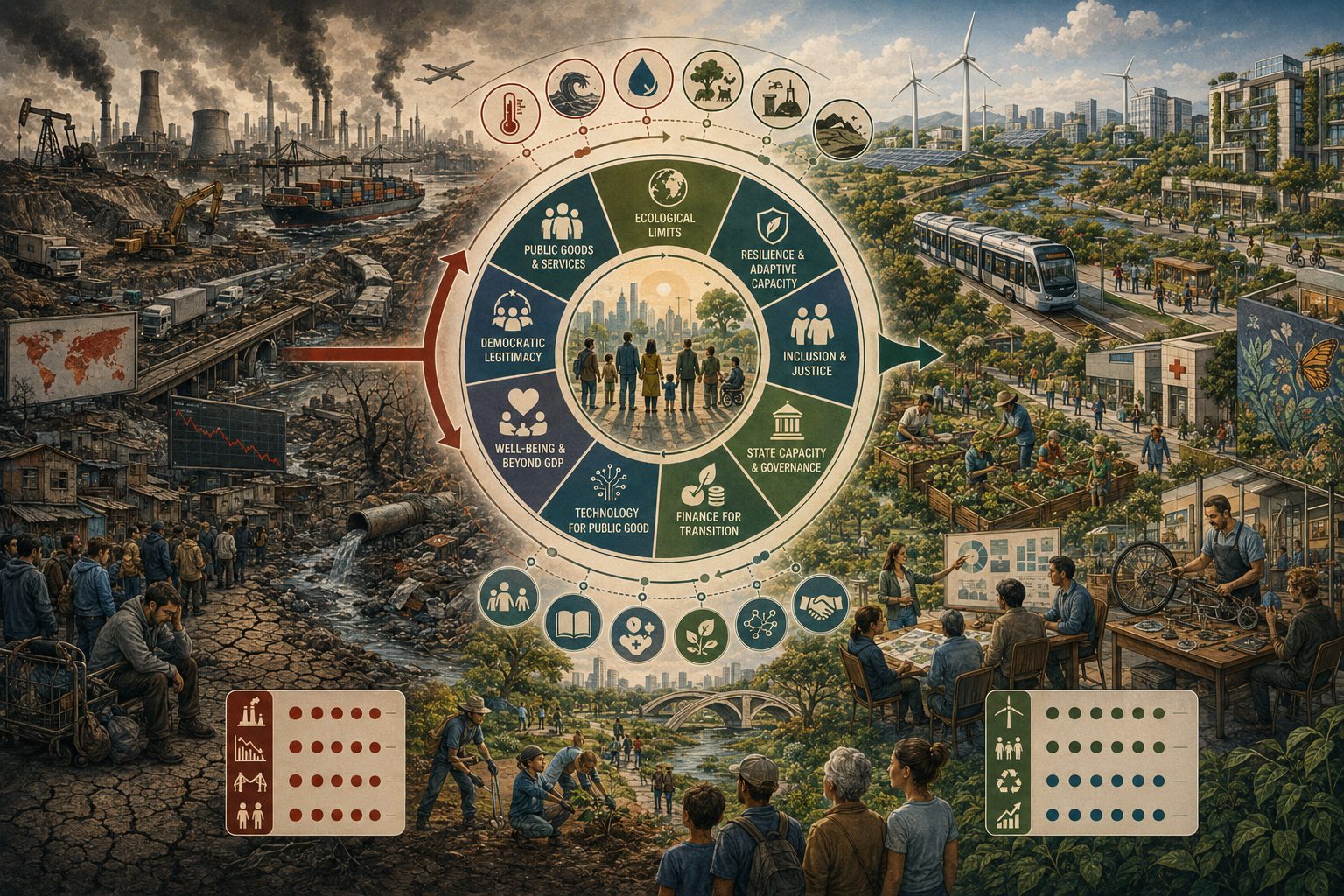
Within a sustainable systems framework, the future of economic systems in an age of limits should be examined not as a narrow question of efficiency, but as a question of resilience, justice, sufficiency, institutional redesign, public capacity, and long-run capability. The deeper issue is whether economic life can be reorganized to remain compatible with Earth-system stability and human dignity at the same time.
Why This Topic Matters
For much of the industrial era, the dominant economic question was how to expand production. Today the harder question is how to maintain flourishing under pressure. Climate hazards, ecological decline, geopolitical fragmentation, and widening inequality now interact with public debt, aging infrastructure, fragile supply chains, demographic change, energy transition, digital disruption, and weak institutional trust. The future of economic systems will therefore be shaped less by abstract equilibrium and more by how societies handle interdependence, scarcity, transition, legitimacy, and accumulated fragility.
This matters because systems that remain organized around short-horizon extraction and narrow output metrics may continue to generate activity while weakening the ecological and social conditions that make long-run stability possible. A society can produce more while becoming less affordable, less equal, less ecologically stable, less institutionally trusted, and less resilient under stress. If economic governance continues to treat output as a sufficient proxy for progress, it may become less capable of seeing the risks it is helping to produce.
The future of economic systems is therefore not simply a future of cleaner technologies or new industries. It is a future of institutional choices. Societies will have to decide what should grow, what should contract, what should be maintained, what should be repaired, what should be protected from markets, and what kinds of economic activity can remain legitimate under ecological constraint.
A serious approach must ask whether economic systems can support human dignity while reducing ecological pressure, widening capability, building public trust, and preserving the material foundations of life.
The question is no longer only how much economies can produce. It is what they preserve, whom they protect, how they adapt, and whether their apparent success can endure.
That makes the future of economic systems a question of political economy, public purpose, ecological realism, and civilizational design rather than a narrow exercise in forecasting.
Limits and the End of the Old Assumptions
The “age of limits” does not mean that all growth stops or that innovation becomes irrelevant. It means that old assumptions of effectively open ecological frontiers, cheap disposal, endlessly expandable material throughput, and unlimited atmospheric and ecological absorption are no longer credible. Economies are materially embedded systems. They require energy, land, minerals, water, infrastructures, social reproduction, political legitimacy, and ecological stability.
This shift changes the meaning of economic realism. A model that once appeared practical because it raised output may become unrealistic if it depends on ecological degradation, unstable energy systems, fragile supply chains, unaffordable housing, financial overextension, or public institutions too weak to coordinate transition. The age of limits therefore does not simply introduce environmental constraints. It exposes the fragility of economic assumptions that treated nature, care, public trust, and future generations as background conditions.
Once those assumptions weaken, economic systems face a legitimacy problem as well as a material one. A model that promises universal improvement through continuous expansion becomes harder to defend when the same expansion deepens ecological destabilization, uneven exposure to harm, and institutional strain.
A serious framework therefore treats limits as systemic conditions rather than external inconveniences.
The question is no longer whether limits exist; it is whether governance will adjust to them in time.
Limits also clarify why marginal reform may be insufficient. Cleaner technologies, better markets, and efficiency gains matter, but if total pressure continues to rise, the system remains misaligned with ecological reality. A future economic order must therefore address scale, distribution, institutions, and purpose together.
The end of the old assumptions does not end economic possibility. It changes what responsible possibility means.
From Growth-First to Boundary-Aware Governance
One likely feature of future economic systems is a gradual move from growth-first governance toward more boundary-aware governance. That does not mean GDP disappears from policy. It means GDP is increasingly joined by indicators of well-being, resilience, emissions, material throughput, ecological condition, distribution, public trust, and future capability.
Boundary-aware governance changes policy priorities. Instead of asking only how to maximize output, it asks how to maintain decent lives within ecological ceilings. That pushes public policy toward energy transition, circular material systems, public goods, infrastructure adaptation, ecological restoration, care systems, and more explicit attention to distributional justice.
This also changes the role of the state. Governments become not merely referees of market activity, but coordinators of transition under constraint. They must help set direction, manage risk, protect vulnerable groups, invest in public goods, regulate destructive activity, and create measurement systems that reveal whether progress is real or merely statistical.
A serious framework therefore treats boundary-aware governance as a new operating logic for economic systems.
The future of economic systems will likely be judged increasingly by whether they can coordinate ecological limits, social foundations, and institutional legitimacy rather than by whether they can simply produce more.
Boundary-aware governance also requires public learning. The relevant boundaries are not only ecological. They include fiscal capacity, social tolerance, household stress, infrastructure durability, and political legitimacy. A system that respects ecological limits while breaking social trust will not endure. A system that protects short-term comfort by ignoring ecological limits will not endure either.
The task is to govern ceilings and foundations together.
The Future Will Be Plural, Not Singular
There is unlikely to be a single “next” economic model. More plausibly, the future will involve competing hybrids: greener versions of market capitalism, stronger public-investment states, boundary-aware social democracies, circular and regenerative industrial systems, uneven post-growth experiments, public-good-centered local economies, and regions that remain more deeply tied to extractive or fossil-intensive models.
This pluralism matters because transition will be shaped by starting conditions. Wealthier states with stronger administrative capacity, deeper fiscal space, and more technological capability may move faster on infrastructure, measurement reform, and clean-technology deployment. More vulnerable states may face tighter tradeoffs between development, debt, adaptation, and ecological protection. Regions dependent on fossil fuels, resource extraction, monocrop agriculture, or narrow industrial bases will face different transition pressures than diversified metropolitan economies.
Pluralism also means conflict. Future economic systems will not evolve through technical consensus alone. Different groups will fight over costs, benefits, land, energy, taxation, labor, technology, finance, and the meaning of prosperity. Some actors will benefit from transition; others will defend inherited assets and privileges.
A serious account therefore treats the future as path-dependent and contested rather than uniform.
The future will not be one model replacing another everywhere. It will be a struggle among competing institutional responses to the same age of limits.
This also means that experimentation matters. Local systems, regional strategies, public investment models, cooperative forms, circular industrial clusters, and national policy frameworks may all become laboratories for what future viability looks like in practice.
The question is not which single model will win, but which combinations of institutions can remain livable, legitimate, and ecologically compatible over time.
Energy Systems After Fossil Abundance
Any serious future economic system will be shaped by how it handles energy transition. Systems organized around cheap fossil abundance are increasingly unstable environmentally, geopolitically, financially, and infrastructurally. Even where fossil fuels persist for some time, the direction of pressure is clear: economies must confront the risks of carbon dependence, energy volatility, stranded assets, and the physical consequences of climate change.
The future therefore points toward electrification, grid expansion, renewable deployment, efficiency, storage, demand management, and more active governance of reliability and affordability. But the question is not purely technical. Energy systems shape regional politics, industrial strategy, household security, public legitimacy, geopolitical dependence, and the distribution of costs and benefits.
Future economic systems that manage energy transition badly may deepen inequality and backlash. If decarbonization appears as higher bills, lost jobs, unreliable infrastructure, and elite opportunity, it will struggle politically. Systems that align energy change with public investment, visible social benefit, local employment, household protection, and industrial renewal are more likely to endure.
A serious framework therefore treats energy transition as political economy, not only engineering.
The future energy system must be clean enough for ecological viability, reliable enough for social trust, affordable enough for legitimacy, and just enough to avoid becoming a new form of exclusion.
Energy transition also raises material questions. Batteries, grids, turbines, solar panels, transmission lines, and electrified transport all require minerals, land, labor, water, and governance. A serious future system must therefore avoid replacing fossil dependence with another extractive model that reproduces ecological harm and global injustice.
The energy future is not only about changing fuels. It is about changing the institutional basis of power, security, and development.
Material Throughput, Resource Pressure, and Industrial Redesign
Future economic systems will also be judged by how they handle material throughput. Resource use is central to climate pressure, biodiversity loss, land transformation, water stress, pollution, and waste. That means industrial redesign cannot stop at cleaner energy alone. It must also address extraction, product life, waste, repair, circularity, material efficiency, and total material demand.
This suggests a future in which circular and regenerative logics become more central. Repair, remanufacturing, reuse, modular design, lower waste intensity, maintenance cultures, shared infrastructure, public procurement standards, and stronger right-to-repair systems are likely to matter more in economies that can no longer assume unlimited cheap material inflows and carefree disposal.
The future of industrial strategy may therefore depend less on how fast materials move and more on how intelligently value is retained. A linear model extracts, produces, consumes, discards, and replaces. A future-oriented model asks how systems can preserve usefulness, reduce waste, regenerate ecological foundations, and design products for maintenance rather than obsolescence.
A serious framework therefore treats throughput as a design problem, not merely an environmental afterthought.
The economy of the future will need to produce value with less destructive material metabolism.
This does not mean all material production becomes suspect. Housing, transit, hospitals, water systems, energy infrastructure, schools, adaptation systems, and public goods all require materials. The question is whether material use is directed toward durable social capability or toward wasteful churn.
Future industrial systems will likely be judged by how well they distinguish necessary material investment from avoidable throughput.
Public Goods, State Capacity, and Strategic Coordination
One of the clearest lessons from current transition debates is that future economic systems will require stronger public coordination. Climate adaptation, decarbonization, infrastructure repair, disaster response, public health, industrial transition, housing security, ecological restoration, and digital governance are not tasks that markets solve reliably on their own.
This points toward renewed importance for state capacity, public goods, and strategic planning. Not every future system will be statist in the same way, but systems with thin administrative capacity and degraded public infrastructure are likely to struggle more under cumulative stress. In an age of limits, competent public institutions become part of economic productivity itself because they underpin coordination, trust, adaptation, and long-term investment.
Public goods also change the meaning of prosperity. Clean air, public transit, healthcare, education, water systems, libraries, parks, care infrastructure, disaster preparedness, housing support, and trusted institutions can improve life directly without relying solely on rising private consumption. A future economy organized around stronger public goods may reduce the pressure to pursue high-throughput consumption as the main route to security.
A serious framework therefore treats public capacity as economic infrastructure.
The future economy will depend not only on firms and markets, but on institutions capable of organizing collective investment under conditions of uncertainty.
Strategic coordination also helps manage transition conflicts. Workers need pathways. Regions need investment. Households need protection. Firms need credible rules. Communities need voice. Without coordination, transition becomes fragmented and socially brittle.
State capacity is therefore not merely bureaucracy. It is the capacity to keep transformation from becoming chaos.
Finance, Risk, and the Redirection of Investment
The future of economic systems will depend heavily on where capital flows. Finance can reinforce carbon-intensive, extractive, speculative, and short-horizon systems, or it can support transition, repair, adaptation, resilience, housing, public goods, and long-term ecological stability. Finance is therefore not neutral. It builds futures.
This gives future economic systems a directional quality. They will not be defined only by how much capital exists, but by what that capital is building: stranded assets or durable infrastructure, speculative bubbles or public capability, extractive dependence or resilient systems. Future governance will increasingly need to manage transition risk, not merely observe it.
Financial systems also face their own fragility. Climate shocks, asset repricing, insurance retreat, resource volatility, geopolitical disruption, and policy uncertainty can all reshape risk. If finance remains organized around short-term returns while ignoring long-term ecological and social exposure, it may amplify instability rather than manage it.
A serious framework therefore treats finance as a steering system.
Capital allocation determines whether the economy deepens the age of limits or builds the capacity to live within it.
Public finance will be especially important because many transition investments have long horizons, public-good characteristics, or uncertain returns. Grid infrastructure, adaptation, ecosystem restoration, public transit, water systems, housing retrofits, and care infrastructure often require public leadership, guarantees, or direct investment.
The future of finance will therefore be judged by whether it supports real resilience rather than merely rebranding risk.
Well-Being, Inclusion, and the Future of Economic Measurement
A major shift likely to define future economic systems is the continued erosion of GDP’s monopoly over public imagination. Output will remain important, but it cannot stand alone as a measure of social progress in an age of ecological stress, inequality, care pressure, and institutional fragility. Future economic governance will need broader measures of health, security, inclusion, housing, ecological quality, public goods, trust, care, time, and resilience.
This matters because future systems will need legitimacy as well as output. A society that grows statistically while becoming less affordable, less equal, less healthy, less trusted, or less ecologically stable will increasingly struggle to sustain confidence in its governing narrative. Measurement is part of legitimacy because it shapes what public institutions recognize as success.
Beyond-GDP measurement also changes policy design. If governments track only output, they will prioritize what raises output. If they also track household security, ecological condition, care, regional inequality, public trust, and resilience, they may better see where life is actually improving or deteriorating.
A serious framework therefore treats measurement reform as future governance infrastructure.
The future of economic systems is likely to involve more dashboard-style governance, more contest over what counts as progress, and stronger pressure to align measurement with lived conditions rather than production alone.
Measurement also has distributive stakes. Averages can hide those left behind. National success can conceal regional decline. Growth can coexist with worsening housing stress or ecological harm. Future measurement systems must therefore be disaggregated enough to show who benefits, who bears costs, and where risks accumulate.
The future economy will be governed partly by what it learns to see.
Resilience, Fragility, and Adaptive Capacity
The age of limits is also an age of repeated disturbance. Future economic systems will be judged less by how smoothly they perform in ideal conditions and more by how they behave under stress: heat, flood, fire, energy shock, geopolitical conflict, supply disruption, cyberattack, fiscal strain, pandemic risk, and infrastructure failure.
This points toward systems with more redundancy, stronger social protection, more durable infrastructure, better public-health capacity, greater supply-chain visibility, stronger household buffers, and deeper adaptive capacity. It also suggests that future economic success may increasingly be measured by continuity of function under pressure rather than by optimization under stability.
Systems built entirely for speed and efficiency may prove too brittle for the conditions ahead. Resilience requires spare capacity, alternative pathways, emergency coordination, trusted information, and the ability to learn from failure. Fragility often grows when these capacities are stripped away in the name of short-run performance.
A serious framework therefore treats resilience as a core economic attribute.
The future economy must not only be productive. It must be durable under stress.
Adaptive capacity is especially important because returning to old patterns may not be enough. When ecological conditions, technologies, demographics, and geopolitical relationships change, systems must be able to reorganize. That requires skills, public investment, institutional learning, and democratic legitimacy.
The future will reward systems that can adapt without sacrificing the vulnerable.
Post-Growth, Degrowth, and the Politics of Enough
As ecological and social limits become harder to ignore, future economic systems will also have to confront the politics of scale. Even where governments do not explicitly adopt post-growth or degrowth language, questions of sufficiency, enoughness, lower-throughput prosperity, and reduced dependence on GDP growth are likely to become more important.
The issue is not whether all forms of production should shrink. Some systems—care, health, education, clean energy, public transit, housing retrofits, ecosystem restoration, and adaptation infrastructure—may need to grow in importance. Other systems—fossil expansion, planned obsolescence, luxury overconsumption, wasteful material churn, speculative construction, and ecological damage—may need to contract.
This shifts the debate from growth versus no growth toward composition, distribution, and purpose. What should expand? What should decline? What should be maintained? What should be repaired? What kinds of consumption are necessary for dignity, and what kinds are markers of excess?
A serious framework therefore treats the politics of enough as central to future economic design.
The future of prosperity may depend less on ever-rising consumption and more on security, time, care, public goods, ecological quality, and shared capability.
This debate will be difficult because growth has long functioned as a political stabilizer. It promises that conflict can be eased by enlarging the pie. If ecological limits weaken that promise, societies will need stronger systems of distribution, public provision, and democratic negotiation.
The future politics of enough must therefore distinguish sufficiency from austerity, and dignity from excess.
Technology, Automation, and the Governance of Capability
Technology will remain central, but future economic systems cannot rely on technology alone to resolve ecological and social contradiction. Energy systems, artificial intelligence, automation, biotechnology, digital infrastructure, advanced manufacturing, and data systems will all shape future economic possibilities. Yet technology becomes socially useful only through governance, distribution, public purpose, and ecological discipline.
This implies that automation, artificial intelligence, and digital infrastructure will raise questions not only of productivity but of working time, inequality, public goods, energy demand, surveillance, labor transition, and institutional control. Future systems that treat technology purely as a growth multiplier may deepen fragility or inequality. Those that govern it as a tool for care, repair, education, resilience, accessibility, and public capacity may widen human capability without relying on the same degree of material expansion.
The governance of technology is therefore a question of ends. Productivity gains can become higher output, higher profits, shorter work, stronger services, lower pressure, or greater inequality depending on institutional design.
A serious framework therefore treats technology as politically organized capability.
The issue is not simply what technology can do, but what kind of society it is asked to serve.
Technology also has material foundations. Data centers, chips, batteries, sensors, vehicles, networks, and automation systems all require energy, minerals, water, labor, and infrastructure. The digital economy is not immaterial. Future systems must therefore govern technology’s ecological footprint alongside its social promise.
The best future uses of technology will expand capability while reducing fragility and ecological pressure, not merely accelerate the old model under new branding.
Global Inequality, Development, and Asymmetric Obligation
The future of economic systems cannot be understood only from the standpoint of affluent societies. Development needs remain profound across much of the world, while responsibility for ecological overshoot, historical emissions, resource use, and accumulated wealth remains highly uneven. A just future cannot impose identical obligations on radically unequal societies.
This means the future will involve asymmetric obligation. High-income systems may need to reduce excess throughput, accelerate transition, and support finance and technology transfer, while poorer societies may still need more infrastructure, housing, energy access, sanitation, healthcare, education, and public services. A durable future economic order must distinguish between reducing excess and denying necessity.
Global inequality also affects adaptive capacity. Vulnerable countries often face higher climate exposure, weaker fiscal space, greater debt burdens, and higher costs of capital. They may be asked to adapt to crises they did relatively little to create. That asymmetry is not only moral; it is institutional. Without finance, technology access, debt relief, and fairer rules, global transition will remain uneven and politically unstable.
A serious framework therefore treats development and ecological responsibility together.
The age of limits does not erase the right to development; it changes the conditions under which development must be pursued and supported.
Future economic systems will need to protect development space while reducing destructive excess where it is most concentrated. That requires international cooperation, not only national transition plans.
A viable global future depends on whether economic systems can reconcile ecological ceilings with unequal starting points.
Democracy, Legitimacy, and the Politics of Transition
No future economic system will remain stable if it cannot command legitimacy. Transition imposed without trust, affordability, fairness, voice, or visible benefit is likely to generate resistance even when its ecological rationale is sound. People do not live inside abstract targets. They live inside bills, jobs, housing, transport, care responsibilities, regional economies, and inherited identities.
This suggests that democracy, participation, and public reasoning will matter more, not less, in an age of limits. Economic systems that ask people to accept new constraints without new forms of security, voice, and fairness may struggle to endure. The future is therefore not just a technical transition but a political one.
Legitimacy depends on distribution. If costs fall on workers, renters, rural regions, low-income households, or vulnerable countries while benefits accrue to asset owners, technology firms, or wealthy consumers, transition will lose trust. Just transition is not a slogan; it is a condition of durability.
A serious framework therefore treats democratic legitimacy as transition infrastructure.
Future economic systems will fail if they ask people to sacrifice for a future they cannot see themselves inside.
Democratic legitimacy also requires honesty. Governments and institutions must communicate tradeoffs without using crisis as an excuse for exclusion or authoritarian shortcuts. Public trust grows when people see competence, fairness, accountability, and real protection.
The politics of transition will determine whether the age of limits becomes an age of shared reconstruction or an age of backlash and fragmentation.
Toward Regenerative, Circular, and Repair-Oriented Systems
Another likely feature of future economic systems is a stronger shift from linear throughput toward circular and regenerative logics. This matters because an age of limits favors systems that preserve value longer, waste less, restore ecosystems, and rely less on continuous extraction.
Repair-oriented economies, regenerative land use, circular manufacturing, maintenance-centered infrastructure, reuse systems, remanufacturing, and modular design are not peripheral themes. They are plausible components of a future economic order that can no longer afford to treat depletion as normal.
Regeneration goes beyond recycling. Recycling still often begins after waste has already been produced. A regenerative and repair-oriented system asks how to design goods, cities, infrastructures, farms, forests, watersheds, and industrial processes so that durability, restoration, and long-term stewardship are built in from the start.
A serious framework therefore treats maintenance as a future economic principle.
The economy of the future may be less defined by the speed of replacement and more by the quality of care, repair, and renewal.
This has cultural implications as well as technical ones. Consumer economies often associate progress with novelty and replacement. Repair-oriented economies associate progress with durability, usefulness, stewardship, and reduced waste. That is a different imagination of value.
In an age of limits, the ability to maintain what matters may become as important as the ability to produce what is new.
Historical Direction and Civilizational Choice
The future of economic systems is not merely a technical adjustment to new data. It is a civilizational choice about what economies are for. If the economy exists only to expand output, then limits appear as obstacles. If the economy exists to support life, capability, dignity, and ecological continuity, then limits become design conditions.
This distinction matters because societies are being pushed to rethink goals, measures, and policy frameworks rather than only improve marginal efficiency within inherited assumptions. The most important question may therefore be cultural as much as economic: will future systems continue to equate prosperity with faster throughput and higher output, or will they become more oriented toward resilience, care, stewardship, sufficiency, and public purpose?
Historical direction is never automatic. Institutions defend themselves. Incumbent assets resist change. People fear loss. Political coalitions fracture. Crises can produce reaction as easily as renewal. The age of limits will not automatically generate wisdom.
A serious historical perspective therefore treats the future as a choice under pressure.
Economic systems will evolve, but whether they evolve toward justice, resilience, and ecological intelligence depends on institutions, movements, public reasoning, and political courage.
This is why the future cannot be reduced to technology or markets alone. It involves moral imagination, social trust, administrative capacity, and an account of prosperity that can survive the end of open-ended expansion as a governing myth.
The future of economic systems is ultimately a question of what societies decide to protect.
The Future of Economic Systems and Sustainable Systems
Within sustainable systems, the future of economic systems depends on whether societies can align prosperity with planetary stability rather than treat them as rivals. Economic systems must reduce ecological pressure, widen human capability, remain resilient under repeated stress, and command democratic legitimacy during transition. Systems that fail these tests may still produce output, but they will struggle to remain durable.
This means future economic systems are likely to be judged by four intertwined tests: ecological compatibility, social inclusion, adaptive resilience, and institutional legitimacy. Ecological compatibility asks whether systems remain within the conditions that support life. Social inclusion asks whether people share security and capability. Adaptive resilience asks whether systems can endure disturbance and learn. Institutional legitimacy asks whether transition can be governed fairly enough to last.
These tests are mutually reinforcing. Ecological transition without inclusion may generate backlash. Inclusion without ecological realism may become unsustainable. Resilience without legitimacy may become coercive. Legitimacy without material viability may become fragile.
A serious sustainable systems framework therefore treats the future economy as an integrated institutional challenge.
The goal is not simply a greener version of the old system. It is an economic order capable of supporting life under the conditions that now exist.
This also means the future of economic systems will not be measured by output alone. It will be measured by what systems can preserve, repair, distribute, and sustain across time.
The future economy must be viable not only in markets, but in households, ecosystems, institutions, and generations.
How Future Economic Systems Should Be Judged
Future economic systems should not be judged only by whether GDP rises, technology advances, or emissions intensity falls. A broader economic systems framework asks whether the economy remains livable, legitimate, resilient, and ecologically viable under real constraints.
| Dimension | Narrow Question | Systems Question |
|---|---|---|
| Ecological Limits | Is environmental performance improving? | Is total ecological pressure moving toward safe operating conditions? |
| Growth | Is GDP rising? | Is economic activity improving human capability without deepening ecological overshoot? |
| Throughput | Is production more efficient? | Is total material and energy throughput compatible with long-run viability? |
| Public Goods | Are services funded? | Do public institutions provide health, care, infrastructure, education, adaptation, and social security? |
| Finance | Is investment increasing? | Is capital building durable systems or reinforcing stranded assets and fragility? |
| Measurement | Are national accounts strong? | Are well-being, inclusion, ecological condition, resilience, and trust measured alongside output? |
| Resilience | Can the economy recover? | Can systems absorb stress, protect vulnerable people, and adapt intelligently? |
| Technology | Is innovation accelerating? | Is technology governed for public capability, ecological compatibility, and fair distribution? |
| Global Justice | Are all countries reducing pressure? | Are excess consumption, development needs, historic responsibility, and adaptive capacity treated asymmetrically? |
| Legitimacy | Are transition targets announced? | Are transition costs, benefits, voice, trust, affordability, and public purpose aligned well enough to last? |
This framework prevents a common mistake: treating the future as a matter of technological substitution alone. Technology matters, but the deeper issue is institutional redesign. Future viability depends on whether energy, materials, finance, public goods, labor, measurement, and ecological systems are reorganized together.
The central issue is therefore not whether economies will change. They will. The deeper question is whether they will change through foresight, justice, and public purpose—or through crisis, fragmentation, and forced adjustment.
Mathematical Lens
Mathematics can clarify the future of economic systems by separating viability, throughput pressure, transition capacity, well-being, finance direction, and democratic legitimacy. These equations do not determine political choices, but they help show what must be examined.
1. Boundary-Aware Viability Relation
FV = f(Ecological\ Pressure,\ Institutional\ Capacity,\ Social\ Inclusion,\ Resilience)
\]
Interpretation: Future viability \(FV\) depends on ecological pressure, institutional capacity, social inclusion, and resilience. Output alone cannot determine whether an economic system remains viable under limits.
2. Throughput Pressure Identity
TP = Population \times Affluence \times Material\ Intensity
\]
Interpretation: Throughput pressure \(TP\) depends on scale, consumption, and material intensity. Efficiency matters, but total pressure depends on how all three components interact.
3. Transition Capacity Relation
TC = f(Public\ Investment,\ Policy\ Credibility,\ Technology,\ Social\ Trust)
\]
Interpretation: Transition capacity \(TC\) depends on enabling conditions rather than market signals alone. Public investment, credibility, technology, and trust shape whether transformation can actually occur.
4. Well-Being Beyond Output Relation
WB = f(Health,\ Security,\ Inclusion,\ Ecological\ Quality,\ Public\ Goods)
\]
Interpretation: Well-being \(WB\) is multidimensional. A future economic system cannot be judged only by production if health, security, inclusion, public goods, or ecological quality deteriorate.
5. Finance Direction Relation
FD = f(Resilience\ Investment,\ Restoration,\ Public\ Goods,\ Fossil\ Exposure,\ Short\text{-}Termism)
\]
Interpretation: Finance direction \(FD\) shows whether capital allocation builds resilience and restoration or reinforces stranded assets, extraction, and short-term fragility.
6. Democratic Transition Legitimacy
DL = f(Fairness,\ Affordability,\ Voice,\ Trust,\ Visible\ Benefit)
\]
Interpretation: Democratic legitimacy \(DL\) is a condition of durable transition. Systems that impose costs without fairness, voice, trust, or visible benefit are likely to face backlash.
7. Practical Interpretation
The mathematical lens clarifies several structural points. Future viability is multidimensional. Throughput pressure depends on scale and intensity together. Transition depends on public investment, credibility, technology, and trust. Well-being must be assessed beyond output. Finance must be judged by what it builds. Democratic legitimacy is not optional; it is part of the transition architecture.
Formalization helps clarify mechanism, but it does not determine how societies should distribute ecological space, how fast transition must occur, or which forms of production should expand or contract. Those remain institutional, ethical, ecological, and political questions.
Python Workflow: The Future of Economic Systems in an Age of Limits
Python is useful for turning future-systems concepts into reproducible indicators. The following compact workflow models a future-viability score, throughput-pressure index, transition-capacity score, well-being score, finance-direction score, and democratic-legitimacy score.
# The Future of Economic Systems in an Age of Limits
# Simple Python workflow

import pandas as pd

# Future viability score
ecological_pressure = 0.42  # lower is better
institutional_capacity = 0.67
social_inclusion = 0.58
resilience = 0.63
public_trust = 0.56
adaptive_learning = 0.60

future_viability = (
    0.22 * (1 - ecological_pressure)
    + 0.20 * institutional_capacity
    + 0.18 * social_inclusion
    + 0.16 * resilience
    + 0.12 * public_trust
    + 0.12 * adaptive_learning
)

print("Future viability score:", round(future_viability, 3))

# Throughput pressure
population = 100
affluence = 1.30
material_intensity = 0.60

throughput_pressure = population * affluence * material_intensity

print("Throughput pressure index:", round(throughput_pressure, 2))

# Transition capacity
public_investment = 0.66
policy_credibility = 0.61
technology = 0.72
social_trust = 0.55
implementation_capacity = 0.60
coordination = 0.58

transition_capacity = (
    0.18 * public_investment
    + 0.18 * policy_credibility
    + 0.16 * technology
    + 0.16 * social_trust
    + 0.16 * implementation_capacity
    + 0.16 * coordination
)

print("Transition capacity score:", round(transition_capacity, 3))

# Well-being beyond output
health = 0.73
security = 0.60
inclusion = 0.57
ecological_quality = 0.54
public_goods = 0.69
care = 0.64
time_balance = 0.58

wellbeing_score = sum([
    health,
    security,
    inclusion,
    ecological_quality,
    public_goods,
    care,
    time_balance
]) / 7

print("Well-being score:", round(wellbeing_score, 3))

# Finance direction
fossil_exposure = 0.30
resilience_investment = 0.66
restoration = 0.58
public_goods_alignment = 0.70
short_termism = 0.42
adaptation_finance = 0.62

finance_direction = (
    0.18 * (1 - fossil_exposure)
    + 0.20 * resilience_investment
    + 0.18 * restoration
    + 0.18 * public_goods_alignment
    + 0.12 * (1 - short_termism)
    + 0.14 * adaptation_finance
)

print("Finance direction score:", round(finance_direction, 3))

# Democratic legitimacy
fairness = 0.62
affordability = 0.58
voice = 0.60
trust = 0.55
visible_benefit = 0.64
policy_stability = 0.61

democratic_legitimacy = (
    0.18 * fairness
    + 0.18 * affordability
    + 0.16 * voice
    + 0.16 * trust
    + 0.18 * visible_benefit
    + 0.14 * policy_stability
)

print("Democratic legitimacy score:", round(democratic_legitimacy, 3))

df = pd.DataFrame({
    "Metric": [
        "Future Viability Score",
        "Throughput Pressure Index",
        "Transition Capacity Score",
        "Well-Being Score",
        "Finance Direction Score",
        "Democratic Legitimacy Score"
    ],
    "Value": [
        future_viability,
        throughput_pressure,
        transition_capacity,
        wellbeing_score,
        finance_direction,
        democratic_legitimacy
    ]
})

print(df)
This workflow is useful because it places future economic performance inside a broader viability frame. It shows why output, technology, and efficiency are not enough. Future systems must also be judged by ecological pressure, public capacity, social inclusion, resilience, finance direction, and legitimacy.
The full GitHub repository expands this example into future-viability scenarios, throughput-pressure identities, transition-capacity indicators, well-being dashboards, finance-direction analysis, circularity and repair scoring, technology-governance analysis, global-asymmetry metrics, democratic-legitimacy scoring, SQL queries, R and Stata replication workflows, Julia simulations, and article-ready figures.
R Workflow: The Future of Economic Systems in an Age of Limits
R is useful for future-systems dashboards, transition-capacity summaries, throughput-pressure comparisons, and article-ready graphics. The following compact workflow performs the same future-viability, throughput-pressure, transition-capacity, well-being, finance-direction, and democratic-legitimacy calculations in R.
# The Future of Economic Systems in an Age of Limits
# Simple R workflow

# Future viability score
ecological_pressure <- 0.42   # lower is better
institutional_capacity <- 0.67
social_inclusion <- 0.58
resilience <- 0.63
public_trust <- 0.56
adaptive_learning <- 0.60

future_viability <- (
  0.22 * (1 - ecological_pressure) +
  0.20 * institutional_capacity +
  0.18 * social_inclusion +
  0.16 * resilience +
  0.12 * public_trust +
  0.12 * adaptive_learning
)

cat("Future viability score:", round(future_viability, 3), "\n")

# Throughput pressure
population <- 100
affluence <- 1.30
material_intensity <- 0.60

throughput_pressure <- population * affluence * material_intensity

cat("Throughput pressure index:", round(throughput_pressure, 2), "\n")

# Transition capacity
public_investment <- 0.66
policy_credibility <- 0.61
technology <- 0.72
social_trust <- 0.55
implementation_capacity <- 0.60
coordination <- 0.58

transition_capacity <- (
  0.18 * public_investment +
  0.18 * policy_credibility +
  0.16 * technology +
  0.16 * social_trust +
  0.16 * implementation_capacity +
  0.16 * coordination
)

cat("Transition capacity score:", round(transition_capacity, 3), "\n")

# Well-being beyond output
health <- 0.73
security <- 0.60
inclusion <- 0.57
ecological_quality <- 0.54
public_goods <- 0.69
care <- 0.64
time_balance <- 0.58

wellbeing_score <- mean(c(
  health,
  security,
  inclusion,
  ecological_quality,
  public_goods,
  care,
  time_balance
))

cat("Well-being score:", round(wellbeing_score, 3), "\n")

# Finance direction
fossil_exposure <- 0.30
resilience_investment <- 0.66
restoration <- 0.58
public_goods_alignment <- 0.70
short_termism <- 0.42
adaptation_finance <- 0.62

finance_direction <- (
  0.18 * (1 - fossil_exposure) +
  0.20 * resilience_investment +
  0.18 * restoration +
  0.18 * public_goods_alignment +
  0.12 * (1 - short_termism) +
  0.14 * adaptation_finance
)

cat("Finance direction score:", round(finance_direction, 3), "\n")

# Democratic legitimacy
fairness <- 0.62
affordability <- 0.58
voice <- 0.60
trust <- 0.55
visible_benefit <- 0.64
policy_stability <- 0.61

democratic_legitimacy <- (
  0.18 * fairness +
  0.18 * affordability +
  0.16 * voice +
  0.16 * trust +
  0.18 * visible_benefit +
  0.14 * policy_stability
)

cat("Democratic legitimacy score:", round(democratic_legitimacy, 3), "\n")

summary_df <- data.frame(
  Metric = c(
    "Future Viability Score",
    "Throughput Pressure Index",
    "Transition Capacity Score",
    "Well-Being Score",
    "Finance Direction Score",
    "Democratic Legitimacy Score"
  ),
  Value = c(
    future_viability,
    throughput_pressure,
    transition_capacity,
    wellbeing_score,
    finance_direction,
    democratic_legitimacy
  )
)

print(summary_df)
This R workflow is deliberately compact for article readability. In the full repository, R reads structured future-viability, throughput, transition-capacity, well-being, finance, circularity, technology-governance, global-asymmetry, and legitimacy scenarios; calculates composite scores; and exports article-ready tables and graphics.
Future Economic Systems articles can extend this foundation with material-flow accounts, energy-system data, national accounts, household surveys, climate-risk data, infrastructure data, public-finance data, investment data, well-being indicators, circular-economy metrics, technology-adoption data, and global equity indicators.
GitHub Repository
The article body includes selected computational examples so the conceptual, ecological, institutional, and mathematical argument remains readable. The full repository contains the expanded research infrastructure: Python future-systems analysis, R viability dashboards, Stata applied indicator replication workflows, SQL future-scenario tables, Julia transition simulations, future-viability scoring, throughput-pressure identities, transition-capacity metrics, well-being beyond output, finance direction, circularity and repair systems, technology governance, global asymmetry, democratic legitimacy, documentation, reproducible sample data, and article-ready figures and tables.
Complete Code Repository
The full code distribution for this article, including selected article examples and advanced research-style computational scaffolding for future economic systems, ecological limits, throughput pressure, transition capacity, public investment, beyond-GDP measurement, finance direction, circularity, repair, regenerative systems, technology governance, asymmetric global obligation, democratic legitimacy, resilience, reproducibility documentation, and cross-language economic analysis, is available on GitHub.
Conclusion
The future of economic systems in an age of limits will be shaped by whether societies can move from an economy organized around short-horizon expansion toward one organized around resilience, inclusion, ecological compatibility, and public purpose. The inherited assumptions are under pressure: resource use is too high, climate risks are rising, public trust is fragile, and broader measures of progress are increasingly necessary.
To think seriously about the future of economic systems, one must therefore ask not only how much they can produce, but what they preserve, whom they protect, how they adapt, and whether they remain compatible with the ecological and institutional conditions of long-run flourishing. Those questions will matter more and more as the age of limits becomes the age in which economic realism itself is redefined.
The serious study of future economic systems also requires rejecting false binaries. The choice is not markets or states, technology or restraint, growth or collapse, environment or development. The deeper choice is whether institutions can organize production, finance, public goods, technology, and distribution in ways that sustain life rather than consume the foundations of life.
In a sustainable economic system, prosperity cannot mean escape from limits. It must mean the intelligent, just, and democratic organization of life within them. The future will belong not simply to economies that grow, but to economies that can remain livable, legitimate, resilient, and ecologically real.
Related Reading
- Economic Systems
- Economic Systems Within Planetary Boundaries
- Beyond GDP: Measuring Well-Being, Inclusion, and Sustainability
- Post-Growth, Degrowth, and the Critique of Endless Expansion
- Economic Resilience, Fragility, and Adaptive Capacity
- Climate Economics, Transition Policy, and Decarbonization
- Ecological Economics and the Embedded Economy
- Circular Economy and Regenerative Production
- Sustainable Development
- Risk & Resilience
Further Reading
- International Energy Agency (IEA) (2023). Net Zero Roadmap: A Global Pathway to Keep the 1.5 °C Goal in Reach. Available at: https://www.iea.org/reports/net-zero-roadmap-a-global-pathway-to-keep-the-15-c-goal-in-reach
- Intergovernmental Panel on Climate Change (IPCC) (2023). AR6 Synthesis Report: Climate Change 2023. Available at: https://www.ipcc.ch/report/ar6/syr/
- Organisation for Economic Co-operation and Development (OECD) (n.d.). Beyond Growth. Available at: https://www.oecd.org/en/publications/beyond-growth_33a25ba3-en.html
- Organisation for Economic Co-operation and Development (OECD) (n.d.). Well-being and beyond GDP. Available at: https://www.oecd.org/en/topics/well-being-and-beyond-gdp.html
- Stockholm Resilience Centre (n.d.). Planetary Boundaries. Available at: https://www.stockholmresilience.org/research/planetary-boundaries.html
- Stockholm Resilience Centre (2023). All planetary boundaries mapped out for the first time, six of nine crossed. Available at: https://www.stockholmresilience.org/research/research-news/2023-09-13-all-planetary-boundaries-mapped-out-for-the-first-time-six-of-nine-crossed.html
- Stockholm Resilience Centre (2024). Earth beyond six of nine planetary boundaries. Available at: https://www.stockholmresilience.org/publications/publications/2024-10-12-earth-beyond-six-of-nine-planetary-boundaries.html
- United Nations Environment Programme (UNEP) (2024). Global Resources Outlook 2024. Available at: https://www.unep.org/resources/Global-Resource-Outlook-2024
References
- International Energy Agency (IEA) (2021). Net Zero by 2050: A Roadmap for the Global Energy Sector. Available at: https://www.iea.org/reports/net-zero-by-2050
- International Energy Agency (IEA) (2023). Net Zero Roadmap: A Global Pathway to Keep the 1.5 °C Goal in Reach. Available at: https://www.iea.org/reports/net-zero-roadmap-a-global-pathway-to-keep-the-15-c-goal-in-reach
- Intergovernmental Panel on Climate Change (IPCC) (2023). AR6 Synthesis Report: Climate Change 2023. Available at: https://www.ipcc.ch/report/ar6/syr/
- Intergovernmental Panel on Climate Change (IPCC) (2023). Climate Change 2023: Synthesis Report — Longer Report. Available at: https://www.ipcc.ch/report/ar6/syr/downloads/report/IPCC_AR6_SYR_LongerReport.pdf
- Organisation for Economic Co-operation and Development (OECD) (n.d.). Beyond Growth. Available at: https://www.oecd.org/en/publications/beyond-growth_33a25ba3-en.html
- Organisation for Economic Co-operation and Development (OECD) (n.d.). Well-being and beyond GDP. Available at: https://www.oecd.org/en/topics/well-being-and-beyond-gdp.html
- Stockholm Resilience Centre (n.d.). Planetary Boundaries. Available at: https://www.stockholmresilience.org/research/planetary-boundaries.html
- Stockholm Resilience Centre (2023). All planetary boundaries mapped out for the first time, six of nine crossed. Available at: https://www.stockholmresilience.org/research/research-news/2023-09-13-all-planetary-boundaries-mapped-out-for-the-first-time-six-of-nine-crossed.html
- Stockholm Resilience Centre (2024). Earth beyond six of nine planetary boundaries. Available at: https://www.stockholmresilience.org/publications/publications/2024-10-12-earth-beyond-six-of-nine-planetary-boundaries.html
- United Nations Environment Programme (UNEP) (2024). Global Resources Outlook 2024. Available at: https://www.unep.org/resources/Global-Resource-Outlook-2024
- United Nations Environment Programme (UNEP) (2024). Circular solutions to the triple planetary crisis. Available at: https://www.unep.org/news-and-stories/speech/circular-solutions-triple-planetary-crisis
- United Nations Environment Programme (UNEP) (2023). A planet that sustains everyone, everywhere. Available at: https://www.unep.org/news-and-stories/speech/planet-sustains-everyone-everywhere