Sustainable Development

Sustainable development is a framework for improving human well-being while preserving the ecological systems on which life depends. It gained global prominence through the 1987 World Commission on Environment and Development report Our Common Future, which defined it as development that meets present needs without compromising the ability of future generations to meet their own.

The concept brings together three interdependent aims: economic vitality, social equity, and environmental stewardship. Rather than treating them as separate or competing goals, sustainable development emphasizes their mutual dependence and now underpins global agendas such as the United Nations Sustainable Development Goals. As a result, it has become a central framework for addressing climate change, biodiversity loss, inequality, and long-term institutional resilience.

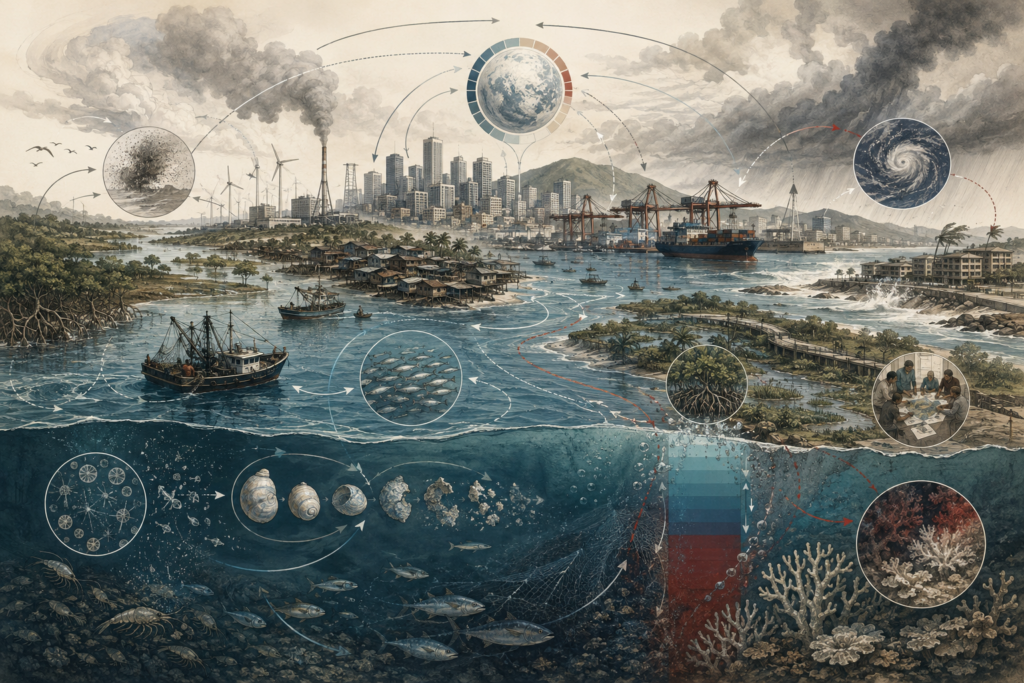
Editorial sustainability illustration showing ocean systems and coastal development as an interconnected landscape of cities, ports, fisheries, wetlands, marine food webs, coral reefs, acidification, storms, and coastal risk.

Ocean Systems, Acidification, and Coastal Development

Ocean Systems, Acidification, and Coastal Development examines why coastal development depends not only on ports, fisheries, infrastructure, and urban growth, but on marine systems whose chemistry and ecological resilience are being altered at planetary scale. The article argues that ocean acidification is not a narrow marine-science issue but a long-run development risk for coastal societies, because changing ocean chemistry affects marine habitability, fisheries, food systems, coastal protection, and the viability of economies concentrated along the sea. It explores ocean acidification as a planetary-boundary issue, the compounding effects of warming and sea-level rise, the uneven justice burdens borne by coastal and island communities, and the governance challenges of planning under accelerating ocean change. The core claim is that sustainable coastal development depends on preserving the marine conditions that keep coasts livable, productive, and resilient across time.
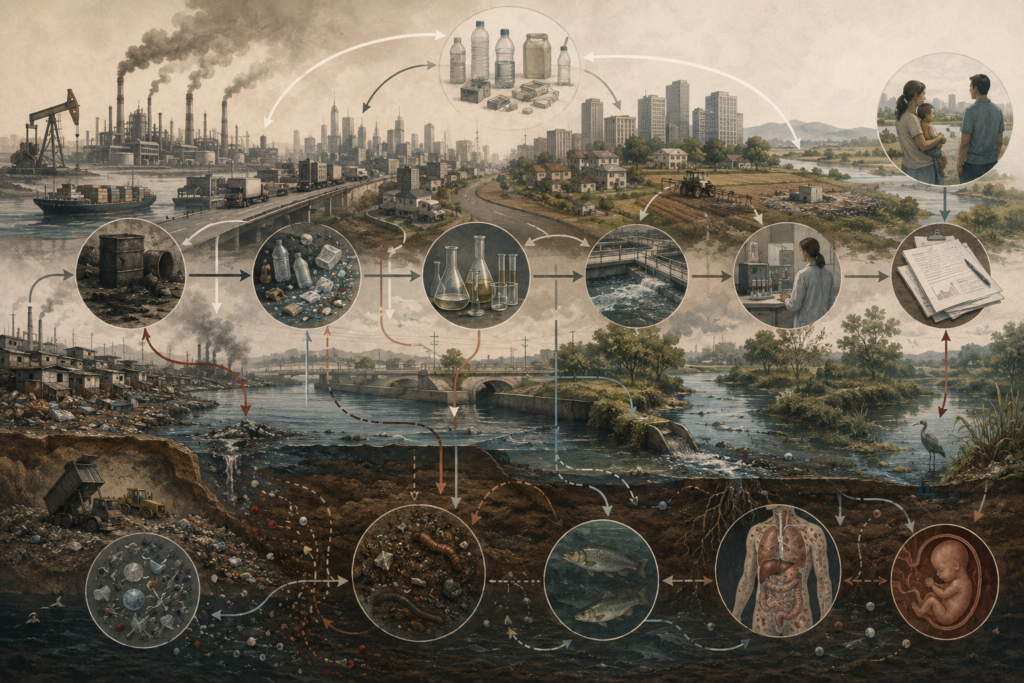
Editorial sustainability illustration showing pollution and novel entities as an interconnected system linking industry, waste, chemicals, waterways, soil contamination, ecosystems, public health, regulation, and long-run development risk.

Pollution, Novel Entities, and Long-Run Development

Pollution, Novel Entities, and Long-Run Development examines why development must be judged not only by what it produces, but by the chemical residues, wastes, and synthetic substances it leaves circulating through bodies, ecosystems, and public systems over time. The article argues that pollution is not a marginal side effect of progress but a structural constraint on long-run development, because persistent contaminants, unmanaged waste, and proliferating novel entities can outpace scientific assessment, regulatory capacity, and remediation systems. It explores toxicity, habitability, inequality, ecological slow violence, and the governance problems created when innovation moves faster than institutional control. The core claim is that sustainable development depends not only on expanding production and consumption, but on governing material complexity in ways that keep future societies healthy, habitable, and ecologically resilient.

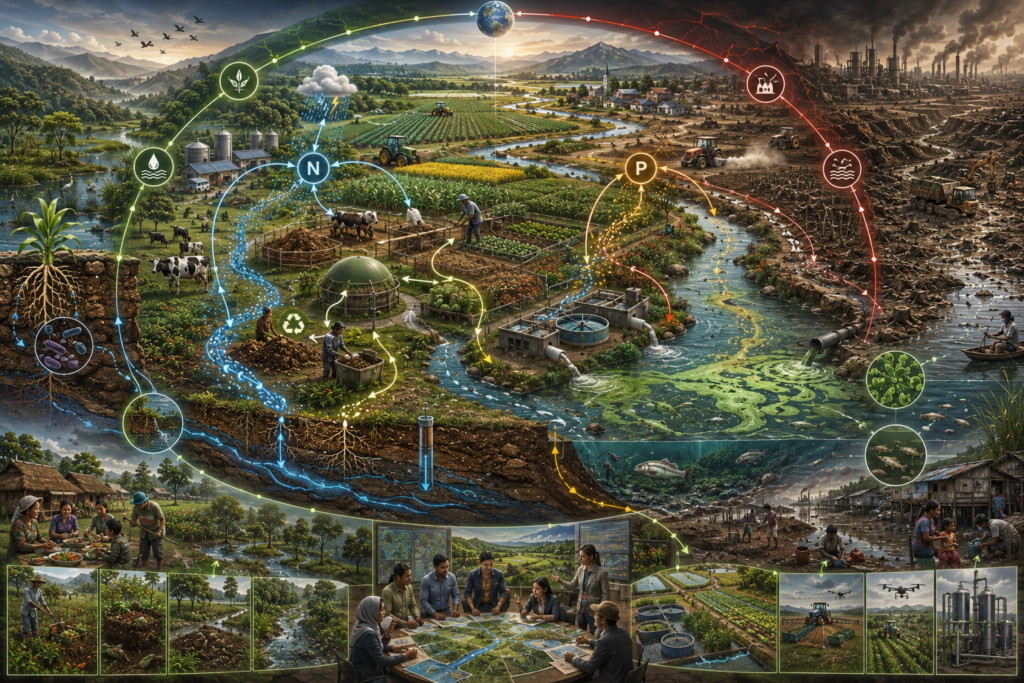
Abstract sustainability illustration of nutrient cycles, agriculture, and ecological stress, showing nitrogen, phosphorus, soil fertility, crop production, runoff, eutrophication, water quality, planetary boundaries, nutrient governance, and sustainable agriculture.

Nutrient Cycles, Agriculture, and Ecological Stress

Nutrient Cycles, Agriculture, and Ecological Stress examines why sustainable development depends on nutrients that make agriculture possible but also on keeping those nutrients within ecological limits. The article argues that nitrogen and phosphorus are not merely farm inputs but part of the biophysical infrastructure of development itself, because they connect food production, soil fertility, water quality, ecosystem resilience, and long-run human wellbeing. It explores agricultural intensification, altered biogeochemical flows, eutrophication, multi-pathway ecological stress, and the governance challenge of balancing productivity with ecological restraint. The core claim is that sustainable development depends not only on feeding populations today, but on governing nutrient systems in ways that keep agriculture productive without progressively degrading the soils, waters, and ecosystems on which future development depends.

Abstract sustainability illustration of land-system change and development pathways, showing forests, agriculture, settlements, infrastructure, land degradation, biodiversity, soil function, restoration, planetary boundaries, justice, and long-run resilience.

Land-System Change and Development Pathways

Land-System Change and Development Pathways examines why development is always written into land through the transformation of forests, wetlands, grasslands, farms, settlements, and infrastructure corridors. The article argues that land-system change is not simply a matter of land-cover conversion, but a broader reorganization of ecological function, social opportunity, territorial habitability, and long-run resilience. It explores land degradation, biodiversity loss, fragmentation, food production, settlement expansion, justice, and governance, showing how different development pathways can either stabilize or erode the ecological conditions on which future development depends. The core claim is that sustainable development requires governing land not only for immediate output and expansion, but for habitability, resilience, rights, and the enduring viability of the landscapes through which human futures are built.

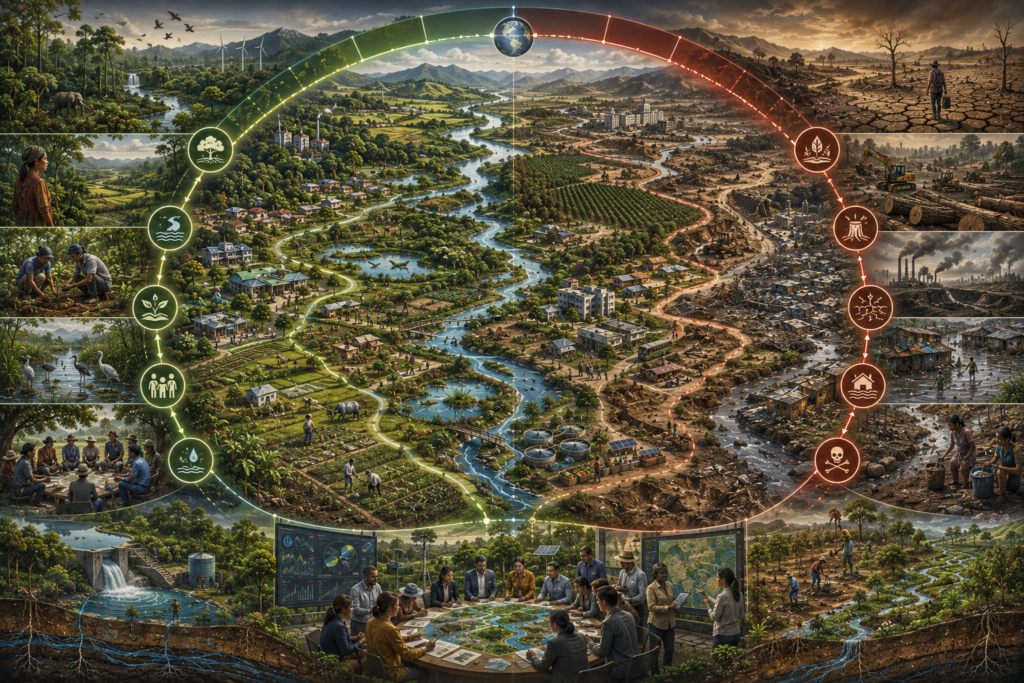
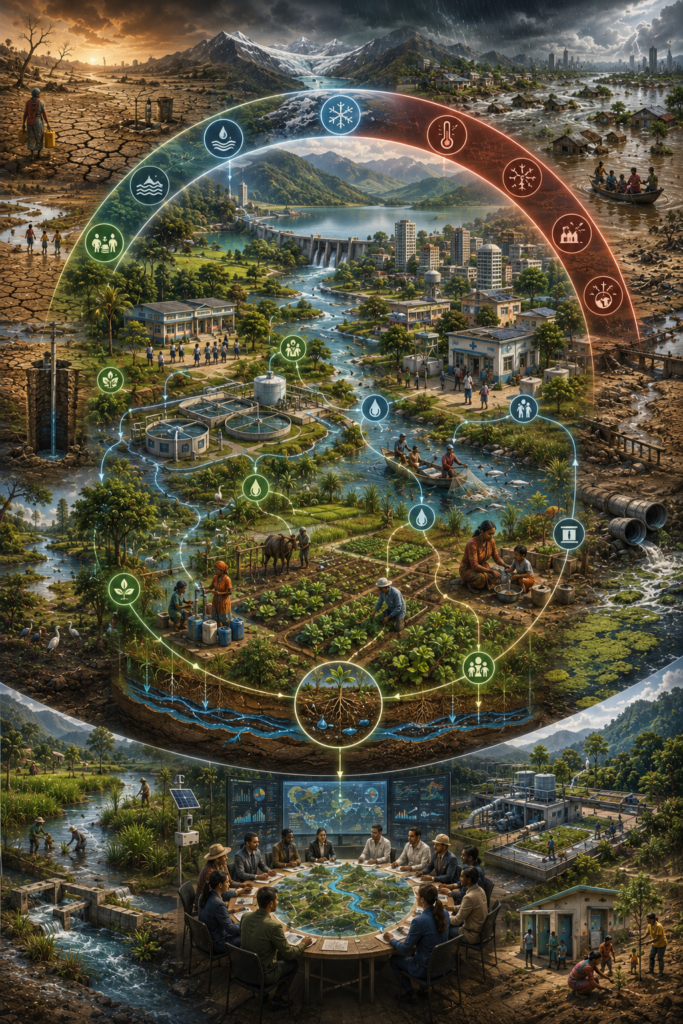
Abstract sustainability illustration of freshwater change and development risk, showing blue water, green water, hydrological instability, water quality, sanitation, food systems, freshwater ecosystems, planetary boundaries, governance, and unequal exposure.

Freshwater Change and Development Risk

Freshwater Change and Development Risk examines why water must be understood not simply as a sector or service, but as one of the material conditions through which health, food production, sanitation, ecosystems, settlement, and economic life become possible. The article argues that freshwater risk is broader than scarcity alone, because development is threatened not only by low supply but by wider hydrological instability across streamflow, groundwater, soil moisture, wastewater treatment, water quality, and freshwater ecosystems. It explores blue water and green water, human capability, food systems, public health, ecological decline, and uneven governance capacity, showing how freshwater change can narrow the conditions of habitability and resilience. The core claim is that sustainable development depends not only on expanding water services, but on sustaining the hydrological conditions that make human life, public systems, and long-run resilience possible across time.

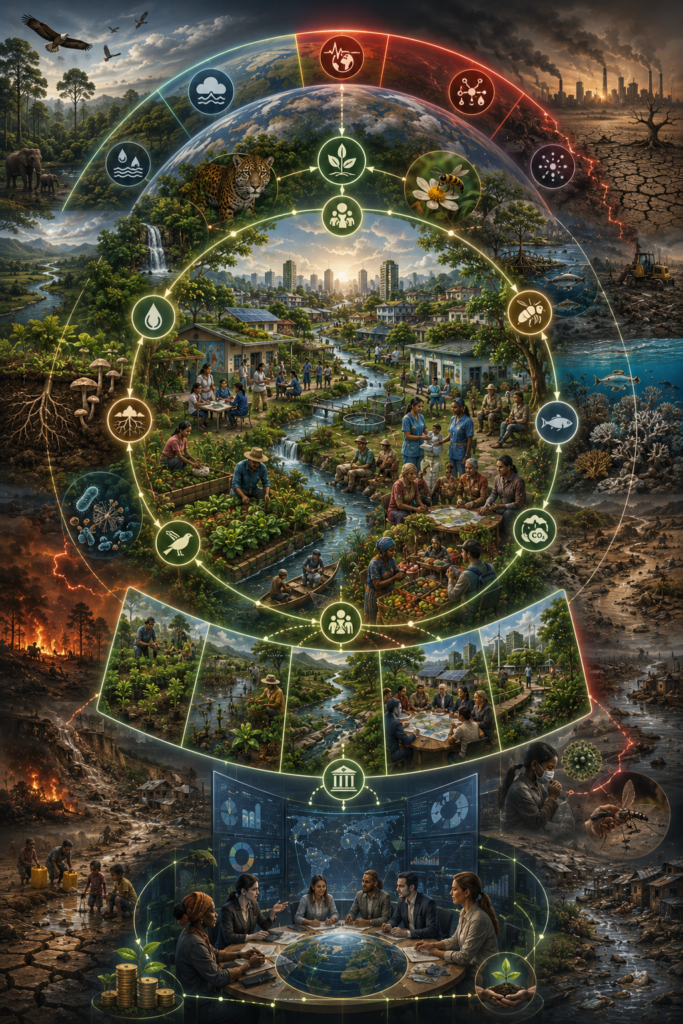
Abstract sustainability illustration of biosphere integrity and human development, showing biodiversity, ecosystem function, food and water systems, pollination, soil fertility, ecological resilience, planetary boundaries, restoration, justice, and long-run wellbeing.

Biosphere Integrity and Human Development

Biosphere Integrity and Human Development examines why human development depends not only on institutions, infrastructure, and economic output, but on the integrity of the living systems that sustain food, water, health, livelihoods, and ecological resilience. The article argues that biosphere integrity is not an external environmental concern but part of the material basis of long-run human wellbeing, because biodiversity loss, fragmentation, and ecosystem degradation weaken the ecological functions on which human capability and social stability depend. It explores habitability, ecosystem services, food and water systems, justice, and planetary boundaries, showing how ecological decline becomes a direct development constraint. The core claim is that sustainable development requires not only social progress and economic inclusion, but also the maintenance and restoration of viable living systems capable of supporting human life across time.

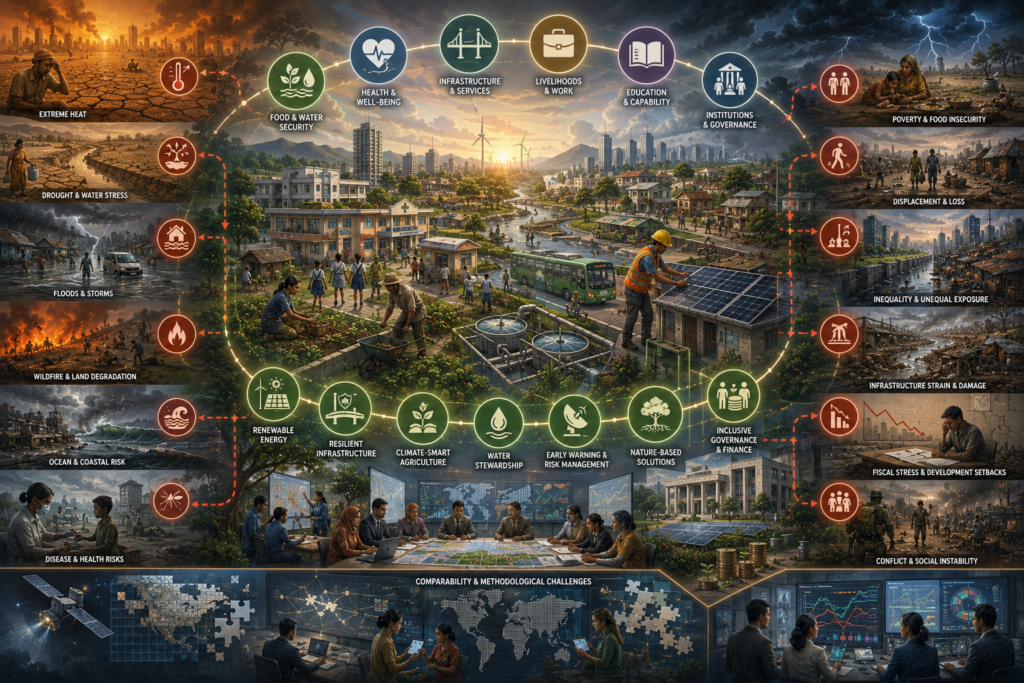
Abstract sustainability illustration of climate change as a development constraint, showing habitability, food and water stress, health risks, infrastructure strain, poverty, unequal exposure, adaptation, mitigation, governance, and climate-resilient development.

Climate Change as a Development Constraint

Climate Change as a Development Constraint examines why climate change must be understood not only as an environmental problem but as a structural condition shaping whether societies can reduce poverty, protect health, secure food and water, sustain livelihoods, build resilient infrastructure, and govern long-run change under increasingly unstable conditions. The article argues that development does not occur outside climate but within climatic systems that shape agriculture, disease burdens, settlement patterns, productivity, public finance, and social stability. It explores habitability, human capability, poverty and vulnerability, food and water stress, health burdens, infrastructure strain, justice, and long-horizon planning, showing how climate disruption turns into a direct constraint on durable development. The core claim is that sustainable development depends not only on expanding wellbeing today, but on preserving and widening human possibility under the changing conditions of a warming world.

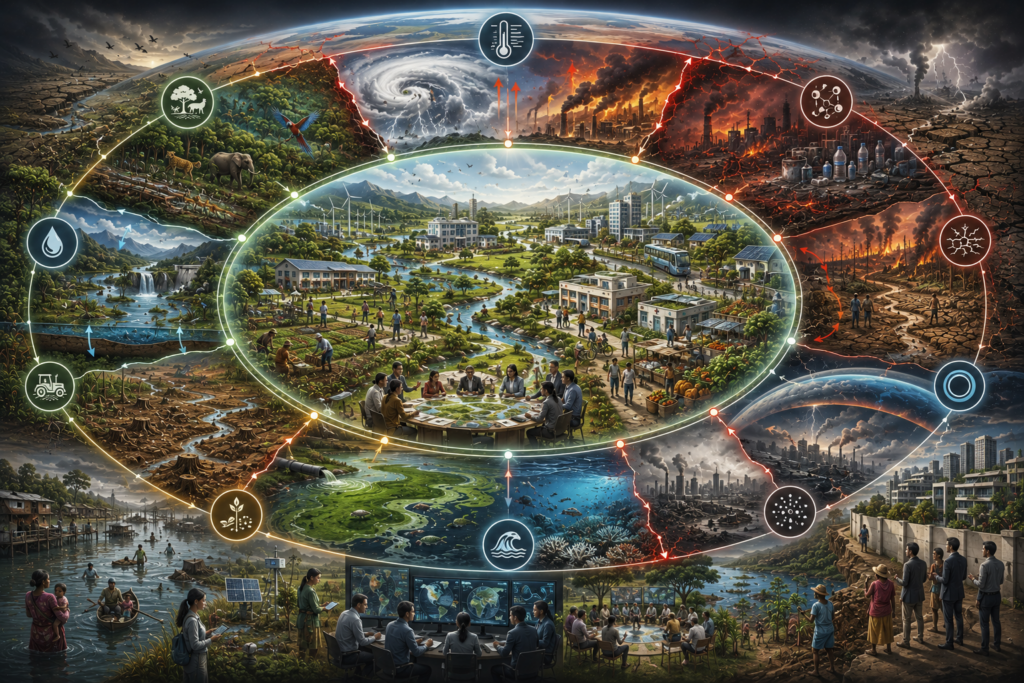
Abstract sustainability illustration of planetary boundaries and sustainable development, showing safe operating space, Earth-system stability, climate change, biosphere integrity, freshwater change, land systems, nutrient flows, ocean stress, pollution, governance, justice, and long-run human viability.

Planetary Boundaries and Sustainable Development

Planetary Boundaries and Sustainable Development examines why development must be understood as unfolding within an Earth system whose stability, resilience, and biophysical integrity shape whether human societies can thrive over the long run. The article argues that planetary boundaries are not a peripheral environmental warning but a framework for identifying the ecological conditions of durable development, because growth, infrastructure, and welfare gains become self-undermining when they destabilize the systems on which future life depends. It explores habitability, safe operating space, boundary transgression, overshoot, justice, and governance, showing how Earth-system pressures translate into developmental risk. The core claim is that sustainable development must be judged not only by present gains in output or wellbeing, but by whether those gains are being pursued within conditions compatible with planetary stability, social resilience, and future human possibility.

Abstract sustainability illustration of human development indicators and their limits, showing composite metrics, HDI-style measurement, hidden inequality, gender gaps, poverty, planetary pressure, data quality, rankings, and lived realities beyond averages.

Human Development Indicators and Their Limits

Human Development Indicators and Their Limits examines why development cannot be governed, compared, or improved without measurement, yet also cannot be reduced to the metrics used to represent it. The article argues that indicators such as the Human Development Index are indispensable because they make social conditions visible across time and place, but they remain selective approximations shaped by methodological choices about what counts, what can be measured, and what forms of human flourishing can be translated into data. It explores the HDI, inequality, gender, multidimensional poverty, planetary pressure, data quality, rankings, and hidden heterogeneity, showing how indicators both clarify and distort development realities. The core claim is that sustainable development requires indicators as essential tools of governance, but also the interpretive judgment to understand what they reveal, what they suppress, and what remains beyond numerical summary.

Scroll to Top