Sustainable Development

Sustainable development is a framework for improving human well-being while preserving the ecological systems on which life depends. It gained global prominence through the 1987 World Commission on Environment and Development report Our Common Future, which defined it as development that meets present needs without compromising the ability of future generations to meet their own.

The concept brings together three interdependent aims: economic vitality, social equity, and environmental stewardship. Rather than treating them as separate or competing goals, sustainable development emphasizes their mutual dependence and now underpins global agendas such as the United Nations Sustainable Development Goals. As a result, it has become a central framework for addressing climate change, biodiversity loss, inequality, and long-term institutional resilience.

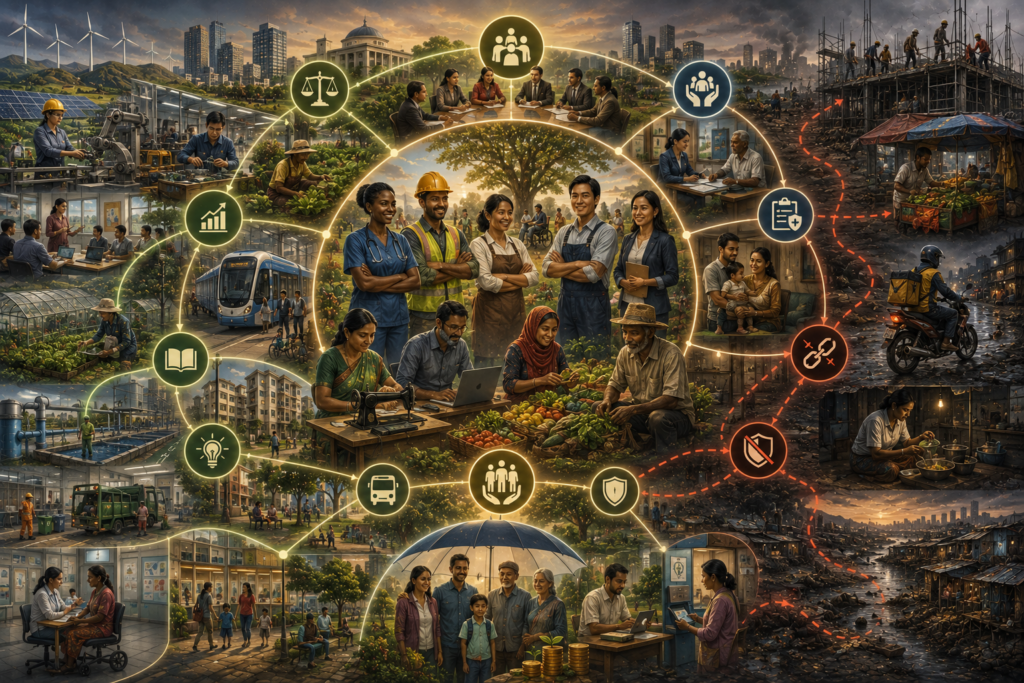
Abstract sustainability illustration of work, livelihoods, and decent employment, showing diverse workers, income security, labor rights, social protection, informal work, precarious work, care work, platform work, youth opportunity, and sustainable development.

Work, Livelihoods, and Decent Employment

Work, Livelihoods, and Decent Employment examines why work must be understood not only as labor-market participation but as one of the main institutions through which people secure income, dignity, social membership, agency, and protection against vulnerability over time. The article argues that development cannot be judged by employment quantity alone, because livelihoods become developmentally meaningful only when work is reasonably secure, rights-protecting, productive, and compatible with human dignity. It explores livelihoods, social recognition, decent work, informality, precarity, labour rights, social protection, youth exclusion, gender inequality, and technological change, showing how labor systems can either widen or narrow human capability. The core claim is that sustainable development requires not just jobs, but labor systems that create fair, stable, and decent livelihood pathways through which people can live and flourish with dignity
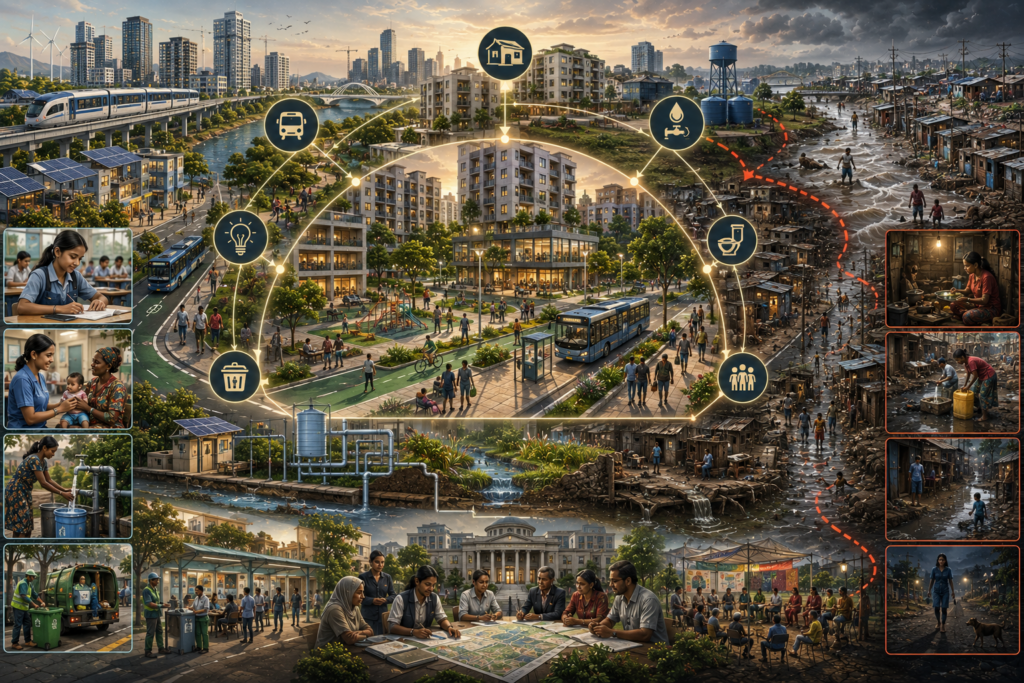
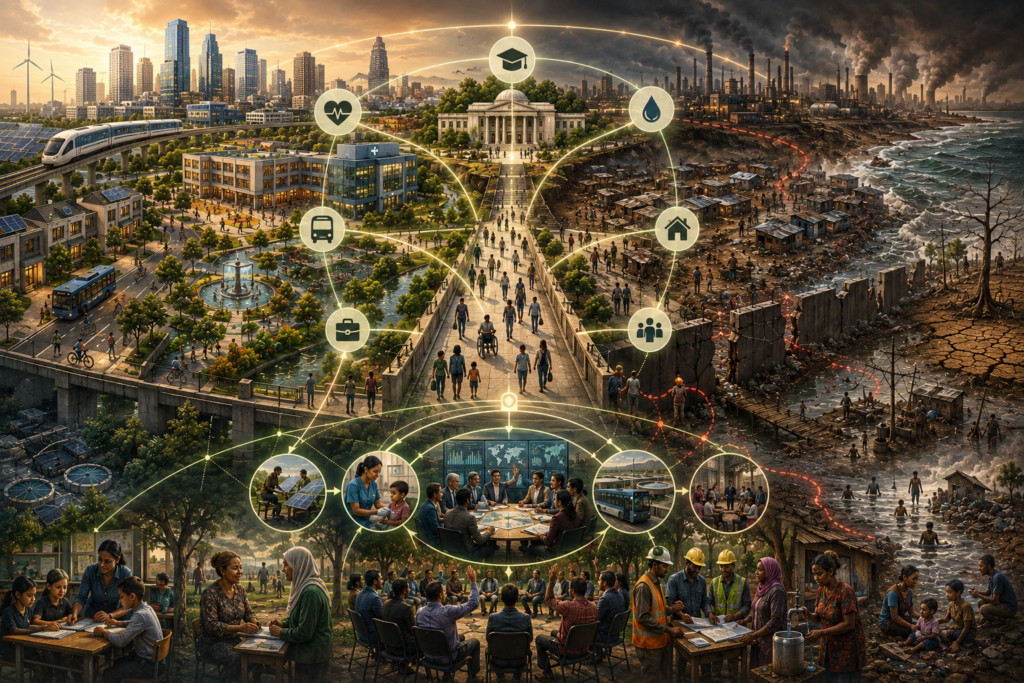
Editorial sustainability illustration showing inclusive urban development through housing, public transit, water, sanitation, energy, schools, clinics, civic institutions, informal settlements, service inequality, and climate-related urban risk.

Urbanization, Housing, and Basic Services

Urbanization, Housing, and Basic Services examines why cities and human settlements must be understood not only as sites of population concentration and economic activity, but as developmental environments that shape access to housing, water, sanitation, energy, mobility, safety, and institutional inclusion. The article argues that urbanization is not successful simply because cities grow, but only when housing and services are organized in ways that widen human capability, urban citizenship, and long-run governability. It explores housing adequacy, affordability, real access, informality, service interdependence, inequality, resilience, and urban governance, showing how unequal settlement conditions can convert urban growth into precarity and exclusion. The core claim is that sustainable development requires cities that are not only productive, but materially habitable, institutionally inclusive, and supported by housing and service systems that make urban life genuinely livable for all.

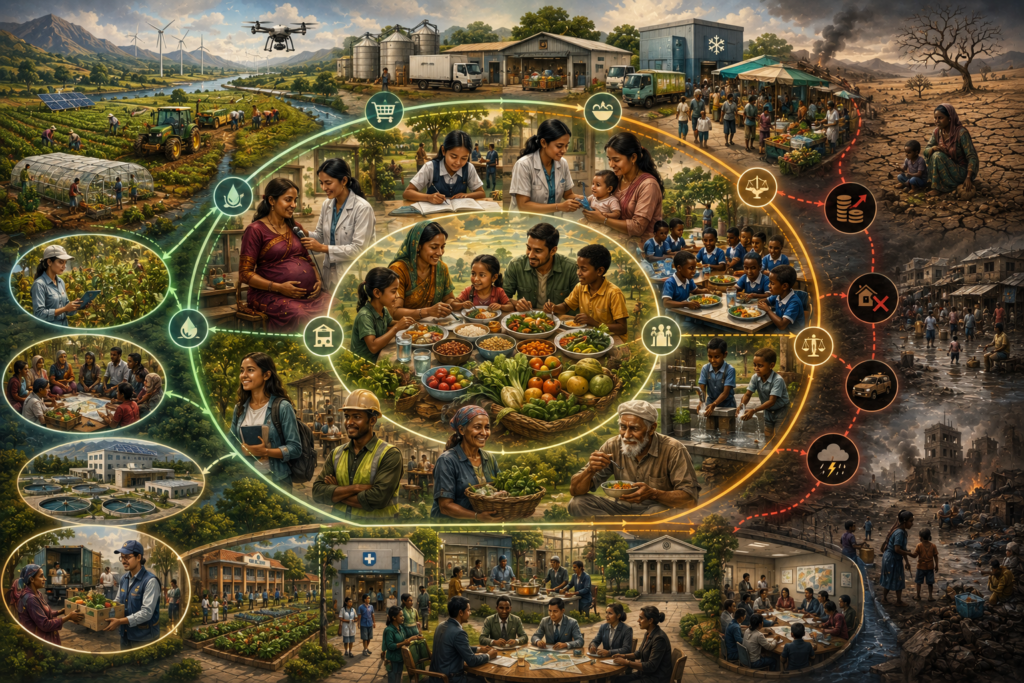
Editorial sustainability illustration showing food security, nutrition, and human development through healthy meals, farms, markets, water systems, schools, clinics, public institutions, food access, affordability, resilience, and climate-related food-system stress.

Food Security, Nutrition, and Human Development

Food Security, Nutrition, and Human Development examines why food must be understood not only as a matter of commodity supply or calories, but as a condition of bodily capability, cognitive development, public health, and long-run human resilience. The article argues that food security is broader than aggregate availability because development depends on whether people can reliably access safe, nutritious, and affordable diets under real social and economic conditions. It explores access, affordability, utilization, nutrition across the life course, food-system resilience, poverty, inequality, and governance, showing how food insecurity becomes a direct constraint on human capability expansion. The core claim is that sustainable development requires food systems that are not only productive, but equitable, resilient, and capable of supporting healthy lives and meaningful human flourishing over time.

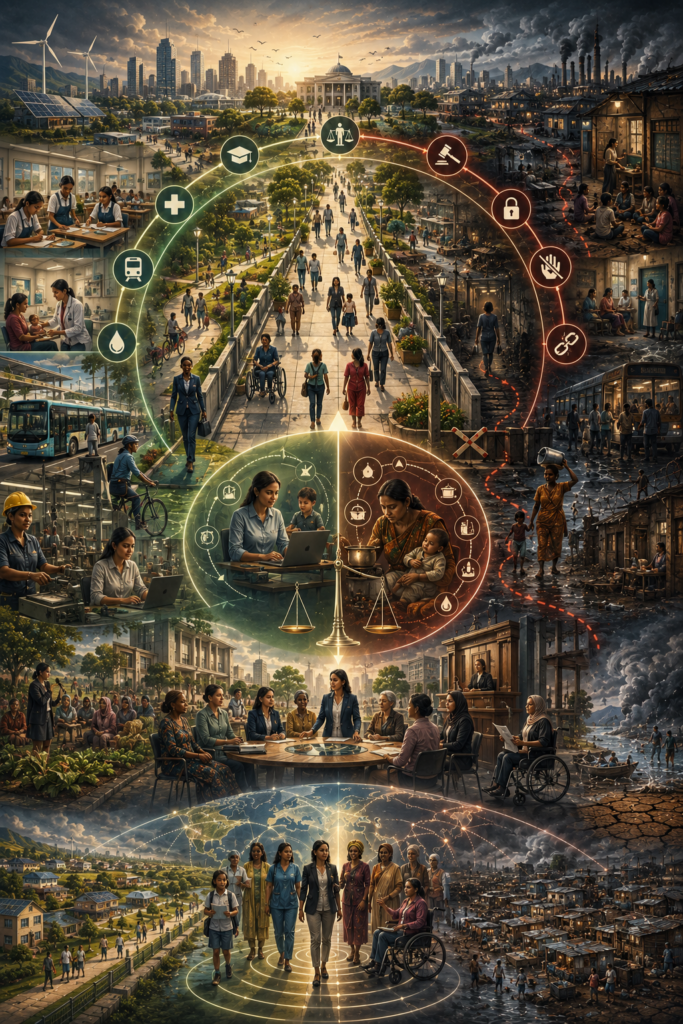
Cinematic sustainability illustration of gender exclusion and development justice, showing unequal access to education, health, bodily autonomy, care support, work, safety, institutional power, public voice, mobility, and substantive freedom.

Gender, Exclusion, and Development Justice

Gender, Exclusion, and Development Justice examines why gender must be understood not as a secondary social variable but as one of the ways development itself is organized, distributed, and experienced. The article argues that development cannot be considered inclusive or just when access to education, health, bodily autonomy, work, property, time, safety, and political voice remains structured by gendered exclusion. It explores capability formation, reproductive justice, unpaid care burdens, institutional power, violence, and intersectionality, showing how formal equality can coexist with deeply unequal substantive freedom. The core claim is that sustainable development requires more than incorporating women and girls into an unchanged system; it requires changing the social and institutional terms on which freedom, protection, and participation are shared across gendered lines.

Editorial sustainability illustration showing inequality and inclusive development through unequal access to schools, clinics, public transit, housing, institutions, opportunity, environmental protection, and civic participation.

Inequality and Inclusive Development

Inequality and Inclusive Development examines why development cannot be judged by growth or average progress alone when access to health, education, income security, public goods, and institutional voice remains distributed unequally. The article argues that inequality is not only a matter of uneven outcomes, but a structural problem of unequal capability formation, unequal exposure to risk, and unequal power over the systems that shape life chances. It explores opportunity, public institutions, human development, social cohesion, and inequality within and among countries, showing how development can appear successful in the aggregate while remaining exclusionary in substance. The core claim is that sustainable development requires more than raising averages: it requires widening the real terms of participation, protection, mobility, and human possibility so that development is broadly shared rather than concentrated among the already advantaged.

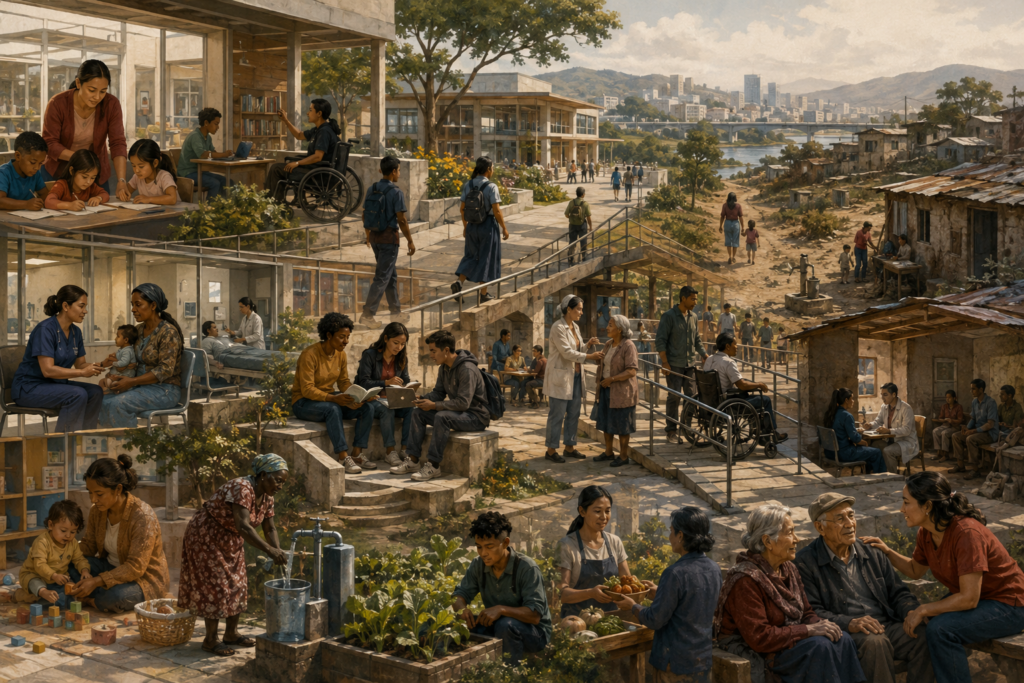
Editorial sustainability illustration showing schools, clinics, care spaces, accessible public systems, intergenerational learning, community health, and unequal access to human capability across a layered landscape.

Health, Education, and Human Capability Expansion

Health, Education, and Human Capability Expansion examines why health and education must be understood not as secondary social sectors but as foundational conditions of human freedom and development. The article argues that development cannot be judged by economic growth alone when people remain unable to live healthy lives, gain meaningful knowledge, or convert formal access into real opportunity. It explores capability expansion, universal access, quality, life-course formation, public systems, and unequal capability formation, showing how health and education shape the real range of lives people are able to live. The core claim is that sustainable development requires institutions capable of making health and education genuinely accessible, equitable, durable, and transformative, so that human possibility expands not only in principle but in lived reality.

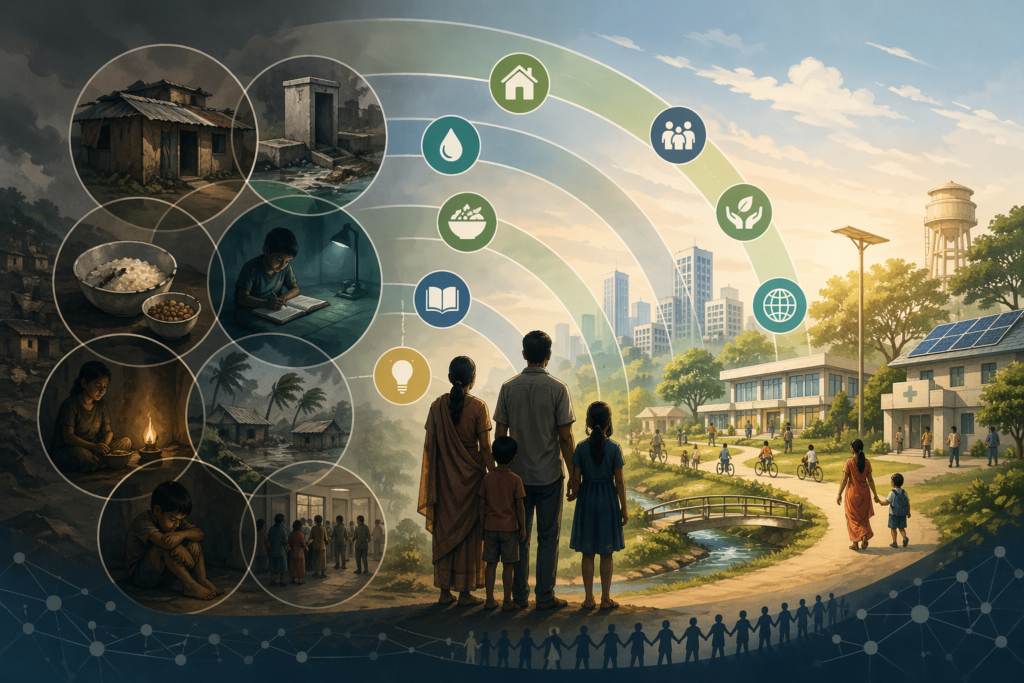
Editorial illustration of a family standing between overlapping zones of deprivation and a more supportive public-goods landscape, with visual cues for housing, sanitation, food, education, energy access, social inclusion, and human capability.

Poverty, Deprivation, and Multidimensional Development

Poverty, Deprivation, and Multidimensional Development examines why poverty cannot be understood as low income alone when human lives are shaped by overlapping deficits in health, education, nutrition, housing, sanitation, energy, security, and access to public goods. The article argues that poverty is best understood as a multidimensional condition of constrained human possibility rather than a single monetary shortfall. It explores capability constraint, clustered deprivation, the Multidimensional Poverty Index, child vulnerability, spatial inequality, institutional failure, and climate exposure, showing how disadvantages accumulate and reproduce one another over time. The core claim is that sustainable development requires more than raising incomes: it requires institutions capable of reducing layered deprivation, expanding real human capability, and interrupting the structural reproduction of poverty across households, places, and generations.

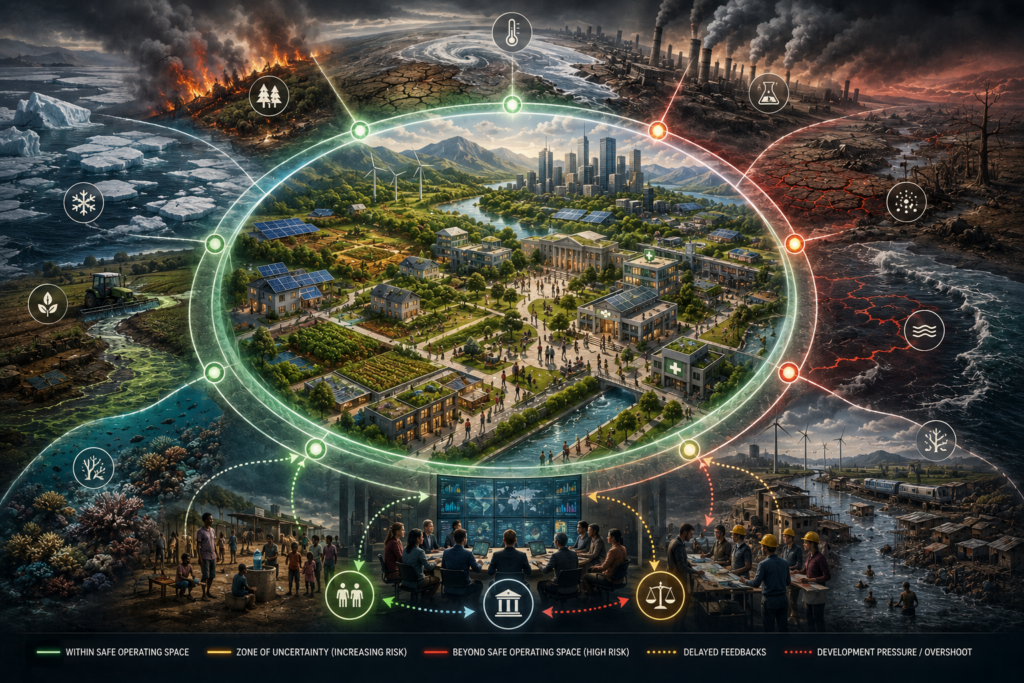
Cinematic sustainability illustration of a safe operating space for long-run development, showing a resilient human settlement within a planetary boundary surrounded by climate stress, pollution, biodiversity loss, water pressure, ecological degradation, governance planning, and uneven exposure.

Safe Operating Space and the Conditions of Long-Run Development

Safe Operating Space and the Conditions of Long-Run Development examines why sustainable development must be judged not only by present welfare gains but by whether those gains are achieved within ecological conditions compatible with Earth-system stability and resilience. The article argues that a safe operating space is not a peripheral environmental concern but one of the core background conditions of durable human development. It explores planetary boundaries, resilience, overshoot, governability, justice, and long-horizon coordination, showing how development can advance materially while undermining the systems on which its own future depends. The core claim is that long-run development requires more than growth, infrastructure, or social improvement in the present; it requires preserving the ecological stability and institutional capacity needed for human flourishing to remain viable over time.

Editorial illustration of multiple generations looking across a restored landscape with wetlands, public institutions, renewable infrastructure, transit, trees, water systems, and future-oriented stewardship.

Intergenerational Justice and Long-Term Stewardship

Intergenerational Justice and Long-Term Stewardship examines why sustainable development must be judged not only by present welfare gains but by what current societies preserve, transfer, or foreclose for those who come after. The article argues that intergenerational justice gives sustainable development its long-range moral force by requiring present generations to account for delayed, cumulative, and sometimes irreversible consequences imposed on future people who cannot yet represent themselves. It explores stewardship, temporal asymmetry, planetary stability, institutional trusteeship, burden transfer, and uneven responsibility, showing how present prosperity can become morally compromised when it consumes future stability as a hidden subsidy. The core claim is that sustainable development requires institutions capable of protecting ecological resilience, social continuity, and future possibility, so that development remains legitimate across time rather than only in the present.

Scroll to Top