
Last Updated May 6, 2026
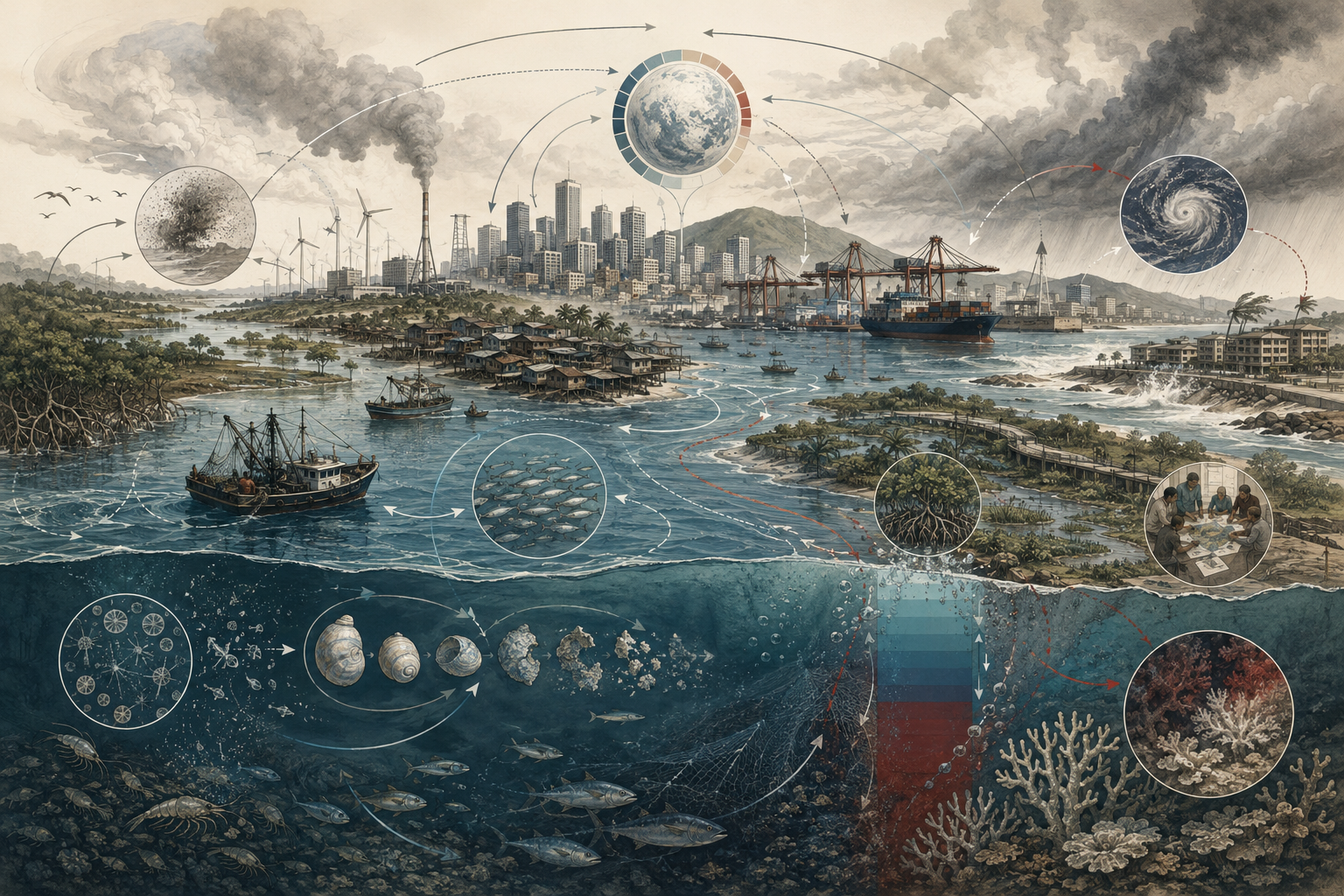
Ocean systems matter for development because coasts are not merely edges of land. They are dense zones of settlement, trade, food production, culture, energy infrastructure, ecological productivity, and climatic regulation. Coastal development depends on marine systems that absorb carbon, buffer storms, sustain fisheries, support tourism, regulate local climates, and connect cities to global circulation. When ocean systems are destabilized through acidification, warming, deoxygenation, pollution, habitat degradation, and overuse, the developmental conditions of coastal societies become more fragile.
Ocean acidification is therefore not only a marine chemistry issue. It is a long-run development issue for coasts, islands, fisheries, ports, coastal cities, and the broader economies that depend on ocean resilience. Sustainable development must ask not only how coastal societies grow, trade, urbanize, and adapt, but whether the marine systems supporting them remain habitable, productive, and resilient enough to sustain those achievements over time.
Main Library
Publications
Article Map
Sustainable Development
Related Topic
Planetary Boundaries
The 2030 Agenda places this issue squarely inside sustainable development through Goal 14, which commits states to conserve and sustainably use the oceans, seas, and marine resources for sustainable development. This matters because the ocean is not treated as a separate environmental theatre. It is treated as part of the wider social and economic conditions of human development. Ocean systems support food security, livelihoods, trade, climate stability, coastal protection, cultural identity, and ecological resilience. Their degradation therefore becomes a development issue rather than a marine issue alone.
The planetary-boundaries framework sharpens the developmental meaning of this issue by identifying ocean acidification as one of the Earth-system processes relevant to long-run stability and resilience. This is significant not only scientifically but developmentally. It means one of the ocean’s core buffering functions is being altered at a scale that now enters the structure of long-run risk for ecosystems and societies. The ocean is not simply being used more intensively. It is being changed in ways that affect the future viability of coastal life.
The wider scientific literature reinforces this point. Ocean acidification is the global reduction in seawater pH caused by the ocean’s absorption of large amounts of anthropogenic carbon dioxide. This is not a marginal chemical shift. It is a substantial alteration of marine conditions at planetary scale, with implications for calcifying organisms, marine food webs, ecosystem resilience, fisheries, coastal protection, and the wider services the ocean provides to human societies.
What Ocean Systems Mean for Development
Ocean systems are developmental systems because they support food production, trade, climate regulation, transport, coastal protection, ecosystem services, and settlement. Oceans and coastal ecosystems are not peripheral to human wellbeing. They help regulate climate, absorb substantial amounts of carbon dioxide, sustain marine food webs, support fisheries and tourism, anchor ports and shipping routes, and shape the material conditions of coastal economies. Marine systems therefore function as part of the infrastructure of human life, even when their contributions remain less visible than roads, buildings, factories, or utilities.
This matters because many development narratives treat the ocean either as scenery or as a resource stock. A more adequate framing recognizes that coasts and oceans are living systems on which social and economic systems depend. Ports connect economies. Mangroves, reefs, dunes, marshes, and seagrass systems buffer storms and erosion. Fisheries support livelihoods and nutrition. Coastal waters support biodiversity, nutrient cycles, and cultural life. Marine ecosystems provide services that are difficult, expensive, or impossible to replace once degraded.
To speak of ocean systems in development terms is therefore to move beyond marine conservation as a siloed issue. It is to recognize that the resilience of ocean systems helps determine whether coastal development remains viable, governable, and socially durable. A port city, fishing community, tourism economy, or island state does not develop apart from the ocean. It develops through the conditions the ocean makes possible.
Ocean systems also reveal the limits of land-centered development thinking. Many development debates focus on agriculture, cities, energy systems, infrastructure, and terrestrial ecosystems. Those are essential, but they do not exhaust the conditions of human development. The ocean connects food systems, carbon systems, global trade, coastal settlement, cultural identity, and planetary regulation. When marine systems are destabilized, development risk appears across sectors that may not initially look marine at all.
This places the article in direct continuity with Planetary Boundaries and Sustainable Development and Sustainable Development as a Systems Problem. Ocean systems show why sustainable development must be understood as a network of interdependent social, ecological, and planetary conditions.
Why Coasts Are Development Frontiers
Coasts are development frontiers because they concentrate people, assets, infrastructure, and ecological productivity in the same spaces. Coastal zones often host major cities, ports, tourist economies, fisheries, industrial corridors, transport systems, energy infrastructure, and dense settlement. At the same time, they contain wetlands, reefs, estuaries, seagrass beds, mangroves, tidal systems, and other ecologically significant habitats. This density makes coasts highly productive, highly connected, and highly exposed.
This matters because coastal development often relies on ecological systems that are treated as secondary to urban and economic expansion. Yet when coastal habitats are degraded or ocean conditions shift, the risks to settlements, infrastructure, food systems, cultural landscapes, and local economies rise sharply. The very features that make coasts attractive for development—connectivity, productivity, density, and openness—also make them focal points of exposure. Coasts gather opportunity and vulnerability together.
Coastal development is therefore not simply about building at the edge of the sea. It is about managing a highly coupled zone where marine change, ecological stress, climate risk, economic concentration, and social inequality interact continuously. A coastline is not only a boundary between land and water. It is a dynamic development system shaped by tides, storms, trade, fisheries, property markets, infrastructure, ecosystems, and public policy.
This is why coastal growth can become fragile even when it appears economically successful. Ports may expand while natural buffers decline. Tourism may grow while reefs and beaches degrade. Housing may spread into exposed zones. Industrial corridors may increase pollution pressure. Fishing communities may face declining marine productivity while more powerful sectors occupy coastal space. Development can therefore intensify exposure unless marine and coastal systems are governed together.
Coasts demand a form of development planning that is spatially and ecologically literate. Housing, infrastructure, fisheries, conservation, tourism, ports, wastewater systems, energy systems, and climate adaptation cannot be planned as separate fragments. Coastal development becomes sustainable only when it recognizes the ocean as a living condition of development rather than an external backdrop.
This section also aligns naturally with Urbanization, Housing, and Basic Services.
What Ocean Acidification Is
Ocean acidification is the ongoing decrease in seawater pH caused mainly by the ocean’s absorption of anthropogenic carbon dioxide. When carbon dioxide dissolves in seawater, it changes marine carbonate chemistry. The result is not that the ocean becomes literally acidic in everyday terms, but that it becomes less alkaline. That shift matters because many marine organisms depend on carbonate chemistry to build shells, skeletons, and reef structures.
This is not a marginal chemical shift. It is a substantial alteration of marine conditions at planetary scale. Acidification affects calcification, organism development, species interactions, habitat formation, and the resilience of marine ecosystems. Corals, shellfish, some plankton, and other calcifying organisms can be especially vulnerable, though impacts vary across species, regions, and ecological contexts. What appears at first to be a chemical matter is in practice an ecological and developmental matter.
Ocean acidification also matters because chemistry is habitability. Marine organisms do not live in a generic ocean. They live within specific ranges of temperature, oxygen, salinity, pH, carbonate availability, nutrients, light, and ecological interaction. When those conditions shift, the biological foundations of marine systems can weaken. Acidification therefore affects the environmental conditions that make marine life possible, especially for organisms that build shells, reefs, or skeletons.
In development terms, acidification is important because marine life supports human systems. Shellfish aquaculture, reef-based tourism, fisheries, coastal protection, biodiversity, and food webs are all affected by the chemistry of the ocean. A change in pH is not only a scientific variable. It can become a development signal when it affects food security, livelihoods, coastal economies, and ecosystem resilience.
Ocean acidification is therefore not merely a marine-science indicator. It is a direct signal that one of the ocean’s core life-support conditions is being altered in ways that matter for ecosystems, economies, and coastal societies.
From Carbon Sink to Development Risk
The ocean has long buffered climate change by absorbing a large share of anthropogenic carbon dioxide. This buffering role has slowed the accumulation of carbon dioxide in the atmosphere compared with what would otherwise have occurred. But the service is not free. Absorbed carbon changes seawater chemistry, driving acidification and affecting marine life and ecosystem services. The same ocean function that moderates climate pressure therefore creates a different form of ocean stress.
This is developmentally significant because a system that helps stabilize the global climate is simultaneously being pushed into new forms of ecological pressure. The ocean’s climate-buffering role is therefore not a free service outside development. It creates trade-offs that increasingly feed back into fisheries, tourism, coastal protection, biodiversity, food systems, and coastal livelihoods. What first appears as climate moderation through ocean uptake can reappear as marine development risk.
This point is important because it changes how societies should understand planetary services. Earth systems often absorb the consequences of human activity silently for long periods. Forests, soils, wetlands, oceans, and the atmosphere buffer human pressure until those buffers themselves begin to degrade. Ocean acidification marks one of those feedback moments: the ocean continues to absorb carbon, but the chemistry of that absorption alters the conditions for marine life.
For coastal development, this means climate and ocean policy cannot be separated. Acidification is inseparable from atmospheric carbon loading. Reducing emissions is therefore also a marine-development strategy, not only a climate strategy. Coastal adaptation can protect communities against some impacts, but it cannot fully solve acidification if carbon emissions continue to alter ocean chemistry at scale.
Ocean acidification marks the point where the ocean’s role as climate regulator becomes inseparable from the question of whether marine and coastal development can remain ecologically supportable over time. This section also connects directly to Climate Change as a Development Constraint.
Acidification and Marine Habitability
One of the strongest ways to understand ocean acidification is through marine habitability. Marine organisms do not simply inhabit the ocean in the abstract; they inhabit specific chemical and ecological conditions. When acidity rises and carbonate chemistry shifts, those conditions become less favorable for many organisms, especially calcifiers such as corals, shellfish, pteropods, and coralline algae. This can weaken habitat formation, biodiversity support, food-web stability, and the broader resilience of marine ecosystems.
This matters because coastal development depends on living marine systems remaining sufficiently functional to support fisheries, reefs, tourism, biodiversity, and ecological resilience. Acidification is therefore not only a species-level issue. It is a system-level issue affecting the habitability of marine environments for the organisms that sustain wider coastal life. If the biological foundations of marine ecosystems weaken, social systems that depend on them also become more exposed.
Coral reefs illustrate this relationship clearly. Reefs are built by organisms whose calcification is affected by changing carbonate chemistry. They support biodiversity, fisheries, tourism, and coastal protection. When reefs weaken, the consequences are not confined to marine ecology. Coastal communities may lose storm buffering, tourism revenue, fish habitat, cultural landscapes, and ecological resilience. Acidification therefore turns chemistry into social and economic risk.
Shellfish systems provide another example. Shellfish aquaculture and wild shellfish populations depend on conditions that support shell formation and early development. Where acidification interacts with local water quality, warming, upwelling, nutrient pollution, or oxygen stress, shellfish systems can become more vulnerable. This matters for food systems, local livelihoods, and regional economies.
Marine habitability belongs inside sustainable development analysis because it influences whether the ocean remains capable of supporting the ecological services and livelihoods on which coastal societies rely. Development becomes more precarious when the chemistry of supporting environments is shifted beyond historical ranges. This section also aligns naturally with Safe Operating Space and the Conditions of Long-Run Development.
Fisheries, Food Systems, and Livelihoods
Ocean acidification and wider ocean change matter for development because they affect fisheries, food systems, and livelihoods. Warming, acidification, and oxygen loss can affect marine organisms across trophic levels, with implications for fisheries, aquaculture, shellfish systems, and food production. This is especially important for coastal and island communities that depend directly on marine food systems and fishing-based livelihoods.
This matters because food security is not only terrestrial. Many coastal economies depend on fish protein, shellfish production, marine harvests, processing, trade, and marine-related work. If ocean chemistry and ecosystem resilience degrade, development risk rises not only through biodiversity loss but through reduced livelihood stability, food insecurity, cultural disruption, and higher vulnerability in communities with limited alternatives.
Fisheries are also social systems. They include fishers, processors, traders, families, markets, infrastructure, traditional knowledge, local institutions, and cultural practices. When marine ecosystems change, impacts move through this whole social chain. A shift in species distribution, reduced shellfish survival, coral degradation, or altered food-web dynamics can affect income, nutrition, identity, local markets, and migration pressure. Development risk therefore emerges through both ecological and social pathways.
Ocean change can also intensify existing pressures on fisheries. Many marine systems already face overfishing, habitat loss, pollution, warming, and governance challenges. Acidification adds another layer of stress. The issue is rarely a single driver acting alone. It is the cumulative pressure on marine systems and the communities that depend on them. A development approach must therefore address fisheries governance, habitat protection, climate mitigation, local livelihoods, and social protection together.
Ocean systems therefore belong within wider development thinking because changes in marine chemistry and ecosystems can narrow the practical capability of communities to feed themselves, sustain livelihoods, and remain economically secure. This section also aligns directly with Food Security, Nutrition, and Human Development and Work, Livelihoods, and Decent Employment.
Coastal Infrastructure, Cities, and Economies
Coastal development depends on infrastructure and urban systems that are tied to ocean conditions. Ports, roads, housing, drainage, tourism assets, wastewater systems, energy infrastructure, desalination systems, fisheries infrastructure, and industrial corridors often cluster in coastal zones. Ocean degradation affects these systems both directly and indirectly, through habitat loss, weakened natural buffers, fisheries decline, tourism disruption, flooding, erosion, pollution, and heightened environmental volatility.
This matters because infrastructure is often planned around assumptions of environmental stability or manageable change. But if coastal ecosystems weaken while ocean stress intensifies, the cost and complexity of maintaining urban and economic systems rise. Coasts are not only exposed to storms and sea-level rise. They are also exposed to the cumulative loss of ecological regulation: degraded reefs, wetlands, mangroves, seagrass beds, dunes, and fisheries systems that once buffered risk or supported local economies.
Coastal economies can therefore become more fragile even when visible built assets expand. A city may build new waterfront districts while natural buffers decline. A port may expand while nearby ecosystems degrade. Tourism may grow while beaches erode and reefs weaken. Coastal property values may rise while long-term exposure quietly increases. Development that counts physical growth while undercounting marine-system deterioration risks becoming materially impressive but structurally unstable.
Ocean acidification enters this infrastructure story because marine ecosystems and built systems are intertwined. Reefs, shellfish beds, wetlands, and coastal habitats are not only ecological features. They support fisheries, tourism, storm buffering, water quality, and community identity. When acidification interacts with warming, pollution, and habitat degradation, coastal infrastructure may face higher adaptation costs and weaker ecological support.
Coastal development therefore requires a wider accounting system. Built infrastructure, natural infrastructure, ecosystem function, social vulnerability, and long-term ocean change must be assessed together. This section also complements Urbanization, Housing, and Basic Services.
Compound Risks: Warming, Acidification, and Sea-Level Rise
Ocean acidification rarely acts alone. It interacts with warming, sea-level rise, oxygen loss, changing nutrient conditions, habitat degradation, pollution, and increasing storm stress. Acidification can lower the resilience of coastal habitats to other climate-linked drivers, increasing the risk of ecosystem shifts and loss of critical services. Coastal development is therefore shaped by compound risk rather than by single variables.
This is developmentally significant because a coastal community may face coral stress from acidification, fishery disruption from warming, flooding from sea-level rise, infrastructure pressure from storm intensification, and water-quality stress from pollution all at once. What appears as a collection of environmental issues is in practice a multidimensional development constraint. The risks overlap, interact, and intensify one another.
Compound risk changes the meaning of adaptation. A seawall may address some forms of flooding but do little to protect fisheries from acidification or reefs from warming. A fisheries policy may reduce overharvest but fail if habitat degradation and ocean chemistry continue to worsen. Tourism infrastructure may be rebuilt after storms while the ecological attractions supporting tourism decline. Adaptation that addresses only one pressure can miss the system-level risk.
Compound ocean risk also makes planning harder because impacts do not occur in neat sequences. Communities may experience repeated shocks before recovery is complete. Public budgets may face infrastructure repair, fisheries support, disaster response, health protection, and ecosystem restoration simultaneously. Coastal governance therefore requires integrated planning that recognizes interactions among climate, ocean chemistry, ecosystems, livelihoods, and infrastructure.
Compound risk belongs at the center of sustainable development because it changes the terms under which coastal planning, adaptation, and livelihood security must be pursued. Development becomes harder not only because each pressure intensifies, but because the pressures reinforce one another. This section also aligns with Trade-Offs, Synergies, and Policy Coherence.
Justice, Inequality, and Coastal Exposure
Ocean change is also a justice issue because exposure and adaptive capacity are unevenly distributed. Coastal populations, small island states, artisanal fishing communities, Indigenous coastal peoples, lower-income settlements, and communities dependent on marine ecosystems often rely more directly on ocean resilience while having fewer buffers against ecological and economic disruption. At the same time, the emissions driving acidification are not equally produced by all societies.
This matters because marine degradation can redistribute burdens onto those least responsible and least protected. The benefits of carbon-intensive development may be concentrated elsewhere, while the risks of acidification and ocean stress are borne disproportionately by vulnerable coastal populations. Sustainable development cannot ignore this asymmetry without becoming morally and politically incomplete.
Small island and low-lying coastal societies illustrate the problem sharply. Their economies, food systems, infrastructure, culture, and settlement patterns may be deeply tied to marine systems, yet their contribution to global carbon loading may be comparatively small. Ocean acidification, warming, sea-level rise, and storm intensification can therefore constrain their development pathways through processes driven largely beyond their borders.
Justice also matters within coastal societies. Wealthier groups may occupy protected or insured spaces, while poorer communities live in more exposed areas with weaker infrastructure, insecure tenure, or fewer options for relocation. Industrial and tourism development may displace small-scale fishers or degrade ecosystems on which local livelihoods depend. Marine conservation can also become unjust if it protects ecosystems while excluding communities from decision-making or undermining customary rights.
To treat ocean systems seriously in development analysis is therefore to ask who depends most directly on marine resilience, who has the least room to adapt, who benefits from ocean use, and whose future is being constrained by changes in systems they did little to destabilize. This section also connects clearly to Inequality and Inclusive Development and Intergenerational Justice and Long-Term Stewardship.
Ocean Acidification as a Planetary Boundary
The planetary-boundaries framework gives ocean acidification a particularly strong long-run development meaning by treating it as one of the Earth-system processes relevant to stability and resilience. This matters because it widens the meaning of acidification beyond marine chemistry. Once ocean acidification is understood as a planetary-boundary issue, it becomes part of the background structure of long-run development risk. It signals that the ocean’s capacity to support ecosystems and social systems is being altered at scales that matter for human futures.
In this sense, ocean acidification is not just one environmental problem among many. It is a marker of whether development remains compatible with the long-run stability of one of the Earth’s most important life-support systems. If the ocean’s chemistry changes in ways that weaken calcifying organisms, food webs, reef systems, fisheries, and marine resilience, then development is not merely facing a marine-sector issue. It is facing a change in planetary operating conditions.
The boundary lens also helps connect acidification to wider development pathways. Acidification is driven primarily by carbon dioxide emissions, so it links marine systems to energy, industry, transport, agriculture, land use, and consumption patterns. Coastal societies experience its effects, but the causes are distributed through global development systems. This means ocean acidification cannot be solved only through local coastal management. It requires emissions reduction, climate governance, marine protection, adaptation, monitoring, and justice-centered development planning.
Ocean acidification also interacts with other planetary boundaries and Earth-system processes. Climate change drives warming, sea-level rise, and marine heat stress. Biogeochemical flows affect coastal eutrophication and oxygen conditions. Pollution and novel entities introduce plastics, chemicals, and toxic substances into marine environments. Biosphere integrity shapes ecosystem resilience. These processes do not remain separate in the ocean; they converge in living marine systems.
For sustainable development, the implication is direct: ocean acidification is part of the safe-operating-space question. Development cannot be durable if it weakens the planetary systems that support marine life, coastal livelihoods, and long-run habitability. This section also aligns directly with Planetary Boundaries and Sustainable Development.
Governing Coastal Development Under Ocean Change
If ocean systems and acidification matter for development, then governance must do more than respond to isolated marine harms. It must organize coastal development in ways that account for marine ecosystem resilience, climate adaptation, fisheries sustainability, habitat protection, pollution control, and the long-run chemistry of the ocean itself. Coastal governance must become capable of planning under accelerating marine change.
This requires stronger marine monitoring, coastal planning grounded in science, habitat protection and restoration, lower-emissions development pathways, and development strategies that do not treat marine systems as expendable buffers. Monitoring is especially important because ocean change can be difficult to see until ecological and economic effects become severe. pH, temperature, oxygen, nutrient conditions, fisheries indicators, habitat health, and coastal exposure all require sustained observation and public interpretation.
Governance must also connect local and global scales. Local coastal planning can reduce pollution, protect habitats, manage fisheries, restore mangroves and reefs, regulate coastal development, and improve adaptation. But acidification itself is linked to global carbon emissions. A city, island, or fishing community can improve resilience, but it cannot fully protect itself from continued global carbon loading. Sustainable coastal development therefore requires both local stewardship and global mitigation.
Coastal governance must also include justice. Communities most dependent on marine systems need voice in decisions about fisheries, conservation, tourism, infrastructure, adaptation, relocation, and development finance. Ocean governance that ignores local knowledge, small-scale fishers, Indigenous rights, or community dependence can reproduce inequality even while claiming sustainability. Marine protection and coastal adaptation must therefore be socially legitimate as well as scientifically grounded.
Sustainable coastal development depends not only on building at the coast, but on governing the ocean conditions that make coastal life and economies viable. Development planning that ignores marine-system change becomes progressively less realistic over time. This section also aligns naturally with The 2030 Agenda and the Logic of the SDGs.
Why This Matters for Sustainable Development
Ocean systems, acidification, and coastal development belong together because coastal societies depend on marine conditions that are being altered by climate and material pressures at scale. A serious development framework must therefore ask not only how coasts grow, trade, urbanize, and adapt, but whether the ocean systems supporting those achievements remain resilient enough to sustain them.
This is why ocean acidification matters so much for sustainable development. It reveals a central truth that development theory can overlook: development can become self-undermining when it depends on ecological systems whose chemistry, habitability, and buffering functions are being steadily degraded. This is not a distant marine concern. It is part of the present structure of long-run coastal development risk.
The issue is also one of justice. Coastal and island communities often face the consequences of ocean change despite contributing far less to the carbon-intensive development pathways that drive acidification. Artisanal fishers, coastal workers, Indigenous peoples, low-income settlements, and small island states may be disproportionately exposed to marine degradation, fisheries disruption, storm risk, and livelihood insecurity. Sustainable development cannot be credible if it treats those burdens as acceptable collateral damage.
To take ocean systems seriously is therefore to take sustainable development seriously. It is to recognize that long-run human development depends not only on building prosperous coasts, but on preserving the marine conditions that keep coastal societies livable, productive, culturally meaningful, and resilient across time.
Development becomes credible when it can support coastal life without undermining the ocean systems that make coastal life possible.
Mathematical Lens
Coastal ocean-development risk can be clarified by thinking in terms of acidification pressure, ecosystem dependence, compound climate exposure, and adaptive capacity rather than coastal growth alone. Let \(R_o\) represent coastal ocean-development risk, \(A\) acidification pressure, \(D\) marine-dependence intensity, \(C\) compound ocean-climate exposure, and \(G\) governance and adaptive capacity:
R_o = \alpha A + \beta D + \gamma C – \delta G
\]
Interpretation: Coastal ocean-development risk rises when acidification pressure, marine dependence, and compound exposure intensify, and falls when governance and adaptive capacity improve.
This captures the article’s central point: the danger comes not only from changing marine chemistry, but from how heavily coastal systems depend on marine stability and how limited their adaptive buffers may be.
We can also express marine-habitability stress as a weighted function of acidification, warming, and oxygen loss:
H_o = w_1 X + w_2 W + w_3 O
\]
Interpretation: Marine-habitability stress rises when acidification, warming, and deoxygenation reinforce one another.
Here, \(X\) is acidification intensity, \(W\) is warming pressure, and \(O\) is deoxygenation pressure. Higher \(H_o\) means living marine conditions are becoming less supportive of fisheries, reefs, calcifiers, and wider ecosystem resilience.
Finally, coastal fragility can be represented as a function of livelihood dependence, infrastructure concentration, and inequality of exposure:
F_o = \lambda L + \mu I + \nu E
\]
Interpretation: Coastal fragility rises when livelihood dependence, infrastructure concentration, and unequal exposure reinforce one another.
Here, \(L\) is livelihood dependence on marine systems, \(I\) is infrastructure concentration in exposed zones, and \(E\) is unequal exposure and weak adaptation capacity. This helps show why similar ocean change can produce very different social consequences across places.
| Term | Meaning | Interpretive role |
|---|---|---|
| \(R_o\) | Coastal ocean-development risk | Represents development risk created by ocean acidification, marine dependence, compound exposure, and weak response capacity. |
| \(A\) | Acidification pressure | Represents declining seawater pH and altered carbonate chemistry relevant to marine life and coastal systems. |
| \(D\) | Marine-dependence intensity | Represents dependence on fisheries, shellfish systems, reefs, tourism, coastal protection, and marine livelihoods. |
| \(C\) | Compound ocean-climate exposure | Represents combined pressure from acidification, warming, sea-level rise, oxygen loss, storms, and ecosystem degradation. |
| \(G\) | Governance and adaptive capacity | Represents monitoring, coastal planning, ecosystem restoration, adaptation finance, fisheries governance, and institutional readiness. |
| \(H_o\) | Marine-habitability stress | Represents ecological stress from acidification, warming, and deoxygenation. |
| \(F_o\) | Coastal fragility | Represents vulnerability from livelihood dependence, infrastructure concentration, and unequal exposure. |
The equations are conceptual rather than predictive. Their value is to make visible the structure of the problem: ocean-development risk depends on marine chemistry, warming, oxygen conditions, dependence, exposure, infrastructure concentration, justice, monitoring, and governance capacity working together.
Advanced Python Workflow: Ocean Acidification and Coastal Development Risk Scoring
This Python workflow translates the article’s core argument into a structured coastal-ocean risk model. Rather than treating acidification as an isolated chemistry variable, it scores coastal systems across acidification pressure, marine-habitability stress, fisheries and livelihood dependence, infrastructure exposure, compound climate-ocean risk, governance capacity, justice exposure, monitoring readiness, habitat protection, restoration capacity, and adaptation finance. That makes it possible to compare not only where ocean change is occurring, but where it is most developmentally consequential.
from __future__ import annotations

import pandas as pd
import numpy as np

INPUT_FILE = "ocean_acidification_coastal_panel.csv"
OUTPUT_FILE = "ocean_acidification_coastal_development_scores.csv"


def load_data(path: str) -> pd.DataFrame:
    """
    Load a coastal-system dataset for ocean acidification and development risk.

    All *_index columns should be normalized to [0, 1].
    Higher values should mean more of the named property.

    Examples:
      - acidification_pressure_index: higher = greater acidification pressure
      - marine_dependence_index: higher = greater dependence on marine systems
      - governance_capacity_index: higher = stronger coastal and marine governance
      - habitat_protection_index: higher = stronger protection of coastal and marine habitats
    """
    df = pd.read_csv(path)

    required_columns = [
        "coastal_system_name",
        "country_or_region",
        "coastal_type",
        "acidification_pressure_index",
        "warming_pressure_index",
        "deoxygenation_pressure_index",
        "marine_dependence_index",
        "fisheries_livelihood_dependence_index",
        "coastal_infrastructure_exposure_index",
        "compound_climate_ocean_exposure_index",
        "justice_exposure_index",
        "governance_capacity_index",
        "monitoring_readiness_index",
        "habitat_protection_index",
        "restoration_capacity_index",
        "adaptation_finance_access_index",
    ]

    missing = [col for col in required_columns if col not in df.columns]

    if missing:
        raise ValueError(f"Missing required columns: {missing}")

    return df


def validate_indices(df: pd.DataFrame) -> pd.DataFrame:
    """Validate that all *_index fields are complete and normalized to [0, 1]."""
    index_columns = [col for col in df.columns if col.endswith("_index")]

    for col in index_columns:
        if df[col].isna().any():
            raise ValueError(f"Column '{col}' contains missing values.")

        if ((df[col] < 0) | (df[col] > 1)).any():
            raise ValueError(f"Column '{col}' contains values outside [0, 1].")

    return df


def compute_scores(df: pd.DataFrame) -> pd.DataFrame:
    """
    Compute marine habitability stress, coastal dependence,
    governance readiness, and constrained coastal-ocean risk.

    Marine habitability stress rises with acidification, warming,
    deoxygenation, and compound ocean-climate exposure.

    Governance readiness rises with governance capacity, monitoring readiness,
    habitat protection, restoration capacity, and adaptation finance access.
    """
    df = df.copy()

    df["marine_habitability_stress_score"] = (
        0.30 * df["acidification_pressure_index"] +
        0.25 * df["warming_pressure_index"] +
        0.22 * df["deoxygenation_pressure_index"] +
        0.23 * df["compound_climate_ocean_exposure_index"]
    ).clip(lower=0, upper=1)

    df["coastal_dependence_score"] = (
        0.32 * df["marine_dependence_index"] +
        0.28 * df["fisheries_livelihood_dependence_index"] +
        0.22 * df["coastal_infrastructure_exposure_index"] +
        0.18 * df["justice_exposure_index"]
    ).clip(lower=0, upper=1)

    df["governance_readiness_score"] = (
        0.24 * df["governance_capacity_index"] +
        0.21 * df["monitoring_readiness_index"] +
        0.20 * df["habitat_protection_index"] +
        0.18 * df["restoration_capacity_index"] +
        0.17 * df["adaptation_finance_access_index"]
    ).clip(lower=0, upper=1)

    df["constrained_coastal_ocean_risk_score"] = (
        0.40 * df["marine_habitability_stress_score"] +
        0.28 * df["coastal_dependence_score"] +
        0.16 * df["justice_exposure_index"] +
        0.10 * (1 - df["governance_readiness_score"]) +
        0.06 * (1 - df["habitat_protection_index"])
    ).clip(lower=0, upper=1)

    df["coastal_governance_gap"] = (
        df["marine_habitability_stress_score"] -
        df["governance_readiness_score"]
    )

    df["risk_band"] = np.select(
        [
            df["constrained_coastal_ocean_risk_score"] >= 0.80,
            df["constrained_coastal_ocean_risk_score"] >= 0.60,
            df["constrained_coastal_ocean_risk_score"] >= 0.40,
        ],
        [
            "Extreme coastal-ocean development risk",
            "High coastal-ocean development risk",
            "Moderate coastal-ocean development risk",
        ],
        default="Lower coastal-ocean development risk",
    )

    df["coastal_warning"] = np.select(
        [
            df["coastal_governance_gap"] >= 0.35,
            df["coastal_governance_gap"] >= 0.20,
            df["coastal_governance_gap"] >= 0.05,
        ],
        [
            "Severe coastal-ocean governance gap",
            "High coastal-ocean governance gap",
            "Moderate coastal-ocean governance gap",
        ],
        default="Lower governance gap or stronger coastal readiness",
    )

    return df


def build_summary(df: pd.DataFrame) -> pd.DataFrame:
    """Return a ranked summary table for review or reporting."""
    columns = [
        "coastal_system_name",
        "country_or_region",
        "coastal_type",
        "marine_habitability_stress_score",
        "coastal_dependence_score",
        "governance_readiness_score",
        "constrained_coastal_ocean_risk_score",
        "coastal_governance_gap",
        "risk_band",
        "coastal_warning",
    ]

    summary = df[columns].copy()

    summary = summary.sort_values(
        by=[
            "constrained_coastal_ocean_risk_score",
            "marine_habitability_stress_score",
            "coastal_dependence_score",
        ],
        ascending=[False, False, False],
    ).reset_index(drop=True)

    return summary


def main() -> None:
    df = load_data(INPUT_FILE)
    df = validate_indices(df)
    scored = compute_scores(df)
    summary = build_summary(scored)

    summary.to_csv(OUTPUT_FILE, index=False)

    print("Ocean acidification and coastal development risk scoring complete.")
    print(summary.to_string(index=False))


if __name__ == "__main__":
    main()
This workflow is intentionally transparent. It does not claim that coastal-ocean development risk can be reduced to one objective score. Instead, it makes assumptions visible: acidification pressure, warming pressure, deoxygenation, marine dependence, fisheries dependence, infrastructure exposure, compound climate-ocean exposure, justice exposure, governance capacity, monitoring readiness, habitat protection, restoration capacity, and adaptation finance are treated as distinct components. The value of the model is diagnostic. It helps identify where ocean acidification and marine change are most likely to become long-run development constraints.
Advanced R Workflow: Coastal Exposure, Marine Dependence, and Compound Ocean-Risk Analysis
This R workflow is designed for the part of the article that emphasizes variation across coasts, territories, and exposed communities. It compares settings across acidification pressure, warming and deoxygenation stress, fisheries dependence, infrastructure exposure, compound ocean-climate risk, justice exposure, monitoring readiness, habitat protection, restoration capacity, adaptation finance, and governance capacity. It then builds grouped summaries that help show where coastal-ocean risk is strongest and where dependence on marine resilience remains developmentally costly.
library(readr)
library(dplyr)

input_file <- "ocean_acidification_country_panel.csv"
region_output_file <- "cross_region_ocean_acidification_summary.csv"
coast_output_file <- "cross_coastal_type_ocean_acidification_summary.csv"

ocean_df <- read_csv(input_file, show_col_types = FALSE)

required_cols <- c(
  "coastal_system_name",
  "country_or_region",
  "coastal_type",
  "acidification_pressure_index",
  "warming_pressure_index",
  "deoxygenation_pressure_index",
  "marine_dependence_index",
  "fisheries_livelihood_dependence_index",
  "coastal_infrastructure_exposure_index",
  "compound_climate_ocean_exposure_index",
  "justice_exposure_index",
  "governance_capacity_index",
  "monitoring_readiness_index",
  "habitat_protection_index",
  "restoration_capacity_index",
  "adaptation_finance_access_index"
)

missing_cols <- setdiff(required_cols, names(ocean_df))

if (length(missing_cols) > 0) {
  stop(paste("Missing required columns:", paste(missing_cols, collapse = ", ")))
}

index_cols <- names(ocean_df)[grepl("_index$", names(ocean_df))]

invalid_index_cols <- index_cols[
  vapply(
    ocean_df[index_cols],
    function(x) any(is.na(x) | x < 0 | x > 1),
    logical(1)
  )
]

if (length(invalid_index_cols) > 0) {
  stop(
    paste(
      "Index columns must be complete and normalized to [0, 1]:",
      paste(invalid_index_cols, collapse = ", ")
    )
  )
}

ocean_df <- ocean_df %>%
  mutate(
    marine_habitability_stress_proxy = (
      acidification_pressure_index +
      warming_pressure_index +
      deoxygenation_pressure_index +
      compound_climate_ocean_exposure_index
    ) / 4,
    coastal_dependence_proxy = (
      marine_dependence_index +
      fisheries_livelihood_dependence_index +
      coastal_infrastructure_exposure_index +
      justice_exposure_index
    ) / 4,
    governance_readiness_proxy = (
      governance_capacity_index +
      monitoring_readiness_index +
      habitat_protection_index +
      restoration_capacity_index +
      adaptation_finance_access_index
    ) / 5,
    coastal_ocean_risk_proxy = (
      marine_habitability_stress_proxy +
      coastal_dependence_proxy +
      justice_exposure_index +
      compound_climate_ocean_exposure_index +
      (1 - governance_readiness_proxy)
    ) / 5,
    coastal_governance_gap = marine_habitability_stress_proxy - governance_readiness_proxy,
    risk_band = case_when(
      coastal_ocean_risk_proxy >= 0.75 ~ "Extreme coastal-ocean development risk",
      coastal_ocean_risk_proxy >= 0.55 ~ "High coastal-ocean development risk",
      coastal_ocean_risk_proxy >= 0.35 ~ "Moderate coastal-ocean development risk",
      TRUE ~ "Lower coastal-ocean development risk"
    )
  )

region_summary <- ocean_df %>%
  group_by(country_or_region) %>%
  summarise(
    avg_coastal_ocean_risk_proxy = mean(coastal_ocean_risk_proxy, na.rm = TRUE),
    avg_marine_habitability_stress_proxy = mean(marine_habitability_stress_proxy, na.rm = TRUE),
    avg_coastal_dependence_proxy = mean(coastal_dependence_proxy, na.rm = TRUE),
    avg_governance_readiness_proxy = mean(governance_readiness_proxy, na.rm = TRUE),
    avg_acidification_pressure = mean(acidification_pressure_index, na.rm = TRUE),
    avg_warming_pressure = mean(warming_pressure_index, na.rm = TRUE),
    avg_deoxygenation_pressure = mean(deoxygenation_pressure_index, na.rm = TRUE),
    avg_marine_dependence = mean(marine_dependence_index, na.rm = TRUE),
    avg_fisheries_livelihood_dependence = mean(fisheries_livelihood_dependence_index, na.rm = TRUE),
    avg_coastal_infrastructure_exposure = mean(coastal_infrastructure_exposure_index, na.rm = TRUE),
    avg_compound_climate_ocean_exposure = mean(compound_climate_ocean_exposure_index, na.rm = TRUE),
    avg_justice_exposure = mean(justice_exposure_index, na.rm = TRUE),
    avg_governance_capacity = mean(governance_capacity_index, na.rm = TRUE),
    avg_monitoring_readiness = mean(monitoring_readiness_index, na.rm = TRUE),
    avg_habitat_protection = mean(habitat_protection_index, na.rm = TRUE),
    avg_restoration_capacity = mean(restoration_capacity_index, na.rm = TRUE),
    avg_adaptation_finance_access = mean(adaptation_finance_access_index, na.rm = TRUE),
    avg_coastal_governance_gap = mean(coastal_governance_gap, na.rm = TRUE),
    observations = n(),
    .groups = "drop"
  ) %>%
  mutate(
    regional_risk_band = case_when(
      avg_coastal_ocean_risk_proxy >= 0.75 ~ "Extreme coastal-ocean development risk",
      avg_coastal_ocean_risk_proxy >= 0.55 ~ "High coastal-ocean development risk",
      avg_coastal_ocean_risk_proxy >= 0.35 ~ "Moderate coastal-ocean development risk",
      TRUE ~ "Lower coastal-ocean development risk"
    )
  ) %>%
  arrange(desc(avg_coastal_ocean_risk_proxy))

coast_summary <- ocean_df %>%
  group_by(coastal_type) %>%
  summarise(
    avg_coastal_ocean_risk_proxy = mean(coastal_ocean_risk_proxy, na.rm = TRUE),
    avg_marine_habitability_stress_proxy = mean(marine_habitability_stress_proxy, na.rm = TRUE),
    avg_coastal_dependence_proxy = mean(coastal_dependence_proxy, na.rm = TRUE),
    avg_governance_readiness_proxy = mean(governance_readiness_proxy, na.rm = TRUE),
    avg_acidification_pressure = mean(acidification_pressure_index, na.rm = TRUE),
    avg_warming_pressure = mean(warming_pressure_index, na.rm = TRUE),
    avg_deoxygenation_pressure = mean(deoxygenation_pressure_index, na.rm = TRUE),
    avg_marine_dependence = mean(marine_dependence_index, na.rm = TRUE),
    avg_fisheries_livelihood_dependence = mean(fisheries_livelihood_dependence_index, na.rm = TRUE),
    avg_coastal_infrastructure_exposure = mean(coastal_infrastructure_exposure_index, na.rm = TRUE),
    avg_compound_climate_ocean_exposure = mean(compound_climate_ocean_exposure_index, na.rm = TRUE),
    avg_justice_exposure = mean(justice_exposure_index, na.rm = TRUE),
    avg_governance_capacity = mean(governance_capacity_index, na.rm = TRUE),
    avg_monitoring_readiness = mean(monitoring_readiness_index, na.rm = TRUE),
    avg_habitat_protection = mean(habitat_protection_index, na.rm = TRUE),
    avg_restoration_capacity = mean(restoration_capacity_index, na.rm = TRUE),
    avg_adaptation_finance_access = mean(adaptation_finance_access_index, na.rm = TRUE),
    avg_coastal_governance_gap = mean(coastal_governance_gap, na.rm = TRUE),
    observations = n(),
    .groups = "drop"
  ) %>%
  arrange(desc(avg_coastal_ocean_risk_proxy))

write_csv(region_summary, region_output_file)
write_csv(coast_summary, coast_output_file)

cat("Cross-region ocean acidification summary exported to:", region_output_file, "\n")
print(region_summary)

cat("\nCross-coastal-type ocean acidification summary exported to:", coast_output_file, "\n")
print(coast_summary)
This workflow helps distinguish ocean change from developmentally consequential coastal risk. A coastal system may face high acidification pressure but stronger monitoring, habitat protection, restoration capacity, adaptation finance, and governance readiness. Another may face moderate acidification pressure but severe fisheries dependence, infrastructure exposure, and justice exposure. The workflow therefore treats ocean acidification as a development condition, not as an isolated chemistry variable.
GitHub Repository
Complete Code Repository
The full code distribution for this article, including coastal-ocean risk scoring workflows, marine-dependence diagnostics, SQL materials, optional ocean-monitoring support tooling, supporting documentation, and repository structure, is available on GitHub.
Related Articles
- Planetary Boundaries and Sustainable Development
- Sustainable Development as a Systems Problem
- Climate Change as a Development Constraint
- Food Security, Nutrition, and Human Development
- Work, Livelihoods, and Decent Employment
- Urbanization, Housing, and Basic Services
- Inequality and Inclusive Development
- Intergenerational Justice and Long-Term Stewardship
- Freshwater Change and Development Risk
- Pollution, Novel Entities, and Long-Run Development
Further Reading
- United Nations (2015) Transforming our world: the 2030 Agenda for Sustainable Development. New York: United Nations. Available at: https://sdgs.un.org/2030agenda
- United Nations Department of Economic and Social Affairs (n.d.) Goal 14: Conserve and sustainably use the oceans, seas and marine resources for sustainable development. New York: United Nations. Available at: https://sdgs.un.org/goals/goal14
- United Nations (n.d.) Goal 14: Life below water. New York: United Nations. Available at: https://www.un.org/sustainabledevelopment/oceans/
- United Nations Department of Economic and Social Affairs (n.d.) Measure and report ocean acidification: Sustainable Development Goal 14.3.1 indicator. New York: United Nations. Available at: https://sdgs.un.org/partnerships/measure-and-report-ocean-acidification-sustainable-development-goal-1431-indicator
- UNESCO IOC (n.d.) Ocean Acidification. Paris: UNESCO Intergovernmental Oceanographic Commission. Available at: https://www.ioc.unesco.org/en/ocean-acidification
- UNESCO (n.d.) Ocean acidification. Paris: UNESCO. Available at: https://www.unesco.org/en/query-list/o/ocean-acidification
- UNESCO (n.d.) The Ocean and Climate Change. Paris: UNESCO. Available at: https://www.unesco.org/en/climate-change/ocean-and-climate-change
- IPCC (2022) Oceans and Coastal Ecosystems and their Services. In: Climate Change 2022: Impacts, Adaptation and Vulnerability. Geneva: Intergovernmental Panel on Climate Change. Available at: https://www.ipcc.ch/report/ar6/wg2/chapter/chapter-3/
- IPCC (2019) Changing Ocean, Marine Ecosystems, and Dependent Communities. In: Special Report on the Ocean and Cryosphere in a Changing Climate. Geneva: Intergovernmental Panel on Climate Change. Available at: https://www.ipcc.ch/srocc/chapter/chapter-5/
- Stockholm Resilience Centre (n.d.) Planetary boundaries. Stockholm: Stockholm Resilience Centre. Available at: https://www.stockholmresilience.org/research/planetary-boundaries.html
References
- United Nations (2015) Transforming our world: the 2030 Agenda for Sustainable Development. New York: United Nations. Available at: https://sdgs.un.org/2030agenda
- United Nations Department of Economic and Social Affairs (n.d.) Goal 14: Conserve and sustainably use the oceans, seas and marine resources for sustainable development. New York: United Nations. Available at: https://sdgs.un.org/goals/goal14
- United Nations (n.d.) Goal 14: Life below water. New York: United Nations. Available at: https://www.un.org/sustainabledevelopment/oceans/
- United Nations Department of Economic and Social Affairs (n.d.) Measure and report ocean acidification: Sustainable Development Goal 14.3.1 indicator. New York: United Nations. Available at: https://sdgs.un.org/partnerships/measure-and-report-ocean-acidification-sustainable-development-goal-1431-indicator
- UNESCO IOC (n.d.) Ocean Acidification. Paris: UNESCO Intergovernmental Oceanographic Commission. Available at: https://www.ioc.unesco.org/en/ocean-acidification
- UNESCO (n.d.) Ocean acidification. Paris: UNESCO. Available at: https://www.unesco.org/en/query-list/o/ocean-acidification
- UNESCO (n.d.) The Ocean and Climate Change. Paris: UNESCO. Available at: https://www.unesco.org/en/climate-change/ocean-and-climate-change
- IPCC (2022) Oceans and Coastal Ecosystems and their Services. In: Climate Change 2022: Impacts, Adaptation and Vulnerability. Geneva: Intergovernmental Panel on Climate Change. Available at: https://www.ipcc.ch/report/ar6/wg2/chapter/chapter-3/
- IPCC (2019) Special Report on the Ocean and Cryosphere in a Changing Climate. Geneva: Intergovernmental Panel on Climate Change. Available at: https://www.ipcc.ch/srocc/download/
- IPCC (2019) Changing Ocean, Marine Ecosystems, and Dependent Communities. In: Special Report on the Ocean and Cryosphere in a Changing Climate. Geneva: Intergovernmental Panel on Climate Change. Available at: https://www.ipcc.ch/srocc/chapter/chapter-5/
- Stockholm Resilience Centre (n.d.) Planetary boundaries. Stockholm: Stockholm Resilience Centre. Available at: https://www.stockholmresilience.org/research/planetary-boundaries.html
- Stockholm Resilience Centre (n.d.) Table of the nine planetary boundaries. Stockholm: Stockholm Resilience Centre. Available at: https://www.stockholmresilience.org/research/planetary-boundaries/quantitative-evolution-of-boundaries.html
- Stockholm Resilience Centre (2025) Seven of nine planetary boundaries now breached. Stockholm: Stockholm Resilience Centre. Available at: https://www.stockholmresilience.org/news–events/general-news/2025-09-24-seven-of-nine-planetary-boundaries-now-breached.html
- Rockström, J., Steffen, W., Noone, K., Persson, Å., Chapin, F.S. III, Lambin, E.F., Lenton, T.M., Scheffer, M., Folke, C., Schellnhuber, H.J., Nykvist, B., de Wit, C.A., Hughes, T., van der Leeuw, S., Rodhe, H., Sörlin, S., Snyder, P.K., Costanza, R., Svedin, U., Falkenmark, M., Karlberg, L., Corell, R.W., Fabry, V.J., Hansen, J., Walker, B., Liverman, D., Richardson, K., Crutzen, P. and Foley, J.A. (2009) A safe operating space for humanity. Nature, 461, pp. 472–475. Available at: https://www.nature.com/articles/461472a
- Steffen, W., Richardson, K., Rockström, J., Cornell, S.E., Fetzer, I., Bennett, E.M., Biggs, R., Carpenter, S.R., de Vries, W., de Wit, C.A., Folke, C., Gerten, D., Heinke, J., Mace, G.M., Persson, L.M., Ramanathan, V., Reyers, B. and Sörlin, S. (2015) Planetary Boundaries: Guiding Human Development on a Changing Planet. Science, 347(6223). Available at: https://www.science.org/doi/10.1126/science.1259855
- Richardson, K., Steffen, W., Lucht, W., Bendtsen, J., Cornell, S.E., Donges, J.F., Drüke, M., Fetzer, I., Bala, G., von Bloh, W., Feulner, G., Fiedler, S., Gerten, D., Gleeson, T., Hofmann, M., Huiskamp, W., Kummu, M., Mohan, C., Nogués-Bravo, D., Petri, S., Porkka, M., Rahmstorf, S., Schaphoff, S., Thonicke, K., Tobian, A., Virkki, V., Wang-Erlandsson, L., Weber, L. and Rockström, J. (2023) Earth beyond six of nine planetary boundaries. Science Advances, 9(37). Available at: https://www.science.org/doi/10.1126/sciadv.adh2458