
Last Updated May 6, 2026
Nutrient cycles matter for sustainable development because agriculture depends on them, ecosystems are regulated through them, and ecological stress increasingly arises when development disrupts them at large scale. Nitrogen and phosphorus are indispensable to plant growth, food production, soil fertility, and the maintenance of living systems. Yet the same nutrients that make agriculture possible can become sources of severe ecological stress when they are mobilized, concentrated, and released in ways that exceed the absorptive and regenerative capacities of soils, waters, and ecosystems.
Nutrient cycles are therefore not merely agronomic processes. They are part of the biophysical infrastructure of development itself. Sustainable development must ask not only whether societies can produce enough food, but whether the nutrient pathways supporting that production remain compatible with clean water, functioning soils, resilient ecosystems, public health, and long-run habitability.
Main Library
Publications
Article Map
Sustainable Development
Related Topic
Planetary Boundaries
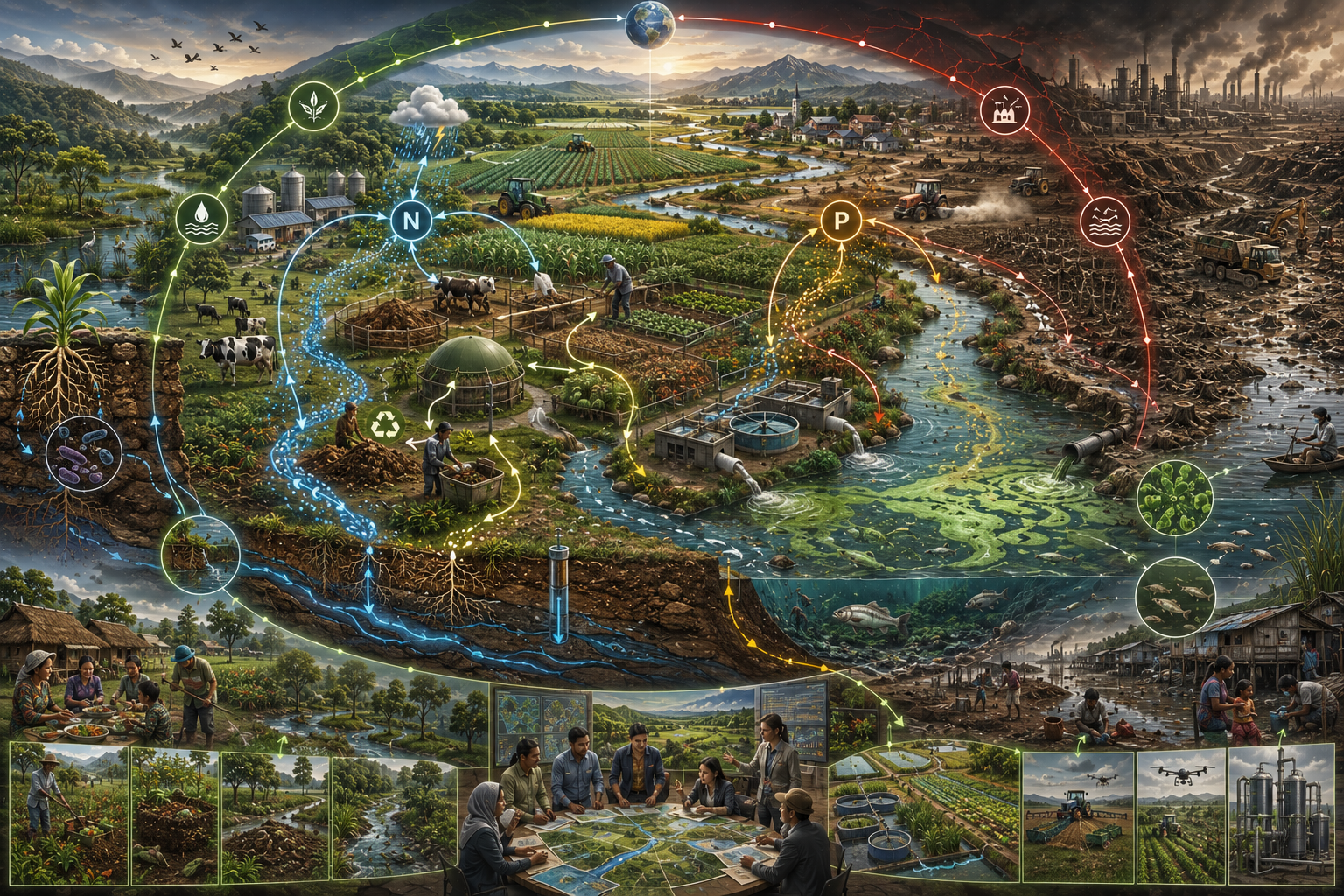
The 2030 Agenda places agriculture, food security, ecosystems, water, oceans, land, and sustainable resource management inside a common development framework. Goal 2 commits countries to ending hunger, improving nutrition, and promoting sustainable agriculture, while Goals 6, 12, 14, and 15 all bear directly on the environmental consequences of nutrient disruption through water quality, pollution, marine stress, land degradation, and ecosystem decline. This matters because nutrient management is not a narrow farm-input issue. It sits at the intersection of food systems, ecological resilience, public health, water governance, and long-run development viability.
The planetary-boundaries framework sharpens this developmental meaning by identifying altered biogeochemical flows, especially nitrogen and phosphorus, as one of the core Earth-system processes regulating stability and resilience. Industrial fixation of nitrogen and intensive phosphorus mobilization have enabled extraordinary increases in food production, but they have also disrupted nutrient balances across terrestrial, freshwater, and marine systems. In this sense, modern development has not simply used nutrients; it has reorganized nutrient cycles at planetary scale.
Current nutrient-governance materials reinforce this broader framing. Sustainable nutrient management is increasingly treated as part of the response to food insecurity, pollution, biodiversity loss, greenhouse-gas emissions, and the wider planetary crisis. Excess phosphorus and nitrogen can pollute lakes, rivers, estuaries, and coastal waters through eutrophication, while nitrogen pathways also connect agriculture to air pollution and climate-relevant emissions. Nutrient governance is therefore not only about boosting yields. It is about preventing agricultural productivity from becoming systemic ecological stress.
What Nutrient Cycles Are
Nutrient cycles are the biogeochemical processes through which essential elements move through soils, plants, water, atmosphere, organisms, and ecosystems. In agriculture, the most prominent macronutrients are nitrogen, phosphorus, and potassium, but nitrogen and phosphorus have become especially significant in environmental and planetary-boundary analysis because of the scale at which human activity has altered their circulation. These nutrients are indispensable to crop growth, biological productivity, and food systems, but they also become sources of ecological stress when mobilized in excess or poorly retained within productive systems.
Nitrogen is essential for proteins, enzymes, chlorophyll, and plant growth. Phosphorus is central to energy transfer, DNA, RNA, roots, seeds, and cellular function. Without adequate nutrient availability, agriculture cannot maintain productivity. Without balanced cycling, however, nutrients can leak into watersheds, accumulate in soils, alter microbial processes, stimulate algal blooms, contribute to hypoxia, and disrupt ecosystems far beyond the farm. Nutrient cycles therefore connect food production to ecological regulation.
This matters because nutrients are often discussed as inputs, but developmentally they are flows. They move across farms, soils, watersheds, markets, livestock systems, wastewater systems, and atmospheric pathways. A bag of fertilizer applied to a field may partly become crop biomass, partly remain in soil, partly run off into waterways, partly volatilize into the atmosphere, and partly contribute to downstream ecological burden. The development question is not simply how much nutrient is applied, but where it goes, what function it serves, who benefits, and what systems bear the cost.
Nutrient cycles also reveal a deeper truth about development: productivity depends on metabolism. Societies feed themselves by transforming ecological matter and energy into food, livelihoods, trade, and public wellbeing. When that metabolism is circular, balanced, and ecologically buffered, agriculture can support resilience. When it becomes linear, concentrated, wasteful, and poorly governed, it produces both food and ecological liability.
To understand nutrient cycles, therefore, is to understand one of the hidden infrastructures of sustainable development. Nutrients make agriculture possible, but unmanaged nutrient disruption can weaken the very ecological systems on which future agriculture depends.
Why Nutrients Matter for Development
Nutrients matter for development because they sit at the foundation of food production. Large-scale agricultural expansion and intensification over the last century would not have been possible without substantial increases in nutrient availability, especially through synthetic nitrogen fertilizer and mined phosphorus. These inputs helped raise yields, support population growth, reduce some forms of hunger, and increase the productive capacity of agricultural systems. This is why nutrient availability cannot be dismissed as merely a technical agricultural concern. It is central to food security and human wellbeing.
At the same time, the developmental importance of nutrients cannot be reduced to input maximization. More nutrient use does not automatically mean better development. Nutrient scarcity can constrain food production, but nutrient excess can degrade water, soils, biodiversity, public health, and downstream livelihoods. Development therefore depends not only on nutrient access, but on nutrient balance, timing, placement, recycling, uptake efficiency, and governance.
This creates one of the central tensions of sustainable agriculture. Food systems must nourish populations and support livelihoods, but they must do so without progressively degrading the ecological systems that make future food production possible. A society that produces more food by exporting nitrogen and phosphorus pollution into rivers, lakes, estuaries, groundwater, and coastal waters may be solving one development problem while creating another. The result is not sustainable abundance, but displaced ecological cost.
Nutrients also matter because agricultural systems are uneven. Some farmers and regions face nutrient deficiency, low soil fertility, and limited access to appropriate inputs. Others operate in high-surplus systems where fertilizer, feed, manure, and wastewater create major nutrient burdens. A sustainable development lens must hold both realities together. It must avoid simplistic calls for nutrient reduction where food production is already constrained, while also refusing to normalize excess where ecological damage is severe.
The goal is therefore not nutrient austerity. It is nutrient governance: enough nutrients for food security, used in ways that protect soils, water, ecosystems, and human health. This section aligns naturally with Food Security, Nutrition, and Human Development.
From Soil Fertility to Biogeochemical Disruption
One of the most important shifts in modern development has been the movement from managing local soil fertility to reorganizing nutrient cycles at industrial scale. In many historical farming systems, nutrients circulated through crop residues, manure, compost, mixed farming, fallows, rotations, local biomass, and relatively tight ecological loops. These systems were not always sufficient, equitable, or sustainable, but their nutrient flows were often more locally embedded. Modern agriculture has increasingly depended on externalized nutrient inputs, long-distance trade, concentrated livestock systems, synthetic fertilizers, mined phosphorus, large-scale monocultures, and global commodity chains.
This transformation helped raise agricultural output, but it also widened the distance between where nutrients are extracted, fixed, processed, applied, consumed, accumulated, and released. Nitrogen may be industrially fixed in one region, applied in another, incorporated into feed or crops, consumed elsewhere, and released through wastewater or manure systems far from its original source. Phosphorus may be mined, traded, applied to fields, concentrated in livestock systems, lost through erosion or runoff, and eventually deposited in water systems where recovery is difficult.
The result is a structural imbalance. Some landscapes are nutrient-depleted while others are nutrient-saturated. Some farmers struggle with low soil fertility, while other systems lose nutrients in quantities that exceed crop uptake and ecological absorption. Modern development has therefore changed the spatial logic of nutrient cycling. Nutrients are no longer simply recycled within local fertility systems; they are mobilized through globalized production and consumption systems that often separate benefit from burden.
This shift matters because biogeochemical disruption is not only a scientific abstraction. It appears as polluted water, algal blooms, dead zones, contaminated drinking-water sources, soil imbalance, air pollution, greenhouse-gas emissions, and declining ecosystem resilience. What begins as fertility management can become planetary-scale ecological stress when the system is organized around throughput rather than balance.
In sustainable development terms, the question is no longer only how to improve soil fertility. It is how to govern nutrient metabolism across farms, watersheds, cities, livestock systems, wastewater systems, trade flows, and ecosystems so that food production does not create cumulative ecological harm.
Nitrogen, Phosphorus, and Modern Agriculture
Nitrogen and phosphorus play different but complementary roles in the ecology of agriculture. Nitrogen is abundant in the atmosphere but largely unavailable to most crops until converted into reactive forms through biological fixation, industrial fixation, or other processes. The industrial fixation of nitrogen made it possible to supply agriculture with reactive nitrogen at a scale that transformed global food production. Phosphorus, by contrast, is mined from finite geological deposits and applied through fertilizers, feed systems, and soil amendments. It is essential to plant growth, but once phosphorus is dispersed into soils and waters, recovery is difficult and ecological consequences can be severe.
Both nutrients are necessary; both can become dangerous in excess. Nitrogen surpluses can leach into groundwater, run off into surface waters, volatilize into air, contribute to nitrous oxide emissions, acidify ecosystems in some contexts, and alter species composition. Phosphorus surpluses can accumulate in soils, move through erosion and runoff, and drive eutrophication in freshwater and coastal systems. These pathways differ chemically and ecologically, but developmentally they raise a common problem: agricultural productivity can externalize costs into surrounding systems.
Modern agriculture is often evaluated through yield, but yield alone can conceal nutrient inefficiency. A high-yield system may still lose large quantities of nitrogen and phosphorus if nutrients are poorly timed, over-applied, weakly matched to crop demand, or applied in landscapes with limited buffers. Conversely, a lower-input system may be undernourished, producing low yields and soil depletion. Sustainable development requires moving beyond the false choice between high input and low productivity. It requires nutrient systems that are productive, efficient, context-sensitive, circular, and ecologically accountable.
Livestock systems are central to this challenge. Concentrated animal production can create dense flows of manure and nutrient waste that exceed local land-absorption capacity. Feed may be grown in one region, transported to another, consumed by livestock, and concentrated as waste in places unable to recycle it safely. This spatial separation between feed production and waste absorption is one of the clearest examples of nutrient-cycle disruption.
Nitrogen and phosphorus therefore show why agriculture cannot be understood only as food production. It is also a biogeochemical system. How societies govern these nutrients will shape food security, ecosystem stability, public health, climate risk, and long-run development viability.
Habitability and Ecological Metabolism
One of the strongest ways to understand nutrient-cycle disruption is through the idea of ecological metabolism. Human societies feed themselves by drawing energy and matter from ecosystems, transforming them through agriculture, redistributing nutrients through markets and waste systems, and releasing residual flows back into soils, waters, and air. When this metabolism becomes too linear, extractive, and wasteful, habitability begins to erode. Nutrients that once sustained fertility become pollutants; productive landscapes become sources of aquatic stress; and the ecological buffers that maintain livable environments become weaker.
This matters because sustainable development depends on more than producing enough calories. It depends on whether the ecological metabolism of food production remains compatible with clean water, functioning soils, healthy air, biodiversity, and resilient ecosystems. A system that delivers food by progressively destabilizing those supporting conditions may appear productive in the short run while becoming more self-undermining over time.
Habitability is affected when nutrient pollution degrades water bodies, produces algal blooms, reduces oxygen, harms fisheries, contaminates drinking-water sources, or increases treatment costs. It is affected when nitrogen pathways contribute to air pollution or climate-relevant emissions. It is affected when soils lose balance and become more dependent on external inputs. It is affected when agricultural landscapes become simplified and less able to buffer nutrient loss. These are not only environmental harms. They shape the conditions under which people can live, work, eat, drink, farm, fish, and remain healthy.
Nutrient disruption also shows how development costs can be delayed and displaced. A farm may gain from nutrient application while downstream communities face eutrophication or drinking-water burdens. A livestock system may produce affordable protein while surrounding communities face manure and air-quality stress. A food system may increase output while future generations inherit degraded watersheds and weakened ecosystem function. Habitability declines when such costs are treated as external to development.
Ecological metabolism therefore gives nutrient governance a broader meaning. It asks whether the flows that sustain human life are organized in ways that renew rather than exhaust the conditions of future life.
Food Production and Ecological Stress
Agriculture depends on nutrients, but ecological stress emerges when nutrient use is organized around throughput rather than balance. High-input systems can generate large harvests while also leaving major surpluses in soils, waterways, and surrounding ecosystems. Nutrient cycles become stressed when application exceeds crop uptake, when livestock concentrations overwhelm local recycling capacity, when wastewater is insufficiently treated, or when landscape simplification weakens the ecological buffering that might otherwise absorb disturbance.
This is developmentally significant because food production and ecological stress are often treated as separate domains. In reality they are tightly linked. The same agricultural systems that support food security can also contribute to degraded water quality, eutrophication, greenhouse-gas emissions, biodiversity decline, soil imbalance, and public-health burdens if nutrient governance remains weak. Food-system success cannot be judged only by volume of production. It must also be judged by whether production systems maintain the ecological conditions that future food systems require.
There is also a scale problem. On an individual farm, additional fertilizer may appear rational if it reduces perceived risk of low yields. Across a watershed, many such decisions can produce cumulative nutrient loading. At national or global scale, this becomes a systemic development problem. Nutrient stress is often created by many local actions that are individually understandable but collectively damaging when incentives, information, infrastructure, and regulation are weak.
A sustainable food system must therefore combine agronomic sufficiency with ecological accountability. This includes better nutrient-use efficiency, soil testing, precision application, crop rotations, cover crops, manure management, agroecological practices, riparian buffers, wetland protection, wastewater recovery, and nutrient recycling. But technical tools alone are not enough. Farmers need institutions, finance, knowledge, markets, and policy environments that make balanced nutrient management practical rather than punitive.
The central development challenge is to feed people without exporting the hidden costs of food production into watersheds, oceans, air systems, and future soil fertility. This section also complements Planetary Boundaries and Sustainable Development.
Water Quality, Eutrophication, and Aquatic Risk
One of the clearest pathways through which nutrient disruption becomes ecological stress is water pollution. Excess nitrogen and phosphorus can move from farmland, livestock systems, wastewater, septic systems, urban runoff, and industrial sources into rivers, lakes, reservoirs, estuaries, and coastal waters. Once there, they can drive eutrophication: the over-enrichment of water systems that stimulates excessive algal growth, depletes oxygen, and destabilizes aquatic life.
Eutrophication matters because water systems are part of the infrastructure of development. They support drinking water, sanitation, fisheries, recreation, biodiversity, irrigation, cultural life, and the resilience of settlements and livelihoods. Nutrient overload can therefore turn an agricultural input problem into a public-health, water-security, fisheries, tourism, and ecosystem-stability problem. A lake, river, or coastal zone affected by nutrient pollution may become less safe, less productive, less biodiverse, and more expensive to manage.
Hypoxia and dead zones are among the most visible symptoms of severe nutrient loading. When algal blooms die and decompose, oxygen can be depleted, harming fish and other aquatic organisms. In coastal waters, nutrient flows from large agricultural basins can contribute to recurring dead zones that affect marine life and fisheries. In freshwater systems, cyanobacterial blooms can threaten drinking water, recreation, and public health. These effects are not isolated ecological events; they are development risks moving through water.
Nutrient pollution also illustrates the problem of downstream burden. The benefits of fertilizer use may be captured upstream through crop production, while the costs of runoff may fall downstream on communities, ecosystems, utilities, fishers, and public agencies. This makes nutrient governance a justice issue as well as a technical water-quality issue.
Water-quality risk therefore belongs inside sustainable development. Goal 6’s emphasis on water quality and sustainable management cannot be separated from agricultural nutrient systems. Nutrient stress migrates: what begins as fertilizer on land can become hazard in water and vulnerability in communities downstream.
Soils, Air, and Multiple Pathways of Stress
Nutrient disruption does not operate only through waterways. Soils can be degraded by imbalance as well as depletion. Nutrient surpluses can alter microbial processes, contribute to acidification in some contexts, create dependency on simplified input regimes, and encourage management systems that reduce long-run ecological resilience. Nutrient deficits can also deplete soil fertility, reduce yields, and trap farmers in low-productivity systems. Sustainable nutrient governance must therefore address both excess and deficiency.
Air pathways also matter. Nitrogen can move into the atmosphere through ammonia volatilization, nitrogen oxides, and nitrous oxide. These pathways connect agriculture to air pollution, particulate matter formation, ecosystem deposition, and climate-relevant emissions. Nutrient governance therefore cannot be limited to farm yield or water runoff. It must also account for atmospheric effects that shape public health and ecological systems.
This broader picture matters because nutrient stress is often multi-pathway stress. A fertilizer regime may support crop growth while simultaneously increasing runoff, atmospheric emissions, and ecosystem simplification. A livestock system may produce valuable food while also concentrating nutrient waste in ways that stress soils, water, air, and surrounding communities. A wastewater system may recover some nutrients while releasing others into rivers and coastal waters if treatment is inadequate. The same nutrient flow can therefore produce multiple development consequences.
Soil, water, and air are often governed by separate agencies and policy frameworks, but nutrient cycles move across those boundaries. This creates a governance challenge. A policy focused only on water quality may miss air emissions. A policy focused only on yield may miss soil health. A policy focused only on fertilizer reduction may harm farmers where soils are undernourished. Coherent nutrient governance must connect these pathways rather than treating them as separate problems.
This section aligns with Trade-Offs, Synergies, and Policy Coherence. Nutrient systems are full of trade-offs and synergies, and sustainable development depends on making those interactions visible.
Nutrient Cycles and Human Development
Nutrient cycles matter for human development because they affect food security, water quality, public health, livelihoods, ecological resilience, and future development capacity. Households depend on productive agriculture, but they also depend on safe water, healthy fisheries, functioning ecosystems, affordable food, and landscapes that do not become progressively more hazardous or degraded. Nutrient disruption can narrow these conditions even where agricultural production remains high.
From a human-development perspective, the key issue is not only whether agriculture raises output, but whether the nutrient systems supporting that output remain compatible with long-run capability. A region facing repeated water pollution, soil degradation, ecosystem decline, or harmful algal blooms due to nutrient overload may experience rising costs, health risks, livelihood insecurity, and public-system burdens even if agricultural statistics remain impressive. Development cannot be reduced to output when the conditions of life are being degraded.
Nutrient stress also affects livelihoods. Farmers may face rising input costs, soil imbalance, regulatory uncertainty, or market pressure to intensify. Fishers may lose income when eutrophication damages aquatic systems. Rural communities may face degraded water, odor, air-quality burdens, or concentrated livestock waste. Urban households may pay higher water-treatment costs. Public agencies may bear the financial burden of pollution control and ecosystem recovery. Nutrient disruption therefore affects the distribution of costs across society.
The human-development question is especially sharp where nutrient access remains unequal. Some low-income farmers need better access to nutrients, soil support, and agronomic knowledge to improve food security and livelihoods. Other regions require major reductions in excess nutrient loss. A just nutrient strategy must distinguish between these contexts rather than imposing one universal prescription.
Nutrient cycles therefore belong within human development because they shape the practical ability of people to eat, farm, drink safe water, sustain livelihoods, avoid pollution exposure, and pass viable ecosystems to future generations.
Inequality, Efficiency, and Nutrient Governance
Nutrient stress is also a question of inequality and governance. Nutrient inefficiency is not distributed evenly across farms, regions, or food systems. Some areas suffer from under-application and declining soil fertility, while others experience severe surpluses, manure concentration, runoff, and aquatic pollution. Some producers lack access to appropriate nutrient inputs, while others operate in systems that reward overuse or fail to internalize environmental costs. A development framework must treat both nutrient poverty and nutrient excess as governance problems.
Efficiency is central, but it must be understood carefully. Nutrient-use efficiency is not only a technical ratio of input to output. It is also a systems question: whether nutrients are applied at the right rate, time, and place; whether soils are capable of retaining them; whether landscapes have buffers; whether livestock waste can be recycled safely; whether wastewater systems recover nutrients; whether farmers have access to advice and testing; whether markets reward balanced practices; and whether pollution costs are borne by those who create them or displaced onto others.
Inequality appears in who benefits and who pays. Industrial food systems may concentrate profit and productivity benefits while downstream communities absorb water-quality harm. Small farmers may be blamed for nutrient inefficiency while lacking access to capital, extension services, soil tests, storage, or appropriate fertilizers. Communities near concentrated livestock operations may bear odor, air, water, and health burdens. Coastal fishers may suffer from dead zones created upstream. Nutrient governance must therefore be distributive, not merely technical.
Governance also requires avoiding simplistic reduction targets. In some regions, reducing nutrient use without improving soil fertility, crop diversity, water management, and farmer support could harm food security. In high-surplus systems, failing to reduce losses can deepen ecological stress. Context matters. Sustainable nutrient management must be site-specific, socially informed, and integrated across farms, watersheds, cities, and supply chains.
The goal is not merely to use fewer nutrients. It is to use nutrients better, recycle them more effectively, reduce harmful losses, support farmers fairly, protect communities, and maintain ecological function.
Biogeochemical Flows as a Planetary Boundary
The planetary-boundaries framework gives nutrient cycles a particularly strong developmental meaning by identifying altered biogeochemical flows as one of the key Earth-system processes regulating stability and resilience. In that framework, nitrogen and phosphorus are not merely farm inputs. They are planetary-scale regulatory elements whose disruption can push human societies farther outside a safe operating space. This is a major conceptual shift: nutrient mismanagement becomes not only a local pollution problem, but part of Earth-system risk.
This matters because nitrogen and phosphorus flows link agriculture to freshwater change, ocean systems, biosphere integrity, climate, land systems, and public health. Nutrient overload contributes to eutrophication in rivers, lakes, estuaries, and coastal waters. Nutrient use interacts with soil health, crop systems, biodiversity, atmospheric pollution, and greenhouse-gas pathways. A boundary lens helps reveal that nutrient disruption is not contained within agriculture. It crosses ecological systems and development sectors.
Biogeochemical flows also expose the limits of development models organized around maximum production alone. A system may raise food output through high nutrient mobilization while weakening the ecological stability on which future production depends. Once this is understood, sustainable development becomes more demanding. It must support food security while reducing nutrient loss, improving recycling, restoring soils, treating wastewater, protecting watersheds, and governing agricultural landscapes as ecological systems.
The planetary-boundaries lens also shows why nutrient governance must operate across scales. Farm-level practices matter, but so do watershed management, livestock geography, fertilizer markets, wastewater infrastructure, food trade, national regulation, and global nutrient flows. No single farm can solve a planetary nutrient imbalance alone, and no global framework can succeed without viable local practices.
Altered biogeochemical flows therefore belong at the center of sustainable development because they reveal how the systems that feed humanity can also destabilize the ecological foundations of development if they are poorly governed.
Toward Sustainable Nutrient Management
If nutrient cycles are foundational to both agriculture and ecological stress, then governance must do more than maximize fertilizer response. It must organize nutrient systems so that productivity, recycling, timing, landscape buffering, water protection, soil health, and ecosystem resilience remain jointly visible. Sustainable nutrient management requires a shift from input expansion to nutrient stewardship.
Integrated nutrient management is central to this shift. It combines mineral fertilizers, organic inputs, crop residues, manure, biological processes, soil testing, crop rotations, cover crops, and site-specific recommendations. The goal is not to romanticize low-input systems or dismiss modern agronomy. It is to optimize nutrient availability while reducing loss pathways. In many places, this means improving nutrient access and soil fertility. In others, it means reducing surplus, increasing efficiency, and preventing leakage.
Landscape design also matters. Riparian buffers, wetlands, cover crops, agroforestry, diversified rotations, restored soils, reduced erosion, and better drainage management can help retain nutrients and reduce runoff. Wastewater treatment and nutrient recovery can reduce the flow of nutrients into aquatic systems while creating opportunities for circular use. Livestock systems require manure management, spatial planning, and recycling pathways that prevent waste concentration from overwhelming local ecosystems.
Monitoring and accountability are also essential. Nutrient flows are often invisible until damage appears downstream. Better data on fertilizer use, manure flows, soil nutrient status, water quality, wastewater treatment, eutrophication, and atmospheric emissions can help make nutrient governance more precise and publicly accountable. But monitoring must be paired with institutions capable of acting on the evidence.
The development challenge is not to abandon nutrient use, but to govern it more intelligently. Sustainable agriculture requires adequate nutrient availability, while sustainable development requires that nutrient pathways remain compatible with clean water, resilient ecosystems, healthy soils, and long-run land productivity. The central question is therefore one of design: how to sustain food production without continuously exporting ecological stress into the systems that future development will depend upon.
Why This Matters for Sustainable Development
Nutrient cycles, agriculture, and ecological stress belong together because modern development has intensified all three simultaneously. Nutrients remain indispensable to food production and human survival, but the way they are currently mobilized often places growing pressure on soils, waters, ecosystems, and Earth-system stability. A serious development framework must therefore ask not only how nutrients raise output, but how nutrient pathways reshape long-run ecological viability.
This is why altered biogeochemical flows matter so much for sustainable development. They reveal a central truth that development theory can overlook: productivity gains can become self-undermining when they depend on nutrient systems that progressively degrade the ecological conditions of future productivity and wellbeing. A society cannot call its food system sustainable if the nutrient metabolism supporting it undermines water quality, aquatic ecosystems, soil resilience, public health, and downstream livelihoods.
The issue is also one of justice. Nutrient burdens are not distributed evenly. Some farmers lack nutrients needed for productivity, while other systems generate damaging surpluses. Some communities benefit from agricultural intensification, while others bear water pollution, air-quality burdens, degraded fisheries, or higher treatment costs. Sustainable nutrient governance must therefore be both ecological and distributive: improving food security while reducing the displacement of environmental cost onto vulnerable communities and future generations.
To take nutrient cycles seriously is to take sustainable development seriously. It is to recognize that long-run human development depends not only on feeding populations today, but on governing the ecological metabolism of agriculture in ways that keep future development productive, resilient, and habitable.
Development becomes credible when it can nourish people without overwhelming the nutrient cycles, soils, waters, and ecosystems that make nourishment possible.
Mathematical Lens
Nutrient-driven development burden can be clarified by thinking in terms of nutrient throughput, uptake efficiency, leakage, ecological exposure, and buffering capacity rather than yield alone. Let \(D_n\) represent nutrient-related development stress, \(N\) nutrient throughput, \(L\) leakage and runoff intensity, \(E\) exposure across water and ecosystems, and \(B\) buffering and governance capacity:
D_n = \alpha N + \beta L + \gamma E – \delta B
\]
Interpretation: Nutrient-related development stress rises when nutrient throughput, leakage, and ecological exposure intensify, and falls when buffering and governance capacity improve.
This captures the article’s core claim: the danger comes not only from nutrient use itself, but from nutrient pathways that exceed ecological absorption and governance capacity.
We can also express eutrophication pressure as a weighted function of nitrogen surplus, phosphorus surplus, and hydrological transport:
P_e = w_1 X_N + w_2 X_P + w_3 H
\]
Interpretation: Eutrophication pressure rises when nitrogen surplus, phosphorus surplus, and hydrological transfer into aquatic systems reinforce one another.
Here, \(X_N\) is reactive nitrogen surplus, \(X_P\) is phosphorus surplus, and \(H\) is hydrological transfer into rivers, lakes, estuaries, and coastal waters. Higher \(P_e\) means aquatic systems face greater risk of eutrophication, hypoxia, and ecological destabilization.
Finally, nutrient-system resilience can be represented as a function of recycling, monitoring, and integrated governance:
R_n = \lambda C + \mu M + \nu G
\]
Interpretation: Nutrient-system resilience improves when circular recycling, monitoring capacity, and integrated governance strengthen together.
Here, \(C\) is circular nutrient recycling, \(M\) is monitoring capacity, and \(G\) is governance coherence across agriculture, water, wastewater, livestock, and ecosystems. This helps show why agriculture can remain visibly productive while accumulating long-run ecological liabilities if monitoring, recycling, and governance remain weak.
| Term | Meaning | Interpretive role |
|---|---|---|
| \(D_n\) | Nutrient-related development stress | Represents development risk created by nutrient throughput, leakage, exposure, and weak response capacity. |
| \(N\) | Nutrient throughput | Represents total mobilization of nitrogen, phosphorus, manure, fertilizer, feed, and nutrient-bearing waste flows. |
| \(L\) | Leakage and runoff intensity | Represents nutrient losses through runoff, leaching, volatilization, erosion, and wastewater discharge. |
| \(E\) | Ecological exposure | Represents exposed rivers, lakes, aquifers, estuaries, coastal waters, soils, ecosystems, and communities. |
| \(B\) | Buffering and governance capacity | Represents soil health, landscape buffers, monitoring, regulation, treatment infrastructure, and institutional readiness. |
| \(P_e\) | Eutrophication pressure | Represents aquatic risk from nitrogen surplus, phosphorus surplus, and hydrological transport. |
| \(R_n\) | Nutrient-system resilience | Represents the strength of recycling, monitoring, and integrated nutrient governance. |
The equations are conceptual rather than predictive. Their value is to make visible the structure of the problem: nutrient-driven development stress depends on throughput, surplus, leakage, exposure, buffering, recycling, monitoring, and governance capacity working together.
Advanced Python Workflow: Nutrient Stress and Agricultural Development Scoring
This Python workflow translates the article’s core argument into a structured nutrient-risk model. Rather than treating fertilizer use as an isolated farm variable, it scores territories across nitrogen surplus, phosphorus surplus, runoff and leakage exposure, eutrophication pressure, soil-balance stress, food-system dependence, livestock-waste concentration, wastewater nutrient burden, water-quality burden, ecological buffering, recycling capacity, monitoring readiness, and governance capacity. That makes it possible to compare not only where nutrient use is high, but where altered nutrient flows are becoming most developmentally consequential.
from __future__ import annotations

import pandas as pd
import numpy as np

INPUT_FILE = "nutrient_cycles_agriculture_panel.csv"
OUTPUT_FILE = "nutrient_cycles_agriculture_stress_scores.csv"


def load_data(path: str) -> pd.DataFrame:
    """
    Load a territory-level nutrient cycles, agriculture, and ecological stress dataset.

    All *_index columns should be normalized to [0, 1].
    Higher values should mean more of the named property.

    Examples:
      - nitrogen_surplus_index: higher = greater reactive nitrogen surplus
      - phosphorus_surplus_index: higher = greater phosphorus surplus
      - recycling_capacity_index: higher = stronger circular nutrient recycling capacity
      - governance_capacity_index: higher = stronger nutrient governance capacity
    """
    df = pd.read_csv(path)

    required_columns = [
        "territory_name",
        "country_or_region",
        "territory_type",
        "nitrogen_surplus_index",
        "phosphorus_surplus_index",
        "runoff_leakage_index",
        "eutrophication_exposure_index",
        "soil_balance_stress_index",
        "food_system_dependence_index",
        "livestock_waste_concentration_index",
        "wastewater_nutrient_burden_index",
        "water_quality_burden_index",
        "ecological_buffer_capacity_index",
        "recycling_capacity_index",
        "monitoring_readiness_index",
        "governance_capacity_index",
        "policy_coherence_index",
    ]

    missing = [col for col in required_columns if col not in df.columns]

    if missing:
        raise ValueError(f"Missing required columns: {missing}")

    return df


def validate_indices(df: pd.DataFrame) -> pd.DataFrame:
    """Validate that all *_index fields are complete and normalized to [0, 1]."""
    index_columns = [col for col in df.columns if col.endswith("_index")]

    for col in index_columns:
        if df[col].isna().any():
            raise ValueError(f"Column '{col}' contains missing values.")

        if ((df[col] < 0) | (df[col] > 1)).any():
            raise ValueError(f"Column '{col}' contains values outside [0, 1].")

    return df


def compute_scores(df: pd.DataFrame) -> pd.DataFrame:
    """
    Compute biogeochemical stress, development dependence,
    governance readiness, and constrained nutrient-development stress.

    Biogeochemical stress rises with nitrogen surplus, phosphorus surplus,
    runoff and leakage, eutrophication exposure, soil balance stress,
    livestock waste concentration, wastewater nutrient burden, and
    water-quality burden.

    Governance readiness rises with ecological buffering, recycling capacity,
    monitoring readiness, governance capacity, and policy coherence.
    """
    df = df.copy()

    df["biogeochemical_stress_score"] = (
        0.18 * df["nitrogen_surplus_index"] +
        0.17 * df["phosphorus_surplus_index"] +
        0.15 * df["runoff_leakage_index"] +
        0.14 * df["eutrophication_exposure_index"] +
        0.12 * df["soil_balance_stress_index"] +
        0.10 * df["livestock_waste_concentration_index"] +
        0.07 * df["wastewater_nutrient_burden_index"] +
        0.07 * df["water_quality_burden_index"]
    ).clip(lower=0, upper=1)

    df["development_dependence_score"] = (
        0.42 * df["food_system_dependence_index"] +
        0.22 * df["water_quality_burden_index"] +
        0.16 * df["eutrophication_exposure_index"] +
        0.12 * df["soil_balance_stress_index"] +
        0.08 * df["wastewater_nutrient_burden_index"]
    ).clip(lower=0, upper=1)

    df["governance_readiness_score"] = (
        0.24 * df["governance_capacity_index"] +
        0.22 * df["monitoring_readiness_index"] +
        0.20 * df["recycling_capacity_index"] +
        0.18 * df["ecological_buffer_capacity_index"] +
        0.16 * df["policy_coherence_index"]
    ).clip(lower=0, upper=1)

    df["constrained_nutrient_stress_score"] = (
        0.42 * df["biogeochemical_stress_score"] +
        0.24 * df["development_dependence_score"] +
        0.14 * df["eutrophication_exposure_index"] +
        0.10 * df["water_quality_burden_index"] +
        0.10 * (1 - df["governance_readiness_score"])
    ).clip(lower=0, upper=1)

    df["nutrient_governance_gap"] = (
        df["biogeochemical_stress_score"] -
        df["governance_readiness_score"]
    )

    df["risk_band"] = np.select(
        [
            df["constrained_nutrient_stress_score"] >= 0.80,
            df["constrained_nutrient_stress_score"] >= 0.60,
            df["constrained_nutrient_stress_score"] >= 0.40,
        ],
        [
            "Extreme nutrient-development stress",
            "High nutrient-development stress",
            "Moderate nutrient-development stress",
        ],
        default="Lower nutrient-development stress",
    )

    df["nutrient_warning"] = np.select(
        [
            df["nutrient_governance_gap"] >= 0.35,
            df["nutrient_governance_gap"] >= 0.20,
            df["nutrient_governance_gap"] >= 0.05,
        ],
        [
            "Severe nutrient governance gap",
            "High nutrient governance gap",
            "Moderate nutrient governance gap",
        ],
        default="Lower governance gap or stronger nutrient readiness",
    )

    return df


def build_summary(df: pd.DataFrame) -> pd.DataFrame:
    """Return a ranked summary table for review or reporting."""
    columns = [
        "territory_name",
        "country_or_region",
        "territory_type",
        "biogeochemical_stress_score",
        "development_dependence_score",
        "governance_readiness_score",
        "constrained_nutrient_stress_score",
        "nutrient_governance_gap",
        "risk_band",
        "nutrient_warning",
    ]

    summary = df[columns].copy()

    summary = summary.sort_values(
        by=[
            "constrained_nutrient_stress_score",
            "biogeochemical_stress_score",
            "development_dependence_score",
        ],
        ascending=[False, False, False],
    ).reset_index(drop=True)

    return summary


def main() -> None:
    df = load_data(INPUT_FILE)
    df = validate_indices(df)
    scored = compute_scores(df)
    summary = build_summary(scored)

    summary.to_csv(OUTPUT_FILE, index=False)

    print("Nutrient stress and agricultural development scoring complete.")
    print(summary.to_string(index=False))


if __name__ == "__main__":
    main()
This workflow is intentionally transparent. It does not claim that nutrient-development stress can be reduced to one objective score. Instead, it makes assumptions visible: nitrogen surplus, phosphorus surplus, runoff, eutrophication exposure, soil balance, food-system dependence, livestock waste, wastewater nutrient burden, water-quality burden, ecological buffers, recycling capacity, monitoring readiness, governance capacity, and policy coherence are treated as distinct components. The value of the model is diagnostic. It helps identify where nutrient flows are most likely to become a development constraint.
Advanced R Workflow: Nutrient Burden, Eutrophication Exposure, and Governance Gap Analysis
This R workflow is designed for the part of the article that emphasizes variation across territories, watersheds, food systems, and exposed groups. It compares settings across nitrogen surplus, phosphorus surplus, runoff, eutrophication exposure, soil-balance stress, livestock-waste concentration, wastewater nutrient burden, water-quality burden, food-system dependence, recycling capacity, monitoring readiness, and governance capacity, then builds grouped summaries that help show where nutrient stress is strongest and where ecological costs remain developmentally significant.
library(readr)
library(dplyr)

input_file <- "nutrient_cycles_country_panel.csv"
region_output_file <- "cross_region_nutrient_summary.csv"
territory_output_file <- "cross_territory_nutrient_summary.csv"

nutr_df <- read_csv(input_file, show_col_types = FALSE)

required_cols <- c(
  "territory_name",
  "country_or_region",
  "territory_type",
  "nitrogen_surplus_index",
  "phosphorus_surplus_index",
  "runoff_leakage_index",
  "eutrophication_exposure_index",
  "soil_balance_stress_index",
  "food_system_dependence_index",
  "livestock_waste_concentration_index",
  "wastewater_nutrient_burden_index",
  "water_quality_burden_index",
  "ecological_buffer_capacity_index",
  "recycling_capacity_index",
  "monitoring_readiness_index",
  "governance_capacity_index",
  "policy_coherence_index"
)

missing_cols <- setdiff(required_cols, names(nutr_df))

if (length(missing_cols) > 0) {
  stop(paste("Missing required columns:", paste(missing_cols, collapse = ", ")))
}

index_cols <- names(nutr_df)[grepl("_index$", names(nutr_df))]

invalid_index_cols <- index_cols[
  vapply(
    nutr_df[index_cols],
    function(x) any(is.na(x) | x < 0 | x > 1),
    logical(1)
  )
]

if (length(invalid_index_cols) > 0) {
  stop(
    paste(
      "Index columns must be complete and normalized to [0, 1]:",
      paste(invalid_index_cols, collapse = ", ")
    )
  )
}

nutr_df <- nutr_df %>%
  mutate(
    biogeochemical_stress_proxy = (
      nitrogen_surplus_index +
      phosphorus_surplus_index +
      runoff_leakage_index +
      eutrophication_exposure_index +
      soil_balance_stress_index +
      livestock_waste_concentration_index +
      wastewater_nutrient_burden_index +
      water_quality_burden_index
    ) / 8,
    development_dependence_proxy = (
      food_system_dependence_index +
      water_quality_burden_index +
      eutrophication_exposure_index +
      soil_balance_stress_index +
      wastewater_nutrient_burden_index
    ) / 5,
    governance_readiness_proxy = (
      governance_capacity_index +
      monitoring_readiness_index +
      recycling_capacity_index +
      ecological_buffer_capacity_index +
      policy_coherence_index
    ) / 5,
    nutrient_development_risk_proxy = (
      biogeochemical_stress_proxy +
      development_dependence_proxy +
      eutrophication_exposure_index +
      water_quality_burden_index +
      (1 - governance_readiness_proxy)
    ) / 5,
    nutrient_governance_gap = biogeochemical_stress_proxy - governance_readiness_proxy,
    risk_band = case_when(
      nutrient_development_risk_proxy >= 0.75 ~ "Extreme nutrient-development stress",
      nutrient_development_risk_proxy >= 0.55 ~ "High nutrient-development stress",
      nutrient_development_risk_proxy >= 0.35 ~ "Moderate nutrient-development stress",
      TRUE ~ "Lower nutrient-development stress"
    )
  )

region_summary <- nutr_df %>%
  group_by(country_or_region) %>%
  summarise(
    avg_nutrient_development_risk_proxy = mean(nutrient_development_risk_proxy, na.rm = TRUE),
    avg_biogeochemical_stress_proxy = mean(biogeochemical_stress_proxy, na.rm = TRUE),
    avg_development_dependence_proxy = mean(development_dependence_proxy, na.rm = TRUE),
    avg_governance_readiness_proxy = mean(governance_readiness_proxy, na.rm = TRUE),
    avg_nitrogen_surplus = mean(nitrogen_surplus_index, na.rm = TRUE),
    avg_phosphorus_surplus = mean(phosphorus_surplus_index, na.rm = TRUE),
    avg_runoff_leakage = mean(runoff_leakage_index, na.rm = TRUE),
    avg_eutrophication_exposure = mean(eutrophication_exposure_index, na.rm = TRUE),
    avg_soil_balance_stress = mean(soil_balance_stress_index, na.rm = TRUE),
    avg_food_system_dependence = mean(food_system_dependence_index, na.rm = TRUE),
    avg_livestock_waste_concentration = mean(livestock_waste_concentration_index, na.rm = TRUE),
    avg_wastewater_nutrient_burden = mean(wastewater_nutrient_burden_index, na.rm = TRUE),
    avg_water_quality_burden = mean(water_quality_burden_index, na.rm = TRUE),
    avg_ecological_buffer_capacity = mean(ecological_buffer_capacity_index, na.rm = TRUE),
    avg_recycling_capacity = mean(recycling_capacity_index, na.rm = TRUE),
    avg_monitoring_readiness = mean(monitoring_readiness_index, na.rm = TRUE),
    avg_governance_capacity = mean(governance_capacity_index, na.rm = TRUE),
    avg_policy_coherence = mean(policy_coherence_index, na.rm = TRUE),
    avg_nutrient_governance_gap = mean(nutrient_governance_gap, na.rm = TRUE),
    observations = n(),
    .groups = "drop"
  ) %>%
  mutate(
    regional_risk_band = case_when(
      avg_nutrient_development_risk_proxy >= 0.75 ~ "Extreme nutrient-development stress",
      avg_nutrient_development_risk_proxy >= 0.55 ~ "High nutrient-development stress",
      avg_nutrient_development_risk_proxy >= 0.35 ~ "Moderate nutrient-development stress",
      TRUE ~ "Lower nutrient-development stress"
    )
  ) %>%
  arrange(desc(avg_nutrient_development_risk_proxy))

territory_summary <- nutr_df %>%
  group_by(territory_type) %>%
  summarise(
    avg_nutrient_development_risk_proxy = mean(nutrient_development_risk_proxy, na.rm = TRUE),
    avg_biogeochemical_stress_proxy = mean(biogeochemical_stress_proxy, na.rm = TRUE),
    avg_development_dependence_proxy = mean(development_dependence_proxy, na.rm = TRUE),
    avg_governance_readiness_proxy = mean(governance_readiness_proxy, na.rm = TRUE),
    avg_nitrogen_surplus = mean(nitrogen_surplus_index, na.rm = TRUE),
    avg_phosphorus_surplus = mean(phosphorus_surplus_index, na.rm = TRUE),
    avg_runoff_leakage = mean(runoff_leakage_index, na.rm = TRUE),
    avg_eutrophication_exposure = mean(eutrophication_exposure_index, na.rm = TRUE),
    avg_soil_balance_stress = mean(soil_balance_stress_index, na.rm = TRUE),
    avg_food_system_dependence = mean(food_system_dependence_index, na.rm = TRUE),
    avg_livestock_waste_concentration = mean(livestock_waste_concentration_index, na.rm = TRUE),
    avg_wastewater_nutrient_burden = mean(wastewater_nutrient_burden_index, na.rm = TRUE),
    avg_water_quality_burden = mean(water_quality_burden_index, na.rm = TRUE),
    avg_ecological_buffer_capacity = mean(ecological_buffer_capacity_index, na.rm = TRUE),
    avg_recycling_capacity = mean(recycling_capacity_index, na.rm = TRUE),
    avg_monitoring_readiness = mean(monitoring_readiness_index, na.rm = TRUE),
    avg_governance_capacity = mean(governance_capacity_index, na.rm = TRUE),
    avg_policy_coherence = mean(policy_coherence_index, na.rm = TRUE),
    avg_nutrient_governance_gap = mean(nutrient_governance_gap, na.rm = TRUE),
    observations = n(),
    .groups = "drop"
  ) %>%
  arrange(desc(avg_nutrient_development_risk_proxy))

write_csv(region_summary, region_output_file)
write_csv(territory_summary, territory_output_file)

cat("Cross-region nutrient summary exported to:", region_output_file, "\n")
print(region_summary)

cat("\nCross-territory nutrient summary exported to:", territory_output_file, "\n")
print(territory_summary)
This workflow helps distinguish nutrient use from developmentally consequential nutrient stress. A territory may have high nutrient throughput but stronger monitoring, recycling, ecological buffering, and governance capacity. Another may have moderate nutrient use but severe eutrophication exposure, weak wastewater treatment, poor monitoring, and high food-system dependence. The workflow therefore treats nutrient cycles as development conditions, not as isolated agronomic variables.
GitHub Repository
Complete Code Repository
The full code distribution for this article, including nutrient-stress scoring workflows, eutrophication diagnostics, SQL materials, optional monitoring support tooling, supporting documentation, and repository structure, is available on GitHub.
Related Articles
- Food Security, Nutrition, and Human Development
- Freshwater Change and Development Risk
- Planetary Boundaries and Sustainable Development
- Land-System Change and Development Pathways
- Trade-Offs, Synergies, and Policy Coherence
- Health, Education, and Human Capability Expansion
- Ocean Systems, Acidification, and Coastal Development
- Pollution, Novel Entities, and Long-Run Development
- Biosphere Integrity and Human Development
- Sustainable Development as a Systems Problem
Further Reading
- United Nations Department of Economic and Social Affairs (n.d.) Goal 2: End hunger, achieve food security and improved nutrition and promote sustainable agriculture. New York: United Nations. Available at: https://sdgs.un.org/goals/goal2
- United Nations Department of Economic and Social Affairs (n.d.) Goal 6: Ensure availability and sustainable management of water and sanitation for all. New York: United Nations. Available at: https://sdgs.un.org/goals/goal6
- United Nations Department of Economic and Social Affairs (n.d.) Goal 14: Conserve and sustainably use the oceans, seas and marine resources for sustainable development. New York: United Nations. Available at: https://sdgs.un.org/goals/goal14
- United Nations Department of Economic and Social Affairs (n.d.) Goal 15: Life on land. New York: United Nations. Available at: https://sdgs.un.org/goals/goal15
- Food and Agriculture Organization of the United Nations (2006) Plant Nutrition for Food Security: A Guide for Integrated Nutrient Management. Rome: FAO. Available at: https://www.fao.org/3/a0443e/a0443e.pdf
- Food and Agriculture Organization of the United Nations (n.d.) Integrated Plant Nutrient Management. Rome: FAO. Available at: https://www.fao.org/agriculture/crops/thematic-sitemap/theme/spi/scpi-home/managing-ecosystems/integrated-plant-nutrient-management/en/
- United Nations Environment Programme (n.d.) Sustainable Nutrient Management. Nairobi: UNEP. Available at: https://www.unep.org/topics/ocean-seas-and-coasts/ecosystem-degradation-pollution/nutrient-management
- United Nations Environment Programme (n.d.) Phosphorus. Nairobi: UNEP. Available at: https://www.unep.org/topics/ocean-seas-and-coasts/ecosystem-degradation-pollution/nutrient-management/nutrients-1
- Stockholm Resilience Centre (n.d.) Planetary boundaries. Stockholm: Stockholm Resilience Centre. Available at: https://www.stockholmresilience.org/research/planetary-boundaries.html
- Richardson, K. et al. (2023) Earth beyond six of nine planetary boundaries. Science Advances, 9(37). Available at: https://www.science.org/doi/10.1126/sciadv.adh2458
References
- United Nations (2015) Transforming our world: the 2030 Agenda for Sustainable Development. New York: United Nations. Available at: https://sdgs.un.org/2030agenda
- United Nations Department of Economic and Social Affairs (n.d.) Goal 2: End hunger, achieve food security and improved nutrition and promote sustainable agriculture. New York: United Nations. Available at: https://sdgs.un.org/goals/goal2
- United Nations Department of Economic and Social Affairs (n.d.) Goal 6: Ensure availability and sustainable management of water and sanitation for all. New York: United Nations. Available at: https://sdgs.un.org/goals/goal6
- United Nations Department of Economic and Social Affairs (n.d.) Goal 12: Ensure sustainable consumption and production patterns. New York: United Nations. Available at: https://sdgs.un.org/goals/goal12
- United Nations Department of Economic and Social Affairs (n.d.) Goal 14: Conserve and sustainably use the oceans, seas and marine resources for sustainable development. New York: United Nations. Available at: https://sdgs.un.org/goals/goal14
- United Nations Department of Economic and Social Affairs (n.d.) Goal 15: Life on land. New York: United Nations. Available at: https://sdgs.un.org/goals/goal15
- Food and Agriculture Organization of the United Nations (2006) Plant Nutrition for Food Security: A Guide for Integrated Nutrient Management. Rome: FAO. Available at: https://www.fao.org/3/a0443e/a0443e.pdf
- Food and Agriculture Organization of the United Nations (n.d.) Integrated Plant Nutrient Management. Rome: FAO. Available at: https://www.fao.org/agriculture/crops/thematic-sitemap/theme/spi/scpi-home/managing-ecosystems/integrated-plant-nutrient-management/en/
- United Nations Environment Programme (n.d.) Sustainable Nutrient Management. Nairobi: UNEP. Available at: https://www.unep.org/topics/ocean-seas-and-coasts/ecosystem-degradation-pollution/nutrient-management
- United Nations Environment Programme (n.d.) Phosphorus. Nairobi: UNEP. Available at: https://www.unep.org/topics/ocean-seas-and-coasts/ecosystem-degradation-pollution/nutrient-management/nutrients-1
- United Nations Environment Programme (n.d.) Nutrient management: the issue. Nairobi: UNEP. Available at: https://www.unep.org/explore-topics/oceans-seas/global-partnership-nutrient-management/nutrient-management-issue
- Stockholm Resilience Centre (n.d.) Planetary boundaries. Stockholm: Stockholm Resilience Centre. Available at: https://www.stockholmresilience.org/research/planetary-boundaries.html
- Stockholm Resilience Centre (n.d.) Table of the nine planetary boundaries. Stockholm: Stockholm Resilience Centre. Available at: https://www.stockholmresilience.org/research/planetary-boundaries/quantitative-evolution-of-boundaries.html
- Rockström, J., Steffen, W., Noone, K., Persson, Å., Chapin, F.S. III, Lambin, E.F., Lenton, T.M., Scheffer, M., Folke, C., Schellnhuber, H.J., Nykvist, B., de Wit, C.A., Hughes, T., van der Leeuw, S., Rodhe, H., Sörlin, S., Snyder, P.K., Costanza, R., Svedin, U., Falkenmark, M., Karlberg, L., Corell, R.W., Fabry, V.J., Hansen, J., Walker, B., Liverman, D., Richardson, K., Crutzen, P. and Foley, J.A. (2009) A safe operating space for humanity. Nature, 461, pp. 472–475. Available at: https://www.nature.com/articles/461472a
- Steffen, W., Richardson, K., Rockström, J., Cornell, S.E., Fetzer, I., Bennett, E.M., Biggs, R., Carpenter, S.R., de Vries, W., de Wit, C.A., Folke, C., Gerten, D., Heinke, J., Mace, G.M., Persson, L.M., Ramanathan, V., Reyers, B. and Sörlin, S. (2015) Planetary Boundaries: Guiding Human Development on a Changing Planet. Science, 347(6223). Available at: https://www.science.org/doi/10.1126/science.1259855
- Richardson, K., Steffen, W., Lucht, W., Bendtsen, J., Cornell, S.E., Donges, J.F., Drüke, M., Fetzer, I., Bala, G., von Bloh, W., Feulner, G., Fiedler, S., Gerten, D., Gleeson, T., Hofmann, M., Huiskamp, W., Kummu, M., Mohan, C., Nogués-Bravo, D., Petri, S., Porkka, M., Rahmstorf, S., Schaphoff, S., Thonicke, K., Tobian, A., Virkki, V., Wang-Erlandsson, L., Weber, L. and Rockström, J. (2023) Earth beyond six of nine planetary boundaries. Science Advances, 9(37). Available at: https://www.science.org/doi/10.1126/sciadv.adh2458
- Guo, Y. et al. (2024) Aspirational nitrogen interventions accelerate air pollution. Science Advances. Available at: https://www.science.org/doi/10.1126/sciadv.ado0112