Sustainable Development

Sustainable development is a framework for improving human well-being while preserving the ecological systems on which life depends. It gained global prominence through the 1987 World Commission on Environment and Development report Our Common Future, which defined it as development that meets present needs without compromising the ability of future generations to meet their own.

The concept brings together three interdependent aims: economic vitality, social equity, and environmental stewardship. Rather than treating them as separate or competing goals, sustainable development emphasizes their mutual dependence and now underpins global agendas such as the United Nations Sustainable Development Goals. As a result, it has become a central framework for addressing climate change, biodiversity loss, inequality, and long-term institutional resilience.

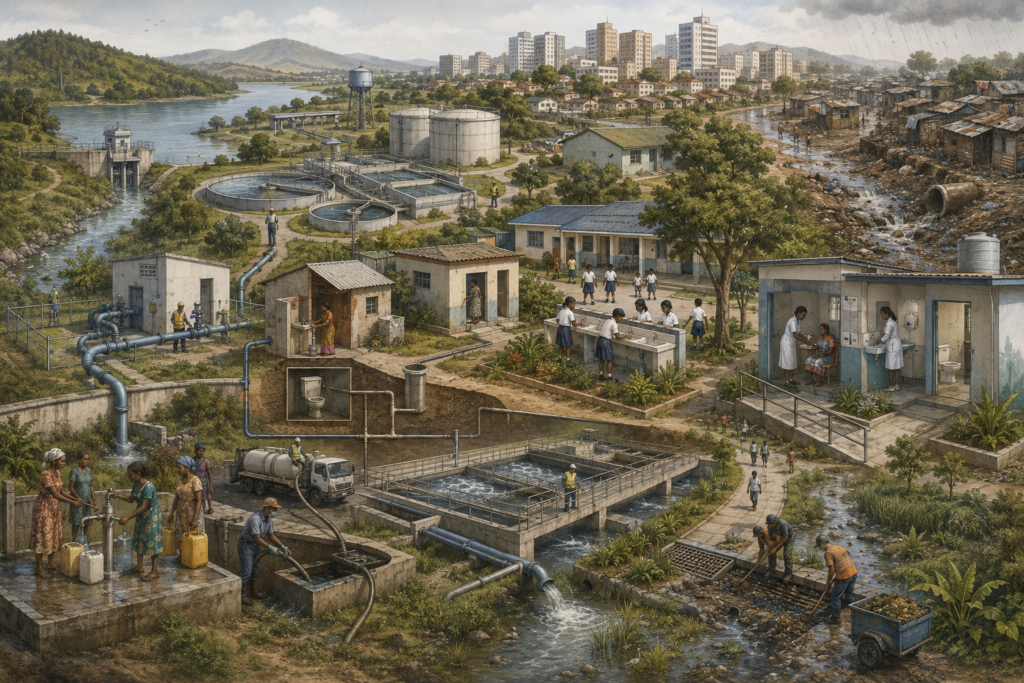
Editorial sustainability illustration showing water treatment, sanitation, hygiene facilities, drainage, wastewater systems, and unequal service conditions across neighborhoods, schools, clinics, and public spaces.

Water, Sanitation, and Public Infrastructure Systems

Water, sanitation, and public infrastructure systems are foundational to sustainable development because they determine whether health, dignity, education, care, and public life can function safely and reliably. This article argues that water and sanitation should be understood not as isolated services, but as governable public systems linking treatment, delivery, wastewater, drainage, finance, maintenance, and institutional capacity. It examines the historical evolution of water infrastructure, the shift from access metrics to systems thinking, and the ways inequality, gender, territorial exclusion, and climate stress shape infrastructural outcomes. It also shows why sustainable development depends on more than construction alone: durable progress requires maintenance, resilience, safe end-to-end management, and institutions capable of reconciling rights, affordability, operational realism, and long-horizon stewardship.
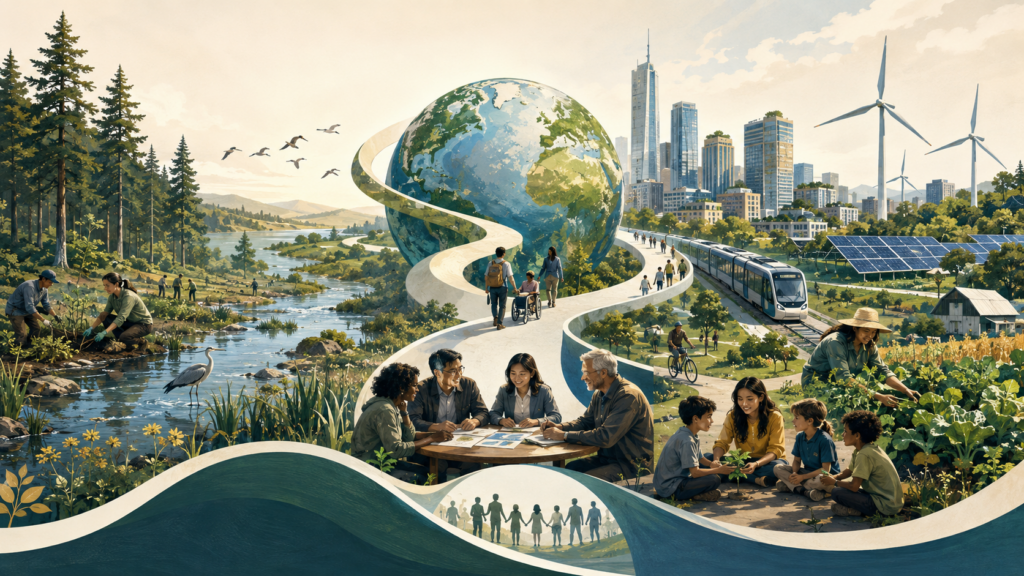
Editorial sustainability illustration showing a globe, ecological restoration, renewable energy, inclusive communities, public transit, agriculture, and a pathway toward a more resilient sustainable future.

Future Directions in Sustainable Development Thought

Future directions in sustainable development thought are being shaped by a deeper redefinition of development itself. This article argues that the field is moving beyond growth-centered frameworks toward a more demanding conception of viability: one that integrates planetary boundaries, resilience, governance capacity, technological power, justice, and long-horizon uncertainty. It examines the biophysical turn in development theory, the rise of fragility and systems thinking, the growing importance of anticipatory governance, and the digital recasting of development through AI and data systems. It also explores how future development thought is becoming more political in its treatment of inequality, more plural in its treatment of knowledge, and more ambitious in its effort to measure flourishing beyond output alone. The result is a field increasingly organized around the problem of sustaining just and governable futures under conditions of systemic stress.

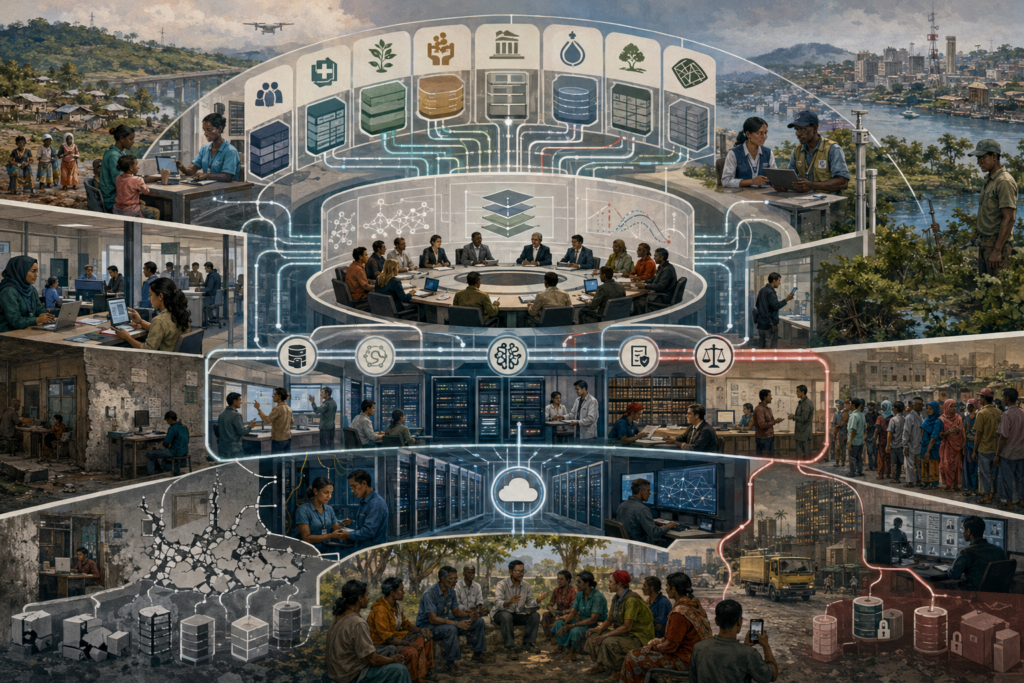
Editorial sustainability and governance illustration showing AI, public data systems, digital infrastructure, institutional oversight, community participation, and unequal access to accountable digital governance.

AI, Data Systems, and the Future of Development Governance

AI, data systems, and development governance increasingly belong to the same analytical frame because public authority is becoming more data-mediated, more automated, and more dependent on digital infrastructure. This article argues that AI is not developmentally meaningful in isolation. Its value depends on data quality, interoperability, compute access, institutional capacity, legal safeguards, and public trust. It examines how AI is reshaping administrative power, service delivery, state legibility, and governance infrastructure, while also intensifying questions of inequality, surveillance, platform dependence, and algorithmic lock-in. The core claim is that sustainable development now depends not only on technical adoption, but on whether societies can build trustworthy data systems and publicly governable AI arrangements. What matters most is not AI sophistication alone, but whether digital governance remains accountable, inclusive, contestable, and institutionally durable.

Planetary boundaries define the Earth-system conditions within which sustainable development remains habitable, just, resilient, and durable over time.

Development Under Deep Uncertainty

Development under deep uncertainty examines how sustainable development decisions should be made when futures are multiple, probabilities are disputed, and system behavior cannot be confidently forecast in advance. This article argues that long-horizon development planning cannot rely on prediction-centered methods alone. It must instead use strategies built around robustness, adaptability, institutional learning, and pathway flexibility. The piece distinguishes deep uncertainty from ordinary risk, explains why forecast-based planning often becomes brittle under changing conditions, and shows how scenario analysis, adaptive pathways, and Decision-Making Under Deep Uncertainty provide a more durable framework for planning. It also foregrounds the justice dimension of uncertainty, emphasizing that the burdens of error, delay, and adjustment are distributed unequally. The result is a more realistic account of how development remains strategic when certainty is no longer available.

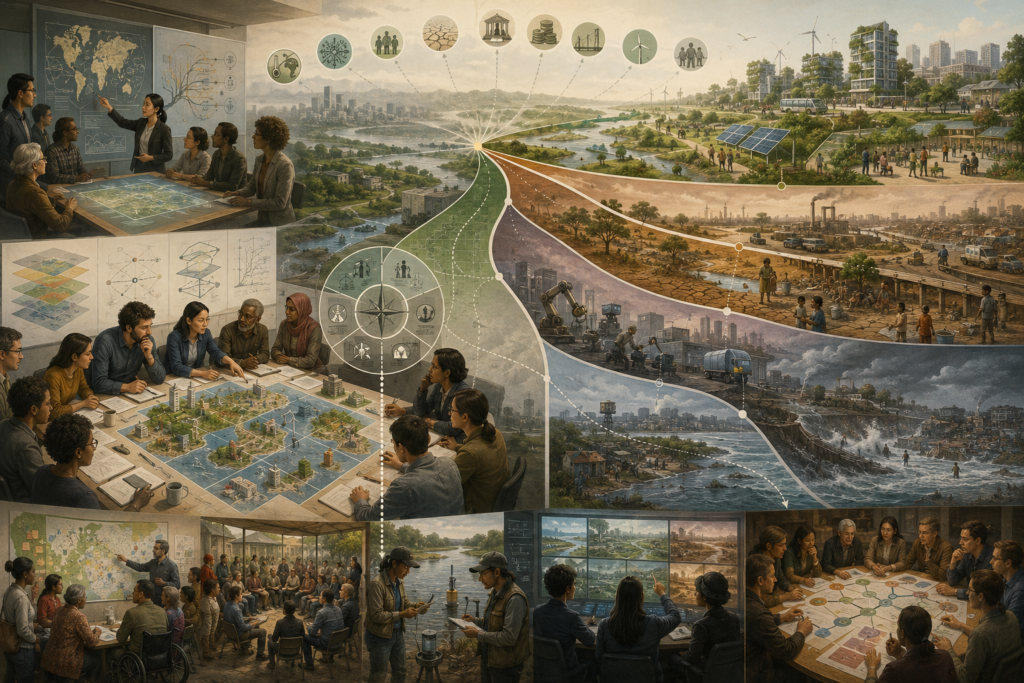
Editorial sustainability illustration showing multiple branching future pathways, planning tables, community workshops, foresight rooms, field monitoring, and contrasting sustainable development scenarios.

Scenario Planning for Sustainable Futures

Scenario planning matters for sustainable development because long-horizon development decisions must be made without knowing which future will arrive. This article argues that scenario planning is valuable not because it predicts one correct outcome, but because it helps institutions think rigorously across multiple plausible futures and improve present strategy under uncertainty. It explains how scenario planning differs from forecasting, why it matters for climate-resilient and path-dependent development, and how it supports robustness, institutional learning, and adaptive decision-making. The article also emphasizes that scenario work is never politically neutral: the futures institutions imagine reflect assumptions about power, vulnerability, and legitimacy. Used well, scenario planning widens strategic awareness, surfaces hidden assumptions, and strengthens present judgment. Used poorly, it becomes decorative futurism detached from real decisions, justice, and institutional change.

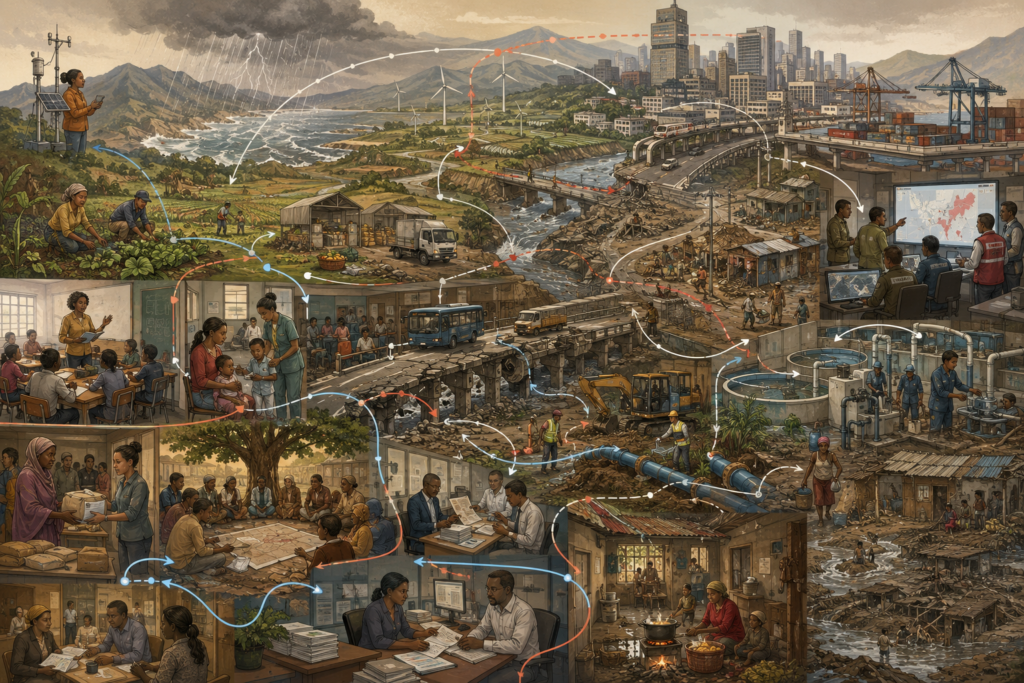
Editorial sustainability illustration showing climate hazards, damaged infrastructure, fragile services, emergency coordination, social protection, and unequal community exposure across interconnected development systems.

Risk, Shock, and Fragility in Development Systems

Risk, shock, and fragility in development systems examines why sustainable development cannot be judged only by the gains societies achieve, but also by how well those gains endure under pressure. The article argues that economic crises, climate hazards, conflict, food insecurity, institutional breakdown, and infrastructure failures are not external interruptions to development, but part of the conditions through which development pathways are tested and sometimes reversed. It explores fragility as the interaction of exposure and insufficient resilience, emphasizes the multidimensional nature of risk across economic, environmental, political, security, societal, and human domains, and shows how compound shocks can cascade across systems. The core claim is that development remains fragile when progress depends on favorable conditions rather than on institutions, infrastructures, and social protections capable of absorbing disturbance, adapting under strain, and preserving human wellbeing across time.

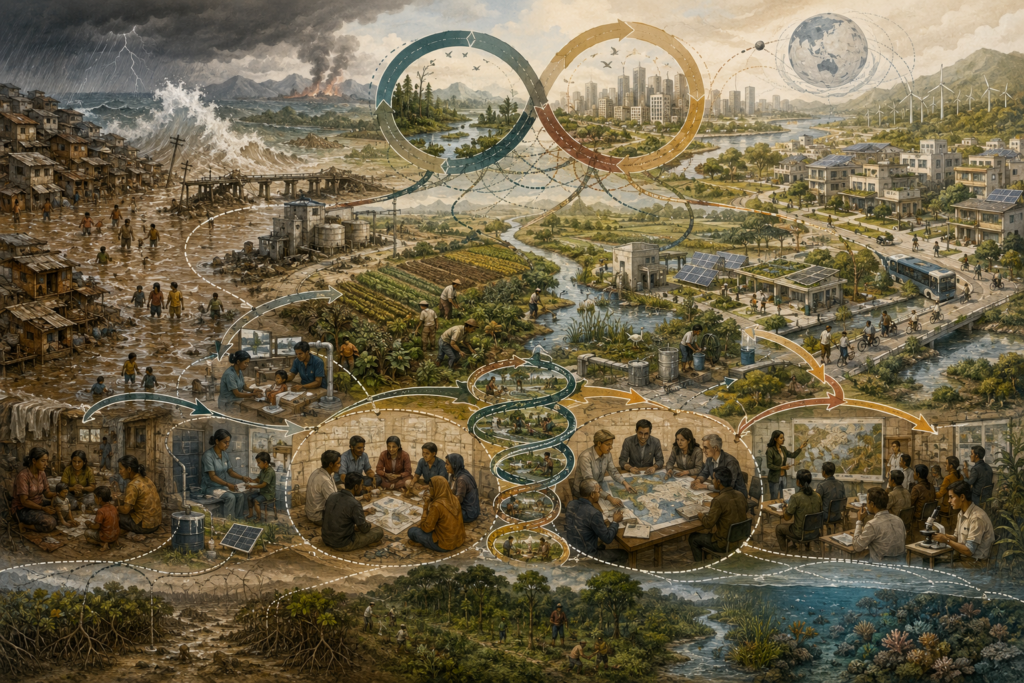
Editorial sustainability illustration showing social-ecological systems under disturbance, with adaptive cycles, community planning, resilient infrastructure, wetlands, diversified farms, public services, and unequal exposure to climate stress.

Resilience Thinking and Sustainable Development

Resilience thinking and sustainable development belong together because development never unfolds under conditions of complete stability. This article argues that development depends not only on present gains in infrastructure, livelihoods, and wellbeing, but on whether social, ecological, and institutional systems can absorb shocks, adapt to changing conditions, and transform when existing trajectories become untenable. It explains why resilience should not be reduced to “bouncing back,” explores the distinction between coping, adapting, and transforming, and shows how concepts such as adaptive cycles, panarchy, and social-ecological systems deepen development analysis. The core claim is that resilience becomes developmentally meaningful only when it is tied to justice, ecological viability, and institutional learning, rather than to preserving the status quo for its own sake.

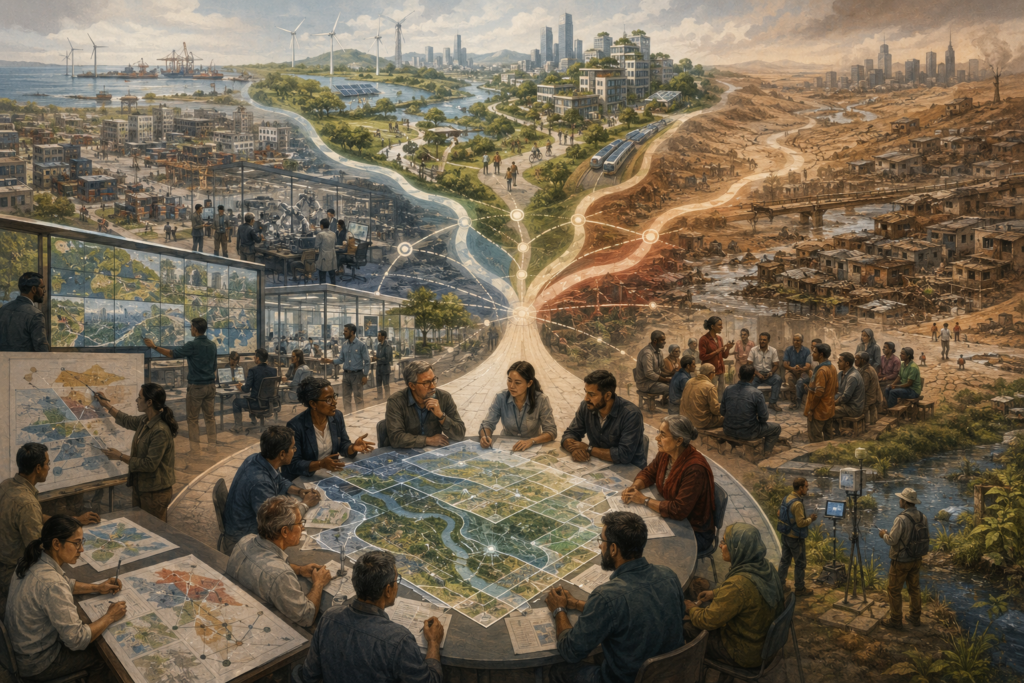
Editorial sustainability illustration showing ecological overshoot, planetary-boundary pressure, unequal development vulnerability, water and food systems, infrastructure stress, and adaptation planning across a divided landscape.

Boundary Transgression and Development Fragility

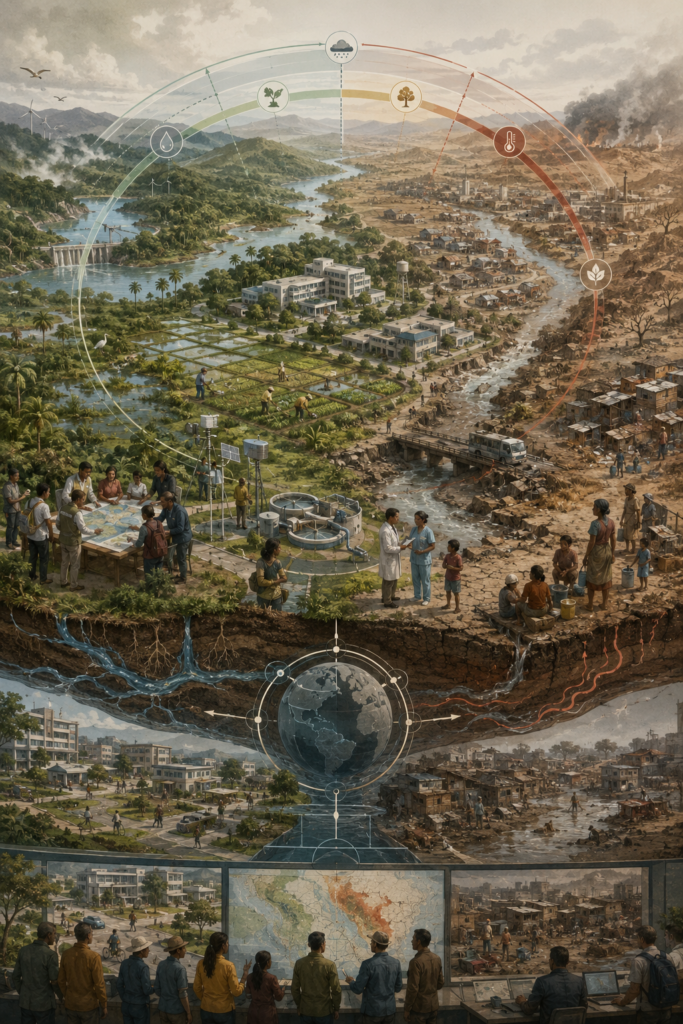
Boundary transgression and development fragility examines why sustainable development becomes less secure when the Earth-system conditions supporting food, water, health, infrastructure, and institutional stability are pushed beyond relatively safe operating ranges. The article argues that ecological overshoot is not simply an environmental cost added onto development, but a systemic condition that can erode the durability of development gains, intensify unequal vulnerability, and raise the cost of preserving social and economic stability. It explores how planetary-boundary pressures move through food-water-health nexuses, infrastructure systems, and governance capacity, and why fragility often accumulates long before visible collapse. The core claim is that sustainable development requires more than adaptation to worsening instability. It also requires reducing the underlying ecological pressures that make development increasingly brittle, unequal, and difficult to sustain across time.

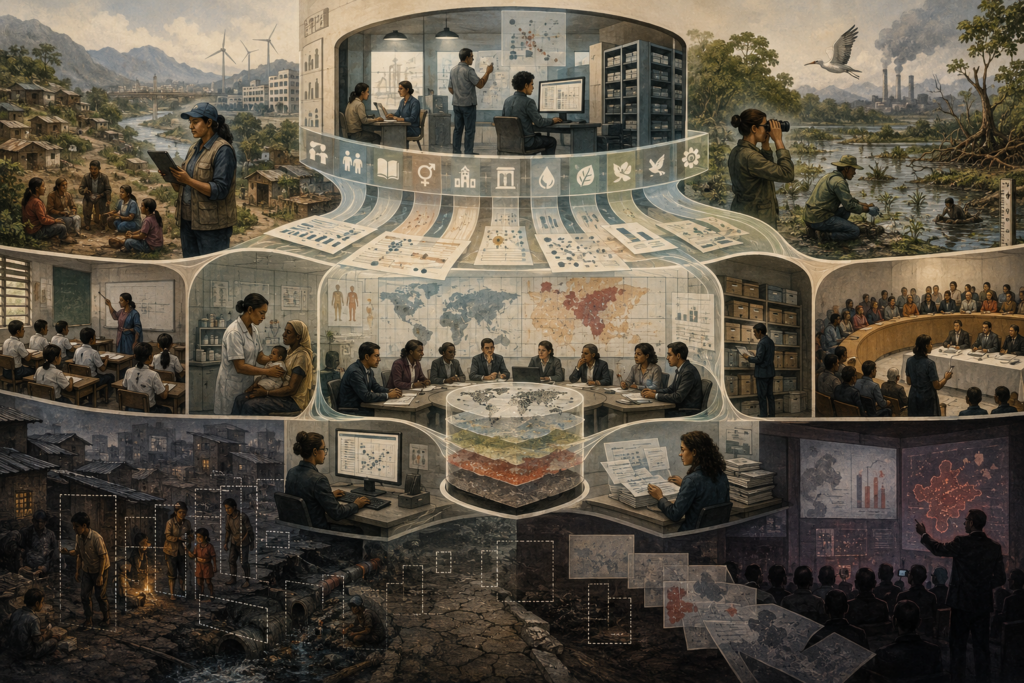
Editorial sustainability illustration showing SDG indicators flowing from field data, statistical offices, and ecological monitoring into governance review, public accountability, and policy interpretation, while some communities and harms remain only partially visible.

SDG Indicators: Strengths, Gaps, and Political Uses

SDG indicators matter because they do more than track progress. They define what becomes visible, comparable, governable, and politically actionable within sustainable development. This article argues that the SDG indicator system should be understood through three lenses at once: as a technical framework with real strengths, as an incomplete measurement architecture marked by data and methodological gaps, and as a political tool used in benchmarking, reform, legitimation, and narrative control. It examines the value of a common global framework, the role of metadata and disaggregation, the risks of aggregation and false clarity, and the institutional uses through which indicators shape budgeting, accountability, and policy priorities. The core claim is that SDG indicators do not simply reflect development reality. They help construct the terms through which development is interpreted and governed.

Scroll to Top