Mythology

Mythology examines the sacred narratives, cosmologies, archetypes, heroic traditions, and symbolic worlds through which cultures have interpreted origins, order, conflict, destiny, and the relationship between human life and the larger cosmos. In the history of ideas, mythology has served not simply as early storytelling, but as a foundational mode of meaning-making through which societies have expressed moral vision, collective memory, metaphysical imagination, and the structure of reality itself.

This category explores myth as a civilizational form that links narrative, ritual, symbolism, and cultural identity across time. It considers how mythic traditions explain the creation of the world, the nature of divine and human power, the role of fate and sacrifice, and the moral tensions embedded in stories of gods, heroes, ancestors, and sacred landscapes.

Mythology plays an important role in human inquiry because it reveals how societies imagine order, transmit values, and confront the enduring questions of suffering, death, transformation, and belonging. By engaging myth seriously, this category deepens understanding of symbolic thought, cultural memory, and the narrative structures through which civilizations have interpreted existence.

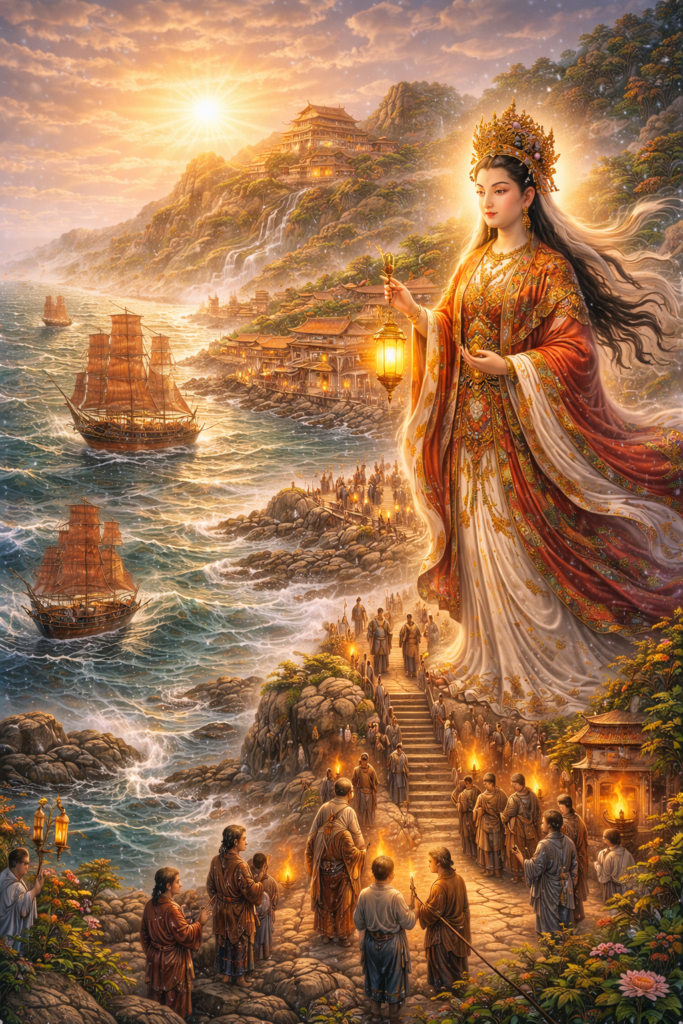
Mythic maritime scene of Mazu overlooking temples, ships, coastal pilgrims, and wind-tossed waters, symbolizing protection, pilgrimage, and the sea-goddess traditions of coastal China

Mazu and the Sea-Goddess Traditions of Coastal China

Mazu is one of the most important religious figures in the Chinese maritime world because her cult turns the sea into a field of protection, memory, danger, and grace. In temple traditions, incense pilgrimage, coastal ritual life, and the remembered story of Lin Moniang of Meizhou, she becomes more than a sea goddess in the narrow sense. She becomes a divine presence through whom coastal China imagines rescue, mobility, communal continuity, and sacred care under conditions of maritime uncertainty. This article examines Mazu within the Chinese Myth, Legend, and Folklore knowledge series as the sea-goddess whose tradition joins local cult, transregional pilgrimage, maritime trade, and the ritual geography of Fujian, Taiwan, and the wider Chinese seafaring world. Under her sign, the sea becomes not empty distance, but a watched and sacred domain.
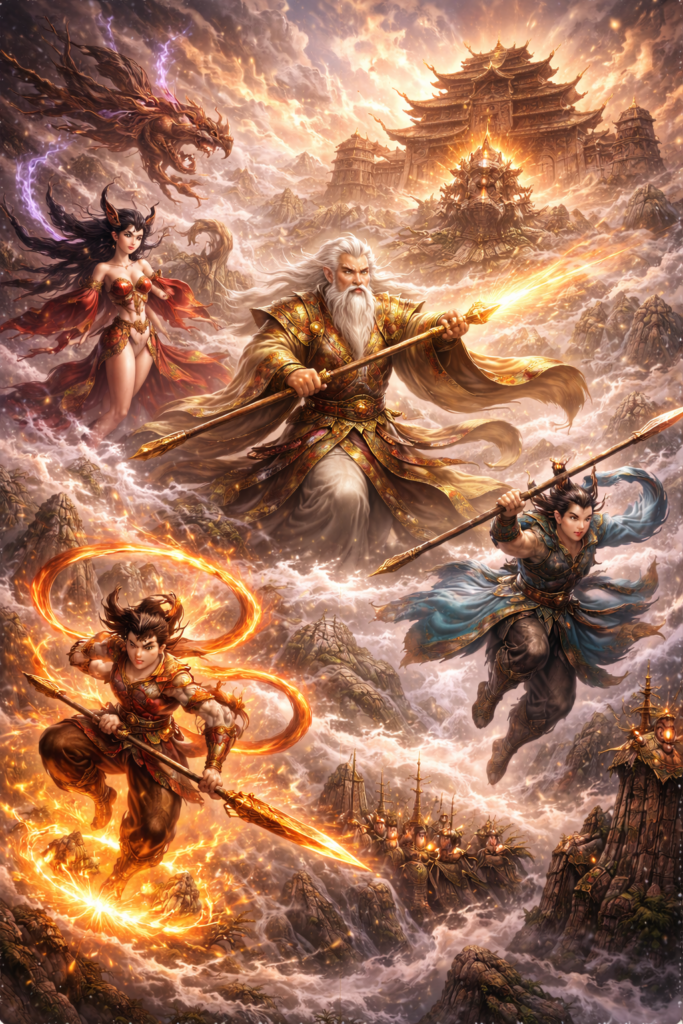
Mythic scene of Jiang Ziya, Nezha, Daji, and divine warriors amid storming skies, burning palaces, and cosmic conflict during dynastic transition

Investiture of the Gods and the Mythologizing of Dynastic Change

Investiture of the Gods occupies a foundational place in Chinese mythic literature because it transforms dynastic transition into cosmic drama. In this vast narrative world, the fall of Shang and the rise of Zhou do not appear merely as matters of war, succession, or political failure, but as a struggle among gods, immortals, demons, ministers, kings, sectarian lineages, and cosmic mandates. This article examines Investiture of the Gods within the Chinese Myth, Legend, and Folklore knowledge series as one of the fullest Chinese literary attempts to mythologize regime change, showing how political collapse becomes legible through sacred causation, moral disorder, divine warfare, and postwar deification. Under its sign, history is not displaced by myth. It is rendered through myth as a crisis in the moral architecture of the universe itself.

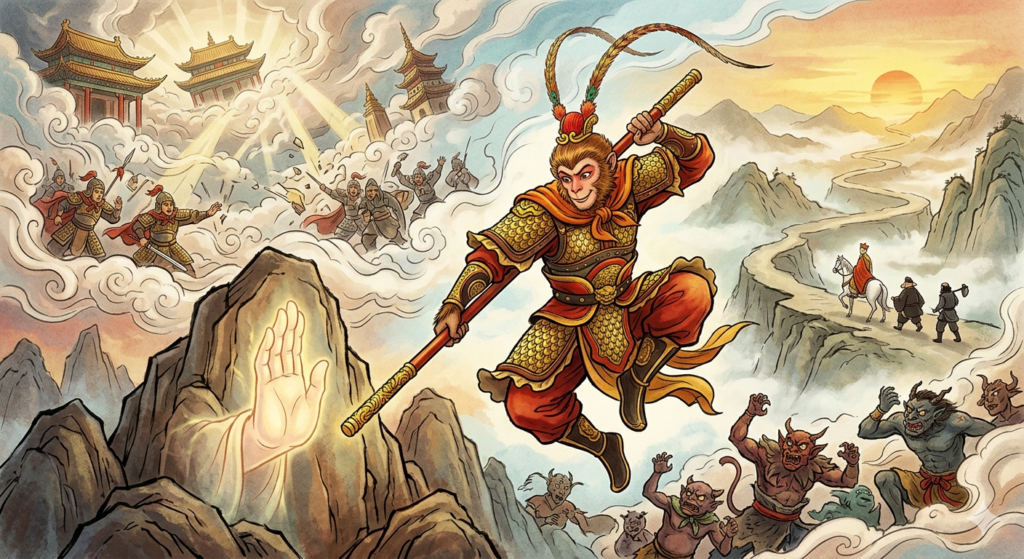
Mythic scene of Sun Wukong leaping through a cloud-filled mountain sky with golden staff and blazing energy, symbolizing rebellion, transformation, and the enduring afterlives of Journey to the West

Sun Wukong and the Mythic Afterlives of Journey to the West

Sun Wukong is one of the most powerful mythic figures in Chinese civilization because he moves across rebellion, immortality, pilgrimage, comic defiance, and spiritual transformation without ever settling into a single meaning. In Journey to the West, he emerges as the Monkey King born from stone, trained in Daoist arts, armed with extraordinary transformations, rebellious against Heaven, and later redirected into the Buddhist pilgrimage as protector, monster-subduer, and disciple. This article examines Sun Wukong within the Chinese Myth, Legend, and Folklore knowledge series as a figure in whom Chinese tradition gathers celestial satire, supernatural combat, religious syncretism, and the problem of disciplining unruly power. Under his sign, rebellion does not simply end in defeat. It becomes one of the great mythic energies through which Chinese literature imagines transformation, endurance, and the afterlife of narrative itself.

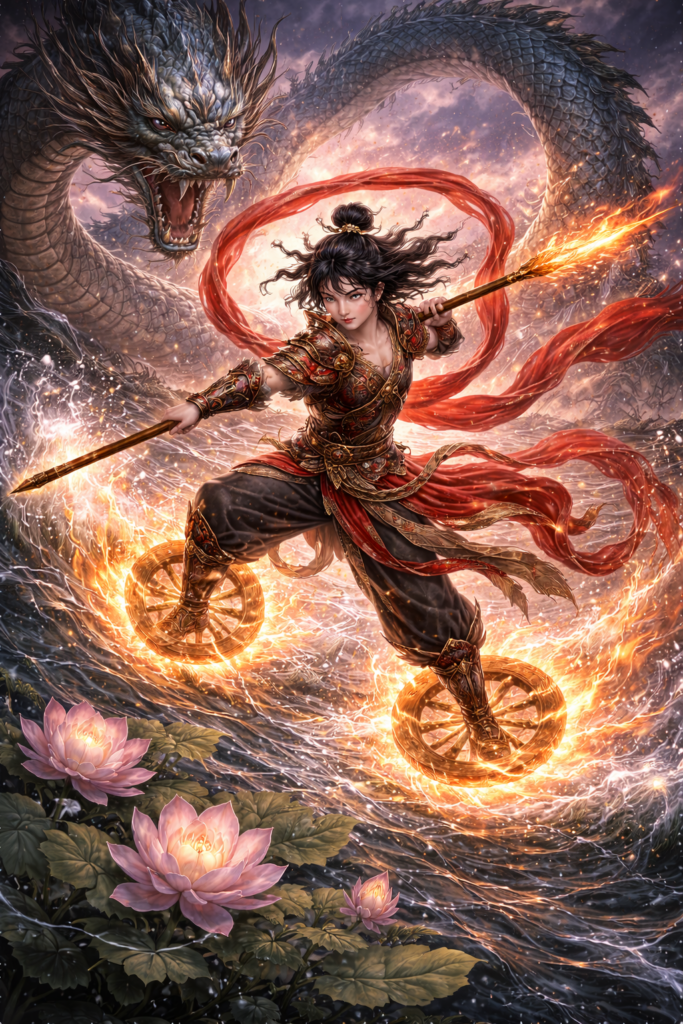
Mythic scene of Nezha riding wind-fire wheels with blazing spear before a dragon, surrounded by lotus blossoms and the energy of divine warfare

Nezha, Rebellion, and Divine Warfare in Chinese Legend

Nezha occupies a singular place in Chinese legend because he fuses childhood, rebellion, cosmic violence, filial conflict, divine warfare, and self-transformation into one of the most explosive figures in the mythic archive. In literary, religious, and visual tradition, he appears as a precocious divine child whose conflict with dragons, father, and cosmic authority turns personal rebellion into a larger drama of justice, sacrifice, and remade power. This article examines Nezha within the Chinese Myth, Legend, and Folklore knowledge series as a figure through whom Chinese tradition explores what happens when extraordinary force emerges before social order can contain it. In Nezha, rebellion is not merely disobedience. It is the mythic struggle to align violent power, filial rupture, divine destiny, and the remaking of the self.

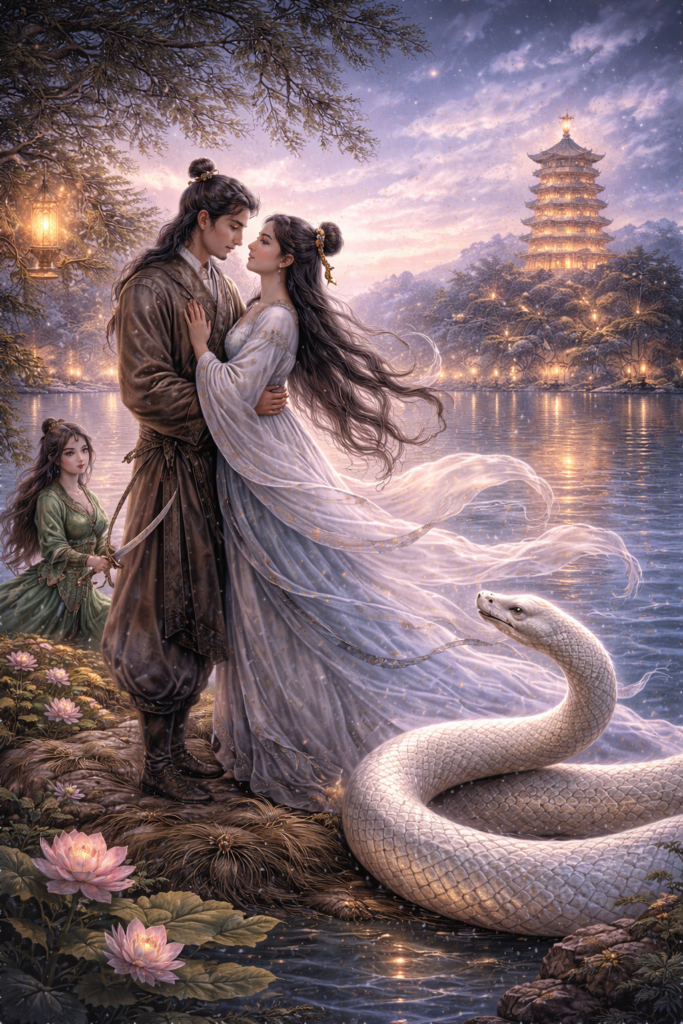
Mythic scene of Bai Suzhen and Xu Xian embracing beside West Lake with Xiaoqing nearby, Leifeng Pagoda in the distance, and a white snake coiled at the water’s edge

The White Snake Tradition and the Legend of Love, Transgression, and Cultivation

The White Snake tradition is one of the most enduring narrative worlds in Chinese folklore because it binds love, metamorphosis, transgression, religion, gender, cultivation, and moral ambiguity into a single story that has never remained fixed. At its center stands Bai Suzhen, a being who is at once spirit, snake, woman, lover, adept, and transgressor, joined by Xu Xian, Green Snake, and the monk Fahai in a legend that repeatedly asks whether love across forbidden boundaries is monstrous, tragic, or morally more compelling than the institutions that condemn it. This article examines the White Snake tradition within the Chinese Myth, Legend, and Folklore knowledge series as one of the great Chinese legends of intimate supernatural life, where marriage, medicine, religious law, sacred geography, and the cultivated supernatural body converge in a story of love under prohibition.

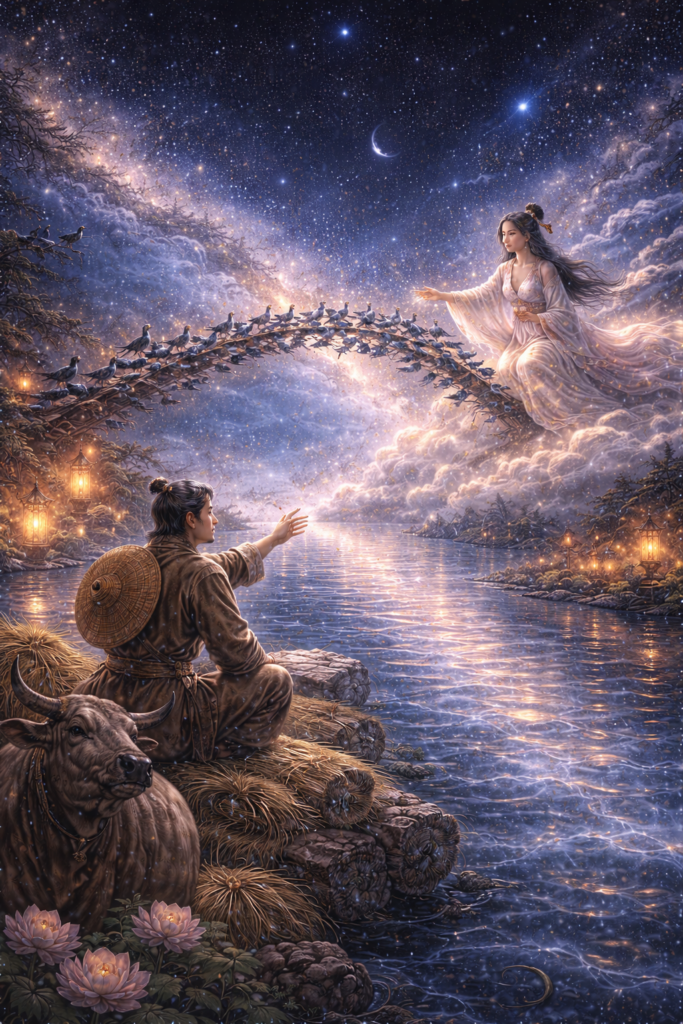
Mythic scene of the Cowherd and the Weaver Girl reaching toward each other across the River of Heaven as magpies form a bridge beneath a star-filled sky

The Cowherd and the Weaver Girl: Stars, Separation, and Festival

The story of the Cowherd and the Weaver Girl is one of the most enduring love myths in Chinese tradition because it transforms the sky into a world of longing, labor, distance, and cyclical reunion. In transmitted poetry, medieval anthology materials, and later festival culture, the two lovers appear not simply as romantic figures, but as celestial presences divided by the River of Heaven and permitted to meet only once each year. This article examines the Cowherd and the Weaver Girl within the Chinese Myth, Legend, and Folklore knowledge series as a myth through which Chinese civilization joined astral observation, emotional symbolism, women’s craft traditions, and seasonal ritual memory. Under their sign, the stars become figures of feeling, and the heavens become a calendar of separation and return.

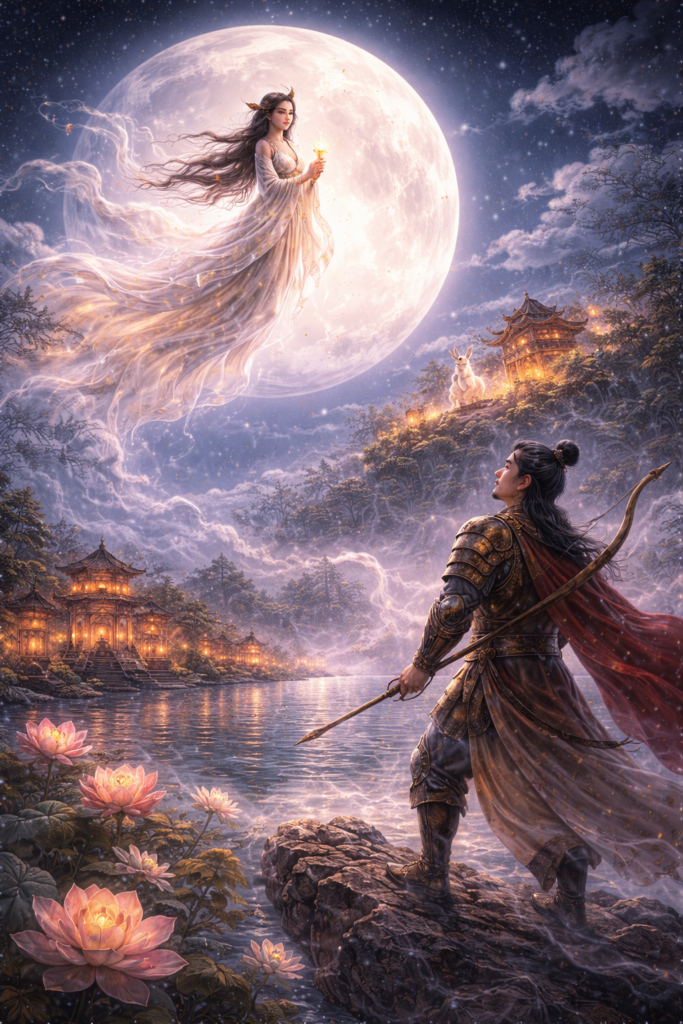
Mythic scene of Chang’e ascending toward the full moon while Hou Yi stands below with bow and longing gaze beside water, lanterns, and lotus blossoms

Chang’e, Hou Yi, and the Mythic Imagination of the Moon

xChang’e and Hou Yi belong to one of the most enduring mythic constellations in Chinese tradition because their story gathers together cosmic crisis, heroic restoration, immortality, separation, and lunar transcendence within a single symbolic world. In transmitted sources and later cultural memory, Hou Yi appears as the archer who restores habitable order to the world, while Chang’e becomes the moon figure whose ascent transforms the lunar sphere into a realm of longing, beauty, exile, and immortality. This article examines Chang’e and Hou Yi within the Chinese Myth, Legend, and Folklore knowledge series as figures through whom Chinese mythology turns the moon into more than celestial scenery. Under their sign, the moon becomes a world of memory, distance, radiance, and the emotional cost of transcendence.

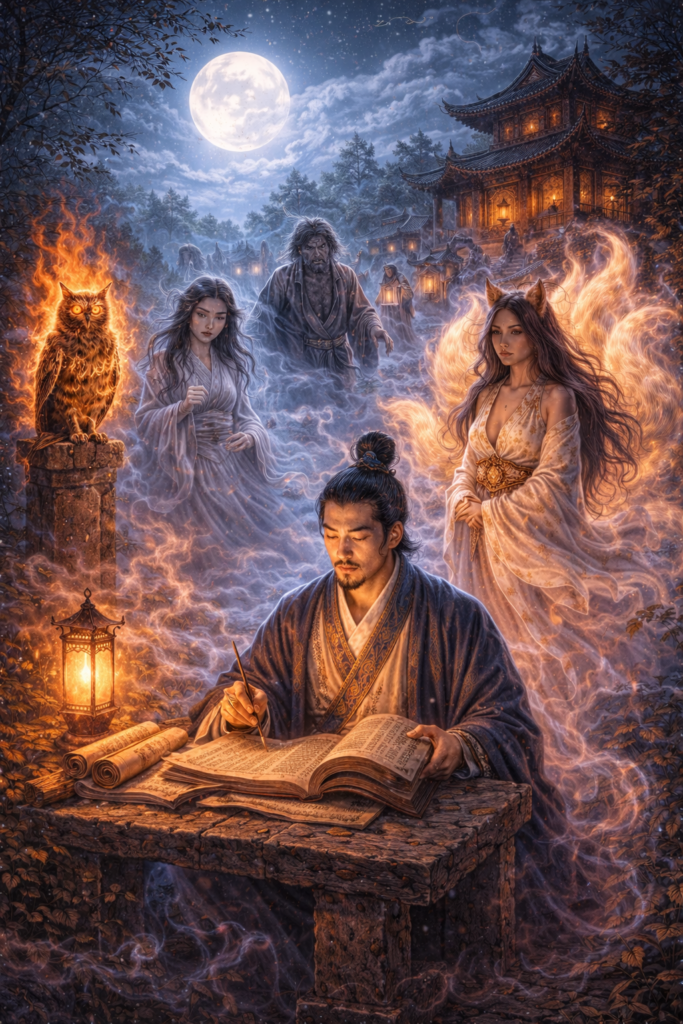
Mythic scene of a medieval Chinese scholar compiling strange tales by lantern light as ghosts, a fox spirit, and uncanny beings gather in a moonlit landscape

Reading the Soushen Ji: Anomaly, Wonder, and the Medieval Supernatural

The Soushen Ji occupies a foundational place in Chinese literary and religious history because it stands at the point where anomaly, wonder, spirit encounter, and the medieval supernatural begin to take durable prose form. Rather than serving merely as a miscellaneous collection of oddities, it gathers ghosts, revenants, transformations, omens, divine interventions, and uncanny events into one of the earliest major archives of the strange in Chinese civilization. This article examines the Soushen Ji within the Chinese Myth, Legend, and Folklore knowledge series as a key text for understanding how medieval China made the supernatural readable through prose. In its pages, the strange is not simply fantasy. It appears as moral pressure, ritual consequence, narrative memory, and the persistent porosity of the boundary between the seen and unseen.

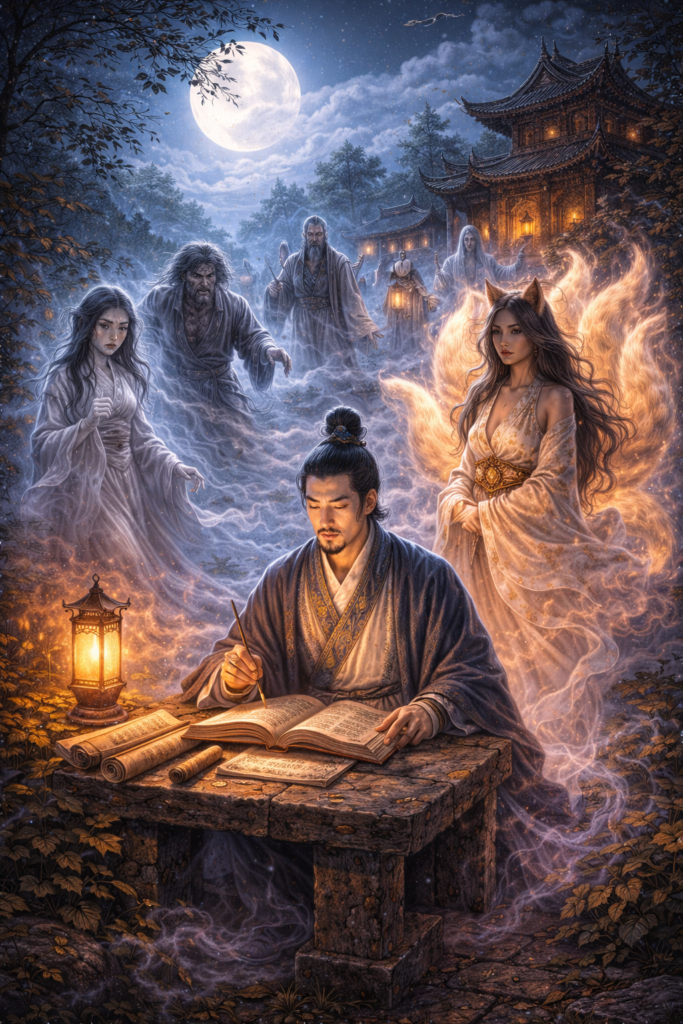
Mythic scene of a Chinese scholar writing by lantern light as ghosts, revenants, and a fox spirit gather in a moonlit landscape, symbolizing the rise of supernatural literature

Strange Tales and the Rise of Supernatural Literature

Strange tales occupy a foundational place in Chinese literary history because they transformed the supernatural from a dispersed field of omen, rumor, religious fear, and local report into one of the most durable forms of imaginative prose. Across anomaly records, ghost stories, fox-spirit narratives, dream journeys, underworld visions, and uncanny encounters, Chinese writers gave literary shape to worlds already alive with revenants, immortals, karmic judgments, transformations, and invisible administrations. This article examines the rise of supernatural literature within the Chinese Myth, Legend, and Folklore knowledge series as the long development of a prose tradition that preserved, refined, and reimagined the strange through works such as the Soushen ji, Taiping guangji, Tang chuanqi, and Liaozhai zhiyi. In this tradition, the strange is not merely recorded. It becomes one of the great literary ways of thinking about reality itself.

Scroll to Top