Mythology

Mythology examines the sacred narratives, cosmologies, archetypes, heroic traditions, and symbolic worlds through which cultures have interpreted origins, order, conflict, destiny, and the relationship between human life and the larger cosmos. In the history of ideas, mythology has served not simply as early storytelling, but as a foundational mode of meaning-making through which societies have expressed moral vision, collective memory, metaphysical imagination, and the structure of reality itself.

This category explores myth as a civilizational form that links narrative, ritual, symbolism, and cultural identity across time. It considers how mythic traditions explain the creation of the world, the nature of divine and human power, the role of fate and sacrifice, and the moral tensions embedded in stories of gods, heroes, ancestors, and sacred landscapes.

Mythology plays an important role in human inquiry because it reveals how societies imagine order, transmit values, and confront the enduring questions of suffering, death, transformation, and belonging. By engaging myth seriously, this category deepens understanding of symbolic thought, cultural memory, and the narrative structures through which civilizations have interpreted existence.

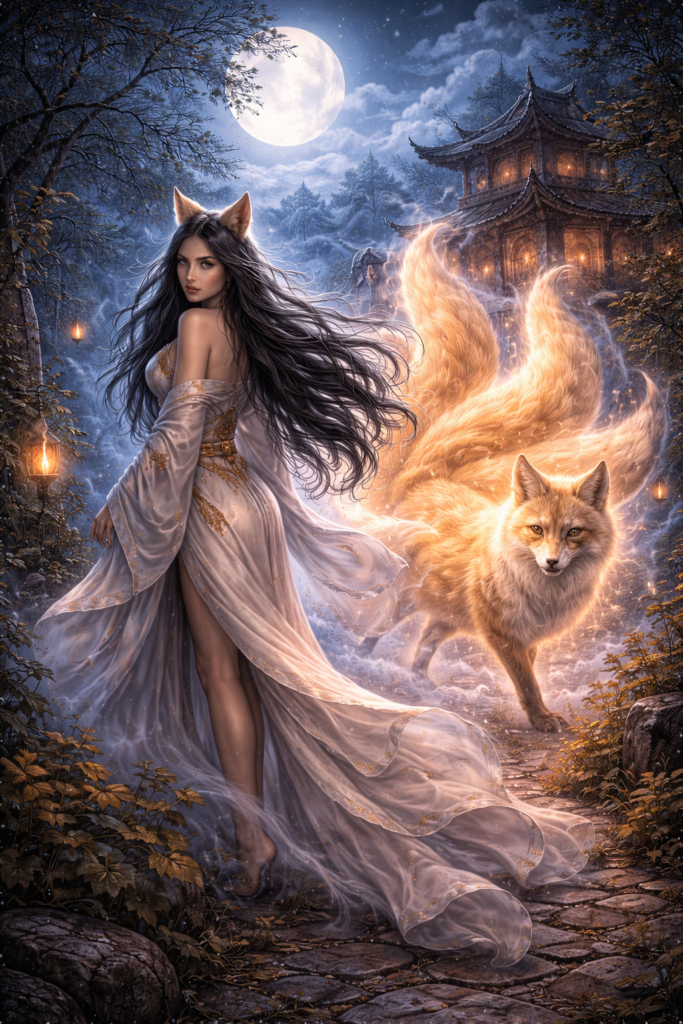
Mythic fox spirit in a moonlit Chinese landscape shifting between human and fox form, symbolizing transformation, seduction, and ambiguity

Fox Spirits, Transformation, and Ambiguity in Chinese Folklore

Fox spirits occupy a singular place in Chinese folklore because they gather transformation, seduction, intelligence, age, spiritual cultivation, danger, sympathy, and moral ambiguity into one of the tradition’s most unstable supernatural figures. In transmitted texts, anecdotal traditions, and later literary works such as Liaozhai zhiyi, the fox appears not simply as a demonic animal or magical trickster, but as a being that repeatedly crosses the boundary between human and nonhuman life. This article examines fox spirits within the Chinese Myth, Legend, and Folklore knowledge series as figures through which Chinese tradition explores desire, identity, disguise, intimacy, deception, and the unsettling proximity of the supernatural to ordinary social life. In the fox spirit, Chinese folklore preserves one of its richest meditations on ambiguity itself.
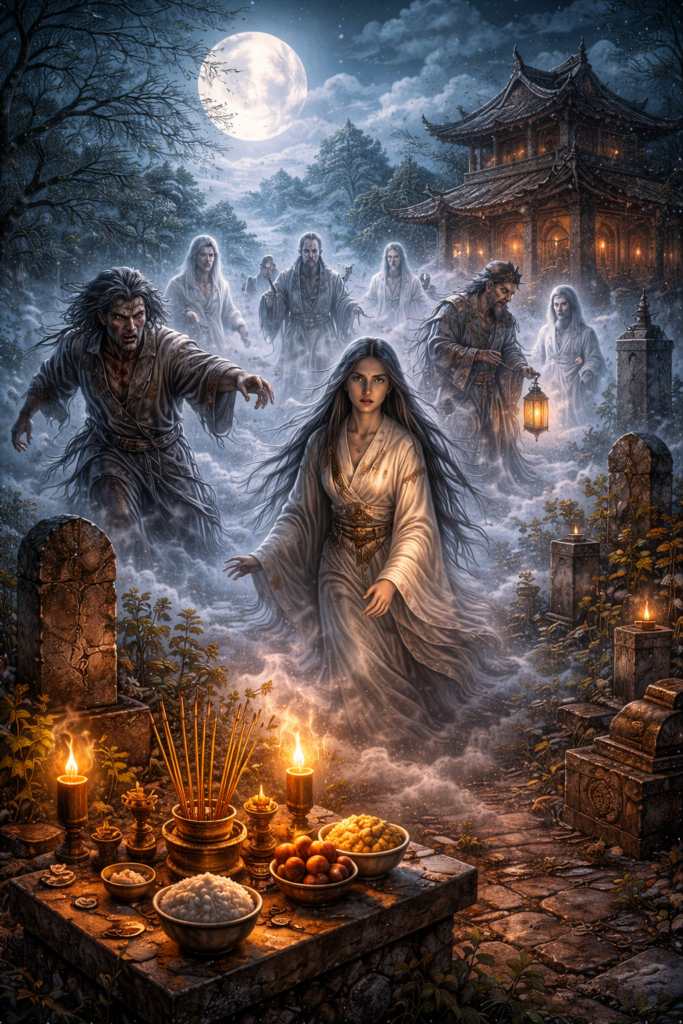
Mythic scene of Chinese ghosts and revenants emerging through moonlit mist beside tombs, offerings, and ritual fire, symbolizing unrest, memory, and unfinished moral claims

Ghosts, Revenants, and the Moral Logic of the Unsettled Dead

Ghosts and revenants occupy a central place in Chinese religious and folkloric imagination because the dead are not always imagined as fully settled, pacified, or successfully integrated into the moral order. Some return because they were wronged. Some linger because they were neglected. Some suffer because ritual obligations were not fulfilled. Some become dangerous because desire, grievance, violence, debt, or improper burial binds them to the world of the living. This article examines ghosts, revenants, and the unsettled dead within the Chinese Myth, Legend, and Folklore knowledge series as figures through whom Chinese tradition explores justice, memory, ritual failure, family obligation, and the ethical pressure exerted by those who have not found peace. In these traditions, the dead do not simply disappear. They return as moral presences.

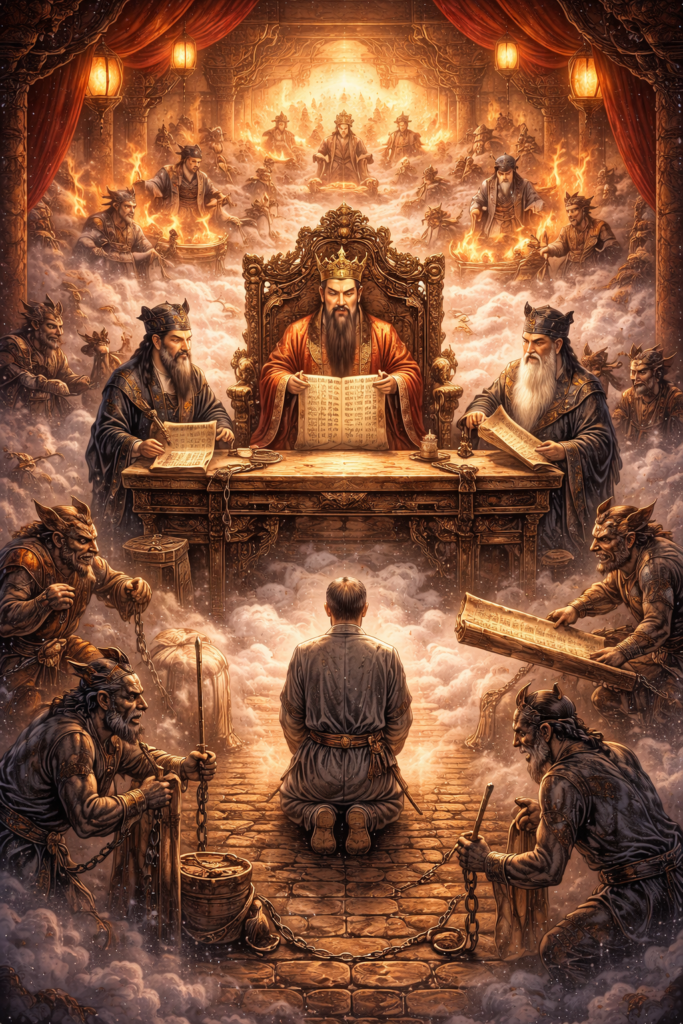
Mythic Chinese underworld court with infernal judges, scribes, demon wardens, ledgers, and a soul kneeling before bureaucratic judgment

Underworlds, Judges, and the Bureaucracy of the Afterlife

Chinese visions of the afterlife are among the most institutionally elaborate in world mythology because they imagine death not as a simple disappearance into shadow, but as entry into a realm of courts, judges, prisons, ledgers, punishments, registries, and moral administration. In the Chinese religious imagination, souls are summoned, examined, sentenced, corrected, and redirected through systems shaped by the interaction of Buddhist karmic hells, Daoist cosmology, local cults, and broader Chinese ideas about official hierarchy and moral order. This article examines underworlds, judges, and the bureaucracy of the afterlife within the Chinese Myth, Legend, and Folklore knowledge series as a distinctive vision of cosmic justice in which the unseen world mirrors the structures of government, accountability, and jurisdiction. In this afterlife, nothing is merely forgotten. Everything is recorded, processed, and judged.

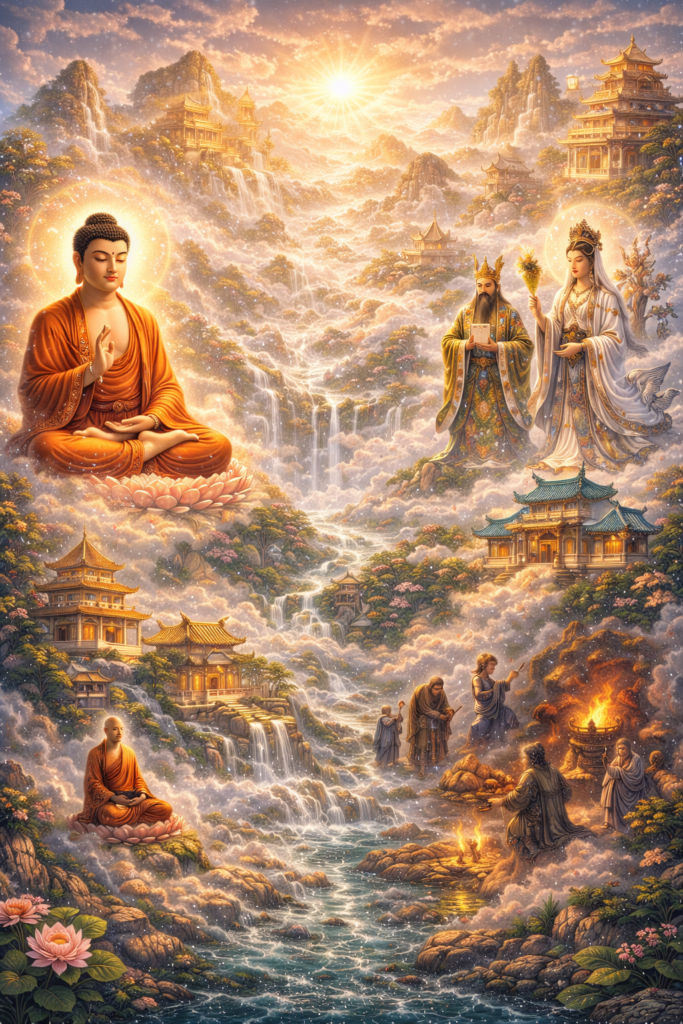
Mythic Chinese religious landscape where Buddhist and Daoist figures, temples, sacred mountains, heavens, and spirit worlds converge in a reimagined sacred cosmos

Buddhism, Daoism, and the Recasting of Chinese Mythic Worlds

Buddhism and Daoism did not remain sealed traditions in China, but transformed one another’s languages, symbols, sacred geographies, supernatural horizons, and visions of salvation across centuries of encounter. As Buddhism entered a religious world already shaped by Daoist cosmology, immortality traditions, mountain cults, spirit worlds, and techniques of bodily cultivation, its ideas were translated through Chinese categories even as Daoist communities responded with new scriptures, heavens, rituals, and claims to salvific power. This article examines that long process of contact, rivalry, adaptation, and mutual recasting within the Chinese Myth, Legend, and Folklore knowledge series, showing how Chinese mythic worlds were permanently altered by the interaction of imported Buddhist cosmology and indigenous Daoist religious imagination. In the process, mountains, paradises, spirits, heavens, hells, bodies, and the very meaning of transcendence were reimagined.

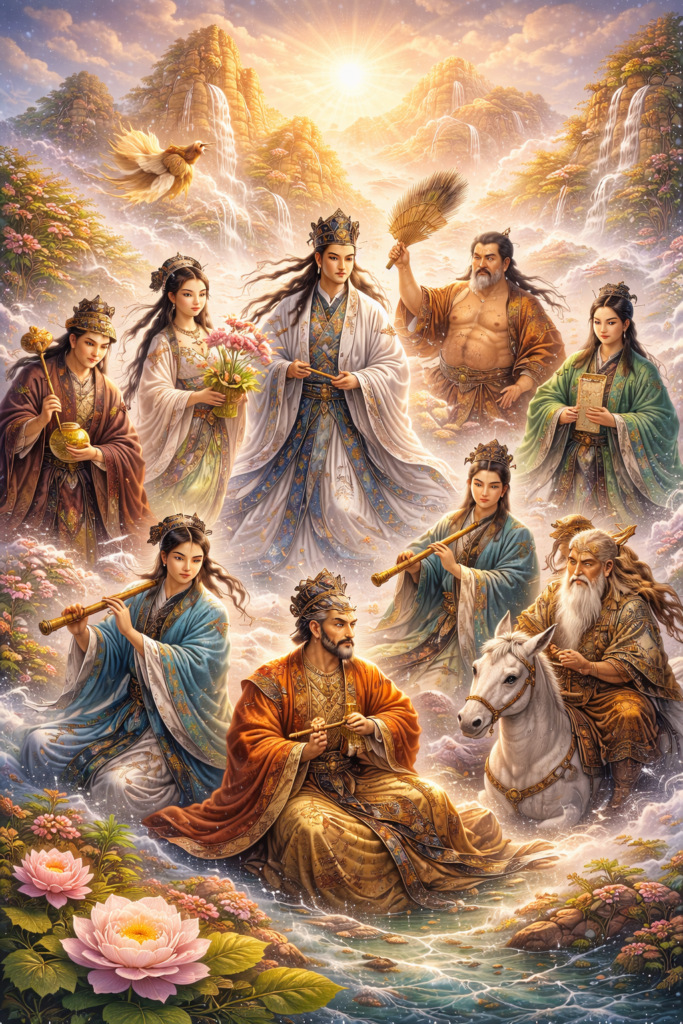
Mythic gathering of the Eight Immortals in a luminous landscape with sacred attributes, flowing clouds, and the festive imagination of Daoist transcendence

The Eight Immortals and the Popular Religious Imagination

The Eight Immortals occupy a singular place in Chinese religious and folkloric imagination because they translate the larger Daoist world of transcendence into a vivid, social, and narratively accessible form. Rather than presenting immortality as a remote abstraction, they embody it through distinct human types, recognizable attributes, festive stories, visual symbols, and popular devotional presence. This article examines the Eight Immortals within the Chinese Myth, Legend, and Folklore knowledge series as a fellowship through which Chinese tradition imagines transcendence as plural, embodied, and culturally portable across theater, art, storytelling, and ritual life. In them, immortality becomes not only a metaphysical possibility, but a shared symbolic world populated by beggars, officials, eccentrics, women, wanderers, and immortal masters.

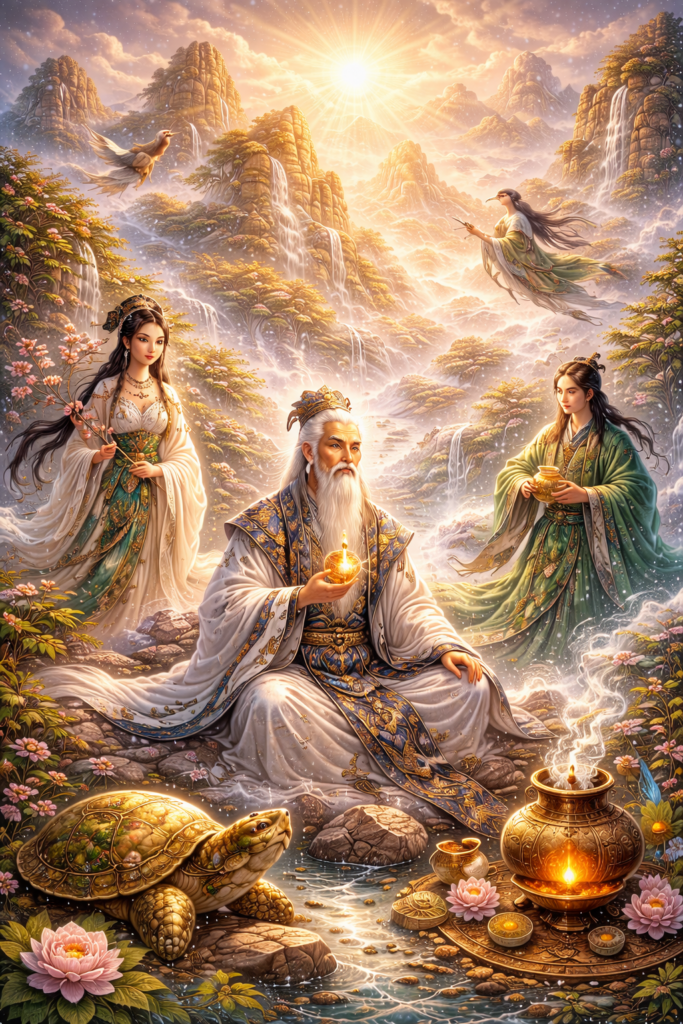
Mythic Daoist scene of immortals, sacred mountains, celestial light, inner cultivation, alchemical vessel, and the supernatural imagination of transcendence

Daoism, Immortality, and the Supernatural Imagination

Daoism has given Chinese civilization one of its richest supernatural imaginations because it refuses to treat transcendence as a distant abstraction. Across transmitted texts, religious practice, and later mythic culture, immortality, spiritual transformation, alchemical refinement, sacred mountains, celestial ascent, inner cultivation, and the disciplined remaking of the body emerge as intertwined possibilities within a single visionary world. This article examines Daoism within the Chinese Myth, Legend, and Folklore knowledge series as a tradition that imagines human life as radically transformable through alignment with the Dao, bodily cultivation, and access to numinous forms of existence. In Daoist supernatural thought, the extraordinary is not merely elsewhere. It may be cultivated through breath, medicine, ritual, meditation, geography, and the reordering of life itself.

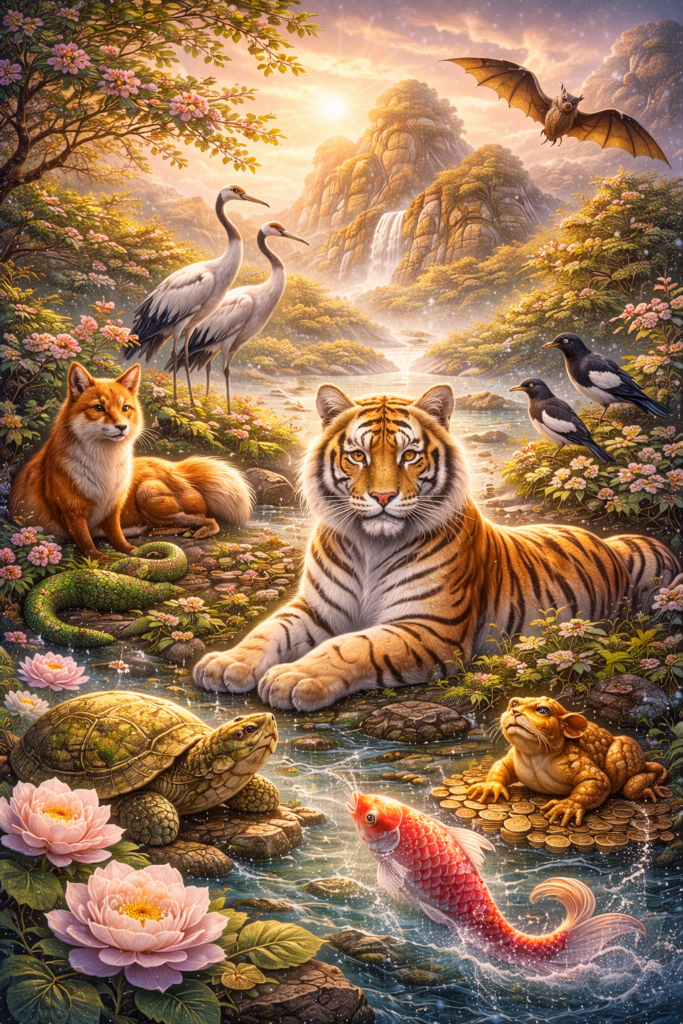
Mythic landscape of symbolic animals including a tiger, fox, turtle, koi, cranes, snake, bat, and toad in a radiant scene of omen, luck, and protection

Animals, Omens, and Symbolic Creatures in Chinese Folk Imagination

Animals, omens, and symbolic creatures occupy a central place in Chinese folk imagination because the natural world has long been understood not only as a field of living beings, but as a realm of signs, warnings, blessings, transformations, and culturally legible presences. Across transmitted texts, strange-tale traditions, ritual practice, and popular symbolism, creatures such as foxes, snakes, birds, turtles, tigers, bats, fish, and other animal forms become carriers of luck, danger, protection, fertility, intelligence, longevity, and moral or political meaning. This article examines how Chinese tradition turned animals into a symbolic ecology through which communities interpreted the world around them, showing that folklore in China often reads living creatures not as mute background to human life, but as expressive forms embedded in omen, ritual, narrative, and everyday imagination.

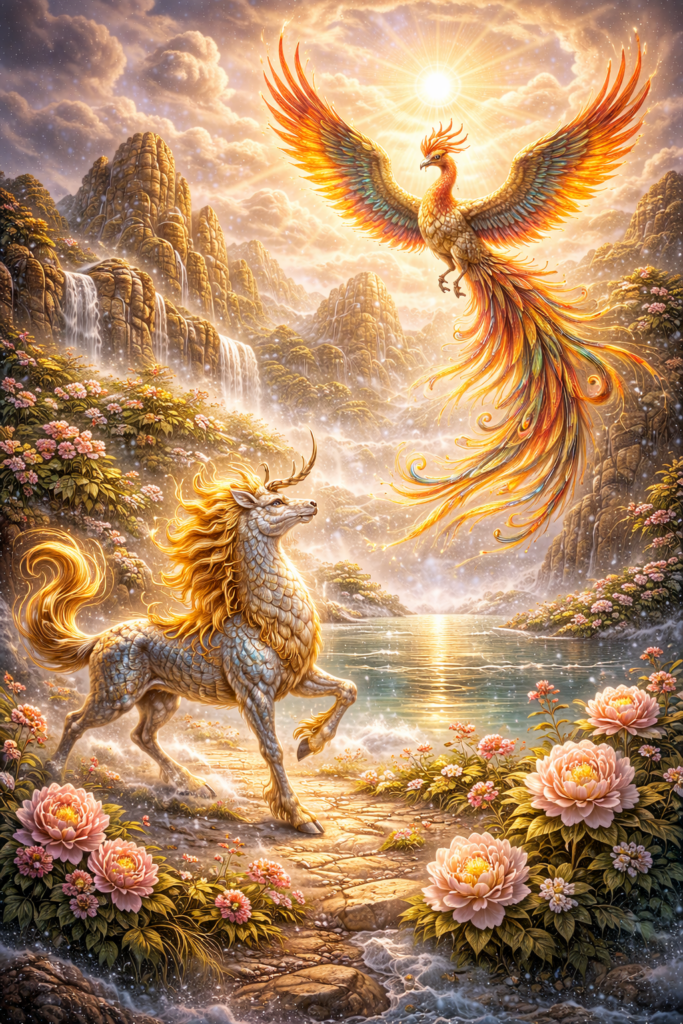
Mythic image of a radiant phoenix and a qilin in a luminous landscape of flowers, waterfalls, and sacred harmony

Phoenix, Qilin, and the World of Auspicious Beings

The fenghuang and the qilin occupy a distinctive place in Chinese mythology because they belong to a world of auspicious beings whose appearance signifies harmony, virtue, sage rule, and the visible flourishing of a rightly ordered realm. In transmitted sources such as the Shanhaijing, the Liji, and the Lunheng, they appear not simply as fabulous animals of wonder, but as symbolic creatures through which Chinese tradition imagines moral order becoming legible in the fabric of the world. This article examines the phoenix, qilin, and the wider field of auspicious beings within the Chinese Myth, Legend, and Folklore knowledge series, showing how omen, beauty, benevolence, and political legitimacy converge in one of the most revealing symbolic registers of Chinese myth.

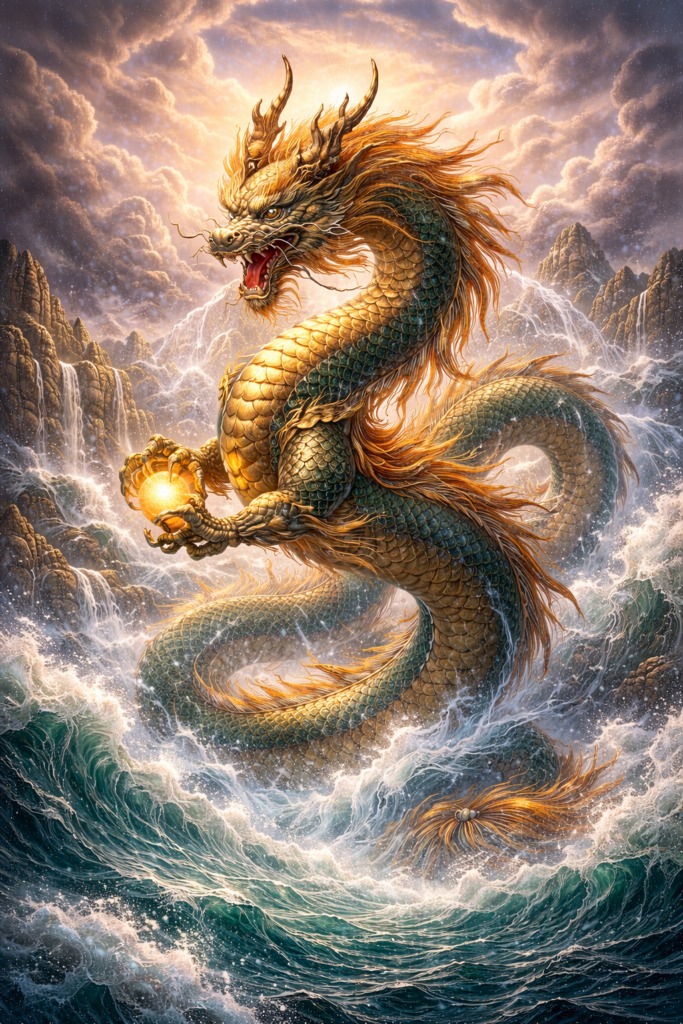
Mythic Chinese dragon rising from storm-tossed waters beneath turbulent clouds, embodying rain power, cosmic force, and imperial symbolism

Dragons in Chinese Myth, Water Cosmology, and Imperial Symbolism

Dragons occupy a singular place in Chinese mythology because they unite natural force, sacred imagination, and political symbolism in one of the tradition’s most enduring figures. In transmitted sources and later cultural memory, they are associated with rain, rivers, lakes, seas, clouds, atmospheric power, and the life-giving circulation of water across the world. This article examines dragons within the Chinese Myth, Legend, and Folklore knowledge series as beings through whom Chinese tradition imagines water cosmology, fertility, weather regulation, and the movement between earthly and heavenly domains. It also traces how the dragon became one of the most powerful emblems of imperial authority, linking sovereignty to cosmic vitality, beneficent force, and the ordering of the realm.

Scroll to Top