Mythology

Mythology examines the sacred narratives, cosmologies, archetypes, heroic traditions, and symbolic worlds through which cultures have interpreted origins, order, conflict, destiny, and the relationship between human life and the larger cosmos. In the history of ideas, mythology has served not simply as early storytelling, but as a foundational mode of meaning-making through which societies have expressed moral vision, collective memory, metaphysical imagination, and the structure of reality itself.

This category explores myth as a civilizational form that links narrative, ritual, symbolism, and cultural identity across time. It considers how mythic traditions explain the creation of the world, the nature of divine and human power, the role of fate and sacrifice, and the moral tensions embedded in stories of gods, heroes, ancestors, and sacred landscapes.

Mythology plays an important role in human inquiry because it reveals how societies imagine order, transmit values, and confront the enduring questions of suffering, death, transformation, and belonging. By engaging myth seriously, this category deepens understanding of symbolic thought, cultural memory, and the narrative structures through which civilizations have interpreted existence.

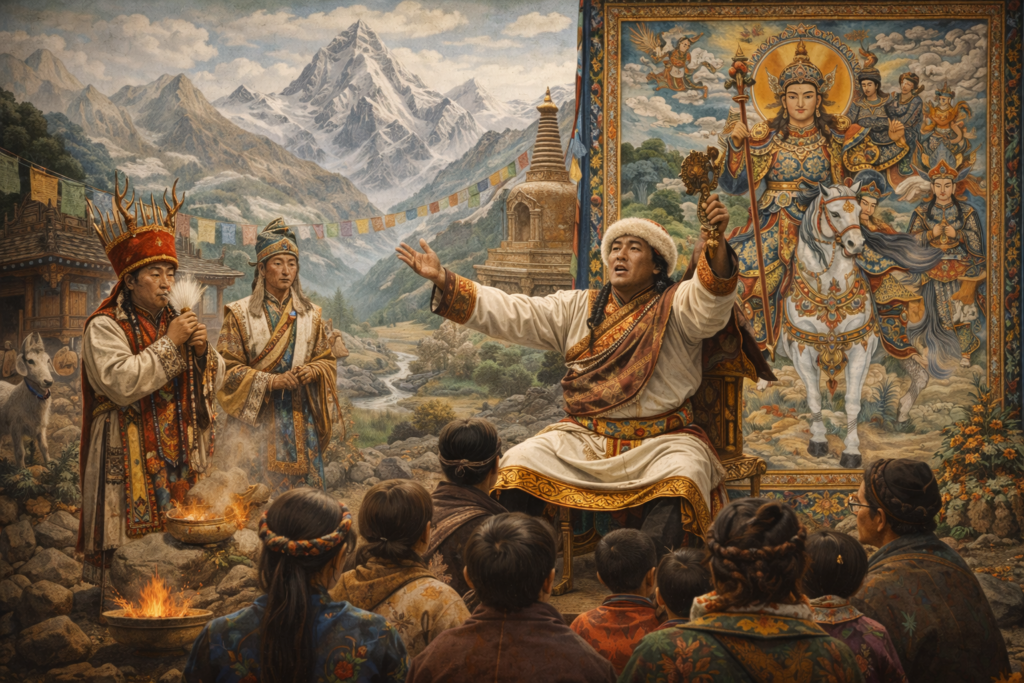
Mountain ritual scene inspired by Qiang and Tibetan traditions, with ceremonial figures, bardic performance, sacred thangka imagery, prayer flags, and gathered community.

Qiang, Tibetan, and Other Regional Mythic Traditions

The mythic traditions of China cannot be reduced to a single literary canon or a uniform civilizational voice. This article explores Qiang, Tibetan, and other regional mythic traditions as vital parts of a wider narrative field shaped by ritual specialists, sacred landscapes, oral performance, festival life, visual art, and community memory. Drawing on traditions such as the Qiang New Year festival, Tibetan opera, Regong arts, and the Gesar epic, it shows how regional worlds preserve distinct understandings of nature, divinity, protection, ancestry, and communal identity. In doing so, these traditions reveal Chinese mythology not as a single closed archive, but as a plural and layered constellation of symbolic worlds.
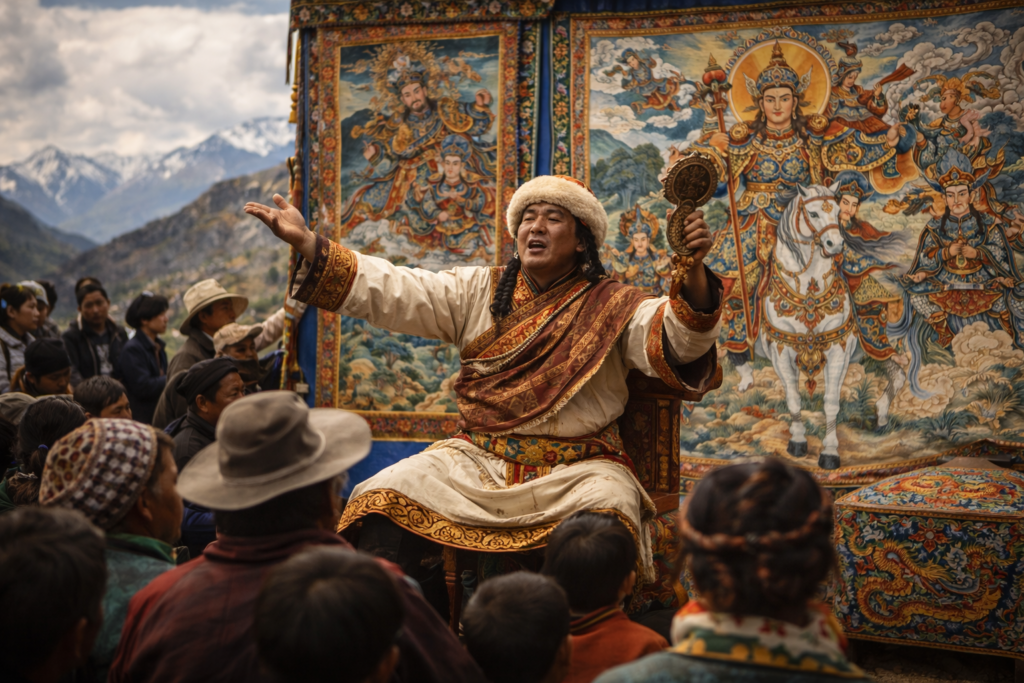
Tibetan bard performing the Gesar epic before a gathered audience, with thangka-style images of King Gesar and mountain landscape in the background.

The Gesar Epic and the Plural Narrative Worlds of China

The Gesar epic is one of the clearest signs that the mythic archive of China is irreducibly plural. This article explores Gesar not only as one of the great heroic traditions of the Tibetan cultural world, but as a living multiethnic narrative ecology carried through singers, ritual specialists, local lineages of performance, printed compilations, manuscript culture, painting, opera, and communal memory. Moving across Tibetan, Mongolian, and Tu contexts, it shows that Gesar survives not as a single fixed book, but as a layered tradition whose authority rests in both oral transmission and textual witness. In doing so, the epic reveals that Chinese myth, folklore, and legend extend far beyond a Han-centered canon into a wider civilizational field of heroic imagination, sacred performance, and regional narrative continuity.

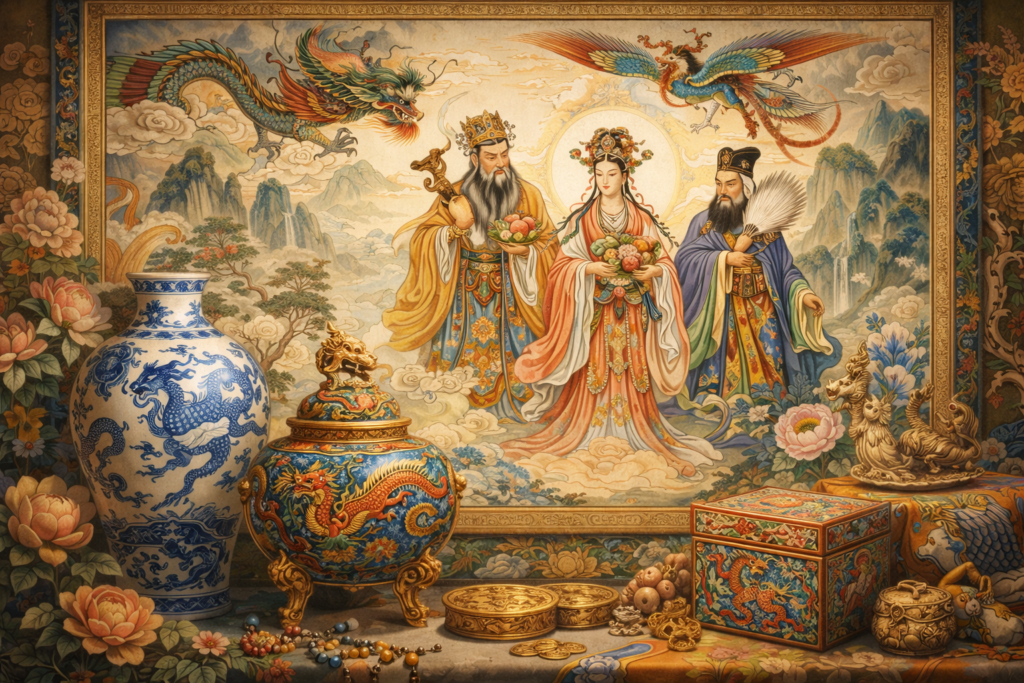
Traditional Chinese mythic art scene with divine figures, dragons, phoenixes, painted scroll imagery, porcelain, incense burner, and richly decorated auspicious objects.

Myth in Painting, Print, and Decorative Art

Chinese myth has long endured not only in texts and performances, but in images and objects that made symbolic worlds visible in everyday life. This article explores how painting, woodblock prints, temple arts, ceramics, lacquer, textiles, and decorative objects carried dragons, immortals, goddesses, auspicious beasts, and sacred motifs across centuries of Chinese culture. By tracing myth through visual and material form, it shows how images functioned not merely as illustration, but as active media of ritual presence, protection, wish, memory, and cosmological meaning. In this wider visual archive, myth became inhabitable through what could be seen, displayed, worn, gifted, and ritually encountered.

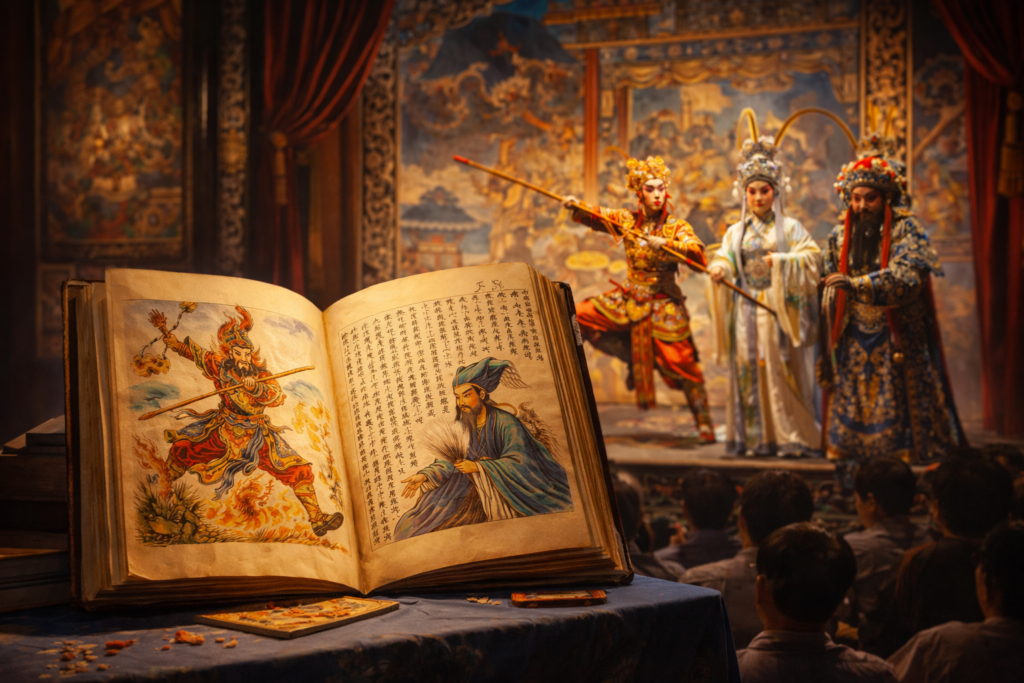
Traditional Chinese opera performance beside an illustrated vernacular book, showing mythic and historical figures carried from printed narrative into staged performance.

Opera, Vernacular Fiction, and the Transmission of Myth

Chinese myth often survived not by remaining fixed in a single sacred or literary canon, but by moving restlessly between oral tale, written narrative, staged performance, and public memory. This article explores how vernacular fiction, storytelling, and opera became the great media through which dispersed mythic materials were consolidated, dramatized, and socially transmitted across late imperial and modern China. From the narrative worlds of Journey to the West and Romance of the Three Kingdoms to the embodied stylization of Kunqu, Peking opera, and regional performance traditions, it shows how legend gained continuity not only through writing, but through repeated acts of voicing, staging, adaptation, and audience recognition. In this media ecology, myth endured because it could move between page and stage without losing its symbolic force.

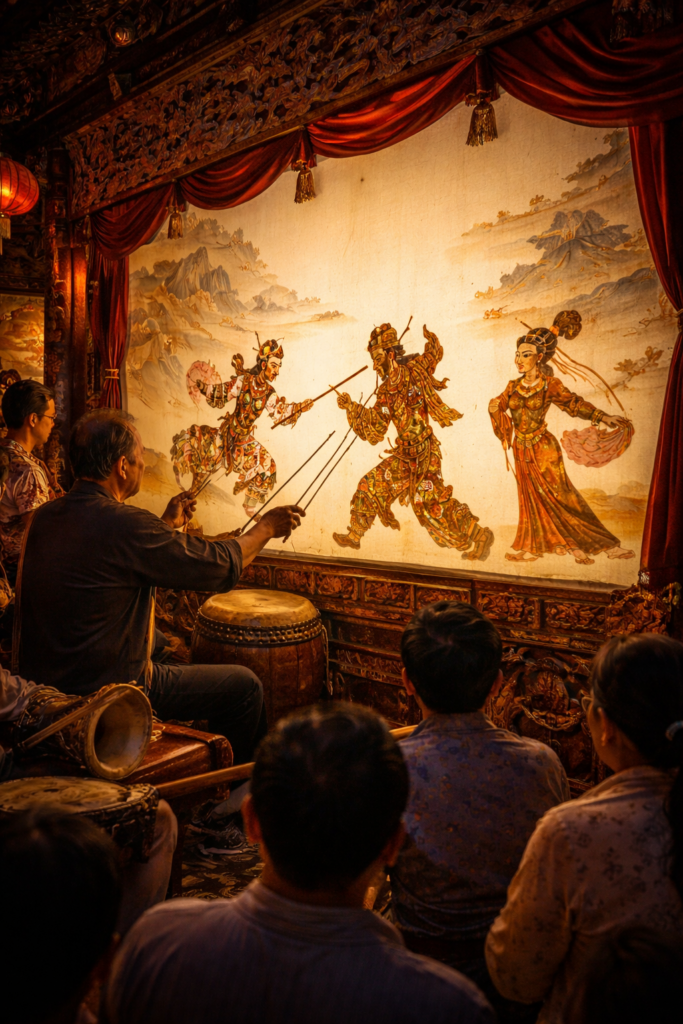
Traditional Chinese shadow puppetry performance with illuminated screen, carved puppet figures, musicians, and an audience watching legendary characters brought to life in silhouette.

Chinese Shadow Puppetry and the Performance of Legend

Chinese shadow puppetry transforms legend into light, silhouette, music, and voice. Far more than a theatrical curiosity, it has long served as a living medium through which myths, historical romances, supernatural tales, and regional legends were transmitted across generations. This article explores shadow puppetry as both an artisanal tradition and a narrative archive, examining how carved figures, oral repertoire, musical accompaniment, and public performance preserved the mythic imagination in embodied form. In the luminous space of the shadow screen, story became movement, memory became spectacle, and inherited legend remained socially alive.

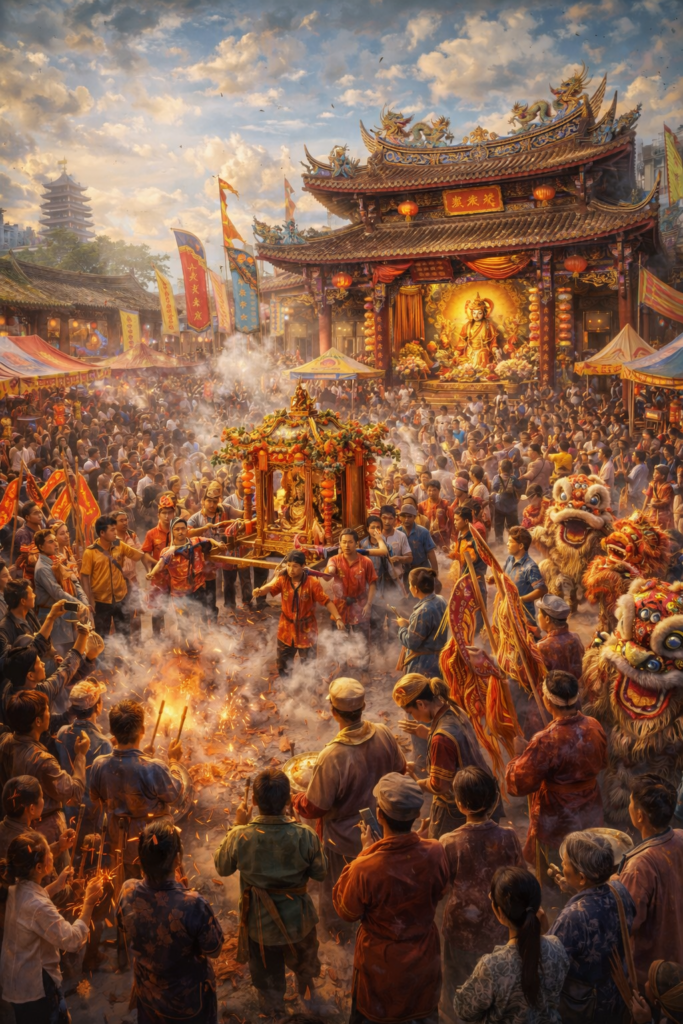
Crowded Chinese temple festival scene with a deity procession, incense smoke, lion dancers, banners, firecrackers, and worshippers gathered before an ornate temple.

Temple Festivals, Popular Religion, and the Social Life of Legend

Temple festivals are among the most important settings in which Chinese legend becomes social life. Far more than isolated acts of worship or quaint survivals of folk custom, they are dense public worlds where deities, sacred territory, ritual specialists, processions, opera, markets, pilgrimage, offerings, and communal memory come together. This article explores temple festivals as key institutions of Chinese popular religion, showing how myths and legends endure not only through texts, but through embodied repetition in streets, temple courtyards, ceremonial routes, and seasonal gatherings. In these environments, sacred presence becomes public, narrative becomes performance, and local society encounters itself through the ritual circulation of gods, images, sound, spectacle, and shared time.

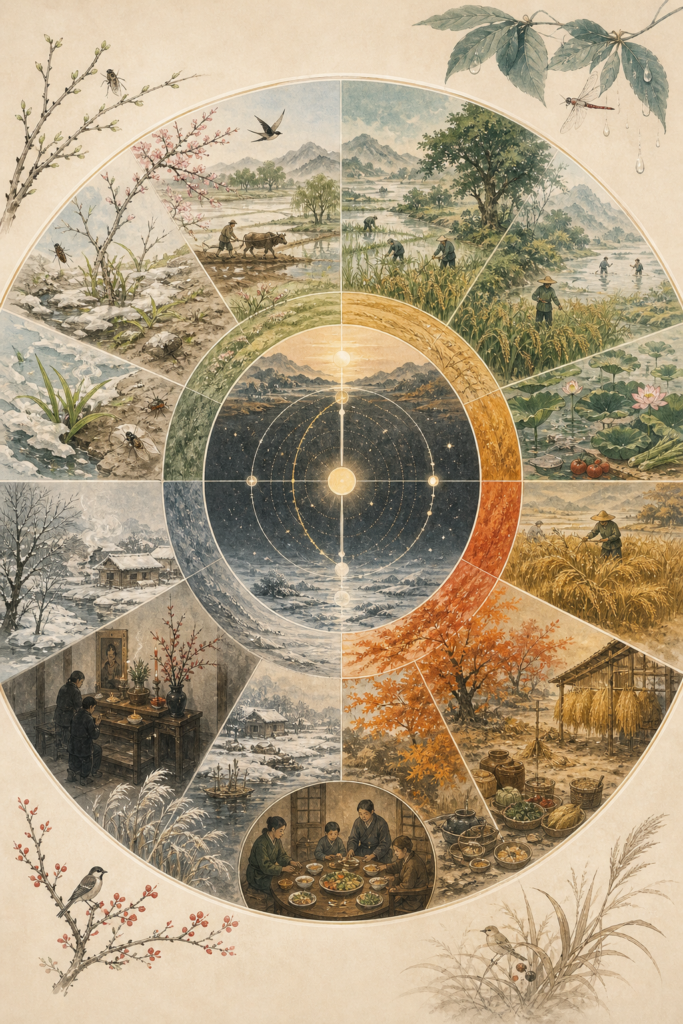
Circular seasonal illustration inspired by the Twenty-Four Solar Terms, showing celestial movement, agricultural labor, changing weather, ancestral remembrance, foodways, and the cyclical rhythm of the Chinese year.

The Twenty-Four Solar Terms and the Mythic Calendar of Seasonal Life

The Twenty-Four Solar Terms are far more than a technical calendrical system. They form a civilizational map of seasonal transition through which Chinese culture has long interpreted the relationship between heaven, earth, agriculture, ritual, and everyday life. This article explores the Solar Terms as a mythic calendar: a patterned structure of time that gave symbolic meaning to climate, labor, ancestral observance, foodways, bodily adaptation, and communal custom. Through their names, thresholds, proverbs, festivals, and ecological intelligence, the Solar Terms reveal how the Chinese year was experienced not merely as chronology, but as a living cosmos.

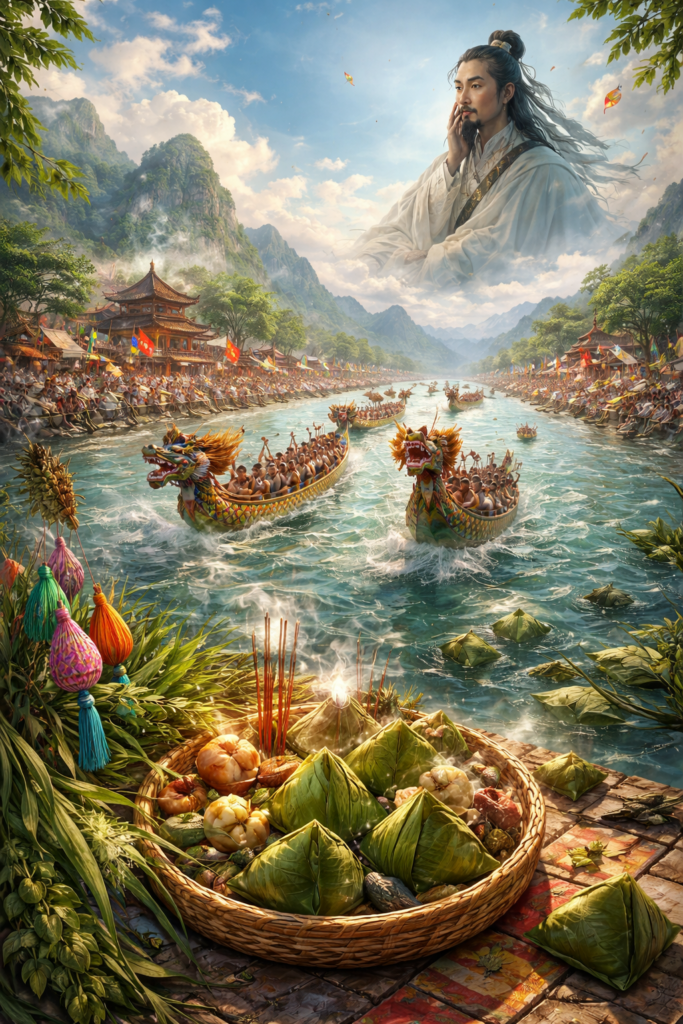
Traditional-style scene of the Dragon Boat Festival with dragon boats racing on a river, wrapped rice dumplings, protective herbs, incense, and the legendary memory of Qu Yuan overlooking the celebration.

The Dragon Boat Festival, Ritual Memory, and Legendary Origins

The Dragon Boat Festival is often explained through the story of Qu Yuan, but its cultural force extends far beyond a single commemorative legend. This article explores the festival as a layered ceremonial formation shaped by seasonal danger, apotropaic custom, river ritual, dragon symbolism, collective performance, and moral memory. Rather than treating dragon boat races, zongzi, fragrant herbs, protective threads, and Qu Yuan remembrance as separate traditions, it shows how they became fused into one of the most enduring observances of the Chinese ritual year. In this festival, myth and folklore do not remain abstract. They become embodied through boats, food, gesture, water, sound, and communal participation. The result is a vivid example of how Chinese legend survives not only in literature, but in the repeated ritual life of society itself.

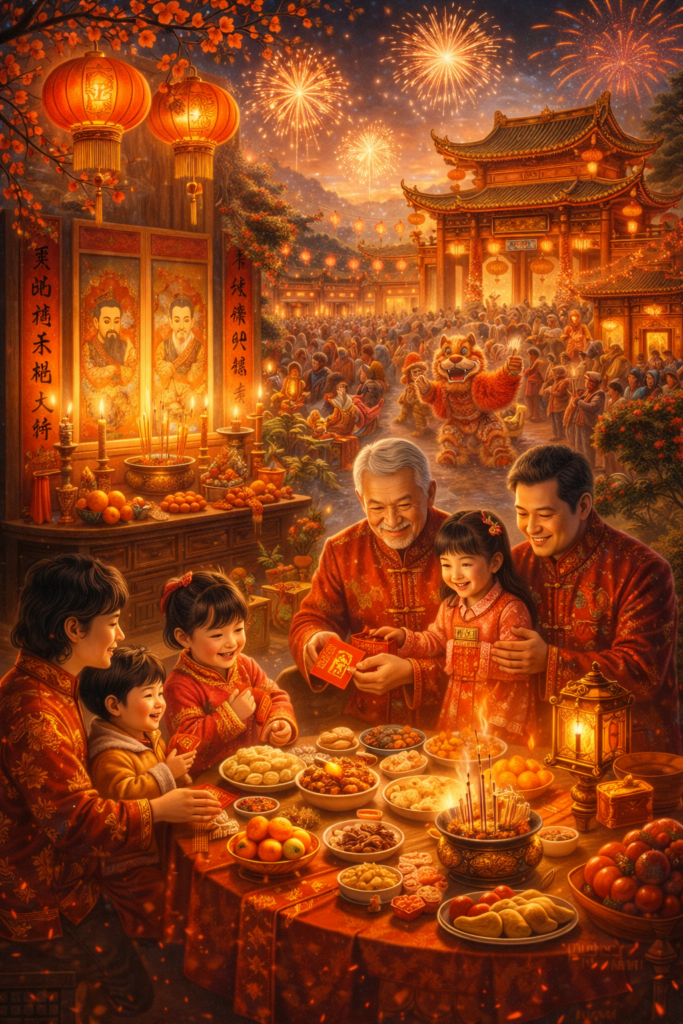
Mythic scene of Chinese New Year cosmology with red lanterns, ancestral offerings, family reunion, temple festivities, and auspicious symbols of renewal in a sacred festive landscape

Spring Festival, New Year Cosmology, and Folk Belief

The Spring Festival is one of the most important ritual and symbolic structures in Chinese civilization because it turns the passage into a new year into a drama of renewal, protection, kinship, moral order, and cosmological transition. In domestic customs, offerings to heaven, earth, and ancestors, public festivities, red decorations, firecrackers, family reunion, and the wider seasonal cycle from preparation to Lantern Festival, the new year becomes more than a date on the calendar. This article examines Spring Festival within the Chinese Myth, Legend, and Folklore knowledge series as a living complex of folk belief and social practice through which households and communities attempt to leave disorder behind, welcome auspicious change, and enter the new year under signs of blessing, continuity, and protection. Under its sign, cosmology is enacted in ordinary life.

Scroll to Top