
Last Updated May 5, 2026
Sun Wukong is one of the most powerful mythic figures in Chinese civilization because he does not remain confined to a single narrative function, religious register, or symbolic meaning. He is at once trickster, rebel, immortal adept, demon-subduer, disciple, pilgrim companion, literary force, theatrical icon, religious figure, and endlessly renewable popular archetype. In him, Chinese tradition preserves one of its richest meditations on unruly power: power that begins in cosmic spontaneity, turns toward defiance and chaos, is subjected to discipline, and is finally redirected toward a redemptive journey. To study Sun Wukong is therefore not only to study a monkey king. It is to study one of the great mythic afterlives of Chinese literature itself.
The Monkey King endures because he carries contradiction without becoming incoherent. He is comic and terrifying, animal and sage, destroyer and protector, self-made immortal and disciplined Buddhist pilgrim, challenger of Heaven and servant of a sacred mission. He mocks power, yet must learn the limits of power. He seeks immortality, yet must accept moral transformation. He refuses rank, yet eventually serves a journey larger than his pride. His story is not a simple tale of rebellion defeated by authority. It is a vast narrative of force being broken, preserved, redirected, and made spiritually useful.
Article Map
Chinese Myth, Folklore & Legend
Related Topic
Nezha & Divine Warfare
Series context: This article is part of the Chinese Myth, Folklore & Legend knowledge series. For the broader category structure, return to the Mythology category.
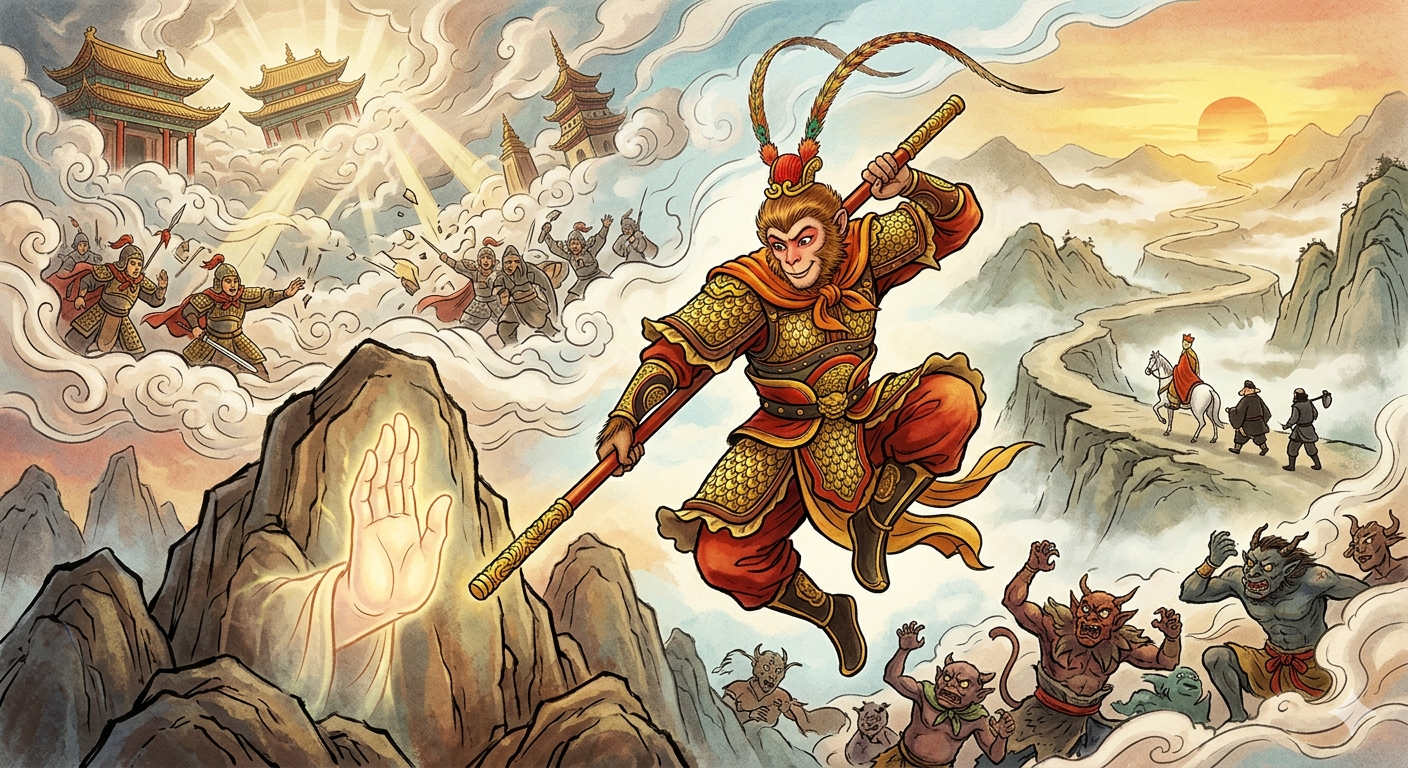
The most influential literary form of Sun Wukong appears in the Ming novel Xiyouji 西遊記, usually known in English as Journey to the West and traditionally attributed to Wu Cheng’en. The novel gave definitive shape to the mythic pattern now most closely associated with him: a monkey born from stone on Flower-Fruit Mountain, trained in Daoist arts, armed with extraordinary transformations and mobility, rebellious against Heaven, punished and sealed beneath Five Elements Mountain, and finally released to serve as protector of the monk Tripitaka on the journey westward in search of Buddhist scriptures. Yet Sun Wukong’s significance cannot be reduced to one role in one novel. The Monkey King quickly became one of Chinese culture’s great afterlives, moving into opera, visual art, temple imagination, children’s culture, political allegory, animation, film, games, and transnational popular iconography.
This article treats Sun Wukong as a layered figure rather than a single symbolic type. He belongs to Daoist cultivation literature, Buddhist pilgrimage narrative, celestial-bureaucratic satire, animal transformation lore, vernacular fiction, religious performance, theatrical embodiment, and modern global media. His story survives because his energies are never exhausted by one interpretation. He is the rebel who must be disciplined, the monster who becomes protector, the comic disruptor who exposes pompous authority, and the pilgrim-disciple whose power becomes meaningful only when redirected toward a journey beyond himself.
Who Is Sun Wukong?
Sun Wukong 孫悟空 is the Monkey King, the great rebellious hero of Journey to the West, and one of the most enduring figures in all of Chinese literature and folklore. He is known by several titles, among them the Handsome Monkey King 美猴王 and, most famously, the Great Sage Equal to Heaven 齊天大聖. These titles matter because they reveal the tensions built into his identity from the beginning. He is comic and majestic, animal and sage, subordinate and self-enthroning, disciple and challenger of cosmic order.
What makes him exceptional is not only his power, but his range. He can be read as rebel, clown, warrior, protector, anarchic spirit, metaphysical seeker, comic adventurer, or disciplined pilgrim. Unlike figures whose symbolic meaning narrows over time, Sun Wukong remains open. Each era rediscovers a different Monkey King: anti-authoritarian trickster, national hero, religious allegory, theatrical role, animated icon, or figure of irrepressible vitality. He endures because he is structurally excessive. No single frame fully contains him.
In the novel, Sun Wukong’s career moves through several decisive transformations. He begins outside ordinary social order, as a stone-born monkey on Flower-Fruit Mountain. He becomes king among monkeys. He seeks immortality and studies under a hidden master. He acquires transformations, cloud-flight, and immense martial power. He rebels against Heaven, is punished by the Buddha, and later becomes Tripitaka’s protector on the pilgrimage to retrieve Buddhist scriptures. The story’s arc is not from evil to good in any simple sense. It is from ungoverned brilliance toward disciplined service.
That arc explains his lasting appeal. Sun Wukong is not tamed into dull obedience. The pilgrimage does not erase the qualities that made him compelling: speed, wit, pride, comic aggression, magical intelligence, and refusal of empty authority. Instead, the novel asks whether such force can be redirected without being destroyed. The Monkey King’s greatness lies in the fact that his transformation preserves his fire.
Source Layers, Text History, and Mythic Afterlife
Sun Wukong’s most influential literary home is the received Ming novel Xiyouji, but the story-world around Journey to the West is itself layered. It draws from the historical memory of Xuanzang’s seventh-century pilgrimage, Buddhist scripture-seeking traditions, earlier journey narratives, vernacular storytelling, drama, demon lore, Daoist techniques, and popular imagination. The Monkey King as readers know him is therefore not simply a timeless folk figure inserted unchanged into a novel. He is the product of long narrative formation and literary crystallization.
This source layering matters because it explains why Sun Wukong can carry so many meanings at once. He belongs to a Buddhist pilgrimage narrative, yet his early powers are deeply tied to Daoist cultivation and immortality-seeking. He is an animal hero, yet one whose transformation and speech make him culturally and spiritually legible. He is a comic rebel against celestial bureaucracy, yet he eventually becomes a defender of a sacred mission. The novel’s genius lies partly in allowing these layers to coexist rather than forcing them into a single doctrinal system.
After the novel, Sun Wukong becomes even more expansive. He moves into opera, puppet theater, woodblock illustration, temple performance, children’s literature, modern animation, martial spectacle, political allegory, global fantasy, and video games. In each medium, he is selected differently. The stage emphasizes movement and face; film emphasizes spectacle; animation emphasizes vitality and rebellion; religious performance may emphasize protection; literary criticism may emphasize satire, allegory, or character formation.
This is why the phrase “mythic afterlife” fits him so well. Sun Wukong’s life as a cultural figure did not end with the novel’s final chapter. The novel became the beginning of an expanding symbolic career. The Monkey King is one of the rare literary characters whose afterlife became mythic in the fullest sense: portable, recognizable, repeatedly reinterpreted, and capable of leaving its original text while still carrying its core energy.
Birth from Stone and the Cosmic Origin of the Monkey King
Sun Wukong’s origin is one of the most famous mythic births in Chinese tradition. He is born from a stone on Flower-Fruit Mountain, a stone nourished by the powers of heaven and earth until it cracks open and releases a living monkey. This birth matters because it places him outside ordinary lineage from the start. He has no human parents, no dynastic ancestry, and no normal social entry into the world. He belongs to the cosmos before he belongs to society.
Primary Source
內育仙胞,一日迸裂,產一石卵,似圓毬樣大。因見風,化作一個石猴,五官俱備,四肢皆全。Within it an immortal embryo was nourished. One day it burst open and produced a stone egg, round as a ball. When it met the wind, it transformed into a stone monkey, complete in its five senses and whole in its four limbs.Xiyouji 西遊記, chapter 1, “Origin of the Spirit Root and Its Nurturing Flow.” Available at: https://ctext.org/xiyouji/ch1
The stone birth makes Sun Wukong a being of cosmic process rather than ordinary descent. He is generated by heaven, earth, sun, moon, stone, wind, and accumulated spiritual potency.
This stone birth is symbolically decisive. It marks Sun Wukong as both natural and supra-natural: a creature of mountain, sky, elemental potency, and primordial spontaneity. Because he is not born into existing hierarchy in ordinary form, he resists ordinary hierarchy with unusual force. The social world encounters him as something already complete in vitality but not yet disciplined by relation. He begins not as son or subject, but as eruption.
The stone itself is described through cosmic correspondences: height, circumference, holes, and openings echo calendrical and cosmological structures. The birth is therefore not random. Sun Wukong comes from a world already charged with number, qi, heaven-earth vitality, and cosmological resonance. His body is strange because his origin is cosmological before it is biological.
This matters for interpretation. Sun Wukong is not merely a monkey who happens to become powerful. From the first, he is born as a problem for cosmic order. His eyes shoot golden light toward Heaven, and celestial powers notice him immediately. The Jade Emperor dismisses the event as a lower-world creature born from heaven-and-earth essence, but the novel has already shown the reader that this “lower” being will eventually disturb the highest court. The rebellion begins in the birth.
Flower-Fruit Mountain and the Monkey Kingdom
Flower-Fruit Mountain is not merely the place where Sun Wukong is born. It is the first form of his world. Before Heaven, before the pilgrimage, before the Buddha’s mountain, Sun Wukong belongs to a landscape of abundance, animals, caves, water, fruit, freedom, and nonhuman society. The mountain is a mythic ecology in which the Monkey King’s vitality first finds community. He is not alone. He becomes king among monkeys.
This setting matters because it gives Sun Wukong a sovereignty before celestial office. His first kingdom is not granted by Heaven. It is discovered, won, and recognized among his own kind. When he leaps through the waterfall and finds the Water Curtain Cave, he earns kingship through courage and initiative. The title “Handsome Monkey King” arises from this local, animal, mountain society before the later cosmic title “Great Sage Equal to Heaven.”
The monkey kingdom also shows that Sun Wukong’s rebelliousness is not simply selfish. He seeks security and immortality partly because he recognizes mortality among his monkey subjects. The fear of death enters the story through community. The Monkey King does not remain content with abundance because abundance is finite. The mountain gives him joy, but also awakens the knowledge that even joy will die.
This is one of the novel’s subtle achievements. Sun Wukong’s quest for immortality is not initially abstract metaphysics. It emerges from grief, fear, and responsibility. He sees that the monkey kingdom is vulnerable to time. His search for the Dao begins when a creature of exuberant life becomes conscious of death.
Daoist Mastery, Immortality, and the Arts of Transformation
Before he becomes a Buddhist pilgrim disciple, Sun Wukong is shaped by Daoist cultivation. He studies under the Patriarch Subhuti and learns arts that define his legendary power: the seventy-two transformations, the cloud-somersault, combat techniques, and the pursuit of life beyond ordinary death. This phase of the story is essential because it roots the Monkey King in a Chinese world already structured by longevity practices, hidden masters, mountain teaching lineages, and the belief that body and self can be altered through disciplined attainment.
That Daoist layer never disappears, even after the later Buddhist framing of the journey becomes dominant. Sun Wukong remains marked by self-cultivation, transformative mastery, and refusal of mortality. He is one of the clearest literary embodiments of the Chinese fascination with acquired powers rather than merely inherited divinity. He becomes dangerous not because he was assigned a fixed godhood from the start, but because he made himself formidable.
This acquired power is crucial to the Monkey King’s symbolism. He is not born fully complete. He seeks, studies, learns, and practices. His powers are extraordinary, but they are not simply gifts. They are tied to discipline, secrecy, instruction, and the transmission of esoteric technique. His later rebellion is therefore the rebellion of a self-fashioned being who has acquired capacities no official order expected him to possess.
The Daoist phase also introduces one of the novel’s central tensions: technique without moral governance. Sun Wukong gains mobility, transformation, longevity, and combat skill, but not humility. He learns how to transcend ordinary limits before he learns how to inhabit power responsibly. The result is not enlightenment, but volatility. The novel distinguishes acquired power from spiritual completion.
The Golden Staff and the Materialization of Force
Sun Wukong’s golden-banded staff, the Ruyi Jingu Bang 如意金箍棒, is among the most recognizable weapons in Chinese literature. Taken from the Dragon King’s underwater treasury, it is not merely a weapon but an object of cosmic scale and magical adaptability. It can shrink to the size of a needle and be stored behind the ear, then expand into a colossal pillar of force. Its very name suggests responsiveness to will. It is power made portable.
The staff matters because it externalizes Sun Wukong’s character. Like him, it is elastic, excessive, comic, terrifying, and difficult to contain. It can be small enough to hide and vast enough to disrupt the world. It obeys his intention, but also reveals the scale of that intention. The Monkey King and staff belong together because both embody force that refuses fixed measure.
The staff also links Sun Wukong to water and dragons. Before he challenges Heaven, he descends into the aquatic world and claims a treasure associated with cosmic measurement and control. This act parallels other Chinese legends in which heroes acquire power by crossing into a nonhuman jurisdiction. The staff is not merely found; it is taken from a world governed by dragon authority.
As iconography, the staff makes Sun Wukong instantly legible. A monkey warrior with a staff is enough to evoke the entire story: rebellion, martial skill, speed, trickery, and pilgrimage. Like Nezha’s fire wheels or the White Snake’s serpent form, the staff condenses myth into image. It is Sun Wukong’s restless will made visible.
The Great Sage Equal to Heaven and the Logic of Rebellion
Sun Wukong’s self-declared title, Great Sage Equal to Heaven 齊天大聖, is one of the most audacious acts of mythic self-naming in Chinese literature. It reveals immediately that his rebellion is not small-scale insubordination but cosmic challenge. He does not wish merely for a better office or a more comfortable place within the celestial order. He contests the order’s right to rank him beneath itself. The Monkey King’s rebellion is therefore fundamentally political and ontological at once.
This matters because Sun Wukong does not rebel in ignorance. He rebels after experiencing the humiliations and evasions of celestial hierarchy. He has seen the bureaucracy of Heaven, understood its logic, and found it inadequate to his being. In this sense, his rebellion carries satirical force. Heaven appears less as perfect transcendence than as an imperial administration vulnerable to vanity, rank anxiety, procedural management, and comic self-importance. The Monkey King’s revolt reveals the fragility of celestial authority by exposing how much of it depends on performance.
The title “Equal to Heaven” is also psychologically revealing. Sun Wukong does not merely ask to be included. He wants recognition proportionate to his own experience of power. The problem is not that he lacks ability. The problem is that the world’s ranking systems refuse to acknowledge that ability except by containment or deception. His title is therefore both absurd and understandable. It is inflated pride, but also a demand for recognition.
The rebellion’s ambiguity is what makes it so enduring. Sun Wukong’s pride is real. His destructiveness is real. Yet the celestial order’s smallness is also real. The novel allows the reader to enjoy his revolt while also recognizing its danger. It does not ask us to choose too quickly between order and freedom. It makes both comic, necessary, and incomplete.
Celestial Bureaucracy, Comedy, and the Satire of Power
One of the greatest achievements of Journey to the West is its portrayal of Heaven as both majestic and absurd. Sun Wukong is first given a low-ranking office as Keeper of Horses, then later other positions designed less to honor him than to neutralize him. The celestial order appears highly structured, but also anxious, evasive, and comic. When the Monkey King disrupts banquets, steals peaches and pills of immortality, and exposes the vanity of the gods, the novel turns cosmology into satire.
This comic dimension is central to Sun Wukong’s mythic power. He is not only a warrior. He is a revealer of inflated institutions. His mockery of celestial bureaucracy allows the novel to stage one of its deepest pleasures: the spectacle of cosmic hierarchy being punctured by unruly intelligence. The Monkey King humiliates Heaven partly by surviving its punishments and partly by making its solemnity look ridiculous.
The satire works because Heaven resembles earthly bureaucracy. It has offices, ranks, reports, titles, banquets, imperial anxiety, procedures, and symbolic honors. Sun Wukong’s presence exposes the weakness of such systems when they encounter someone who refuses to believe in their prestige. He cannot be managed by paperwork, title inflation, or empty office. The celestial order’s attempt to absorb him through bureaucracy only makes the rebellion more comic.
Yet the comedy is not merely anti-authoritarian. The novel also shows that Sun Wukong’s refusal of order can become catastrophic. Satire does not equal anarchy. The reader can laugh at Heaven’s self-importance while also seeing why ungoverned monkey-power cannot become the world’s highest principle. The novel’s brilliance lies in letting comedy and discipline coexist.
Peaches, Pills, and the Theft of Immortality
Sun Wukong’s thefts of peaches of immortality, heavenly wine, and Laozi’s elixir pills are among the great comic-sacred thefts in Chinese literature. These episodes matter because they intensify his challenge to celestial privilege. Immortality in Heaven is not merely a metaphysical condition; it is administered, stored, cultivated, ritually distributed, and reserved for those recognized by cosmic rank. Sun Wukong breaks into that economy and consumes its treasures directly.
The theft of immortality substances also deepens his paradox. He had already sought immortality through training, but now he seizes it through appetite and audacity. Cultivation and theft meet in one body. Sun Wukong is both adept and rogue, practitioner and burglar. He does not wait patiently for celestial authorization. He eats the symbolic capital of Heaven.
These thefts are comic because they are excessive. Sun Wukong does not simply steal a peach; he plunders the system of heavenly privilege. Yet they are also serious because they reveal how immortality can be imagined as controlled resource. The peaches and pills belong to a larger Chinese religious imagination of longevity, alchemy, paradisal fruit, and divine substance. To eat them is to cross boundaries of rank and access.
The punishment that follows is therefore not only punishment for theft. It is punishment for violating the distribution of transcendence. Sun Wukong’s body becomes saturated with immortality, making him even harder to kill. The very substances meant to preserve heavenly order make the rebel more indestructible. The system arms its own disruptor.
The Buddha, the Palm, and Five Elements Mountain
Sun Wukong’s defeat by the Buddha is one of the novel’s great structural turning points because it marks the limit of ungoverned power. The Monkey King can outfight celestial generals, evade punishments, consume immortality substances, survive Laozi’s furnace, and proclaim equality with Heaven, but he cannot surpass the Buddha’s order. When he believes he has reached the end of Heaven, he discovers that he has never left the Buddha’s palm. The episode is one of the most elegant demonstrations in Chinese literature of the limit of egoic power.
Primary Source
原來佛祖右手中指寫著「齊天大聖,到此一遊」。There, on the middle finger of the Buddha’s right hand, were written the words: “The Great Sage Equal to Heaven was here.”Xiyouji 西遊記, chapter 7, “The Great Sage Escapes from the Eight Trigrams Furnace; the Mind-Monkey Is Stilled Beneath Five Elements Mountain.” Available at: https://ctext.org/xiyouji/ch7
The joke is metaphysical. Sun Wukong mistakes the Buddha’s fingers for pillars at the edge of Heaven, proving that even his cosmic leap remains inside a larger field of awareness.
The Buddha’s palm scene matters because it does not merely overpower Sun Wukong. It reframes him. The Monkey King’s speed, transformations, and audacity remain real, but they are shown to operate within a reality larger than his self-conception. He is not defeated by a stronger soldier. He is defeated by a different order of scale.
Primary Source
將五指化作金、木、水、火、土五座聯山,喚名「五行山」,輕輕的把他壓住。He transformed his five fingers into five joined mountains of Metal, Wood, Water, Fire, and Earth, called them Five Elements Mountain, and gently pressed him beneath them.Xiyouji 西遊記, chapter 7. Available at: https://ctext.org/xiyouji/ch7
The mountain functions not only as punishment, but as cosmic containment: the rebel is held under the very elemental order he once tried to outrun.
The mountain functions not only as prison, but as interval. It suspends force long enough for it to become available to another purpose. The Monkey King is neither annihilated nor vindicated. He is held between those possibilities until the pilgrimage gives his energies a new direction. This is one of the most important structures in the novel: power is not destroyed, but detained until it can be reoriented.
Tripitaka, the Pilgrimage, and the Remaking of the Rebel
The release of Sun Wukong to accompany Tripitaka westward is one of the most profound acts of narrative reorientation in Chinese literature. The rebel becomes disciple, the destroyer becomes protector, and the anarchic force that once assaulted Heaven is placed in service of sacred retrieval. Yet this transformation is never simple. Sun Wukong does not stop being himself. The pilgrimage does not erase his violence, pride, impatience, wit, or cunning. It repeatedly tests whether those qualities can be disciplined without being extinguished.
This is one reason the Monkey King remains so compelling during the journey itself. He is neither fully converted saint nor unchanged outlaw. He is in process. The journey becomes a structure for moral remaking, but remaking through conflict rather than instant serenity. His loyalty to Tripitaka is real, yet often strained. His insight is often greater than his master’s, yet he remains bound to serve. The pilgrimage is therefore not only geographic. It is a trial in the governance of power.
Tripitaka’s weakness is essential to the structure. He is vulnerable, credulous, physically fragile, and often unable to recognize demons when Sun Wukong sees them clearly. Yet he is also the sacred center of the mission. Sun Wukong protects a master who frequently misunderstands him. This creates one of the novel’s richest moral tensions: the strongest figure must serve a weaker figure because the mission depends on relation, not simply force.
The pilgrimage therefore disciplines Sun Wukong not by making him less brilliant, but by forcing brilliance into service. He must learn that power is not justified merely by accuracy, strength, or speed. He must protect, endure frustration, submit to correction, and continue the journey even when misunderstood. The rebel’s transformation is relational.
The Tightening Headband and the Discipline of Force
The tightening headband, placed on Sun Wukong and activated by Tripitaka’s spell, is one of the most morally uncomfortable and narratively important devices in the novel. It is a technology of discipline. Sun Wukong’s force is too necessary to abandon, but too volatile to leave unchecked. The headband becomes a visible sign that the pilgrimage depends on controlled power.
This device matters because it prevents easy romanticization of rebellion. Sun Wukong’s freedom is curtailed. His body is made subject to pain when he exceeds the limits imposed on him. Yet the headband also raises troubling questions. Is discipline spiritual training, or coercion? Is Tripitaka’s authority always wise, or can it become unjust when he misunderstands the Monkey King’s actions? The novel does not flatten this tension.
In many episodes, Sun Wukong sees the truth before Tripitaka does. He recognizes demons when others see innocent victims. He acts decisively where his master hesitates. Yet his methods are often violent, mocking, and excessive. The headband therefore dramatizes the difficulty of governing insight when insight comes attached to arrogance and force. The problem is not that Sun Wukong is useless without discipline; the problem is that he is indispensable and dangerous at the same time.
As a symbol, the headband is the opposite of the staff. The staff externalizes power; the headband internalizes constraint. One expands and contracts at Sun Wukong’s command; the other contracts against him when commanded by another. Together they define his pilgrimage identity: force and restraint, weapon and discipline, motion and pain.
Sun Wukong as Monster-Subduer and Protector
Once the journey begins, Sun Wukong emerges above all as the protector of the pilgrimage. His combat is redirected from rebellion against Heaven toward the subjugation of demons, monsters, and predatory beings that obstruct the retrieval of scriptures. In this mode, he becomes one of Chinese tradition’s great monster-subduers, though the term is never simple, since many of the beings he encounters are themselves fallen celestial figures, transformed animals, escaped mounts, local spirits, or products of the same spiritually crowded cosmos that produced him.
This monster-subduing role matters because it transforms defiance into guardianship. The energy that once challenged the highest order now preserves a vulnerable sacred mission. Sun Wukong remains violent, but the moral valence of that violence changes. The Monkey King’s force becomes justifiable not because it ceases to be excessive, but because excess is now placed in defense of something fragile, slow, and spiritually necessary.
The demons of Journey to the West also reveal the novel’s complex religious imagination. Many are not simply evil creatures from outside moral order. They may be beings who have escaped from celestial households, animals transformed by proximity to divine power, or local forces misusing spiritual capacity. Sun Wukong often functions as investigator as much as fighter. He identifies hidden forms, tracks origins, exposes deception, and restores beings to their proper place.
This makes him an agent of classification as well as combat. The rebellious monkey who once refused celestial hierarchy becomes the one who often determines what kind of being has appeared: demon, spirit, animal, celestial servant, false monk, transformed monster, or divine test. The journey turns his suspicion into a religious skill. He protects by seeing through appearances.
Companionship, Conflict, and the Moral Drama of the Journey Party
Sun Wukong cannot be understood in isolation from the journey party. Tripitaka, Zhu Bajie, Sha Wujing, and the White Dragon Horse create the relational field in which his mythic personality becomes fully legible. Among them, the Monkey King is often the most capable, but not always the most patient or most spiritually mature. His relation to Bajie is quarrelsome and comic; his relation to Sha Wujing is less turbulent; his relation to Tripitaka is marked by loyalty, frustration, misunderstanding, and deep asymmetry.
This communal structure is essential to the mythic afterlife of Journey to the West. Sun Wukong’s individuality is sharpened by contrast. He appears all the more brilliant because Tripitaka is vulnerable, all the more fierce because Bajie is comic and compromised, all the more kinetic because Sha Wujing is steady. The journey party allows the Monkey King to remain singular without becoming narratively isolated. He is the center of energy, but not the whole of the mission.
Zhu Bajie is especially important because he gives Sun Wukong a comic counterpart. Bajie’s appetite, sensuality, laziness, and evasions make the Monkey King’s sharpness even sharper. Their quarrels create much of the novel’s humor, but they also reveal different forms of imperfect discipleship. Sun Wukong’s problem is prideful force; Bajie’s problem is appetite and self-excuse. The pilgrimage needs both correction and comedy.
Sha Wujing and the White Dragon Horse give the group additional forms of disciplined transformation. Each companion bears a history of fall, punishment, or conversion. The journey party is not a band of pure saints; it is a moving community of redirected beings. Sun Wukong is the most vivid example, but the whole group participates in the novel’s larger structure: flawed beings turned toward sacred work.
Buddhist, Daoist, and Folkloric Layers in the Monkey King’s Identity
Sun Wukong’s complexity depends on the coexistence of multiple religious and folkloric layers. He carries Daoist techniques of self-cultivation, immortality, and transformation. He is disciplined within a Buddhist pilgrimage toward scripture and enlightenment. He belongs to a folkloric world of talking animals, mountain kingdoms, demons, tricksters, and magical combat. These layers do not always fit together seamlessly, but their tension is part of what makes him mythically alive.
The Monkey King therefore stands as one of the clearest examples of Chinese syncretic narrative imagination. He is not simply Buddhist, not simply Daoist, not simply folk hero. He is the product of a literary world willing to let these systems interact without fully dissolving their differences. His afterlives remain rich because each layer can be emphasized differently in later interpretation.
The Daoist layer gives him techniques: immortality-seeking, transformations, cloud travel, magical combat, and the figure of the hidden master. The Buddhist layer gives him discipline: the mountain, the pilgrimage, Tripitaka, Guanyin’s mediation, scripture retrieval, and eventual transformation through service. The folkloric layer gives him vitality: animal trickery, comic defiance, mountain kingship, and heroic exaggeration. Remove any one of these layers and Sun Wukong becomes smaller.
This layered identity is one reason he travels so well across media. A children’s version may emphasize adventure. A religious reading may emphasize discipline and enlightenment. A political reading may emphasize rebellion. A theatrical version may emphasize acrobatics. A fantasy adaptation may emphasize transformation and combat. All of these readings are selective, but they are not arbitrary. The character contains the seeds of each.
Opera, Performance, and the Visual Life of Sun Wukong
Sun Wukong’s afterlife owes much to performance. In opera and theatrical traditions, his acrobatics, expressive face, staff combat, comic defiance, and rapid emotional shifts make him one of the most stageworthy characters in the Chinese repertoire. The visual grammar of the Monkey King—crown, monkey features, staff, cloudlike mobility, martial agility, painted face, and theatrical energy—gave later culture a figure who could be recognized instantly and embodied dramatically.
This performative vitality matters because it moved the Monkey King beyond the page. He became not just a literary protagonist but a public presence, renewed through gesture, costume, sound, and movement. Performance keeps him kinetic. It preserves the quality that the written text first made central: Sun Wukong is never still for long. Even when interpreted morally or politically, he remains visually energetic, almost impossible to imagine without motion.
The stage also intensifies his liminality. A performer playing Sun Wukong must move between animal and human, comedy and violence, agility and control. The role makes visible what the novel narrates: the Monkey King is a being of transition. He is neither ordinary animal nor ordinary human, neither clown nor solemn warrior, neither pure rebel nor docile disciple. Performance turns that instability into embodied technique.
Visual culture also makes Sun Wukong portable. A single silhouette with staff and monkey face can evoke the entire narrative. This is why he survives so easily in prints, comics, cartoons, film posters, toys, games, and public festivals. His body has become a readable sign: speed, mischief, force, and refusal gathered into one image.
Modern Afterlives: Animation, Games, and Global Popular Culture
The modern afterlife of Sun Wukong is enormous. He appears in animated films, television serials, comics, martial-arts fantasy, children’s books, video games, internet culture, stage adaptations, and global reimaginings. Some modern versions emphasize his rebellious energy; others emphasize adventure, humor, combat, discipline, national culture, or fantasy spectacle. Even when the full pilgrimage structure is simplified, the Monkey King remains recognizable because his symbolic package is so concentrated: monkey, staff, cloud-speed, transformation, defiance, and indestructible vitality.
Modern adaptations often intensify Sun Wukong’s anti-authoritarian dimension. The image of a being who mocks heavenly power, refuses humiliation, and names himself equal to Heaven speaks strongly to modern audiences. Yet the older novel is more complex than simple rebellion. It also insists that force without discipline becomes destructive. The strongest modern readings preserve both sides: Sun Wukong is thrilling because he rebels, but enduring because he changes.
Animation and games are especially suited to him because his powers are visual and kinetic. Seventy-two transformations, cloud-somersaults, staff expansion, battles with demons, and cosmic leaps all translate naturally into moving image and interactive form. Sun Wukong was almost made for media that can show motion at impossible scale. His mythic body anticipates spectacle.
Global popular culture has sometimes detached the Monkey King from the full religious and literary texture of Journey to the West, but this detachment also proves his portability. He can become a superhero, trickster, martial avatar, comic mascot, or fantasy archetype. The risk is flattening; the opportunity is renewal. The Monkey King survives because each retelling takes one part of him and sends it leaping into another world.
Source History and Interpretive Caution
A careful reading of Sun Wukong must distinguish among the literary figure in the received Ming novel, the broader history of Journey to the West as a fictionalization of Xuanzang’s pilgrimage, earlier narrative and dramatic materials, later sequels and adaptations, and the wider religious, performative, and popular life of the Monkey King in East Asian and global culture. The received novel gives the most influential shape to Sun Wukong, but his afterlives quickly exceed it.
This does not diminish his power. It helps explain it. Sun Wukong survives because the literary text was strong enough to become mythic in the fullest sense: capable of leaving the conditions of its first formation and entering many others. His afterlives are evidence not of dilution, but of exceptional narrative fertility.
It is also important not to reduce the novel to a single allegory. Sun Wukong has often been read through religious, psychological, political, comic, and moral frameworks. He can represent the mind-monkey, egoic power, anti-bureaucratic rebellion, disciplined force, spiritual transformation, popular vitality, or literary satire. These readings can be illuminating, but no single one exhausts the figure. The novel’s greatness lies in its ability to sustain multiple interpretive registers simultaneously.
Finally, modern readers should be careful not to treat every recent adaptation as if it were a direct reflection of the Ming novel. Animation, film, television, comics, and games often select the rebel, warrior, or trickster elements while minimizing the pilgrimage’s religious discipline. Those adaptations are part of the Monkey King’s living afterlife, but source-critical interpretation should keep the layers distinct: textual Sun Wukong, performed Sun Wukong, religious Sun Wukong, and modern media Sun Wukong overlap without becoming identical.
Why Sun Wukong Still Matters
Sun Wukong still matters because he gives narrative form to desires and contradictions that do not disappear. He is the dream of unbounded vitality, the pleasure of mocking pompous authority, the thrill of transformation, the danger of ego without discipline, and the hope that even the most unruly force can be redirected toward meaningful purpose. Few figures allow rebellion and redemption to coexist so intensely without neutralizing one another.
He also matters because he is emotionally and symbolically plural. Children can love him as adventurer; performers can embody him as energy; religious readers can treat him as a figure of discipline and insight; political readers can treat him as a challenger of unjust power; literary readers can admire him as one of the great character inventions of world narrative. Under every interpretation, the Monkey King remains what he was from the start: impossible to ignore.
Sun Wukong matters, too, because he shows that transformation is not the opposite of identity. The pilgrimage changes him, but does not erase him. He remains clever, fierce, impatient, funny, and combative. What changes is the direction of his force. This is why he remains such a powerful figure of maturation: not because he becomes tame, but because his wildness becomes capable of service.
Finally, the Monkey King matters because he demonstrates how literature becomes mythology. Journey to the West gave him narrative form, but centuries of performance, retelling, worship, adaptation, and visual reinvention turned him into a cultural presence larger than any single edition. Sun Wukong leaps from stone into story, from story into theater, from theater into popular religion, from popular culture into global imagination. He is still leaping.
Related Reading
- Chinese Myth, Folklore & Legend
- Strange Tales and the Rise of Supernatural Literature
- Reading the Soushen Ji: Anomaly, Wonder, and the Medieval Supernatural
- Daoism, Immortality, and the Supernatural Imagination
- Buddhism, Daoism, and the Recasting of Chinese Mythic Worlds
- Nezha, Rebellion, and Divine Warfare in Chinese Legend
- Dragons in Chinese Myth, Water Cosmology, and Imperial Symbolism
Primary Sources
- Wu Cheng’en 吳承恩, attributed (n.d.) Xiyouji 西遊記 / Journey to the West. Chinese Text Project overview page. Available at: https://ctext.org/xiyouji
- Wu Cheng’en 吳承恩, attributed (n.d.) Xiyouji 西遊記, chapter 1, “Origin of the Spirit Root and Its Nurturing Flow” 靈根育孕源流出 心性修持大道生. Useful for Sun Wukong’s stone birth, Flower-Fruit Mountain, and the cosmic origin of the Monkey King. Available at: https://ctext.org/xiyouji/ch1
- Wu Cheng’en 吳承恩, attributed (n.d.) Xiyouji 西遊記, chapter 2, “Attaining Enlightenment to Bodhi’s True and Sublime Teachings” 悟徹菩提真妙理 斷魔歸本合元神. Useful for Subhuti, Daoist-style training, transformations, and the arts that make Sun Wukong dangerous. Available at: https://ctext.org/xiyouji/ch2
- Wu Cheng’en 吳承恩, attributed (n.d.) Xiyouji 西遊記, chapter 3, “All Seas and Mountains Bow to Him” 四海千山皆拱伏 九幽十類盡除名. Useful for the Monkey King’s acquisition of weapons, underworld disruption, and extension of power beyond Flower-Fruit Mountain. Available at: https://ctext.org/xiyouji/ch3
- Wu Cheng’en 吳承恩, attributed (n.d.) Xiyouji 西遊記, chapter 4, “Official Appointment as Bimawen” 官封弼馬心何足 名注齊天意未寧. Useful for celestial bureaucracy, low office, and the emergence of the title Great Sage Equal to Heaven. Available at: https://ctext.org/xiyouji/ch4
- Wu Cheng’en 吳承恩, attributed (n.d.) Xiyouji 西遊記, chapter 5, “The Great Sage Steals Immortal Peaches” 亂蟠桃大聖偷丹 反天宮諸神捉怪. Useful for the peaches, elixirs, heavenly banquet, and comic-sacred theft of immortality. Available at: https://ctext.org/xiyouji/ch5
- Wu Cheng’en 吳承恩, attributed (n.d.) Xiyouji 西遊記, chapter 7, “The Great Sage Escapes from the Eight Trigrams Furnace; the Mind-Monkey Is Stilled Beneath Five Elements Mountain” 八卦爐中逃大聖 五行山下定心猿. Useful for the Buddha’s palm episode and Sun Wukong’s imprisonment beneath Five Elements Mountain. Available at: https://ctext.org/xiyouji/ch7
- Wu Cheng’en 吳承恩, attributed (n.d.) Xiyouji 西遊記, chapter 14, “The Mind-Monkey Returns to Rightness” 心猿歸正 六賊無蹤. Useful for Sun Wukong’s release, relation to Tripitaka, and beginning of the disciplined pilgrimage role. Available at: https://ctext.org/xiyouji/ch14
- Da Tang xiyu ji 大唐西域記 / Great Tang Records on the Western Regions. Useful as a historical and Buddhist geographical background source for Xuanzang’s pilgrimage world, though it should not be confused with the later fictional Journey to the West. Available at: https://ctext.org/wiki.pl?if=gb&res=101843
Further Reading
- Encyclopaedia Britannica (2026) “Journey to the West.” Available at: https://www.britannica.com/topic/Journey-to-the-West
- Encyclopaedia Britannica (2026) “Wu Cheng’en.” Available at: https://www.britannica.com/biography/Wu-Chengen
- Chinese Text Project (n.d.) Xiyouji 西遊記. Available at: https://ctext.org/xiyouji
- The Metropolitan Museum of Art (n.d.) “The Monkey King Songokū, from the Chinese novel Journey to the West.” Available at: https://www.metmuseum.org/art/collection/search/54818
- Association for Asian Studies (n.d.) “The Journey to the West: A Platform for Learning about China?” Available at: https://www.asianstudies.org/publications/eaa/archives/journey-to-the-west/
- University of Chicago Press (2012) Anthony C. Yu, trans., The Journey to the West. Revised edition. Publisher page available at: https://press.uchicago.edu/ucp/books/book/chicago/J/bo12079518.html
- Yu, A.C. (2012) The Journey to the West. Revised edition. Chicago: University of Chicago Press.
- Plaks, A.H. (1987) The Four Masterworks of the Ming Novel. Princeton: Princeton University Press.
- Dudbridge, G. (1970) The Hsi-yu chi: A Study of Antecedents to the Sixteenth-Century Chinese Novel. Cambridge: Cambridge University Press.
- Shahar, M. (2008) The Shaolin Monastery: History, Religion, and the Chinese Martial Arts. Honolulu: University of Hawai‘i Press.
- Yang, L. and An, D. (2005) Handbook of Chinese Mythology. Santa Barbara: ABC-CLIO. Available at: https://archive.org/details/handbookofchines0000yang
References
- Association for Asian Studies (n.d.) “The Journey to the West: A Platform for Learning about China?” Available at: https://www.asianstudies.org/publications/eaa/archives/journey-to-the-west/
- Chinese Text Project (n.d.) Da Tang xiyu ji 大唐西域記. Available at: https://ctext.org/wiki.pl?if=gb&res=101843
- Chinese Text Project (n.d.) Xiyouji 西遊記. Available at: https://ctext.org/xiyouji
- Chinese Text Project (n.d.) Xiyouji 西遊記, chapter 1, “Origin of the Spirit Root and Its Nurturing Flow” 靈根育孕源流出 心性修持大道生. Available at: https://ctext.org/xiyouji/ch1
- Chinese Text Project (n.d.) Xiyouji 西遊記, chapter 2, “Attaining Enlightenment to Bodhi’s True and Sublime Teachings” 悟徹菩提真妙理 斷魔歸本合元神. Available at: https://ctext.org/xiyouji/ch2
- Chinese Text Project (n.d.) Xiyouji 西遊記, chapter 3, “All Seas and Mountains Bow to Him” 四海千山皆拱伏 九幽十類盡除名. Available at: https://ctext.org/xiyouji/ch3
- Chinese Text Project (n.d.) Xiyouji 西遊記, chapter 4, “Official Appointment as Bimawen” 官封弼馬心何足 名注齊天意未寧. Available at: https://ctext.org/xiyouji/ch4
- Chinese Text Project (n.d.) Xiyouji 西遊記, chapter 5, “The Great Sage Steals Immortal Peaches” 亂蟠桃大聖偷丹 反天宮諸神捉怪. Available at: https://ctext.org/xiyouji/ch5
- Chinese Text Project (n.d.) Xiyouji 西遊記, chapter 7, “The Great Sage Escapes from the Eight Trigrams Furnace; the Mind-Monkey Is Stilled Beneath Five Elements Mountain” 八卦爐中逃大聖 五行山下定心猿. Available at: https://ctext.org/xiyouji/ch7
- Chinese Text Project (n.d.) Xiyouji 西遊記, chapter 14, “The Mind-Monkey Returns to Rightness” 心猿歸正 六賊無蹤. Available at: https://ctext.org/xiyouji/ch14
- Dudbridge, G. (1970) The Hsi-yu chi: A Study of Antecedents to the Sixteenth-Century Chinese Novel. Cambridge: Cambridge University Press.
- Encyclopaedia Britannica (2026) “Journey to the West.” Available at: https://www.britannica.com/topic/Journey-to-the-West
- Encyclopaedia Britannica (2026) “Wu Cheng’en.” Available at: https://www.britannica.com/biography/Wu-Chengen
- Plaks, A.H. (1987) The Four Masterworks of the Ming Novel. Princeton: Princeton University Press.
- Shahar, M. (2008) The Shaolin Monastery: History, Religion, and the Chinese Martial Arts. Honolulu: University of Hawai‘i Press.
- The Metropolitan Museum of Art (n.d.) “The Monkey King Songokū, from the Chinese novel Journey to the West.” Available at: https://www.metmuseum.org/art/collection/search/54818
- University of Chicago Press (2012) Anthony C. Yu, trans., The Journey to the West. Revised edition. Publisher page available at: https://press.uchicago.edu/ucp/books/book/chicago/J/bo12079518.html
- Yang, L. and An, D. (2005) Handbook of Chinese Mythology. Santa Barbara: ABC-CLIO. Available at: https://archive.org/details/handbookofchines0000yang
- Yu, A.C. (2012) The Journey to the West. Revised edition. Chicago: University of Chicago Press.