
Last Updated May 5, 2026
Chang’e and Hou Yi belong to one of the most enduring mythic constellations in Chinese tradition because their story gathers together several of its deepest symbolic themes at once: the dangerous excess of cosmic heat, the heroic restoration of order, the theft or transfer of immortality, the sorrow of separation, and the transformation of the moon into a space of longing, beauty, exile, and transcendence. The myth does not remain confined to one stable meaning. In different tellings, it may be read as a tale of cosmic rescue, a tragedy of estrangement, an etiological account of the moon goddess, or a meditation on the costs of immortality itself. What gives the story its unusual power is that it moves between cosmology and intimacy with remarkable ease. The fate of suns and the fate of a marriage become parts of one mythic world.
The story is especially important because it joins two forms of mythic imagination that are sometimes treated separately: the public drama of cosmic order and the private drama of human attachment. Hou Yi restores a damaged world by correcting solar excess. Chang’e enters the lunar realm through the elixir of immortality, becoming a figure of radiance, absence, and unreachable beauty. Together they create a myth in which the sky is not remote from human emotion. It is the place where human choices become visible forever.
Article Map
Chinese Myth, Folklore & Legend
Related Topic
Queen Mother of the West
Series context: This article is part of the Chinese Myth, Folklore & Legend knowledge series. For the broader category structure, return to the Mythology category.
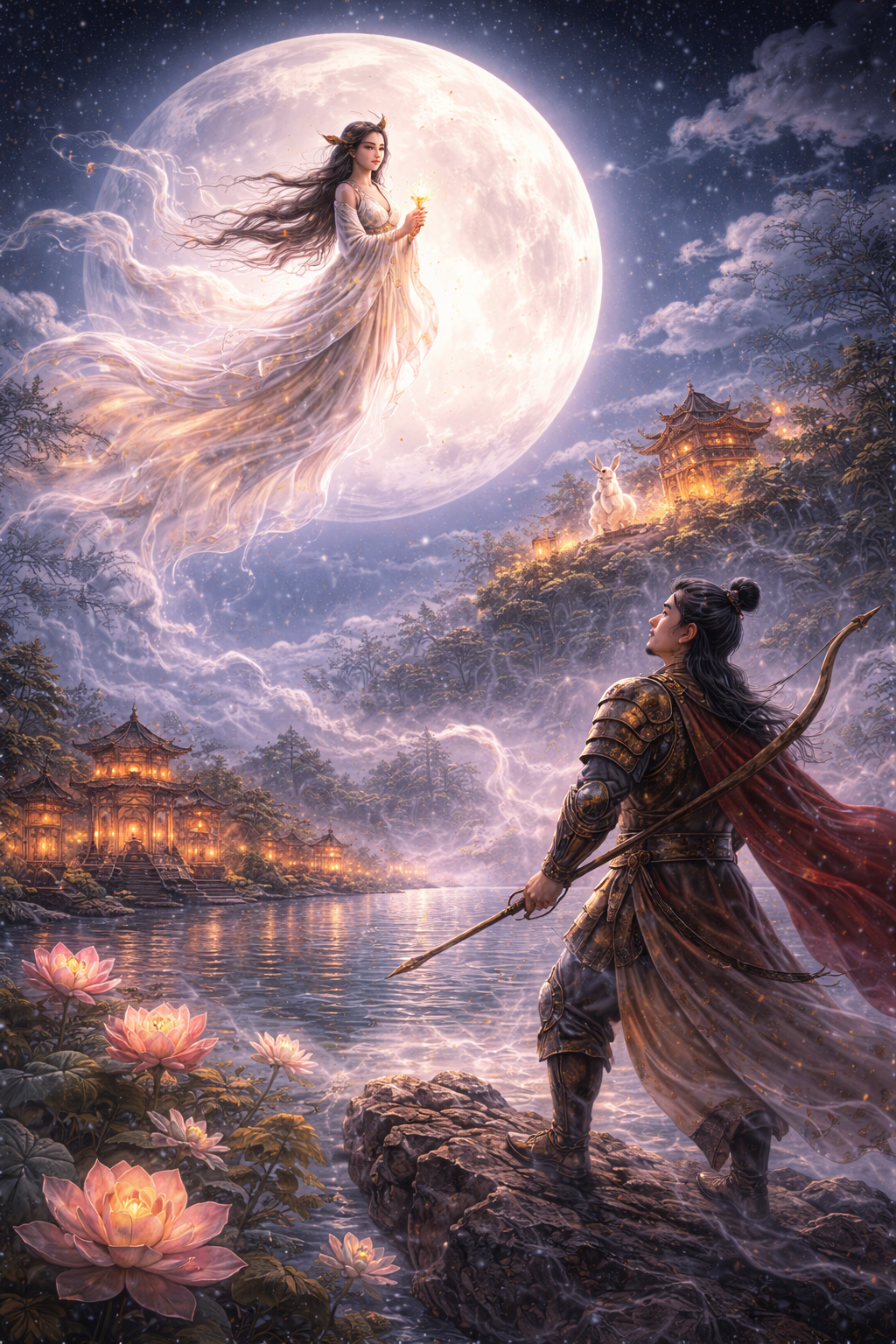
The primary textual anchor for the best-known version of the myth is the Huainanzi, which states that Hou Yi obtained the drug of immortality from the Queen Mother of the West and that Chang’e stole it and fled to the moon. Later literary, religious, and artistic traditions expanded that brief formulation into one of the most recognizable mythic narratives in Chinese civilization, linking Hou Yi to the shooting down of surplus suns and Chang’e to the moon palace, the hare, the toad, and the wider Mid-Autumn imagination. The myth therefore exemplifies a common pattern in Chinese tradition: a compact early textual core that later grows into a vast symbolic afterlife.
Who Are Chang’e and Hou Yi?
Chang’e is the great moon figure of Chinese mythology, while Hou Yi is the heroic archer whose feats place him among the major order-restoring figures of the mythic archive. In later popular memory they are often encountered together as husband and wife, joined by a story in which heroism, immortality, and separation become inseparable. Hou Yi is remembered above all for saving the world from destructive solar excess, while Chang’e is remembered for ascending or fleeing to the moon after taking the elixir of immortality.
What makes the pair so important is not only the sequence of events attached to them, but the symbolic structure they create. Hou Yi belongs to the world of active intervention, earthly danger, and heroic correction. Chang’e belongs to the world of distance, radiance, longing, and transformed existence. Together they form one of the most resonant pairings in Chinese mythology: the archer who restores the world below and the moon figure who remains suspended above it.
The story also carries a distinctive emotional architecture. Hou Yi’s heroism is not enough to secure happiness. Chang’e’s immortality is not enough to secure peace. The myth therefore resists simple moral reduction. It does not allow the reader to say only that Hou Yi is a hero, only that Chang’e is a thief, only that immortality is a reward, or only that the moon is a paradise. Each element is double. Heroism leads toward loss. Immortality creates exile. The moon becomes both beautiful and unbearable.
This doubleness is central to the myth’s survival. It can be told to children as a story of the moon goddess. It can be read by scholars as a layered myth of cosmology, immortality, gender, and ritual memory. It can be invoked during the Mid-Autumn season as part of a wider cultural language of reunion and separation. Few myths are so flexible while remaining so immediately recognizable.
The Primary Mythic Core in the Huainanzi
The most important early textual formulation of the Chang’e myth appears in the Huainanzi, in the “Lanming” chapter, where the narrative is compressed into a few highly charged lines. Hou Yi requests the drug of immortality from the Queen Mother of the West, Chang’e steals it, and she flees to the moon. That concise statement is one of the decisive primary-source moments in all of Chinese mythology because it gives later tradition its central mythic hinge. The moon is not merely inhabited. It becomes the destination of a morally and emotionally consequential act.
譬若羿請不死之藥於西王母,姮娥竊以奔月,悵然有喪,無以續之。何則?不知不死之藥所由生也。
It is like Yi requesting the drug of deathlessness from the Queen Mother of the West: Heng’e stole it and fled to the moon. There was sorrow, loss, and no way to continue it. Why? Because the source from which the drug of deathlessness arose was not known.
The passage is brief, but its implications are immense. It does not give the later full romance. It does not narrate every detail of the marriage, every motive behind the theft, or every feature of the moon palace. It offers instead a mythic nucleus: an archer, the Queen Mother of the West, the elixir of immortality, a stolen substance, a flight to the moon, and a condition of loss that cannot be repaired by ordinary means.
This brevity is significant. The Huainanzi does not elaborate every emotional implication later readers would draw from the story. It places the episode within a philosophical argument about sources, dependence, and the failure to understand the root of things. In that context, Chang’e’s flight is not simply a romantic episode. It becomes an example of possessing a powerful thing without possessing the knowledge of its origin. The elixir can be stolen, but its source cannot be reproduced. Immortality can be taken, but its conditions cannot be mastered.
Precisely because the textual core is so concentrated, later tradition could expand it in multiple directions: toward romance, regret, celestial beauty, festival culture, and symbolic associations with the moon hare and lunar palace. The myth’s later richness depends in part on the spareness of its early formulation. The Huainanzi gives the story enough structure to endure and enough silence to invite interpretation.
Hou Yi and the Restoration of Cosmic Order
Later tradition strongly associates Hou Yi with the shooting down of surplus suns that were scorching the earth. In this form of the myth, the world is endangered by unbearable celestial excess, and Hou Yi’s archery restores habitable balance. He is therefore not only a warrior but a cosmological corrector. His action is directed against too much heaven, not against heaven as such. The aim is not destruction of the cosmic order, but its repair.
This role matters because it places Hou Yi within a recurring Chinese mythic pattern in which heroic action restores measure rather than glorifying sheer force. He is not simply powerful. He is appropriately powerful. His arrows return the world to livability. In some tellings, the problem is not the existence of the suns but their simultaneous appearance. The cosmic system is damaged by excess, simultaneity, and disorder. Hou Yi’s action is a restoration of proportion.
That theme gives the story a wider symbolic importance. Chinese myth often imagines catastrophe not only as evil, but as imbalance: too much water, too much fire, too much distance between heaven and earth, too much disorder in the relations between beings. Hou Yi’s solar feat belongs to this world of mythic correction. He intervenes when ordinary life has become impossible. Fields burn, people suffer, and the sky itself becomes a threat. The hero’s arrow is therefore not only a weapon. It is an instrument of restored measure.
This is one reason Hou Yi’s figure remains ethically legible even when later stories introduce tragedy into his household. Hou Yi begins as a hero of proportion, the one who makes a damaged world inhabitable again. Yet the later Chang’e cycle complicates him. The restorer of cosmic order cannot prevent disorder within the human household. The archer who can strike the suns cannot bridge the distance between earth and moon. Mythic greatness does not exempt him from grief.
Chang’e and the Flight to the Moon
Chang’e’s ascent to the moon is among the most memorable mythic transformations in Chinese tradition because it turns a domestic rupture into a cosmic relocation. Whether later tellings emphasize theft, desperate refuge, protection from another figure, fear of Hou Yi’s anger, or tragic inevitability, the result is the same: Chang’e becomes inseparable from the moon. Her story explains not only why the moon is inhabited, but why it is emotionally charged. The moon becomes the place of a figure who is both glorified and separated.
The act of ascent is narratively decisive because it creates irreversible distance. Chang’e does not merely disappear. She becomes visible in absence. The moon, always present yet unreachable, is the perfect mythic home for such a figure. Its brilliance suggests beauty; its remoteness suggests loss. Her flight therefore transforms the sky into a field of memory.
The myth’s emotional power depends on this paradox. Chang’e is more visible after she is lost. She becomes an object of sight precisely because she can no longer be approached. In human terms, this is the condition of memory: what is gone may become clearer, brighter, and more charged after separation. In cosmological terms, it is the condition of the moon itself: near to the eye, far from the hand, familiar in rhythm, unreachable in place.
Chang’e’s transformation also gives the myth its gendered complexity. She can be read as transgressive, tragic, strategic, punished, liberated, lonely, or sublime, depending on the version and interpretive lens. The early source names the theft, but later traditions surround that act with emotional and moral ambiguity. What did she intend? Was she escaping? Was she protecting the elixir? Was she overcome by desire for immortality? Was the theft a moral failure, an act of self-preservation, or a narrative device that reveals the danger of immortality itself? The myth remains powerful because it does not settle all these questions.
The Moon as Exile, Palace, and Paradise
Once Chang’e is placed on the moon, the lunar world begins to gather new meanings. It may be imagined as a palace, an otherworldly residence, a place of ethereal beauty, or a site of estrangement. The moon is not simply punitive exile, nor is it simply blissful immortality. It holds both elevation and loneliness. This doubleness is one of the reasons the myth became so durable in poetry and festival culture. The moon is beautiful because it is distant, and distant because it is beautiful.
Chinese mythic imagination repeatedly treats remote celestial or mountain spaces as locations where transcendence and separation coexist. Kunlun, the Queen Mother’s western paradise, immortal islands, grotto-heavens, and lunar palaces all suggest spaces beyond ordinary social life. Such places may promise refinement, deathlessness, or sacred proximity, but they also remove the transformed person from common human bonds. The otherworld is never merely elsewhere. It is a test of what one is willing to lose.
In the Chang’e story, the moon becomes one of the clearest expressions of that logic. It is near enough to be seen by all and far enough never to be reached by ordinary means. The result is a uniquely powerful symbolic space: a luminous elsewhere permanently suspended above the human world. Unlike a hidden paradise, the moon is public. Every viewer can see it. Yet visibility does not overcome distance. That is the source of its melancholy force.
The moon’s cyclical nature also matters. It waxes, wanes, disappears, and returns. This rhythm makes it especially suited to stories of longing, reunion, and memory. Chang’e’s presence in the moon means that her story is not fixed in a single mythic past. It is renewed whenever the moon is observed. The sky becomes a repeating narrative surface.
Immortality, Loss, and the Cost of Transcendence
At the heart of the myth lies the problem of immortality. The elixir promises release from ordinary human limits, but its acquisition or use does not produce uncomplicated fulfillment. Instead, immortality is achieved at the cost of separation. Chang’e gains the moon and loses earthly union. Hou Yi remains in the human realm marked by absence. The myth therefore asks one of the most serious questions in Chinese supernatural thought: what if transcendence is real, but tragic?
This is one reason the Chang’e story stands out even within a larger culture rich in immortality motifs. Daoist traditions often imagine ascension, refinement, and transformation as spiritually desirable, yet this myth preserves a counterpoint. To become more than human may also mean to become less available to human relation. Immortality is not denied, but it is burdened with emotional consequence.
The Huainanzi passage intensifies this problem by emphasizing the source of the elixir. Chang’e can take the drug, but the knowledge of its origin remains inaccessible. The text’s philosophical point is larger than the mythic episode: a thing taken without knowledge of its root cannot be renewed. The elixir may confer deathlessness, but it does not confer mastery over deathlessness. Power without source-knowledge leads to loss.
This makes the myth unusually sophisticated. It does not simply ask whether immortality is desirable. It asks what kind of knowledge, relation, and moral order must accompany the desire to transcend mortality. The elixir is not merely a magical object. It is a test of whether human beings can receive extraordinary power without breaking the ordinary bonds that make life meaningful.
Chang’e’s immortality is therefore not a simple reward. It is an altered condition. She becomes radiant, but isolated; divine or semi-divine, but separated; memorable, but unreachable. The myth does not deny the beauty of transcendence. It insists that transcendence has a cost.
The Moon Hare, the Toad, and the Lunar Companions
Later Chinese artistic and folkloric traditions frequently associate Chang’e with other lunar presences, most notably the hare pounding the elixir and, in some accounts, a toad. These companions matter because they enrich the moon’s symbolic ecology. The lunar world becomes not an empty sphere occupied by a single goddess, but a small supernatural environment in which elixir-making, transformation, animal symbolism, and visual culture converge.
The hare in particular extends the immortality theme by linking the moon to continual preparation or grinding of the elixir. In artistic representation, the hare’s pestle and mortar become signs of the moon’s alchemical and medicinal imagination. The moon is not only a place of exile or beauty; it is also a workshop of deathlessness. The elixir that sent Chang’e there continues to shape the symbolic life of the lunar world.
The toad introduces a stranger and more archaic note into the lunar imagination. In some traditions, Chang’e herself is linked to the toad, and in visual culture the toad may appear as part of the moon’s supernatural landscape. This association complicates any purely graceful or romantic view of Chang’e. The lunar realm is beautiful, but it is also strange. Its inhabitants belong to transformation, not ordinary domestic harmony.
Together these images show how the Chang’e myth did not remain only a story about one woman’s ascent. It generated a broader moon mythology in which companionship, symbolism, and visual culture multiplied around the central figure. The moon became populated by figures of elixir, metamorphosis, rhythm, and longing. Chang’e stands at the center, but the mythic field around her is larger than her alone.
Mid-Autumn Memory and the Cultural Afterlife of the Myth
The cultural afterlife of Chang’e and Hou Yi is inseparable from the Mid-Autumn Festival and the wider poetic, artistic, and seasonal life of the moon in Chinese civilization. Chang’e becomes one of the principal figures through whom moon-viewing, longing, reunion, and separation are imagined. The moon is no longer just an astronomical body or generic poetic symbol. It is inhabited by story. Looking at it becomes an act of cultural remembrance.
This festive and literary afterlife matters because it demonstrates how myth survives by attaching itself to recurring practices. The Chang’e story continues not only because it is told, but because the moon continues to be seen, celebrated, and emotionally interpreted. Myth here is cyclical. Each full moon, and especially each Mid-Autumn full moon, renews the conditions under which the narrative remains imaginatively available.
Mid-Autumn symbolism is especially powerful because it holds reunion and separation together. Families gather under the moon, but the moon is also the classic sign of distance from those who are absent. Chang’e’s story deepens that emotional structure. She is the figure who makes lunar beauty inseparable from longing. The round moon may symbolize reunion, but Chang’e’s presence reminds viewers that not every distance is overcome.
The myth’s afterlife also shows how literary and ritual traditions can soften, expand, or transform an older textual core. The terse Huainanzi account gives later tradition a stark image: theft, flight, sorrow, irretrievability. Festival and poetic traditions do not erase that starkness, but they surround it with seasonal beauty, offerings, mooncakes, lanterns, family memory, and aesthetic reflection. The myth becomes livable through culture.
Gender, Separation, and the Poetics of Distance
The Chang’e story has also endured because it lends itself to reflection on gender, estrangement, and emotional distance. In many later retellings, Chang’e is not reducible to a thief or idealized goddess alone. She becomes a figure of separation whose beauty is intensified by inaccessibility. Hou Yi, by contrast, becomes the earthly remainder of a broken union. The myth thus makes possible multiple emotional readings: accusation, pity, admiration, loss, resentment, and longing.
This emotional multiplicity helps explain why Chang’e became so powerful in poetry. The moon already lends itself to meditation on absence and memory; the myth gives that tendency a figure. Chang’e is the personification of visible distance. She is seen by all, possessed by none, and remembered through a light that can be shared without being overcome.
A careful gender reading must avoid flattening Chang’e into either villain or victim. The textual tradition itself is layered. Some versions emphasize theft and moral failure. Others soften the act or place it within a context of danger, coercion, or tragic necessity. Still others dwell less on motive than on result: Chang’e becomes the moon figure, and the emotional center of the myth shifts from blame to distance. The story’s long life depends on this interpretive openness.
Hou Yi’s role is also complex. As solar archer, he is the heroic restorer of cosmic balance. As abandoned husband, he is a figure of grief. In some later versions, anger enters the story; in others, reconciliation or ritual remembrance softens the rupture. The same hero who can correct the sky cannot prevent the transformation of his own household into a myth of absence. This contrast gives the story its tragic proportion.
The poetics of distance may be the myth’s deepest emotional achievement. Chang’e is not lost into darkness. She is lost into light. Her absence is luminous. That is why the myth remains so powerful: it gives form to the human experience of seeing what cannot be recovered.
Source History and Interpretive Caution
A careful reading of Chang’e and Hou Yi must distinguish between the compact early textual core and the much broader later legendary elaboration. The Huainanzi gives the decisive early formulation of Chang’e’s theft of the elixir and flight to the moon. Later reference traditions, poetic associations, festival practices, and artistic representations expand that story by joining it to Hou Yi’s sun-shooting heroism, the moon hare, the lunar toad, reconciliation motifs, and Mid-Autumn culture. These layers should not be collapsed into one timeless version without qualification.
This distinction is not a skeptical reduction of the myth. It is a way of reading the myth more carefully. Chinese mythic traditions often develop through accumulation, citation, adaptation, commentary, and visual elaboration. A brief classical source establishes a durable image, and later literary and artistic traditions amplify its emotional and symbolic range. Chang’e’s story is one of the clearest examples of that process. Its power lies not in textual uniformity, but in mythic accretion.
Interpretive caution also helps prevent the modern reader from forcing the myth into a single moral. The story has often been retold as romance, betrayal, cosmic myth, festival legend, or lunar goddess narrative. Each reading captures something real, but none exhausts the whole tradition. The early text is morally sharper and more compressed. Later tradition is emotionally fuller and more pictorial. Modern cultural memory often emphasizes longing, moon-viewing, and the poignancy of separation.
To read Chang’e and Hou Yi well, then, is to hold these layers together without confusing them. The myth has an early textual anchor, but it also has a long afterlife. It belongs to philosophical prose, folklore, art history, poetry, ritual practice, children’s storytelling, and modern cultural memory. Its durability comes from the fact that each layer adds meaning without entirely erasing what came before.
Why Chang’e and Hou Yi Still Matter
Chang’e and Hou Yi still matter because they preserve one of the most compelling Chinese myths of celestial distance and human cost. Their story is about more than a moon goddess and a heroic archer. It is about what happens when cosmic correction, immortality, love, theft, transcendence, and loss become inseparable. Few myths bind the fate of the sky and the fate of intimacy so closely.
They also matter because the myth gives the moon a distinctly Chinese moral and emotional life. The moon is not empty. It is inhabited by memory, beauty, exile, and the afterimage of separation. Under the sign of Chang’e and Hou Yi, the lunar world becomes one of the great symbolic landscapes of Chinese civilization.
The myth remains powerful because it does not solve the tensions it creates. Hou Yi saves the world but cannot save the marriage. Chang’e becomes immortal but cannot remain at home. The elixir overcomes death but not loss. The moon shines beautifully but remains unreachable. These unresolved tensions are not weaknesses in the story. They are the reason it continues to speak across time.
In the end, Chang’e and Hou Yi transform the moon into a mirror of human longing. The moon’s light is shared by all, yet it belongs to no one. It promises return through its cycle, yet it preserves distance through its place in the sky. In that luminous contradiction, the myth finds its lasting form: a story of restoration and rupture, beauty and exile, immortality and grief.
Related Reading
- Chinese Myth, Folklore & Legend
- Chaos, Cosmos, and the Origins of the World in Chinese Myth
- Kunlun, Paradise Mountains, and the Sacred Geography of the West
- The Queen Mother of the West and the Imagery of Immortality
- Daoism, Immortality, and the Supernatural Imagination
- Buddhism, Daoism, and the Recasting of Chinese Mythic Worlds
Primary Sources
- Huainanzi (n.d.) “Lanming xun” / “覽冥訓.” Chinese Text Project. Available at: https://ctext.org/huainanzi/lan-ming-xun
- Huainanzi (n.d.) Chinese Text Project dictionary entry on 姮娥 / 嫦娥. Available at: https://ctext.org/dictionary.pl?char=%E5%A7%AE%E5%A8%A5&if=en&remap=gb
Further Reading
- Birrell, A. (1993) Chinese Mythology: An Introduction. Baltimore: Johns Hopkins University Press.
- Birrell, A. (1999) The Classic of Mountains and Seas. London: Penguin Classics.
- Major, J.S., Queen, S.A., Meyer, A.S. and Roth, H.D. (2010) The Huainanzi: A Guide to the Theory and Practice of Government in Early Han China. New York: Columbia University Press.
- Yang, L. and An, D. (2005) Handbook of Chinese Mythology. Oxford: Oxford University Press.
- Encyclopaedia Britannica (n.d.) “Chang’e.” Available at: https://www.britannica.com/topic/Change-Chinese-deity
- The Metropolitan Museum of Art (n.d.) “Mirror with moon goddess and rabbit.” Available at: https://www.metmuseum.org/art/collection/search/61405
References
- Birrell, A. (1993) Chinese Mythology: An Introduction. Baltimore: Johns Hopkins University Press.
- Birrell, A. (1999) The Classic of Mountains and Seas. London: Penguin Classics.
- Chinese Text Project (n.d.) Huainanzi: Lanming xun. Available at: https://ctext.org/huainanzi/lan-ming-xun
- Chinese Text Project (n.d.) “姮娥 / 嫦娥.” Available at: https://ctext.org/dictionary.pl?char=%E5%A7%AE%E5%A8%A5&if=en&remap=gb
- Encyclopaedia Britannica (n.d.) “Chang’e.” Available at: https://www.britannica.com/topic/Change-Chinese-deity
- Major, J.S., Queen, S.A., Meyer, A.S. and Roth, H.D. (2010) The Huainanzi: A Guide to the Theory and Practice of Government in Early Han China. New York: Columbia University Press.
- The Metropolitan Museum of Art (n.d.) “Mirror with moon goddess and rabbit.” Available at: https://www.metmuseum.org/art/collection/search/61405
- Yang, L. and An, D. (2005) Handbook of Chinese Mythology. Oxford: Oxford University Press.