
Last Updated May 5, 2026
Soushen ji, usually translated as In Search of the Supernatural or Records in Search of Spirits, occupies a foundational place in Chinese literary and religious history because it stands at the point where anomaly, wonder, spirit encounter, and the medieval supernatural begin to take durable prose form. It is not merely a miscellaneous storehouse of oddities. It is one of the earliest and most influential efforts to gather ghosts, revenants, transformations, omens, divine interventions, marvels, and uncanny events into a recognizably organized written archive. Through it, the strange becomes legible not only as rumor or local memory, but as a field of narrative preservation.
To read the Soushen ji is therefore to encounter one of the major early Chinese attempts to record a world in which the seen and unseen remain porous, morally charged, and narratively active. The collection gives prose form to ghosts, foxes, dream visitations, karmic disturbances, divine punishments, miraculous rescues, violent revenge, strange births, uncanny transformations, and signs that expose hidden patterns of consequence. It is neither fully secular anecdote nor fully doctrinal theology. It is an archive of the strange as cultural memory.
Article Map
Chinese Myth, Folklore & Legend
Related Topic
Chinese Literature
Series context: This article is part of the Chinese Myth, Folklore & Legend knowledge series. It examines the Soushen ji as a key medieval archive of anomaly literature, ghost narrative, transformation, divine response, ritual consequence, and the prose formation of the supernatural imagination.
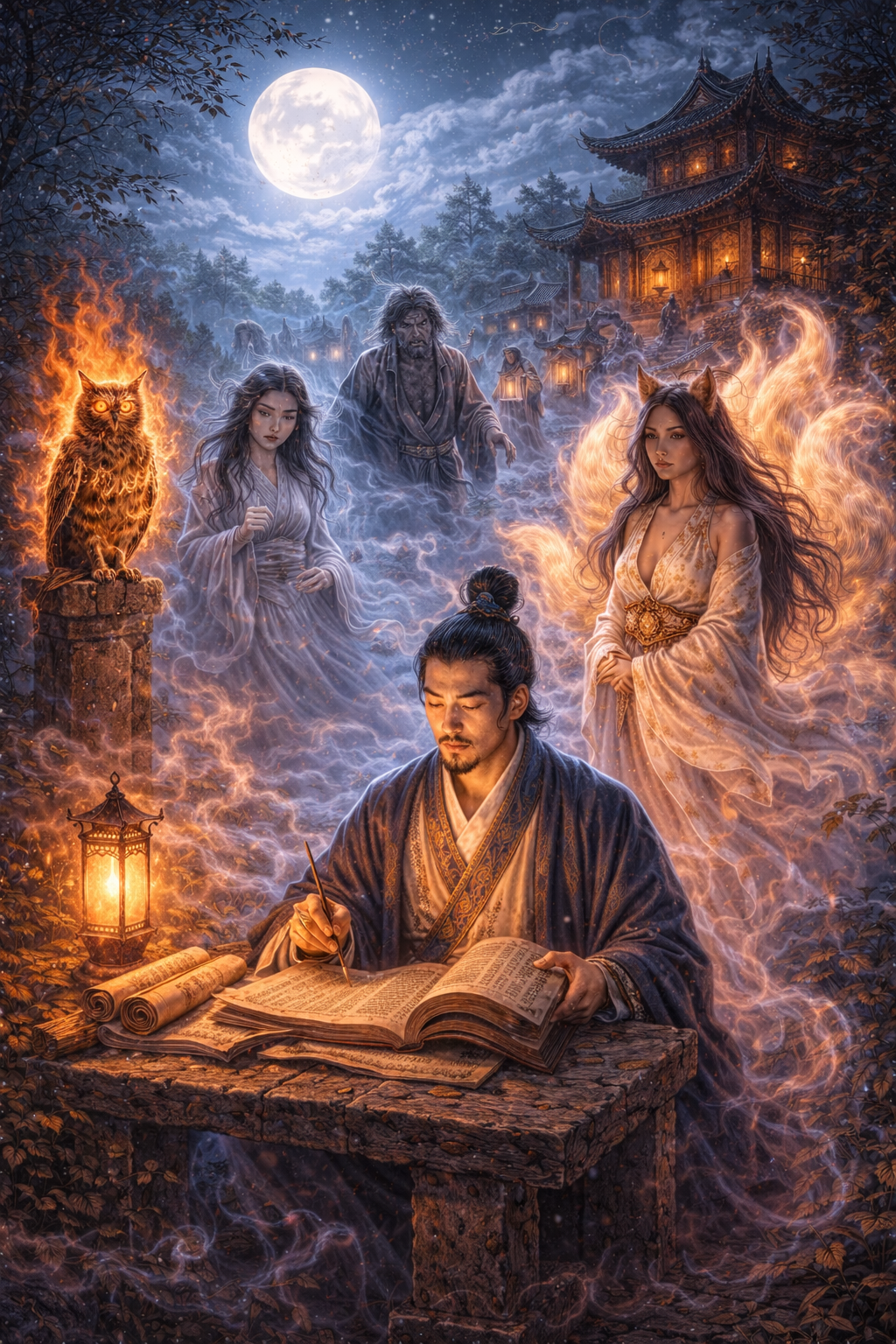
The work conventionally associated with Gan Bao belongs to the broader zhiguai tradition, often described as “records of anomalies” or “accounts of the strange.” Yet the Soushen ji is more than a neutral catalogue of odd events. It gathers the supernatural into a written environment where moral consequence, ritual failure, divine response, uncanny embodiment, gendered vulnerability, heroic resistance, and the instability of ordinary appearances all become narratively present. Some entries are concise and reportorial, almost case-like in tone. Others are sharper miniatures of fear, justice, irony, wonder, or grief. Taken together, they show that the medieval Chinese supernatural was not imagined as random fantasy. It was structured by memory, causation, ritual obligation, and the conviction that the unseen world presses repeatedly upon human life.
What Is the Soushen ji?
The Soushen ji is one of the most important early Chinese collections of strange narratives. It belongs to the medieval prose tradition that records apparitions, ghosts, divine manifestations, anomalous events, strange creatures, dream revelations, transformations, spirit encounters, and marvels. It is not a novel, and it is not a single sustained doctrinal argument. It is a collection of episodes whose cumulative force lies in what they imply about the world: that human life remains exposed to invisible agencies, moral causation, and supernatural interruption.
That episodic structure is essential to its effect. The Soushen ji does not build one total mythology in systematic form. Instead, it accumulates examples. One uncanny event follows another. A ghost returns. A fox changes form. A deity responds. A dead person speaks. A dream proves true. A sword becomes the instrument of vengeance. A girl confronts a serpent. An omen reveals a hidden structure of consequence. Through repetition, the world of the strange begins to look less like isolated fantasy and more like a parallel order pressing against ordinary life.
The work is important for Chinese myth, folklore, and legend because it occupies a transitional position. It is later than archaic mythic sources such as the Shanhaijing, but earlier than the fully elaborated strange-tale traditions of later centuries. It gives prose shape to materials that may have circulated through local legend, oral report, religious memory, family story, official anecdote, and regional lore. In doing so, it helps transform scattered supernatural memory into literary archive.
The title itself is revealing. To “search for spirits” or “seek the divine” is not simply to invent fantasy. It suggests inquiry, collection, pursuit, and evidentiary curiosity. The compiler does not merely tell stories; he gathers signs of a world whose hidden dimensions require attention.
Gan Bao and the Medieval Archive of the Strange
The text is traditionally associated with Gan Bao, a figure of the Eastern Jin period, and that association matters because it situates the work within a medieval moment of compilation, reflection, and narrative preservation. Medieval China did not simply inherit supernatural motifs from earlier antiquity without reworking them. It gathered them into new prose forms. The Soushen ji is one of the clearest examples of this movement from dispersed report to deliberate archive.
This archival impulse is culturally significant. It shows that the strange was not treated merely as entertainment or superstition, but as something worth collecting. To preserve reports of ghosts, marvels, transformations, and divine intervention is already to make a claim: that these events belong to the serious texture of the world, or at least to the serious texture of cultural memory. The compiler becomes not only storyteller, but curator of the porous boundary between the ordinary and the uncanny.
The figure of Gan Bao also reminds readers that medieval supernatural writing should not be dismissed as naïve credulity. Such collections often emerge from educated literary and historical environments. Their brevity and reportorial tone are part of their authority. The strange is not always framed as extravagant spectacle. It is often presented as a record: something heard, transmitted, localized, and preserved.
That record-like quality matters for the later development of Chinese prose. The Soushen ji helps establish a form in which anomalous events can be written with enough concision to seem evidentiary and enough symbolic force to become literature. It stands at the threshold between archive and art.
Anomaly as a Literary Category
The Soushen ji belongs to the broader zhiguai tradition, but reading it closely reveals that anomaly is not merely a synonym for fantasy. An anomaly is an event or presence that does not fit the expected pattern of ordinary life yet still demands interpretation. The strange in this tradition is often narrated with brevity and relative restraint. The tone may be closer to notation than to overt embellishment. This gives the text a distinctive force. The uncanny is not always dramatized extravagantly; it is often reported with unsettling calm.
This restraint matters because it positions the text between record and imagination. The marvelous is neither wholly naturalized nor wholly detached from reality. Instead, it is presented as a disturbance in the expected order of things. The anomaly becomes meaningful precisely because it interrupts a world assumed to be legible, stable, and socially structured. A strange event is therefore never only strange. It is interpretively urgent.
As a literary category, anomaly allows the collection to preserve different kinds of material without forcing them into one doctrinal system. A ghost story, serpent-slaying legend, dream report, divine punishment, marvel of transformation, and revenge tale can all belong to the same archive because each marks a rupture in ordinary expectation. The category is flexible enough to hold myth, folklore, religious sign, moral exemplum, and local legend together.
This flexibility is one reason the Soushen ji became so influential. Later supernatural literature would expand narrative complexity, psychological depth, and stylistic polish, but the basic insight is already present here: the strange deserves preservation because it reveals something about the world that ordinary narrative cannot fully contain.
Wonder, Fear, and the Porous Boundary of the Real
One of the most important features of the Soushen ji is the way it treats wonder and fear as contiguous experiences. The supernatural may terrify, but it may also astonish, reveal, console, punish, rescue, vindicate, or confirm. The strange is not confined to horror. It includes marvel, divine assistance, meaningful coincidence, prophetic dream, and the visible surfacing of hidden moral order. This breadth is one reason the collection is so important for understanding the medieval supernatural. It preserves a spectrum rather than a single emotional register.
The text also assumes that the boundary of the real is porous. Humans are not sealed off from spirits, gods, ghosts, transformed animals, dream messages, and dead ancestors. Dreams may carry truth. The dead may return. Animals may exceed their kind. Gods may intervene. Objects may hold dangerous memory. What matters is not whether every report is literally verifiable in modern terms, but that the collection preserves a world in which the ordinary and extraordinary remain interpenetrating.
Medieval reality, as presented by the Soushen ji, is not disenchanted. It is unstable in the presence of the unseen. Social life takes place against a larger field of agents and consequences. Human beings may think they have completed an act, hidden a crime, neglected a ritual, or buried a memory, but the supernatural world may return what has been suppressed.
This is why the collection can feel morally intense even when individual stories are brief. The uncanny does not merely shock. It exposes. It reveals what ordinary appearances conceal: guilt, injustice, failed obligation, hidden desire, broken ritual order, or the force of a vow that outlives the body.
Ghosts, Revenants, and the Return of the Dead
Ghosts and revenants are among the most important presences in the Soushen ji. The dead return because death has not resolved what life left broken. Wronged individuals reappear. Neglected dead linger. Unfinished obligations persist beyond burial. The revenant is not merely a frightening apparition. It is often a moral reminder that certain injuries do not disappear simply because the injured person has died.
This is where the Soushen ji reveals its ethical seriousness. Ghosts are not only atmospheric devices. They function as indices of disturbed order. They appear when justice has failed, memory has been denied, burial has gone awry, or ritual obligations have been left incomplete. The supernatural therefore becomes one of the ways medieval prose registers the persistence of moral consequence.
Ghost narrative also gives voice to the socially vulnerable. The dead may speak when the living refused to listen. A murdered person, abandoned woman, betrayed subject, neglected family member, or improperly buried body may become narratively powerful through return. In this sense, ghost stories can preserve marginal voices that ordinary social order tried to silence.
The return of the dead also challenges the assumption that time moves cleanly forward. Past injury remains active. The dead are not gone if the conditions of justice, ritual, or remembrance remain unresolved. The supernatural archive thus becomes a memory system: it keeps track of what social life would prefer to forget.
Foxes, Transformations, and the Instability of Form
The Soushen ji is also crucial for the history of transformation. In the wider world of Chinese anomaly literature, foxes, animals, spirits, objects, and humans may cross boundaries that ordinary classification treats as stable. Such transformations matter not only because they are magical. They undermine confidence in visible form. The world becomes populated by beings whose appearance cannot be taken as final truth.
Fox-spirit lore would become far more elaborate in later Chinese literature, religion, and popular imagination, but early anomaly collections help establish the narrative conditions under which such figures can flourish. The fox is powerful because it is near and not-near, animal and human, seductive and dangerous, marginal and socially intimate. It moves across the boundary between wilderness and household, desire and threat, knowledge and deception.
Transformation in the Soushen ji and related zhiguai materials therefore destabilizes ordinary social categories. Human identity, animal identity, gendered appearance, and moral identity can separate from one another. A person may not be what he or she seems. A beautiful figure may hide danger. A marginal being may reveal truth. The visible world becomes unreliable, not because it is meaningless, but because meaning may lie beneath form.
This instability has deep consequences for folklore. Transformation stories preserve social anxieties around sexuality, marriage, scholarship, class mobility, household order, and the vulnerability of men and women to beings outside ordinary kinship structures. The supernatural becomes a language for the instability of social trust.
Gods, Omens, and the Moral Pressure of the Unseen
The collection also preserves gods, omens, and divine responses that make the supernatural world morally pressurized. A deity may punish arrogance, respond to sincerity, reveal hidden truth, or mark the consequences of conduct. An omen may expose the state of a household, a polity, or a person’s fate. These materials show that the strange in medieval China often has ethical weight. The unseen does not merely intrude for spectacle. It comments, rewards, warns, and judges.
This is one of the reasons the Soushen ji cannot be read simply as entertainment. It participates in a larger moral universe where invisible agencies register conduct and where apparent chance may disclose structured significance. The text does not always preach overtly, but it repeatedly implies that the world is responsive in ways not visible on the surface.
Omens are especially important because they make the world semiotic. A strange event is not simply an event; it is a sign. A dream, animal, bodily anomaly, uncanny sound, unexpected appearance, or monstrous birth may point beyond itself to hidden disorder or future consequence. The supernatural world communicates through disruption.
In this respect, the Soushen ji belongs to a broader Chinese tradition in which heaven, earth, spirits, ancestors, and human affairs are not isolated domains. Events carry correspondences. A disturbance in one realm may disclose imbalance in another. The strange tale therefore becomes a miniature theory of relation.
Ritual Failure, Divine Response, and Cosmic Consequence
Many episodes in the Soushen ji become intelligible only when read against ritual life. Improper burial, neglected offerings, broken vows, violated sacred spaces, failures of reverence, and disrupted kinship obligations may all generate supernatural consequence. The strange is often what happens when human beings fall out of alignment with obligations extending beyond the merely social. The cosmos is not neutral toward ritual failure. It reacts.
This reaction may take frightening or marvelous form. A god may answer, a ghost may arise, a wonder may appear, or disaster may reveal a hidden fault. In such cases, the supernatural works as a mode of consequence. The Soushen ji shows a world in which ritual and ontology are linked: what people fail to do properly may alter the traffic between living and dead, seen and unseen.
The ritual dimension also helps explain the collection’s tone. Many stories do not require elaborate explanation because the cultural grammar of obligation is assumed. Burial, sacrifice, vow, ancestor, deity, place, and family duty are already meaningful categories. When they are violated, the narrative does not need to invent supernatural punishment from nowhere. It emerges from the world’s moral and ritual structure.
For readers of Chinese myth and folklore, this is crucial. The supernatural archive is not separate from social practice. It preserves the invisible consequences of visible obligations. Ritual failure becomes narrative because the unseen world must respond.
Gender, Vulnerability, and Resistance
The Soushen ji is especially important for understanding how medieval supernatural literature preserves stories of gendered vulnerability and resistance. Many tales involve women placed under extreme pressure: sacrificed, desired, abducted, betrayed, silenced, haunted, transformed, or remembered through uncanny return. The supernatural often appears where ordinary social protection has failed.
The story of Li Ji slaying the serpent is one of the clearest examples of this dynamic. It begins with a community terrorized by a giant serpent that demands young girls as offerings. The victims are socially vulnerable, and the ritualized sacrifice of girls becomes a system of communal fear. Li Ji’s resistance interrupts that system. She does not wait for male rescue; she arms herself with strategy, sword, dog, and courage.
Primary Source
東越閩中,有庸嶺,高數十里,其西北隙中,有大蛇,長七八丈大十餘圍,土俗常懼……累年如此,已用九女。In Minzhong of Eastern Yue there was Yongling, several tens of li high. In a crevice to its northwest there was a great serpent, seven or eight zhang long and more than ten arm-spans around, and the local people constantly feared it. Year after year it was so, and already nine girls had been used.Soushen ji, juan 19, “Li Ji Slays the Serpent” 李寄斬蛇.
The passage frames supernatural terror as social violence. The serpent is not only a monster; it has become the center of a ritualized system that consumes vulnerable girls until Li Ji disrupts it.
Li Ji’s story matters because it gives narrative agency to a girl whom the social order might otherwise treat as expendable. Her victory is not only over a serpent. It is over a structure of fear that had normalized sacrifice. In this sense, the story belongs not only to monster-slaying legend, but also to the history of how supernatural narrative can preserve voices of resistance.
This is one of the reasons the Soushen ji remains so valuable for modern readers. It preserves not only elite cosmology or doctrinal belief, but narrative situations in which marginalized figures confront danger, return from death, reveal injustice, or transform the conditions imposed upon them.
Revenge, Justice, and the Unsettled Social Order
The Soushen ji also preserves powerful stories in which justice exceeds ordinary legal or political structures. The story of Gan Jiang and Mo Xie is one of the most famous. It involves sword-making, royal violence, inheritance, revenge, sacrifice, and the final collapse of identity in the boiling cauldron where the heads of the king, the avenger, and the son become indistinguishable. It is a brutal story, but its brutality reveals the depth of the social rupture it narrates.
In such tales, vengeance is not merely personal anger. It becomes a sign that political order has failed. When the ruler kills unjustly, justice can no longer be contained by normal institutions. The supernatural or uncanny quality of the narrative intensifies that failure. The sword, the dream, the severed head, and the refusal of the head to dissolve all turn revenge into a moral and symbolic drama.
Primary Source
王夢見一兒,眉間廣尺,言欲報讎。王即購之千金……煮頭三日,三夕,不爛。頭踔出湯中,躓目大怒。The king dreamed he saw a boy whose brow was a foot wide, saying that he wished to avenge a wrong. The king then offered a thousand pieces of gold for him. The head was boiled for three days and three nights, but it would not decompose; it leapt up from the broth, eyes glaring in great fury.Soushen ji, juan 11, “Gan Jiang and Mo Xie” 干將莫邪.
The severed head that refuses to dissolve makes injustice materially visible. The supernatural intensifies the story’s moral claim: wrongful violence does not disappear simply because the ruler commands it.
Stories of revenge and unsettled justice show how anomaly literature can critique power indirectly. The Soushen ji does not need to present a formal political argument. It can narrate a world in which unjust violence produces consequences that return through dreams, objects, bodies, and uncanny persistence. The strange becomes one of the languages through which broken order is exposed.
This also links the Soushen ji to broader Chinese traditions of moral memory. A wrong must be remembered. If society forgets, the ghost, dream, sword, omen, or monstrous return may remember for it.
From Local Report to Cultural Memory
One of the achievements of the Soushen ji is that it turns what may once have been local reports or isolated anecdotes into lasting cultural memory. A ghost story told in one place, a transformation tale associated with one region, or an omen attached to one event becomes portable once written down. The collection does not merely preserve the strange. It redistributes it. Stories can circulate across time and place, entering broader literary and religious imagination.
This portability changes the status of the supernatural. The strange becomes available for repetition, comparison, adaptation, and imitation. Later writers inherit not only motifs, but forms of narration. The Soushen ji therefore matters not only as a source of individual stories, but as a mechanism by which the medieval supernatural became translocal and durable.
The movement from local report to cultural memory also changes scale. A story that may have once explained a local shrine, family misfortune, regional danger, or unusual event becomes part of a wider archive of ghosts, gods, foxes, dreams, and transformations. This is how folklore enters literature without losing all trace of local life.
For the Chinese myth, folklore, and legend series, this is one of the most important lessons of the Soushen ji. Myth does not survive only through great classical texts or monumental religious systems. It also survives through small stories that move, accumulate, and become reusable across generations.
Why the Soushen ji Matters for Medieval Supernatural Literature
The Soushen ji matters for medieval supernatural literature because it consolidates several tendencies at once. It preserves anomaly in prose. It gathers together ghosts, transformations, gods, dreams, revenge, marvels, and monstrous beings. It grants the strange archival seriousness. It builds a repertoire that later collections and writers would inherit, expand, and refine. Without works like the Soushen ji, the later flourishing of strange tales would be much harder to imagine in the same form.
It also matters because it preserves a mode of writing that remains close to belief without collapsing into doctrinal rigidity. The strange may be narrated as if it happened, yet the literary force of the episode does not depend entirely on modern factual verification. The text occupies the fertile space between record, memory, wonder, and narrative. That space would remain central to Chinese supernatural literature for centuries.
The collection helps prepare the ground for later literary developments such as the Taiping guangji, Tang chuanqi, and eventually Liaozhai zhiyi. Later works would become more elaborate, psychologically complex, and stylistically refined, but many of their fundamental materials are already present here: ghosts who expose injustice, foxes who destabilize identity, dreams that reveal hidden truth, deities who intervene, and marvels that force ordinary people to confront a larger invisible order.
The Soushen ji therefore belongs to the prehistory of later Chinese fiction, but it should not be reduced to an immature precursor. Its compression is part of its power. It gives the strange the authority of record and the force of legend at the same time.
Source History and Interpretive Caution
A careful reading of the Soushen ji requires attention to textual history, transmission, attribution, and later redaction. The received work has a complicated bibliographic history, and scholars have long noted issues of survival, compilation, and later reconstruction. For interpretive purposes, this means the collection should not be treated as a perfectly transparent authorial object. It is a transmitted archive shaped by preservation as much as by original composition.
Yet this instability is itself revealing. It reminds us that the medieval supernatural survives through editorial care, anthologizing, quotation, reconstruction, and reuse. The strange tale tradition is not only about stories within the text. It is also about the historical survival of texts that preserve strange worlds. Reading the Soushen ji therefore means reading both the medieval uncanny and the fragility of literary transmission.
Source caution also helps avoid a common modern mistake: treating every strange tale as direct evidence of what “people believed.” The stories are evidence, but evidence of many things at once: narrative form, elite compilation, local memory, religious imagination, moral anxiety, social tension, and literary convention. Their value lies in this layered quality.
The Soushen ji is best read as a witness to how the supernatural became narratable. It does not simply tell us that ghosts, gods, foxes, and omens were imagined. It shows how they were organized into prose events, given settings, attached to consequences, and preserved as meaningful disturbances in the order of things.
Why Reading the Soushen ji Still Matters
Reading the Soushen ji still matters because it provides one of the clearest entrances into the medieval Chinese supernatural imagination. It shows a world in which ghosts, gods, foxes, dreams, wonders, violent wrongs, heroic resistance, and moral disruptions do not belong to a marginal fantasy realm. They belong to lived reality as narrated through prose. The text allows modern readers to see how anomaly once functioned not as mere escape from the world, but as a way of understanding the world’s hidden pressures.
It also matters because the Soushen ji stands near the beginning of a literary tradition that would later produce some of the richest supernatural writing in world literature. To read it is to see the early formation of narrative habits that later become more elaborate in the Taiping guangji, Tang chuanqi, and Liaozhai zhiyi. The medieval supernatural did not emerge fully formed. The Soushen ji is one of the places where it learned to speak.
The collection also remains important because it preserves a world in which marginalized voices, forgotten injuries, gendered vulnerability, ritual neglect, and local memory can return through the supernatural. The strange is not trivial. It is one of the ways a culture remembers what ordinary order cannot contain.
For Chinese myth, folklore, and legend, the Soushen ji is therefore indispensable. It shows myth after mythic antiquity: no longer only the world of sacred mountains and cosmic origins, but the world of ghosts in households, foxes near scholars, girls confronting serpents, gods answering vows, and dead voices refusing silence. It is the supernatural as social memory.
Related Reading
- Chinese Myth, Folklore & Legend
- Strange Tales and the Rise of Supernatural Literature
- Ghosts, Revenants, and the Moral Logic of the Unsettled Dead
- Fox Spirits, Transformation, and Ambiguity in Chinese Folklore
- Underworlds, Judges, and the Bureaucracy of the Afterlife
- Buddhism, Daoism, and the Recasting of Chinese Mythic Worlds
- Chinese Literature and Classical Memory
- East Asian Traditions
Primary Sources
- Chinese Text Project (n.d.) Soushen ji 搜神記 / In Search of the Supernatural. Available at: https://ctext.org/wiki.pl?if=en&res=839038
- Chinese Text Project (n.d.) Soushen ji: Juan 11 搜神記:第十一卷. Available at: https://ctext.org/wiki.pl?chapter=648373&if=en
- Chinese Text Project (n.d.) Soushen ji: Juan 19 搜神記:第十九卷. Available at: https://ctext.org/wiki.pl?chapter=307958&if=gb
- Wikisource (n.d.) Soushen ji: Juan 19 搜神記:第十九卷. Available at: https://zh.wikisource.org/zh-hant/%E6%90%9C%E7%A5%9E%E8%A8%98/%E7%AC%AC19%E5%8D%B7
- Chinese Text Project (n.d.) Taiping guangji 太平廣記. Available at: https://ctext.org/taiping-guangji
- Chinese Text Project (n.d.) Liaozhai zhiyi 聊齋志異. Available at: https://ctext.org/liao-zhai-zhi-yi
Further Reading
- Campany, R.F. (1996) Strange Writing: Anomaly Accounts in Early Medieval China. Albany: State University of New York Press.
- DeWoskin, K.J. and Crump, J.I. Jr. (1996) In Search of the Supernatural: The Written Record. Stanford: Stanford University Press.
- Gan, Bao (n.d.) Soushen ji. Chinese Text Project edition. Available at: https://ctext.org/wiki.pl?if=en&res=839038
- Chinese Text Project (n.d.) Soushen ji: Juan 11. Available at: https://ctext.org/wiki.pl?chapter=648373&if=en
- Chinese Text Project (n.d.) Soushen ji: Juan 19. Available at: https://ctext.org/wiki.pl?chapter=307958&if=gb
- Chinese Text Project (n.d.) Taiping guangji. Available at: https://ctext.org/taiping-guangji
- Chinese Text Project (n.d.) Liaozhai zhiyi. Available at: https://ctext.org/liao-zhai-zhi-yi
- Idema, W.L. and Haft, L. (1997) A Guide to Chinese Literature. Ann Arbor: Center for Chinese Studies, University of Michigan.
- Lu, Xun (1959) A Brief History of Chinese Fiction. Beijing: Foreign Languages Press.
References
- Campany, R.F. (1996) Strange Writing: Anomaly Accounts in Early Medieval China. Albany: State University of New York Press.
- Chinese Text Project (n.d.) Soushen ji. Available at: https://ctext.org/wiki.pl?if=en&res=839038
- Chinese Text Project (n.d.) Soushen ji: Juan 11. Available at: https://ctext.org/wiki.pl?chapter=648373&if=en
- Chinese Text Project (n.d.) Soushen ji: Juan 19. Available at: https://ctext.org/wiki.pl?chapter=307958&if=gb
- Chinese Text Project (n.d.) Taiping guangji. Available at: https://ctext.org/taiping-guangji
- Chinese Text Project (n.d.) Liaozhai zhiyi. Available at: https://ctext.org/liao-zhai-zhi-yi
- DeWoskin, K.J. and Crump, J.I. Jr. (1996) In Search of the Supernatural: The Written Record. Stanford: Stanford University Press.
- Idema, W.L. and Haft, L. (1997) A Guide to Chinese Literature. Ann Arbor: Center for Chinese Studies, University of Michigan.
- Lu, Xun (1959) A Brief History of Chinese Fiction. Beijing: Foreign Languages Press.
- Wikisource (n.d.) Soushen ji: Juan 19. Available at: https://zh.wikisource.org/zh-hant/%E6%90%9C%E7%A5%9E%E8%A8%98/%E7%AC%AC19%E5%8D%B7