
Last Updated May 5, 2026
Nezha occupies a singular place in Chinese legend because he fuses childhood, rebellion, cosmic violence, filial conflict, divine warfare, bodily destruction, and self-transformation into one of the most explosive figures in the mythic archive. He is not simply a child god, nor simply a warrior deity, nor simply a rebellious son. He is a being through whom Chinese tradition explores what happens when extraordinary power appears before social order is ready to contain it. In Nezha, divine warfare begins in domestic conflict, rebellion becomes a mode of justice, and the child becomes a battlefield between bloodline, cosmic destiny, religious transformation, and moral autonomy.
Nezha endures because he concentrates contradiction. He is young but terrifyingly powerful; filial yet violently severed from his parents; rebellious yet eventually protective; destructive yet reborn through sacred lotus matter; mythic yet cultic; literary yet devotional; ancient yet constantly renewed in animation, temple practice, opera, film, and popular culture. His story is one of the great Chinese narratives of misfit power: power too great for childhood, too unruly for paternal authority, too morally charged to be dismissed as mere disobedience, and too enduring to remain confined to one text.
Article Map
Chinese Myth, Folklore & Legend
Related Topic
Dragons in Chinese Myth
Series context: This article is part of the Chinese Myth, Folklore & Legend knowledge series. For the broader category structure, return to the Mythology category.
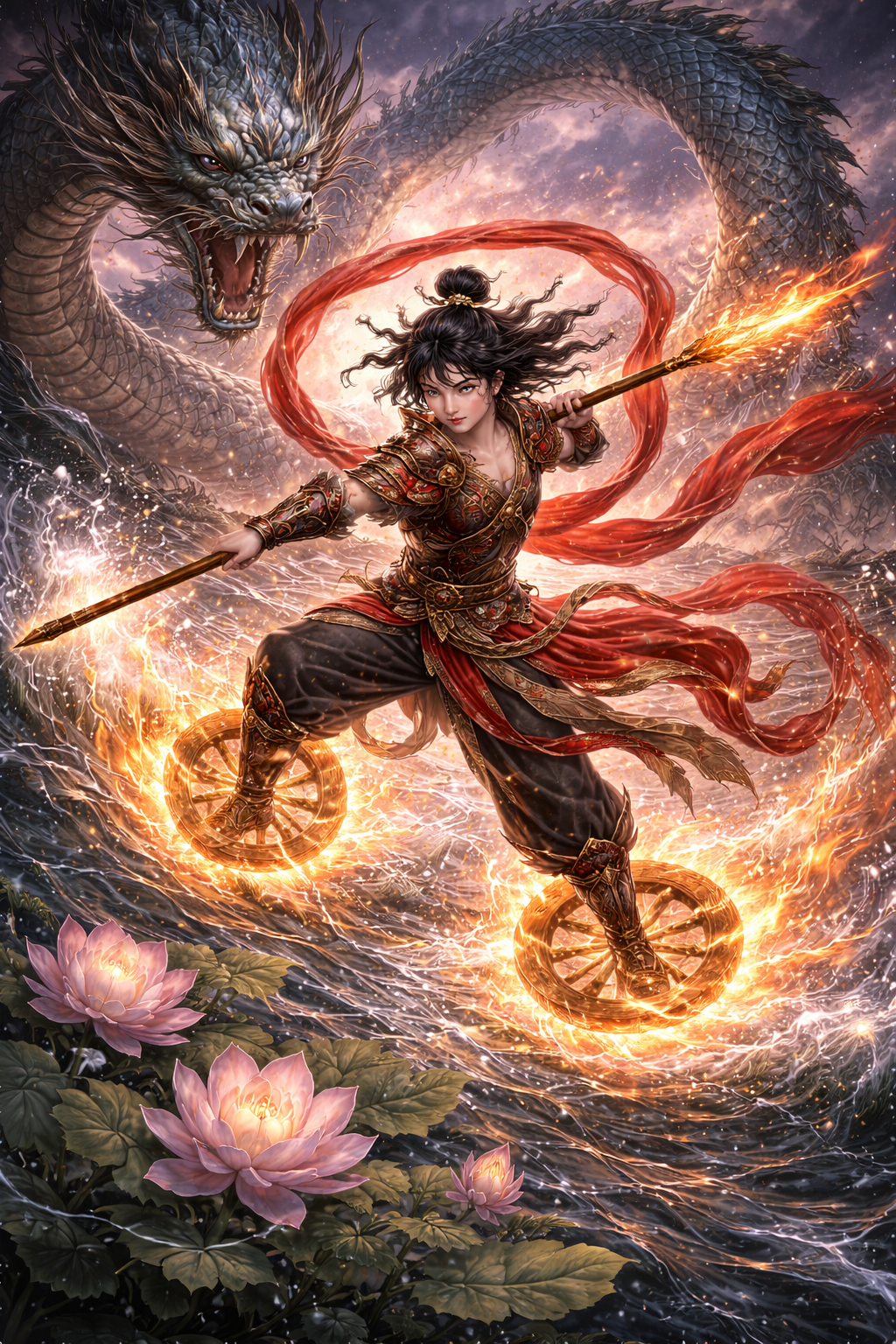
The most influential narrative shaping Nezha’s later legendary form appears in the Ming novel Fengshen yanyi 封神演義, usually known in English as Investiture of the Gods. There Nezha is the third son of Li Jing of Chentang Pass, a precocious divine child associated with Lingzhuzi 靈珠子 and trained by Taiyi Zhenren 太乙真人. His conflict with the Dragon Kings, his self-sacrifice to spare his parents, his lotus-body rebirth, and his later participation in the war that topples Shang rule and inaugurates Zhou legitimacy make him one of the novel’s most unforgettable figures. Yet Nezha’s story does not belong to one source alone. His earlier Buddhist associations, later Daoist and popular religious life, Journey to the West appearances, temple iconography, and modern animation afterlives show how Chinese tradition repeatedly returned to him as an image of divine force that refuses passivity.
This article treats Nezha as a layered figure rather than a single fixed character. He belongs to vernacular fiction, popular religion, Buddhist transmission, Daoist adaptation, filial ethics, dragon conflict, martial iconography, temple devotion, and contemporary media. His story is powerful because it never fully resolves its central tension: Nezha is both dangerous and necessary. He breaks order, but he also exposes the inadequacy of order. He resists family, but he also sacrifices himself for family. He dies to return flesh and bone, but returns in lotus form beyond the body that parental debt once claimed. Nezha’s myth is therefore not only a tale of youthful violence. It is a profound meditation on what it means to be born, claimed, judged, destroyed, remade, and finally turned toward protection.
Who Is Nezha?
Nezha 哪吒 is one of the most recognizable warrior-deities in Chinese tradition, but his power lies partly in the fact that he never fits comfortably into a single category. He is a child, yet terrifyingly capable of violence. He is divine, yet constantly enmeshed in family conflict. He is rebellious, yet often aligned with larger cosmic, political, or protective justice. In later religious life he could be honored as a protective deity, martial guardian, and Third Prince, while in vernacular legend he remained the volatile prodigy whose refusal to submit made him unforgettable.
This instability is essential. Nezha is not powerful because he represents social harmony from the start. He is powerful because he dramatizes the problem of how force, justice, and authority can be brought into relation at all. He erupts into the mythic world before stable placement has been achieved. His story is therefore always about misfit power: power too great for childhood, too unruly for domestic order, too dangerous for simple moral approval, and too morally charged to remain merely destructive.
In the familiar Fengshen yanyi narrative, Nezha is born into the household of Li Jing 李靖 and Lady Yin 殷夫人 at Chentang Pass. His birth is abnormal, his weapons are divine, his teacher is an immortal, and his childhood actions immediately produce consequences at the scale of gods, dragons, parents, and dynastic destiny. The myth’s brilliance lies in making cosmic conflict emerge from a family household. Before Nezha enters the great war of investiture, he first becomes a crisis for his parents.
That family setting matters because Nezha’s myth is never only martial. It is also psychological, ethical, and bodily. He asks what it means to be a child whose power is already beyond the father, whose destiny is already beyond the household, and whose body is treated as debt. The legend repeatedly returns to one question: can a child born from parental flesh belong fully to himself?
Source Layers: Buddhist, Daoist, Vernacular, and Popular
Nezha should not be read as a figure with a single simple origin. His name and early religious background are often connected to Buddhist guardian traditions associated with Nalakuvara or Nalakūbara, a figure linked with Vaiśravaṇa, the northern Heavenly King. Over time, that transmitted guardian figure was thoroughly reworked in Chinese religious culture, vernacular fiction, Daoist adaptation, local cult, temple iconography, and popular performance. The Nezha most familiar today is therefore not simply “Buddhist” or “Daoist” or “folk.” He is a layered religious and literary construction.
This layeredness matters because it explains the figure’s flexibility. In Buddhist-related materials, Nezha belongs to the world of heavenly guardians and martial protection. In Daoist and popular religious contexts, he becomes a powerful marshal, prince, or protective deity. In Fengshen yanyi, he becomes a rebellious child-warrior whose self-sacrifice and lotus rebirth reshape his body and destiny. In Journey to the West, he appears as a heavenly martial figure under Li Jing, capable of assuming a three-headed, six-armed form in combat. In modern media, he becomes a symbol of youth, rage, refusal, and self-definition.
These layers are not merely background. They are the reason Nezha remains culturally alive. Each tradition finds a different Nezha: guardian, rebel, child, deity, son, warrior, protective god, martial spectacle, and anti-authoritarian youth. The figure survives because none of these identities fully cancels the others. He carries all of them as accumulated force.
This source history also warns against treating any single modern retelling as the original or definitive version. Nezha is older than modern animation, but modern animation has powerfully reshaped his public image. Nezha is central to Fengshen yanyi, but that novel itself reworks earlier religious and legendary materials. Nezha is worshipped in temples, but temple devotion is not reducible to literary plot. He is a tradition of transformations, not one frozen text.
Supernatural Birth and the Problem of Power
Nezha’s story begins in excess. In the later legendary tradition, his birth is prolonged, uncanny, and already marked by divine exception. Lady Yin carries him for three years and six months, and when he emerges, he does not arrive as an ordinary infant. In Fengshen yanyi, the birth episode produces a strange ball of flesh, which Li Jing cuts open, revealing the extraordinary child within. This is not an ordinary birth but an eruption of power through the family body.
Chinese mythology repeatedly uses unusual birth to signal unusual responsibility, but in Nezha the emphasis falls especially on uncontrollable potency. The child enters the world with too much force already in him. He is not simply gifted. He is destabilizing. This is one reason his story remains so compelling. It asks not only what divine power can accomplish, but what it costs to embody power before one has been socially or morally reconciled to the structures around it.
Nezha’s birth also marks him as already contested. His father’s first reaction is not simple joy. The strange birth produces fear and suspicion. The child is not immediately legible as blessing. He may be sign, weapon, calamity, destiny, or demon-like prodigy. This ambiguity is crucial. From the beginning, Nezha’s existence is difficult for his household to interpret.
The birth episode therefore sets up the central problem of the legend: power arrives before meaning. Nezha’s body appears before the family knows how to understand it. His destiny exceeds the emotional and moral capacity of the household into which he is born. The rest of the myth shows that such power cannot remain private. It will soon draw dragons, immortals, heavenly law, parental terror, and dynastic war into its orbit.
The Child Who Cannot Be Contained
Nezha is a child, but the myth repeatedly refuses to let childhood remain innocent. His youth intensifies his power rather than softening it. He plays, but his play kills. He acts impulsively, but his actions shake cosmic jurisdictions. He is young enough to be treated as a son, yet powerful enough to humiliate fathers, dragons, generals, and divine opponents. This contradiction gives Nezha his unsettling force.
Childhood in the Nezha tradition is therefore not sentimental. It is volatile. Nezha represents a form of sacred youth that has not yet been domesticated into obedience. He embodies intensity before discipline, talent before maturity, courage before restraint, and cosmic destiny before social integration. The myth does not pretend this is harmless. Nezha’s force causes disaster. Yet the myth also refuses to reduce him to misbehavior.
This is one reason Nezha differs from more orderly divine children. He is not a model child whose virtue harmonizes family and cosmos. He is the child as rupture. He reveals where family authority, divine bureaucracy, and cosmic hierarchy cannot easily process exceptional beings. His myth asks what happens when childhood becomes the vessel of sacred violence.
For modern readers, this helps explain Nezha’s ongoing appeal as a symbol of youth rebellion. He is not simply “young.” He is young in a world that expects submission, and he refuses to disappear into that expectation. His childhood is the form his revolt takes.
Childhood Violence and the Dragon Conflict
One of the most famous episodes in Nezha’s legend is his conflict with the Dragon Kings, especially the slaying of Ao Bing 敖丙, son of the Dragon King of the East Sea. This episode is foundational because it joins childlike impulsiveness to cosmic consequence. Nezha’s actions are not petty mischief. They disrupt relations between the human and aquatic-divine worlds, drawing the wrath of a dragon court whose power extends over rain, sea, and regional order.
This dragon conflict matters for several reasons. First, it places Nezha inside the broader Chinese symbolic world in which dragons are not merely monsters but powers of water, rank, weather, and cosmic vitality. Second, it reveals how divine warfare in Chinese legend can begin from a local quarrel that rapidly becomes cosmological. Third, it establishes Nezha as a being who does not merely fear higher authorities. He attacks them. That audacity is inseparable from his mythic identity.
In Fengshen yanyi, the conflict escalates because Ao Bing and the dragon court are not merely private victims. They belong to a divinely appointed order. Nezha’s violence therefore becomes jurisdictional crisis. Who has the right to kill a dragon prince? Who answers for the death of a divine official? Can a child’s force be separated from the family and territory that produced him? The dragon episode becomes the mechanism by which Nezha’s private unruliness becomes public catastrophe.
The episode also reveals the difference between power and authority. Nezha has power: weapons, courage, speed, supernatural backing. The Dragon Kings have authority: office, rank, jurisdiction, access to heavenly complaint. The conflict is therefore not simply child versus dragon. It is force versus office. Nezha’s myth lives in the violent gap between the two.
Dragons, Water, and the Politics of Cosmic Authority
The dragon conflict cannot be understood if dragons are treated merely as beasts. In Chinese mythic imagination, dragons belong to water, weather, rivers, seas, rain, fertility, imperial symbolism, and cosmic administration. A Dragon King is not simply a large serpent defeated by a heroic child. He is a ruler in a watery bureaucracy, a divine official whose realm touches the survival of communities dependent on rain and order.
Nezha’s conflict with the Dragon Kings therefore has political weight. It is a struggle against aquatic authority, not only against a monster. When Nezha kills Ao Bing and humiliates dragon power, he disrupts a structure that links sea, heaven, local order, and family responsibility. This is why the episode so quickly threatens Li Jing and Lady Yin. Nezha’s act cannot be contained within Nezha alone.
The dragon episode also helps explain why Nezha can be read as both reckless and heroic. On one hand, he causes catastrophe by refusing restraint. On the other, dragon authority can appear oppressive, violent, or unjust in later retellings, especially versions that emphasize demands for sacrifice, flooding, or abusive power. Nezha then becomes the child who resists an older aquatic sovereignty. The same episode can sustain cautionary and liberatory readings.
This flexibility is one of the reasons Nezha remains culturally powerful. The dragon conflict can be staged as divine misconduct, youthful justice, anti-authoritarian rebellion, filial crisis, or cosmic disorder. Nezha’s meaning shifts depending on whether dragon authority is seen as legitimate order or tyrannical power. The myth keeps that ambiguity alive.
Nezha and the Moral Logic of Rebellion
Nezha is one of the great Chinese legends of rebellion because he repeatedly resists inherited structures of obedience. Yet his rebellion is not pure chaos. It is morally charged, even when destructive. He does not rebel only because he hates order. He rebels because the demands placed upon him appear intolerable, unjust, or incapable of recognizing what he is. This gives his story its unusual ethical texture. Rebellion is not merely disobedience. It is a response to forms of authority that cannot adequately contain divine singularity.
This is also why Nezha remains so adaptable across periods. He can be read as a warning against ungoverned force, but also as a hero of resistance against oppressive hierarchy. His volatility allows different traditions to emphasize different lessons. Yet the core remains: Nezha is the figure through whom Chinese legend imagines revolt from within the family, from within the divine order, and from within the structures that claim to define rightful submission.
The myth’s deepest insight is that rebellion may be both necessary and dangerous. Nezha’s refusal exposes the violence of authority, but his own violence creates suffering. He is not a simple model of righteous resistance. He is a mythic problem: how can a world survive power that is both morally alive and socially ungoverned?
This moral instability makes Nezha more compelling than a straightforward rebel-hero. He breaks the world before he helps defend it. He destroys his body before receiving a new one. He resists the father before eventually entering protective martial order. His story does not glorify rebellion without cost. It shows rebellion as a path through death, remaking, and dangerous maturation.
Self-Sacrifice, Flesh, Bone, and Filial Crisis
The most shocking and philosophically charged episode in Nezha’s legend is his self-sacrifice, often described through the return of flesh to the mother and bones to the father. This act is central because it converts filial crisis into bodily drama. Nezha does not merely apologize or withdraw. He destroys his own embodied life in an attempt to spare his family from the consequences of his conflict with the Dragon Kings. In doing so, he turns his body into the site where kinship, debt, and autonomy are violently negotiated.
Primary Source
一人行事一人當……剔骨肉,還於父母,不累雙親。One person’s deeds should be borne by that one person… I will strip away bone and flesh, return them to my parents, and not implicate them.Fengshen yanyi 封神演義, chapter 13, “Taiyi Zhenren Subdues Shiji” 太乙真人收石磯. Available at: https://ctext.org/wiki.pl?chapter=38542&if=gb
This is the legend’s most extreme articulation of filial debt. Nezha accepts responsibility for his own violence while also severing the body through which parental claim is expressed.
This moment is among the most important in all Chinese legend because it stages one of the deepest tensions in the tradition: the body as gift from parents and the self as something that may nevertheless refuse parental ownership. Nezha’s act can be read as radical filial repayment, but also as a violent severing of familial claim. He acknowledges bodily debt by annihilating the body that debt structures. Few myths take the question of filiality to such an extreme.
The episode is not reducible to simple obedience or simple anti-filial revolt. It is both. Nezha saves his parents from dragon retaliation, which appears filial. Yet he also returns flesh and bone in a way that declares the debt completed, which appears as a terrifying claim to self-possession. In one act, he fulfills and destroys the logic of filial embodiment.
This is why the scene has remained so powerful for later readers and viewers. It gives bodily form to a conflict many traditions leave abstract: what does a child owe parents, and where does that debt end? Nezha’s answer is extreme because the myth itself is extreme. He can become his own being only by dying to the body that family and society claim.
Lotus Rebirth and the Remaking of the Body
After self-destruction comes one of the most memorable rebirths in Chinese mythology: Nezha’s restoration through lotus roots, lotus leaves, and immortal technique by Taiyi Zhenren. This lotus-body rebirth matters because it transforms Nezha into a being no longer bound to ordinary fleshly inheritance. He does not simply return to life. He returns in another kind of body. The reborn Nezha is at once purified, weaponized, and spiritually reconstituted.
Primary Source
哪吒不成人形,更待何時!Nezha, if you do not take human form now, what moment are you waiting for?Fengshen yanyi 封神演義, chapter 14, “Nezha Manifests as a Lotus Incarnation” 哪吒現蓮花化身. Available at: https://ctext.org/fengshen-yanyi/14/zhs
The command marks Nezha’s second birth. He returns not through parental flesh, but through lotus matter, alchemical technique, and the authority of his immortal teacher.
This remaking is symbolically powerful on several levels. The lotus, long associated across Chinese Buddhist, Daoist, and broader religious worlds with purity, transcendence, and rebirth, becomes the material of martial resurrection. The reborn body is no longer entirely parental in origin. It is teacher-made, spiritually crafted, and cosmically recalibrated. This is one of the deepest reasons Nezha remains so compelling: he is not only rebellious, but remade beyond the biological and familial order against which he rebelled.
The lotus body also changes the meaning of Nezha’s violence. Before death, his power is volatile and socially disastrous. After rebirth, that power can be redirected into larger divine warfare and protective function. This does not erase his rebellious nature, but it gives it a new body and a new field. The myth suggests that power cannot simply be suppressed. It must be transformed.
Nezha’s lotus rebirth is therefore one of the great Chinese myths of second embodiment. The first body is born from parents and debt; the second body is born from ritual, lotus, teacher, and destiny. The first body brings crisis; the second body turns crisis into weaponized service. Nezha becomes most himself only after becoming other than the child his parents bore.
Taiyi Zhenren, Teachers, and the Second Birth
Taiyi Zhenren is crucial because he gives Nezha a second origin. Li Jing and Lady Yin produce Nezha’s first body, but Taiyi Zhenren restores and remakes him after death. This creates a powerful tension between biological parentage and spiritual lineage. Nezha is no longer only the son of Li Jing. He is also the disciple of an immortal master whose techniques can create a new body from lotus matter and return the wandering soul to form.
This teacher-student relationship changes the structure of authority in the myth. Li Jing represents fatherhood, military hierarchy, and household order. Taiyi Zhenren represents esoteric knowledge, immortal technique, and a cosmic destiny wider than family. Nezha’s second birth shifts him from the domain of parental ownership toward the domain of spiritual and martial purpose.
The second birth also raises difficult questions. Is Nezha liberated from family, or simply bound to another authority? Is the lotus body a form of freedom, or a way of turning unruly force into weaponized service? The myth allows both readings. Taiyi Zhenren rescues Nezha, but also prepares him for war. Rebirth is healing, but also mobilization.
This complexity makes Nezha’s transformation richer than a simple resurrection. He is not merely restored. He is reclassified. The child whose body caused filial crisis becomes a divine warrior whose body belongs to a larger cosmic struggle. Taiyi Zhenren does not only save Nezha’s life. He gives Nezha a new place in the universe.
Divine Warfare, Weaponry, and the Cosmos of Combat
Nezha’s legendary presence is inseparable from his weaponry. The fire-tipped spear, wind-fire wheels, universe ring, red armillary sash, and related implements transform him into one of the most visually and narratively dynamic combatants in Chinese mythology. These are not incidental props. They help define the very character of divine warfare in the tradition. Combat is not merely brute force; it is a contest of magical technologies, cultivated lineages, and cosmic instruments.
This matters because Nezha’s warfare is never only personal aggression. Once reborn and armed, he enters a larger world of gods, immortals, spirits, and dynastic struggle. He is a warrior of the threshold between mythic combat and political destiny. The battlefield is simultaneously theological and historical. His weapons make him iconic, but they also locate him in a universe where divine conflict and regime change are inseparable.
The wind-fire wheels are especially important because they make Nezha visually kinetic. He is not a seated god of remote majesty. He moves. He rushes, spins, descends, charges, and appears as flame-driven youth. The fire-tipped spear gives him piercing force; the universe ring gives circular power; the red sash gives binding, flowing, almost textile dynamism. Nezha’s iconography is built from motion.
This motion is central to his character. Nezha is not a god of stillness. He is a god of eruption and intervention. His weapons externalize his temperament: swift, hot, circular, sharp, excessive, and difficult to restrain. The martial objects do not merely accompany him. They reveal him.
Li Jing, Fatherhood, Authority, and Cosmic Conflict
No relationship in Nezha’s legend is more charged than that with his father, Li Jing. This father-son conflict is not a secondary domestic subplot. It is one of the legend’s structural cores. Li Jing stands for paternal authority, military order, and social hierarchy. Nezha stands for the unruly child who cannot be contained within those forms. Their antagonism gives the myth its emotional violence because cosmic conflict is repeatedly refracted through the household.
The importance of Li Jing lies in the fact that he is not simply villainous. He represents an intelligible order. That is precisely why the conflict cuts so deeply. Nezha is not fighting nonsense. He is fighting claims that have legitimacy, and yet are insufficient to his reality. The father is not merely wrong, and the son is not merely right. The myth becomes enduring because it stages a tragic collision between valid forms of order and irreducible personal force.
The conflict also continues after Nezha’s death. In Fengshen yanyi, Li Jing’s destruction of Nezha’s spirit shrine intensifies the father-son rupture and leads toward renewed confrontation. Nezha’s body may have been returned, but the emotional and spiritual conflict remains unsettled. The father’s authority reaches beyond life into the son’s postmortem cultic existence.
This is why the later image of Li Jing as pagoda-bearing Heavenly King is so important. The pagoda becomes a symbol of containment. A father who could not contain Nezha through ordinary authority requires divine technology. Their relationship is therefore not merely familial. It becomes iconographic: father with tower, son with fire wheels. Chinese mythology turns family conflict into sacred image.
Nezha in Investiture and the War for Dynastic Order
Within Fengshen yanyi, Nezha’s story does not remain a local family tragedy. It becomes part of the vast divine war surrounding the collapse of Shang rule and the establishment of Zhou legitimacy. In that larger narrative, individual gods, immortals, monsters, martial adepts, and political actors are drawn into a cosmic-political struggle over the shape of the realm. Nezha is therefore not only a rebellious child-god. He is a participant in one of Chinese literature’s grand mythic wars of dynastic transition.
This larger frame matters because it transforms rebellion into political theology. Nezha’s earlier conflicts prepare him for a world in which heaven, destiny, lineage, and war are all being renegotiated. His violence becomes part of the machinery by which one order is destroyed and another installed. Divine warfare, in this setting, is also a theory of history. Nezha’s rage is not just personal. It helps remake the political cosmos.
The investiture frame also helps redirect Nezha’s force. The child who once threatened the family becomes a warrior in a cosmic campaign. The power that could not be domesticated becomes militarized within a larger heavenly design. This is one of the key movements in the legend: from domestic crisis to dynastic instrument, from rebellious son to divine combatant.
Yet the earlier trauma does not disappear. Nezha remains recognizable because he carries the memory of rupture into the war. He is not simply absorbed into order as if nothing happened. His lotus body, weapons, and continuing intensity keep the mark of his earlier rebellion. In Fengshen yanyi, dynastic justice does not erase personal violence; it recruits it.
Journey to the West and the Three-Headed, Six-Armed Nezha
Nezha’s mythic afterlife also includes his appearance in Xiyouji 西遊記, Journey to the West, where he appears as a heavenly martial figure under Li Jing. In the famous early conflict with Sun Wukong, Nezha confronts the Monkey King and transforms into a three-headed, six-armed form. This version emphasizes Nezha’s celestial office, martial skill, and capacity for divine transformation rather than the full birth-death-rebirth arc emphasized in Fengshen yanyi.
The Journey to the West Nezha is important because it shows that the figure’s identity was already mobile across major vernacular works. He can be a rebellious child in one narrative framework and a heavenly general in another. He can oppose dragons in one story-world and oppose Sun Wukong in another. The same figure can serve different mythic functions while retaining recognizable features: youth, martial power, divine weaponry, and association with Li Jing.
The three-headed, six-armed form also expands Nezha’s iconographic possibilities. In this form, he becomes a concentrated image of combat multiplicity: many faces, many arms, many weapons, one youthful body. The image communicates not only power but surplus. Nezha exceeds ordinary bodily form because ordinary bodily form cannot contain his martial capacity.
Reading Journey to the West alongside Fengshen yanyi therefore helps prevent over-narrow interpretation. There is no single literary Nezha. There are Nezhas shaped by different narrative worlds. The figure’s continuity lies not in complete consistency, but in a repeated cluster of energies: youth, speed, weaponry, defiance, divine service, and excessive force.
Religion, Iconography, and the Afterlife of the Third Prince
Nezha’s life did not end with vernacular narrative. He became a major figure in later popular religion, Daoist and Buddhist-adjacent practice, temple iconography, and protective cult. As the Third Prince, the Third Lotus Prince, or Marshal of the Central Altar, he could be revered not only as a legendary character but as an active divine presence. This religious afterlife is crucial because it demonstrates how Chinese mythology repeatedly moves between story and worship, literature and cult.
His iconographic endurance also reflects the singularity of his form. The child warrior on wheels of fire, armed and radiant, remains one of the most distinctive images in the Chinese pantheon. He is youthful yet terrible, playful yet martial, rebellious yet protective. The persistence of that image shows how strongly Chinese culture responded to a deity who embodies power before maturity but not without moral force.
Iconography also helps stabilize what texts vary. Some traditions emphasize dragon conflict; others emphasize lotus rebirth; others emphasize heavenly warfare or temple protection. But the visual Nezha—youthful, armed, swift, fire-wheeled, and radiant—can gather these layers into one immediately recognizable image. He is one of the mythic figures whose body is almost a compressed story.
The titles associated with Nezha also matter. “Third Prince” preserves his filial and hierarchical identity; “Lotus Prince” recalls his rebirth; “Marshal of the Central Altar” places him inside ritual and protective systems. Each title organizes a different aspect of the figure. Together they show how a rebellious child could become a divine office-holder without losing the explosive memory of rebellion.
Temple Devotion, Mediumship, and Protective Power
In lived popular religion, Nezha is not only a literary memory. He is a protective and responsive deity. In Taiwan and other Chinese religious contexts, the Third Prince can be associated with temple worship, spirit-medium practice, festival performance, protective processions, and martial divine energy. His youthfulness and intensity make him especially suited to forms of ritual presence that emphasize movement, possession, noise, speed, and public visibility.
This living religious dimension matters because it changes how the myth is experienced. A reader may encounter Nezha as a character in Fengshen yanyi; a devotee may encounter him as a god who protects, answers, moves, and manifests. The same figure can function as literature, icon, deity, and embodied ritual power. Chinese myth often lives precisely in this crossing between text and practice.
Nezha’s protective role also reorients his violence. The child who once threatened order becomes a power that can defend communities against disorder. His anger and force are not erased; they are ritually redirected. This transformation is central to many protective deities. The dangerous power is not destroyed. It becomes a guardian when properly honored, named, and placed.
This also helps explain modern “Techno Nezha” and other contemporary ritual forms. Nezha’s image can adapt to changing public culture because his core energy is already kinetic. He is a god of movement, youth, electricity, and spectacle before modernity ever touches him. Contemporary performance does not invent his dynamism; it amplifies a quality already central to his mythic body.
Modern Afterlives: Animation, Youth, and Rebellion
Nezha has become one of the most adaptable figures in modern Chinese and global popular culture. Animated films, television dramas, comics, games, and stage works continually reinterpret him for new audiences. Modern versions often intensify themes already present in older materials: alienated youth, conflict with parents, refusal of destiny, rage against prejudice, bodily transformation, and the search for selfhood beyond inherited judgment.
This modern popularity should not be treated as a departure from tradition. Nezha has always been a figure of reinterpretation. His earlier movement from Buddhist guardian to Chinese child-warrior, from temple deity to vernacular hero, from rebellious son to protective marshal, already shows extraordinary adaptability. Modern media continue that process by translating Nezha’s old contradictions into contemporary emotional language.
Recent animated versions often place special emphasis on self-definition. Rather than presenting Nezha only as a child who must be disciplined into order, they foreground the injustice of being judged monstrous before being understood. This resonates strongly with the older mythic structure: Nezha is always born under a sign of excess, fear, and misrecognition. Modern retellings make that misrecognition emotionally central.
Nezha’s modern afterlife therefore reveals the durability of his core myth. Audiences continue to respond to the child whose power is feared, the son whose body is claimed, the rebel who refuses confinement, and the being who must be destroyed and remade before finding a place in the world. Few figures from Chinese legend speak so directly to the pain and necessity of becoming oneself under judgment.
Source History and Interpretive Caution
A careful reading of Nezha must distinguish among several layers: Buddhist guardian traditions associated with Nalakuvara; Daoist and popular religious transformations; deity compendia such as Sanjiao soushen daquan; the Ming literary form in Fengshen yanyi; the heavenly martial Nezha of Journey to the West; local temple and devotional traditions; opera, drama, and performance; and modern animation and popular media. These layers do not always present the same Nezha. Some emphasize child divinity, some martial rebellion, some filial rupture, some protective deityhood, and some youthful self-definition.
These variations should not be treated as distortions of a single pure original. They are the history of the figure. Nezha remained culturally central precisely because he could move across these registers while retaining a recognizable core: precocious divine power, rebellion against constraint, bodily transformation, dragon conflict, and entry into larger worlds of sacred combat. His legend survives through accretion, not stasis.
It is especially important to distinguish the Fengshen yanyi narrative from later popular retellings. Some details widely known today, including specific moral emphases in “Nezha Conquers the Dragon King” type narratives, may reflect later dramatic, cinematic, or popular transformations rather than the exact structure of the Ming novel. The same is true of modern anti-authoritarian readings. They are often legitimate interpretations of the tradition’s energies, but they should not be projected uncritically backward into every older source.
The filial episode also requires care. Nezha’s return of flesh and bone can be read as filial sacrifice, radical severance, anti-paternal rebellion, or a tragic dramatization of bodily debt. Different readings illuminate different parts of the story. The most responsible interpretation preserves the tension rather than reducing it. Nezha is powerful because he is not simply obedient or disobedient. He is the son who fulfills filial debt by making the debt impossible to continue.
Why Nezha Still Matters
Nezha still matters because he makes contradiction unforgettable. He is a child who defeats dragons, a son who resists paternal order, a self-sacrificing rebel, a dead youth reborn in lotus form, and a divine warrior whose rage can both destroy and protect. Few figures in Chinese legend bring together so many unstable but compelling elements. He is never only one thing, and that multiplicity gives him unusual longevity across religious, literary, and popular traditions.
He also matters because his story continually reactivates questions that do not disappear. What does a parent owe a child of exceptional force? What does a child owe to the body and lineage from which he came? When is rebellion destructive, and when is it just? Can power be remade without being silenced? Can a being marked as dangerous become protective without losing the memory of being misjudged?
Nezha matters, too, because he gives mythic form to the desire for a second body. The first body is born into debt, hierarchy, fear, and misunderstanding. The second body is made from lotus, teacherly power, and transformed destiny. In that passage from flesh to lotus, Nezha becomes one of the great Chinese figures of self-remaking. He does not merely survive death. He returns as an argument that identity can be rebuilt beyond inherited constraint.
Finally, Nezha matters because he remains alive in cultural memory. He belongs to classical vernacular fiction, temple processions, opera, animation, contemporary youth culture, and global media. Each age finds in him what it needs: child-god, rebel, warrior, protector, wounded son, lotus-born hero, anti-authoritarian icon, or divine force of renewal. Under Nezha’s sign, Chinese legend turns divine warfare into an inquiry into selfhood itself.
Related Reading
- Chinese Myth, Folklore & Legend
- Heaven, Mandate, and the Mythic Imagination of Rule
- Dragons in Chinese Myth, Water Cosmology, and Imperial Symbolism
- Phoenix, Qilin, and the World of Auspicious Beings
- Daoism, Immortality, and the Supernatural Imagination
- Buddhism, Daoism, and the Recasting of Chinese Mythic Worlds
- Animals, Omens, and Symbolic Creatures in Chinese Folk Imagination
Primary Sources
- Xu Zhonglin 許仲琳, attributed (n.d.) Fengshen yanyi 封神演義 / Investiture of the Gods. Chinese Text Project overview page. Available at: https://ctext.org/fengshen-yanyi/zh
- Xu Zhonglin 許仲琳, attributed (n.d.) Fengshen yanyi 封神演義, chapter 12, “Chentang Pass: Nezha’s Birth” 陳塘關哪吒出世. Useful for Nezha’s supernatural birth, Li Jing’s household, and the beginning of the dragon conflict. Available at: https://ctext.org/fengshen-yanyi/12/zhs
- Xu Zhonglin 許仲琳, attributed (n.d.) Fengshen yanyi 封神演義, chapter 13, “Taiyi Zhenren Subdues Shiji” 太乙真人收石磯. Useful for Nezha’s self-sacrifice, the Dragon Kings’ complaint, and the flesh-and-bone filial crisis. Available at: https://ctext.org/wiki.pl?chapter=38542&if=gb
- Xu Zhonglin 許仲琳, attributed (n.d.) Fengshen yanyi 封神演義, chapter 14, “Nezha Manifests as a Lotus Incarnation” 哪吒現蓮花化身. Useful for lotus-body rebirth, Taiyi Zhenren’s ritual remaking of Nezha, and the second body motif. Available at: https://ctext.org/fengshen-yanyi/14/zhs
- Wu Cheng’en 吳承恩, attributed (n.d.) Xiyouji 西遊記 / Journey to the West, chapter 4. Useful for Nezha as heavenly martial figure, his relation to Li Jing, and his three-headed, six-armed combat form against Sun Wukong. Available at: https://ctext.org/xiyouji/ch4
- Sanjiao soushen daquan 三教源流搜神大全 / Complete Collection of Deities of the Three Religions. Chinese Text Project overview page. Useful for the deity-compendium layer of Nezha’s religious and iconographic development. Available at: https://ctext.org/wiki.pl?if=gb&remap=gb&res=750570
- Sanjiao yuanliu sōushen daquan 三教源流搜神大全, “Nezha Prince” 那叱太子, Wikisource transcription. Useful with caution as a source for pre- and para-Fengshen deity traditions around Nezha. Available at: https://zh.wikisource.org/wiki/%E4%B8%89%E6%95%99%E6%BA%90%E6%B5%81%E6%90%9C%E7%A5%9E%E5%A4%A7%E5%85%A8/%E5%8D%B7%E4%B8%83
Further Reading
- Encyclopaedia Britannica (n.d.) “Investiture of the Gods.” Available at: https://www.britannica.com/topic/Investiture-of-the-Gods
- Encyclopaedia Britannica (n.d.) “Chinese mythology.” Available at: https://www.britannica.com/topic/Chinese-mythology
- Whyke, T.W. (2021) “Calling for a Hero: The Displacement of the Nezha Archetypal Image from Chinese Animated Film Nezha Nao Hai to Ne Zha.” Humanities and Social Sciences Communications. Available at: https://pmc.ncbi.nlm.nih.gov/articles/PMC8522546/
- Sun, J. (2025) “Ne Zha: From Myth to Cultural Icon.” The World of Chinese. Available at: https://www.theworldofchinese.com/2025/02/ne-zha-from-myth-to-cultural-icon/
- Taiwan Panorama (n.d.) “Summoning the Divine: Celebrating the Third Prince’s Birthday.” Available at: https://www.taiwan-panorama.com/en/Articles/Details?CatId=10&Guid=c54b3cef-be4a-40ce-8bca-9068c2d87984
- Chen, Y. (2021) “Marshal Nezha ‘Transformed’: Techno Nezha in Taiwan.” International Journal of Intangible Heritage. Available at: https://www.ijih.org/volumes/article/462
- The World of Chinese (2015) “Investiture of the Gods: The 16th Century Tale Inspiring Ne Zha 2.” Available at: https://www.theworldofchinese.com/2015/01/game-of-gods/
- Shen Yun (2014) “Ne Zha: The Most Unusual Boy in Chinese Mythology.” Available at: https://www.shenyun.org/explore/view/article/e/1Puo-xmwOG8/ne-zha-child-deity-of-chinese-mythology.html
- Birrell, A. (1993) Chinese Mythology: An Introduction. Baltimore: Johns Hopkins University Press. Available at: https://archive.org/details/chinesemythology0000birr
- Yang, L. and An, D. (2005) Handbook of Chinese Mythology. Santa Barbara: ABC-CLIO. Available at: https://archive.org/details/handbookofchines0000yang
References
- Birrell, A. (1993) Chinese Mythology: An Introduction. Baltimore: Johns Hopkins University Press. Available at: https://archive.org/details/chinesemythology0000birr
- Chen, Y. (2021) “Marshal Nezha ‘Transformed’: Techno Nezha in Taiwan.” International Journal of Intangible Heritage. Available at: https://www.ijih.org/volumes/article/462
- Chinese Text Project (n.d.) Fengshen yanyi 封神演義. Available at: https://ctext.org/fengshen-yanyi/zh
- Chinese Text Project (n.d.) Fengshen yanyi 封神演義, chapter 12, “Chentang Pass: Nezha’s Birth” 陳塘關哪吒出世. Available at: https://ctext.org/fengshen-yanyi/12/zhs
- Chinese Text Project (n.d.) Fengshen yanyi 封神演義, chapter 13, “Taiyi Zhenren Subdues Shiji” 太乙真人收石磯. Available at: https://ctext.org/wiki.pl?chapter=38542&if=gb
- Chinese Text Project (n.d.) Fengshen yanyi 封神演義, chapter 14, “Nezha Manifests as a Lotus Incarnation” 哪吒現蓮花化身. Available at: https://ctext.org/fengshen-yanyi/14/zhs
- Chinese Text Project (n.d.) Sanjiao soushen daquan 三教源流搜神大全. Available at: https://ctext.org/wiki.pl?if=gb&remap=gb&res=750570
- Chinese Text Project (n.d.) Xiyouji 西遊記 / Journey to the West, chapter 4. Available at: https://ctext.org/xiyouji/ch4
- Encyclopaedia Britannica (n.d.) “Chinese mythology.” Available at: https://www.britannica.com/topic/Chinese-mythology
- Encyclopaedia Britannica (n.d.) “Investiture of the Gods.” Available at: https://www.britannica.com/topic/Investiture-of-the-Gods
- Shen Yun (2014) “Ne Zha: The Most Unusual Boy in Chinese Mythology.” Available at: https://www.shenyun.org/explore/view/article/e/1Puo-xmwOG8/ne-zha-child-deity-of-chinese-mythology.html
- Sun, J. (2025) “Ne Zha: From Myth to Cultural Icon.” The World of Chinese. Available at: https://www.theworldofchinese.com/2025/02/ne-zha-from-myth-to-cultural-icon/
- Taiwan Panorama (n.d.) “Summoning the Divine: Celebrating the Third Prince’s Birthday.” Available at: https://www.taiwan-panorama.com/en/Articles/Details?CatId=10&Guid=c54b3cef-be4a-40ce-8bca-9068c2d87984
- The World of Chinese (2015) “Investiture of the Gods: The 16th Century Tale Inspiring Ne Zha 2.” Available at: https://www.theworldofchinese.com/2015/01/game-of-gods/
- Whyke, T.W. (2021) “Calling for a Hero: The Displacement of the Nezha Archetypal Image from Chinese Animated Film Nezha Nao Hai to Ne Zha.” Humanities and Social Sciences Communications. Available at: https://pmc.ncbi.nlm.nih.gov/articles/PMC8522546/
- Wikisource (n.d.) Sanjiao yuanliu sōushen daquan 三教源流搜神大全, volume 7. Available at: https://zh.wikisource.org/wiki/%E4%B8%89%E6%95%99%E6%BA%90%E6%B5%81%E6%90%9C%E7%A5%9E%E5%A4%A7%E5%85%A8/%E5%8D%B7%E4%B8%83
- Yang, L. and An, D. (2005) Handbook of Chinese Mythology. Santa Barbara: ABC-CLIO. Available at: https://archive.org/details/handbookofchines0000yang