
Last Updated May 5, 2026
Investiture of the Gods occupies a foundational place in Chinese mythic literature because it transforms dynastic transition into cosmic drama. The collapse of the Shang and the rise of the Zhou do not appear merely as a matter of war, succession, or political failure. In this narrative world, regime change becomes a struggle among gods, immortals, demons, ministers, kings, sectarian lineages, magic weapons, cosmic mandates, and sacred offices. Human history is not displaced by the supernatural. It is mythologized through it. The fall of a dynasty becomes legible as a crisis in the moral architecture of the universe itself.
The novel’s power lies in the scale of its answer to one of Chinese political culture’s most important questions: how does a ruling house lose the right to rule? Fengshen yanyi 封神演義 does not answer only through administrative failure, military defeat, or court corruption. It answers through divine insult, monstrous seduction, broken ritual order, failed remonstrance, celestial conflict, sectarian warfare, and the postwar assignment of divine offices. The result is not simply historical fiction with supernatural ornament. It is a vast mythic explanation of why one world must end before another can be consecrated.
Article Map
Chinese Myth, Folklore & Legend
Related Topic
Heaven & Mandate
Series context: This article is part of the Chinese Myth, Folklore & Legend knowledge series. For the broader category structure, return to the Mythology category.
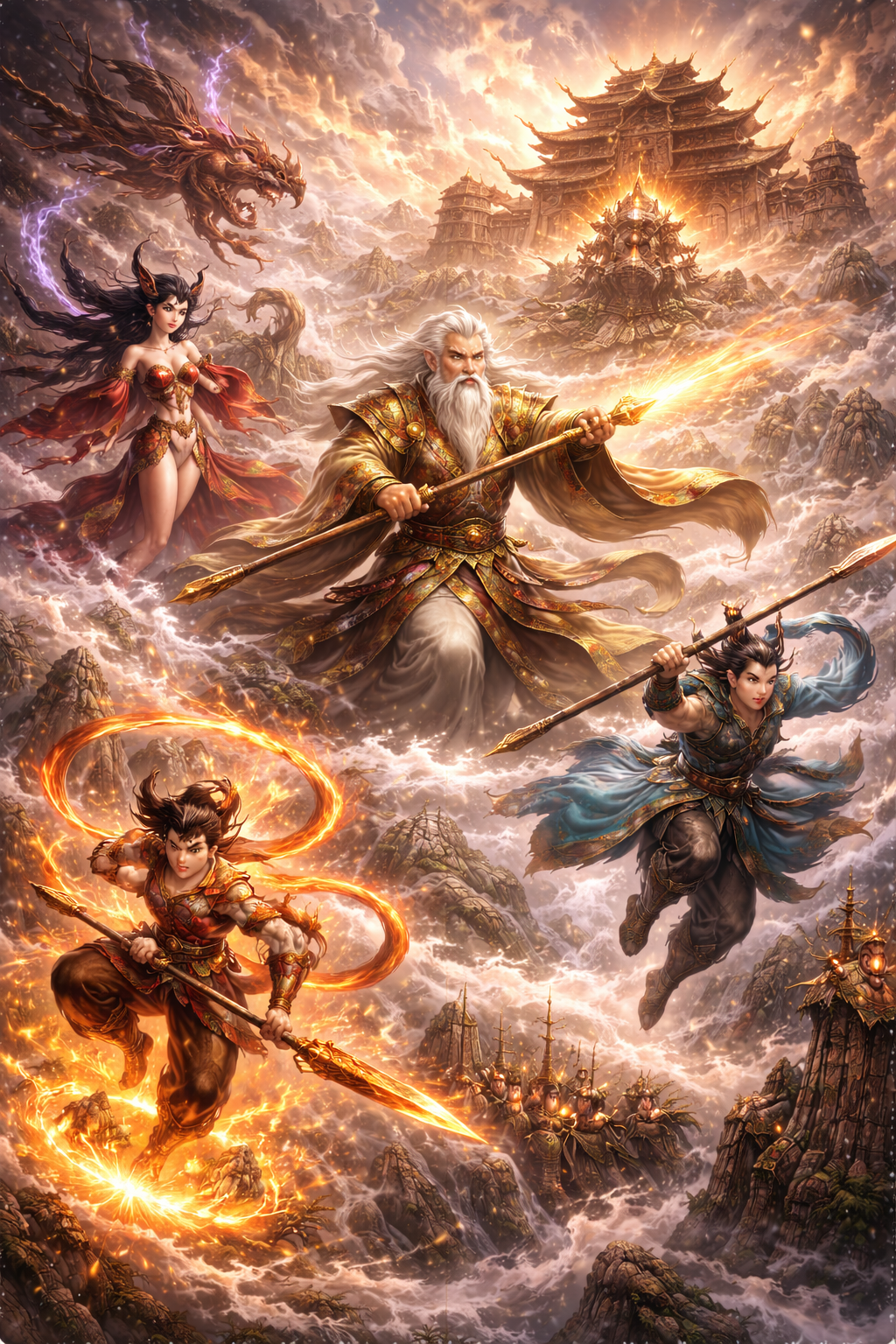
The received Ming-dynasty novel Fengshen yanyi, often known in English as Investiture of the Gods, gives its most influential literary form to the mythic Shang-Zhou transition. It begins from the familiar premise of late Shang collapse under a morally ruined ruler, but enlarges that political crisis into a vast cosmological narrative involving Nüwa, Daji, Jiang Ziya, Nezha, Yang Jian, the Dragon Kings, immortals of rival lineages, Daoist masters, animal spirits, monstrous allies, loyal ministers, rebellious generals, and the final conferral of divine offices upon the dead. The fall of Shang is not merely narrated. It is staged as sacred diagnosis.
This article treats Investiture of the Gods as a layered mythic-literary system rather than a transparent historical source. It belongs to the Ming vernacular novel, the gods-and-demons tradition, the political imagination of the Mandate of Heaven, Daoist and popular religious cosmology, the literary afterlife of ancient dynastic memory, and the visual and performative worlds that later reused its characters. Its importance lies not in giving direct access to early Zhou political theology, but in showing how later Chinese culture reimagined antiquity as sacred history: a world in which political collapse, moral judgment, supernatural warfare, and divine administration become inseparable.
What Is Investiture of the Gods?
Investiture of the Gods is one of the great Ming vernacular mythological novels and among the most influential works in the gods-and-demons tradition. Its importance lies not only in the scale of its cast or the extravagance of its battles, but in the peculiar kind of story it tells. It takes a remembered political transition—the end of the Shang and rise of the Zhou—and renders it as a universe-wide struggle in which heavenly powers, spirit forces, monsters, adepts, kings, ministers, strategists, and warrior-disciples all intervene in the fate of the realm. Political collapse is therefore never merely human failure. It is an event that exposes the entire cosmos.
This literary form matters because it gives Chinese culture a way to narrate regime change without reducing it to dry chronicle. The death of ministers, the corruption of court, the mobilization of armies, and the triumph of a new ruling house become mythically legible through divine agency and sacred conflict. The novel thus occupies a threshold between political imagination and mythic cosmology. It is one of the principal texts through which dynastic history becomes metaphysical drama.
The title itself points toward the novel’s final movement. The story is not only about defeating Shang and establishing Zhou. It is also about investing the dead with sacred offices. War produces a new divine order. Fallen combatants, loyalists, enemies, heroes, and supernatural participants are not simply removed from the story when they die. Their deaths become material for a reorganized cosmos. The battlefield becomes a recruitment ground for divine bureaucracy.
This is why the novel feels larger than conventional heroic romance. Its stakes are not limited to victory, revenge, or inheritance. The old order must fall; the new order must rise; the dead must be placed; the gods must be named; and history must become intelligible as sacred administration. Investiture of the Gods is therefore a novel about how disorder becomes order through war, death, judgment, and office.
Source Layers, Text History, and Literary World
The received Fengshen yanyi belongs to the late-imperial vernacular novel tradition, but it draws on much older materials: memories of the Shang-Zhou transition, Mandate of Heaven discourse, popular deity traditions, Daoist cosmology, gods-and-demons fiction, military romance, local cult figures, and earlier legends surrounding Jiang Ziya, King Zhou, Daji, Nezha, and other figures. Its world is therefore not a single-source construction. It is a literary gathering of many strands of Chinese sacred and political imagination.
This layering explains the novel’s unusual density. Some characters belong to remembered antiquity; others to religious pantheons; others to popular legend; others to literary invention or later narrative crystallization. The novel does not attempt to keep these domains separate. It places kings, ministers, fox spirits, immortals, warrior children, Daoist masters, demons, and cosmic administrators into the same unfolding crisis. That mixture is not accidental. It is the form through which the novel imagines dynastic change as total event.
The novel’s textual history also requires caution. Attribution has often been associated with Xu Zhonglin, and sometimes with Lu Xixing in other traditions, while the work circulated in printed late-Ming forms and later editions. Modern readers often approach it as a stable mythological classic, but the text’s historical formation belongs to the world of Ming print culture, vernacular fiction, religious storytelling, and commentary. It is ancient in setting, not in the date of its received literary form.
This does not weaken the novel’s value. It clarifies it. Investiture of the Gods is powerful precisely because it shows how late-imperial Chinese culture reimagined ancient political transition through the resources of its own religious, literary, and popular imagination. It is not a window transparently looking back into the eleventh century BCE. It is a Ming literary cosmos built around the problem of why Shang had to fall.
History Becoming Myth
One of the central achievements of Investiture of the Gods is that it does not merely add marvelous elements to a historical skeleton. It restructures historical understanding itself. The fall of Shang is not presented as accidental decline, nor simply as the consequence of bad governance in administrative terms. It is presented as the visible surface of a deeper unraveling in moral and cosmic order. Tyranny, seduction, omen, divine displeasure, supernatural intervention, sectarian struggle, and deification all become parts of one explanatory system.
This is what mythologizing means here. History does not disappear into fantasy. It becomes readable through a language of sacred causation. The question is no longer only why a dynasty lost power, but why Heaven, the gods, the immortals, and the moral architecture of the world permitted or required that loss. The novel therefore turns political narrative into a theology of historical transition.
The Shang-Zhou transition had long been central to Chinese political memory because it offered a paradigm for dynastic legitimacy: a morally decayed ruler loses Heaven’s support, while a more virtuous house rises under mandate. Fengshen yanyi expands this paradigm into a vast dramatic mechanism. It does not merely state that Shang lost legitimacy. It shows legitimacy collapsing through spectacle: insult to a goddess, demonic infiltration, cruelty toward ministers, misuse of power, supernatural battles, and eventual cosmic reallocation.
In this sense, the novel is not content to let history remain abstract. It gives political transition bodies, weapons, voices, temptations, punishments, and gods. It makes legitimacy visible. Readers do not merely learn that Shang fell because it had become corrupt; they watch corruption become a cosmic event. The transformation of history into myth allows political judgment to become emotionally and imaginatively unforgettable.
The Shang-Zhou Transition and the Problem of Legitimacy
At the heart of the novel lies a problem central to Chinese political thought: legitimacy. Why should one house rule, and why should another lose the right to do so? In the broad tradition of the Mandate of Heaven, dynastic change is justified through moral decline and transfer of rightful authority. Investiture of the Gods does not reject that logic. It radicalizes it. Legitimacy is no longer demonstrated only by virtue and historical outcome, but by an entire supernatural field that aligns itself around the transition.
This is why the novel is so important for the mythic imagination of rulership. The Zhou do not merely win. They are cosmologically enabled. The Shang do not merely fail. They become the house through which corruption, excess, cruelty, violated ritual order, and moral inversion are made narratively undeniable. Dynastic transfer thus appears not merely as success in war, but as the visible recognition of an already-shifting cosmic verdict.
The novel also shows that legitimacy is not automatic even for those aligned with eventual victory. Zhou success requires guidance, restraint, strategy, sacrifice, and the mediation of figures such as Jiang Ziya. The new order does not appear effortlessly. It must be fought into being through human and supernatural labor. The Mandate is not treated as a passive abstraction. It must be interpreted and enacted.
This gives the novel a double structure. On one side, the collapse of Shang is inevitable because its moral order has decayed beyond repair. On the other, the rise of Zhou requires agency, planning, alliances, and war. Cosmic justice does not replace political action. It authorizes and structures it. Fengshen yanyi imagines legitimacy as something revealed by history, but achieved through struggle.
Heaven, Mandate, and the Moral Logic of Dynastic Change
The novel’s moral world depends on the idea that rulership cannot be separated from Heaven. A ruler is not legitimate merely because he possesses the throne. He must govern in a way that sustains the relation between political order, ritual propriety, moral restraint, and cosmic harmony. When that relation breaks, the dynasty becomes vulnerable not only to rebellion, but to metaphysical judgment. Investiture of the Gods turns this principle into narrative architecture.
King Zhou’s failure is therefore not simply personal vice, though personal vice matters greatly. His disorder radiates outward. Desire becomes sacrilege; sacrilege becomes demonic entry; demonic entry becomes court corruption; court corruption becomes torture, death, and political collapse; political collapse becomes war; war becomes deification. The ruler’s inner disorder becomes a cosmic chain reaction.
This structure reflects a broader Chinese political imagination in which moral rule and cosmic order are linked. The sovereign is not merely an administrator. He is a symbolic hinge between Heaven, earth, ancestral order, ritual, and the people. When that hinge fails, everything attached to it begins to distort. Fengshen yanyi dramatizes this distortion with maximal mythic force.
The Mandate of Heaven is therefore not treated as an invisible doctrine floating above the plot. It is embodied in scenes: Nüwa’s offense, Daji’s corruption, loyal ministers’ deaths, Jiang Ziya’s strategy, battlefield interventions, and final investiture. The novel’s great achievement is to make political theology narratively concrete.
Nüwa, Offense, and the Cosmic Trigger of Dynastic Ruin
One of the novel’s most important mythic gestures is to begin the downfall of Shang through King Zhou’s offense against Nüwa. This move is decisive because it means dynastic ruin is not explained solely from within political history. The king’s disorder reaches upward. A violation of sacred decorum at the level of goddess and cult becomes the trigger for a wider unraveling. What follows is not a private curse alone, but a chain of consequences that eventually remakes the political cosmos.
Primary Source
明日乃三月十五日,女媧娘娘聖誕之辰,請陛下駕臨女媧宮降香。Tomorrow is the fifteenth day of the third month, the sacred birthday of Lady Nüwa. I request that Your Majesty proceed to Nüwa’s palace and offer incense.Fengshen yanyi 封神演義, chapter 1, “King Zhou Visits Nüwa Temple to Burn Incense.” Available at: https://ctext.org/fengshen-yanyi/1
The novel opens dynastic crisis through ritual obligation. King Zhou is not first tested on the battlefield, but in a sacred space where reverence should govern royal conduct.
The Nüwa temple episode matters because it places reverence at the foundation of political legitimacy. King Zhou is urged to honor a goddess associated with cosmic repair and the protection of the people. Instead, his desire turns sacred image into object. This is not merely impropriety. It is the symbolic moment when the king’s inner disorder becomes visible before Heaven.
By beginning with Nüwa, the novel connects dynastic collapse to one of the deepest mythic figures in Chinese tradition. Nüwa is not a marginal deity. She belongs to the cosmic repair of the world itself. To offend her is to reveal a ruler’s failure to recognize the sacred structure that precedes and exceeds kingship. The insult shows that King Zhou no longer understands the order that makes rule meaningful.
This opening also gives the novel a powerful gendered and theological structure. A goddess who repairs the cosmos is dishonored by a ruler whose desire helps ruin the state. Nüwa’s response then introduces forces that will help expose and accelerate Shang’s fall. The novel thereby turns violated reverence into dynastic consequence. The king’s poem on the temple wall is not a small private lapse. It is the first crack in the world.
King Zhou, Daji, and the Moral Collapse of Rule
No figures are more central to the novel’s portrayal of Shang ruin than King Zhou and Daji. Together they create one of the most enduring Chinese narrative images of decadent rule. The king is not simply politically ineffective. He becomes morally disordered, sensually captive, punitive, and detached from the conditions of just governance. Daji, in turn, functions not merely as seductress but as catalytic force through whom the corruption of the court becomes concentrated, personalized, and mythically intensified.
Their importance lies in how they turn political collapse into legible moral theater. The state does not drift quietly into weakness. It is deformed from within by appetite, cruelty, spectacle, and treacherous counsel. Loyal ministers die, remonstrance fails, and the court becomes a site where political illegitimacy is dramatized with escalating intensity. The novel gives tyranny a face, a chamber, and a rhythm of destruction.
King Zhou’s degeneration matters because he still occupies the formal seat of sovereignty. This creates the central political horror of the novel: office and virtue have separated. The ruler remains ruler, but rulership has become morally hollow. In such a world, law can become violence, command can become cruelty, and courtly splendor can become the mask of collapse. The visible machinery of state continues, but its sacred legitimacy has already begun to rot.
Daji intensifies this collapse by focusing the narrative’s anxieties around seduction, deception, feminine danger, demonic infiltration, and the corruption of royal desire. Yet a careful interpretation should not reduce the entire fall of Shang to a misogynistic blame of a woman. The novel’s deeper structure implicates the king. Daji may catalyze and dramatize corruption, but King Zhou is the ruler whose desires make the court vulnerable to ruin. The dynasty falls because sovereign judgment fails.
Daji, Fox Spirit, and the Gendered Theater of Decadence
Daji is one of the most powerful and troubling figures in Investiture of the Gods. She belongs simultaneously to court romance, fox-spirit lore, demonology, political allegory, and gendered narrative anxiety. In the novel’s world, her body becomes the site through which demonic force enters royal intimacy. The private chamber becomes politically catastrophic. Desire becomes statecraft’s undoing.
This figure must be read carefully. Daji’s demonic role participates in a long tradition of blaming seductive women for dynastic collapse. Similar patterns appear across many historical and literary cultures, where the woman near the ruler becomes a narrative explanation for male misrule. Fengshen yanyi makes this pattern supernatural by transforming Daji into more than a dangerous consort: she becomes a fox-spirit instrument of cosmic retribution.
Yet this does not absolve King Zhou. The novel’s opening with Nüwa makes clear that the ruler’s disorder precedes Daji’s deepest influence. He is already vulnerable because he has violated reverence. Daji does not create sovereign corruption from nothing; she magnifies, channels, and theatricalizes it. The fox spirit exposes the king’s weakness by giving it form.
Daji’s importance therefore lies in the fusion of several symbolic systems: fox transformation, female beauty, court seduction, demonic possession, cruel spectacle, and political decay. She becomes the narrative figure through whom the invisible sickness of rule becomes visible. Whether read as demon, scapegoat, agent of divine punishment, or gendered construction of decadence, she remains one of the novel’s central engines of mythic ruin.
Loyal Ministers, Remonstrance, and the Failure of Court Order
The moral collapse of Shang is shown not only through the king’s cruelty, but through the failure of remonstrance. Loyal ministers speak, warn, advise, protest, and suffer. Their presence matters because it prevents the court from being portrayed as uniformly corrupt. There are still voices of integrity within the old order, but they are increasingly unable to alter its course. The tragedy of Shang lies partly in the fact that good counsel remains present and yet becomes powerless.
This failure of remonstrance is central to Chinese political thought. A ruler is supposed to hear correction; loyal ministers are supposed to risk speech for the sake of the state. When the ruler punishes truth rather than receiving it, the political system’s moral feedback mechanism collapses. The novel repeatedly dramatizes this breakdown through scenes of punishment, torture, dismissal, and death.
The loyal minister in Fengshen yanyi is therefore not merely a moral decoration. He marks the difference between a flawed dynasty that can still reform and a doomed dynasty that can no longer hear truth. Shang falls not because no one knows what justice requires, but because those who know can no longer persuade power.
This makes the novel’s violence toward ministers especially significant. Torture and execution are not sensational details alone. They show that the court has turned against its own conscience. Once the voice of remonstrance becomes punishable, the dynasty has already crossed into terminal illegitimacy. War later confirms what the court has already revealed.
Jiang Ziya and the Mythic Management of Transition
If King Zhou and Daji personify dynastic corruption, Jiang Ziya personifies guided transition. He is among the novel’s most important mediating figures because he stands between the human realm of statecraft and the larger supernatural structure governing change. He is strategist, ritual specialist, political advisor, disciple, and eventually the one who oversees the postwar logic of deification. Through him, the narrative shows that dynastic transfer is not simply spontaneous cosmic correction. It must be managed, interpreted, and ritually organized.
Jiang Ziya’s role is especially significant because he gives the transition intelligence rather than brute inevitability. The fall of one order and rise of another still require discernment, patience, and correct alignment with larger forces. He is therefore not only a hero of Zhou success. He is the administrator of mythic transition, the figure who helps history pass into a newly ordered sacred structure.
Unlike the more spectacular warrior figures, Jiang Ziya often represents timing, strategy, ritual authority, and mandate recognition. His power is not merely martial. He knows how to read the moment. That is crucial in a novel about dynastic transition, because the problem is not only defeating enemies, but discerning when Heaven’s verdict has shifted and how human action should align with that shift.
Jiang Ziya’s final investiture role completes this meaning. He does not merely help Zhou win the war. He helps distribute the dead into a new cosmic order. His function therefore extends from battlefield strategy to sacred administration. He is the manager of transition before, during, and after the collapse of Shang. In him, political intelligence and ritual intelligence converge.
Gods, Demons, and the Widening of Political War
As the story unfolds, political conflict widens into supernatural war. Armies are joined by immortals, adepts, animal spirits, demons, magical weaponry, celestial beings, and cosmic-level interventions. This widening is not decorative. It changes what war means. Battles are no longer contests only between generals and formations. They become struggles between worlds of power, training, protection, and destiny. The battlefield is transformed into a place where political and cosmological futures are decided together.
This matters because it reveals one of the novel’s deepest commitments: dynastic change is too significant to remain merely human. If a ruling house rises or falls, the entire unseen order must also be implicated. The realm cannot be remade by military force alone. Gods, monsters, sectarian masters, and sacred technologies must enter the field because the meaning of political succession is larger than politics itself.
The novel’s supernatural war also changes the meaning of heroism. Ordinary courage is not enough when enemies possess magical weapons, transformation powers, formations, talismans, spiritual lineages, and divine protections. Victory depends on correct relationships among masters, disciples, techniques, objects, and cosmic timing. The heroic field becomes religiously technical.
This is one reason Fengshen yanyi feels so different from conventional historical romance. The battlefield does not merely test bravery or strategy. It tests cosmological affiliation. A warrior’s lineage, teacher, weapon, destiny, and place in the coming investiture all matter. The war is fought by armies, but decided in a universe crowded with powers that ordinary political history cannot contain.
Sectarian Cosmology and the War Between Lineages
One of the most consequential dimensions of Investiture of the Gods is the role played by rival sacred lineages and their adepts. The struggle is not only between Shang and Zhou. It is also between larger formations of cosmological allegiance, teaching, and spiritual hierarchy. Different masters and disciples enter the war with differing relationships to legitimacy, power, and fate. The result is that dynastic transition becomes inseparable from sectarian conflict.
This layer is crucial because it turns the novel into more than a moral allegory of bad kingship. It becomes a map of competing sacred orders. Political change is mirrored by rearrangement among transcendent powers. The novel suggests that history moves when lineages of knowledge, discipline, and heavenly authorization move with it. This gives the Shang-Zhou transition unusual depth as myth. It is simultaneously a military, moral, and cosmological realignment.
The role of masters and disciples also makes the novel a story about transmission. Power is not possessed in isolation. It is taught, inherited, stolen, misused, refined, and countered by other forms of power. A magical weapon may be effective only within a particular ritual-technical world; a battle array may require an opposing adept who knows how to break it. The war is therefore also a contest among systems of knowledge.
This sectarian dimension helps explain the novel’s enormous cast. The proliferation of characters is not merely excess. It reflects the sense that a dynastic transition pulls many lineages, schools, and spiritual networks into crisis. When history turns, whole cosmological communities are drawn into the turning.
Nezha, Yang Jian, and the Young Warriors of Transition
Among the novel’s most enduring figures are Nezha and Yang Jian, who give the cosmic war some of its most memorable martial energy. Nezha’s birth, dragon conflict, self-sacrifice, lotus rebirth, and later service in the Zhou-aligned struggle make him one of the clearest examples of how the novel transforms volatile divine power into dynastic instrument. His personal myth of rebellion and remaking becomes part of the larger political-theological transition.
Yang Jian likewise belongs to the novel’s world of transformation, divine skill, and martial intelligence. His powers and battlefield roles reveal the novel’s fascination with bodies that exceed ordinary human limits. Such figures are not merely strong warriors. They are embodiments of sacred technique. Their abilities mark the war as something more than human combat.
The prominence of these younger warrior figures matters because dynastic change is not represented only through old sages and kings. It also requires dangerous youth, transformed bodies, magical weapons, and beings whose energies have not been domesticated by ordinary hierarchy. The new order is built not only by moral legitimacy, but by the redirection of extraordinary force.
Nezha’s presence is especially important because he makes the cost of sacred power visible. Before he becomes a divine warrior, he is a child whose body, family, and identity are shattered and remade. In the larger structure of Fengshen yanyi, the war for dynastic order depends on figures who have themselves passed through disorder. The cosmos is reorganized by beings already marked by rupture.
Magic Weapons, Battle Arrays, and the Technology of Sacred War
The world of Investiture of the Gods is full of magic weapons, battle arrays, talismans, traps, enchanted objects, and specialized techniques. These are not incidental fantasy devices. They are one of the novel’s main ways of imagining sacred war as a contest of technologies. Power is materialized through objects: banners, swords, ropes, seals, mirrors, wheels, diagrams, gourds, whips, and formations. Combat is fought through things as much as through bodies.
This materiality matters because it gives the novel a strongly technical imagination. Spiritual power must be equipped, activated, countered, transferred, or neutralized. A warrior’s strength often depends on the proper object, and the proper object often depends on the proper lineage or master. The battlefield becomes a laboratory of sacred technology.
Battle arrays also reveal the novel’s architectural imagination of conflict. War is not only charge and countercharge. It is arrangement, enclosure, diagram, and patterned danger. An array can become a temporary cosmos, trapping opponents within a constructed field of power. To break an array is to solve a sacred system, not merely to win a duel.
This helps explain the novel’s appeal in visual and performative media. Magic weapons and battle arrays are intensely imageable. They create scenes of spectacle, color, movement, and technical wonder. The novel’s sacred war is not abstract theology. It is theology weaponized into objects and staged as combat.
Deification and the Bureaucracy of the Postwar Cosmos
The title of the novel points to one of its most distinctive features: deification. The dead do not simply disappear after the war. They are assigned places in a reordered sacred administration. This is one of the novel’s most powerful acts of mythic imagination. Political conflict produces not only victors and casualties, but a new pantheon. The cost of dynastic change is translated into offices, titles, and divine placements within a postwar cosmos.
This deifying logic is essential because it binds violence to reorganization rather than pure annihilation. The world after the transition is not emptier. It is more articulated. Defeat, sacrifice, loyalty, betrayal, and martial death are all absorbed into a new sacred bureaucracy. The novel thereby offers a distinctively Chinese answer to the problem of historical rupture: the fallen are not merely mourned; they are administered into transcendence.
Deification also changes how death functions in the novel. Death is often tragic, violent, and morally charged, but it is not always final in the ordinary sense. It may become appointment. The battlefield is a threshold into office. Those who die in the conflict may be placed within the very cosmic order that the conflict produces. This gives the war a posthumous logic that ordinary political narrative lacks.
The novel’s sacred bureaucracy reflects a broader Chinese tendency to imagine the cosmos through offices, ranks, jurisdictions, registers, and ritual recognition. Just as the underworld can be imagined as a court system and Heaven as an imperial administration, the postwar pantheon in Fengshen yanyi is organized through appointment. The sacred world after dynastic transition must be staffed.
The Investiture List and the Administration of the Dead
The investiture list is the novel’s great administrative symbol. It gives structure to death, consequence, and sacred placement. In a conventional war story, the dead may be remembered, lamented, or forgotten. In Investiture of the Gods, the dead are sorted into a postwar cosmic order. This means that the end of the war is not only political settlement. It is an act of naming.
Naming matters because it converts chaotic violence into legible office. A fallen figure receives a role; a role receives a place; a place becomes part of the cosmic system. The novel’s title therefore points to the deep connection between mythology and administration. To invest a god is to establish a relationship among death, title, function, and ritual memory.
Chapter 99, “Jiang Ziya Returns to His Country and Enshrines Deities,” is especially important because it brings the novel’s long arc toward this administrative culmination. The war’s casualties are not simply narrative debris. They become the population of a reorganized sacred order. Jiang Ziya’s authority reaches beyond strategy into final placement.
This gives the novel an unusual emotional structure. It can be brutal in battle, but bureaucratic in resolution. Its violence produces a ledger. Its deaths become appointments. Its heroes and enemies alike may find posthumous roles. The world is broken open by war, then sealed into a new sacred administration.
Dynastic Change as Cosmic Justice
In Investiture of the Gods, dynastic change becomes an enactment of cosmic justice. This does not mean the novel is morally simple. It is crowded with ambivalent figures, heroic enemies, tragic deaths, complicated loyalties, and violent excess. Yet taken as a whole, the story insists that political order cannot remain detached from the larger moral structure of the universe. A corrupt house will not endure indefinitely. A transfer of authority can be read as a judgment that history itself is making under sacred conditions.
This is one reason the novel remained so culturally significant. It gives vivid narrative form to a broad civilizational intuition that legitimacy is never only institutional. It is moral, cosmic, and in some sense metaphysical. The collapse of Shang is therefore not just the failure of a regime. It is the revelation that misrule had already rendered that regime cosmically untenable.
Yet the novel’s justice is not gentle. Cosmic justice arrives through war, deception, suffering, and mass death. This is one of the work’s unsettling features. The restoration of order requires immense destruction. The new cosmos is built from the dead of the old conflict. The novel therefore does not offer a sentimental vision of moral correction. It offers a martial and administrative one.
That severity is part of its enduring force. Fengshen yanyi understands that dynastic transitions are not clean moral diagrams. They involve loyalty on both sides, suffering among the righteous, opportunism, technical power, divine manipulation, and the absorption of violence into later order. Cosmic justice is real in the novel, but it is neither simple nor bloodless.
Vernacular Myth and the Public Imagination of History
The novel’s vernacular form also matters. By rendering the Shang-Zhou transition in expansive narrative prose, Investiture of the Gods helped transmit complex ideas of divine intervention, dynastic justice, and sacred hierarchy beyond elite historiography. It made the transition memorable not only as a matter of classical record, but as public myth. Characters such as Daji, Jiang Ziya, Nezha, Yang Jian, King Zhou, and Nüwa became culturally durable because they were narratively vivid and emotionally legible.
This broad circulation changed how history could live in cultural memory. The fall of Shang and rise of Zhou were no longer confined to bronze inscriptions, classical texts, or scholarly discourse. They became part of popular narrative imagination. Through the novel, dynastic change acquired faces, scenes, weapons, betrayals, miracles, gods, and punishments. History became memorable because it became narratable at the scale of myth.
Vernacular fiction also allowed moral and political ideas to travel through entertainment. A reader did not need to receive a formal lecture on Mandate theory to understand that tyrannical rule leads to cosmic rejection. The novel teaches through spectacle. It makes political legitimacy emotionally intuitive by placing readers inside a world where misrule produces monsters, rebellion, war, and final deification.
This is one reason the novel’s characters escaped the book. They became reusable figures in opera, visual art, popular religion, temple culture, film, television, animation, comics, and games. Vernacular myth produces cultural portability. Once a character like Nezha or Daji becomes narratively vivid, the figure can live far beyond the page.
Religious Syncretism and the Narrative World of Fengshen
Another reason the novel endured is that its world is religiously layered. Daoist masters, Buddhist presence, Confucian moral assumptions, goddess traditions, fox-spirit lore, popular deity cults, and a broader vernacular sacred imagination coexist within the narrative. The cosmos of Fengshen is not doctrinally simple. It is structurally syncretic. Sacred authority appears distributed across multiple traditions and symbolic languages, even when the novel gives especially strong weight to Daoist frames of revelation, lineage, technique, and cosmological mediation.
This syncretism is not a weakness. It is one of the novel’s strengths. It allowed the story to speak across multiple religious and cultural registers. Dynastic change could be read as moral judgment, cosmological reordering, sectarian contest, and sacred administration all at once. The novel’s afterlife in art, ritual imagination, and performance depends heavily on this layered narrative architecture.
The Met’s mid-17th-century brush pot with a scene from Investiture of the Gods is especially revealing in this regard: its object record identifies the novel as sixteenth-century and notes imagery involving deities as well as figures representing Daoism, Buddhism, and Confucianism. This kind of material afterlife shows how the novel could be visually received as a religiously plural universe, not merely as a military romance.
The novel’s syncretic world also reflects the practical texture of Chinese religious culture, where literary, ritual, popular, and doctrinal traditions often overlapped. A figure might be a character in fiction, a god in temple practice, an image on porcelain, an actor’s role, and a modern media icon. Fengshen yanyi helped produce exactly that kind of multi-register sacred imagination.
Visual Culture, Performance, and Material Afterlife
Investiture of the Gods did not remain confined to print. Its characters and scenes entered visual culture, theater, decorative arts, religious imagery, and popular performance. This afterlife matters because the novel’s world is intensely imageable: storming skies, divine battles, fox spirits, magical weapons, grotesque punishments, deified warriors, banners, palaces, dragons, and immortal masters. Its scenes invite visualization.
Material culture is especially important for understanding how the novel circulated beyond reading communities. A painted or porcelain object depicting a Fengshen scene does more than illustrate a story. It makes the story part of domestic, scholarly, or ritual space. The novel’s mythic world becomes available as visual memory, conversation piece, moral emblem, and decorative narrative.
Performance likewise helps explain the durability of its figures. Characters such as Nezha, Daji, Jiang Ziya, and various divine warriors can be staged through costume, gesture, voice, combat, and spectacle. The novel’s magical battles and moral confrontations lend themselves to theatrical embodiment. Performance turns cosmic war into public event.
This visual and performative afterlife also changes interpretation. A printed narrative may emphasize plot and moral causation; a stage version may emphasize charisma, spectacle, pathos, or martial skill; a visual object may condense the story into one symbolic scene. Fengshen yanyi survives because its world can be translated across media without losing recognizability. It is a narrative engine for images.
Modern Afterlives: Film, Animation, and Fantasy Media
The modern afterlife of Investiture of the Gods is expansive. Its characters and themes continue to appear in films, television dramas, animation, video games, comics, fantasy novels, and internet culture. Modern adaptations often select particular strands: Nezha’s rebellion and self-remaking, Daji’s dangerous glamour, Jiang Ziya’s strategic wisdom, Yang Jian’s divine martial power, or the spectacle of gods and demons at war. The whole novel may be vast, but its characters are highly portable.
This modern portability reflects the novel’s original structure. Fengshen yanyi is already episodic, crowded, spectacular, and character-rich. It offers many points of entry. A modern film can foreground the fall of Shang; an animation can foreground Nezha; a game can foreground weapons and divine combat; a fantasy adaptation can foreground sectarian cosmology or demon warfare. The novel’s world is modular without being empty.
Modern retellings often intensify themes that resonate with contemporary audiences: rebellion against unjust power, the trauma of destiny, the burden of inherited identity, the ambiguity of monsters, the corruption of rulers, and the remaking of the self through war and loss. These emphases are modern, but they are not arbitrary. They draw from energies already present in the older narrative.
The risk of modern adaptation is simplification. A vast political-theological novel can become mere fantasy spectacle if stripped of mandate, deification, court failure, sacred bureaucracy, and moral transition. The opportunity, however, is renewal. Every adaptation testifies to the novel’s unusual fertility. Investiture of the Gods continues to produce myth because its central question remains powerful: what happens when the moral order of a world has to be rebuilt?
Source History and Interpretive Caution
A careful reading of Investiture of the Gods must distinguish among the historical Shang-Zhou transition, the much later Ming literary form of the novel, the broader gods-and-demons tradition, popular religious uses of its figures, visual and performative afterlives, and modern adaptations that may further reframe the material. The novel should not be treated as a transparent record of early Zhou political theology. It is a later literary mythologization of that earlier transition.
Yet this historical distance is exactly what makes the work so revealing. It shows how later Chinese culture reworked remembered antiquity through vernacular myth, religious layering, and narrative spectacle. The novel is not valuable because it gives raw historical fact. It is valuable because it shows how dynastic change became culturally thinkable as sacred history.
It is also important not to flatten the novel’s religious world into a single doctrinal system. Daoist frames are especially prominent, but the narrative also uses Buddhist, Confucian, popular religious, goddess, animal-spirit, and vernacular mythic materials. Its syncretism is part of its form. The novel’s sacred world is not a theological manual. It is a narrative cosmos.
Finally, modern readers should be cautious with gendered interpretations of Daji and dynastic decadence. The novel participates in a long tradition of associating female beauty, seduction, and court intimacy with political ruin. A serious reading can acknowledge that structure while also refusing to let it obscure the king’s responsibility, the ritual violation that begins the narrative, and the broader institutional failure of Shang rule. The novel’s gendered symbolism is powerful, but it should be read critically rather than repeated unexamined.
Why Investiture of the Gods Still Matters
Investiture of the Gods still matters because it gives narrative body to a problem that never entirely disappears: how does a civilization explain why one political order has forfeited the right to endure? The novel’s answer is immense. It does not speak only of armies and ministers. It speaks of goddesses, spirits, deification, sacred lineages, cosmic verdict, and the reorganization of the dead. Dynastic change becomes not merely event, but revelation.
It also matters because its characters and scenes escaped the novel and entered wider Chinese culture. Daji, Jiang Ziya, Nezha, Yang Jian, Nüwa, King Zhou, and many others acquired independent afterlives in art, theater, devotion, and modern media. The book proved narratively fertile enough to function as a generator of mythology long after its first publication. Its world remains alive because it did not merely retell the past. It reimagined how the past could become sacred drama.
The novel matters, too, because it shows how political imagination and religious imagination can merge. The fall of Shang is a political event, but the novel refuses to let politics remain isolated from morality, ritual, family, desire, violence, and cosmic administration. It imagines history as a field in which visible action and invisible judgment meet.
Finally, Investiture of the Gods matters because it remains one of the great Chinese stories of reordering after collapse. It knows that worlds do not end neatly. They end through cruelty, war, betrayal, sacrifice, spectacle, and grief. But they may also be reorganized through naming, office, mandate, and memory. The novel’s deepest vision is not only that corrupt orders fall. It is that the dead of history continue to require placement in the moral imagination of those who inherit the world after them.
Related Reading
- Chinese Myth, Folklore & Legend
- Heaven, Mandate, and the Mythic Imagination of Rule
- Nezha, Rebellion, and Divine Warfare in Chinese Legend
- Dragons in Chinese Myth, Water Cosmology, and Imperial Symbolism
- Daoism, Immortality, and the Supernatural Imagination
- Buddhism, Daoism, and the Recasting of Chinese Mythic Worlds
- Nüwa, Creation, Repair, and the Mythic Origins of Order
Primary Sources
- Xu Zhonglin 許仲琳, attributed (n.d.) Fengshen yanyi 封神演義 / Investiture of the Gods. Chinese Text Project overview page. Available at: https://ctext.org/fengshen-yanyi/ens
- Xu Zhonglin 許仲琳, attributed (n.d.) Fengshen yanyi 封神演義, chapter 1, “King Zhou Visits Nüwa Temple to Burn Incense” 紂王女媧宮進香. Useful for the novel’s opening ritual offense against Nüwa and the sacred trigger of dynastic ruin. Available at: https://ctext.org/fengshen-yanyi/1
- Xu Zhonglin 許仲琳, attributed (n.d.) Fengshen yanyi 封神演義, chapter 4, “Enzhou Inn: The Fox Dies and Daji Perishes” 恩州驛狐狸死妲己. Useful for the fox-spirit layer of Daji’s narrative formation. Available at: https://ctext.org/fengshen-yanyi/4
- Xu Zhonglin 許仲琳, attributed (n.d.) Fengshen yanyi 封神演義, chapter 6, “King Zhou’s Tyranny and the Creation of Paoluo Punishment” 紂王無道造炮烙. Useful for the novel’s portrayal of cruelty, punishment, and the moral collapse of rule. Available at: https://ctext.org/fengshen-yanyi/6
- Xu Zhonglin 許仲琳, attributed (n.d.) Fengshen yanyi 封神演義, chapter 12, “Chentang Pass: Nezha’s Birth” 陳塘關哪吒出世. Useful for Nezha’s entry into the novel’s divine-war structure. Available at: https://ctext.org/fengshen-yanyi/12
- Xu Zhonglin 許仲琳, attributed (n.d.) Fengshen yanyi 封神演義, chapter 23, “Wen Wang’s Night Dream of the Flying Bear” 文王夜夢飛熊兆. Useful for Jiang Ziya’s connection to Zhou transition and the mythic recognition of strategic destiny. Available at: https://ctext.org/fengshen-yanyi/23
- Xu Zhonglin 許仲琳, attributed (n.d.) Fengshen yanyi 封神演義, chapter 72, “Guangchengzi Visits the Green Roaming Palace Three Times” 廣成子三謁碧遊宮. Useful for sectarian lineage conflict and the escalation of sacred war. Available at: https://ctext.org/fengshen-yanyi/72
- Xu Zhonglin 許仲琳, attributed (n.d.) Fengshen yanyi 封神演義, chapter 84, “Ziya’s Military Forces Take the Immortal-Trapping Pass” 子牙兵取臨潼關. Useful for the later divine-war sequence and the novel’s sustained integration of battle, magic, and mandate. Available at: https://ctext.org/fengshen-yanyi/84
- Xu Zhonglin 許仲琳, attributed (n.d.) Fengshen yanyi 封神演義, chapter 98, “King Wu of Zhou Distributes Wealth at Lutai” 周武王鹿臺散財. Useful for the political aftermath of Shang collapse and Zhou moral contrast. Available at: https://ctext.org/fengshen-yanyi/98
- Xu Zhonglin 許仲琳, attributed (n.d.) Fengshen yanyi 封神演義, chapter 99, “Jiang Ziya Returns to His Country and Enshrines Deities” 姜子牙歸國封神. Essential for the novel’s final deification sequence and the administration of the postwar cosmos. Available at: https://ctext.org/fengshen-yanyi/99
- Xu Zhonglin 許仲琳, attributed (n.d.) Fengshen yanyi 封神演義, chapter 100, “King Wu Enfeoffs Feudal Lords of Various States” 武王封列國諸侯. Useful for the political closure of dynastic transition after sacred investiture. Available at: https://ctext.org/fengshen-yanyi/100
- Project Gutenberg (2007) Fengshen yanyi 封神演義. Public-domain Chinese text. Available at: https://www.gutenberg.org/ebooks/23910
- Shangshu 尚書 / Book of Documents. Useful for the older classical framework of kingship, mandate, and moral-political legitimacy against which later literary mythologization can be compared. Chinese Text Project edition available at: https://ctext.org/shang-shu
Further Reading
- Encyclopaedia Britannica (n.d.) “Fengshen Yanyi.” Available at: https://www.britannica.com/topic/Fengshen-Yanyi
- Chinese Text Project (n.d.) Fengshen yanyi 封神演義. Available at: https://ctext.org/fengshen-yanyi/ens
- Project Gutenberg (2007) Fengshen yanyi 封神演義. Available at: https://www.gutenberg.org/ebooks/23910
- The Metropolitan Museum of Art (n.d.) “Brush pot with scene from The Investiture of the Gods.” Available at: https://www.metmuseum.org/art/collection/search/666569
- Encyclopedia.com (n.d.) “Chinese Fiction and Religion.” Available at: https://www.encyclopedia.com/environment/encyclopedias-almanacs-transcripts-and-maps/fiction-chinese-fiction-and-religion
- Lu, X. (1959) A Brief History of Chinese Fiction. Translated by G. Yang and Y. Yang. Beijing: Foreign Languages Press.
- Plaks, A.H. (1987) The Four Masterworks of the Ming Novel. Princeton: Princeton University Press.
- Hanan, P. (1981) The Chinese Vernacular Story. Cambridge, MA: Harvard University Press.
- Idema, W.L. and Haft, L. (1997) A Guide to Chinese Literature. Ann Arbor: Center for Chinese Studies, University of Michigan.
- Yang, L. and An, D. (2005) Handbook of Chinese Mythology. Santa Barbara: ABC-CLIO. Available at: https://archive.org/details/handbookofchines0000yang
- Birrell, A. (1993) Chinese Mythology: An Introduction. Baltimore: Johns Hopkins University Press. Available at: https://archive.org/details/chinesemythology0000birr
References
- Birrell, A. (1993) Chinese Mythology: An Introduction. Baltimore: Johns Hopkins University Press. Available at: https://archive.org/details/chinesemythology0000birr
- Chinese Text Project (n.d.) Fengshen yanyi 封神演義. Available at: https://ctext.org/fengshen-yanyi/ens
- Chinese Text Project (n.d.) Fengshen yanyi 封神演義, chapter 1, “King Zhou Visits Nüwa Temple to Burn Incense” 紂王女媧宮進香. Available at: https://ctext.org/fengshen-yanyi/1
- Chinese Text Project (n.d.) Fengshen yanyi 封神演義, chapter 4, “Enzhou Inn: The Fox Dies and Daji Perishes” 恩州驛狐狸死妲己. Available at: https://ctext.org/fengshen-yanyi/4
- Chinese Text Project (n.d.) Fengshen yanyi 封神演義, chapter 6, “King Zhou’s Tyranny and the Creation of Paoluo Punishment” 紂王無道造炮烙. Available at: https://ctext.org/fengshen-yanyi/6
- Chinese Text Project (n.d.) Fengshen yanyi 封神演義, chapter 12, “Chentang Pass: Nezha’s Birth” 陳塘關哪吒出世. Available at: https://ctext.org/fengshen-yanyi/12
- Chinese Text Project (n.d.) Fengshen yanyi 封神演義, chapter 23, “Wen Wang’s Night Dream of the Flying Bear” 文王夜夢飛熊兆. Available at: https://ctext.org/fengshen-yanyi/23
- Chinese Text Project (n.d.) Fengshen yanyi 封神演義, chapter 72, “Guangchengzi Visits the Green Roaming Palace Three Times” 廣成子三謁碧遊宮. Available at: https://ctext.org/fengshen-yanyi/72
- Chinese Text Project (n.d.) Fengshen yanyi 封神演義, chapter 84, “Ziya’s Military Forces Take the Immortal-Trapping Pass” 子牙兵取臨潼關. Available at: https://ctext.org/fengshen-yanyi/84
- Chinese Text Project (n.d.) Fengshen yanyi 封神演義, chapter 98, “King Wu of Zhou Distributes Wealth at Lutai” 周武王鹿臺散財. Available at: https://ctext.org/fengshen-yanyi/98
- Chinese Text Project (n.d.) Fengshen yanyi 封神演義, chapter 99, “Jiang Ziya Returns to His Country and Enshrines Deities” 姜子牙歸國封神. Available at: https://ctext.org/fengshen-yanyi/99
- Chinese Text Project (n.d.) Fengshen yanyi 封神演義, chapter 100, “King Wu Enfeoffs Feudal Lords of Various States” 武王封列國諸侯. Available at: https://ctext.org/fengshen-yanyi/100
- Chinese Text Project (n.d.) Shangshu 尚書 / Book of Documents. Available at: https://ctext.org/shang-shu
- Encyclopaedia Britannica (n.d.) “Fengshen Yanyi.” Available at: https://www.britannica.com/topic/Fengshen-Yanyi
- Encyclopedia.com (n.d.) “Chinese Fiction and Religion.” Available at: https://www.encyclopedia.com/environment/encyclopedias-almanacs-transcripts-and-maps/fiction-chinese-fiction-and-religion
- Hanan, P. (1981) The Chinese Vernacular Story. Cambridge, MA: Harvard University Press.
- Idema, W.L. and Haft, L. (1997) A Guide to Chinese Literature. Ann Arbor: Center for Chinese Studies, University of Michigan.
- Lu, X. (1959) A Brief History of Chinese Fiction. Translated by G. Yang and Y. Yang. Beijing: Foreign Languages Press.
- Plaks, A.H. (1987) The Four Masterworks of the Ming Novel. Princeton: Princeton University Press.
- Project Gutenberg (2007) Fengshen yanyi 封神演義. Available at: https://www.gutenberg.org/ebooks/23910
- The Metropolitan Museum of Art (n.d.) “Brush pot with scene from The Investiture of the Gods.” Available at: https://www.metmuseum.org/art/collection/search/666569
- Yang, L. and An, D. (2005) Handbook of Chinese Mythology. Santa Barbara: ABC-CLIO. Available at: https://archive.org/details/handbookofchines0000yang