
Last Updated May 5, 2026
Temple festivals are among the most important settings in which Chinese legend becomes public life. They are not merely occasions of worship, nor are they simply survivals of “folk custom” in a narrow antiquarian sense. In the world often described as Chinese popular religion, temple festivals bring together deities, sacred territory, local history, pilgrimage, commerce, opera, procession, exorcistic rite, incense, offerings, food, neighborhood order, and communal memory. During such festivals, legends are not only recounted in texts or remembered abstractly. They are carried through streets in deity images, embodied in ritual specialists, staged in performance, attached to banners and lanterns, invoked in incense and offerings, and woven into the temporary public order of neighborhoods, marketplaces, and temple precincts.
For that reason, temple festivals are indispensable to the study of Chinese myth and folklore. They reveal how stories about gods, heroes, ancestors, saints, tutelary protectors, sea goddesses, city gods, dragon kings, plague-expelling deities, and miraculous interventions become durable not because they remain fixed in a single canonical text, but because communities repeatedly enact them. Legend survives by moving through space, sound, food, choreography, obligation, return, and public gathering. The temple festival is one of the primary institutions through which that survival occurs.
Series context: This article is part of the Chinese Myth, Folklore & Legend knowledge series. For the broader category structure, return to the Mythology category.
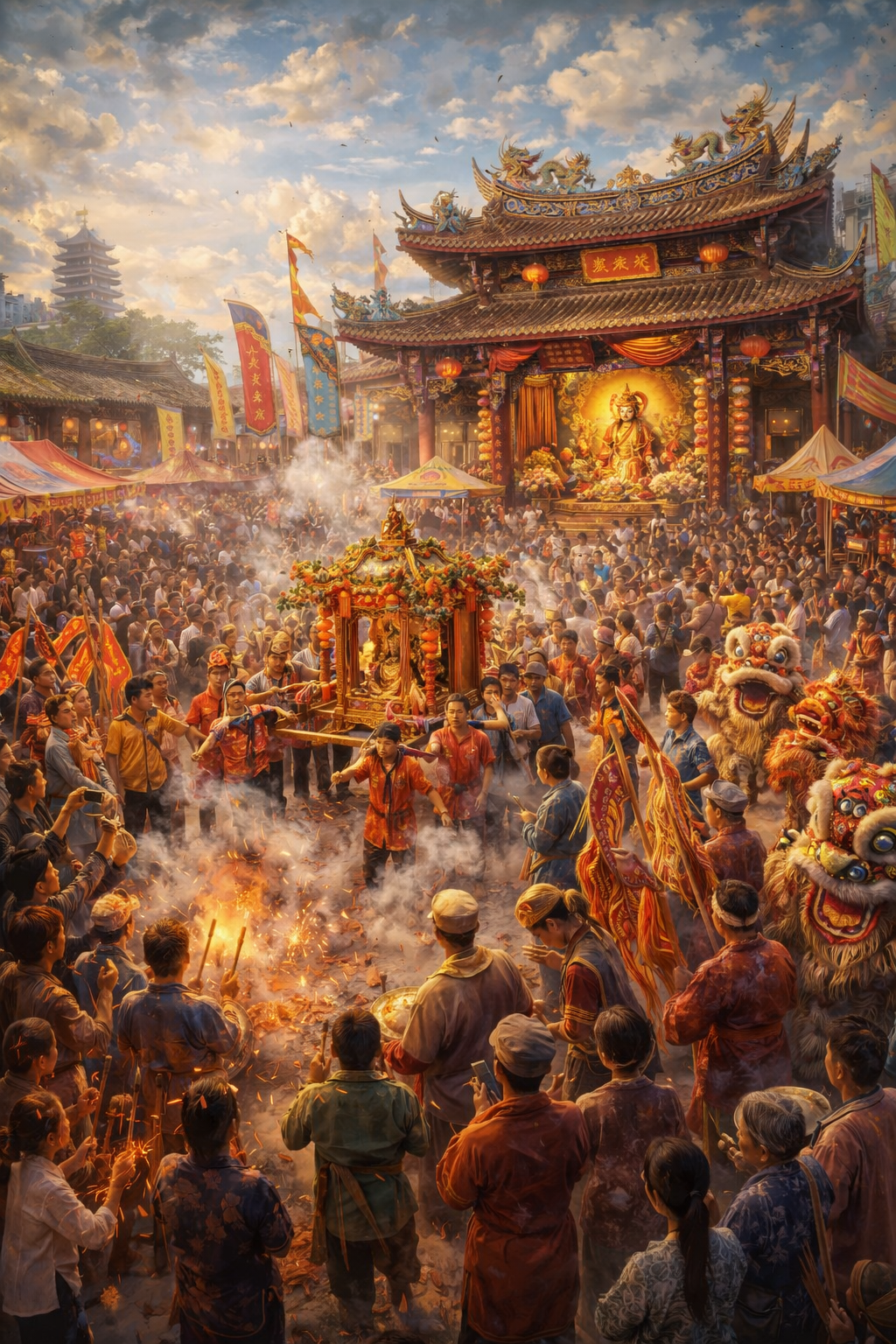
Temple festivals are not only local celebrations but social formations in which myth, ritual, economy, territorial order, and public memory become briefly inseparable. They show how Chinese religious life has often worked through layered sovereignties: local cult, community patronage, lineage association, temple committee, ritual specialist, inherited calendar, market economy, pilgrimage network, and, at times, official recognition by state institutions. Temple festivals therefore illuminate not only folklore and religious practice, but also the deep relation between sacred presence and social organization in Chinese history.
At their center is a simple but powerful movement: the deity leaves the stillness of the shrine and becomes public. The god or goddess may be carried in a palanquin, escorted through streets, welcomed into temporary altars, presented before opera stages, invited to patrol boundaries, or returned ceremonially to the temple. That movement turns the city, village, riverfront, harbor, market road, or neighborhood into ritual geography. It is one of the clearest ways Chinese legend becomes spatial, audible, visible, and socially binding.
Popular Religion and the Temple World
Chinese popular religion is best understood not as a single unified church or creed, but as a historically layered field in which Buddhism, Daoism, ancestor reverence, territorial cults, exorcistic practices, protective rites, local vows, lineage obligations, pilgrimage networks, and community traditions overlap. This layered quality is one reason temple festivals matter so much. The temple is rarely just a sacred building. It is a node of patronage, calendrical organization, local identity, ritual obligation, symbolic geography, and social trust.
A deity enshrined in a temple is not only an object of inward devotion. The god or goddess often functions as protector of place, guarantor of blessing, receiver of petitions, witness to vows, responder to crisis, and participant in the moral and seasonal life of the community. The temple gathers stories around that presence: origin legends, miracle tales, rescue narratives, dreams, punishments, healings, warnings, fulfilled vows, and remembered interventions.
Temple festivals intensify this relationship. They are moments when sacred power becomes socially visible and publicly mobile. A deity who ordinarily resides in a temple may be ceremonially awakened, honored, enthroned, processed, invited to patrol the territory, presented before opera, or returned after a circuit through the community. The temple world is therefore not static architecture but recurring action. It binds calendar to place, place to cult, and cult to local memory.
This is one reason the category of “popular religion” remains useful despite its imperfections. It names a world in which practical devotion, local identity, miracle belief, ritual efficacy, household need, and festive sociability often matter more than abstract doctrinal consistency. Temple festivals belong to that world. They preserve sacred relation not as a system of propositions but as an inherited pattern of collective practice.
Temple Festivals as Ritual Publics
A temple festival is often described as a religious celebration, but that description is too narrow. Such festivals are also ritual publics: temporary but highly structured social worlds in which villagers, urban residents, pilgrims, merchants, temple associations, lineage groups, ritual specialists, musicians, opera troupes, spirit-mediums, food vendors, donors, spectators, and local officials may be drawn into the same ceremonial field. The sacred and the social are not easily separable.
The social density of temple festivals helps explain their endurance. They do not survive merely because communities preserve a belief statement. They survive because they organize relationships: between households and temple committees, between ritual sponsors and local performers, between generations, between sacred images and public routes, between seasonal time and collective identity. The festival is one of the places where a community sees itself assembled and where the social body becomes briefly legible to itself.
In this sense, temple festivals are public-making institutions. They gather people who may otherwise meet only in fragments: kin groups, guilds, migrant associations, neighborhood committees, occupational communities, market vendors, and worshippers from different localities. Ritual draws them into a shared ceremonial time. The festival becomes a temporary civic order, but one organized around sacred presence rather than secular administration alone.
Temple festivals also create a public in which the unseen becomes socially actionable. The deity’s authority, miracle history, and protective power are not only matters of private conviction. They are ritually enacted through offerings, processions, performances, vows, and public sponsorship. The god becomes socially present because the community makes space, time, music, route, and body available to that presence.
Legend, Procession, and Territorial Presence
Temple festivals are one of the chief mechanisms through which legend enters public space. The deity’s image is carried, displayed, enthroned, invited, or welcomed. Processions extend sacred presence beyond the temple interior into the landscape of ordinary life. The god moves through streets, lanes, bridges, docks, fields, harbor roads, market routes, or village boundaries, and with that movement the community’s stories about origin, protection, miracle, sacrifice, intervention, or territorial guardianship are reactivated.
The procession is not merely a parade attached to worship. It is a ritual claim about space. When a deity is carried through a route, that route becomes part of the deity’s field of concern. The procession maps sacred territory through movement. It blesses, inspects, protects, and remembers. Streets that ordinarily function as traffic, commerce, or neighborhood space become ceremonial corridors. The community is made sacred by being traversed.
This is why processional routes matter. They often preserve older geographies of settlement, labor, kinship, occupational association, or temple affiliation. A route may pass through areas that depend on the deity’s protection, past sponsors who maintain ritual obligations, or toward affiliated temples that share incense connection. The procession therefore tells a story not only about a god, but about the community’s own spatial history.
Legend lives in this movement because the deity is not kept still. A sea goddess associated with rescue circulates through coastal communities. A city god associated with urban order enters the streets. A plague-expelling rite sends danger away. A dragon king or local protector is honored in relation to water, rain, or boundary. Procession converts legendary memory into territorial presence.
Deity Images, Palanquins, and the Public Body of the God
The deity image is one of the most important material forms in a temple festival. During ordinary time, the image may sit enthroned within the temple, receiving incense, offerings, prayers, and petitions. During festival time, that image can become mobile. It may be placed in a palanquin, lifted by bearers, escorted by musicians, surrounded by banners, and moved through the community. In that moment, the statue becomes the public body of the god.
This public body matters because it gives visible form to sacred presence. The community does not only imagine that the deity protects them; it sees the deity enter public space. The palanquin may rock, surge, pause, turn, or respond to ritual direction. Worshippers may interpret such movement as divine will, approval, warning, or power. The god’s body is carried by humans, but the carrying itself can be experienced as mutual relation rather than mere transport.
The image also gathers offerings and attention as it moves. People bow, light incense, prepare altars, set out food, hang lanterns, burn paper, perform music, or wait at thresholds. The deity’s route reorganizes ordinary space around reception. Houses and shops become temporary ritual stations. Streets become lines of encounter.
This is one reason temple festivals are so powerful for folklore. A story attached to a deity can become physically present in the deity’s image. Mazu is not only narrated as a rescuer; her image travels. A city god is not only named as a jurisdictional protector; his image patrols. A local goddess is not only remembered for a miracle; she appears again in ceremonial form. The image is a carrier of narrative, authority, and communal memory.
Incense, Offerings, and the Material Language of Devotion
Temple festivals are built from material acts. Incense smoke, candles, flowers, fruit, tea, wine, cooked food, ritual money, banners, lanterns, paper horses, paper boats, musical instruments, and temporary altars all help create the festival world. These objects are not peripheral decoration. They are the language through which devotion becomes visible, fragrant, edible, audible, and socially shared.
Incense is especially important because it connects body, atmosphere, and sacred address. It rises from human hands toward the unseen. It marks the temple interior, the processional route, the temporary altar, and the gathered crowd with a sensory sign of petition. In many temple traditions, incense connection can also express lineage between temples: a branch temple may receive incense from an ancestral shrine, and the movement of incense becomes a movement of legitimacy and shared sacred presence.
Offerings translate respect into form. Food acknowledges hospitality to the deity and to associated divine or spirit worlds. Candles and lamps create light. Flowers and fruits mark beauty and auspiciousness. Ritual money belongs to the economy of the unseen. Together, these offerings show that temple festivals are not made only through speech. They are made through giving.
The material world of devotion also helps transmit memory across generations. A child may first know a deity not through doctrine but through smell, sound, color, heat, movement, and the repeated gestures of elders. The festival teaches through the senses. That sensory education is one of the main reasons temple traditions can endure even when textual literacy, formal instruction, or doctrinal knowledge vary widely.
Performance, Opera, and the Multisensory Archive
Temple festivals are rarely silent. They are environments of music, recitation, opera, dance, puppet theater, martial display, smoke, banners, percussion, firecrackers, and color. The result is a multisensory world in which sacred narrative is performed rather than simply explained. This is one reason temple festivals matter so much for folklore: they preserve stories through embodied repetition and collective attention.
In many temple-festival settings, opera does not simply entertain a human audience. It may also be performed for the deity. A stage facing the temple makes the god or goddess the principal spectator, even while human audiences gather around. This arrangement changes the meaning of performance. The play is not merely cultural display. It is an offering, a fulfillment of vow, a sign of gratitude, or a way of maintaining the festival’s ritual atmosphere.
Performance is also a living archive. Legends about gods, generals, ghosts, loyal ministers, immortals, and moral exemplars circulate through opera scenes, puppet shows, ritual recitation, and festival staging. Such stories may be adapted to local taste, available performers, devotional emphasis, or the ritual occasion. The result is repetition with variation rather than fixed canon. A myth survives because it can be staged again.
The visual archive expands this further. Printed images, protective icons, auspicious pictures, deity portraits, ritual banners, and festival decorations circulate alongside performance. Temple festivals therefore operate within a wider ecology of transmission: opera stages, ritual prints, lanterns, deity icons, shrine furnishings, and temple imagery all help carry the legendary world. The festival is not only a place where stories are told. It is a place where stories are seen, heard, smelled, touched, and walked through.
Lion Dance, Dragon Dance, and Festival Movement
Lion dances, dragon dances, martial displays, drumming, cymbals, and ritual movement often appear in temple festivals because they give the festival a public body. These forms are not simply ornamental. They activate space. They draw crowds, mark routes, create auspicious noise, and make protective energy visible. In the festival environment, movement itself becomes a ritual medium.
The lion dance often functions as a protective and auspicious performance. The lion enters streets, shops, temple courtyards, and public spaces as a mobile sign of power, blessing, and the expulsion of harmful influence. The dragon dance draws upon another symbolic field: water, vitality, rain, imperial and cosmic force, and collective coordination. Both forms turn mythic beings into coordinated human performance.
This is important because temple festivals often require visible intensity. Sacred power must not only be believed; it must be made public. Drums, gongs, firecrackers, and movement transform the atmosphere. They announce that ordinary time has been interrupted by festival time. The community hears and sees that a ritual public has formed.
Dance and martial display also preserve embodied knowledge. Techniques are passed through practice, not only through text. Younger performers learn timing, rhythm, route, costume, gesture, and discipline from older participants. In this way, the festival transmits not only narratives about gods, but skills that keep those narratives socially alive.
Exorcism, Plague Expulsion, and the Ritual Management of Danger
Many temple festivals are linked not only to blessing but to danger. Communities may seek to expel plague, avert disaster, send away wandering spirits, pacify the dead, secure the sea, protect crops, prevent fire, calm water, or renew territorial boundaries. These concerns reveal the protective dimension of Chinese festival life. The festival is not always simply celebratory. It may be a public technology for managing crisis.
Exorcistic rites are especially important because they show how ritual can act upon invisible threat. A harmful influence may be named, summoned, expelled, transformed, or sent away. Procession may clear space; firecrackers may drive away danger; ritual boats may carry away calamity; offerings may appease spirits; opera may fulfill vows; deity patrols may inspect territory. The community does not only hope for safety. It performs safety into being.
This protective logic is visible across multiple traditions. Mazu festivals respond to maritime danger and the need for safe return. Ong Chun / Wangchuan / Wangkang rites address relations between humans, the ocean, plague-expelling ritual, and the ceremonial sending away of harmful forces. Ghost Festival observances address the unsettled dead and the needs of orphaned spirits. Different rituals address different dangers, but all reveal the same broader principle: public religion makes danger socially manageable.
This is one reason temple festivals remain important even in modern settings. Scientific medicine, state administration, and urban management change the conditions of danger, but they do not eliminate vulnerability. Communities still face illness, disaster, migration, loss, debt, ecological risk, and social uncertainty. Temple festivals preserve older ritual languages for responding to conditions that exceed individual control.
Markets, Pilgrimage, and the Economy of the Festival
Temple festivals are also economic and civic events. Historically, many temple fairs drew traders, food vendors, artisans, pilgrims, book sellers, opera troupes, ritual specialists, fortune-tellers, entertainers, and visitors from surrounding regions. This commercial activity does not mean the sacred dimension was absent or secondary. Rather, it shows how deeply religion, exchange, travel, and sociability were intertwined.
When people journey to a temple festival, they do not arrive as isolated believers. They come as members of households, guilds, fishing communities, lineages, devotional associations, villages, market networks, or migrant communities. The festival becomes a meeting point where sacred obligation and worldly exchange coexist. Goods circulate alongside offerings. News travels alongside rumor, entertainment, ritual instruction, and devotional testimony.
This economic dimension can strengthen the social life of legend. Pilgrims buy prints, incense, talismans, food, images, books, toys, and festival goods. Performers stage episodes from religious and legendary worlds. Vendors help feed crowds. Artisans produce objects that carry auspicious and protective meanings into households. The festival market becomes a circulation system for stories, images, and ritual objects.
The coexistence of commerce and devotion can also produce tension. Officials, reformers, and moralists have often worried about crowding, gambling, mixed-gender gatherings, expense, unruly performance, and excessive display. Such concerns remind us that temple festivals were powerful precisely because they gathered so much social life in one place. The festival could be sacred, joyful, disorderly, profitable, morally contested, and politically visible all at once.
Temple Fairs, Bookstalls, Prints, and the Circulation of Stories
Temple fairs have often served as important sites for the circulation of printed and visual culture. Almanacs, auspicious prints, deity images, protective charms, storybooks, opera texts, religious booklets, and popular fiction could move through festival markets. This matters because it shows that legend circulated through multiple media at once. It was not confined to oral telling or elite literature.
Printed images were especially important because they made sacred and legendary worlds portable. A household could purchase an image of a door god, wealth deity, protective figure, auspicious scene, or festival motif and bring it home. The image extended the festival’s symbolic world into domestic space. The temple fair thus became a bridge between public ritual and household practice.
Bookstalls and printed texts also helped connect temple festivals to vernacular literature. Stories about gods, immortals, loyal ministers, strange beings, miraculous interventions, and moral retribution could circulate through inexpensive printed materials. The boundary between festival culture and reading culture was porous. People did not only watch stories on opera stages; they could also buy, read, hang, burn, gift, or preserve them.
This circulation of images and texts helps explain why Chinese myth does not have to be organized around a single canonical mythology book. Mythic material lived through distributed media: temple inscriptions, hagiographies, opera plots, deity prints, festival booklets, seasonal records, miracle tales, processions, and household images. The temple fair was one of the places where these media met.
State, Local Cult, and the Politics of Recognition
A deeper historical account must also reckon with the relation between local cult and state recognition. Chinese temple religion has often moved in both directions at once: from local miracle and communal devotion upward toward inscription, title, or official acknowledgment, and from the state downward through sacrificial inclusion, ranking, regulation, or suppression. Temple festivals therefore illuminate not only community religion but also the politics of sacred legitimacy.
Official recognition could elevate a local deity into a wider sacred order. A god or goddess associated with a village, harbor, mountain, river, city, or occupational group might receive titles, temple inscriptions, or inclusion in official sacrifice because the deity was believed to have demonstrated efficacy. In such cases, local devotion and political authority did not simply oppose one another. They interacted.
This interaction produced layered sovereignty. A deity might remain deeply local while also carrying imperial titles. A temple might serve a specific community while also being linked to broader ritual networks. A festival might celebrate a local miracle while also using official language of title, rank, and state-recognized virtue. The result is not the replacement of popular religion by state ideology, but a layered relationship in which state recognition can amplify an already living cult.
At the same time, temple festivals could be contested. Officials sometimes sought to regulate expenditures, public processions, theatrical performances, spirit-medium practices, or crowd behavior. Reform movements sometimes criticized temple religion as superstition. Modern heritage institutions sometimes preserve and reframe festival practices in cultural rather than explicitly religious terms. The politics of recognition therefore includes both elevation and control.
Mazu as a Model of Temple-Festival Expansion
Mazu offers one of the clearest examples of how a local protective cult can become a vast temple-festival network. Originating in the memory of Lin Moniang of Meizhou, Mazu became the great sea-goddess of Chinese maritime life. Her temples spread across Fujian, Taiwan, Hong Kong, Macau, Southeast Asia, and wider Chinese maritime communities. Her festivals include processions, temple fairs, incense networks, pilgrimage, offerings, and public devotion centered on protection, rescue, and safe passage.
Mazu’s cult demonstrates how temple festivals turn myth into social infrastructure. A story of maritime rescue becomes a network of shrines. A local goddess becomes a transregional protector. A temple image becomes a traveling sacred presence. Incense connection links ancestral temples and branch temples. Pilgrimage routes bind dispersed communities. The goddess becomes public not only through belief, but through repeated ceremonial movement.
Her festival life also shows the relationship between local devotion and official recognition. Mazu received honorific titles over time, and her cult was incorporated into wider political and ritual frameworks because maritime safety mattered to coastal communities, merchants, migrants, envoys, and states. Yet her power remained rooted in lived need: people crossing dangerous waters, families awaiting return, fishermen exposed to storms, and migrants carrying sacred protection across the sea.
In this sense, Mazu is not only an example of a Chinese goddess. She is a model for understanding temple-festival expansion more broadly. A deity becomes culturally durable when narrative, place, ritual efficacy, material image, pilgrimage, official recognition, and community need reinforce one another. Mazu’s temples make maritime legend public and mobile.
Ong Chun, Wangchuan, and the Oceanic Ritual Public
The Ong Chun / Wangchuan / Wangkang ceremonial tradition offers another major example of temple-centered public ritual. Associated with communities in southern Fujian and Melaka, among other places, the ceremony centers on welcoming Ong Yah and sending off a ritual barge associated with the removal of danger, plague, or misfortune. UNESCO describes the tradition as involving temple or clan-hall reception, procession, opera, dances, dragon and lion dances, and puppet shows.
This tradition matters because it reveals the oceanic and exorcistic dimension of temple festivals. The sea is not only a route of trade and migration. It is also a domain of danger, spirits, illness, and uncertainty. The ceremonial barge becomes a ritual vehicle for carrying away harmful forces. The festival does not simply honor a deity; it reorganizes the community’s relation to danger.
The public character of the ritual is central. The procession clears a path for the barge, performances accompany the ceremony, and the community participates in a shared act of removal and renewal. The rite is collective because the danger is collective. A plague, epidemic, storm, or oceanic threat does not affect only an individual household. It requires public action.
Ong Chun also illustrates how Chinese temple festivals travel across maritime networks. Ritual forms developed in one region can be adapted in another through migration, trade, clan association, and temple connection. The festival world therefore follows people across water, just as Mazu devotion does. Maritime religion is portable because maritime communities are mobile.
City Gods, Ghost Festival, and Urban Ritual Geography
City-god processions and Ghost Festival observances show another dimension of temple festivals: the ritual administration of urban space and the dead. The city god is not simply another deity among many. He often represents jurisdiction, moral oversight, and the relationship between the living city and the unseen bureaucratic order. When a city god image moves through the streets, urban space is ritually inspected and reconstituted.
Ghost Festival practices likewise reveal how temple-centered ritual can address the vulnerable dead. Offerings to orphaned spirits, public rites for hungry ghosts, lanterns, processions, and ritual performances express the concern that the living community includes obligations to beings who have no proper descendants or whose deaths left them unsettled. The festival world therefore expands society beyond the visible living population.
Late-imperial seasonal records such as Dijing suishi jisheng preserve evidence of urban festival life in which divine images, offerings, ritual display, markets, crowds, and seasonal observances were deeply intertwined. Such sources are valuable because they show temple festivals as public infrastructure in cities as well as villages. Urban religious life was not only temple interior worship. It also involved streets, markets, gates, bridges, and processional routes.
These urban festivals help explain why Chinese religion so often imagines the unseen world through offices, jurisdictions, registers, and courts. City gods, underworld judges, and ritual officials all participate in a bureaucratic sacred imagination. Temple festivals make that invisible administration publicly visible. The city becomes legible as a moral and ritual territory.
Regional Variation and Living Tradition
No single temple festival can stand for all of China. Regional variation is fundamental. Different deities, local saints, dragon kings, city gods, sea goddesses, silkworm divinities, plague-expelling gods, tutelary protectors, and ritual specialists generate different ceremonial worlds. Even when formal structures look similar, the emotional and narrative charge of a festival depends on local memory, occupation, ecology, migration history, and regional religious style.
Coastal festivals often foreground maritime protection, sea crossings, fishing communities, harbors, and oceanic danger. Agricultural festivals may center on crop cycles, rain, soil, harvest, and village territory. Urban temple fairs may emphasize city gods, markets, opera, prints, and crowds. Sericulture-related temple fairs may connect divine protection to silkworms, women’s labor, and regional economies. Local festival worlds reflect the conditions of the communities that sustain them.
This local specificity is not a weakness in the tradition; it is one of its main strengths. Temple festivals endure because they are adaptable. A community can preserve core ritual structures while emphasizing its own deity, geography, labor pattern, miracle narratives, or remembered history. The result is not a single canonical festival culture but a plural archive of lived ceremonial forms.
Living tradition also means change. Routes shift, temple committees reorganize, younger generations reinterpret participation, tourism enters, public-safety rules alter fireworks or processions, and heritage institutions reframe local practice. Yet change does not automatically mean disappearance. A temple festival may remain recognizably continuous precisely because it adapts. Its continuity lies in repeated public relation to deity, place, memory, and community, not in perfect sameness.
Diaspora Temples and Portable Festival Worlds
Temple festivals have also been central to Chinese diasporic religious life. Migrant communities carried gods, incense lineages, ritual calendars, temple associations, and festival practices into new port cities, mining towns, plantation regions, trading centers, and urban neighborhoods. In diaspora settings, the temple could become one of the most important institutions for preserving belonging, language, regional identity, mutual aid, and ritual continuity.
This portability is especially visible in maritime traditions. Mazu devotion, Ong Chun ceremonies, and other coastal rites traveled through migration networks linking Fujian, Guangdong, Taiwan, Southeast Asia, and beyond. The temple festival became a way of making a new place ritually continuous with an older homeland. A deity’s image or incense could cross the sea with migrants and help recreate community in a new environment.
Diaspora festivals also transform public identity. A temple procession in Malaysia, Singapore, Thailand, Indonesia, the Philippines, Hong Kong, Macau, Taiwan, or an overseas Chinatown may speak simultaneously to religious devotion, ethnic heritage, regional memory, civic multiculturalism, and tourism. The same festival can be sacred practice for devotees, cultural performance for spectators, and heritage display for public institutions.
This layered public meaning should not be treated as inauthentic. It is part of how temple festivals survive in changing social worlds. Diaspora communities often preserve older ritual forms while also adapting them to new legal systems, urban layouts, interethnic publics, and generational expectations. The festival remains a carrier of legend because it remains a maker of community.
UNESCO, Living Heritage, and Contemporary Framing
UNESCO’s intangible-cultural-heritage framework has become an important modern context for understanding several Chinese temple-festival traditions, including Mazu belief and customs and the Ong Chun / Wangchuan / Wangkang ceremony. This framing is useful because it emphasizes practice, transmission, community participation, performance, ritual objects, and living continuity rather than treating festivals as dead remnants of the past.
Living-heritage language helps preserve the fact that temple festivals are enacted. They survive through people who carry images, make offerings, build boats, sew banners, sponsor opera, organize routes, prepare food, train performers, maintain temple committees, and teach children how to participate. A festival is not simply remembered. It is done.
At the same time, heritage recognition should be interpreted carefully. UNESCO inscription does not create the value of a temple festival. The traditions existed before modern heritage institutions and often derive their force from devotional efficacy, local obligation, communal memory, and sacred relation. Heritage status is a modern layer that can document, preserve, and promote, but it is not the source of the festival’s sacred life.
Modern heritage framing can also change how festivals are presented. Rituals may become tourist events, civic spectacles, educational programs, or symbols of regional identity. These transformations can bring resources and visibility, but they may also simplify religious meanings. A serious interpretation should therefore hold together both dimensions: temple festivals as living religious practice and temple festivals as modern heritage objects shaped by documentation, preservation, and public display.
Source History and Interpretive Caution
A careful reading of Chinese temple festivals must distinguish among several layers: local oral tradition, temple inscription, hagiography, miracle collection, seasonal record, late-imperial urban description, imperial title record, official gazetteer, ethnographic fieldwork, UNESCO heritage documentation, tourism description, and contemporary festival publicity. These sources do not all do the same work, and they should not be read as if they were interchangeable.
Temple records and hagiographies often preserve the viewpoint of devotees, temple patrons, or cult promoters. They may emphasize miracles, divine titles, exemplary virtue, or sacred efficacy. Seasonal records may describe festivals from the viewpoint of urban observers, literati, officials, or compilers interested in custom. Modern heritage documents may summarize living practice for international recognition. Academic scholarship may analyze social organization, gender, politics, economy, or religious change. Each source type reveals something, but each also frames the festival according to its own purpose.
It is also important not to reduce “popular religion” to an inferior or unsystematic form of belief. Temple festivals may lack a single creed, but they possess elaborate structures of time, space, authority, material practice, sensory form, and social obligation. Their logic is practical, relational, and performative. To understand them, one must attend to what people do: carry, burn, offer, sponsor, watch, cook, vow, return, and remember.
Finally, modern interpretations should avoid treating temple festivals as either timeless survivals or purely invented performances. They are historical, adaptive, contested, and alive. They preserve older ritual structures while responding to modern urbanization, regulation, tourism, diaspora, media, and heritage policy. Their vitality lies in this ongoing negotiation between inheritance and renewal.
Why Temple Festivals Matter for Chinese Myth, Folklore, and Legend
Temple festivals matter because they show how legend becomes durable in the absence of a closed canon. Chinese mythic culture has often survived not through one authoritative mythology book, but through distributed practices carried by temples, rituals, seasonal observances, processions, performances, incense networks, and local cults. The festival is one of the main sites where those distributed forms come together.
They also matter because they resist modern categories that separate religion from entertainment, economy from ritual, narrative from social organization, or sacred space from public space. In a temple festival, offerings, opera, markets, deity processions, incense, food, territorial patrol, firecrackers, printed images, vows, and local memory can all belong to the same meaningful world. That integrated structure helps explain why the festival remains such a powerful carrier of cultural continuity.
Most of all, temple festivals reveal that the life of legend is public. Stories about gods and spirits do not persist only because they are written down. They persist because communities make room for them in streets, temple courtyards, markets, music, spectacle, procession, and shared time. The social life of legend is therefore not secondary to myth. It is one of the principal ways myth remains alive.
Temple festivals finally matter because they give voice to communities whose religious life is often overlooked when attention is limited to elite texts, formal doctrine, or imperial ideology. Fishermen, merchants, migrants, women’s devotional groups, opera performers, temple volunteers, ritual specialists, village elders, artisans, and neighborhood associations all participate in sustaining legend. The festival preserves myth as a communal achievement.
Related Reading
- Chinese Myth, Folklore & Legend
- Mazu and the Sea-Goddess Traditions of Coastal China
- Spring Festival, New Year Cosmology, and Folk Belief
- The Dragon Boat Festival, Ritual Memory, and Legendary Origins
- Buddhism, Daoism, and the Recasting of Chinese Mythic Worlds
- Daoism, Immortality, and the Supernatural Imagination
- From Classical Text to Folkloric Archive: How Chinese Myth Survived
Primary Sources
- Lu Rongbi 陸榮陛 (n.d.) Dijing suishi jisheng 帝京歲時紀勝 / Records of Seasonal Customs in the Imperial Capital. Useful for late-imperial Beijing seasonal observances, city-god processions, temple fairs, Ghost Festival practices, markets, and urban ritual public space. Chinese Text Project edition available at: https://ctext.org/wiki.pl?if=gb&res=790386
- Lin, Y. 林堯俞 and Huang, Q. 黃啟佑, attributed / compiled tradition (n.d.) Tianfei xiansheng lu 天妃顯聖錄 / Records of the Manifested Holiness of the Heavenly Consort. Useful for Mazu hagiography, miracle traditions, imperial title recognition, and temple-cult expansion. Chinese Text Project edition available at: https://ctext.org/wiki.pl?chapter=614954&if=gb
- Lin, Y. and Huang, Q. (2017) Tianfei xiansheng lu 天妃顯聖錄. Project Gutenberg public-domain Chinese text. Useful for Mazu miracle narratives, title records, and the textualization of sea-goddess devotion. Available at: https://www.gutenberg.org/ebooks/54777
- Xu wenxian tongkao 續文獻通考 / Continuation of the Comprehensive Examination of Literature. Useful for historical notices on shrine traditions, divine titles, local cults, and official recognition of deities. Chinese Text Project edition available at: https://ctext.org/wiki.pl?if=gb&res=649970
- UNESCO Intangible Cultural Heritage (2009) “Mazu belief and customs.” Useful as a contemporary heritage record of Mazu temple fairs, processions, offerings, household devotion, and living maritime religious practice. Available at: https://ich.unesco.org/en/RL/mazu-belief-and-customs-00227
- UNESCO Intangible Cultural Heritage (2020) “Ong Chun/Wangchuan/Wangkang ceremony, rituals and related practices for maintaining the sustainable connection between man and the ocean.” Useful as a contemporary heritage record of temple reception, procession, ritual barge practice, opera, dances, dragon and lion dances, puppet shows, and oceanic exorcistic ritual. Available at: https://ich.unesco.org/en/RL/ong-chun-wangchuan-wangkang-ceremony-rituals-and-related-practices-for-maintaining-the-sustainable-connection-between-man-and-the-ocean-01608
- UNESCO Intangible Cultural Heritage (n.d.) “Yueju opera being performed at A-Ma Temple fair.” Useful visual documentation for opera performance within a Mazu temple-fair setting in Macau. Available at: https://ich.unesco.org/en/photo/16965
Further Reading
- UNESCO Intangible Cultural Heritage (2009) “Mazu belief and customs.” Available at: https://ich.unesco.org/en/RL/mazu-belief-and-customs-00227
- UNESCO Intangible Cultural Heritage (2020) “Ong Chun/Wangchuan/Wangkang ceremony, rituals and related practices for maintaining the sustainable connection between man and the ocean.” Available at: https://ich.unesco.org/en/RL/ong-chun-wangchuan-wangkang-ceremony-rituals-and-related-practices-for-maintaining-the-sustainable-connection-between-man-and-the-ocean-01608
- UNESCO Intangible Cultural Heritage (2020) “Decision of the Intergovernmental Committee: 15.COM 8.b.22.” Available at: https://ich.unesco.org/en/Decisions/15.COM/8.b.22
- Chinese Text Project (n.d.) Dijing suishi jisheng 帝京歲時紀勝. Available at: https://ctext.org/wiki.pl?if=gb&res=790386
- Chinese Text Project (n.d.) Tianfei xiansheng lu 天妃顯聖錄. Available at: https://ctext.org/wiki.pl?chapter=614954&if=gb
- Project Gutenberg (2017) Tianfei xiansheng lu 天妃顯聖錄. Available at: https://www.gutenberg.org/ebooks/54777
- Metropolitan Museum of Art (2012) “The Printed Image in China, 8th–21st Century.” Available at: https://www.metmuseum.org/exhibitions/listings/2012/printed-image-in-china
- Zhang, Y. (2020) “The Local Promotion of Mazu: The Intersection of Lineage, Textual Representation, Confucian Values, and Temples in Late Imperial China.” Religions, 11(3), 123. Available at: https://www.mdpi.com/2077-1444/11/3/123
- Watson, J.L. (1985) “Standardizing the Gods: The Promotion of T’ien Hou along the South China Coast, 960–1960.” In Johnson, D., Nathan, A.J. and Rawski, E.S. (eds) Popular Culture in Late Imperial China. Berkeley: University of California Press.
- Dean, K. (1993) Taoist Ritual and Popular Cults of Southeast China. Princeton: Princeton University Press.
- Dean, K. and Zheng, Z. (2010) Ritual Alliances of the Putian Plain. Leiden: Brill.
- Feuchtwang, S. (2001) Popular Religion in China: The Imperial Metaphor. Richmond: Curzon.
- Goossaert, V. and Palmer, D.A. (2011) The Religious Question in Modern China. Chicago: University of Chicago Press.
- Wolf, A.P. (ed.) (1974) Religion and Ritual in Chinese Society. Stanford: Stanford University Press.
References
- Chinese Text Project (n.d.) Dijing suishi jisheng 帝京歲時紀勝. Available at: https://ctext.org/wiki.pl?if=gb&res=790386
- Chinese Text Project (n.d.) Tianfei xiansheng lu 天妃顯聖錄. Available at: https://ctext.org/wiki.pl?chapter=614954&if=gb
- Chinese Text Project (n.d.) Xu wenxian tongkao 續文獻通考. Available at: https://ctext.org/wiki.pl?if=gb&res=649970
- Dean, K. (1993) Taoist Ritual and Popular Cults of Southeast China. Princeton: Princeton University Press.
- Dean, K. and Zheng, Z. (2010) Ritual Alliances of the Putian Plain. Leiden: Brill.
- Encyclopaedia Britannica (n.d.) “China: Daoism.” Available at: https://www.britannica.com/place/China/Daoism
- Feuchtwang, S. (2001) Popular Religion in China: The Imperial Metaphor. Richmond: Curzon.
- Goossaert, V. and Palmer, D.A. (2011) The Religious Question in Modern China. Chicago: University of Chicago Press.
- Metropolitan Museum of Art (2012) “The Printed Image in China, 8th–21st Century.” Available at: https://www.metmuseum.org/exhibitions/listings/2012/printed-image-in-china
- Project Gutenberg (2017) Tianfei xiansheng lu 天妃顯聖錄. Available at: https://www.gutenberg.org/ebooks/54777
- UNESCO Intangible Cultural Heritage (2009) “Mazu belief and customs.” Available at: https://ich.unesco.org/en/RL/mazu-belief-and-customs-00227
- UNESCO Intangible Cultural Heritage (2020) “Decision of the Intergovernmental Committee: 15.COM 8.b.22.” Available at: https://ich.unesco.org/en/Decisions/15.COM/8.b.22
- UNESCO Intangible Cultural Heritage (2020) “Ong Chun/Wangchuan/Wangkang ceremony, rituals and related practices for maintaining the sustainable connection between man and the ocean.” Available at: https://ich.unesco.org/en/RL/ong-chun-wangchuan-wangkang-ceremony-rituals-and-related-practices-for-maintaining-the-sustainable-connection-between-man-and-the-ocean-01608
- UNESCO Intangible Cultural Heritage (n.d.) “Yueju opera being performed at A-Ma Temple fair.” Available at: https://ich.unesco.org/en/photo/16965
- Watson, J.L. (1985) “Standardizing the Gods: The Promotion of T’ien Hou along the South China Coast, 960–1960.” In Johnson, D., Nathan, A.J. and Rawski, E.S. (eds) Popular Culture in Late Imperial China. Berkeley: University of California Press.
- Wolf, A.P. (ed.) (1974) Religion and Ritual in Chinese Society. Stanford: Stanford University Press.
- Zhang, Y. (2020) “The Local Promotion of Mazu: The Intersection of Lineage, Textual Representation, Confucian Values, and Temples in Late Imperial China.” Religions, 11(3), 123. Available at: https://www.mdpi.com/2077-1444/11/3/123