
Last Updated May 5, 2026
The Spring Festival is one of the most important ritual and symbolic structures in Chinese civilization because it turns the passage into a new year into a drama of renewal, protection, kinship, moral order, and cosmological transition. It is not merely a holiday at the opening of the calendar. In the social practices, ritual gestures, domestic customs, offerings, decorations, processions, greetings, foods, taboos, temple fairs, and festive prohibitions associated with it, the new year becomes a threshold through which households and communities attempt to reorder their relationship to time, fortune, ancestry, and the unseen world. Spring Festival is therefore not only a celebration. It is a cosmology enacted in lived form.
The festival matters because it joins the smallest and largest scales of Chinese cultural life. A swept room, a pasted couplet, a red lantern, a family meal, an ancestor offering, a red envelope, a temple fair, a dragon dance, a firecracker, a greeting to an elder, and a public procession all participate in the same symbolic work: the old year must be closed, disorder must be expelled, blessing must be invited, kinship must be renewed, and the new year must be entered under auspicious signs. In this ritual world, the household becomes a sacred site, the doorway becomes a boundary between danger and blessing, and the calendar becomes something that must be crossed with care.
Article Map
Chinese Myth, Folklore & Legend
Related Topic
Buddhism & Daoism
Series context: This article is part of the Chinese Myth, Folklore & Legend knowledge series. For the broader category structure, return to the Mythology category.
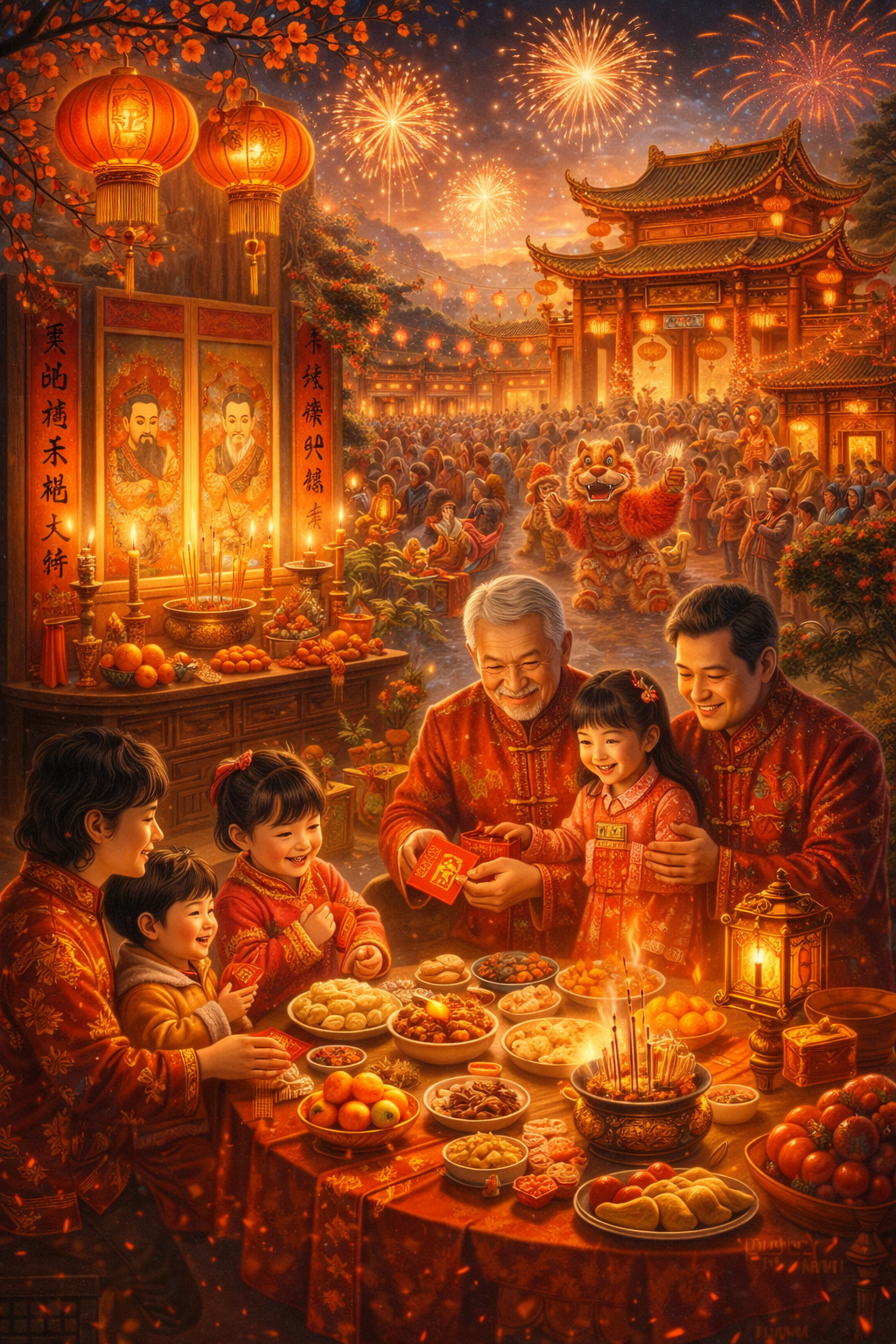
Modern heritage language is revealing here. UNESCO describes Spring Festival as a set of social practices through which people bid farewell to the old year, welcome the new one, pray for good fortune, celebrate family reunion, make offerings to heaven, earth, and ancestors, extend greetings to relatives and neighbors, and take part in public festivities. That description is important because it shows that the festival is not reducible to spectacle or entertainment. It is a deeply layered pattern of ritualized transition in which cosmology, kinship, moral duty, seasonal anxiety, and public culture converge.
The Spring Festival is also important because it is not a single custom with one origin story. It is a long-accumulated seasonal complex. Some of its practices are domestic; others are communal. Some are tied to ancestor reverence; others to protection, blessing, prosperity, or public festivity. Some are ancient in form; others are modern, regional, diasporic, or heritage-shaped. Its power lies in this layered structure. The festival gathers many practices into one shared grammar of renewal: clean, decorate, gather, offer, eat, greet, give, remember, protect, visit, and begin again.
What Is Spring Festival?
Spring Festival is the Chinese celebration of the traditional new year, centered on the first day of the first month of the Chinese calendar and extending through a broader cycle of domestic, ritual, and communal observances. Yet this formal calendrical description is not enough. What defines the festival in lived practice is its role as a structured passage from one moral and symbolic condition to another. The old year must be closed. Misfortune must be left behind. Blessing must be invited. Family lines must be honored. Social ties must be renewed. The festival’s importance lies in that total reorientation.
This is why Spring Festival is best understood not as a single day but as an entire cultural system of transition. Homes are cleaned. Doors are marked with red. Ancestors are honored. Families gather. Firecrackers and fireworks sound. Greetings circulate. Offerings are made. Public festivities unfold. The new year arrives not merely because a calendar changes, but because society performs its arrival through repeated symbolic acts.
The festival also carries a distinctive emotional force. It is a time of hope, but also pressure. People return home, reconcile obligations, honor elders, remember the dead, prepare food, settle accounts, and seek auspicious beginnings. The joy of the festival depends partly on the work of preparation. Renewal is not automatic. It must be made visible, audible, edible, social, and ritual.
For this reason, Spring Festival is one of the clearest examples of Chinese civilization treating time as something morally and ritually charged. A year is not merely counted. It is entered. It is crossed. It is protected. It is greeted. The festival gives that transition form.
New Year as Threshold Time
Threshold moments matter in many ritual cultures, but Spring Festival is especially significant because it turns calendrical transition into a dense field of moral and cosmological concern. The year does not simply begin. It must be properly crossed. This is why the festival repeatedly emphasizes leaving behind the old and welcoming the new. In practical terms, this means cleaning, preparation, feasting, visiting, decorating, and ritual care. In symbolic terms, it means moving from the accumulation of disorder into a hoped-for state of renewed alignment.
Threshold time is dangerous as well as auspicious. The old year has not fully released its burdens; the new year’s fortune has not yet been secured. Many customs become intelligible in this light. Noise, color, food, offerings, greetings, and visitation are not random embellishments. They are technologies of crossing. Spring Festival preserves one of the clearest examples in Chinese culture of time being treated as something that must be ritually managed.
This threshold structure explains why prohibitions and precautions matter. Many new-year customs are not only celebratory but protective. One avoids unlucky speech, mishandles no ominous signs, cleans before rather than during key festive days, prepares the house, and marks thresholds with auspicious symbols. The aim is not only to enjoy the new year, but to begin it without carrying forward disorder.
The festival therefore makes time relational. The new year is entered through the household, the ancestors, the gods, the community, and the visible signs of fortune. A person does not cross the year as a solitary individual. The passage is made through networks of kinship, memory, blessing, and protection.
Guonian and the Social Drama of Crossing the Year
Contemporary official and UNESCO language often uses the expression guonian 過年, “crossing the year,” to describe the process of celebration. That phrase is conceptually important because it suggests motion rather than static observance. The new year is not passively received. It is traversed. Families dine together on New Year’s Eve, stay up late to welcome the year, make offerings, visit one another, and enter a sequence of social practices that turn transition into a collectively enacted passage.
The phrase also helps explain why Spring Festival has such durable emotional power. It is a festival of movement across time, but also across relationship. People return home. Greetings extend outward. Generations gather. Elders, descendants, neighbors, and wider community are drawn into a single pattern of renewal. One does not cross the year alone. One crosses it with kin and with a remembered moral world.
The social drama of crossing the year is especially visible in the reunion meal. New Year’s Eve is not merely the night before the calendar changes. It is the gathered moment when the household attempts to become whole again. Family members return, food is prepared, ancestors are remembered, and the year is crossed from within the domestic center. The table becomes a ritual map of belonging.
This crossing also extends beyond the household. New-year greetings, visits, public festivities, and temple fairs push renewal outward from family to community. The year is crossed first in the home, then in the street, temple, market, workplace, village, city, and diaspora. Spring Festival is therefore both intimate and public. Its ritual energy begins at the threshold of the house but does not stop there.
Household Cosmology: Cleaning, Red, and the Remaking of Space
One of the most widely recognized features of Spring Festival is the thorough cleaning of the house before the new year. This practice matters because it reveals how domestic space is moralized. The home is not neutral shelter. It can hold residue from the passing year, and that residue must be removed before fortune can properly enter. Cleaning is therefore not only practical. It is symbolic expulsion.
The widespread use of red in decorations, clothing, couplets, lanterns, paper cuttings, and festive markers belongs to the same logic. Red is not only decorative intensity. It is a visible sign of happiness, luck, vitality, and auspicious protection. Doorways, walls, and thresholds are made to announce what kind of order the household seeks to inhabit. The house is remade as a cosmological space: cleansed of ill fortune, marked for blessing, and turned outward toward a new year entered under auspicious signs.
This domestic cosmology is one of the festival’s most important features. Chinese religious life is often associated with temples, gods, ancestral halls, and public rites, but Spring Festival shows that the house itself can become a site of cosmological action. The broom, the red paper, the food table, the doorframe, the ancestor altar, and the family gathering all participate in the ritual remaking of space.
Cleaning before the new year also creates a temporal boundary. The disorder of the old year is swept away before the new year begins. Once the new year arrives, customs in many places discourage sweeping or discarding in ways that might symbolically remove fresh fortune. The practice is simple, but the logic is deep: what belongs to the old year must be removed before blessing enters; what belongs to the new year must not be carelessly swept away.
Doorways, Couplets, and Threshold Protection
The doorway is one of the most important symbolic sites of Spring Festival because it is where inside and outside meet. During the new-year season, doors are often transformed through red couplets, auspicious characters, images, paper cuttings, and sometimes door-god traditions. The threshold is marked because the household is vulnerable at its openings. Blessing enters through doors, but so may misfortune. The doorway must therefore be made ritually legible.
Spring couplets express hopes for prosperity, longevity, harmony, learning, health, promotion, peace, and auspicious renewal. Their language matters because the new year is entered through speech as well as action. Written blessings become visible architecture. The house speaks its hopes before the year begins. The doorway becomes a text addressed to fortune.
Door-god and threshold-protection traditions add a further layer. They show that the new-year household is not simply decorated, but guarded. Whether through explicit guardian images or more general auspicious markings, the door is treated as a border that must be secured. This protective logic links Spring Festival to wider Chinese traditions of ghosts, demons, household gods, and the management of unseen danger.
The famous upside-down fu 福 character also belongs to this doorway logic. Its visual play on arrival and inversion turns written language into festive symbolism. Fortune is not only named; it is invited. The door becomes the place where the household announces that blessing should come in and misfortune should stay out.
Ancestors, Offerings, and the Moral Order of the Family
UNESCO’s description of the festival explicitly notes that people make offerings to heaven, earth, and ancestors during Spring Festival. This is a load-bearing point because it reveals the festival’s moral depth. The new year is not simply about private hope or consumption. It is about the right ordering of relation between the living and the dead, the household and the cosmos, present prosperity and inherited lineage.
Ancestor reverence here is not a peripheral survival. It is one of the festival’s structuring principles. Family reunion gains its full meaning because the family is imagined as extending beyond the living generation. To greet the new year properly is to do so in continuity with those who came before. The household enters the future by acknowledging the dead, and in doing so preserves a distinctly Chinese vision of moral time as intergenerational rather than merely individual.
This ancestral dimension also gives depth to the reunion meal. The family table is not only a table for the living. In many households, offerings, incense, and ancestral remembrance create a wider moral gathering. The dead are not simply absent from the year’s beginning. They are ritually acknowledged as part of the household’s continuity.
Spring Festival therefore turns family into a temporal institution. The living receive the year from the dead and pass blessing toward descendants. Elders give red envelopes; younger generations offer greetings; ancestors receive offerings; the household becomes a bridge across generations. Newness is not a break from the past. It is renewal inside continuity.
Firecrackers, Noise, and the Expulsion of Misfortune
Firecrackers and fireworks are among the most recognizable signs of the Spring Festival, but their meaning is not merely festive excitement. Sound is one of the festival’s major technologies of transition. Loudness marks the end of one condition and the opening of another. Misfortune is not quietly ignored. It is driven out. The year begins with noise because the boundary between old and new must be made audible.
Early seasonal sources already connect new-year explosive sound with protection against harmful beings. The Jingchu suishi ji, a major record of seasonal customs, describes people rising early on the first day of the first month and setting off explosive bamboo in the courtyard to ward away harmful mountain spirits and ghosts. The later firecracker tradition changes technology, but the ritual logic remains recognizable: sound protects the threshold of the year.
Primary Source
正月一日。是三元之日也……先於庭前爆竹,以闢山臊惡鬼。On the first day of the first month, the day of the three beginnings… people first set off exploding bamboo before the courtyard to ward away mountain spirits and harmful ghosts.Jingchu suishi ji 荊楚歲時記, “First Baoyantang Secret Collection Edition.” Available at: https://ctext.org/wiki.pl?chapter=328815&if=gb
This early seasonal record shows the protective logic behind New Year noise: explosive sound marks the threshold and drives away dangerous presences.
This source is important because it shows that Spring Festival noise belongs to a longer protective tradition, not only to modern spectacle. The purpose is not simply celebration after fear has vanished. The purpose is celebration as protection. Sound itself becomes a ritual force.
Even where fireworks are restricted today for safety, environmental, or urban-management reasons, the symbolic pattern remains culturally legible. Noise, light, and collective energy still mark transition. The old year is not allowed to fade silently. It is sent off with force.
Nian Folklore and the Symbolic Language of Danger
The popular story of the Nian 年 monster is one of the best-known narrative explanations for Spring Festival customs. In many tellings, the beast appears at the turn of the year and is frightened away by red color, loud noise, fire, and collective action. Historically, this folklore should be handled carefully because it is not the single origin of all Spring Festival customs. Yet symbolically, it is powerful because it gathers many protective practices into one memorable narrative form.
The Nian story matters because it personifies danger. Instead of treating misfortune as vague, it gives it a body. The monster becomes a way to explain why doors are red, why firecrackers sound, why people gather, and why the new year must be crossed actively rather than passively. Folklore transforms ritual practice into story.
The deeper logic of the Nian narrative is the same logic found across the festival: danger is not merely endured; it is repelled. The household must be prepared. The community must act together. Sound, color, light, and courage can drive away what threatens the new beginning. Whether or not the story is ancient in all its current forms, it expresses the festival’s protective imagination with great clarity.
It also explains why Spring Festival can hold fear and joy together. The new year is joyful because danger has been faced and driven away. Celebration follows protection. Red, noise, and light are beautiful, but they are also defensive. The festival’s brightness is inseparable from its memory of threat.
Food, Feasting, and the Symbolism of Plenty
Feasting is central to Spring Festival because the new year must be entered under signs of abundance, continuity, and shared life. UNESCO notes the importance of family reunion, while widely recognized festival practice ties particular foods to wishes for prosperity, unity, surplus, longevity, sweetness, and renewal in the year ahead. Food does not merely satisfy hunger. It becomes a language in which hopes for the future are materially staged.
This is why the festival table has such cultural weight. Families gather not only to eat together, but to perform the fact of reunion and continuity. The meal affirms that the household remains intact enough to receive the year collectively. In this sense, food during Spring Festival is sacramental in a broad cultural sense. It is nourishment, symbol, and social bond at once.
Many foods become meaningful through sound, shape, color, or association. Fish can evoke surplus because of the verbal connection between fish and abundance. Dumplings can suggest wealth through their shape. Rice cakes can suggest advancement or rising. Sweet foods can express hope for sweetness in the year ahead. These symbolic readings are not random decoration. They show how language, appetite, and fortune become intertwined.
The meal also marks moral order. Elders and children gather; absent members may be remembered; ancestors may be honored; dishes are prepared with care; and the table becomes a sign that the household has survived one year and is ready to enter another. Food makes continuity visible.
Red Envelopes, Greetings, and the Circulation of Good Fortune
Red envelopes, often called hongbao 紅包 in Mandarin and known through related regional terms, are among the most visible forms of Spring Festival blessing. They are significant because they turn auspiciousness into circulation. Good fortune is not only wished verbally. It is embodied in a gift, passed from elder to younger in visible form. The new year’s blessing moves through kinship lines and social hierarchy as something both symbolic and practical.
Seasonal greetings function similarly. To greet elders, relatives, friends, and neighbors is to redistribute goodwill and reaffirm social bonds at the opening of the year. Spring Festival therefore operates as a moral economy of auspicious exchange. The community is renewed because fortune, respect, and acknowledgment are made to move. Blessing is social before it is private.
This circulation also gives the festival a pedagogy of relation. Children learn the language of greeting; elders enact generosity; households visit one another; neighbors exchange good wishes; communities become audible through repeated formulas of blessing. Speech itself becomes seasonal ritual. The right words help shape the right beginning.
Red envelopes are especially powerful because they connect color, money, protection, and affection. The envelope matters as much as the money inside it. It wraps material support in auspicious red and social intention. The gift is economic, but it is also ritualized care.
Temple Fairs, Public Festivities, and Community Order
UNESCO emphasizes that public festivities are held by communities, cultural institutions, social groups, and art troupes during the festival. This matters because it shows that Spring Festival is not confined to domestic ritual. It extends outward into streets, public squares, temple fairs, performances, markets, lantern displays, processions, and collective celebration. The new year must be recognized not only in the household but in the visible body of the community.
Temple fairs and communal festivities reveal another important dimension of Spring Festival cosmology: renewal is public. Social order must reappear in shared space. The crowd, the procession, the performance, and the decorated street all testify that the year is being entered collectively. Community becomes visible to itself, and that visibility is itself part of the festival’s power.
Temple fairs also bring together commerce, devotion, entertainment, and social reunion. This mixture is important. The festival does not divide sacred and ordinary life cleanly. Eating, buying, watching performances, praying, greeting, and walking through decorated public space may all belong to the same seasonal atmosphere. The sacred enters the public through repetition, display, and collective participation.
Public festivities also allow the festival to exceed family boundaries. Not everyone’s household is intact; not everyone can return home; not every person experiences the festival through the same kinship structure. Public celebration gives another form of belonging. The community itself becomes a festive household, briefly renewed under shared signs of fortune and light.
Dragon Dance, Lion Dance, and the Public Body of Fortune
Dragon dances and lion dances are among the most recognizable public forms of the Spring Festival season. They matter because they turn auspicious power into moving bodies. The dragon, associated in Chinese tradition with vitality, water, imperial symbolism, and good fortune, becomes a collective performance requiring many coordinated dancers. The lion, often associated with protection and the expulsion of harmful forces, enters streets, shops, and community spaces as a festive guardian presence.
These performances are not merely entertainment. They are mobile signs of blessing. A dragon moving through the street makes auspicious energy visible as coordinated movement. A lion dance accompanied by drums and cymbals transforms noise, color, and motion into public protection. The community does not only watch fortune arrive; it performs fortune into presence.
The collective labor of these dances also matters. A dragon must be carried by many people; music must be coordinated; audiences must gather; routes must be planned. The performance becomes a social body. Fortune is not represented by an isolated individual but by coordinated communal action. This makes the dances especially fitting for Spring Festival, when social renewal is as important as private hope.
At the same time, regional variations are important. Dragon and lion dances differ across northern, southern, urban, rural, diasporic, and contemporary performance contexts. Their meanings may shift between ritual protection, martial display, cultural heritage, tourism, and community identity. The shared point is that Spring Festival often makes auspiciousness move through public space.
From Laba to Lantern Festival: The Extended Season of Renewal
Official Beijing municipal materials describe the traditional cycle as beginning with Laba, while broader descriptions of Chinese New Year note the culminative importance of Lantern Festival at the close of the season. This extended sequence is important because it shows that Spring Festival is not a punctual event. It is a season of preparation, crossing, visiting, display, and closure.
The beginning with Laba underscores that renewal requires prelude. The ending with Lantern Festival underscores that festive transition requires completion. The old year must be left properly; the new year must be entered gradually; the season must culminate in light, display, and symbolic fullness. The calendar is stretched so that cosmological transition can be socially absorbed.
Laba practices such as eating Laba congee and preparing foods associated with the coming new year make the festival season begin before New Year’s Eve. Preparation becomes part of the celebration. The household does not suddenly enter the new year; it approaches it through a sequence of acts. Time thickens as the year nears its crossing.
Lantern Festival, on the fifteenth day of the first lunar month, gives the season a luminous close. Lanterns, public display, riddles, sweet rice balls in many communities, and nighttime festivity transform the end of the new-year cycle into a second threshold. The festival season that began with preparation and reunion culminates in light. The year is not merely opened; it is ritually completed.
Spring Festival Between Folk Belief, Daoist, Buddhist, and State Forms
Spring Festival is best understood as a layered religious and cultural complex rather than as a custom belonging to one exclusive doctrine. It includes ancestor reverence, popular domestic rites, temple practices, public festivities, seasonal protections, auspicious language, symbolic foods, deity visits, and forms that have intersected variously with Daoist ritual, Buddhist observance, local cult, and state-recognized heritage language. Its strength lies partly in this flexibility.
This layered character helps explain the festival’s enormous durability. It can be lived intimately in the household, theatrically in the street, ritually in the temple, and culturally at the level of national identity without losing coherence. Spring Festival belongs less to a single orthodoxy than to a civilizational pattern of renewal that can absorb multiple sacred and social forms at once.
Daoist and popular religious elements appear in the attention to household gods, protective rites, temple offerings, and the management of unseen forces. Buddhist elements may appear through temple visits, prayers, merit-making, and local devotional practices in some communities. Ancestor reverence preserves the moral continuity of family lines. Modern public culture and heritage institutions frame the festival as national, cultural, and communal heritage. These layers coexist in practice.
This coexistence is not confusion. It is one of the defining features of Chinese religious life. Spring Festival shows how ritual systems can remain coherent without being doctrinally exclusive. What unifies the festival is not a single theology but a shared seasonal task: to cross into the new year under signs of blessing, continuity, protection, and renewed relation.
Regional Variation and Diasporic Renewal
Spring Festival is widely recognized as a Chinese cultural festival, but it is not practiced in exactly the same way everywhere. Customs vary by region, dialect community, rural or urban context, religious tradition, family background, migration history, and national setting. Foods differ. Greetings differ. Temple practices differ. Public festivities differ. Taboos and emphases differ. The festival’s unity exists through shared symbolic grammar rather than strict uniformity.
This variation is important because it prevents the festival from becoming a flattened stereotype. A Beijing account of Laba and temple fairs, a Fujian or Guangdong household practice, a Taiwanese temple procession, a Singaporean or Malaysian public celebration, and an overseas Chinese family gathering may all belong to Spring Festival, but each carries distinct local histories and social meanings.
Diasporic practice is especially important. For migrant communities, Spring Festival can become a way of preserving language, kinship, foodways, ritual memory, and cultural identity across distance. The festival is portable because its core forms can be recreated in new places: a family meal, red envelopes, ancestor remembrance, greetings, temple visits, lanterns, music, and public gatherings. These practices allow communities to carry a sense of home into new surroundings.
At the same time, diaspora changes the festival. Work schedules, school calendars, intermarriage, public multicultural events, local laws on fireworks, and new media all reshape how the new year is celebrated. This is not necessarily loss. It is adaptation. Spring Festival survives because it can be renewed under changed conditions while preserving its central grammar of return, blessing, and beginning again.
UNESCO, Living Heritage, and Contemporary Framing
Spring Festival was inscribed on UNESCO’s Representative List of the Intangible Cultural Heritage of Humanity in 2024 under the title “Spring festival, social practices of the Chinese people in celebration of traditional new year.” This contemporary recognition is significant because it frames the festival not simply as a holiday, but as a living system of practices: reunion, offerings, greetings, public festivities, ritual customs, and social renewal.
This heritage framing is useful because it recognizes the festival’s lived and communal nature. Spring Festival is not only a set of symbols to be interpreted from a distance. It is enacted through bodies, homes, streets, temples, travel, food, sound, color, and speech. It is intangible heritage precisely because it lives through repeated practice rather than through objects alone.
At the same time, heritage language should be interpreted carefully. UNESCO recognition does not create the festival’s importance. Spring Festival existed for centuries before modern heritage institutions. The inscription documents and recognizes a living tradition, but the tradition’s power comes from the communities that continue to practice it. Heritage status is one modern layer in a much older ritual history.
Contemporary framing also raises questions about national culture, tourism, public performance, diaspora, and modern identity. Spring Festival can be family ritual, religious practice, cultural heritage, commercial season, public holiday, televised spectacle, travel event, and global celebration all at once. A serious interpretation should preserve this complexity rather than reducing the festival to either ancient custom or modern branding.
Source History and Interpretive Caution
A careful reading of Spring Festival must distinguish among contemporary heritage descriptions, long-standing festival practices, early seasonal records, local and regional custom, popular folklore such as the later Nian narrative, modern public-holiday structures, and broader global framings of “Chinese New Year” or “Lunar New Year.” These layers do not all arise from the same historical moment, nor do they carry identical meanings in every region or community.
Early seasonal texts such as the Jingchu suishi ji are valuable because they preserve older practices and ritual logics, including new-year protective sound, early rising, and seasonal customs. But they should not be treated as if they describe all Chinese communities across all periods. They are specific textual witnesses from particular historical and regional contexts. Their value lies in showing early patterns, not in providing a single universal origin for everything now associated with Spring Festival.
Modern sources such as UNESCO, Britannica, municipal cultural pages, and tourism materials are also useful but must be read according to genre. UNESCO frames the festival as intangible cultural heritage. Britannica provides concise encyclopedic overview. Municipal sources often present local custom and official cultural interpretation. None should be confused with the full lived diversity of the festival itself.
Yet the layered quality of the festival is part of its significance. Spring Festival is not powerful because it can be reduced to one origin story or one uniform set of rites. It is powerful because it gathers many centuries of seasonal practice, domestic symbolism, communal ritual, migration memory, public festivity, and moral imagination into a living structure of renewal. Its plurality is not a defect. It is its civilizational strength.
Why Spring Festival Still Matters
Spring Festival still matters because it addresses needs that remain structurally powerful: the need to mark time, renew kinship, manage uncertainty, invite fortune, remember ancestors, and convert the vulnerability of transition into patterned action. A new year always carries anxiety as well as hope. Spring Festival gives that condition ritual form.
It also matters because it joins the smallest and largest scales of human life. The cleaning of a room, the hanging of a red couplet, the family meal, the gift in a red envelope, the offering to ancestors, the public fair, and the bright noise of celebration are all made to participate in one larger effort to begin again under favorable signs. Under Spring Festival, cosmology enters ordinary life, and ordinary life becomes one of the principal places where cosmology is enacted.
The festival matters, too, because it preserves intergenerational continuity. The new year is not simply a future-facing celebration. It is entered through memory: ancestors, elders, family names, old greetings, inherited foods, local customs, and repeated gestures. Each year feels new because it is crossed through forms that are old. Renewal depends on return.
Finally, Spring Festival matters because it remains a living, adaptive, global tradition. It can be practiced in ancestral villages, dense cities, overseas communities, temples, homes, public squares, and digital spaces. Its forms change, but its central grammar endures: leave the old year, welcome the new, gather the family, honor the dead, protect the threshold, circulate blessing, and begin again.
Related Reading
- Chinese Myth, Folklore & Legend
- Buddhism, Daoism, and the Recasting of Chinese Mythic Worlds
- Underworlds, Judges, and the Bureaucracy of the Afterlife
- Ghosts, Revenants, and the Moral Logic of the Unsettled Dead
- The Cowherd and the Weaver Girl: Stars, Separation, and Festival
- Mazu and the Sea-Goddess Traditions of Coastal China
- Dragons in Chinese Myth, Water Cosmology, and Imperial Symbolism
Primary Sources
- Zong Lin 宗懍, attributed (n.d.) Jingchu suishi ji 荊楚歲時記 / Record of the Seasonal Customs of Jingchu. Chinese Text Project overview page. Useful for early seasonal customs, New Year protective sound, and the ritual logic of exorcistic festive practice. Available at: https://ctext.org/wiki.pl?if=gb&remap=gb&res=755522
- Zong Lin 宗懍, attributed (n.d.) Jingchu suishi ji 荊楚歲時記, “First Baoyantang Secret Collection Edition” 第一部寶顏堂秘笈本. Chinese Text Project edition. Useful for the first-day new-year passage, exploding bamboo, and protective customs. Available at: https://ctext.org/wiki.pl?chapter=328815&if=gb
- UNESCO (2024) “Spring festival, social practices of the Chinese people in celebration of traditional new year.” Representative List of the Intangible Cultural Heritage of Humanity. Useful as an official contemporary heritage record of reunion, offerings, greetings, public festivities, and living social practices. Available at: https://ich.unesco.org/en/RL/spring-festival-social-practices-of-the-chinese-people-in-celebration-of-traditional-new-year-02126
- UNESCO (2024) “Decision 19.COM 7.B.29.” Useful for the formal inscription decision placing Spring Festival on the Representative List of the Intangible Cultural Heritage of Humanity. Available at: https://ich.unesco.org/en/decisions/19.COM/7.B.29
- Beijing Municipal Government (2021) “Traditional Spring Festival Customs in Beijing.” Useful for contemporary official description of the extended festive cycle beginning with Laba and continuing through New Year customs. Available at: https://english.beijing.gov.cn/beijinginfo/culture/beijingfolklore/festivals/202110/t20211018_2514753.html
Further Reading
- UNESCO (2024) “Spring festival, social practices of the Chinese people in celebration of traditional new year.” Available at: https://ich.unesco.org/en/RL/spring-festival-social-practices-of-the-chinese-people-in-celebration-of-traditional-new-year-02126
- UNESCO (2024) “Decision 19.COM 7.B.29.” Available at: https://ich.unesco.org/en/decisions/19.COM/7.B.29
- Encyclopaedia Britannica (2026) “Chinese New Year.” Available at: https://www.britannica.com/topic/Chinese-New-Year
- Encyclopaedia Britannica (2026) “Lunar New Year.” Available at: https://www.britannica.com/topic/Lunar-New-Year
- Beijing Municipal Government (2021) “Traditional Spring Festival Customs in Beijing.” Available at: https://english.beijing.gov.cn/beijinginfo/culture/beijingfolklore/festivals/202110/t20211018_2514753.html
- Chinese Text Project (n.d.) Jingchu suishi ji 荊楚歲時記. Available at: https://ctext.org/wiki.pl?if=gb&remap=gb&res=755522
- Chinese Text Project (n.d.) Jingchu suishi ji 荊楚歲時記, “First Baoyantang Secret Collection Edition.” Available at: https://ctext.org/wiki.pl?chapter=328815&if=gb
- Bodde, D. (1975) Festivals in Classical China: New Year and Other Annual Observances During the Han Dynasty, 206 B.C.–A.D. 220. Princeton: Princeton University Press.
- Feuchtwang, S. (2001) Popular Religion in China: The Imperial Metaphor. Richmond: Curzon.
- Overmyer, D.L. (2009) Local Religion in North China in the Twentieth Century: The Structure and Organization of Community Rituals and Beliefs. Leiden: Brill.
- Teiser, S.F. (1996) “The Ghost Festival in Medieval China.” Princeton: Princeton University Press.
- Yang, C.K. (1961) Religion in Chinese Society: A Study of Contemporary Social Functions of Religion and Some of Their Historical Factors. Berkeley: University of California Press.
References
- Beijing Municipal Government (2021) “Traditional Spring Festival Customs in Beijing.” Available at: https://english.beijing.gov.cn/beijinginfo/culture/beijingfolklore/festivals/202110/t20211018_2514753.html
- Bodde, D. (1975) Festivals in Classical China: New Year and Other Annual Observances During the Han Dynasty, 206 B.C.–A.D. 220. Princeton: Princeton University Press.
- Chinese Text Project (n.d.) Jingchu suishi ji 荊楚歲時記. Available at: https://ctext.org/wiki.pl?if=gb&remap=gb&res=755522
- Chinese Text Project (n.d.) Jingchu suishi ji 荊楚歲時記, “First Baoyantang Secret Collection Edition” 第一部寶顏堂秘笈本. Available at: https://ctext.org/wiki.pl?chapter=328815&if=gb
- Encyclopaedia Britannica (2026) “Chinese New Year.” Available at: https://www.britannica.com/topic/Chinese-New-Year
- Encyclopaedia Britannica (2026) “Lunar New Year.” Available at: https://www.britannica.com/topic/Lunar-New-Year
- Feuchtwang, S. (2001) Popular Religion in China: The Imperial Metaphor. Richmond: Curzon.
- Overmyer, D.L. (2009) Local Religion in North China in the Twentieth Century: The Structure and Organization of Community Rituals and Beliefs. Leiden: Brill.
- Teiser, S.F. (1996) The Ghost Festival in Medieval China. Princeton: Princeton University Press.
- UNESCO (2024) “Decision 19.COM 7.B.29.” Available at: https://ich.unesco.org/en/decisions/19.COM/7.B.29
- UNESCO (2024) “Spring festival, social practices of the Chinese people in celebration of traditional new year.” Available at: https://ich.unesco.org/en/RL/spring-festival-social-practices-of-the-chinese-people-in-celebration-of-traditional-new-year-02126
- Yang, C.K. (1961) Religion in Chinese Society: A Study of Contemporary Social Functions of Religion and Some of Their Historical Factors. Berkeley: University of California Press.