
Last Updated May 6, 2026
The mythic traditions of China cannot be reduced to a single civilizational voice, a single literary canon, or a single dominant archive of sacred stories. Any serious treatment of Chinese myth, folklore, and legend must move beyond the assumption that the field is adequately represented by classical Han texts and later vernacular fiction alone. Across the regions of China, mythic life has long been preserved through seasonal rites, sacred landscapes, ritual specialists, oral performance, epic recitation, temple ceremony, local song, painted iconography, ceremonial dance, and communal memory. The result is not one mythology with neat borders, but a layered field of symbolic worlds that overlap, diverge, and sometimes travel across communities.
This broader frame matters because regional traditions do not merely add picturesque “local variation” to a dominant center. They change the structure of the archive itself. They show that sacred mountains, protective deities, heroic epics, ritual ecologies, animal symbolism, oral song, religious theater, and ceremonial arts have been produced and transmitted in multiple cultural zones at once. To study Qiang, Tibetan, Tu, Mongolian, Kirgiz, Uyghur, Dong, Korean-ethnic, and other regional traditions is therefore not to leave the field of Chinese mythology. It is to enter it more fully, and to recognize that the mythic imagination of China has always been plural, multilingual, regionally grounded, and unevenly preserved across different media and historical forms.
Series context: This article is part of the Chinese Myth, Folklore & Legend knowledge series. For the broader category structure, return to the Mythology category.
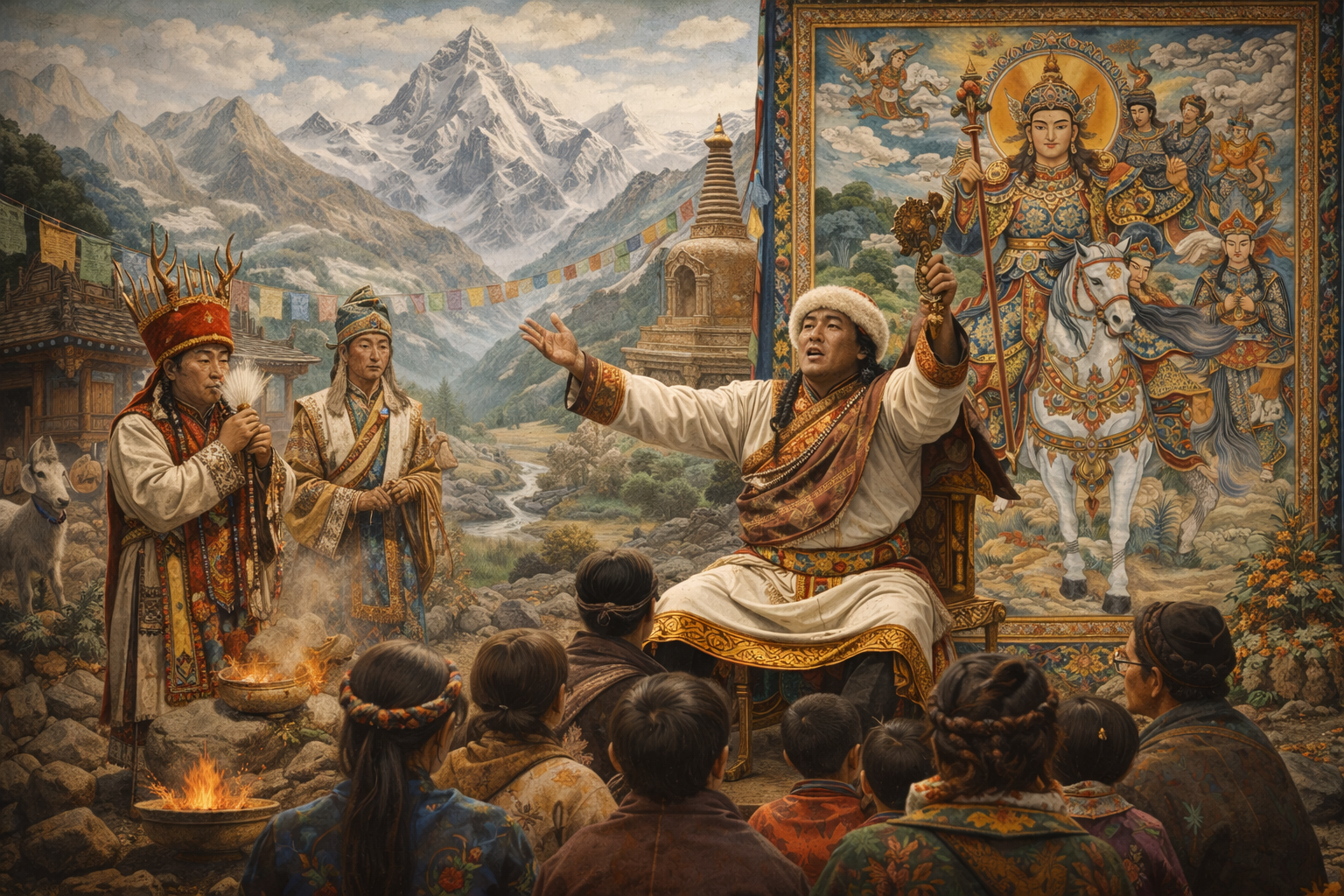
Regional plurality also changes how the archive must be read. Some traditions are preserved primarily through texts, but others live through voice, dance, ritual, seasonal return, sacred geography, masked theater, musical training, and visual apprenticeship. Some are transmitted by priests, bards, elders, opera performers, painters, singers, dancers, or community specialists. Others are preserved in UNESCO heritage records, museum archives, performance videos, local ceremonies, and oral lineages whose social meaning cannot be captured by text alone. The archive is therefore not a single shelf. It is a many-voiced field of practice.
This is especially important for a scholarly and ethically responsible article. Regional traditions must not be used as decorative proof of diversity while remaining subordinated to a single center. They deserve to be treated as knowledge systems in their own right. Their songs, rituals, dances, epics, sacred arts, and landscape practices preserve ways of understanding land, divinity, ancestry, protection, seasonality, and communal life that would disappear if myth were defined only by classical textual inheritance.
Beyond a Single Mythological Canon
One of the most persistent distortions in the study of Chinese mythology is the assumption that the subject can be sufficiently represented through a sequence of classical and later Han-centered texts. Those sources are foundational, but they do not encompass the full narrative geography of China. The official cultural record itself already points toward plurality: alongside Han-associated forms stand Tibetan opera, the Gesar epic tradition, Regong arts, Manas, Mongolian Khoomei, Qiang New Year, Uyghur Muqam, Dong Grand Song, Korean-ethnic farmers’ dance, and many other regionally rooted traditions that carry mythic, ritual, and symbolic content.
Regional traditions matter not because they are peripheral curiosities, but because they preserve other models of cosmology, heroism, sacred landscape, ritual order, oral inheritance, ecological relation, and communal memory. Some are carried primarily through festival and rite. Others survive through painted and sung traditions, heroic epic, opera, dance, musical training, and community-specific ceremonial forms. Their presence means that “Chinese myth” is better understood as a field of interacting narrative worlds than as a single unified mythology.
This is methodologically important. Once the archive is approached as plural, categories such as center and periphery, text and performance, literature and ritual, or elite and popular no longer hold as neatly as they once seemed to. Regional traditions are not simply supplementary evidence. They are among the clearest demonstrations that myth in China has always been distributed across languages, landscapes, and institutions.
They also expose the limits of preservation. Written traditions that entered libraries, dynastic histories, printed books, or elite commentarial systems are more easily cited and stabilized. Oral, ritual, and performance traditions often depend on living practitioners and local transmission. When those practitioners are marginalized, displaced, regulated, or no longer able to transmit their work, the archive becomes fragile. Regional plurality is therefore not only a descriptive fact; it is a responsibility for interpretation.
Regional Traditions and the Structure of the Archive
Regional traditions change the structure of the archive because they force the reader to ask what counts as evidence. A classical text can be quoted. A ritual can be described. A song can be transcribed, but transcription cannot fully preserve the sound, breath, gesture, audience, and occasion that give the song its force. A thangka can be photographed, but the photograph cannot reproduce the ritual setting, training lineage, and devotional use of the image. A festival can be documented, but documentation cannot fully replace participation.
This matters because myth is not always preserved as story in the narrow sense. It may be preserved as practice. A community’s relation to mountains, trees, ancestors, harvest, protective beings, heroic founders, sacred music, or ceremonial dance may not always produce a single plot that can be summarized like a novel. Yet it may still organize a mythic understanding of the world. A ritual calendar, a sacred image, a mountain pilgrimage, a harvest dance, or an epic song may all transmit cosmology.
Regional materials therefore require an expanded method. The scholar or editor must read texts, but also attend to performance, image, landscape, ritual action, sound, kinship, ecological relation, and the politics of heritage classification. The mythic archive is not merely what has been written down. It is what communities have preserved as meaningful relation between people, place, memory, and the unseen.
This also means that a regional article cannot be exhaustive. It must function as a map of the problem rather than a claim of completion. Qiang, Tibetan, Tu, Mongolian, Kirgiz, Uyghur, Dong, Korean-ethnic, and other traditions each deserve deeper independent treatment. The aim here is to establish why regional plurality belongs at the center of the series, not as an afterthought.
Qiang Traditions, Ritual, Nature, and Community
The Qiang case is especially revealing because it shows how mythic culture can be embedded in seasonal rite, reverence for nature, priestly mediation, and communal renewal rather than primarily in a canonical text. The Qiang New Year festival allows the Qiang people of Sichuan to express gratitude and reverence, reaffirm a harmonious and respectful relationship with nature, and promote social and family harmony. That structure is important because it places cosmology, ecology, ethics, and social order within a single ritual frame.
The festival is also visually and ritually dense. Ceremonial dress, sacrifices, offerings, blessing, sheepskin-drum dance, round dance, and communal meals reveal a mythic system not reducible to “belief” in the abstract. Trees, mountains, ritual specialists, animal sacrifice, dance, blessing, and feast all participate in a world where sacred relation is enacted through ceremony and seasonal repetition.
Living Heritage Source
The Qiang New Year Festival is an occasion “to offer thanks and worship to heaven.”UNESCO Intangible Cultural Heritage, “Qiang New Year festival.” Available at: https://ich.unesco.org/en/RL/qiang-new-year-festival-02155
This heritage description anchors the festival as a ritual act of gratitude, cosmological address, and communal renewal rather than a simple seasonal celebration.
For this reason, Qiang traditions help correct a text-heavy bias in mythology studies. They show that a people’s mythic life may be carried through ritual roles, sacred ecology, offerings, communal dance, and life-cycle memory rather than through a famous literary corpus alone. In that sense, the Qiang material belongs centrally to folklore and religion, but it also belongs to mythology in the deeper sense of how a community orders its place in the world.
What emerges here is a model of myth not as a distant story-world but as a lived environmental ethic. Sacred relation is renewed through rite, not merely remembered through tale. This makes Qiang material especially important for any broader understanding of how cosmology and locality meet in Chinese cultural life.
Shibi Priests, Sacred Trees, and Ritual Ecology
The role of the shibi priest is central to the ritual ecology of Qiang New Year. A priestly specialist mediates the ritual field, helping transform the festival from a general celebration into a structured act of relation among community, mountain, heaven, tree, animal offering, and blessing. The priest is not simply a functionary. He stands at the point where inherited knowledge, ritual sequence, and sacred address meet.
The offering to the god of trees is especially important because it shows how Qiang ritual imagination treats nature not as inert scenery but as a field of relation. Trees are not merely botanical objects in this ceremonial context. They are sacred presences or ritual partners through which gratitude, reverence, and communal protection are enacted. A tree-centered rite suggests that cosmology is embedded in ecological form.
The sheepskin-drum dance and round dance deepen this pattern. Dance turns community into movement. The body becomes part of the ritual system. People do not merely state their relation to the sacred; they enact it through rhythm, circularity, gesture, and gathering. The dance creates a visible social body around the festival’s sacred center.
This is why Qiang traditions are so valuable for a mythological series. They show that myth may be preserved through ecological ritual rather than through narrative plot. A sacred tree, priestly act, goat sacrifice, drum, dance, and communal meal can together constitute a mythic grammar of gratitude and renewal. The archive here is ceremonial.
Tibetan Mythic Worlds, Epic Performance, and Sacred Landscape
Tibetan traditions widen the picture further by preserving mythic culture through epic, opera, sacred art, sacred geography, ritual practice, and living performance. These traditions cannot be reduced to literary narrative alone. Tibetan mythic worlds are often carried through sung performance, masked action, prayer, blessing, thangka painting, pilgrimage, monastic and local religious settings, and communal forms of memory.
The Gesar tradition belongs to this wider world of plural transmission. It is shared by Tibetan, Mongolian, and Tu communities, sustained through performance, embedded in religious and daily life, and adapted into thangka painting and opera. Gesar demonstrates that some of the most important mythic traditions in China survive through oral and performative systems that do not fit neatly into the categories established by classical literary history.
Sacred geography intensifies this distinctiveness. Mountains are not merely backdrops but cosmological centers, pilgrimage destinations, and divine presences in their own right. Even where a mountain belongs to several religious worlds at once, its significance for Tibetan and Himalayan sacred imagination shows how regional traditions often organize myth through place as much as through narrative. A mountain may function simultaneously as axis, dwelling, pilgrimage route, and image of cosmic order.
For this reason, Tibetan materials are indispensable to the wider argument of the pillar. They show that myth may live through the conjunction of land, performance, prayer, and image rather than through any single authored text. The sacred is encountered as landscape and ceremony as much as story.
Tibetan Opera: Prayer, Mask, and Public Sacred Performance
Tibetan opera is one of the clearest examples of a regional performance tradition in which theater, storytelling, ritual, and communal memory converge. UNESCO describes it as a comprehensive art combining folk song, dance, storytelling, chant, acrobatics, and religious performance. That combination matters because it refuses the modern separation of drama from devotion. The stage is not merely a place of entertainment. It is a sacred and communal field.
The structure of Tibetan opera reinforces this point. UNESCO’s heritage archive describes performances beginning with a prayer ceremony, including cleansing of the stage and blessings, and concluding with another blessing. This means that the dramatic world is ritually framed. The story is not simply performed in empty space. It is opened, protected, blessed, and closed through sacred action.
Living Heritage Source
The performance begins with “a prayer ceremony” and concludes with another blessing.UNESCO Archives, “Tibetan Opera.” Available at: https://www.unesco.org/archives/multimedia/document-345
This framing shows why Tibetan opera belongs to mythic and ritual study as much as theater history: performance is enclosed within prayer, blessing, and sacred public action.
Mask, movement, song, and narration give Tibetan opera a distinctive mythic power. The masked figure does not merely represent a character; it transforms the visible body of the performer into a ritualized presence. The narrator, singers, dancers, and acrobats help create a performance world in which story is spoken, sung, danced, and blessed into public form.
This matters for the series because Tibetan opera shows that regional mythic traditions may be preserved through a full-body archive. Voice, costume, mask, stage-cleansing, blessing, movement, and communal reception all carry meaning. A text-only approach would miss the core of the tradition.
Gesar and the Epic Plurality of China
The Gesar epic, discussed more fully in the previous article, is one of the strongest examples of the plural narrative worlds of China. It is an epic tradition associated especially with Tibetan cultural worlds, but also shared across Mongolian and Tu communities. It survives through singers, storytellers, ritual contexts, textual witnesses, thangka painting, opera, and contemporary heritage safeguarding. Its importance lies not only in its scale, but in the way it reveals how oral epic can preserve mythic authority outside a single stable book.
Gesar is a heroic figure, but he is more than a warrior. His battles against oppressive forces, monsters, hostile powers, and disorder belong to a larger moral imagination of world repair. The epic gives communities a narrative through which courage, justice, protection, sacred mission, and regional identity become audible. It is not a detached literary artifact. It is a living storehouse of heroic memory.
The Gesar tradition also helps widen the idea of Chinese mythology beyond Han-centered textual pathways. If Journey to the West and Investiture of the Gods show how vernacular fiction can build mythic worlds, Gesar shows how oral epic can do the same through performance and communal inheritance. The archive is not smaller because it is sung. It is different, and that difference matters.
The study of Gesar also requires caution. It should not be absorbed into a generic national frame in a way that erases Tibetan, Mongolian, Tu, and Inner Asian specificity. Its value for this series is precisely that it reveals plurality. Gesar belongs to the broader field of Chinese myth, folklore, and legend because the field itself is multiethnic and regionally layered, not because every tradition must be flattened into one center.
Sacred Landscape: Kailash, Mountains, and Pilgrimage
Sacred geography is one of the strongest regional correctives to text-centered mythology. Mountains, lakes, passes, plateaus, valleys, and pilgrimage routes can hold mythic meaning without requiring a single narrative source. In Tibetan and Himalayan traditions, Mount Kailash is one of the most important examples: a sacred mountain associated with multiple religious worlds, pilgrimage practices, cosmological imagination, and regional sacred geography.
A mountain like Kailash is not merely a place where stories are set. It is a sacred presence in its own right. Pilgrimage, circumambulation, ritual practice, and devotional imagination make the landscape a lived cosmology. The mountain functions as axis, boundary, destination, body of the sacred, and test of devotion. Its meaning is enacted through movement as much as through belief.
This has methodological consequences. If myth is only searched for in texts, the sacred mountain becomes scenery. If myth is understood through practice, the mountain becomes archive. Paths, rituals, offerings, bodily difficulty, visual approach, and collective memory all become forms of transmission. Landscape is not a passive container of myth. It is one of myth’s media.
Regional traditions across China often preserve this place-based mythic logic. Sacred mountains, ancestral villages, rivers, caves, forests, temple routes, and ritual fields may hold meaning that cannot be fully detached from location. Mythic study therefore needs geography as much as philology. The land remembers differently from a book.
Regong Arts: Thangka, Mural, and Local Sacred Image
Regional mythic traditions are also carried through visual arts that do not map neatly onto literary categories. Regong arts show how Buddhist monks and folk artists of Tibetan and Tu ethnicity create thangka, murals, patchwork barbola, and sculpture in ways that combine Tibetan Buddhism with local traditional culture to represent a regionally distinctive identity. This is especially important because it shows mythic and sacred imagery as both doctrinally inflected and locally shaped.
In other words, mythic transmission here happens through image as much as through story. A thangka of a king, deity, protector, bodhisattva, or sacred being is not merely illustration. It belongs to a ritual and artistic environment that teaches communities how to imagine power, sanctity, lineage, memory, and cosmic order. Royal-historical memory and sacred art can converge within a single visual tradition, making image itself a bearer of narrative legitimacy.
Regong arts also show how community, apprenticeship, and religious image-making work together. Art is not only a private aesthetic act. It can be a transmitted practice, a form of devotional labor, and a visual theology. The artist participates in preserving sacred memory through technique, pattern, color, iconographic discipline, and local inheritance.
This is one reason regional arts matter so much for the series. They demonstrate that myth often survives through media ecologies that include painting, opera, rite, epic, and festival at once. Regional traditions are not less sophisticated than courtly or classical traditions. They are often more obviously integrated across media, and therefore especially revealing of how myth operates in lived cultural systems.
Mongolian Khoomei: Voice, Landscape, and Sonic Cosmology
Mongolian Khoomei, or throat-singing, broadens the archive in a different direction. It is not mythology in the narrow sense of named gods and narrative episodes, yet it belongs to a symbolic world in which voice, landscape, breath, animal sound, environmental imitation, and community identity are deeply connected. UNESCO describes Khoomei as a style in which one performer produces multiple voice parts, including a sustained bass element in the throat.
This matters because mythic culture can live in sound. A tradition that imitates or resonates with natural forces can preserve a cosmological relation to landscape without presenting that relation as a written doctrine. Voice becomes a bridge between human body and environment. The singer does not merely perform for a landscape; the singer brings landscape into the body’s sound.
Khoomei’s practice among Mongolian communities in Inner Mongolia, western Mongolia, and Tuva also reveals the cross-border and transregional character of many Inner Asian traditions. Such traditions cannot be understood only through national containers. They move through language, pastoral memory, musical lineages, landscape, and community identity across political borders.
For the study of Chinese myth, folklore, and legend, Khoomei is important because it reminds the reader that the mythic archive includes sonic cosmology. Not every tradition organizes sacred meaning through narrative. Some organize it through breath, resonance, imitation, and the disciplined transformation of the human voice into a world-sound.
Manas, Kirgiz Epic, and Heroic Memory
The Kirgiz epic Manas adds another heroic and oral dimension to the regional archive. UNESCO describes Manas as one of the “three major epics of China” and as both an artistic creation and an oral encyclopaedia of the Kirgiz people. That phrase matters because it frames epic not only as entertainment, but as a storehouse of history, belief, language, values, and communal self-understanding.
Living Heritage Source
Manas is described as an “oral encyclopaedia of the Kirgiz people.”UNESCO Intangible Cultural Heritage, “Manas.” Available at: https://ich.unesco.org/en/RL/manas-00209
The phrase helps explain why oral epic belongs to the mythic archive: it preserves historical memory, beliefs, moral imagination, and communal identity through performance.
Manas also demonstrates that heroic epic is not confined to Gesar in the Inner Asian and western Chinese context. Like Gesar, it shows how epic can preserve collective memory through recitation, rhythm, formula, and narrative expansion. The heroic figure becomes a structure through which a people remembers conflict, origin, courage, suffering, and continuity.
The tradition also requires careful representation because Manas is tied to Kirgiz identity across borders and has been subject to modern heritage politics. Its presence in China’s UNESCO listing must be read alongside the broader Kyrgyz world, including the separate Kyrgyz epic trilogy inscribed through Kyrgyzstan. A responsible account should recognize both the Chinese regional context and the wider Central Asian life of the epic.
Manas belongs in this article because it makes a larger point visible: the mythic field of China includes epic traditions whose deepest authority is oral, performative, and community-centered. The archive is not only textual, and heroic memory is not confined to one ethnicity, language, or literary form.
Uyghur Muqam, Song, Dance, and Silk Road Memory
The Uyghur Muqam of Xinjiang expands the regional archive through music, dance, poetic performance, and Silk Road memory. UNESCO describes Uyghur Muqam as including songs, dances, folk and classical music, and as diverse in content, choreography, musical style, and instruments. This makes Muqam not only a musical form, but a multimedia cultural system of voice, rhythm, movement, poetic memory, and communal inheritance.
Muqam matters for a mythology and folklore series because sacred and symbolic memory is often carried through musical worlds that resist easy summary as “stories.” The tradition preserves modes of emotional, religious, historical, and social meaning through performance. It belongs to a Central Asian and Silk Road cultural ecology in which music, poetry, dance, and communal identity have long been intertwined.
Modern readers should approach Uyghur Muqam with particular care. Uyghur culture has been subject to intense political pressure, and any heritage framing should avoid treating official recognition as if it fully represents the lived experience or autonomy of the communities who sustain the tradition. UNESCO listing can document cultural significance, but it does not settle the politics of preservation, representation, or control.
For this article’s purpose, Muqam matters because it broadens the mythic archive beyond narrative and image into performed sound, dance, and poetic memory. It reminds the reader that a civilization’s symbolic life can be stored in melodic systems, bodily movement, and sung forms that carry the weight of collective identity.
Dong Grand Song and the Mythic Life of Community Voice
The Grand Song of the Dong ethnic group offers another model of regional symbolic transmission. UNESCO’s materials cite a Dong saying from Guizhou: “rice nourishes the body and songs nourish the soul.” The phrase is important because it places song alongside food as a necessity of life. Music is not an ornament added to community. It is one of the ways community itself is sustained.
Living Heritage Source
“Rice nourishes the body and songs nourish the soul.”UNESCO Intangible Cultural Heritage, “Grand song of the Dong ethnic group.” Available at: https://ich.unesco.org/en/RL/grand-song-of-the-dong-ethnic-group-00202
This saying frames song as a life-sustaining medium of community, memory, education, and symbolic continuity.
The Grand Song is not mythology in the sense of a single heroic story, but it belongs to the broader mythic field because it preserves a worldview of relation: human beings, nature, community, and voice are imagined together. Multi-part singing without instrumental accompaniment or a leader creates a social sound-world in which harmony is not only musical but communal. The form itself becomes an image of social relation.
Song traditions such as this help challenge the assumption that myth is always narrative. Sometimes the mythic imagination is embedded in repeated communal sound, in the way voices join, in the social discipline of listening, and in the memory of ecological and moral relation preserved through performance. The archive may sing rather than speak in prose.
The Dong example also helps balance the article. Regional plurality is not only heroic epic or religious ritual. It also includes lyrical, communal, and ecological forms of memory. Songs can carry the soul of a community just as epics carry heroic identity or festivals carry seasonal renewal.
Korean-Ethnic Farmers’ Dance: Land Ritual and Harvest
The farmers’ dance of China’s Korean ethnic group is another example of how regional cultural practice can connect labor, land, ritual, and community identity. UNESCO describes the practice as beginning with a traditional sacrifice to the God of the Land, offered in fields or villages during community festivals to pay homage to nature and pray for good fortune and a plentiful harvest. That structure places agricultural life inside a ritual and symbolic frame.
The dance matters for a mythology series because it shows how the sacred can enter collective movement. Harvest and fertility are not only economic concerns. They are ritually addressed through sacrifice, dance, music, and communal celebration. The God of the Land is not merely a belief-object; the deity is encountered through the social choreography of festival life.
This tradition also shows that regional mythic life often sits at the intersection of ethnicity, agriculture, and public performance. The dance is a cultural heritage of China’s Korean ethnic group, but it also connects to broader East Asian patterns of land veneration, harvest prayer, music, and communal festivity. The tradition’s meaning therefore lies in both specificity and relation.
In the larger argument of the article, the farmers’ dance helps show that mythology can be embodied as communal motion. A field, sacrifice, drum, dance, and harvest wish together form a ritual ecology. This is the same broader principle visible in Qiang New Year, Tibetan opera, temple festivals, and seasonal rites: myth lives where people gather to enact relation with land, ancestors, gods, and one another.
Regional Arts, Local Cosmologies, and Shared Forms
Regional mythic traditions are often carried through arts that do not map neatly onto literary categories. Regong thangka, Tibetan opera, Qiang ritual dance, Mongolian throat singing, Dong Grand Song, Manas epic recitation, Uyghur Muqam, and Korean-ethnic farmers’ dance all demonstrate that mythic transmission can be musical, visual, bodily, oral, ritual, seasonal, and communal. The archive is multimedia because the communities that sustain it are embodied and social.
In many of these traditions, art is not separate from cosmology. Song may express relation to nature. Dance may renew land and harvest. Epic may preserve heroic memory. Painting may make sacred beings visible. Opera may transform prayer and story into public performance. Festival may renew relation between community and heaven, mountain, tree, ancestor, or protective deity. Myth is therefore not only content. It is a pattern of relation enacted through media.
This is one reason regional traditions are not less sophisticated than courtly or classical traditions. They are often more obviously integrated across media and therefore especially revealing of how myth operates in lived cultural systems. A classical text may preserve a story, but a living regional tradition may preserve a whole ecology of performance, ritual, sound, image, and communal transmission.
Such traditions also show that the relationship between religion and art is not secondary or decorative. In many regional contexts, the image, song, dance, or performance is one of the primary ways the sacred world becomes present, memorable, and socially transmissible. Art is not merely representation. It is one of the forms through which sacred relation is maintained.
Other Regional Traditions and the Problem of Representation
Any article like this must also acknowledge its own incompleteness. “Qiang, Tibetan, and other regional mythic traditions” names a field that extends far beyond what a single essay can fully contain. UNESCO’s China listing alone includes traditions connected to Mongolian singing, Manas, Hua’er, Uyghur Muqam, Dong Grand Song, Korean-ethnic dance, and many other regionally rooted forms. Some of these are not conventionally labeled “mythology,” but they participate in wider worlds of memory, sacred pattern, oral inheritance, ecological relation, and symbolic identity.
That point matters methodologically. A mythic archive is not only made up of stories explicitly called myths. It also includes festivals, song forms, ritual arts, sacred landscapes, heroic performances, and community-specific symbolic practices through which people remember origins, values, and relations to the seen and unseen worlds. The difficulty of representation is therefore built into the subject itself. Once the frame widens beyond a Han-only canon, the archive becomes larger, more distributed, and harder to summarize without distortion.
This incompleteness should not be treated as a failure of the field, but as one of its defining realities. China’s mythic life is so regionally layered and historically entangled that any responsible synthesis must leave room for traditions that exceed the current map. That is one of the strongest reasons to retain a plural framework rather than forcing everything back into a single civilizational script.
It is also why future articles could expand this regional map. Uyghur Muqam, Manas, Mongolian Khoomei, Dong song traditions, Korean-ethnic farmers’ dance, Hua’er, and other local traditions each deserve dedicated treatment if the series continues into regional performance and oral heritage. This article establishes the principle: the mythic field is plural before it is organized by any later outline.
Heritage Politics and Ethical Caution
Modern heritage recognition is useful but not neutral. UNESCO listings provide valuable documentation, visibility, and safeguarding frameworks, but they also belong to modern institutional processes shaped by states, nomination files, committees, cultural policy, tourism, and representation. A regional tradition’s presence on a heritage list should not be mistaken for the whole of that tradition’s lived meaning.
This is especially important for minority and borderland traditions. Qiang, Tibetan, Mongolian, Kirgiz, Uyghur, Dong, Korean-ethnic, Tu, and other communities do not exist merely as cultural categories within state heritage documents. They are living communities with their own histories, languages, vulnerabilities, religious experiences, and internal diversity. Their traditions should not be flattened into state-approved symbolism or treated as decorative evidence of harmony without attention to power.
Heritage language can preserve, but it can also simplify. It may emphasize continuity, identity, and safeguarding while saying less about rupture, marginalization, political pressure, migration, religious restriction, commercialization, or generational change. A responsible article should therefore use heritage documentation as evidence, not as final interpretation.
At the same time, one should not dismiss heritage records. UNESCO pages often preserve concise descriptions of living practices that are otherwise difficult for general readers to access. They are valuable entry points. The task is to read them carefully, supplement them with scholarship and community-centered sources when possible, and preserve the distinction between official recognition and lived tradition.
Source History and Interpretive Caution
A careful reading of regional mythic traditions must distinguish among several layers: oral tradition, ritual practice, local religious knowledge, performance lineage, visual art, festival documentation, UNESCO heritage description, state cultural framing, academic scholarship, museum object records, and contemporary media representation. These source types do not all speak in the same voice. Each illuminates part of the archive while leaving other dimensions less visible.
UNESCO records are especially useful for identifying living practices, safeguarding status, community participation, and formal heritage recognition. But they are not replacements for oral histories, ethnographic fieldwork, local-language scholarship, practitioner testimony, ritual observation, and community-controlled archives. A heritage listing can summarize a tradition, but it cannot fully reproduce the experience of singing, dancing, painting, praying, sacrificing, processing, or listening within the community that sustains it.
It is also important not to reduce regional traditions to examples of “diversity” in a generic way. Each tradition has its own internal structure. Qiang New Year is not interchangeable with Tibetan opera. Regong arts are not simply another visual form. Manas is not merely another Gesar. Khoomei is not simply music attached to ethnicity. Uyghur Muqam is not merely performance. Dong Grand Song is not merely polyphony. Each tradition must be interpreted according to its own historical, ecological, religious, and performative logic.
Finally, the phrase “Chinese myth, folklore, and legend” should be used with care. It can name the broad civilizational field within contemporary China and its historical regions, but it should not erase the distinctiveness of Tibetan, Qiang, Mongolian, Kirgiz, Uyghur, Dong, Korean-ethnic, Tu, and other communities. The best use of the category is not assimilation. It is an expanded map that allows plurality to remain visible.
Why Regional Plurality Matters for Chinese Myth, Folklore, and Legend
Regional plurality matters because it changes what counts as “Chinese myth” in the first place. If the archive includes Qiang seasonal rites, Tibetan opera, Regong sacred arts, Gesar performance, Mongolian Khoomei, Kirgiz Manas, Uyghur Muqam, Dong Grand Song, Korean-ethnic farmers’ dance, and other locally sustained traditions, then mythology in China cannot be defined by one textual lineage alone. It must be understood as a mosaic of narrative worlds carried by different peoples through different historical forms.
It also matters because these traditions preserve ways of thinking about land, ancestry, divinity, protection, seasonality, community, sound, and sacred image that would otherwise disappear from view. Qiang materials emphasize reverence for nature and communal harmony. Tibetan materials emphasize prayer, blessing, sacred performance, and multi-media transmission. Mongolian Khoomei reveals voice as ecological relation. Manas and Gesar show epic as communal history and heroic memory. Dong Grand Song and Korean-ethnic farmers’ dance reveal how song and dance carry social cosmology. Uyghur Muqam preserves a Silk Road world of music, poetry, dance, and identity.
Most of all, regional traditions matter because they resist flattening. They remind us that a civilization of China’s scale has never contained just one mythic voice. Its legends are local as well as imperial, oral as well as textual, sacred as well as theatrical, mountainous as well as riverine, musical as well as literary, and plural as well as continuous. To study Qiang, Tibetan, and other regional traditions is therefore not to leave the field of Chinese mythology. It is to enter it more fully.
In that sense, regional plurality is not a complication to be managed after the fact. It is one of the clearest truths the archive itself teaches. The mythic imagination of China has always been wider than any singular center could contain.
Related Reading
- Chinese Myth, Folklore & Legend
- The Gesar Epic and the Plural Narrative Worlds of China
- Temple Festivals, Popular Religion, and the Social Life of Legend
- Opera, Vernacular Fiction, and the Transmission of Myth
- Myth in Painting, Print, and Decorative Art
- Buddhism, Daoism, and the Recasting of Chinese Mythic Worlds
- From Classical Text to Folkloric Archive: How Chinese Myth Survived
Primary Sources
- UNESCO Intangible Cultural Heritage (2024) “Qiang New Year festival.” Useful as primary institutional documentation of Qiang seasonal rite, shibi priestly roles, sacrifice, sacred trees, sheepskin-drum dance, round dance, communal meals, and ritual ecology. Available at: https://ich.unesco.org/en/RL/qiang-new-year-festival-02155
- UNESCO Archives (2009) “Qiang New Year Festival.” Useful audiovisual heritage documentation for the ritual and communal structure of Qiang New Year before its later Representative List inscription. Available at: https://www.unesco.org/archives/multimedia/document-295
- UNESCO Intangible Cultural Heritage (2009) “Tibetan opera.” Useful as primary institutional documentation of Tibetan opera as a comprehensive art combining song, dance, storytelling, chant, acrobatics, prayer, blessing, and religious performance. Available at: https://ich.unesco.org/en/RL/tibetan-opera-00208
- UNESCO Archives (2009) “Tibetan Opera.” Useful audiovisual heritage documentation for performance procedure, prayer ceremony, stage cleansing, blessing, narration, masks, singing, dancing, and acrobatics. Available at: https://www.unesco.org/archives/multimedia/document-345
- UNESCO Intangible Cultural Heritage (2009) “Regong arts.” Useful as primary institutional documentation of Tibetan and Tu sacred visual arts, thangka, murals, patchwork barbola, sculpture, Buddhist imagery, and local traditional culture. Available at: https://ich.unesco.org/en/RL/regong-arts-00207
- UNESCO Intangible Cultural Heritage (2009) “Gesar epic tradition.” Useful as primary institutional documentation of Tibetan, Mongolian, and Tu epic performance, living transmission, thangka painting, opera, and communal identity. Available at: https://ich.unesco.org/en/RL/gesar-epic-tradition-00204
- UNESCO Intangible Cultural Heritage (2009) “Manas.” Useful as primary institutional documentation of Kirgiz epic performance, heroic memory, oral transmission, and communal identity. Available at: https://ich.unesco.org/en/RL/manas-00209
- UNESCO Intangible Cultural Heritage (2009) “Mongolian art of singing, Khoomei.” Useful as primary institutional documentation of Mongolian throat-singing, multi-part vocal production, Inner Mongolian practice, and sonic heritage. Available at: https://ich.unesco.org/en/RL/mongolian-art-of-singing-khoomei-00210
- UNESCO Intangible Cultural Heritage (2008) “Uyghur Muqam of Xinjiang.” Useful as primary institutional documentation of Uyghur song, dance, folk and classical music, choreography, instruments, and Silk Road cultural memory. Available at: https://ich.unesco.org/en/RL/uyghur-muqam-of-xinjiang-00109
- UNESCO Intangible Cultural Heritage (2009) “Grand song of the Dong ethnic group.” Useful as primary institutional documentation of Dong polyphonic song, community memory, oral transmission, and the symbolic role of song in social life. Available at: https://ich.unesco.org/en/RL/grand-song-of-the-dong-ethnic-group-00202
- UNESCO Intangible Cultural Heritage (2009) “Farmers’ dance of China’s Korean ethnic group.” Useful as primary institutional documentation of Korean-ethnic land sacrifice, harvest prayer, music, dance, and communal festival practice. Available at: https://ich.unesco.org/en/RL/farmers-dance-of-china-s-korean-ethnic-group-00213
- UNESCO Intangible Cultural Heritage (n.d.) “China: elements on the lists.” Useful as a primary institutional index of the wider range of China-listed intangible cultural heritage elements relevant to regional mythology, folklore, ritual arts, and performance traditions. Available at: https://ich.unesco.org/en/state/china-CN?info=elements-on-the-lists
Further Reading
- UNESCO Intangible Cultural Heritage (2024) “Qiang New Year festival.” Available at: https://ich.unesco.org/en/RL/qiang-new-year-festival-02155
- UNESCO Archives (2009) “Qiang New Year Festival.” Available at: https://www.unesco.org/archives/multimedia/document-295
- UNESCO Intangible Cultural Heritage (2009) “Tibetan opera.” Available at: https://ich.unesco.org/en/RL/tibetan-opera-00208
- UNESCO Archives (2009) “Tibetan Opera.” Available at: https://www.unesco.org/archives/multimedia/document-345
- UNESCO Intangible Cultural Heritage (2009) “Regong arts.” Available at: https://ich.unesco.org/en/RL/regong-arts-00207
- UNESCO Intangible Cultural Heritage (2009) “Gesar epic tradition.” Available at: https://ich.unesco.org/en/RL/gesar-epic-tradition-00204
- UNESCO Intangible Cultural Heritage (2009) “Manas.” Available at: https://ich.unesco.org/en/RL/manas-00209
- UNESCO Archives (2009) “Manas.” Available at: https://www.unesco.org/archives/multimedia/document-344
- UNESCO Intangible Cultural Heritage (2009) “Mongolian art of singing, Khoomei.” Available at: https://ich.unesco.org/en/RL/mongolian-art-of-singing-khoomei-00210
- UNESCO Archives (2009) “Mongolian Art of Singing: Khoomei.” Available at: https://www.unesco.org/archives/multimedia/document-343
- UNESCO Intangible Cultural Heritage (2008) “Uyghur Muqam of Xinjiang.” Available at: https://ich.unesco.org/en/RL/uyghur-muqam-of-xinjiang-00109
- UNESCO Archives (2014) “The Art of Chinese Xinjiang Uyghur Muqam.” Available at: https://www.unesco.org/archives/multimedia/document-3756
- UNESCO Intangible Cultural Heritage (2009) “Grand song of the Dong ethnic group.” Available at: https://ich.unesco.org/en/RL/grand-song-of-the-dong-ethnic-group-00202
- UNESCO Archives (2009) “Grand Song of the Dong Ethnic Group.” Available at: https://www.unesco.org/archives/multimedia/document-350
- UNESCO Intangible Cultural Heritage (2009) “Farmers’ dance of China’s Korean ethnic group.” Available at: https://ich.unesco.org/en/RL/farmers-dance-of-china-s-korean-ethnic-group-00213
- UNESCO Archives (2009) “Farmers’ Dance of China’s Korean Ethnic Group.” Available at: https://www.unesco.org/archives/multimedia/document-340
- Encyclopaedia Britannica (2025) “Mount Kailash.” Available at: https://www.britannica.com/place/Mount-Kailash
- Kapstein, M.T. (2006) The Tibetans. Malden, MA: Blackwell.
- Samuel, G. (1993) Civilized Shamans: Buddhism in Tibetan Societies. Washington, DC: Smithsonian Institution Press.
- Stein, R.A. (1959) Recherches sur l’épopée et le barde au Tibet. Paris: Presses Universitaires de France.
- Karmay, S.G. (1998) The Arrow and the Spindle: Studies in History, Myths, Rituals and Beliefs in Tibet. Kathmandu: Mandala Book Point.
- Light, N. (2008) Intimate Heritage: Creating Uyghur Muqam Song in Xinjiang. Berlin: Lit Verlag.
- Harris, R. (2008) The Making of a Musical Canon in Chinese Central Asia: The Uyghur Twelve Muqam. Aldershot: Ashgate.
References
- Encyclopaedia Britannica (2025) “Mount Kailash.” Available at: https://www.britannica.com/place/Mount-Kailash
- Harris, R. (2008) The Making of a Musical Canon in Chinese Central Asia: The Uyghur Twelve Muqam. Aldershot: Ashgate.
- Kapstein, M.T. (2006) The Tibetans. Malden, MA: Blackwell.
- Karmay, S.G. (1998) The Arrow and the Spindle: Studies in History, Myths, Rituals and Beliefs in Tibet. Kathmandu: Mandala Book Point.
- Light, N. (2008) Intimate Heritage: Creating Uyghur Muqam Song in Xinjiang. Berlin: Lit Verlag.
- Samuel, G. (1993) Civilized Shamans: Buddhism in Tibetan Societies. Washington, DC: Smithsonian Institution Press.
- Stein, R.A. (1959) Recherches sur l’épopée et le barde au Tibet. Paris: Presses Universitaires de France.
- UNESCO Archives (2009) “Farmers’ Dance of China’s Korean Ethnic Group.” Available at: https://www.unesco.org/archives/multimedia/document-340
- UNESCO Archives (2009) “Grand Song of the Dong Ethnic Group.” Available at: https://www.unesco.org/archives/multimedia/document-350
- UNESCO Archives (2009) “Manas.” Available at: https://www.unesco.org/archives/multimedia/document-344
- UNESCO Archives (2009) “Mongolian Art of Singing: Khoomei.” Available at: https://www.unesco.org/archives/multimedia/document-343
- UNESCO Archives (2009) “Qiang New Year Festival.” Available at: https://www.unesco.org/archives/multimedia/document-295
- UNESCO Archives (2009) “Tibetan Opera.” Available at: https://www.unesco.org/archives/multimedia/document-345
- UNESCO Archives (2014) “The Art of Chinese Xinjiang Uyghur Muqam.” Available at: https://www.unesco.org/archives/multimedia/document-3756
- UNESCO Intangible Cultural Heritage (2008) “Uyghur Muqam of Xinjiang.” Available at: https://ich.unesco.org/en/RL/uyghur-muqam-of-xinjiang-00109
- UNESCO Intangible Cultural Heritage (2009) “Decision of the Intergovernmental Committee: 4.COM 13.19.” Available at: https://ich.unesco.org/en/decisions/4.COM/13.19
- UNESCO Intangible Cultural Heritage (2009) “Decision of the Intergovernmental Committee: 4.COM 13.21.” Available at: https://ich.unesco.org/en/decisions/4.COM/13.21
- UNESCO Intangible Cultural Heritage (2009) “Decision of the Intergovernmental Committee: 4.COM 13.23.” Available at: https://ich.unesco.org/en/decisions/4.COM/13.23
- UNESCO Intangible Cultural Heritage (2009) “Farmers’ dance of China’s Korean ethnic group.” Available at: https://ich.unesco.org/en/RL/farmers-dance-of-china-s-korean-ethnic-group-00213
- UNESCO Intangible Cultural Heritage (2009) “Gesar epic tradition.” Available at: https://ich.unesco.org/en/RL/gesar-epic-tradition-00204
- UNESCO Intangible Cultural Heritage (2009) “Grand song of the Dong ethnic group.” Available at: https://ich.unesco.org/en/RL/grand-song-of-the-dong-ethnic-group-00202
- UNESCO Intangible Cultural Heritage (2009) “Manas.” Available at: https://ich.unesco.org/en/RL/manas-00209
- UNESCO Intangible Cultural Heritage (2009) “Mongolian art of singing, Khoomei.” Available at: https://ich.unesco.org/en/RL/mongolian-art-of-singing-khoomei-00210
- UNESCO Intangible Cultural Heritage (2009) “Regong arts.” Available at: https://ich.unesco.org/en/RL/regong-arts-00207
- UNESCO Intangible Cultural Heritage (2009) “Tibetan opera.” Available at: https://ich.unesco.org/en/RL/tibetan-opera-00208
- UNESCO Intangible Cultural Heritage (2024) “Qiang New Year festival.” Available at: https://ich.unesco.org/en/RL/qiang-new-year-festival-02155
- UNESCO Intangible Cultural Heritage (n.d.) “China: elements on the lists.” Available at: https://ich.unesco.org/en/state/china-CN?info=elements-on-the-lists