
Last Updated May 5, 2026
The Twenty-Four Solar Terms are more than a calendrical device. They represent one of the most important ways in which Chinese civilization organized the relationship between heaven, earth, agriculture, seasonality, ritual practice, bodily adaptation, and social life. Although often described in modern terms as markers of climate and agricultural timing, the Solar Terms also belong to a much broader symbolic world. They helped structure the perception of cosmic rhythm, seasonal transition, ecological attentiveness, foodways, local custom, festival timing, and the moral significance of living in accord with the patterned year.
The Solar Terms form a mythic calendar not because each term narrates a single legend, but because the system places human life within a meaningful cosmos. In this calendar, spring does not merely arrive; it begins, awakens, brightens, rains, and ripens. Summer does not merely become hot; it begins, fills, seeds grain, reaches heat, and turns toward greater heat. Autumn does not merely cool; it begins, gathers dew, clarifies the sky, frosts the fields, and marks descent. Winter does not merely freeze; it begins, snows, contracts, deepens, and reaches great cold before the year turns again. Time becomes qualitative as well as quantitative.
Series context: This article is part of the Chinese Myth, Folklore & Legend knowledge series. For the broader category structure, return to the Mythology category.
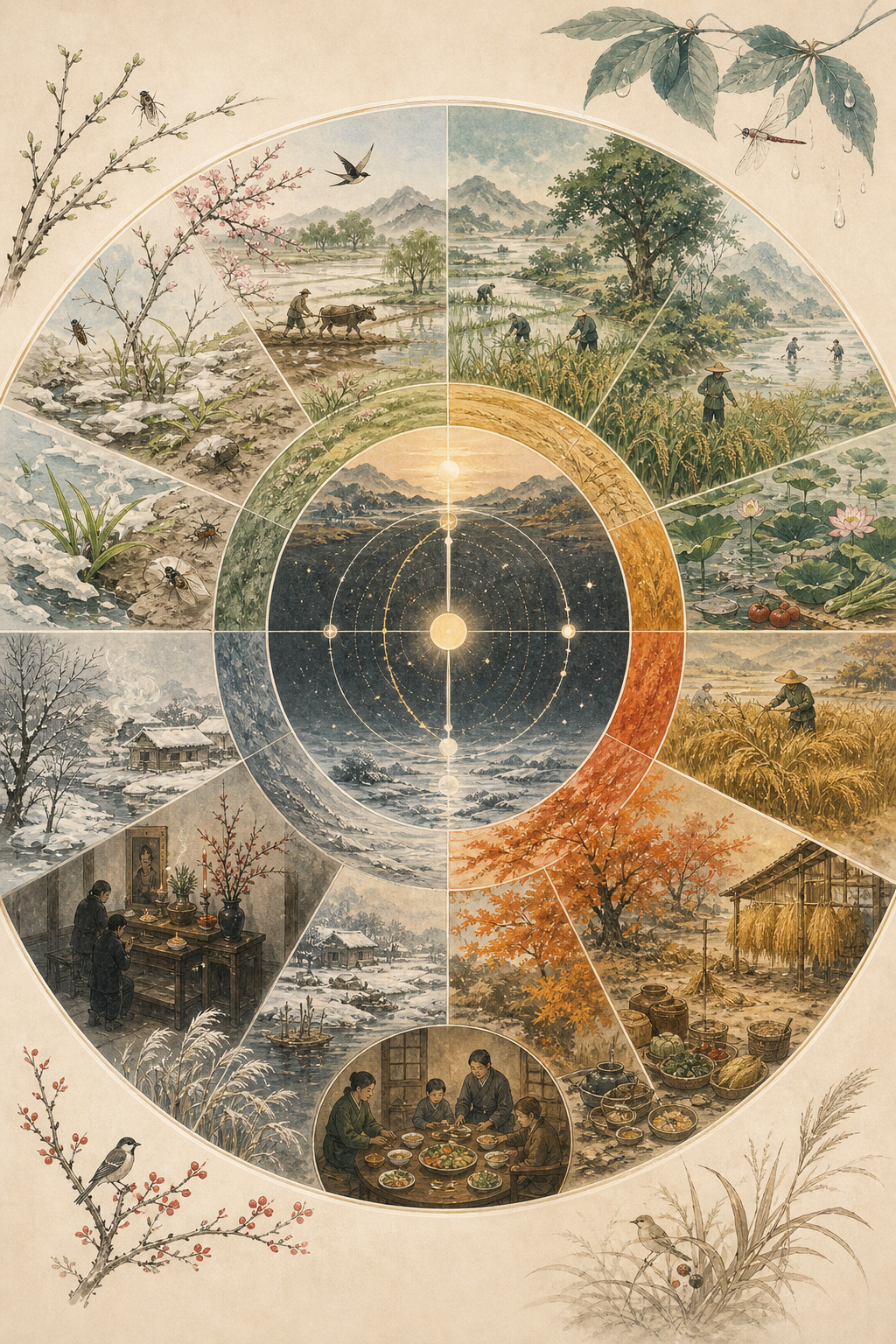
The Twenty-Four Solar Terms divide the solar year into named phases linked to the sun’s annual motion. In traditional practice, however, they were never only astronomical abstractions. They became part of a lived cultural grammar through which people interpreted weather, work, health, ritual timing, festival observance, local memory, and the seasonal body. The result is a calendar of seasonal life in which observational knowledge, cosmological thought, agrarian experience, and folklore became deeply intertwined.
UNESCO describes the Twenty-Four Solar Terms as knowledge in China of time and practices developed through observation of the sun’s annual motion. That formulation is important because it refuses to reduce the system to either science or folklore alone. The Terms are observational, empirical, practical, poetic, ritual, and social at once. They organize production and daily life, but they also shape cultural identity, festival time, foodways, proverbs, songs, and the embodied feeling of the year.
What Are the Twenty-Four Solar Terms?
The Twenty-Four Solar Terms, or ershisi jieqi 二十四節氣 / 二十四节气, are a system of named seasonal markers that divide the solar year into twenty-four phases. They include terms such as Beginning of Spring, Rain Water, Awakening of Insects, Spring Equinox, Clear Brightness, Grain Rain, Beginning of Summer, Grain Buds, Grain in Ear, Summer Solstice, Minor Heat, Major Heat, Beginning of Autumn, End of Heat, White Dew, Autumn Equinox, Cold Dew, Frost Descent, Beginning of Winter, Minor Snow, Major Snow, Winter Solstice, Minor Cold, and Major Cold.
Modern explanations often emphasize their astronomical basis: the sun’s annual path is divided into twenty-four segments. That is accurate and important. But the cultural meaning of the Terms extends far beyond astronomical classification. Each term names a moment in the changing relation between sky, climate, vegetation, animals, soil, water, human labor, diet, ritual timing, and social memory. The Terms are therefore both a calendar and a seasonal philosophy.
Their importance comes from the way they convert observation into cultural form. Weather changes, insects stir, grain ripens, dew appears, heat intensifies, frost descends, and cold deepens. These events happen in nature, but the Solar Terms give them names, sequence, and ritual intelligibility. The world becomes readable because its transitions are remembered.
This is why the Solar Terms belong within a study of myth, folklore, and legend even though they are not myths in the narrow sense. They show how Chinese tradition made time meaningful through patterned observation. They are part of the symbolic infrastructure through which seasonal reality became social life.
Time, Cosmos, and the Ordering of the Year
Chinese calendrical culture is fundamentally relational. It does not simply count units of time in the abstract. It situates time within recurring patterns of celestial movement, terrestrial change, and human response. The Twenty-Four Solar Terms belong to this larger framework by articulating the solar year as a sequence of meaningful transitions rather than as an undifferentiated continuum. The year becomes legible through thresholds: the beginning of spring, the awakening of insects, clear brightness, grain rain, great heat, white dew, cold dew, frost descent, winter solstice, and greater cold.
This form of temporal division matters because it transforms time into a patterned world of signs. A season is not merely a stretch of days. It is a phase in a larger cosmological rhythm, carrying implications for planting, harvesting, mourning, travel, diet, ritual, and embodied conduct. Time is thus experienced not only numerically but symbolically.
In this respect, the Solar Terms are closely aligned with the broader Chinese tendency to view order as emerging from correspondence between heaven, earth, and human life. Calendrical knowledge becomes one of the principal means by which this correspondence is perceived and maintained. To know the season properly is to inhabit the year ethically and practically, in a way that respects natural process rather than resisting it.
The Terms therefore turn chronology into orientation. They teach people where they stand in the year, what kinds of change are unfolding, what kinds of labor are appropriate, what the body may need, and what kinds of ritual or household practice may be seasonally meaningful. A calendar becomes a guide to inhabiting the world.
Heaven, Earth, and Human Attunement
The Solar Terms are rooted in the Chinese idea that human life should respond to the patterned relation of Heaven and Earth. Heaven is not merely sky in the physical sense, and Earth is not merely ground in the material sense. Together they form the cosmic field in which growth, decline, heat, cold, moisture, dryness, birth, harvest, storage, and renewal unfold. Human beings prosper when they read these patterns and act in harmony with them.
This principle of attunement is one of the most important reasons the Solar Terms have mattered for so long. They do not present nature as inert background. They present it as an ordered sequence of transformations to which people must pay attention. Farming, food, clothing, ritual, travel, health, and household custom become forms of seasonal intelligence.
Classical seasonal texts often present the year as a coordinated system of astronomical signs, winds, animal behavior, agricultural tasks, ritual actions, and governmental conduct. Such texts show that seasonal time was never understood only as weather. It was part of political order, bodily order, ritual order, and cosmic order.
Primary Source
東風解凍,蟄蟲始振,魚上冰。The east wind thaws the frozen; hibernating insects begin to stir; fish rise toward the ice.Liji 禮記, “Yue Ling” 月令 / “Monthly Ordinances.” Available at: https://ctext.org/liji/yue-ling
The passage shows the older seasonal imagination from which later Solar Term culture draws: wind, ice, insects, fish, and human timing are read together as signs of transition.
The passage does not list the Twenty-Four Solar Terms as a modern calendar chart would, but it reveals the same underlying worldview: the year is readable through natural signs. Seasonal knowledge is formed by attending to wind, cold, animal movement, moisture, light, and growth. The Solar Terms carry that sensibility into a durable calendrical system.
The Astronomical Structure of the Solar Year
The Twenty-Four Solar Terms are tied to the apparent annual motion of the sun. In practical terms, they divide the year into a sequence of solar positions, each associated with a named phase of seasonal transformation. Because the traditional Chinese calendar is lunisolar, this solar framework helped align lunar months with the changing year of light, climate, agriculture, and ecological rhythm.
This astronomical basis matters because it shows the observational sophistication of the system. The Terms are not arbitrary poetic labels. They are attached to a structured reading of the sun’s motion and its relation to seasonal change. They translate celestial regularity into social and agrarian time.
Yet astronomy alone does not explain their cultural power. A technically accurate solar division could remain a specialist tool. The Twenty-Four Solar Terms became far more than that because their names entered daily life, farming calendars, health practices, festival observance, proverbs, local custom, and cultural memory. The system became durable because it bridged technical knowledge and ordinary experience.
This bridge between sky and practice is central. The sun’s movement is astronomical; planting grain is agricultural; adjusting diet is bodily; holding a festival is social; reciting a seasonal proverb is folkloric. The Solar Terms connect all these levels. They are a calendrical technology for translating cosmic movement into human action.
The Twenty-Four Terms as a Seasonal Sequence
The full sequence of the Twenty-Four Solar Terms matters because the system is not a loose list of seasonal impressions. It is an ordered cycle. Each term gains meaning from its position in relation to the others: spring begins, rain softens the earth, insects awaken, light balances, brightness clears, grain receives rain; summer begins, grain fills, seed is sown, the sun reaches height, heat enters, heat intensifies; autumn begins, heat withdraws, dew appears, equinox balances, cold dew gathers, frost descends; winter begins, snow arrives, snow deepens, the sun turns, cold enters, cold reaches its extreme.
| Season | Solar Terms | Seasonal Logic |
|---|---|---|
| Spring | Beginning of Spring, Rain Water, Awakening of Insects, Spring Equinox, Clear Brightness, Grain Rain | Return of warmth, thawing, stirring life, balanced light, clarity, and rainfall for grain growth. |
| Summer | Beginning of Summer, Grain Buds, Grain in Ear, Summer Solstice, Minor Heat, Major Heat | Expansion of heat, plant growth, sowing and ripening, long daylight, and climatic intensity. |
| Autumn | Beginning of Autumn, End of Heat, White Dew, Autumn Equinox, Cold Dew, Frost Descent | Cooling, condensation, harvest atmosphere, balance, deeper cold, and the approach of frost. |
| Winter | Beginning of Winter, Minor Snow, Major Snow, Winter Solstice, Minor Cold, Major Cold | Contraction, storage, snow, shortest daylight, deepening cold, and the turning toward renewal. |
This sequence is one of the most elegant features of the system. It does not treat each season as a block. It breaks seasonal change into phases. Spring is not one thing; it moves from first beginning to rain, insect awakening, balance, clarity, and grain rain. Autumn is not merely decline; it moves through residual heat, dew, balance, cold dew, and frost. The calendar teaches gradual perception.
This gradualism is culturally important. It reflects an ecological understanding that change happens through subtle thresholds. The year does not suddenly transform. It turns in stages. The Solar Terms train attention to those stages and thereby preserve a form of environmental literacy.
As a symbolic system, the sequence also gives the year narrative shape. It has emergence, expansion, culmination, decline, contraction, and return. The cycle does not need a single hero because time itself becomes the protagonist. The year is the story.
Lichun and the Ritual Beginning of Spring
Lichun 立春, the Beginning of Spring, is one of the most important Solar Terms because it marks the ritual and cosmological opening of spring even before spring may be fully felt in local weather. This distinction matters. A Solar Term is not simply a weather report. It is a threshold in the ordered year. The beginning of spring announces a shift in cosmic direction even if cold remains in the air.
Lichun has long been associated with customs of welcoming spring, agricultural anticipation, and symbolic renewal. In some traditions, spring ox rituals, seasonal foods, and public or household observances marked the arrival of the new seasonal phase. Such practices show how a calendrical term can become socially enacted. People do not merely know that spring begins; they greet it.
The ritual importance of Lichun also reveals the difference between calendar time and lived weather. A season can be ritually inaugurated before it is climatically secure. This gives the term a forward-looking quality. It names the direction of change rather than only present conditions. Lichun teaches that seasonal order is a process underway.
As the first term of the annual cycle, Lichun also gives the Solar Terms a philosophical opening. The year begins by standing spring upright. The Chinese character li 立 suggests establishment or standing. Spring is not simply arriving; it is being set in place as the year’s generative beginning. This makes Lichun one of the clearest examples of how the Solar Terms transform time into symbolic action.
Jingzhe: Insects, Thunder, and the Awakening of Life
Jingzhe 驚蟄, often translated as Awakening of Insects, is one of the most vivid Solar Terms because it names the reanimation of hidden life. The term evokes the moment when creatures that have been dormant begin to stir, traditionally associated with spring thunder and the loosening of winter’s grip. It is a term of sound, movement, and biological return.
Its cultural importance lies in how it makes unseen life perceptible. Insects under the earth, dormant bodies, seeds, roots, and hidden processes become part of the seasonal imagination. The calendar teaches that what is invisible during winter has not vanished. It waits, and then it awakens. Time is therefore not only succession but reemergence.
Jingzhe also shows why the Solar Terms belong to folklore as well as astronomy. The awakening of insects is an ecological observation, but it becomes a named cultural moment. It enters proverbs, farming guidance, weather sayings, local custom, and seasonal feeling. A small biological sign becomes a civilizational marker.
Symbolically, Jingzhe belongs to the larger spring movement from stillness to activity. If Lichun establishes spring and Rain Water softens the ground, Jingzhe dramatizes life stirring within it. The world becomes audible again. Thunder and insects mark the return of motion.
Qingming: Clear Brightness and Ancestor Remembrance
Qingming 清明, often translated as Clear Brightness or Pure Brightness, is especially important because it is both a Solar Term and the basis for one of the most significant observances of ancestor remembrance. The Qingming Festival, associated with tomb-sweeping and offerings to ancestors, occurs on the first day of this Solar Term. This is one of the clearest examples of how the Solar Terms structure ritual life rather than merely agricultural time.
Qingming’s seasonal meaning and ritual meaning are deeply compatible. The term evokes clarity, brightness, spring air, and renewed contact with the landscape. The festival associated with it sends families outdoors to clean graves, make offerings, remember the dead, and maintain ancestral continuity. The living move through spring landscape to honor those who came before. Seasonal renewal and ancestral memory become joined.
This conjunction is culturally profound. Spring’s brightness does not erase the dead; it creates the conditions for remembering them. New growth and grave-sweeping are not opposites. They belong to a worldview in which continuity between generations is part of the renewal of life. Qingming therefore reveals the moral depth of the Solar Terms: a calendrical marker can become a structure of kinship and remembrance.
The importance of Qingming also shows why the Solar Terms are not purely technical. A technical calendar can tell people when the sun reaches a position. A cultural calendar tells people when to remember, mourn, clean, offer, walk, gather, and renew relation with ancestors. Qingming does both.
Grain Rain and the Poetics of Agricultural Time
Guyu 穀雨, or Grain Rain, shows the agricultural and poetic power of the Solar Terms with unusual clarity. The term joins grain and rain in a single phrase, making seasonal precipitation meaningful through its relation to plant growth and human livelihood. Rain is not merely weather. It is timed nourishment.
This term matters because it reveals the agrarian intelligence embedded in the calendar. Farming communities depend not only on rain in the abstract but on rain at the right time. Grain Rain names that relation. It encodes an understanding that crops, moisture, soil, and labor must align for survival. The term is therefore both practical and symbolic.
Grain Rain also helps explain the aesthetic quality of the Solar Terms. Names such as Grain Rain, White Dew, Cold Dew, and Frost Descent are not bureaucratic labels. They are compact seasonal images. They turn ecological process into language that can be remembered and felt. The calendar becomes a poem of agricultural life.
In a broader cultural sense, Grain Rain stands for the dependence of human society on seasonal generosity. The term acknowledges that food begins long before harvest. It begins in properly timed rain, soil conditions, and attentive work. By naming this moment, the calendar honors the hidden stages of nourishment.
Summer Heat and the Body in Seasonal Transition
The summer terms—Beginning of Summer, Grain Buds, Grain in Ear, Summer Solstice, Minor Heat, and Major Heat—track the expansion of warmth into intensity. They also show how the Solar Terms connect environment and body. Heat is not merely measured outside the person. It affects labor, appetite, sleep, clothing, illness, vulnerability, and household routine. Summer time is body time.
The progression from Minor Heat to Major Heat is especially revealing. The calendar does not simply say “hot.” It distinguishes degrees and phases of heat. This distinction matters because seasonal adaptation depends on nuance. The body responds differently to emerging warmth, humid fullness, and peak heat. The calendar preserves that sensitivity.
Summer terms also connect agricultural and bodily time. Crops are growing, fields require labor, and heat intensifies precisely when work may be difficult. The Solar Terms help organize this tension between necessity and vulnerability. They remind communities that work must be timed according to seasonal conditions, not imposed abstractly against them.
In folklore and daily practice, summer terms often became associated with foods, cooling practices, heat avoidance, and local customs of bodily regulation. These practices show that the Solar Terms are not simply about observing nature from a distance. They are about living inside seasonal change with the body as one of its sensitive instruments.
White Dew, Cold Dew, and the Sensory Calendar of Autumn
The autumn terms are among the most sensorially evocative in the entire system. White Dew and Cold Dew mark changing moisture, temperature, and atmosphere. They teach people to notice not only large seasonal transitions but subtle surface signs: condensation, chill, brightness, clarity, and the changing feel of morning air. Autumn becomes readable through dew.
This matters because the Solar Terms preserve a sensory calendar. They are not only tools of calculation. They train perception. Dew is delicate, temporary, and easily overlooked; yet the calendar gives it seasonal significance. To name White Dew is to affirm that small atmospheric details matter in the structure of the year.
Frost Descent deepens this logic. The first signs of frost mark a further movement toward winter. Frost is not merely cold. It is cold made visible on the surface of things. The calendar converts a phenomenon of moisture, temperature, and light into a cultural threshold. The world is changing, and the signs are on leaves, fields, roofs, and ground.
Autumn terms therefore show how the Solar Terms bind observation and emotion. Dew and frost carry aesthetic associations of clarity, melancholy, harvest, decline, and beauty. The calendar does not merely tell people when autumn occurs. It teaches them how autumn feels.
Winter Terms: Contraction, Cold, and the Return of the Year
The winter terms—Beginning of Winter, Minor Snow, Major Snow, Winter Solstice, Minor Cold, and Major Cold—mark contraction, storage, darkness, cold, and eventual return. Winter in the Solar Terms is not simply the absence of growth. It is a necessary phase in the year’s transformation. Cold protects, stores, conceals, and prepares.
The Winter Solstice is especially important because it marks the turning point of light. The year reaches its deepest contraction, but precisely there the return begins. This gives winter a paradoxical symbolic power. The darkest point becomes the seed of renewal. The Solar Terms preserve that structure in calendrical form.
Minor Cold and Major Cold also show the system’s attention to deepening degrees. The cold does not arrive all at once. It strengthens, reaches extremity, and then yields to the return of spring. This pattern gives the calendar a rhythm of endurance. The year teaches that intensification is followed by change.
Winter terms also historically shaped food storage, clothing, rest, household practice, and preparation for the coming agricultural cycle. The season’s work is different from spring’s work, but it is still work. To store, endure, conserve, and prepare are all seasonal actions. Winter is not empty time. It is hidden time.
The Twenty-Four Solar Terms as a Knowledge System
UNESCO describes the Twenty-Four Solar Terms as a knowledge system and set of social practices developed through observation of the sun’s annual motion. This is an important formulation because it emphasizes that the Terms are not just labels on a chart. They are part of a transmitted body of knowledge linking astronomy, agriculture, ecology, weather, health, ritual timing, and daily life. The system was historically used to guide production and living, and it continues to shape cultural identity through custom, ritual, and inherited practice.
The names of the Terms themselves reveal their interpretive richness. They do not simply describe temperature. They register subtle transformations in light, moisture, vegetal growth, animal activity, and atmospheric feel. Terms such as Grain Rain, White Dew, Cold Dew, and Awakening of Insects show that the calendar encodes an environmental poetics as well as a practical system. Nature is read not as background but as text.
Because the Chinese calendar is lunisolar, the Solar Terms also help coordinate seasonal reality with the broader calendrical structure. Lunar months alone do not perfectly track the solar year. The Solar Terms help preserve the relation between civil time and seasonal time. They keep the calendar grounded in the year of light and climate.
This makes the Solar Terms a rare example of knowledge that is technical, poetic, agricultural, social, and ritual all at once. They show that durable knowledge systems often survive because they do not remain confined to specialists. They become embedded in ordinary practice, speech, food, festivals, and memory.
Mythic Calendar and Seasonal Imagination
To call the Solar Terms a mythic calendar is not to claim that each Term is attached to a single mythological tale. Rather, it is to recognize that the system places human life within an enchanted order of recurrence, transformation, and significance. The Terms give names to transitions that might otherwise pass unnoticed, and in naming them they render the world symbolically inhabited. Time becomes storied even when no single narrative dominates.
This is one of the most important features of mythic thought in China more broadly. Myth is not confined to origin stories, divine biographies, or supernatural beings. It also appears in the patterned interpretation of the cosmos itself. A world in which insects awaken, dew whitens, grains ripen, frost descends, and spring begins on a named threshold is a world already ordered by meaning. The Terms help cultivate attentiveness to these rhythms, and that attentiveness is inseparable from the larger cosmological imagination.
The result is a calendar that mediates between abstraction and experience. It is observational and practical, but also aesthetic and symbolic. It guides labor, but it also shapes sensibility. The year becomes something to dwell within, not merely something to measure.
This is why the Solar Terms belong in the same broader intellectual field as myths of creation, flood control, dragons, river gods, agricultural culture heroes, seasonal festivals, and ancestor rites. They express a worldview in which human life is meaningful only when placed within a larger pattern of transformation. The mythic here is not fantasy. It is patterned belonging.
Ritual Life, Festivals, and the Social Year
The Solar Terms also matter because they intersect with ritual time and festive observance. UNESCO notes that rituals and festivities are associated with particular Terms, including local rites linked to seasonal beginnings and other regionally specific observances. This makes the Solar Terms part of a wider ceremonial ecology in which astronomical knowledge, local custom, and social participation reinforce one another.
Qingming is especially important here. Qingming, often translated as Clear Brightness or Pure Brightness, is the fifth Solar Term, and the festival associated with ancestor remembrance occurs on its first day. This is a revealing example of how the calendrical and ritual dimensions of Chinese culture overlap. A seasonal marker becomes the temporal basis for one of the most important observances of memory, kinship, and ancestral continuity.
The Winter Solstice also illustrates the ritual dimension of the Solar Terms. In many Chinese communities, the solstice has been associated with family gathering, offerings, special foods, and the recognition of yang’s return after deepest yin. The astronomical turning of light becomes socially and ritually meaningful. The sky’s change becomes a household event.
In this sense, the Solar Terms do not merely indicate weather. They structure the ceremonial year. They create the temporal architecture within which rites of remembrance, agricultural observance, household custom, food practice, and public festivity can be meaningfully situated. The calendar is therefore not external to social life. It is one of its hidden organizers.
Agrarian Time, Body Time, and Ecological Attunement
Historically, the Solar Terms were indispensable to agrarian life. They helped communities recognize when to sow, transplant, harvest, store, and prepare for climatic change. Yet their significance extends beyond farming in a narrow sense. They also reflect an ideal of ecological attunement: the belief that human flourishing depends on learning to read environmental process with care and precision.
This attunement has bodily implications as well. Seasonal change in Chinese traditions often carries consequences for diet, rest, clothing, and health practices. The Terms thus participate in a broader cultural understanding that the body should adapt to the year’s transformations rather than remain indifferent to them. Time is not only out there in the sky or field. It is experienced in the rhythms of work, vulnerability, appetite, and adjustment.
For this reason, the Solar Terms can be read as a civilizational technology of orientation. They teach perception. They cultivate habits of noticing. They encourage social memory about how to live well within recurring patterns of heat, cold, moisture, growth, and decline. In an age of industrial abstraction and digital detachment, that older ecological intelligence is part of what makes the system feel newly significant.
The Terms also remind modern readers that agrarian knowledge is not primitive because it is local or seasonal. It is sophisticated precisely because it is adaptive. It reads gradients, thresholds, signs, and recurring transformations. The Solar Terms preserve a form of long-duration environmental attention that remains valuable in a time of climate instability and ecological disconnection.
Foodways, Health, and Seasonal Practice
The Solar Terms have long been associated with foodways and seasonal health practices. Different terms may call for different foods, tonics, cooling or warming habits, festival dishes, or local dietary customs. Such practices vary widely by region, but the underlying logic is consistent: the body should respond to seasonal transformation. Food becomes one of the most practical ways of aligning human life with the year.
This food culture is important because it makes the Solar Terms intimate. A calendar can appear abstract until it enters the kitchen. Seasonal eating turns cosmic rhythm into taste, preparation, family memory, and bodily adjustment. Soup, tea, grain, vegetables, rice cakes, dumplings, fruits, and medicinal foods can all become ways of inhabiting the calendar.
Health practices associated with the Solar Terms also reflect a broader Chinese understanding that climatic change affects bodily vulnerability. Heat, cold, dampness, dryness, wind, and seasonal transition are not only external conditions. They shape the body’s condition and require adjustment. The calendar therefore guides care.
This is why the Terms remain culturally active even among people no longer engaged in farming. Urban life may distance people from fields, but it does not remove them from seasonality. People still eat, sleep, dress, travel, fall ill, recover, and remember in time. The Solar Terms continue to offer a language for noticing how the body belongs to the year.
Proverbs, Songs, and the Folklore of Seasonality
The Twenty-Four Solar Terms also survive through oral and vernacular forms. UNESCO notes that the Terms may be referenced in nursery rhymes, ballads, and proverbs, which means that calendrical knowledge is transmitted not only through formal instruction but also through everyday speech and communal memory. This is one of the clearest signs that the system belongs to folklore as much as to astronomy.
Proverbs linked to seasonal transitions condense long experience into memorable verbal forms. They translate observation into guidance and rhythm into speech. In doing so, they allow the calendar to circulate through ordinary life. Children learn the year not merely through calculation but through repetition, sound, and culturally meaningful phrases. The Terms become part of the acoustic life of a civilization.
This vernacular survival matters because it shows how knowledge remains durable when it is socially embedded. A chart can be forgotten. A proverb or seasonal saying can live for generations. The mythic calendar persists because it is spoken, sung, recited, cooked, planted, and enacted as part of daily life.
Such sayings also reveal local adaptation. A proverb about rain, planting, frost, or insects may make strong sense in one region and require adjustment elsewhere. The Solar Terms provide the shared framework; local speech provides ecological precision. Folklore keeps the calendar responsive rather than static.
Regional Variation and Local Ecological Knowledge
The Twenty-Four Solar Terms are widely recognized across Chinese culture, but their practical meaning has always varied by region. A term that corresponds to one kind of weather in northern China may be experienced differently in the south, in coastal areas, in highlands, or in regions shaped by different rainfall patterns. This variation is not a flaw in the system. It is part of how the system enters local life.
Regional variation matters because it prevents the Solar Terms from being treated as abstract universals detached from place. The terms provide a shared language of seasonal sequence, but communities interpret them through local climate, crops, soils, winds, river systems, and foodways. This gives the system both unity and flexibility.
Local ecological knowledge often survives through farming sayings, festivals, household customs, and food traditions tied to specific terms. These practices show how the calendar becomes meaningful only when translated into lived environment. A term names a phase of the solar year; local custom explains what that phase means here.
This regional adaptability is one reason the Solar Terms have endured. They are structured enough to create common cultural memory, but flexible enough to be localized. They provide a shared map without erasing local terrain.
UNESCO, Living Heritage, and Contemporary Meaning
The Twenty-Four Solar Terms were inscribed on UNESCO’s Representative List of the Intangible Cultural Heritage of Humanity in 2016. That recognition is important because it frames the Terms not merely as historical calendar knowledge, but as living heritage: a knowledge system and set of social practices that continue to shape identity, custom, production, and everyday life.
This living-heritage framing is useful because it recognizes that the Solar Terms survive through practice, not only through technical calculation. They live in calendars, farming knowledge, food customs, rituals, proverbs, public education, seasonal festivals, health practices, and family memory. They are intangible heritage because they organize ways of perceiving and acting in time.
At the same time, UNESCO recognition should be interpreted carefully. It did not create the value of the Solar Terms. The system existed long before modern heritage institutions. The inscription is one contemporary layer in a much longer history of astronomical observation, agricultural practice, ritual adaptation, and vernacular transmission.
Contemporary interest in the Solar Terms also reflects new concerns. Climate change, ecological loss, urban detachment from seasonal rhythms, and renewed interest in traditional foodways have all made the system feel newly relevant. The Terms preserve an older language of environmental attention at a moment when such attention is urgently needed.
Source History and Interpretive Caution
A careful reading of the Twenty-Four Solar Terms must distinguish among several related layers: ancient seasonal observation, classical monthly ordinances, later calendrical standardization, agrarian practice, local custom, festival association, medical and dietary adaptation, oral sayings, modern state and educational framing, and UNESCO living-heritage language. These layers overlap, but they are not identical.
Classical texts such as the Liji “Yue Ling” preserve older systems of monthly seasonal correspondence, but they should not be treated as a simple modern list of the Twenty-Four Solar Terms. They are valuable because they reveal the cosmological and ritual imagination from which Solar Term culture draws: Heaven, Earth, winds, animals, plants, agriculture, governance, and ritual all move together. The Solar Terms belong to that world, but the history of the system’s formation and transmission is layered.
Modern sources such as UNESCO and Britannica are also useful but genre-specific. UNESCO frames the Solar Terms as intangible cultural heritage and social practice. Britannica provides concise reference context for the Chinese calendar and Qingming. These sources help modern readers situate the system, but they do not replace primary textual traditions, regional custom, or lived practice.
Finally, the Solar Terms should not be romanticized as timeless ecological harmony untouched by history. They are a sophisticated traditional knowledge system, but they have changed across regions, periods, and social conditions. Their endurance lies not in unchanging uniformity, but in their ability to connect astronomical order, agricultural practice, folklore, ritual, and everyday life across changing worlds.
Why the Solar Terms Matter for Chinese Myth and Folklore
The Twenty-Four Solar Terms matter for the study of Chinese myth, folklore, and legend because they reveal a form of mythic culture that is not centered on a single deity or dramatic narrative. Instead, they show how a civilization can mythologize time itself by organizing the year into symbolically charged thresholds that bind observation, practice, and meaning together.
They also challenge the modern tendency to separate science from culture too sharply. The Solar Terms are observational, empirical, and practical, yet they are also ritual, poetic, social, and cosmological. Their endurance suggests that societies do not live by information alone. They live by meaningful forms that allow knowledge to be inhabited collectively.
Most of all, the Solar Terms still matter because they preserve an older intuition that time is qualitative as well as quantitative. Some days do more than pass. They open, ripen, cool, brighten, darken, and turn. By giving names to those transitions, the Twenty-Four Solar Terms made the year legible as a living cosmos.
That is why they belong not only to the history of calendars, but to the deeper history of Chinese symbolic life. They show how mythic imagination can live inside seasonal attention, how folklore can preserve ecological intelligence, and how a calendar can become one of the most enduring forms of cultural memory.
Related Reading
- Chinese Myth, Folklore & Legend
- Spring Festival, New Year Cosmology, and Folk Belief
- The Dragon Boat Festival, Ritual Memory, and Legendary Origins
- The Cowherd and the Weaver Girl: Stars, Separation, and Festival
- Heaven, Mandate, and the Mythic Imagination of Rule
- Buddhism, Daoism, and the Recasting of Chinese Mythic Worlds
- From Classical Text to Folkloric Archive: How Chinese Myth Survived
Primary Sources
- Liji 禮記 / Book of Rites, “Yue Ling” 月令 / “Monthly Ordinances.” Useful for the classical seasonal-cosmological framework linking months, celestial signs, winds, animals, agriculture, ritual order, and governance. Chinese Text Project edition available at: https://ctext.org/liji/yue-ling
- Huainanzi 淮南子, “Tianwen xun” 天文訓 / “Treatise on the Patterns of Heaven.” Useful for early Chinese cosmological, calendrical, astronomical, and seasonal thought. Chinese Text Project edition available at: https://ctext.org/huainanzi/tian-wen-xun
- Lüshi Chunqiu 呂氏春秋 / Master Lü’s Spring and Autumn Annals. Useful for seasonal ordinances, monthly order, agriculture, government, ritual timing, and the relation between cosmic rhythm and human conduct. Chinese Text Project edition available at: https://ctext.org/lv-shi-chun-qiu
- Yueling qishier hou jijie 月令七十二候集解 / Collected Explanations of the Seventy-Two Seasonal Phenological Periods. Useful for later seasonal micro-periods and phenological interpretations associated with the Solar Terms. Chinese Text Project edition available at: https://ctext.org/wiki.pl?if=gb&res=977650
- Xia xiaozheng 夏小正 / Small Calendar of the Xia. Useful with caution as an early calendrical text associated with monthly seasonal observations, agricultural timing, and animal or plant signs. Chinese Text Project edition available at: https://ctext.org/xia-xiao-zheng
- UNESCO Intangible Cultural Heritage (2016) “The Twenty-Four Solar Terms, knowledge in China of time and practices developed through observation of the sun’s annual motion.” Useful as an official contemporary heritage source for the Solar Terms as living knowledge, social practice, agricultural guidance, folk custom, and cultural identity. Available at: https://ich.unesco.org/en/RL/the-twenty-four-solar-terms-knowledge-in-china-of-time-and-practices-developed-through-observation-of-the-sun-s-annual-motion-00647
Further Reading
- UNESCO Intangible Cultural Heritage (2016) “The Twenty-Four Solar Terms, knowledge in China of time and practices developed through observation of the sun’s annual motion.” Available at: https://ich.unesco.org/en/RL/the-twenty-four-solar-terms-knowledge-in-china-of-time-and-practices-developed-through-observation-of-the-sun-s-annual-motion-00647
- UNESCO Archives (2016) “The Twenty-Four Solar Terms: Chinese Knowledge of Time.” Available at: https://www.unesco.org/archives/multimedia/document-4397
- Encyclopaedia Britannica (n.d.) “Chinese calendar.” Available at: https://www.britannica.com/science/Chinese-calendar
- Encyclopaedia Britannica (2026) “Qingming Festival.” Available at: https://www.britannica.com/topic/Qingming-Festival
- Chinese Text Project (n.d.) Liji 禮記, “Yue Ling” 月令. Available at: https://ctext.org/liji/yue-ling
- Chinese Text Project (n.d.) Huainanzi 淮南子, “Tianwen xun” 天文訓. Available at: https://ctext.org/huainanzi/tian-wen-xun
- Chinese Text Project (n.d.) Lüshi Chunqiu 呂氏春秋. Available at: https://ctext.org/lv-shi-chun-qiu
- Metropolitan Museum of Art (2021) “Notes on Time: Art, Language, and the Night Sky.” Available at: https://www.metmuseum.org/perspectives/night-sky-2
- Bodde, D. (1975) Festivals in Classical China: New Year and Other Annual Observances During the Han Dynasty, 206 B.C.–A.D. 220. Princeton: Princeton University Press.
- Major, J.S., Queen, S.A., Meyer, A.S. and Roth, H.D. (2010) The Huainanzi: A Guide to the Theory and Practice of Government in Early Han China. New York: Columbia University Press.
- Knoblock, J. and Riegel, J. (2000) The Annals of Lü Buwei: A Complete Translation and Study. Stanford: Stanford University Press.
- Feuchtwang, S. (2001) Popular Religion in China: The Imperial Metaphor. Richmond: Curzon.
References
- Bodde, D. (1975) Festivals in Classical China: New Year and Other Annual Observances During the Han Dynasty, 206 B.C.–A.D. 220. Princeton: Princeton University Press.
- Chinese Text Project (n.d.) Huainanzi 淮南子, “Tianwen xun” 天文訓. Available at: https://ctext.org/huainanzi/tian-wen-xun
- Chinese Text Project (n.d.) Liji 禮記, “Yue Ling” 月令. Available at: https://ctext.org/liji/yue-ling
- Chinese Text Project (n.d.) Lüshi Chunqiu 呂氏春秋. Available at: https://ctext.org/lv-shi-chun-qiu
- Chinese Text Project (n.d.) Xia xiaozheng 夏小正. Available at: https://ctext.org/xia-xiao-zheng
- Chinese Text Project (n.d.) Yueling qishier hou jijie 月令七十二候集解. Available at: https://ctext.org/wiki.pl?if=gb&res=977650
- Encyclopaedia Britannica (n.d.) “Chinese calendar.” Available at: https://www.britannica.com/science/Chinese-calendar
- Encyclopaedia Britannica (2026) “Qingming Festival.” Available at: https://www.britannica.com/topic/Qingming-Festival
- Feuchtwang, S. (2001) Popular Religion in China: The Imperial Metaphor. Richmond: Curzon.
- Knoblock, J. and Riegel, J. (2000) The Annals of Lü Buwei: A Complete Translation and Study. Stanford: Stanford University Press.
- Major, J.S., Queen, S.A., Meyer, A.S. and Roth, H.D. (2010) The Huainanzi: A Guide to the Theory and Practice of Government in Early Han China. New York: Columbia University Press.
- Metropolitan Museum of Art (2021) “Notes on Time: Art, Language, and the Night Sky.” Available at: https://www.metmuseum.org/perspectives/night-sky-2
- UNESCO Archives (2016) “The Twenty-Four Solar Terms: Chinese Knowledge of Time.” Available at: https://www.unesco.org/archives/multimedia/document-4397
- UNESCO Intangible Cultural Heritage (2016) “The Twenty-Four Solar Terms, knowledge in China of time and practices developed through observation of the sun’s annual motion.” Available at: https://ich.unesco.org/en/RL/the-twenty-four-solar-terms-knowledge-in-china-of-time-and-practices-developed-through-observation-of-the-sun-s-annual-motion-00647