
Last Updated May 5, 2026
The Dragon Boat Festival endures because it gathers multiple layers of Chinese cultural life into a single recurring ceremonial form. It is at once a seasonal observance, a ritual response to danger, a public performance of communal coordination, a site of literary remembrance, and a living repository of regional custom. Although modern explanation often presents the festival primarily as a commemoration of Qu Yuan, that familiar account is only one powerful stratum within a much older and broader ritual complex shaped by water, seasonality, protection, sacrifice, local ecology, and the social memory of place.
This layered character is precisely what makes the Dragon Boat Festival so important for the study of Chinese myth, folklore, and legend. Here one can see how narrative does not remain separate from calendrical life, how moral memory attaches itself to inherited practice, and how communal rites gradually absorb literary and political meanings without losing their older ritual force. Dragon boats, river races, zongzi, fragrant herbs, protective threads, realgar wine, mugwort, calamus, and the remembered image of Qu Yuan do not belong to separate cultural worlds. They are fused into one ceremonial formation in which seasonal danger, symbolic action, and legendary interpretation continually reinforce one another.
Series context: This article is part of the Chinese Myth, Folklore & Legend knowledge series. For the broader category structure, return to the Mythology category.
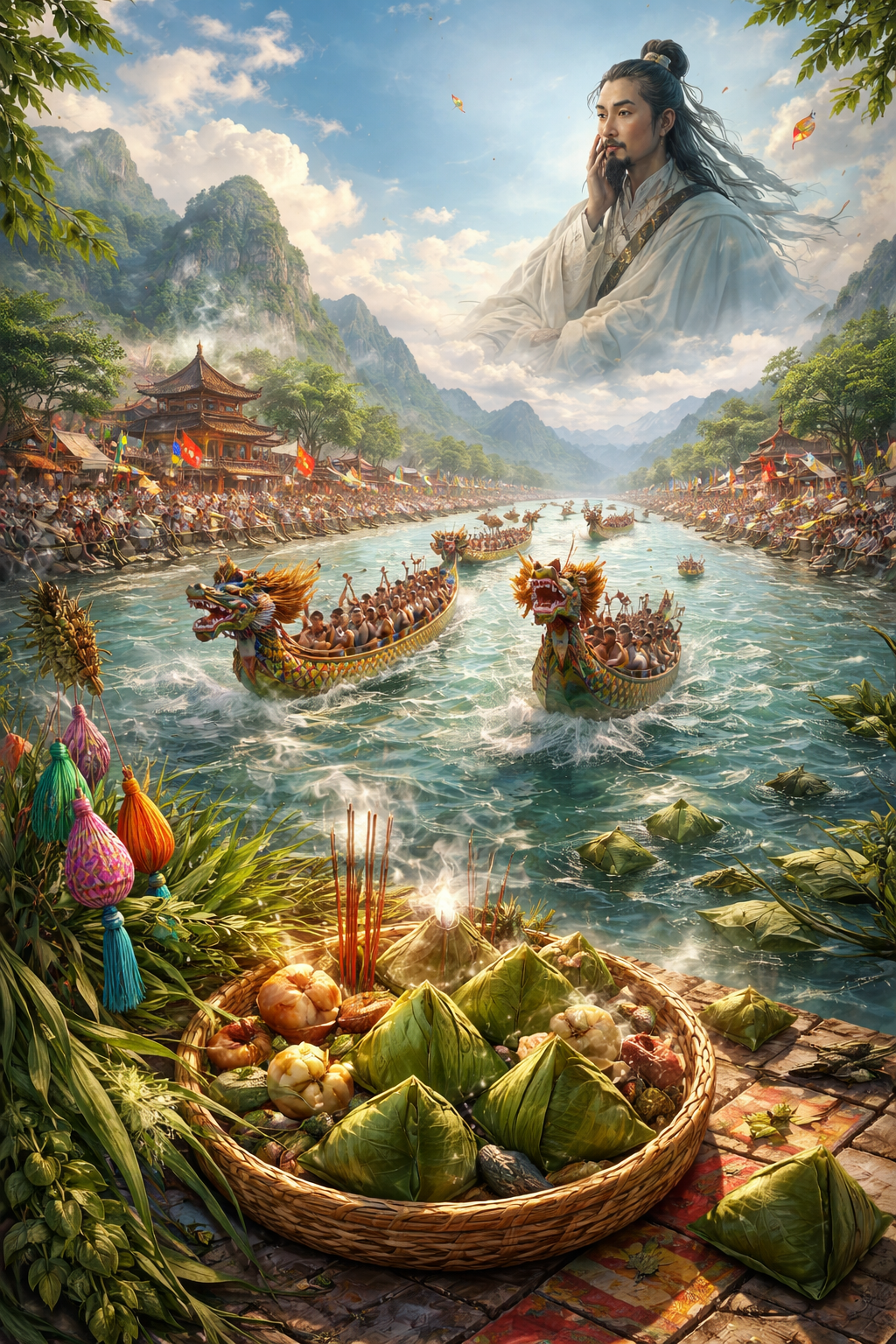
The Dragon Boat Festival is often known as Duanwu 端午 and is observed on the fifth day of the fifth lunar month. Its date is part of its meaning. In older seasonal thought, the fifth month was widely associated with danger, heat, disease, poisonous creatures, and bodily vulnerability. The festival therefore belongs not only to commemoration but to protection. Its customs address a charged point in the year when households and communities seek to ward off harm, purify space, strengthen bodies, and cross a difficult seasonal threshold.
Modern heritage language preserves this layered quality. UNESCO describes the Dragon Boat Festival as a living cultural practice involving rituals, boat races, foodways, protective customs, and community participation. That contemporary framing is useful because it prevents the festival from being reduced to one story. Qu Yuan is central to its moral and literary memory, but the festival also belongs to river culture, seasonal medicine, household protection, communal performance, local variation, and the long life of embodied tradition.
What Is the Dragon Boat Festival?
The Dragon Boat Festival is a traditional Chinese festival observed on the fifth day of the fifth lunar month. It is associated with dragon boat racing, eating zongzi, hanging protective herbs, wearing perfumed sachets, tying colorful threads, drinking or symbolically using realgar wine in some traditions, and remembering Qu Yuan, the poet-minister of Chu whose death became the festival’s most famous commemorative explanation. Yet the festival cannot be reduced to any one of those elements. It is a seasonal complex in which ritual, food, memory, medicine, water, performance, and folklore converge.
The festival’s importance lies partly in its ability to hold multiple meanings without collapsing them into one origin. It is a festival of water, but not only water. It is a festival of Qu Yuan, but not only Qu Yuan. It is a festival of protection, but not only protection. It is a festival of dragon boats, but not only spectacle. Its ritual strength comes from accumulation. Each custom adds another layer to the ceremonial field.
For that reason, the Dragon Boat Festival is best read as a living structure rather than a single story. The boat race stages collective force on water. The rice dumpling condenses offering, food, and memory. Protective herbs mark the household against seasonal danger. The Qu Yuan legend gives the festival a moral and literary center. Public celebration renews community. Together, these elements make the fifth day of the fifth month one of the richest ritual dates in Chinese calendrical life.
The festival also reveals how Chinese tradition often joins cosmic time to embodied practice. Heat, disease, poison, river danger, ancestral memory, political grief, public coordination, and household protection are all made ritually manageable. The festival does not merely describe danger. It acts upon it.
Ritual Time and Seasonal Danger
The Dragon Boat Festival occurs at a charged point in the ritual year. The fifth lunar month was often regarded in traditional Chinese culture as a dangerous seasonal threshold associated with heat, pestilence, poisonous creatures, and bodily vulnerability. The festival therefore belongs not only to a commemorative tradition but also to a broader set of practices intended to avert harm, restore balance, and protect households and communities during a period understood as climatically and spiritually unstable.
This seasonal dimension is crucial because it reveals how deeply Chinese festival culture is bound to lived cosmology. Many customary acts linked to the festival, including the wearing of perfumed sachets, the hanging of mugwort and calamus, the tying of protective threads, and the preparation of ritual foods, make sense within a wider apotropaic framework. Their function was not merely decorative. They formed part of a ritual grammar of warding, purification, and embodied protection.
Seen in this light, the Dragon Boat Festival belongs to the same broader civilizational pattern that links seasonal observance to cosmic rhythm, agricultural timing, bodily care, and ritual adaptation. It is not simply a memorial anniversary. It is a calendrical event in which the natural year, the social body, and the mythic imagination intersect. This is one reason the festival has remained so durable: it is attached not only to a story, but to a felt moment in the cycle of life itself.
The festival’s timing also gives it a different emotional texture from the Spring Festival. Spring Festival marks renewal at the threshold of the year; Dragon Boat Festival marks danger within the unfolding year. One opens the calendar with auspicious beginning; the other confronts a seasonal intensification of heat, illness, and disorder. Both are festivals of protection, but they protect different thresholds.
The Fifth Month and the Problem of Poison
The fifth month’s association with poison is one of the keys to understanding the Dragon Boat Festival’s older ritual logic. Heat and humidity bring insects, illness, snakes, scorpions, centipedes, and other feared creatures into human awareness. Traditional festival customs often refer to the “five poisons” or to a wider field of noxious influences, seasonal illness, and bodily vulnerability. The festival responds by surrounding the household and body with protective signs.
This is why herbs, fragrance, color, and symbolic substances matter so much. Mugwort and calamus are hung not simply because they are attractive, but because they are imagined as protective. Sachets worn by children are not merely decorative ornaments; they carry fragrance, medicine, and apotropaic meaning. Colorful threads bind protection to the body. The festival turns fear of seasonal poison into a set of manageable ritual practices.
Early seasonal texts preserve this protective framework. The Jingchu suishi ji, a major record of seasonal customs, describes fifth-day practices involving medicinal and protective substances. These records are important because they show that Duanwu customs were embedded in a wider seasonal-medical imagination, not only in later Qu Yuan commemoration.
Primary Source
五月五日,謂之浴蘭節。The fifth day of the fifth month is called the Festival of Bathing in Orchids.Jingchu suishi ji 荊楚歲時記, seasonal customs record. Available at: https://ctext.org/wiki.pl?chapter=328815&if=gb
The line preserves an early association between the fifth day of the fifth month and purifying, fragrant, medicinal, and seasonal protective practice.
The phrase “Bathing in Orchids” is especially revealing because it places the festival within a cleansing and aromatic frame. The fifth day is not only a day of racing or remembrance. It is a day when the body, household, and community respond to danger through fragrance, medicine, and ritual purification. The festival protects by making the vulnerable body part of the ritual field.
Qu Yuan and the Politics of Memory
The best-known explanation of the festival centers on Qu Yuan 屈原, the poet and minister traditionally associated with the state of Chu during the Warring States period. According to later accounts, Qu Yuan, alienated from court and devastated by political decline, drowned himself in the Miluo River. People then raced out in boats to recover his body and cast rice into the water so that fish would not consume it. Over time, this story became the most famous narrative explanation for the boat races and dumpling offerings associated with the festival.
The power of this legend lies in more than pathos. Qu Yuan became a figure through whom loyalty, protest, exile, poetic truth, and political grief could be condensed into a single moral image. His story transformed the festival into a ritual of remembrance centered on incorruptibility and cultural loss. In this sense, the Dragon Boat Festival became not only a seasonal rite but also a drama of ethical memory. It attached the affective force of ritual repetition to the image of a wronged minister whose fidelity outlasted the political world that rejected him.
This moralization of the festival proved extraordinarily durable. As Qu Yuan’s literary prestige grew, especially through his association with the Chu Ci 楚辭 tradition, the commemorative explanation gained wider cultural authority. What may once have been regionally varied seasonal rites could now be read through the lens of patriotic mourning, literary remembrance, and the exemplary suffering of a righteous man. The result was not a replacement of ritual by literature, but a fusion of the two. Qu Yuan did not erase the older layers of the festival; he gave them a new moral and political center.
Yet this moral center should be read carefully. Qu Yuan’s festival role is not a simple historical origin in the modern documentary sense. It is a powerful act of cultural interpretation. The festival gave his memory ritual form, while his memory gave the festival ethical depth. Together they created one of Chinese culture’s most enduring examples of literature entering the calendar.
Chu Ci, Poetry, and the Literary Afterlife of Qu Yuan
The association between Qu Yuan and the Chu Ci is essential to the festival’s later moral and literary force. The Chu Ci, or Songs of Chu, preserves a southern poetic world of exile, divine encounter, fragrant plants, shamanic movement, political frustration, and moral self-fashioning. Qu Yuan’s traditional association with this corpus made him not only a historical minister but a figure of poetic conscience. The Dragon Boat Festival therefore became tied to a literary memory of integrity under political failure.
Among the most famous lines associated with the Qu Yuan tradition is the resolve to continue searching along a long and difficult road. Whether read through the specific poetic voice of Li Sao or through later cultural memory, the phrase became emblematic of moral persistence. It captures why Qu Yuan could become a festival figure: he is remembered as someone whose search for truth and right order continued despite exile and defeat.
Primary Source
路漫漫其修遠兮,吾將上下而求索。The road is long and far; I will search above and below.Chu Ci 楚辭, Li Sao 離騷. Chinese Text Project overview available at: https://ctext.org/chu-ci
The line helps explain the later moral image of Qu Yuan as a figure of searching, exile, loyalty, and uncompromising integrity.
Qu Yuan’s literary afterlife matters because it shows how poetry can become public memory. A poem remains text, but a festival makes the poet annually present. The Dragon Boat Festival transforms literary grief into embodied custom. Boat races, rice dumplings, and river remembrance become ways of keeping a poetic-political figure within communal time.
The Chu Ci also gives the festival a southern cultural resonance. Its landscapes, spirits, waters, plants, and ritual atmosphere belong to a world distinct from northern classical forms. The Dragon Boat Festival’s association with Qu Yuan therefore also preserves the memory of Chu as a powerful southern source of Chinese literary and ritual imagination.
Beyond a Single Origin Legend
Yet the Qu Yuan story does not exhaust the festival’s meanings, nor does it necessarily explain all of its historical layers. Many features of the Dragon Boat Festival point to broader southern river traditions, seasonal rites, and protective customs that cannot be reduced to the biography of one historical-literary figure. The commemorative legend is culturally central, but it is best understood as one especially powerful interpretive overlay within a more complex ritual field.
In some traditions, the festival has also been associated with other figures, regional heroes, local memories, or river-related rites. This plurality matters because it shows how Chinese festival culture often operates: not through fixed dogmatic origins, but through accretion, reinterpretation, and coexistence. A single festival can hold multiple genealogies at once: cosmological, seasonal, communal, literary, regional, and political.
This is one reason the Dragon Boat Festival is so important for the study of myth and folklore. It demonstrates how legendary origin is often retrospective. Communities do not merely inherit rituals; they narrate them, moralize them, localize them, and reframe them through figures who embody the values they wish to preserve. Qu Yuan became one such figure, but his prominence also reveals how legend can reorganize older ritual structures without entirely displacing them.
The festival therefore becomes a model case of how memory works in Chinese tradition: layered, cumulative, and interpretively generative rather than singular and fixed. A ritual can be older than the story that now explains it; a story can deepen a ritual it did not originally create; a local custom can survive inside a national festival; and public heritage can reframe all of them for modern audiences.
Dragon Boats, Water, and Collective Performance
The dragon boat itself is one of the festival’s most striking symbolic forms. Long, narrow racing vessels marked by dragon imagery bind together water, motion, danger, spectacle, and sacred symbolism. In Chinese mythic culture, the dragon is not merely a monster or decorative emblem. It is a being associated with water, rain, transformation, power, and the dynamic mediation between heaven and earth. To stage competitive rowing in dragon-shaped boats is therefore to perform a ritualized encounter with forces larger than the human community.
Boat racing also dramatizes collective coordination. Unlike solitary acts of devotion, the race requires rhythm, discipline, cooperation, and public synchronization. Drums regulate motion, paddlers move as one body, and spectators are drawn into a charged communal scene. This gives the festival a social density that is essential to its durability. Legend is not merely told; it is enacted through embodied public performance. The race becomes a visible expression of order wrested from danger through communal discipline.
Water is equally central. Rivers in Chinese cultural history are not neutral settings. They are arteries of agriculture, commerce, political geography, flood, danger, and sacred imagination. To race boats on rivers is to enter a space long charged with both life and risk. In this sense, the festival stages not only remembrance but also a patterned negotiation with watery power. The dragon boat is both commemorative vessel and ritual technology of participation in a living environmental world.
The race also turns memory into motion. If read through the Qu Yuan legend, the racing boat echoes the urgent search for the drowned poet. If read through older ritual frameworks, the boat moves as a communal intervention into seasonal danger. If read through modern sport and heritage, the boat becomes an emblem of coordinated identity. The same movement can carry all these meanings at once.
Dragons, Rivers, and the Ritual Imagination of Water
The dragon imagery of the festival should be read within the broader Chinese symbolic world of water. Dragons are associated with rain, rivers, seas, clouds, seasonal fertility, imperial authority, and the movement of vital forces. A dragon boat is therefore not simply a decorative racing vessel. It is a moving sign of watery power brought under communal rhythm.
This symbolic background helps explain why dragon boat racing is such a compelling festival practice. The boat enters the river not as an ordinary craft alone, but as a dragon-shaped body animated by human coordination. The paddlers become the limbs of the dragon; the drum becomes its pulse; the river becomes the field through which communal energy moves. The performance transforms a dangerous element into a choreographed, auspicious, public act.
The dragon also links the festival to questions of rain, agriculture, and environmental dependence. Water gives life, but it can also flood, drown, rot, sicken, or destroy. The Dragon Boat Festival sits at the intersection of this ambiguity. It celebrates on water, remembers death in water, and uses dragon imagery to engage water’s mythic force.
In this sense, the festival belongs beside other Chinese water traditions: Dragon Kings, river spirits, Mazu devotion, rainmaking rites, flood-control myths, and legends of beings who mediate between human settlements and unstable waters. The Dragon Boat Festival is not only a human memorial. It is a ritual encounter with water as a sacred and dangerous field.
Zongzi, Offering, Memory, and Ritual Food
The making and sharing of zongzi, glutinous rice parcels wrapped in leaves, is often explained through the Qu Yuan legend: villagers cast rice into the river so fish would spare the poet’s body. This explanation remains culturally important, but the food also belongs to the wider ritual logic of festival offering, seasonal marking, and communal continuity. Festival foods are never merely nutritional. They are condensed forms of memory, participation, and symbolic repetition.
Zongzi are powerful because they are made, wrapped, tied, cooked, shared, offered, and eaten. Their meaning is tactile as much as narrative. The leaves, the rice, the binding, the family labor, and the regional differences in filling all make the festival materially present. One does not only remember the Dragon Boat Festival by hearing a story. One tastes it.
As ritual food, zongzi also bridge the domestic and the public. They can be made at home, given to relatives, sold in markets, offered symbolically, or eaten during public celebration. Their repeated preparation preserves memory through habit. The recipe becomes an archive. The hand that folds the leaves participates in the same tradition as the boat that crosses the river.
The food’s association with Qu Yuan gives it moral force, but its continued life depends on household practice. The legend explains; the kitchen transmits. In this way, zongzi show how Chinese festival culture preserves meaning through embodied repetition rather than text alone.
Herbs, Sachets, Threads, and Household Protection
Other objects associated with the festival deepen its protective dimension. Sachets filled with fragrant herbs, mugwort and calamus placed at doors, and colorful threads worn by children are all part of a protective repertoire. Their meanings point outward from the commemorative legend toward anxieties about illness, malign influence, poisonous creatures, and vulnerable transition. The festival is therefore both memorial and medicinal in the broad cultural sense: a time when households actively intervene in the uncertainties of season and body.
Mugwort and calamus are especially significant because they bring protective plant power to the household threshold. Like red couplets at Spring Festival, herbs at Duanwu transform the doorway into a boundary under ritual management. They mark the house as defended. The plants are not decorative greenery in the modern ornamental sense. They are protective signs that join fragrance, medicine, and apotropaic force.
Sachets worn by children show the festival’s concern with bodily vulnerability. Children are especially exposed in seasonal-protection customs because they represent both fragility and continuity. A perfumed sachet protects the child’s body while also displaying family care. The object becomes a small portable boundary against harmful influence.
Colorful threads similarly bind protection to the body. Whether read through color symbolism, regional custom, or child-protection practice, such threads make ritual defense wearable. The festival’s protective logic is therefore not only spatial but bodily. Doors, boats, food, herbs, and skin all become places where seasonal danger is answered.
Realgar Wine, Medicine, and Dangerous Seasonality
Realgar wine is another custom often associated with the Dragon Boat Festival, although its use has varied across regions and periods and modern safety concerns require caution. Symbolically, it belongs to the same seasonal-protective complex as herbs, sachets, and threads. Realgar was associated with repelling poison and harmful creatures, making it culturally intelligible in a festival tied to the dangerous fifth month.
The symbolic importance of realgar is visible in literature as well as custom. In the White Snake legend, the Dragon Boat Festival and realgar wine become the conditions under which Bai Suzhen’s concealed serpentine form is revealed. That famous scene draws upon the festival’s association with repelling poisonous or hidden beings. The legend is not incidental to Duanwu; it dramatizes one of the festival’s deeper anxieties about bodies, poison, concealment, and revelation.
In the Dragon Boat Festival context, realgar wine shows how traditional seasonal observance often blurred the boundaries between medicine, ritual, folklore, and household protection. People responded to heat, illness, insects, and poisonous creatures with substances understood as protective. The practice was part of a broader attempt to make a dangerous season manageable.
Modern readers should handle this topic carefully. Realgar contains arsenic compounds, and historical use should not be treated as modern health advice. Its importance here is cultural and symbolic: it reveals how communities made sense of seasonal danger and how protective substances entered festival practice, literature, and popular imagination.
Wu Zixu, Cao E, and Regional Memory
Although Qu Yuan is the best-known figure associated with the Dragon Boat Festival, other regional traditions have linked the fifth day of the fifth month with different figures, including Wu Zixu and Cao E. These associations matter because they show that the festival’s commemorative layer was not always singular. Different regions could attach their own moral memories, local heroes, filial exemplars, or tragic figures to the same seasonal date.
Wu Zixu, associated with loyalty, revenge, and political tragedy in the Wu-Yue historical imagination, gives the festival another possible politics of memory. Cao E, remembered as a filial daughter associated with river death and recovery, gives it a different ethical focus centered on filial devotion and local remembrance. These traditions do not displace Qu Yuan so much as demonstrate the festival’s capacity to absorb multiple regional moral histories.
This plurality is important because it challenges simplified origin narratives. The Dragon Boat Festival is not best understood as a custom that began in one event and then spread unchanged. It is a ritual date onto which many communities could map danger, water, death, loyalty, filiality, and remembrance. Qu Yuan became the most nationally prominent figure, but he is not the only figure through whom the festival has been interpreted.
Regional memory also reveals the role of rivers as moral landscapes. Whether associated with Qu Yuan, Wu Zixu, Cao E, or local rites, water becomes a medium through which loss is remembered and meaning is recovered. The river is not only a place of drowning. It is a place where communities return each year to enact memory.
Popular Religion, Local Variation, and Living Heritage
The Dragon Boat Festival should also be situated within the broader field often described as Chinese popular religion. Festivals in this world rarely separate neatly into religious, civic, seasonal, and folkloric categories. Temple networks, river communities, village associations, lineage groups, local deities, protective customs, and public performances often overlap. The same festival can be at once communal celebration, seasonal safeguard, local spectacle, ritual duty, and moral remembrance.
Regional diversity is therefore fundamental rather than incidental. The forms of boat racing, the foods prepared, the ritual emphases, and the narratives foregrounded vary across place. Some communities emphasize Qu Yuan. Others emphasize local dragon boat traditions, river gods, village solidarity, protective medicine, or public competition. This matters because the festival is not a frozen relic but a living complex sustained in multiple regions and among multiple communities.
This living quality is essential to interpretation. The Dragon Boat Festival is not important merely because it preserves an ancient legend. It matters because it shows how communities preserve meaning through repeated, adaptive practice. Ritual continuity here is neither static nor purely invented. It is maintained by social participation, regional identity, memory work, and the ability of inherited forms to absorb new contexts without losing symbolic force.
Local variation also explains why the festival can feel simultaneously familiar and different across the Chinese-speaking world and diaspora. The date, dragon boats, and zongzi may be widely recognized, but the specific foods, rites, race forms, protective objects, and stories can differ. The festival’s coherence lies in shared ritual grammar, not complete uniformity.
Festival Performance and Communal Coordination
One of the festival’s most important features is that it makes community visible through coordinated action. Dragon boat racing requires teams, drummers, organizers, boat builders, ritual specialists in some contexts, sponsors, spectators, and river management. The community does not merely observe a symbolic object. It becomes the body that moves the boat.
This performance of coordination is central to the festival’s social meaning. The paddlers’ synchronized motion turns many people into one moving force. The drum regulates collective time. The boat’s speed depends on discipline and shared rhythm. The race therefore becomes a public image of social order under pressure. The river is dangerous; the community responds by moving together.
Public performance also transforms memory into spectacle. Qu Yuan’s story may be narrated verbally, but the race makes remembrance kinetic. The community acts out urgency, search, and collective response. Even when participants approach the race as sport, the form carries older ritual resonances. Competition does not erase meaning; it often becomes the modern mode through which the older form survives.
Festival performance also makes the Dragon Boat Festival accessible beyond textual literacy. A person does not need to read the Chu Ci to understand the emotional force of a boat cutting across water under the sound of drums. The festival communicates through movement, sound, color, food, and gathering. That sensory breadth is one reason it has endured so strongly.
UNESCO, Living Heritage, and Contemporary Practice
The Dragon Boat Festival was inscribed by UNESCO in 2009 on the Representative List of the Intangible Cultural Heritage of Humanity. This recognition is important because it frames the festival as a living practice rather than only as an ancient story. It emphasizes regional diversity, community participation, boat racing, foodways, protective customs, and transmission across generations. The festival is heritage not because it is frozen, but because it continues to be enacted.
This living-heritage framing is useful because it captures how the Dragon Boat Festival survives: through repeated social practice. People race, cook, wrap, hang, wear, drum, watch, teach, and remember. These actions transmit the festival as a lived body of knowledge. The tradition exists not only in books or official explanations, but in families, river communities, regional associations, and public spaces.
At the same time, UNESCO recognition should be interpreted carefully. It does not create the festival’s value. The festival existed for centuries before modern heritage institutions. Heritage status is one modern layer in a much longer history of seasonal ritual and cultural memory. It can support preservation and visibility, but the deeper vitality of the festival comes from communities that continue to practice it.
Contemporary practice also involves modern transformations. Dragon boat racing has become an international sport. Public celebrations may be shaped by tourism, civic branding, diaspora identity, athletic competition, and cultural diplomacy. These modern forms can sometimes simplify older meanings, but they also keep the festival visible. The task is not to reject modernity, but to read modern practice alongside the older ritual, seasonal, and literary layers it carries forward.
Diaspora, Sport, and Modern Dragon Boat Culture
In modern global culture, dragon boat racing has become one of the most recognizable Chinese festival practices beyond China. Races are now held in many cities around the world, often involving Chinese diaspora communities as well as multicultural teams with no ancestral connection to the festival. This global spread changes the festival’s public form while also extending its symbolic reach.
Sport can detach dragon boat racing from some of its older ritual and seasonal frameworks, but it can also preserve important elements of the tradition. Team rhythm, drumming, water, dragon imagery, and public gathering remain central. The race still turns collective coordination into visible action. Even where Qu Yuan commemoration or protective customs are less emphasized, the boat itself carries a long cultural memory.
Diaspora communities often use the festival to preserve identity, teach children, gather families, sponsor public cultural events, and maintain continuity with ancestral heritage. In this setting, the Dragon Boat Festival becomes a bridge between memory and modern civic life. A race on an urban lake or river may function as sport, cultural education, public celebration, and diasporic belonging at once.
Modern dragon boat culture therefore belongs to the festival’s continuing afterlife. It is not identical to older village rites or regional river festivals, but it is part of the same long history of adaptation. The festival survives because it can move: from river ritual to national heritage, from local custom to international sport, from moral memory to global performance.
Myth, Folklore, and Cultural Continuity
The Dragon Boat Festival reveals several of the central dynamics of Chinese mythic culture. First, it shows that myth and folklore are often inseparable from calendrical life. Narratives do not float above the social world; they become anchored in days, objects, foods, landscapes, and communal gestures. Second, it shows that legendary origins are often layered onto older ritual structures, producing traditions that are meaningful precisely because they hold several histories at once.
Third, the festival demonstrates how moral memory becomes embodied. Qu Yuan’s legend endured not simply because it was written down, but because it could be attached to an already powerful ritual frame of water, danger, communal action, and seasonal repetition. The legend entered the body of the calendar. Once there, it became extraordinarily difficult to separate commemoration from custom.
Fourth, the festival shows how folklore preserves multiple kinds of knowledge at once. It preserves environmental knowledge about seasonal danger, social knowledge about coordination, culinary knowledge about ritual foods, poetic knowledge about Qu Yuan and the Chu tradition, and protective knowledge about herbs, threads, sachets, and household thresholds. These forms of knowledge are not kept in separate compartments. They are bundled in practice.
Finally, the Dragon Boat Festival still matters because it discloses a pattern visible across the broader Chinese mythic archive: the persistence of symbolic forms through adaptation. Boats, dragons, herbs, dumplings, river rites, and poems belong to different domains of culture, yet the festival gathers them into a single ceremonial world. That world is historical, regional, moral, and mythic all at once. For that reason, the Dragon Boat Festival stands as one of the clearest examples of how Chinese legend survives not merely in texts, but in the ritual memory of social life.
Source History and Interpretive Caution
A careful reading of the Dragon Boat Festival must distinguish among several layers: early seasonal customs of the fifth month, southern river rites, protective household practices, dragon boat racing traditions, zongzi foodways, Qu Yuan commemoration, regional associations with other figures, modern public-holiday structures, UNESCO heritage framing, and contemporary global dragon boat sport. These layers overlap, but they are not identical.
The Qu Yuan narrative is culturally central, but it should not be treated as the single historical origin of every festival practice. It is better understood as a powerful commemorative and moral explanation that became attached to, and then helped reorganize, a broader ritual complex. The festival’s older seasonal and protective dimensions remain visible in customs involving herbs, sachets, threads, realgar, poison avoidance, and the dangerous fifth month.
Early textual sources also require caution. Seasonal records such as the Jingchu suishi ji preserve valuable evidence for older customs, but they are not universal descriptions of all Chinese communities in all periods. The Chu Ci gives crucial access to Qu Yuan’s literary world and later moral image, but the relationship between historical Qu Yuan, textual authorship, and festival commemoration is mediated by centuries of interpretation. Modern encyclopedic and heritage sources are useful, but they simplify complex regional practice for broad audiences.
Finally, local variation should not be treated as secondary. The Dragon Boat Festival has never existed only as one standardized national narrative. Its power comes from the way regional practice, household custom, river culture, literary memory, and public performance continue to interact. Its plurality is not a problem to be solved. It is the festival’s historical form.
Why the Dragon Boat Festival Still Matters
The Dragon Boat Festival still matters because it preserves one of Chinese culture’s richest examples of ritual layering. It addresses seasonal danger, remembers political and poetic integrity, performs community coordination, protects households and bodies, and transforms water into a field of public meaning. Few festivals join so many registers with such force.
It also matters because it gives embodied form to memory. Qu Yuan is not remembered only through reading. He is remembered through boats, rice, water, drums, and communal repetition. This is one of the festival’s great achievements: it places moral remembrance inside ordinary and extraordinary acts alike. Eating, racing, tying, hanging, rowing, and watching become ways of preserving cultural memory.
The festival matters, too, because it continues to adapt. It can be practiced in villages, cities, temples, schools, diaspora communities, sports clubs, river festivals, and heritage events. Some contexts emphasize Qu Yuan; others emphasize racing; others emphasize family foodways or protective customs. The festival survives because it can carry different layers forward under changing conditions.
Finally, the Dragon Boat Festival matters because it teaches a broader lesson about myth and folklore: traditions endure when they become lived patterns. A story alone can be forgotten; a ritual alone can become opaque. But when story, season, food, performance, danger, and community reinforce one another, cultural memory becomes durable. The Dragon Boat Festival is one of the clearest examples of that durability in Chinese civilization.
Related Reading
- Chinese Myth, Folklore & Legend
- Spring Festival, New Year Cosmology, and Folk Belief
- The Cowherd and the Weaver Girl: Stars, Separation, and Festival
- Mazu and the Sea-Goddess Traditions of Coastal China
- Dragons in Chinese Myth, Water Cosmology, and Imperial Symbolism
- From Classical Text to Folkloric Archive: How Chinese Myth Survived
- Buddhism, Daoism, and the Recasting of Chinese Mythic Worlds
Primary Sources
- Chinese Text Project (n.d.) Chu Ci 楚辭 / Songs of Chu. Useful as the primary textual environment associated with Qu Yuan, the southern poetic tradition, exile, political grief, and moral searching. Available at: https://ctext.org/chu-ci
- Chinese Text Project (n.d.) Chu Ci: Li Sao 楚辭:離騷. Useful for the poetic and moral tradition associated with Qu Yuan’s later cultural image. Available through: https://ctext.org/chu-ci
- Chinese Text Project (n.d.) Chu Ci: Jiu Zhang 楚辭:九章. Useful for poems traditionally associated with Qu Yuan, including exile, river imagery, loyalty, and grief. Available through: https://ctext.org/chu-ci
- Zong Lin 宗懍, attributed (n.d.) Jingchu suishi ji 荊楚歲時記 / Record of the Seasonal Customs of Jingchu. Useful for early seasonal customs, fifth-month practices, protective customs, fragrant purification, and the older ritual logic of dangerous seasonality. Available at: https://ctext.org/wiki.pl?if=gb&remap=gb&res=755522
- Zong Lin 宗懍, attributed (n.d.) Jingchu suishi ji 荊楚歲時記, “First Baoyantang Secret Collection Edition” 第一部寶顏堂秘笈本. Chinese Text Project edition. Useful for fifth-day seasonal customs and early protective festival language. Available at: https://ctext.org/wiki.pl?chapter=328815&if=gb
- Sima Qian 司馬遷 (n.d.) Shiji 史記 / Records of the Grand Historian, “Biography of Qu Yuan and Jia Sheng” 屈原賈生列傳. Useful for the classical biographical tradition of Qu Yuan as loyal minister, exile, and moral-political figure. Available through Chinese Text Project: https://ctext.org/shiji
- Chinese Text Project (n.d.) Shijing 詩經 / Book of Poetry. Useful for broader early Chinese poetic and ritual context relevant to seasonal observance, symbolic time, and classical memory. Available at: https://ctext.org/book-of-poetry
- UNESCO Intangible Cultural Heritage (2009) “Dragon Boat festival.” Useful as an official contemporary heritage record of the festival’s living practices, regional variation, boat racing, foodways, and community transmission. Available at: https://ich.unesco.org/en/RL/dragon-boat-festival-00225
Further Reading
- UNESCO Intangible Cultural Heritage (2009) “Dragon Boat festival.” Available at: https://ich.unesco.org/en/RL/dragon-boat-festival-00225
- UNESCO (2009) “Decision of the Intergovernmental Committee: 4.COM 13.12.” Available at: https://ich.unesco.org/en/decisions/4.COM/13.12
- Encyclopaedia Britannica (2026) “Dragon Boat Festival.” Available at: https://www.britannica.com/topic/Dragon-Boat-Festival
- Encyclopaedia Britannica (n.d.) “Qu Yuan.” Available at: https://www.britannica.com/biography/Qu-Yuan
- Chinese Text Project (n.d.) Chu Ci 楚辭. Available at: https://ctext.org/chu-ci
- Chinese Text Project (n.d.) Jingchu suishi ji 荊楚歲時記. Available at: https://ctext.org/wiki.pl?if=gb&remap=gb&res=755522
- Chinese Text Project (n.d.) Shiji 史記. Available at: https://ctext.org/shiji
- Hawkes, D. (1985) The Songs of the South: An Ancient Chinese Anthology of Poems by Qu Yuan and Other Poets. Harmondsworth: Penguin.
- Schneider, L.A. (1980) A Madman of Ch’u: The Chinese Myth of Loyalty and Dissent. Berkeley: University of California Press.
- Bodde, D. (1975) Festivals in Classical China: New Year and Other Annual Observances During the Han Dynasty, 206 B.C.–A.D. 220. Princeton: Princeton University Press.
- Stepanchuk, C. and Wong, C. (1991) Mooncakes and Hungry Ghosts: Festivals of China. San Francisco: China Books & Periodicals.
- Watson, B. (1993) Records of the Grand Historian: Qin Dynasty. New York: Columbia University Press.
- Knechtges, D.R. and Chang, T. (eds) (2010) Ancient and Early Medieval Chinese Literature: A Reference Guide. Leiden: Brill.
References
- Bodde, D. (1975) Festivals in Classical China: New Year and Other Annual Observances During the Han Dynasty, 206 B.C.–A.D. 220. Princeton: Princeton University Press.
- Chinese Text Project (n.d.) Chu Ci 楚辭. Available at: https://ctext.org/chu-ci
- Chinese Text Project (n.d.) Jingchu suishi ji 荊楚歲時記. Available at: https://ctext.org/wiki.pl?if=gb&remap=gb&res=755522
- Chinese Text Project (n.d.) Jingchu suishi ji 荊楚歲時記, “First Baoyantang Secret Collection Edition” 第一部寶顏堂秘笈本. Available at: https://ctext.org/wiki.pl?chapter=328815&if=gb
- Chinese Text Project (n.d.) Shiji 史記. Available at: https://ctext.org/shiji
- Chinese Text Project (n.d.) Shijing 詩經 / Book of Poetry. Available at: https://ctext.org/book-of-poetry
- Encyclopaedia Britannica (2026) “Dragon Boat Festival.” Available at: https://www.britannica.com/topic/Dragon-Boat-Festival
- Encyclopaedia Britannica (n.d.) “Qu Yuan.” Available at: https://www.britannica.com/biography/Qu-Yuan
- Hawkes, D. (1985) The Songs of the South: An Ancient Chinese Anthology of Poems by Qu Yuan and Other Poets. Harmondsworth: Penguin.
- Knechtges, D.R. and Chang, T. (eds) (2010) Ancient and Early Medieval Chinese Literature: A Reference Guide. Leiden: Brill.
- Schneider, L.A. (1980) A Madman of Ch’u: The Chinese Myth of Loyalty and Dissent. Berkeley: University of California Press.
- Stepanchuk, C. and Wong, C. (1991) Mooncakes and Hungry Ghosts: Festivals of China. San Francisco: China Books & Periodicals.
- UNESCO (2009) “Decision of the Intergovernmental Committee: 4.COM 13.12.” Available at: https://ich.unesco.org/en/decisions/4.COM/13.12
- UNESCO Intangible Cultural Heritage (2009) “Dragon Boat festival.” Available at: https://ich.unesco.org/en/RL/dragon-boat-festival-00225
- Watson, B. (1993) Records of the Grand Historian: Qin Dynasty. New York: Columbia University Press.