
Last Updated May 5, 2026
Chinese shadow puppetry turns legend into light, movement, and voice. It is one of the most important media through which mythic stories, historical romances, religious narratives, moral dramas, supernatural tales, local legends, and popular memories have been preserved and transmitted across generations. Unlike a written text, shadow puppetry does not preserve narrative by fixing it on the page alone. It preserves story through performance: carved figures of leather or paper, rods and screens, light and silhouette, singing voices, instrumental accompaniment, stylized speech, and the memory of puppeteers able to sustain large repertoires.
For the study of Chinese myth and folklore, this matters enormously. Shadow puppetry demonstrates that narrative continuity in China has often depended on performative media rather than on a single canonical mythology. The screen becomes a threshold between worlds: between the human and the supernatural, the visible and the invisible, memory and reenactment, craft and spirit, story and apparition. Legend is not simply told. It is projected, voiced, sung, cut, painted, manipulated, and made to move before a gathered public.
Series context: This article is part of the Chinese Myth, Folklore & Legend knowledge series. For the broader category structure, return to the Mythology category.
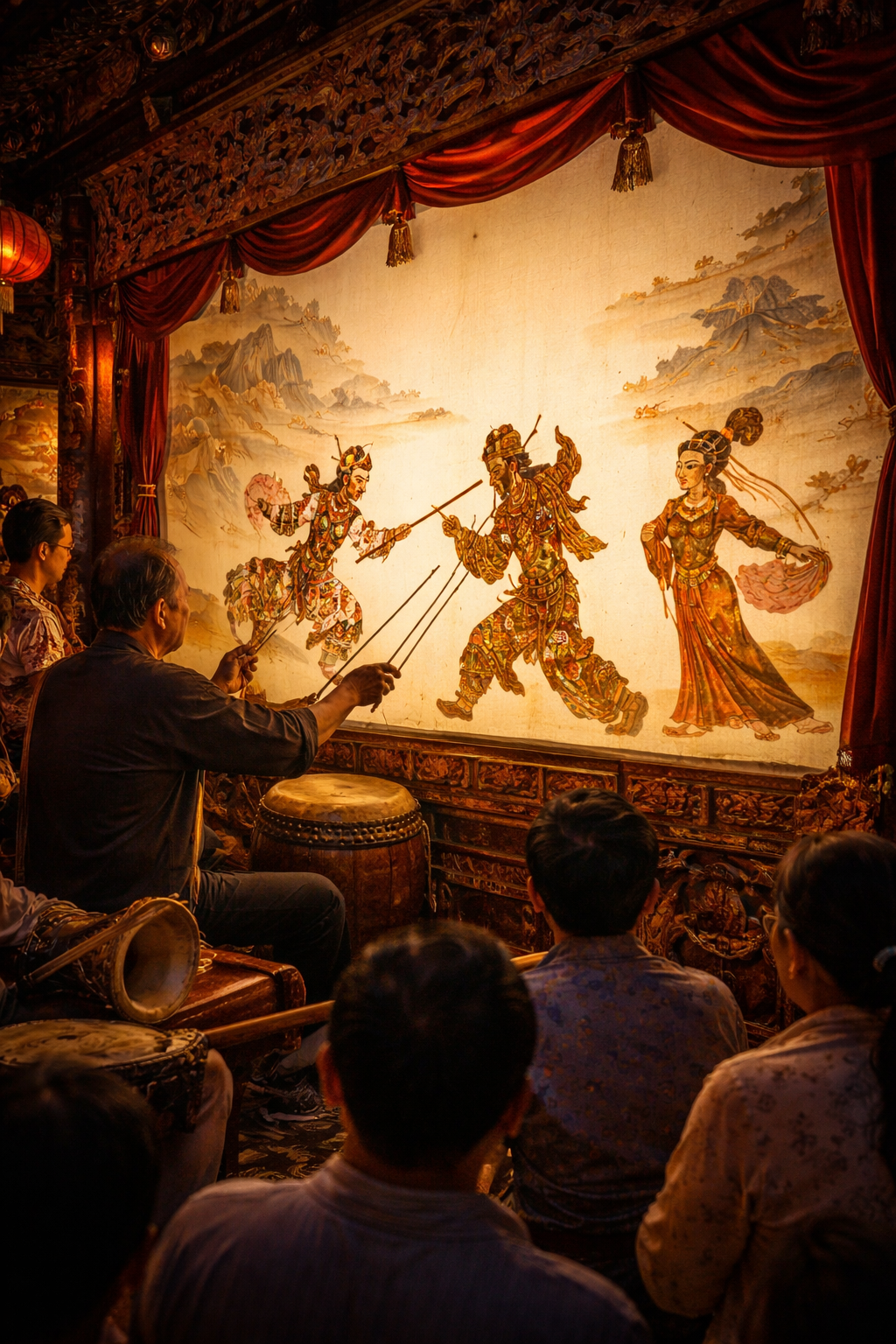
In this respect, shadow puppetry belongs to the living archive of Chinese folklore. Legends survive not merely because they are recorded, but because they are repeatedly enacted before audiences in ways that keep them audible, visible, and emotionally charged. A ghost appears as a silhouette. A general rides across the screen. An immortal descends. A goddess intervenes. A demon is exposed. A loyal minister speaks. A comic servant interrupts. A battle unfolds with light, rods, percussion, and voice. The legendary world is not only remembered; it is made present.
UNESCO describes Chinese shadow puppetry as a theater of colorful silhouette figures made from leather or paper, manipulated by rods behind a translucent screen and accompanied by music and singing. That definition captures the technical form, but the cultural significance is larger. Shadow puppetry is a medium in which craft, performance, oral transmission, local style, religious atmosphere, festival setting, and narrative memory converge. It is one of the clearest examples of how Chinese mythic culture survives through distributed performance rather than through one authoritative mythology book.
What Is Chinese Shadow Puppetry?
Chinese shadow puppetry is a form of theater in which carved figures are manipulated between a light source and a translucent screen so that audiences see illuminated silhouettes in motion. The figures are commonly made from leather or paper, articulated through joints, and controlled by rods. They perform stories with the support of singing, speech, percussion, string instruments, and stylized theatrical convention. The result is neither ordinary puppet theater nor ordinary projected image. It is a distinctive art of moving shadow.
The form is technically economical but culturally expansive. A small troupe can bring forth courts, battlefields, mountains, temples, underworlds, gardens, roads, heavenly realms, and supernatural spaces. A single screen can hold dynastic history, strange tales, religious legend, romance, comedy, war, and moral instruction. The medium’s power lies in its ability to make large narrative worlds appear through minimal physical means: hide, paper, pigment, rods, voice, light, and memory.
Because of this structure, shadow puppetry is especially important for folklore. It shows how stories circulate through embodied practice. A shadow play is not simply a text performed aloud. It is a collaboration among craft objects, performers, musicians, inherited scripts or oral repertoires, regional style, audience expectation, and performance occasion. The story exists across all of them. The legend is distributed.
Chinese shadow puppetry also belongs to a wider Asian and global family of shadow-performance traditions, but its Chinese forms developed within specific regional cultures, dialects, musical systems, temple settings, and narrative repertoires. It should therefore be studied both comparatively and locally: as part of the global history of shadow theater and as a deeply Chinese medium of popular narrative.
The Shadow Screen as a Story World
The shadow screen is one of the most symbolically charged spaces in Chinese performance. It separates puppeteer and audience, but it also connects them. The puppeteers remain partly hidden, while the figures become visible through light. The audience sees bodies that are not bodies, presences that are made from absence, and characters whose life depends on movement across an illuminated surface. The screen is therefore not only a stage. It is a threshold.
This threshold quality makes the medium especially powerful for legends involving spirits, immortals, demons, ghosts, divine interventions, dreamlike encounters, and miraculous transformations. A fully embodied actor is always visibly human. A shadow figure is more ambiguous. It seems both there and not there. It has outline, color, gesture, and voice, yet its body is made from light. That ambiguity gives shadow puppetry an unusual affinity with the supernatural imagination.
The screen also compresses distance. A palace can appear beside a battlefield; a god can descend; a mountain can be crossed; a spirit can vanish; a journey can unfold through rapid visual transitions. Shadow puppetry does not require realistic scenic architecture. Its world is conventional, symbolic, and mobile. This makes it especially well suited to mythic narrative, where the boundaries between spaces are often porous.
In this sense, the shadow screen becomes a small cosmology. The audience sits before a visible surface, but behind that surface are hidden hands, voices, instruments, light, and memory. What appears on the screen is only the visible edge of a larger performance ecology. Legend itself works similarly: what a community sees in a story is supported by inherited practices, social memory, ritual settings, and unseen labor.
Light, Shadow, and the Ontology of Apparition
Shadow puppetry is an art of apparition. Its figures do not simply stand before the audience as material objects. They arrive as luminous traces. The puppet is behind the screen; the audience sees its projection. This gives the form a special ontology: the character exists as a relationship among object, light, screen, motion, sound, and perception. A shadow puppet is therefore never only a carved figure. It is a figure activated by conditions.
This matters for Chinese myth and folklore because so many stories concern beings whose reality is unstable or hidden: ghosts who appear at night, fox spirits who shift form, gods who reveal themselves through signs, immortals who arrive disguised, demons who must be recognized, and ancestors who remain present without being ordinarily visible. Shadow puppetry’s visual logic already belongs to that world of mediated presence.
Light also creates moral and emotional atmosphere. A warrior’s silhouette can be sharp and heroic; a demon can become jagged and strange; a beauty can move with delicacy; a ghost can flicker; a battle can become a rapid choreography of crossings and strikes. The visible form is simplified, but not impoverished. Reduction produces intensity. A silhouette can make a character more iconic than a fully detailed body.
The medium therefore teaches an important lesson about legendary imagination: sometimes indirect representation is more powerful than direct depiction. A god or ghost may be more persuasive as a shadow because the shadow preserves mystery. The viewer sees enough to recognize, but not so much that wonder disappears. Shadow puppetry makes legend visible without making it ordinary.
Craft, Performance, and the Living Puppet
The puppet itself is a work of craft before it becomes a figure in motion. The making of a shadow puppet can involve selecting material, preparing leather or paper, cutting, carving, piercing, coloring, joining limbs, attaching rods, and shaping visual identity according to character type. A general, maiden, demon, monk, clown, official, deity, animal, or spirit may require different visual conventions. The puppet is therefore a material condensation of artisanal knowledge, regional style, and narrative expectation.
Yet the puppet does not live until it is animated. The puppeteer’s task is not only mechanical manipulation. It involves timing, speech, singing, rhythm, character differentiation, and often the handling of multiple figures within a scene. The puppet must move in ways that make audiences believe in intention, emotion, conflict, and presence. The figure has no life outside the performer’s hands, but the performer’s hands must disappear into the figure’s apparent life.
This union of craft and performance is one reason shadow puppetry has such value for the study of folklore. It preserves tradition not in a single container but across media: in hands, voices, carved hides or paper, musical accompaniment, local performance spaces, inherited techniques, and social settings of reception. A story can survive because the puppet survives; the puppet can survive because the craft survives; the craft can survive because performance remains socially meaningful.
Craft also gives the legendary world durability. A puppet figure may outlast one performer and pass to another. It may be repaired, repainted, reinterpreted, or reused in many plays. Its body accumulates history through use. In this sense, a shadow puppet is both tool and archive. It carries traces of the stories it has helped perform.
Leather, Paper, Color, and the Material Body of Legend
The materials of Chinese shadow puppetry matter. Leather and paper are light enough to move, thin enough to respond to illumination, and strong enough to hold intricate cutting. In many traditions, translucent color allows the projected figure to appear not only as dark outline but as glowing, patterned, semi-luminous form. The puppet’s physical delicacy becomes part of the medium’s expressive power.
Carving and cutting also structure meaning. Openwork patterns can suggest clothing, armor, status, ornament, supernatural identity, or regional style. Articulation determines gesture. A movable arm, head, waist, or leg permits bowing, fighting, riding, pointing, dancing, or comic motion. The puppet’s design anticipates the performance. It is made to move according to the kind of being it represents.
The material body of the puppet also reveals the collaboration between visual culture and narrative culture. A figure must be recognizable at a glance, often from a distance and in motion. This encourages stylization. Shadow puppetry works through typology: officials, warriors, maidens, monks, deities, ghosts, demons, animals, and comic characters can be distinguished through visual codes. Those codes allow audiences to enter the story quickly.
For myth and folklore, this is crucial. Legendary memory often survives through iconic forms: a staff, a crown, a robe, a weapon, a beard, a headdress, a monstrous profile, a celestial ornament. Shadow puppetry turns those forms into mobile signs. The puppet is not merely an illustration of legend. It is one of the ways legend becomes readable to the eye.
Voice, Music, and the Sounded Story
Shadow puppetry is visual, but it is never only visual. Voice and music are essential. Singing, recitation, dialogue, percussion, and instrumental accompaniment give the shadows emotional and dramatic life. The audience does not simply watch silhouettes. It hears characters speak, sing, quarrel, lament, boast, pray, deceive, command, and confess. The puppet’s visible body is completed by sound.
This sounded dimension matters because Chinese narrative performance has long depended on the interplay of voice and image. A shadow puppet cannot produce facial expression in the same way as a human actor, so vocal technique becomes especially important. The performer must differentiate characters through pitch, rhythm, dialect, register, phrasing, and theatrical convention. A single puppeteer may move between roles rapidly, giving the screen the illusion of a populated world.
Music also organizes time. It signals entrance, battle, travel, sorrow, comedy, ritual atmosphere, danger, or divine arrival. Percussion can make combat feel sudden; strings can intensify longing; singing can turn narration into emotional memory. The audience experiences the legendary world not only as sequence of events but as patterned sound.
This is one reason shadow puppetry is so effective at preserving folklore. Music and rhythm make stories memorable. A tale attached to melody, chant, instrumental cue, and voice can survive differently from a tale preserved silently on a page. The narrative is carried by the ear as much as by the eye.
Oral Transmission and Repertoire
One of UNESCO’s most important observations is that many traditional shadow plays are orally transmitted, though some also exist in written form. This means Chinese shadow puppetry belongs to a mixed system of transmission in which memory and text interact rather than exclude one another. Such hybridity is typical of Chinese mythic culture more broadly, where stories move among manuscripts, printed literature, ritual speech, storytelling, opera, temple performance, and local narration.
Oral transmission changes the nature of narrative continuity. A story learned by performance is not preserved in exactly the same way as a story copied from a book. It is shaped by voice, scene structure, local phrasing, musical habit, audience response, and the inherited style of a troupe or master. This does not make the tradition unstable in a negative sense. It makes it adaptive. The repertoire can remain recognizably traditional while still allowing regional accent, improvisational energy, and performance memory to leave their mark.
Repertoire is therefore more than a list of plays. It is a living memory system. A master puppeteer may carry dozens of plays, stock scenes, character voices, songs, ritual openings, comic routines, and performance solutions. Such knowledge is difficult to preserve fully in writing because it lives through timing, breath, gesture, and response. The performer is not merely a transmitter of content. The performer is part of the archive.
This adaptive continuity is central to the performance of legend. Myth and folklore endure not because they remain frozen, but because they remain performable. Shadow puppetry provides a framework within which stories can be repeatedly renewed without losing their inherited authority.
Legend, History, and the Supernatural on Stage
Chinese shadow puppetry has long drawn on a broad narrative repertoire that includes historical tales, martial epics, religious stories, romances, court dramas, supernatural legends, and local narratives. This breadth is important. Chinese folklore is not neatly separable into “myth,” “history,” and “popular entertainment.” A legendary general, a miraculous deity, a wronged spirit, a loyal minister, a ghostly lover, and a comic trickster may all inhabit the same performance tradition.
Shadow puppetry thrives precisely because it can stage combat, metamorphosis, apparition, travel, heavenly judgment, family conflict, moral retribution, and divine intervention with striking economy. Light and silhouette allow large narrative worlds to appear with relatively few materials. A horse can cross the screen, an army can be implied, a palace can be entered, a demon can transform, and a spirit can vanish. The medium’s simplicity becomes theatrical power.
The historical repertoire is especially important because late-imperial and popular Chinese culture often treated history as a field of moral exemplarity and legendary expansion. Stories of dynastic struggle, loyal ministers, righteous rebels, generals, judges, and virtuous women could be performed not as dry record, but as emotionally charged public memory. Shadow puppetry helped make the past visible to audiences who encountered history through performance as much as through books.
The supernatural repertoire adds another layer. Ghosts, gods, demons, immortals, and strange beings belong naturally to a medium of shadow. The screen gives them a body without fully materializing them. The audience sees the supernatural as a projected presence, and that presence retains ambiguity. Shadow theater therefore offers something more than visual charm. It creates a public form through which communities remember the past, imagine the unseen, and interpret moral order.
The Han Emperor Origin Legend and the Problem of Beginnings
One of the best-known origin stories links shadow performance to Emperor Wu of Han and the death of Lady Li. In the Han shu account, the emperor grieves for Lady Li, and the fangshi Shaoweng claims he can summon her spirit. The scene involves night, lamps, curtains, offerings, distance, longing, and a form that appears like Lady Li but cannot be approached. Later tradition often connected this episode to the origin of shadow play.
Primary Source
乃夜張燈燭,設帷帳,陳酒肉,而令上居他帳,遙望好女如李夫人之貌。At night he set out lamps and candles, arranged curtains, placed wine and meat, and had the emperor sit in another tent, gazing from afar at a beautiful woman who resembled Lady Li.Han shu 漢書, “Waiqi zhuan” 外戚傳 / “Traditions of Imperial Relatives.” Available at: https://ctext.org/han-shu/wai-qi-zhuan/zh
This passage is important for the later origin legend of shadow play, but it should be read cautiously. It describes a ritualized apparition scene involving light and curtains, not a fully documented shadow-puppet theater.
The story matters because it captures something essential about the symbolic imagination of shadow theater: shadow as mourning, apparition, desire, and mediated presence. The emperor wants to see the dead beloved. The figure appears at a distance, behind arrangement and light, close enough to wound memory but too distant to grasp. Even if this is not direct evidence for formal shadow puppetry, it explains why later tradition found the story compelling. Shadow performance already feels like a technology of return.
Historically, however, the story should not be treated as straightforward documentation of the art’s origin. The formal development of Chinese shadow puppetry as theater belongs to a more complex history involving performance traditions, religious practice, popular entertainment, regional craft, and later textual evidence. The Han story is best understood as an origin legend: culturally meaningful, symbolically powerful, and historically suggestive, but not a simple starting point.
This distinction matters for responsible interpretation. Origin legends reveal how a culture explains an art’s meaning, even when they do not provide a modern historical proof of beginnings. The Lady Li story tells us that shadow could be imagined as a medium of loss, memory, and apparition. That symbolic truth remains important even if the historical formation of shadow puppetry requires a wider evidentiary frame.
Religion, Ritual, and the Threshold Between Worlds
Shadow puppetry has often been discussed as entertainment, but its relation to religion and ritual is equally important. A shadow screen can create a boundary between visible and invisible worlds, and Chinese religious culture has long been concerned with such boundaries: ancestors and descendants, gods and worshippers, ghosts and living households, demons and exorcists, humans and immortals, performers and deities. Shadow performance resonates strongly with that ritual imagination.
In some contexts, performances may be connected with temple festivals, vows, thanksgiving, seasonal rites, household ceremonies, or community gatherings. A play may entertain human audiences while also honoring a deity or marking a ceremonial occasion. This layered audience is important. The performance may be for people, for gods, for ancestors, for local memory, or for the maintenance of ritual atmosphere all at once.
The medium’s visual logic also makes it appropriate for stories involving the unseen. Ghosts, underworld judges, deities, and demons are not ordinary bodies. Shadow puppetry gives them a form that feels visibly present but metaphysically unstable. It allows the unseen to appear without losing its otherness. This is one reason the art belongs so naturally beside temple festivals, opera, ritual prints, and popular religious storytelling.
Religion here should not be understood only as doctrine. It also includes practical relations with danger, blessing, gratitude, vow, protection, memory, and unseen agency. Shadow puppetry participates in those relations by giving stories a ceremonial body. A narrative about a god or ghost becomes a public event of sound and light. The threshold between worlds becomes theatrical.
Temple Festivals, Ritual Context, and Public Life
Shadow puppetry has often existed within broader public and ritual settings rather than as an isolated art form. Performances in courtyards, teahouses, countryside alleys, temple precincts, and troupe settings suggest that shadow theater belongs to the social life of communities as much as to formal stages. This is crucial for understanding the medium as folklore: it circulates where people gather, celebrate, worship, trade, and remember together.
In many parts of China, performance traditions such as shadow puppetry have historically been tied to temple fairs, seasonal observances, communal entertainment, and ceremonial occasions. Even where a particular modern heritage description emphasizes the art form itself rather than a single ritual setting, the social logic remains clear. Puppetry participates in the same worlds of festival, local association, and public storytelling that sustain opera, deity processions, and popular religion.
This social embedding helps explain the durability of the art. A legend staged at a festival is not encountered in private isolation. It is absorbed amid crowd life, shared attention, sound, food, incense, timing, and place. The story becomes part of remembered occasion. A child may remember not only the plot, but the smell of the courtyard, the glow of the screen, the sound of instruments, the crowd’s laughter, and the feeling of being present when the shadows came alive.
Temple-festival settings also allow shadow puppetry to participate in the public life of legend. A performance may retell a story already visible in temple images, deity processions, printed talismans, opera scenes, or local oral tradition. The puppet screen becomes one node in a larger ceremonial network. Legend moves among media, and the festival gathers those media together.
Regional Schools and Local Styles
Chinese shadow puppetry is not a single uniform tradition. UNESCO’s materials and photographic documentation point to multiple regional forms, including performances and making traditions in provinces such as Gansu, Hubei, Anhui, Shaanxi, Yunnan, and others. This diversity matters because it shows that the art survives through local schools, regional aesthetics, dialects, musical idioms, and community-specific transmission rather than through one centralized national canon.
Regional difference may appear in the carving style of the figures, the materials used, the translucency or opacity of the puppet, the vocal register of the performers, the instrumental accompaniment, the structure of the repertoire, or the ritual and social settings in which performances occur. Some traditions emphasize delicate ornamental design; others foreground bold silhouette and rhythmic intensity. Some are closely associated with specific local histories, temple customs, or family lineages.
This local variation is not peripheral to the meaning of shadow puppetry. It is one of the reasons the medium has been so resilient. A story can remain culturally recognizable while taking on the tonal color of a particular place. The legend lives in the differences as much as in the continuity. A warrior tale in one region may sound, look, and move differently from the same tale elsewhere. That difference is part of the art’s life.
Regional schools also matter because they challenge overly abstract descriptions of “Chinese shadow puppetry.” There is no single shadow tradition that exhausts the field. The national category is useful, but the art is lived locally. Its history is made from provinces, counties, villages, troupes, families, master-apprentice lines, and performance circuits. To study shadow puppetry seriously is to study plurality.
Shadow Puppetry and Vernacular Literature
Shadow puppetry exists in close relation to vernacular literature and popular narrative. Stories known from novels, romances, historical cycles, religious tales, opera repertoires, and local legends could move into shadow performance. Conversely, performance traditions could shape how audiences imagined literary figures. The same character might live in a printed book, an opera role, a temple image, a storytelling session, and a shadow puppet.
This circulation is especially important for major Chinese narrative worlds: dynastic romances, gods-and-demons fiction, stories of loyal generals, supernatural encounters, righteous judges, filial children, clever women, wandering monks, bandits, immortals, and spirits. Shadow puppetry can compress such material into performable scenes. It translates large literary worlds into light, voice, gesture, and rhythm.
That translation changes the story. A printed novel can pause for description, commentary, and extended narration. A shadow play must move. It must create visual signs, dramatic pacing, musical cues, and immediate character recognition. This often intensifies iconic moments: a battle, recognition scene, transformation, judgment, reunion, betrayal, or divine intervention. Performance selects what will live on the screen.
This relation between literature and performance helps explain why Chinese mythic culture is so difficult to reduce to one category. A tale may be literary, oral, theatrical, ritual, visual, and local at once. Shadow puppetry is one of the media that makes such movement possible. It keeps stories from being locked in one form.
Memory, Training, and the Puppeteer as Archive
The puppeteer is one of the central archives of the tradition. A skilled performer may preserve scripts, songs, character voices, musical conventions, manipulation techniques, stage openings, jokes, ritual formulas, and inherited scene structures. Such knowledge cannot be reduced to an object collection. A museum may preserve puppets, but the living art depends on people who know how to make them speak and move.
Training therefore matters profoundly. Shadow puppetry is learned through observation, repetition, apprenticeship, correction, and performance experience. A student must learn not only where to place a figure, but when to move, how to coordinate with music, how to shift voices, how to maintain audience attention, and how to carry inherited repertoire. The art is cognitive, vocal, manual, musical, and social at once.
This embodied archive is vulnerable. When elder artists die without transmitting their repertoires, the loss is not only personal. It may mean the disappearance of local variants, songs, dialect performance styles, carving methods, and stories no longer written or performed elsewhere. The safeguarding of shadow puppetry therefore requires attention to people, not only objects.
At the same time, transmission is not mere preservation of the past. Each generation must decide how to perform for its audiences. Schools, cultural institutions, heritage programs, tourism, digital video, and contemporary theater all reshape transmission. The challenge is to keep the art alive without flattening it into museum demonstration. A living puppeteer is not only a guardian of memory, but an interpreter of it.
Visual Culture, Animation, and the Afterlife of Shadow
Shadow puppetry also belongs to the longer history of visual media. Its use of cut figures, articulated motion, light, screens, silhouettes, and sequential action gives it a striking relationship to animation, cinema, illustrated storytelling, and modern design. Before film could move images through mechanical projection, shadow theater already created moving images through craft and performance. It is one of the deep ancestors of screen culture.
This does not mean shadow puppetry should be valued only because it resembles later media. Its importance is not merely that it anticipates animation. Rather, animation and cinema help modern viewers recognize the sophistication of shadow performance. The puppet screen is already a moving-image system, but one governed by live skill, oral repertoire, and communal gathering rather than by recorded frames.
Modern artists have drawn on shadow-puppet aesthetics in animation, theater, installation, education, and cultural heritage work. Silhouette, cut-paper movement, backlit figures, and layered screens remain visually powerful because they retain the mystery of partial visibility. Shadow creates mood quickly. It can suggest memory, dream, ghostliness, history, and myth without requiring realism.
The afterlife of shadow also raises questions about continuity. When shadow-puppet imagery enters digital media, does it preserve the tradition or transform it into style? The answer depends on context. A digital work may honor the art’s visual language, but it cannot replace the full performance ecology of carved figures, live voice, local repertoire, apprenticeship, and public gathering. The shadow survives in new media, but the living tradition requires more than visual quotation.
UNESCO, Living Heritage, and Contemporary Safeguarding
Chinese shadow puppetry was inscribed on UNESCO’s Representative List of the Intangible Cultural Heritage of Humanity in 2011. That recognition is important because it frames the art as living heritage: a form of performance, craft, oral transmission, music, singing, and social memory that depends on communities, troupes, families, and master-apprentice transmission. The art is not only an artifact of the past. It is a practice that must continue to be performed if it is to remain alive.
UNESCO’s record emphasizes the combination of leather or paper figures, rods, translucent screens, music, singing, and traditional plays. It also notes the importance of elder artists and inherited repertoires. This framing helps modern readers understand that the art’s value lies in a whole ecosystem. Puppets alone are not enough. A screen alone is not enough. A script alone is not enough. The living tradition requires craft, performance, music, memory, and audience.
Safeguarding therefore involves more than collecting old puppets. It may include training young performers, documenting regional repertoires, supporting local troupes, preserving carving techniques, recording musical styles, creating performance opportunities, and helping communities maintain meaningful contexts for the art. The goal is not to freeze shadow puppetry, but to sustain its capacity to live.
At the same time, heritage recognition should be interpreted carefully. UNESCO inscription does not create the art’s value. Shadow puppetry existed long before modern heritage systems. The inscription is a contemporary recognition of a much older practice, and it can help with visibility and safeguarding. But the deeper source of the tradition remains the communities and performers who keep making shadows move.
Source History and Interpretive Caution
A careful reading of Chinese shadow puppetry must distinguish among several layers: origin legends, historical references to shadow-like spectacle, evidence for formal shadow theater, regional performance traditions, oral repertoires, written play texts, craft lineages, temple-festival settings, modern heritage documentation, museum collections, and contemporary revival or educational performance. These layers overlap, but they are not identical.
The Han Emperor Wu and Lady Li story is especially important but easily misunderstood. It is a powerful narrative about grief, light, curtains, distance, and apparition. Later tradition often treated it as an origin story for shadow play. Yet the Han shu passage does not prove the existence of formal shadow-puppet theater in the Han. It should be read as a symbolic prehistory or origin legend rather than as a precise documentary beginning.
UNESCO materials are also valuable but genre-specific. They describe the art as recognized intangible heritage and emphasize performance method, transmission, and safeguarding. Britannica provides a concise general definition of shadow play as a theatrical form using flat figures, light, and translucent screen. These sources help orient modern readers, but they do not replace regional histories, troupe knowledge, local archives, fieldwork, and Chinese-language scholarship.
Finally, shadow puppetry should not be romanticized as an unchanged survival. It has adapted across dynasties, regions, media environments, political contexts, and audience expectations. Some forms declined; others were revived; some entered school and heritage programs; some became tourist performance; others remain locally rooted. Its history is one of continuity through transformation. That is precisely why it matters for folklore.
Why Shadow Puppetry Matters for Chinese Myth, Folklore, and Legend
Chinese shadow puppetry matters because it shows that legend survives through media of performance as much as through books and archives. It is a living art in which craft, oral memory, music, voice, silhouette, and public gathering combine to keep inherited stories socially legible. A mythic figure does not need to remain confined to a classical text. It can be carried by a carved body, sung through a performer’s voice, and renewed by an audience’s attention.
It also matters because shadow puppetry clarifies something larger about Chinese mythic culture: narrative authority can be distributed across many forms. A story may live in a classical text, a temple image, a festival procession, an opera stage, a printed illustration, a storytelling repertoire, and a puppet screen at once. Shadow theater is one of the clearest examples of that distributed archive, where voice and light do work that elsewhere might be done by manuscript or monument.
Most of all, the medium matters because of its special relation to appearance and disappearance. A shadow enters, speaks, fights, transforms, and vanishes. That rhythm makes it especially suited to worlds of ghosts, gods, warriors, lovers, demons, immortals, loyal ministers, and legendary memory. Chinese shadow puppetry is therefore not just a technique of entertainment. It is one of the most elegant forms through which legend has been made visible without ever losing its mystery.
For Chinese Myth, Folklore & Legend as a field of study, shadow puppetry is indispensable because it reminds us that the archive is not only textual. It is also performative, regional, embodied, handmade, musical, and public. The shadow screen preserves what no page alone can preserve: the moment when a community watches inherited story become light.
Related Reading
- Chinese Myth, Folklore & Legend
- Temple Festivals, Popular Religion, and the Social Life of Legend
- Strange Tales and the Rise of Supernatural Literature
- Reading the Soushen Ji: Anomaly, Wonder, and the Medieval Supernatural
- Investiture of the Gods and the Mythologizing of Dynastic Change
- Sun Wukong and the Mythic Afterlives of Journey to the West
- Buddhism, Daoism, and the Recasting of Chinese Mythic Worlds
Primary Sources
- Ban Gu 班固 (n.d.) Han shu 漢書 / Book of Han, “Waiqi zhuan” 外戚傳 / “Traditions of Imperial Relatives.” Useful for the Lady Li and Emperor Wu apparition story later associated with shadow-play origin legends, though it should not be treated as direct proof of formal shadow-puppet theater. Chinese Text Project edition available at: https://ctext.org/han-shu/wai-qi-zhuan/zh
- UNESCO Intangible Cultural Heritage (2011) “Chinese shadow puppetry.” Useful as the official contemporary heritage record for materials, screen technique, rod manipulation, music, singing, oral transmission, elder artists, and safeguarding context. Available at: https://ich.unesco.org/en/RL/chinese-shadow-puppetry-00421
- UNESCO Intangible Cultural Heritage (2011) “Decision of the Intergovernmental Committee: 6.COM 13.3.” Useful for the formal inscription decision placing Chinese shadow puppetry on the Representative List of the Intangible Cultural Heritage of Humanity. Available at: https://ich.unesco.org/en/decisions/6.COM/13.3
- UNESCO Archives (2011) “Chinese Shadow Puppetry.” Useful audiovisual heritage documentation for the performance method, screen, rods, music, and living transmission of the art form. Available at: https://www.unesco.org/archives/multimedia/document-2233
- UNESCO Intangible Cultural Heritage (n.d.) “Video: Chinese shadow puppetry.” Useful for seeing the audiovisual dimension of manipulation, singing, and screen performance. Available at: https://ich.unesco.org/en/video/06486
- UNESCO Intangible Cultural Heritage (n.d.) “Photos: Chinese shadow puppetry.” Useful visual documentation for regional variation, making traditions, performance settings, and contemporary safeguarding contexts. Available at: https://ich.unesco.org/en/13-representative-list-00411?call=slideshow&id=00421&include=slideshow_inc.php&mode=scroll&width=620
Further Reading
- UNESCO Intangible Cultural Heritage (2011) “Chinese shadow puppetry.” Available at: https://ich.unesco.org/en/RL/chinese-shadow-puppetry-00421
- UNESCO Intangible Cultural Heritage (2011) “Decision of the Intergovernmental Committee: 6.COM 13.3.” Available at: https://ich.unesco.org/en/decisions/6.COM/13.3
- UNESCO Archives (2011) “Chinese Shadow Puppetry.” Available at: https://www.unesco.org/archives/multimedia/document-2233
- UNESCO Intangible Cultural Heritage (n.d.) “Video: Chinese shadow puppetry.” Available at: https://ich.unesco.org/en/video/06486
- UNESCO Intangible Cultural Heritage (n.d.) “Photos: Chinese shadow puppetry.” Available at: https://ich.unesco.org/en/13-representative-list-00411?call=slideshow&id=00421&include=slideshow_inc.php&mode=scroll&width=620
- Encyclopaedia Britannica (n.d.) “Shadow play.” Available at: https://www.britannica.com/art/shadow-play
- Encyclopaedia Britannica (n.d.) “Shadow puppet.” Available at: https://www.britannica.com/art/shadow-puppet
- Chinese Text Project (n.d.) Han shu 漢書, “Waiqi zhuan” 外戚傳. Available at: https://ctext.org/han-shu/wai-qi-zhuan/zh
- Google Arts & Culture (n.d.) “The History of Chinese Shadow Art.” Available at: https://artsandculture.google.com/story/the-history-of-chinese-shadow-art/pAVxjXX69TPSWQ
- Fan, P. (2007) Chinese Shadow Theatre: History, Popular Religion, and Women Warriors. Montreal: McGill-Queen’s University Press.
- Chen, F. (2003) Chinese Shadow Theatre: History, Popular Religion, and Women Warriors. Montreal: McGill-Queen’s University Press.
- Liu, H. (2010) The Art of Chinese Shadow Puppetry. Beijing: China Intercontinental Press.
- Broman, S. (1981) Chinese Shadow Theatre. Stockholm: Museum of Far Eastern Antiquities.
References
- Ban Gu 班固 (n.d.) Han shu 漢書, “Waiqi zhuan” 外戚傳. Chinese Text Project. Available at: https://ctext.org/han-shu/wai-qi-zhuan/zh
- Broman, S. (1981) Chinese Shadow Theatre. Stockholm: Museum of Far Eastern Antiquities.
- Chen, F. (2003) Chinese Shadow Theatre: History, Popular Religion, and Women Warriors. Montreal: McGill-Queen’s University Press.
- Encyclopaedia Britannica (n.d.) “Shadow play.” Available at: https://www.britannica.com/art/shadow-play
- Encyclopaedia Britannica (n.d.) “Shadow puppet.” Available at: https://www.britannica.com/art/shadow-puppet
- Fan, P. (2007) Chinese Shadow Theatre: History, Popular Religion, and Women Warriors. Montreal: McGill-Queen’s University Press.
- Google Arts & Culture (n.d.) “The History of Chinese Shadow Art.” Available at: https://artsandculture.google.com/story/the-history-of-chinese-shadow-art/pAVxjXX69TPSWQ
- Liu, H. (2010) The Art of Chinese Shadow Puppetry. Beijing: China Intercontinental Press.
- UNESCO Archives (2011) “Chinese Shadow Puppetry.” Available at: https://www.unesco.org/archives/multimedia/document-2233
- UNESCO Intangible Cultural Heritage (2011) “Chinese shadow puppetry.” Available at: https://ich.unesco.org/en/RL/chinese-shadow-puppetry-00421
- UNESCO Intangible Cultural Heritage (2011) “Decision of the Intergovernmental Committee: 6.COM 13.3.” Available at: https://ich.unesco.org/en/decisions/6.COM/13.3
- UNESCO Intangible Cultural Heritage (n.d.) “Photos: Chinese shadow puppetry.” Available at: https://ich.unesco.org/en/13-representative-list-00411?call=slideshow&id=00421&include=slideshow_inc.php&mode=scroll&width=620
- UNESCO Intangible Cultural Heritage (n.d.) “Video: Chinese shadow puppetry.” Available at: https://ich.unesco.org/en/video/06486