Mathematical Thinking

Mathematical thinking examines how abstraction, logic, pattern recognition, and formal reasoning enable people to understand structure, quantity, and relationships within complex systems. In interdisciplinary fields such as sustainability, economics, governance, data analysis, and systems research, mathematical reasoning provides a way to move beyond surface description toward deeper conceptual clarity and analytical precision.

This mode of thought involves identifying patterns, defining variables, recognizing constraints, and expressing relationships in structured ways that can be tested, compared, or generalized. Mathematical thinking is not limited to calculation. It includes the capacity to reason symbolically, model relationships conceptually, and frame problems in terms of scale, proportion, uncertainty, and interdependence.

Mathematical thinking plays an essential role in scientific inquiry, strategic analysis, technical problem-solving, and decision support. By making complex relationships more explicit, it helps transform ambiguity into structured understanding and allows institutions, researchers, and practitioners to reason more effectively about systems, evidence, and change over time.

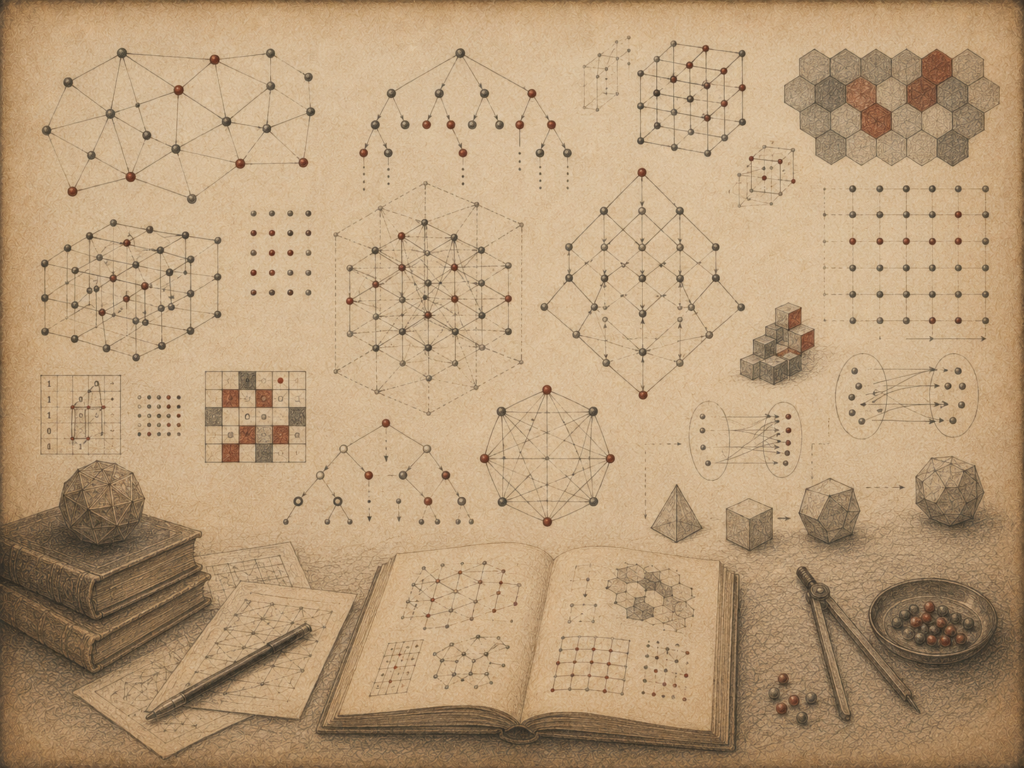
Scholarly editorial illustration of graphs, trees, grids, networks, mappings, lattice structures, polyhedra, and combinatorial diagrams arranged across textured parchment.

Discrete Mathematics and the Logic of Structure

Discrete Mathematics and the Logic of Structure examines how mathematics reasons about distinct units, finite rules, symbolic systems, logical inference, graphs, trees, recurrence, counting, modular cycles, Boolean structure, and algorithms. The article explains discrete mathematics as the study of structure built from separated elements rather than continuous flow, showing why it is foundational for computer science, databases, cryptography, networks, data systems, AI, proof, and formal reasoning. It explores sets, relations, combinatorics, induction, recurrence, graph theory, tree structures, modular arithmetic, Boolean logic, algorithmic invariants, Haskell algebraic data types, SQL schemas, and responsible interpretation of discrete systems. By connecting mathematical rigor to digital infrastructure and institutional decision systems, the article shows how discrete thinking helps identify units, relations, rules, edge cases, invariants, categories, rankings, and consequences in technical, educational, public, and computational contexts where formal structure can materially shape real outcomes.
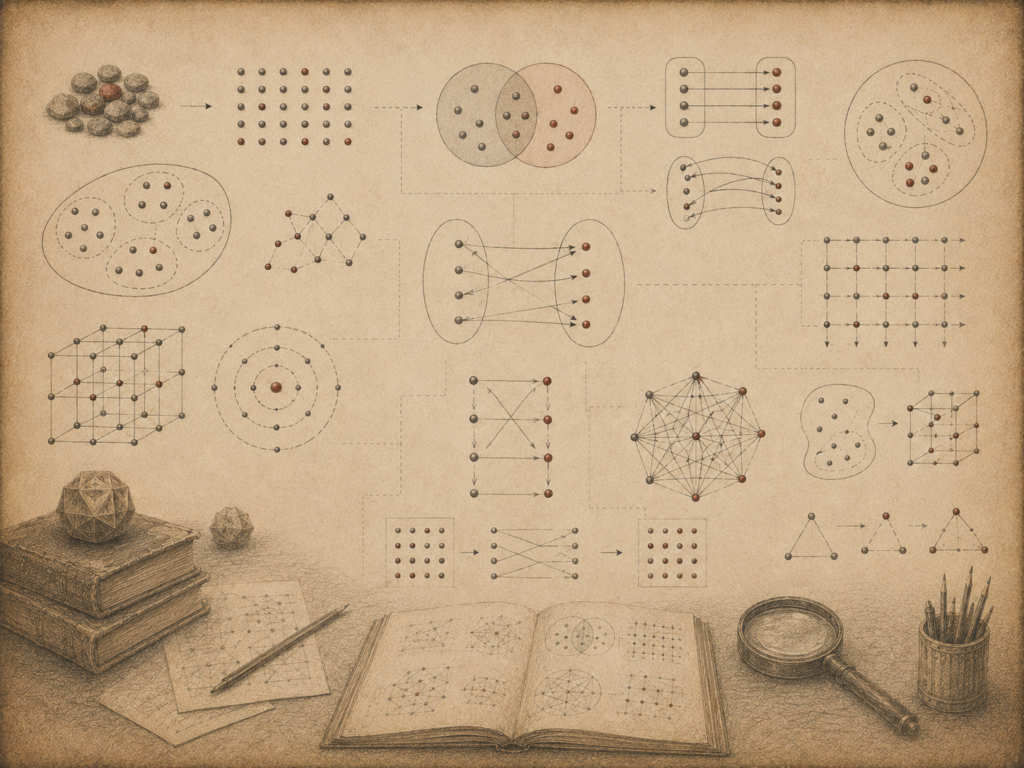
Scholarly editorial illustration of sets, mappings, arrows, grids, networks, relation diagrams, function-like structures, open notebooks, and research instruments on textured parchment.

Sets, Relations, and Functions as Modes of Thought

Sets, Relations, and Functions as Modes of Thought examines three foundational structures that shape how mathematics organizes objects, connections, and mappings. The article explains sets as tools for defining belonging, boundary, inclusion, and classification; relations as tools for expressing connection, equivalence, order, adjacency, dependency, and structure; and functions as disciplined mappings from domains to codomains. It explores membership, subsets, classification, equivalence relations, partial orders, domain and codomain discipline, composition, inverses, proof patterns, mathematical modeling, databases, typed computation, Haskell algebraic data types, SQL schemas, and responsible mapping interpretation. By treating sets, relations, and functions as modes of thought rather than isolated definitions, the article shows how they support abstraction, proof, data systems, AI models, scientific reasoning, and ethical reflection on categories, rankings, classifications, and predictive mappings across educational, technical, institutional, and public decision contexts where structure directly shapes consequence materially.

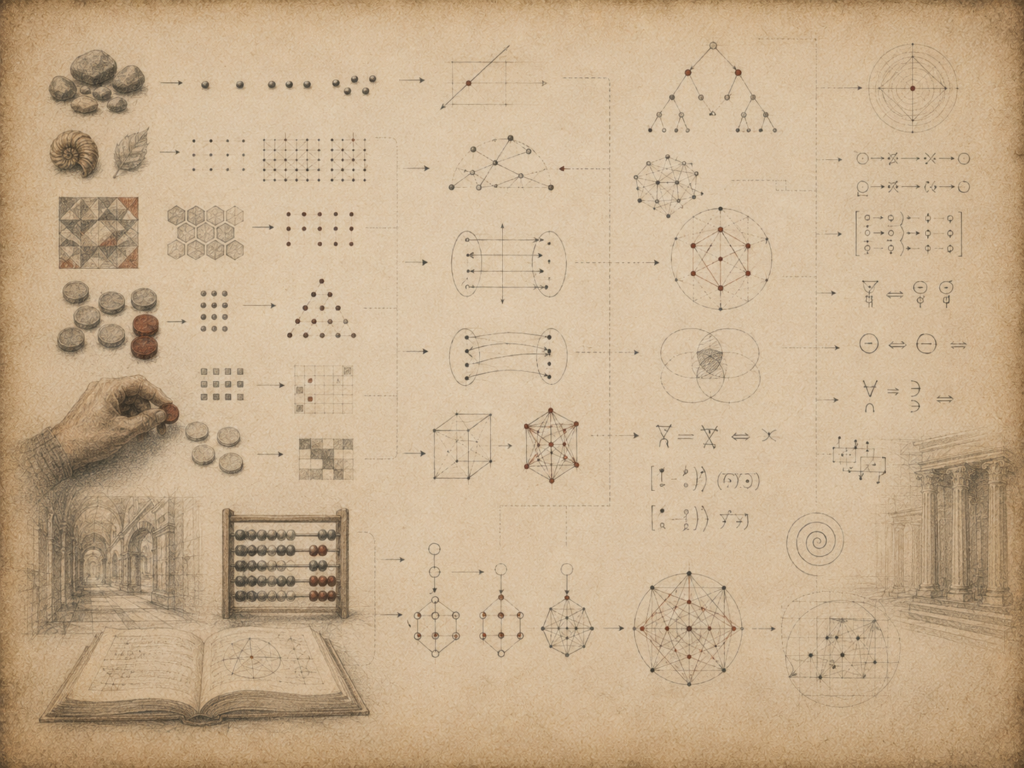
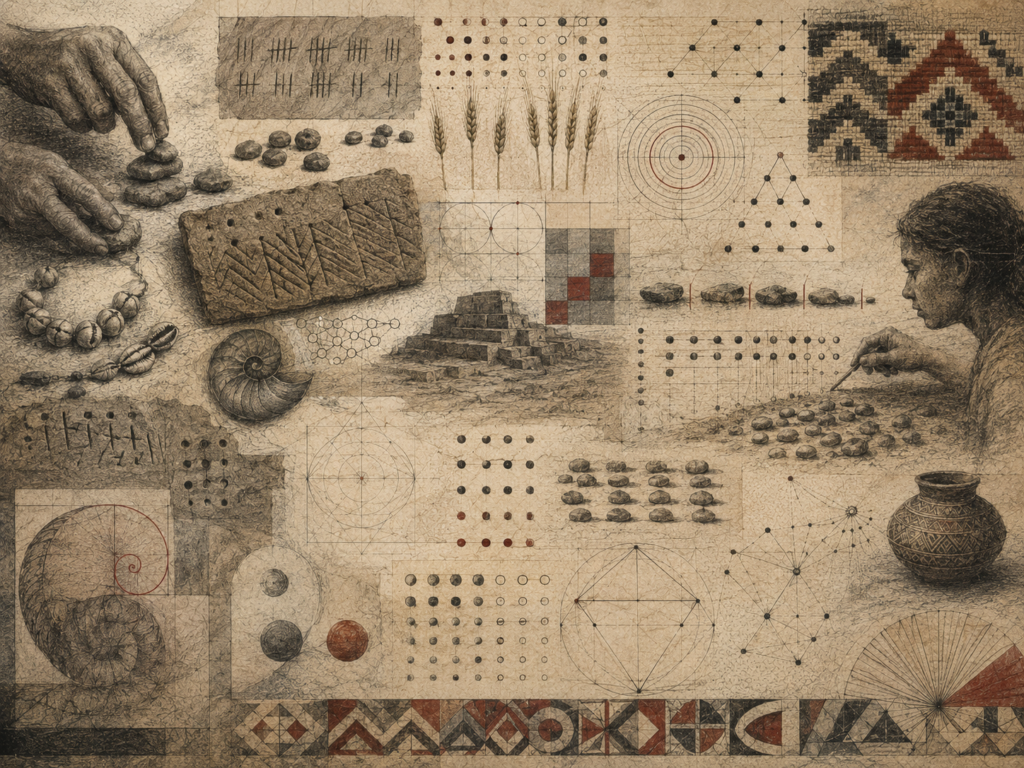
Scholarly editorial illustration of early counting stones, tally marks, carved artifacts, patterned textiles, grids, geometric diagrams, shells, pottery, and ancient mathematical arrangements on textured parchment.

Number, Pattern, and the Origins of Mathematical Thought

Number, Pattern, and the Origins of Mathematical Thought examines how mathematics begins in the human ability to notice quantity, repetition, order, rhythm, symmetry, comparison, and structure. The article traces mathematical thought from number sense, counting, one-to-one correspondence, tally marks, tokens, spatial reasoning, rhythm, cycles, cultural practice, and symbolic representation toward abstraction, proof, computation, and modern pattern analysis. It shows how number detaches quantity from particular objects, while pattern allows the mind to recognize order across time, space, and variation. By connecting early counting, craft, trade, calendars, geometry, Haskell algebraic data types, sequence detection, modular cycles, and responsible interpretation, the article frames mathematics as both cognitive and cultural. It also cautions that detected patterns, numerical classifications, and computational outputs require proof-status discipline, context, and ethical judgment before being treated as meaningful structure.

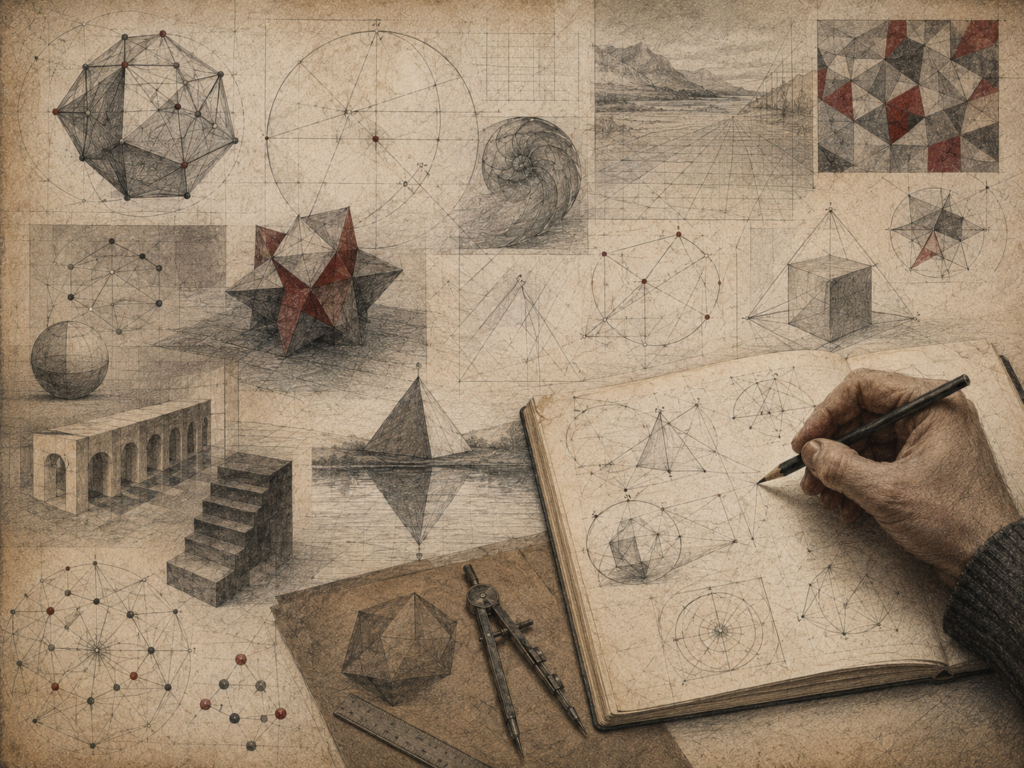
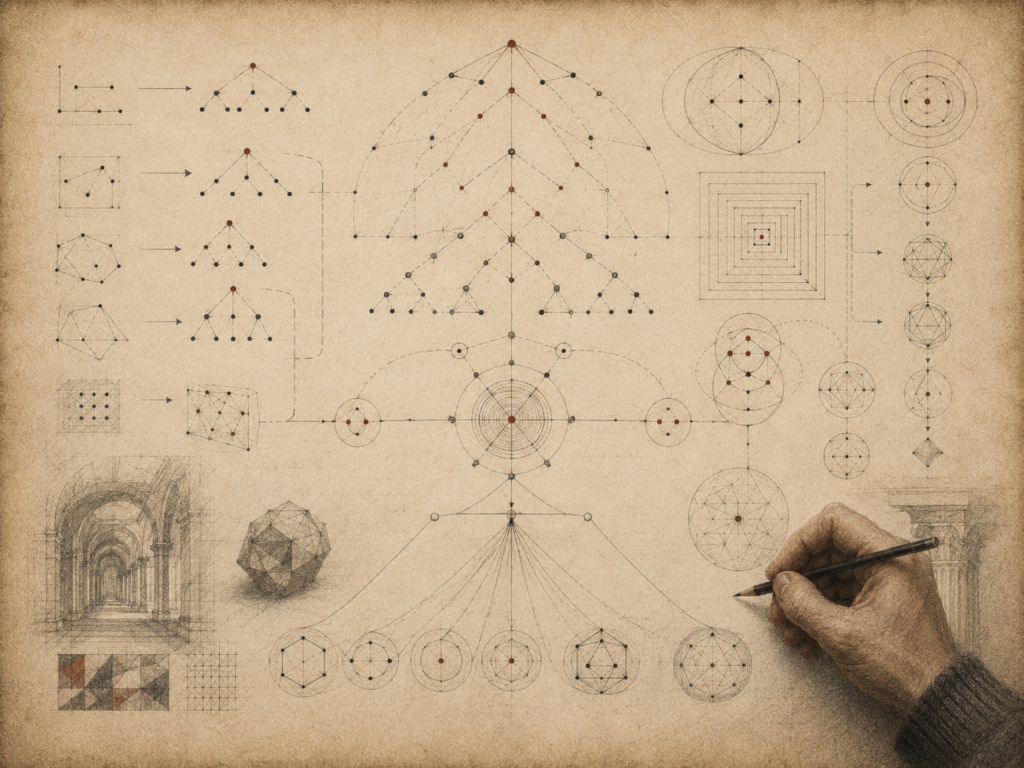
Scholarly editorial illustration of geometric constructions, polyhedra, perspective grids, circles, pyramids, spatial diagrams, drawing instruments, and a hand sketching in an open notebook on textured parchment.

Geometry and the Visual Mind in Mathematics

Geometry and the Visual Mind in Mathematics examines how mathematical understanding begins with shape, space, relation, transformation, and visual intuition, then becomes rigorous through definition, proof, and representation. The article explores geometry as a bridge between perception and abstraction, showing how diagrams, figures, spatial reasoning, Euclidean deduction, coordinate systems, symmetry, invariance, topology, and computational geometry help the mind recognize structure. It argues that diagrams are not decorative illustrations but active tools for discovery, explanation, and proof planning, while also emphasizing that visual evidence must be disciplined by logic and verification. By connecting classical geometry to modern visualization, Haskell algebraic data types, computational geometry, AI-generated diagrams, and responsible interpretation, the article frames the visual mind as essential to mathematical learning, modeling, scientific reasoning, and the ethical use of visual representations in technical and public contexts across education, research, and practice.

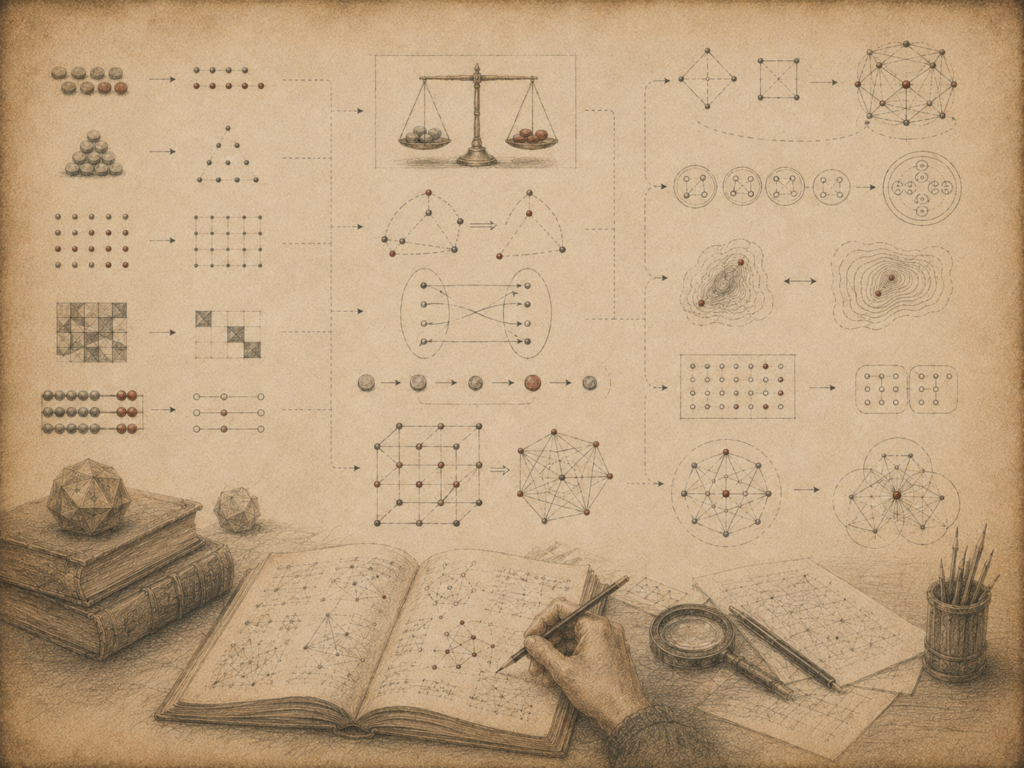
Scholarly editorial illustration of quantities, grids, balance scales, mappings, networks, variable-like structures, and transformation diagrams on aged parchment, representing algebraic thinking as relational and structural reasoning.

What Makes Algebraic Thinking Distinct?

What Makes Algebraic Thinking Distinct? examines algebra as a shift from calculation to reasoning about relationships, structures, variables, equivalence, transformation, and generality. The article explains that algebra is not simply arithmetic with letters; it is a way of seeing expressions as objects, equations as relations, variables as flexible symbols, and functions as structures of dependence. It explores generalized arithmetic, variable roles, symbolic expressions, equivalence-preserving transformations, equations, functions, patterns, algebraic systems, proof, computational algebra, Haskell algebraic data types, and responsible interpretation of symbolic models. By connecting school algebra to broader mathematical structures, the article shows how algebraic thinking prepares learners for proof, modeling, calculus, data science, computer science, formal reasoning, and abstract mathematics. It also addresses common misconceptions, including treating equals as an answer signal or variables only as unknowns in learning.

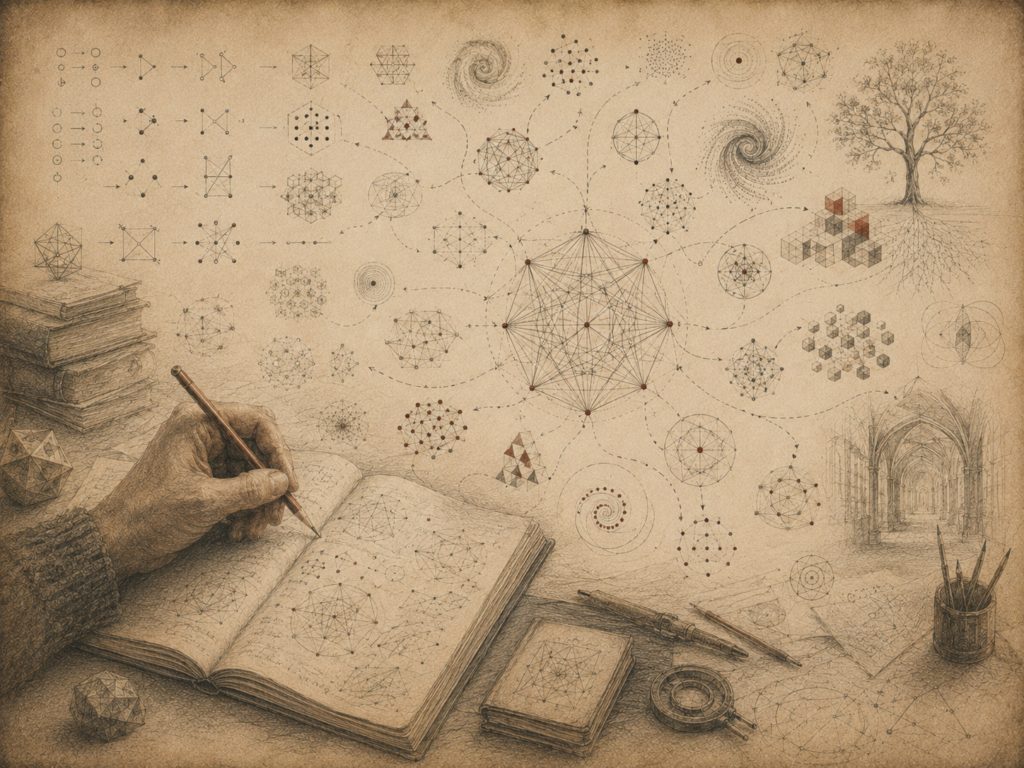
Scholarly editorial illustration of open notebooks, branching geometric diagrams, exploratory pathways, networks, spirals, books, instruments, and architectural forms on textured parchment.

Non-Algorithmic Reasoning and the Future of Mathematics Learning

Non-Algorithmic Reasoning and the Future of Mathematics Learning examines why mathematical thinking cannot be reduced to procedure, formula use, or algorithm execution. The article argues that students need fluency with methods, but also judgment about when methods apply, what assumptions they require, which representations reveal structure, and whether an answer is meaningful. It explores problem framing, conceptual understanding, representation choice, conjecture, proof, metacognition, creativity, assessment, AI-output verification, Haskell algebraic data types, and responsible tool-assisted learning. By distinguishing procedural performance from mathematical reasoning, the article frames the future of mathematics education around the ability to notice, frame, represent, reason, justify, and reflect. It also addresses equity and agency, arguing that learners should be taught not merely to execute instructions but to interpret, question, verify, and communicate mathematical ideas in a computational world.

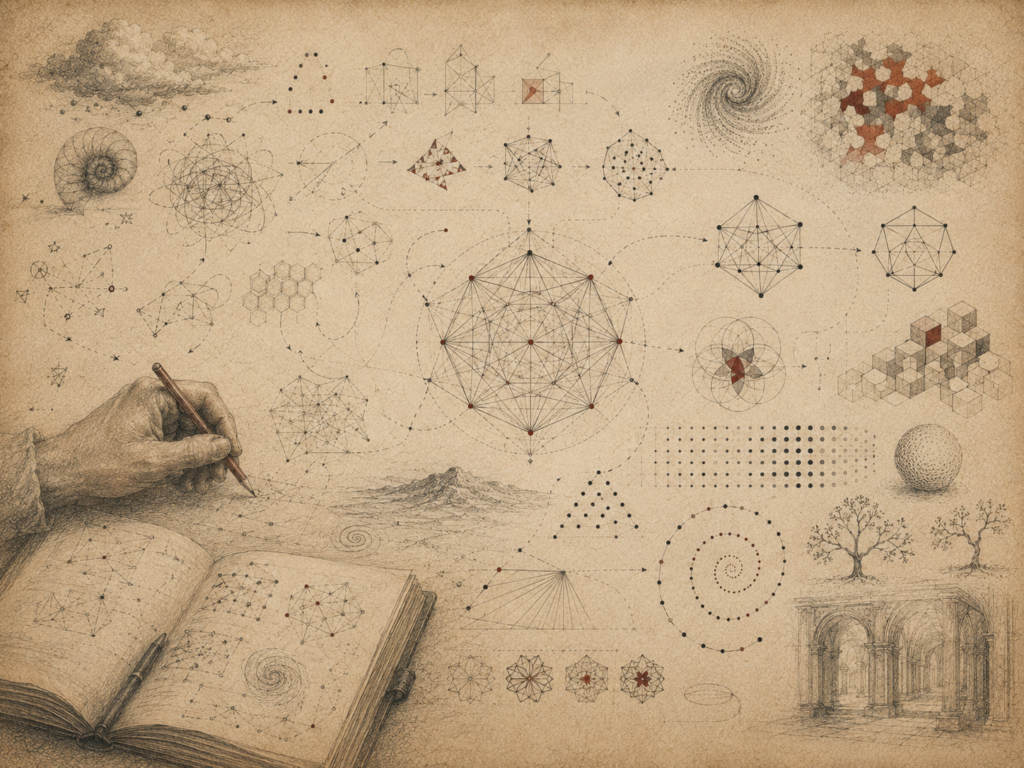
Scholarly editorial illustration of open notebooks, hand-drawn geometric diagrams, branching conjectures, spirals, networks, tessellations, and abstract mathematical forms on aged parchment.

Conjecture, Creativity, and Mathematical Discovery

Conjecture, Creativity, and Mathematical Discovery examines how mathematics moves from observation to theorem through disciplined imagination. The article explains that conjectures are not random guesses, but structured proposals shaped by examples, patterns, analogy, diagrams, computation, partial arguments, and the search for proof. It explores pattern recognition, special cases, counterexamples, abstraction, visualization, experimental mathematics, graph invariants, proof-status tracking, Haskell algebraic data types, and the creative tension between freedom and constraint in mathematical work. By showing how conjectures are tested, revised, refuted, proved, or generalized, the article frames mathematical discovery as an iterative process rather than a finished product. It also addresses the responsible use of AI and computation in mathematical exploration, where generated patterns, simulations, and finite evidence must be clearly distinguished from proof, theorem, and verified mathematical knowledge in research, education, technology, and public reasoning.

Scholarly editorial illustration showing objects, counting marks, grids, diagrams, symbolic notations, networks, and geometric forms moving from concrete representation toward abstract mathematical language.

Symbols, Language, and Mathematical Representation

Symbols, Language, and Mathematical Representation examines how mathematics becomes thinkable, shareable, and rigorous through systems of notation, symbol, diagram, formula, graph, formal language, and computational encoding. The article argues that symbols are not decorative marks added after reasoning is complete; they shape what can be seen, manipulated, generalized, proved, and communicated. It explores variables, quantifiers, equality, equivalence, functions, diagrams, notation, translation between representations, formal languages, proof systems, symbolic computation, Haskell algebraic data types, and representation audits. By distinguishing mathematical objects from the signs that express them, the article shows why every representation preserves selected structure while omitting other detail. It also addresses the ethical responsibility of mathematical modeling, where metrics, graphs, algorithms, and symbolic systems can clarify complex realities but can also distort context, uncertainty, meaning, and human consequence in research, education, AI, policy, and technical decision-making globally today.

Scholarly editorial illustration of branching logical diagrams, geometric constructions, inference pathways, circular proof structures, architectural forms, and a hand drawing on textured parchment.

Logic and the Structure of Formal Inference

Logic and the Structure of Formal Inference examines logic as the architecture that makes mathematical reasoning explicit, inspectable, and accountable. The article introduces propositions, predicates, quantifiers, connectives, implication, equivalence, validity, soundness, proof systems, derivation trees, sequent reasoning, and the relationship between formal inference and proof. It explains why logical form matters: a theorem’s meaning depends on its assumptions, quantifier order, inference rules, and the distinction between implication, converse, inverse, and contrapositive. By connecting truth tables, quantifier logic, counterexamples, proof-system metadata, derivation graphs, formal verification, and proof assistants, the article frames logic as both a foundational discipline and a practical tool for modern mathematical work. It also addresses the limits of formal systems and the ethical responsibilities of using formal reasoning in AI, software, institutional rules, risk models, and public decision-making across research, education, technology, governance, and responsible civic systems.

Scroll to Top