Mathematical Thinking

Mathematical thinking examines how abstraction, logic, pattern recognition, and formal reasoning enable people to understand structure, quantity, and relationships within complex systems. In interdisciplinary fields such as sustainability, economics, governance, data analysis, and systems research, mathematical reasoning provides a way to move beyond surface description toward deeper conceptual clarity and analytical precision.

This mode of thought involves identifying patterns, defining variables, recognizing constraints, and expressing relationships in structured ways that can be tested, compared, or generalized. Mathematical thinking is not limited to calculation. It includes the capacity to reason symbolically, model relationships conceptually, and frame problems in terms of scale, proportion, uncertainty, and interdependence.

Mathematical thinking plays an essential role in scientific inquiry, strategic analysis, technical problem-solving, and decision support. By making complex relationships more explicit, it helps transform ambiguity into structured understanding and allows institutions, researchers, and practitioners to reason more effectively about systems, evidence, and change over time.

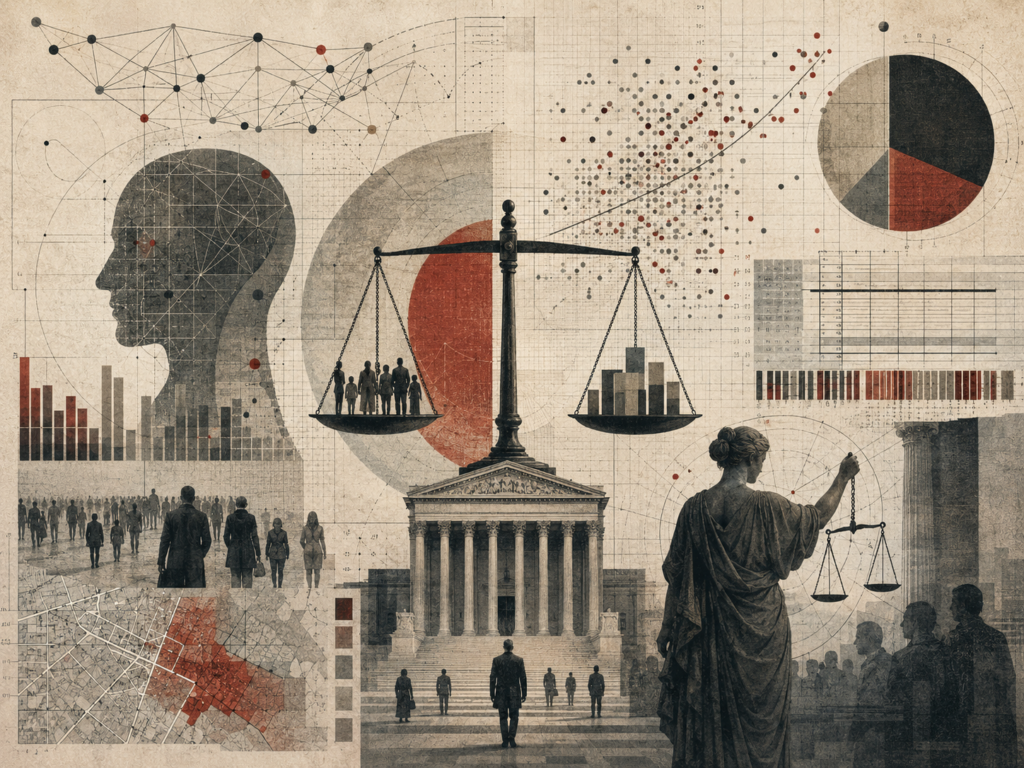
Scholarly editorial illustration of data charts, demographic silhouettes, institutional architecture, balance scales, networks, maps, and abstract measurement systems, representing the ethical stakes of quantification.

Mathematical Thinking and the Ethics of Quantification

Mathematical Thinking and the Ethics of Quantification examines how numbers shape knowledge, judgment, institutions, and public life. The article shows that quantification is not merely technical measurement, but an ethical act that defines what counts, what is compared, what is omitted, and what consequences follow. It explores measurement, classification, commensuration, indicators, proxies, rankings, risk scores, cost-benefit analysis, performance metrics, research assessment, AI benchmarks, sustainability metrics, uncertainty, aggregation, and metric governance. The article emphasizes that numbers can clarify reality, but they can also distort it through false precision, hidden assumptions, Goodhart effects, context erasure, proxy substitution, and unequal impact. By framing responsible quantification through define, measure, contextualize, and govern, it shows how mathematical thinking can support accountability, justice, and better public reasoning without allowing metrics to become unaccountable power.
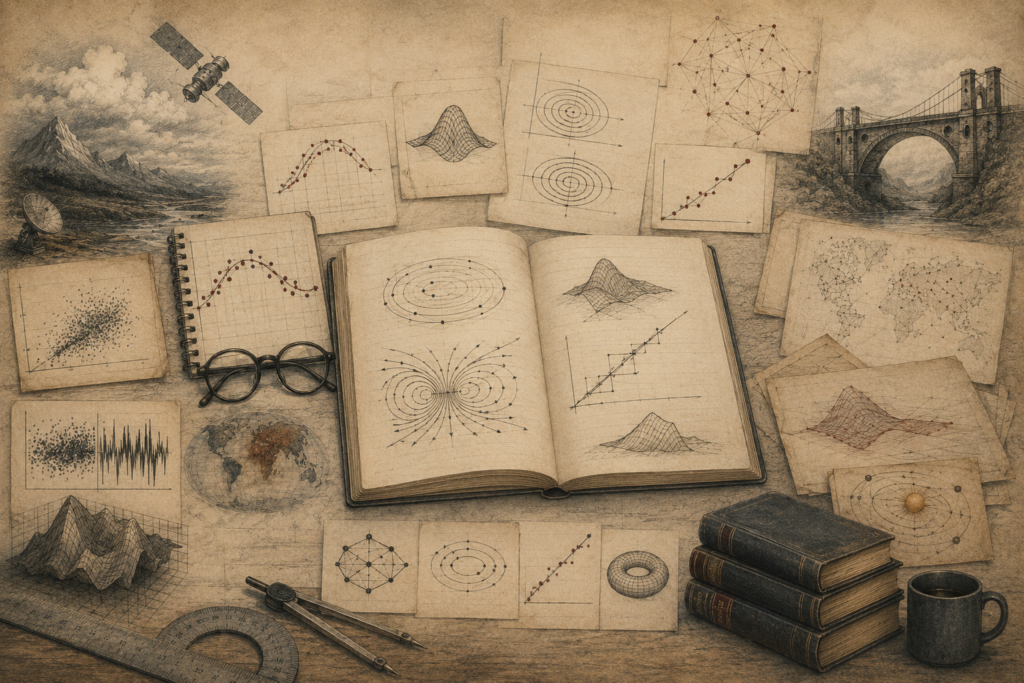
Scholarly editorial illustration of mathematical notebooks, scientific diagrams, graphs, models, instruments, landscapes, data plots, and a hand drawing structured reasoning on aged paper.

Mathematical Thinking and Scientific Modeling

Mathematical Thinking and Scientific Modeling examines how mathematics turns complex systems into structured representations for inquiry, explanation, prediction, and decision support. The article shows that scientific models are not reality itself, but disciplined abstractions shaped by variables, parameters, assumptions, equations, data, boundaries, and uncertainty. It explores idealization, measurement, parameterization, calibration, validation, verification, sensitivity analysis, simulation, mechanistic models, statistical models, systems models, agent-based models, climate models, epidemic models, policy models, and AI-assisted scientific modeling. The article emphasizes that model outputs must be interpreted through purpose, scope, uncertainty, evidence, and responsible use. By framing modeling through the cycle represent, relate, test, and revise, it shows how mathematical thinking supports scientific understanding while resisting false precision, hidden assumptions, model overreach, black-box authority, and the misuse of models in public decisions.

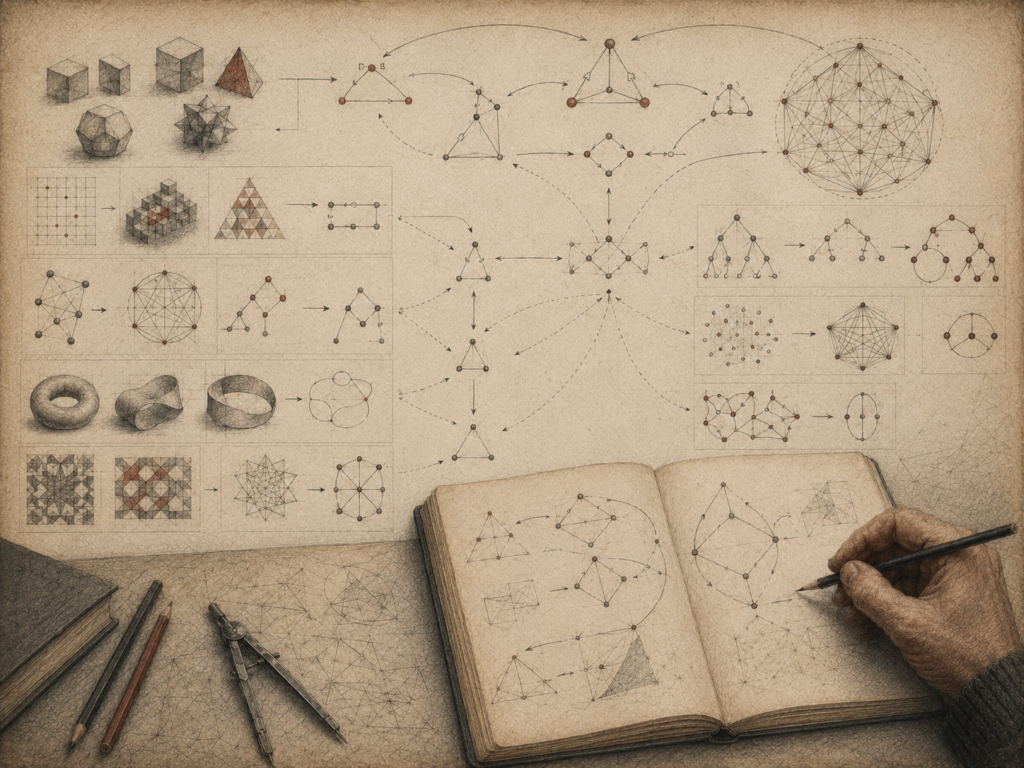
Scholarly editorial illustration of geometric objects, mappings, arrows, diagrams, networks, topological forms, notebooks, and hand-drawn relational structures on textured parchment.

Mathematical Thinking and Category-Level Abstraction

Mathematical Thinking and Category-Level Abstraction examines how category theory changes the scale of mathematical reasoning. Rather than focusing only on the internal contents of objects, the article shows how category-level thinking emphasizes morphisms, composition, structure-preserving maps, functors, natural transformations, diagrams, universal properties, duality, adjunctions, and Yoneda-style relational understanding. It explains why category theory is not abstraction for its own sake, but a disciplined way to recognize common patterns across algebra, topology, logic, computer science, data systems, applied modeling, and knowledge representation. The article also addresses the risks of premature abstraction, overgeneralization, decorative diagrams, jargon inflation, forgotten structure, and irresponsible modeling. By framing category-level abstraction through objects, arrows, structure, universality, and responsibility, it shows how mathematics can reason across domains while preserving rigor, interpretability, and ethical awareness in complex systems.

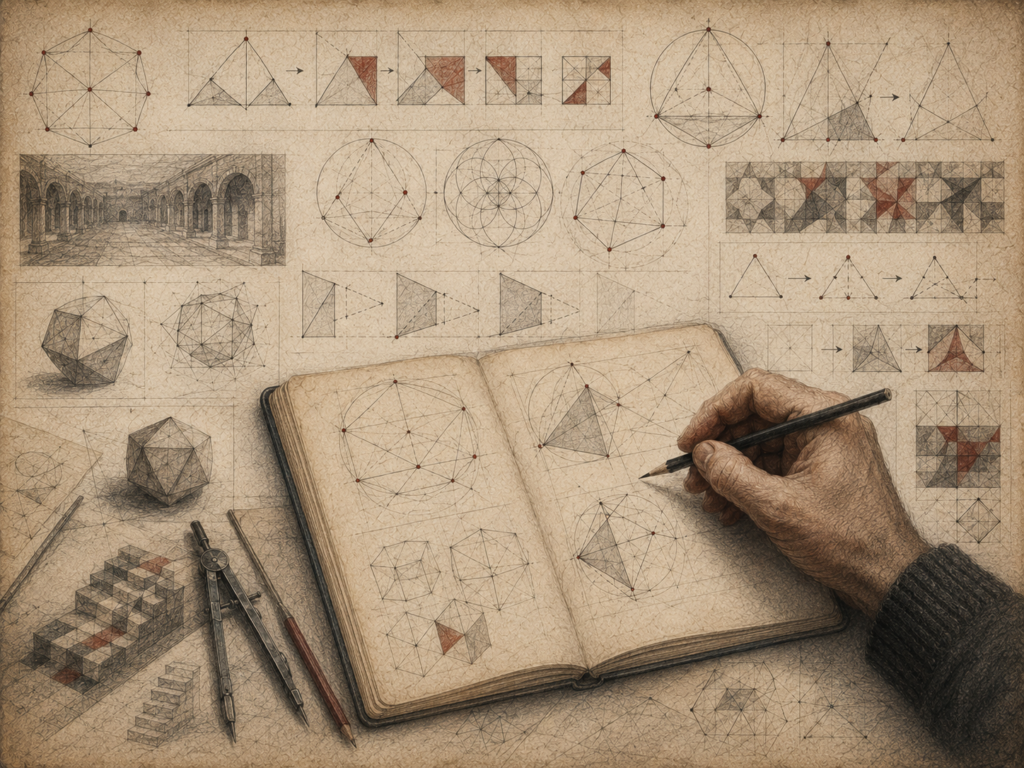
Scholarly editorial illustration of geometric constructions, visual proof diagrams, shaded transformations, polyhedra, compass tools, an open sketchbook, and a hand drawing on textured parchment.

Mathematical Thinking and Visual Proof

Mathematical Thinking and Visual Proof examines how diagrams, spatial reasoning, visual algebra, dynamic geometry, graph drawings, proofs without words, and diagrammatic systems shape mathematical understanding. The article argues that visual proof is not a lesser form of mathematics but a powerful mode of reasoning when paired with abstraction, generalization, and proof discipline. It distinguishes illustration, evidence, heuristic insight, diagrammatic argument, and formal diagrammatic proof, showing why visual plausibility must be tested against structure, assumptions, invariants, and exceptional cases. The article also explores geometric construction, area reasoning, combinatorial arrangements, calculus visualization, graph representation, machine reasoning with diagrams, accessibility, and responsible mathematical communication. By framing visual proof through the sequence see, abstract, prove, and interpret, it shows how mathematical images can reveal structure while still requiring rigorous justification and accessible explanation across classrooms, research, visualization, accessibility, and formal mathematical workflows alike.

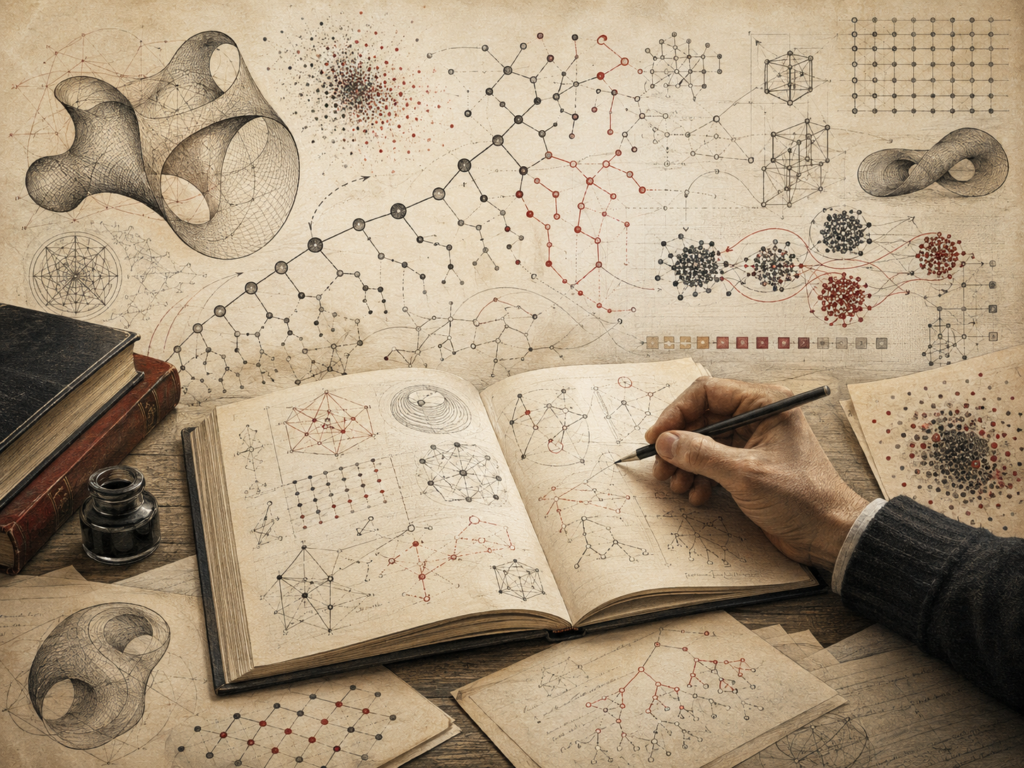
Scholarly editorial illustration of open mathematical notebooks, hand-drawn networks, abstract structures, data clusters, topological forms, and branching diagrams representing human reasoning and AI-assisted mathematical discovery.

Mathematical Thinking and AI-Assisted Discovery

Mathematical Thinking and AI-Assisted Discovery examines how artificial intelligence is changing the exploratory side of mathematics. The article frames AI as a discovery amplifier rather than a source of mathematical authority, showing how systems can generate examples, suggest conjectures, write candidate programs, search large spaces, propose proof strategies, assist formalization, and connect ideas across domains. It distinguishes AI-generated output from mathematical knowledge by emphasizing verification through counterexample search, evaluator design, proof, formal checking, and human interpretation. The article also explores program search, geometric reasoning, proof assistants, education, credit, reproducibility, and the ethics of AI-assisted discovery. Rather than treating AI as a replacement for mathematicians, it argues that human judgment becomes more important: framing problems, choosing representations, testing claims, recognizing significance, documenting workflows, and deciding what a discovery means within the broader structure of mathematics.

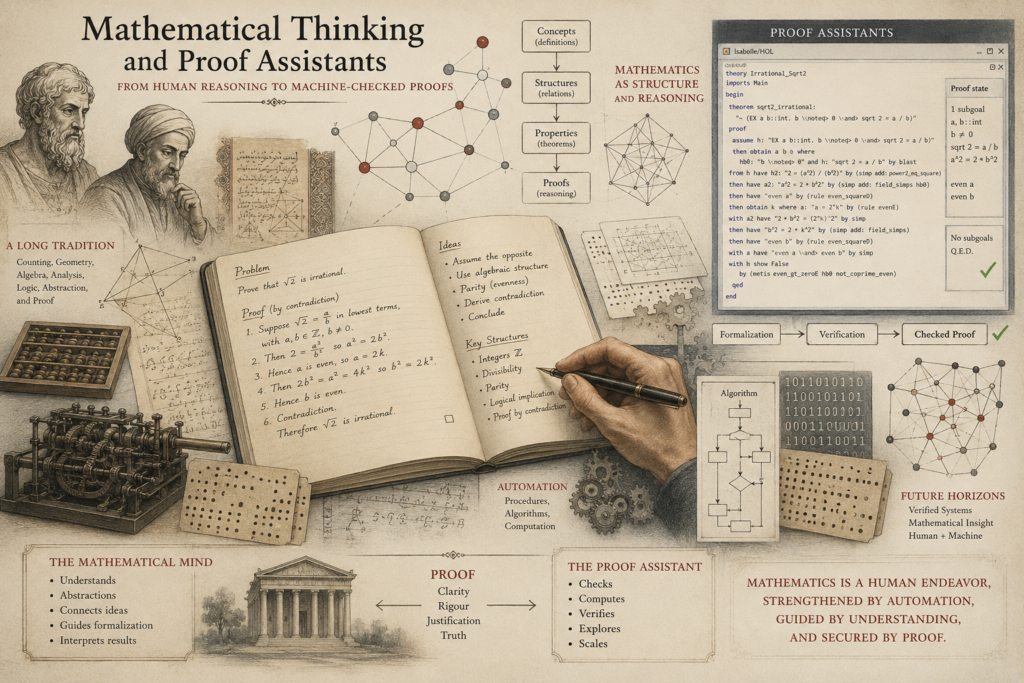
Scholarly editorial illustration of mathematical notebooks, proof diagrams, historical scholars, mechanical computation, algorithmic flowcharts, and a proof-assistant interface representing human reasoning and machine-checked proof.

Mathematical Thinking and Proof Assistants

Mathematical Thinking and Proof Assistants examines how machine-checkable proof is changing the medium of mathematical reasoning. The article explains proof assistants as formal environments where definitions, theorem statements, proof steps, libraries, kernels, axioms, and trust boundaries must be made explicit. It distinguishes informal proof from formal proof, showing why human mathematical insight remains essential even when machines can verify derivations. The article explores type theory, higher-order logic, constructive reasoning, formal libraries, proof automation, AI-assisted formalization, theorem-statement audits, and the role of proof assistants in mathematical education. It also emphasizes responsible verification: a machine-checked proof establishes a formal statement within a system, but humans must still review meaning, assumptions, scope, application, and consequence. The result is a deeper account of proof assistants as mathematical infrastructure that strengthens rigor while making definition, interpretation, and judgment more visible within contemporary mathematical culture.

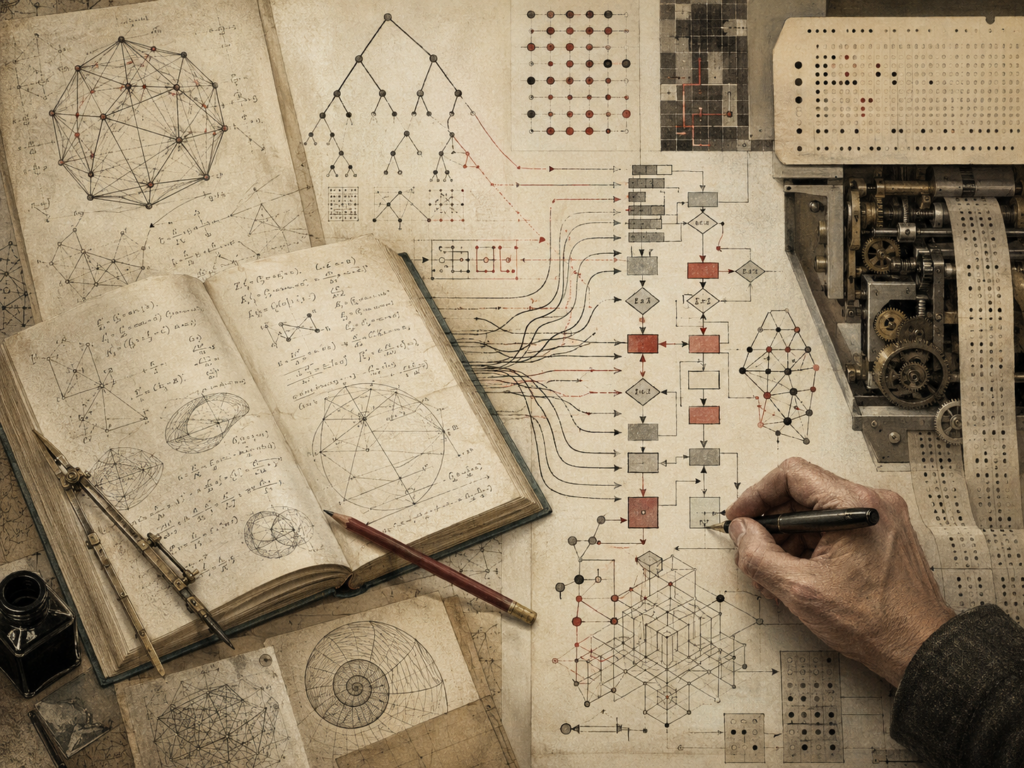
Scholarly editorial illustration of mathematical notebooks, formal diagrams, algorithmic flowcharts, mechanical computation, punched-card machinery, and a hand drawing structured reasoning on aged paper.

Mathematical Thinking in an Age of Automation

Mathematical Thinking in an Age of Automation examines how calculators, computer algebra systems, numerical simulation, proof assistants, AI-assisted reasoning, and automated verification are changing what it means to think mathematically. The article argues that automation does not eliminate mathematics; it shifts human responsibility toward specification, representation choice, assumption tracking, verification, interpretation, and ethical judgment. It distinguishes calculation, symbolic manipulation, simulation, AI-generated explanation, and formal proof as different forms of mathematical output requiring different evidence standards. The article also explores how education must change when routine procedures can be automated, emphasizing conceptual understanding, tool literacy, counterexample thinking, proof literacy, model validation, and responsible use. By framing automation as both historical continuity and new mathematical infrastructure, the article shows why human mathematical agency becomes more important, not less, when machines can compute, search, generate, simulate, and check.

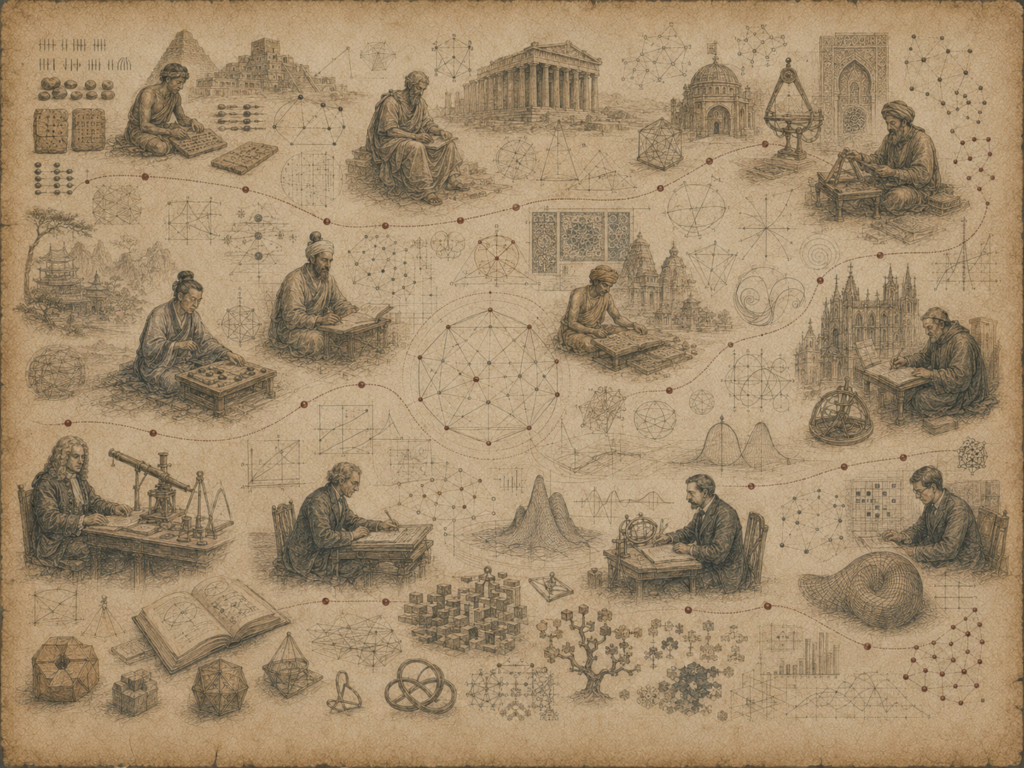
Scholarly editorial illustration of mathematicians across cultures and eras, surrounded by manuscripts, geometric diagrams, instruments, architecture, graphs, networks, and abstract mathematical structures on textured parchment.

The Historical Understanding of Mathematics

The Historical Understanding of Mathematics examines mathematics as both timeless in proof and historical in practice. The article explains how mathematical ideas become thinkable, writable, teachable, transferable, authoritative, and usable through changing media, methods, institutions, and interpretations. It traces mathematics from counting, measurement, administration, astronomy, and geometry through deductive proof, notation, translation, global traditions, canon formation, foundations, structural abstraction, mathematical modeling, computation, and proof assistants. Rather than reducing mathematics to culture or treating it as historyless truth, the article distinguishes formal validity from the historical conditions through which mathematics is represented, transmitted, taught, and applied. It also foregrounds responsible historiography, including the risks of presentism, Eurocentrism, notation anachronism, textual bias, canon exclusion, and formal overconfidence. The result is a deeper view of mathematics as durable reasoning shaped by human practice across cultures, technologies, schools, archives, models, and public institutions.

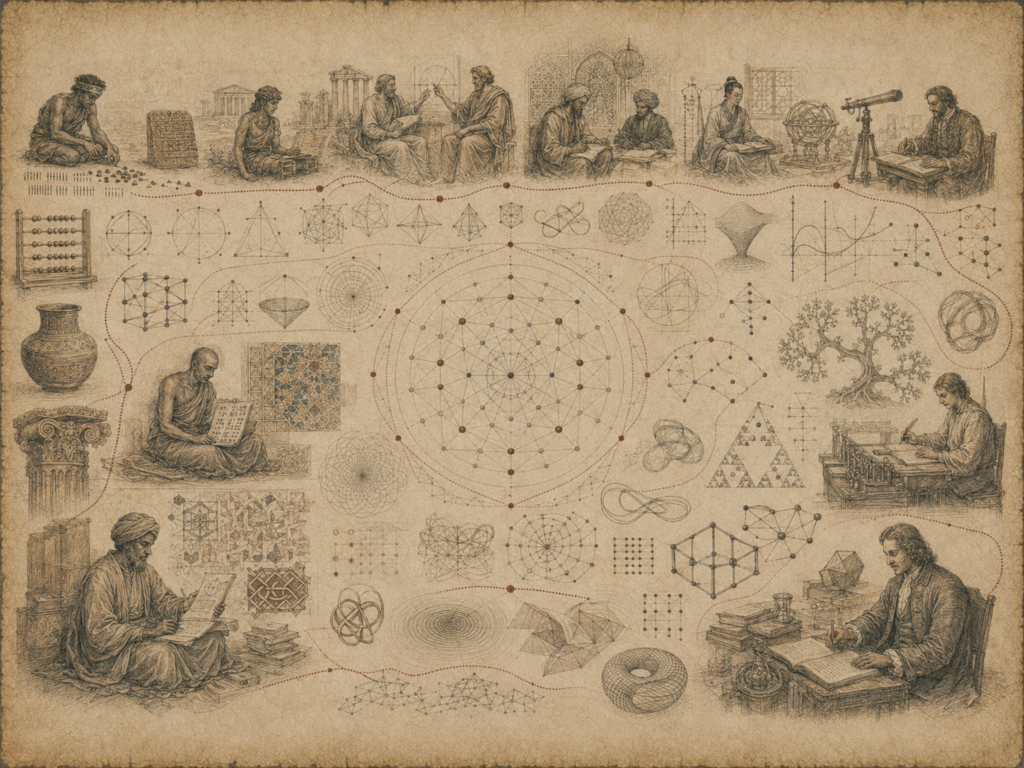
Scholarly editorial illustration of mathematicians across cultures and eras, surrounded by geometric diagrams, manuscripts, instruments, networks, topology, graphs, and abstract mathematical structures on textured parchment.

Historical Development and the Unity of Mathematical Ideas

Historical Development and the Unity of Mathematical Ideas examines how mathematics becomes coherent across seemingly separate fields. The article traces recurring ideas from ancient counting, measurement, geometry, astronomy, and procedural calculation through Greek proof, Indian and Chinese algorithmic traditions, Islamic algebra, Renaissance symbolism, analytic geometry, calculus, nineteenth-century rigor, structural mathematics, logic, probability, computation, modeling, category theory, and formal verification. It shows that mathematics is unified not by reducing every field to one subject, but by the movement of patterns across representations: quantity becomes relation, geometry becomes equation, proof becomes formal system, algorithms become reasoning, and structures become maps, invariants, and transformations. The article also emphasizes responsible generalization, showing why formal similarity must not be confused with contextual sameness when mathematical ideas move across history, science, technology, data systems, models, institutions, and public decision-making.

Scroll to Top