Mathematical Thinking

Mathematical thinking examines how abstraction, logic, pattern recognition, and formal reasoning enable people to understand structure, quantity, and relationships within complex systems. In interdisciplinary fields such as sustainability, economics, governance, data analysis, and systems research, mathematical reasoning provides a way to move beyond surface description toward deeper conceptual clarity and analytical precision.

This mode of thought involves identifying patterns, defining variables, recognizing constraints, and expressing relationships in structured ways that can be tested, compared, or generalized. Mathematical thinking is not limited to calculation. It includes the capacity to reason symbolically, model relationships conceptually, and frame problems in terms of scale, proportion, uncertainty, and interdependence.

Mathematical thinking plays an essential role in scientific inquiry, strategic analysis, technical problem-solving, and decision support. By making complex relationships more explicit, it helps transform ambiguity into structured understanding and allows institutions, researchers, and practitioners to reason more effectively about systems, evidence, and change over time.

Scholarly editorial illustration of mathematical foundations across history, showing geometric diagrams, networks, manuscripts, scholars, instruments, abstract structures, and modern relational forms on textured parchment.

Foundations, Structure, and the Reimagining of Mathematics

Foundations, Structure, and the Reimagining of Mathematics examines how modern mathematics transformed from a discipline of number, space, and calculation into an evolving architecture of formal systems, structural relations, models, computation, and proof. The article traces foundational questions through non-Euclidean geometry, set theory, logicism, formalism, intuitionism, Gödelian limits, structuralism, category-level abstraction, mathematical modeling, computation, and machine-checked proof. It argues that mathematics is not only a body of formulas, but a disciplined practice for creating and interpreting formal worlds under explicit assumptions. The article also distinguishes formal correctness from ethical adequacy, showing why models, optimization systems, metrics, proof assistants, and abstractions require human judgment. By connecting foundations, structure, computation, education, and responsible abstraction, the article frames mathematics as a living intellectual practice that continually reimagines what reason can make visible, testable, transformable, and accountable across science, technology, and public life.
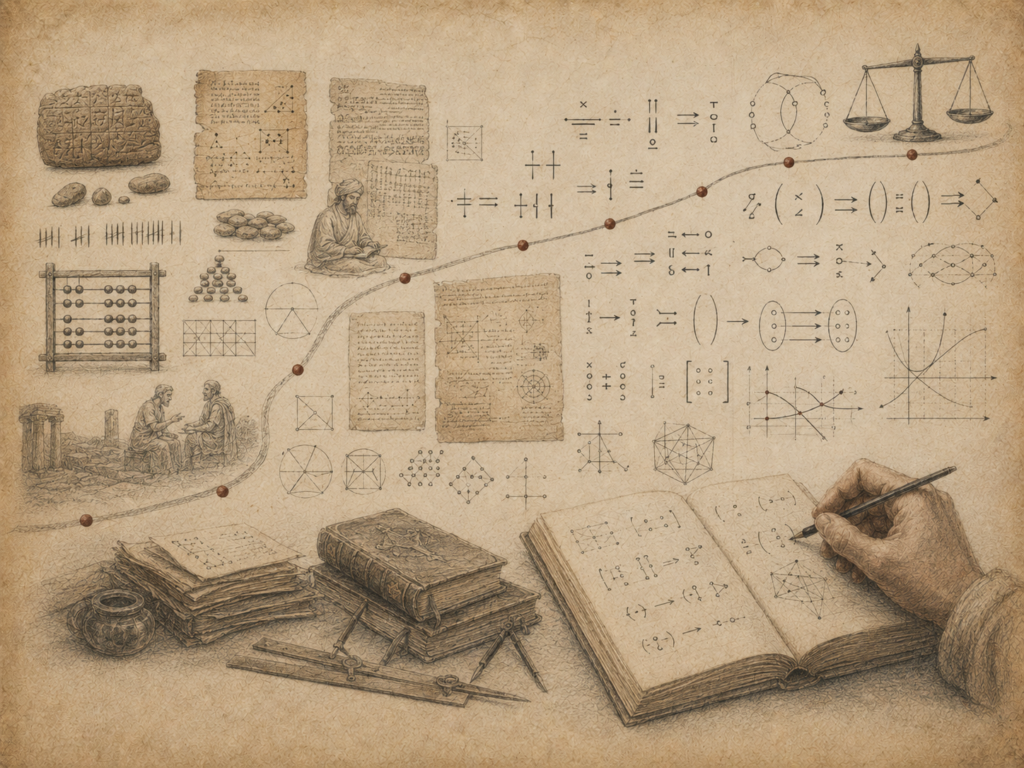
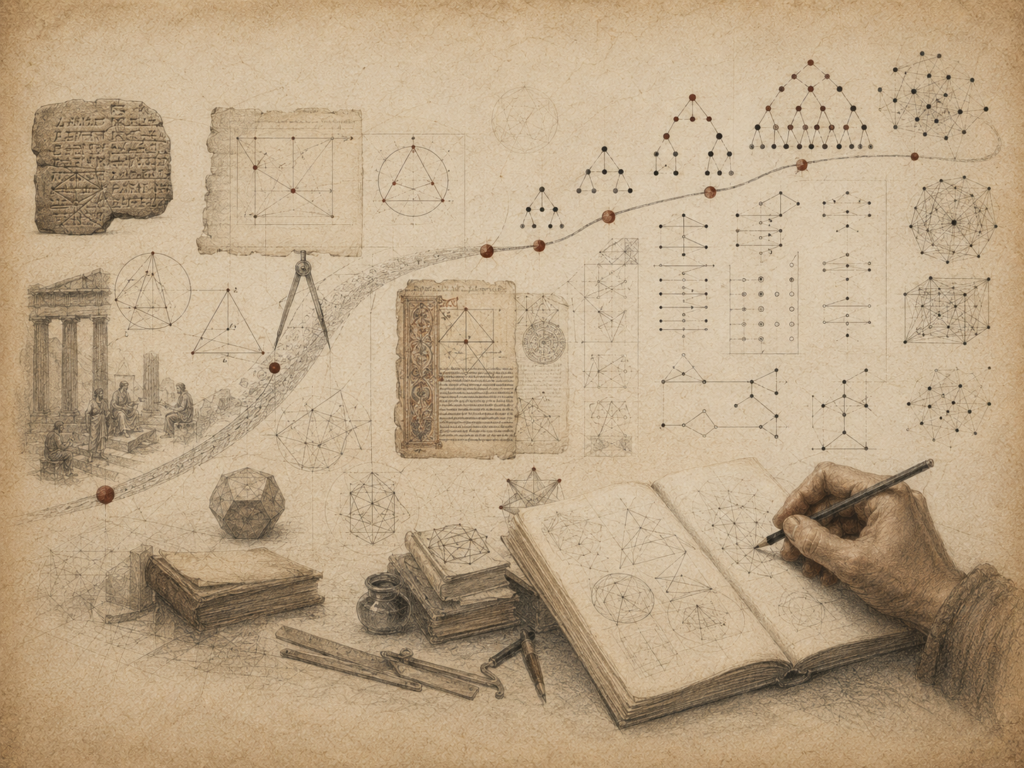
Scholarly editorial illustration of ancient counting systems, geometric diagrams, manuscripts, classical and Islamic architecture, scientific instruments, graphs, networks, open books, and a hand drawing mathematical forms on textured parchment.

The History of Mathematical Thinking from Antiquity to Modernity

The History of Mathematical Thinking from Antiquity to Modernity traces mathematics as a changing human discipline of pattern, representation, proof, structure, and computation. The article follows mathematical thought from ancient counting, measurement, administration, astronomy, and construction through Mesopotamian tables, Egyptian measurement, Greek deductive geometry, Euclid, Archimedes, Indian place-value numeration and astronomy, Chinese procedural systems, Islamic algebra and trigonometry, medieval logic, Renaissance symbolism, early modern analytic geometry and calculus, nineteenth-century rigor, non-Euclidean geometry, set theory, mathematical logic, modern structural abstraction, algorithms, computer algebra, simulation, and machine-checked proof. It emphasizes that mathematics is not only a sequence of discoveries but a history of intellectual tools: numerals, diagrams, tables, symbols, functions, matrices, axioms, proofs, models, programs, and formal languages. The article also foregrounds global traditions, historiographic justice, and responsible interpretation of mathematics in modern technical society.

Scholarly editorial illustration of ancient tablets, abacus forms, manuscripts, symbolic marks, algebraic diagrams, balance scales, graphs, open books, and a hand writing notation on textured parchment.

The Evolution of Algebraic Notation

The Evolution of Algebraic Notation examines notation as intellectual infrastructure rather than mathematical decoration. The article traces algebraic expression from ancient procedural mathematics, rhetorical problem statements, and syncopated abbreviation through Diophantus, Indian and Islamic algebraic traditions, European cossic notation, Viète’s symbolic breakthrough, Descartes’ exponent notation and analytic geometry, Leibnizian and Eulerian standardization, function notation, matrix notation, symbolic logic, set theory, abstract algebra, computer algebra, and formal languages. It shows how symbols made unknowns, parameters, operations, powers, equations, mappings, structures, and transformations visible enough to manipulate, generalize, prove, and compute. The article also emphasizes notation’s ethical and pedagogical dimensions: compact symbols can empower experts while excluding learners, hiding assumptions, or erasing older traditions. Understanding algebraic notation historically reveals how mathematical thought became increasingly abstract, portable, structural, computational, and culturally standardized across classrooms, research, software, and public mathematical communication globally today.

Scholarly editorial illustration of ancient tablets, geometric manuscripts, classical architecture, compass tools, proof diagrams, timelines, open books, and a hand drawing mathematical constructions on textured parchment.

The Historical Development of Proof

The Historical Development of Proof traces proof as a changing human practice of mathematical justification, not a fixed ritual that appeared fully formed. The article follows proof from ancient rule-based calculation, measurement, and scribal procedure through Greek deductive geometry, Euclid’s axiomatic architecture, Aristotelian demonstration, Hellenistic exhaustion, Indian algorithmic and astronomical traditions, Chinese procedural verification, Islamic algebraic-geometric synthesis, medieval scholastic reasoning, early modern symbolism, calculus, nineteenth-century rigor, non-Euclidean geometry, set theory, logic, Gödelian limits, twentieth-century abstraction, and machine-checked proof. It emphasizes that proof standards depend on notation, medium, institution, culture, pedagogy, and community judgment. By foregrounding global traditions and historiographic risks such as Eurocentrism, presentism, canon bias, and technological triumphalism, the article frames proof as both a logical discipline and an ethical practice of intellectual accountability across mathematics, history, education, computation, and responsible public reasoning in modern knowledge systems today.

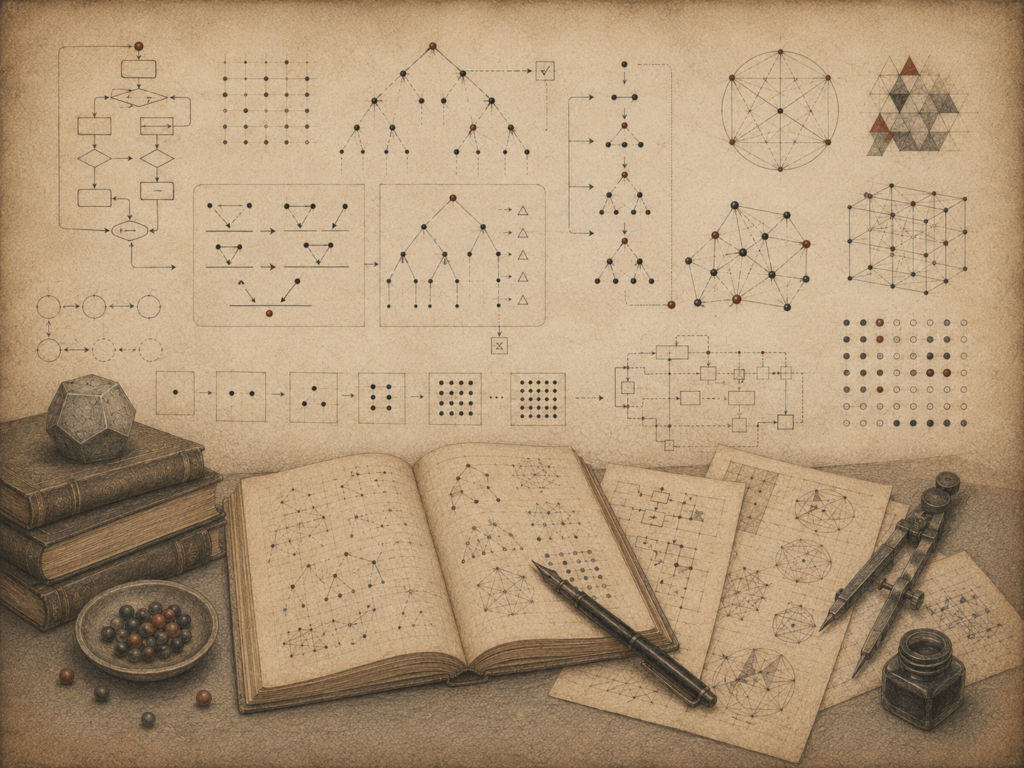
Scholarly editorial illustration of algorithmic flow diagrams, proof trees, grids, logic structures, networks, discrete patterns, open notebooks, books, and mathematical instruments on textured parchment.

Algorithms, Proof, and Formal Reasoning

Algorithms, Proof, and Formal Reasoning examines algorithms as mathematical objects that require specification, proof, termination arguments, and complexity analysis before they can be trusted. The article explains how preconditions, postconditions, loop invariants, induction, recursive correctness, well-founded descent, data-structure invariants, graph-algorithm assumptions, type systems, formal methods, testing, and proof work together to justify computational procedures. It emphasizes that examples and benchmarks are not proofs: a program may run, pass tests, and still fail beyond the observed cases. Formal reasoning clarifies what an algorithm guarantees, under what assumptions, and at what computational cost. The article also connects formal correctness to responsible computing, showing that an algorithm can satisfy its specification while still serving a harmful, incomplete, or poorly chosen objective. Rigorous algorithmic reasoning therefore requires specification, proof, cost analysis, evidence, interpretation, and accountability in modern software, data, AI, infrastructure, and governance.

Scholarly editorial illustration of graph networks, branching trees, binary-like patterns, recursion diagrams, flowcharts, discrete structures, notebooks, books, and research tools on textured parchment.

Mathematical Thinking for Computer Science

Mathematical Thinking for Computer Science examines computer science as a discipline of structure, procedure, representation, proof, complexity, and computational limits. The article explains how mathematical thinking supports algorithms, data structures, logic, sets, relations, functions, recursion, induction, graphs, automata, computability, type systems, probability, linear algebra, modular arithmetic, cryptography, and responsible software reasoning. It shows how programs depend on formal specifications, how algorithms require correctness proofs and complexity analysis, how data structures preserve invariants, and how models of computation define what can and cannot be solved algorithmically. The article also connects mathematical rigor to ethical computing, emphasizing that formal correctness alone does not guarantee just or meaningful outcomes. By linking abstraction, implementation, proof, cost, interpretation, and accountability, the article frames mathematics as the intellectual architecture that makes computer science understandable, scalable, verifiable, and publicly responsible in modern technical systems.

Scholarly editorial illustration of graph networks, branching trees, grids, node-link structures, polyhedra, notebooks, books, and mathematical instruments on textured parchment.

Graphs, Networks, and Discrete Structure

Graphs, Networks, and Discrete Structure examines graph theory as a mathematical language for relationship, connection, path, dependency, flow, hierarchy, clustering, reachability, and network form. The article explains how vertices and edges define discrete structure, then explores adjacency, degree, neighborhoods, paths, cycles, connected components, trees, directed graphs, weighted graphs, bipartite graphs, graph representations, traversal algorithms, shortest paths, centrality, Haskell typed graph models, SQL graph schemas, and responsible network interpretation. It connects graph theory to computer science, data systems, AI, knowledge graphs, infrastructure, citation networks, social systems, biological networks, and institutional analysis. The article emphasizes that networks are interpreted graphs: edge meaning, weight semantics, direction, provenance, missing data, centrality, and visualization choices all shape what can responsibly be inferred. Graph thinking is framed as a disciplined way to understand how local relationships create global structure across technical, scientific, and civic systems.

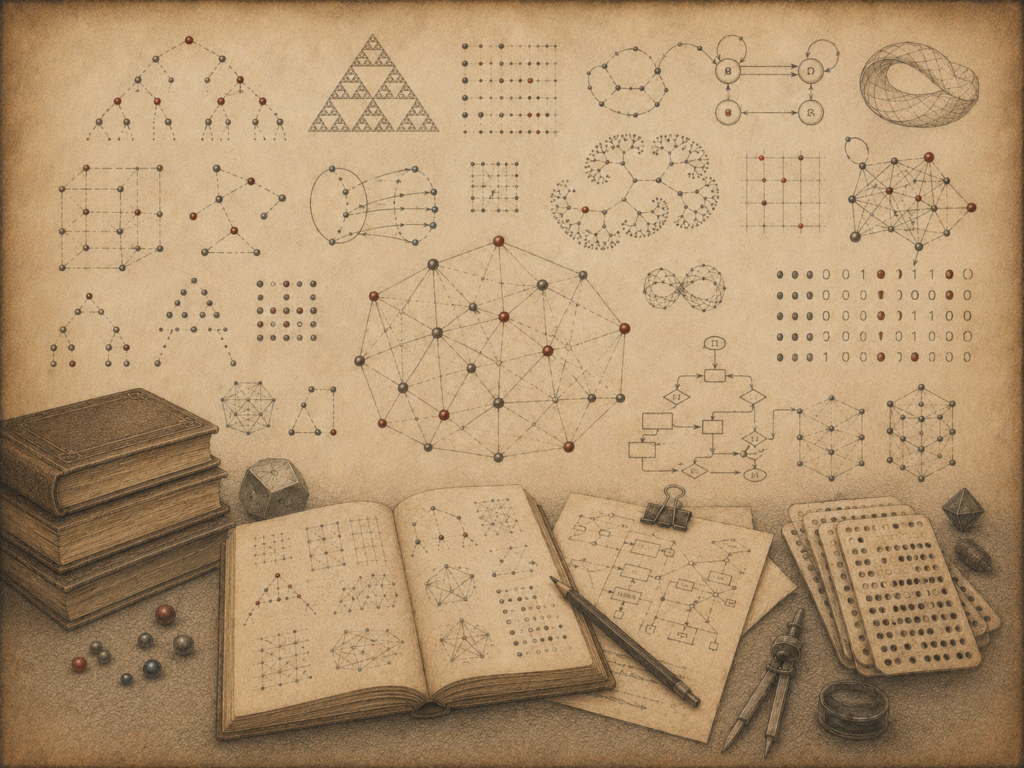
Scholarly editorial illustration of recursive trees, fractal triangles, spirals, nested grids, repeating geometric structures, open notebooks, books, and drawing instruments on textured parchment.

Recursion and Recursive Thinking

Recursion and Recursive Thinking examines recursion as a foundational mode of mathematical reasoning, computation, proof, language, and systems analysis. The article explains recursive definitions through base cases, recursive rules, stopping conditions, recurrence relations, induction, structural recursion, trees, self-similarity, divide-and-conquer algorithms, memoization, dynamic programming, recursive grammar, Haskell algebraic data types, SQL schemas, and recursive model auditing. It shows how large structures can arise from small repeated rules, how proofs propagate from base cases, how algorithms reduce problems to smaller versions of themselves, and how nested symbolic systems generate complexity. The article also emphasizes responsible interpretation: recursive systems can amplify error, bias, feedback, or instability when base cases, update rules, stopping conditions, and validation boundaries are poorly defined. Recursion is framed as controlled self-reference, not circular confusion, and as a disciplined way to understand structure, growth, reduction, and return across mathematics.

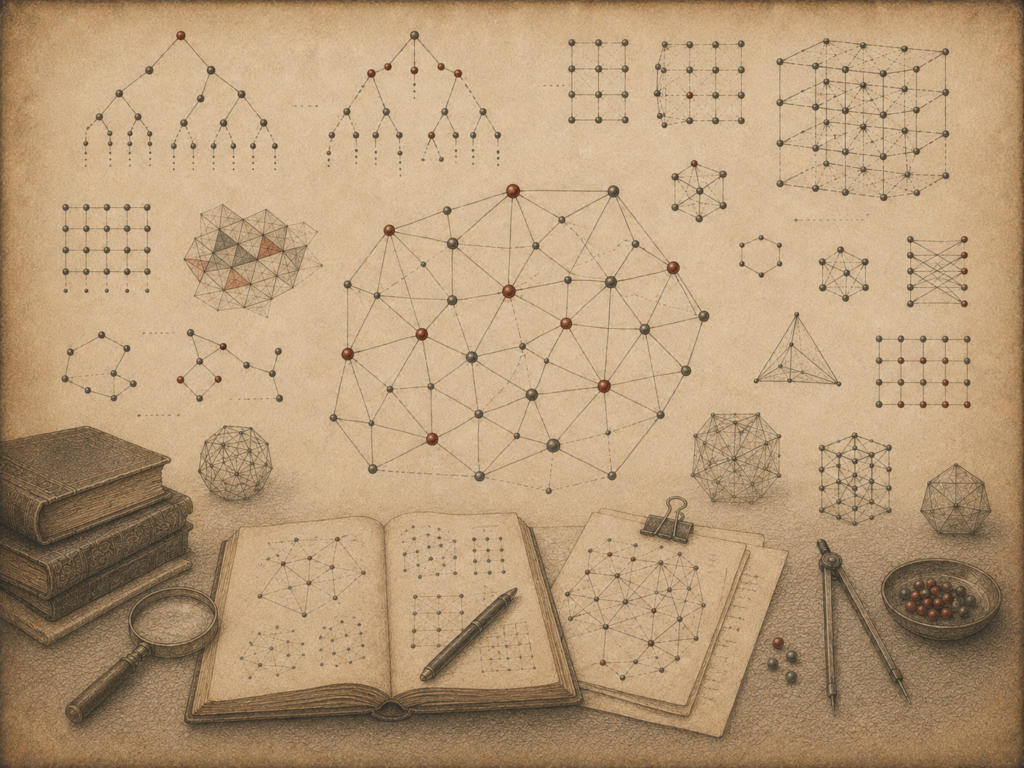
Scholarly editorial illustration of branching trees, grids, arrangements, permutations, combinations, network diagrams, counting objects, polyhedra, notebooks, and research instruments on textured parchment.

Combinatorics and the Mathematics of Possibility

Combinatorics and the Mathematics of Possibility examines how mathematics counts structured possibilities: arrangements, selections, paths, partitions, graph configurations, schedules, codes, outcomes, and search spaces under explicit rules. The article explains combinatorics as more than counting, showing how order, repetition, overlap, symmetry, constraints, labels, recurrence, and equivalence determine what is being counted. It explores addition and multiplication principles, permutations, combinations, binomial coefficients, Pascal structure, inclusion-exclusion, the pigeonhole principle, recurrence relations, generating functions, graph counting, integer partitions, probability, algorithms, Haskell algebraic data types, SQL schemas, and responsible interpretation of possibility spaces. By connecting combinatorial rigor to AI, optimization, risk modeling, data systems, institutional categories, and public decision-making, the article frames combinatorics as a discipline for defining what could happen, what has been excluded, and how possibility should be counted responsibly across technical, educational, scientific, and civic contexts where choices carry consequences.

Scroll to Top