
Last Updated May 30, 2026
Sets, relations, and functions are often introduced as technical topics: a set is a collection, a relation connects elements, and a function assigns each input exactly one output. But these ideas are more than definitions. They are modes of thought. They shape how mathematics organizes objects, compares structures, defines similarity, describes dependence, models change, and builds abstract systems.
Set thinking asks what belongs together and under what rule. Relational thinking asks how things are connected, ordered, equivalent, adjacent, dependent, or constrained. Functional thinking asks how one thing determines another. Together, these ideas form one of the deepest architectures of modern mathematics: classification, structure, mapping, transformation, modeling, proof, computation, data systems, logic, category theory, and artificial intelligence all depend on them.
This article examines sets, relations, and functions as foundational ways of thinking. It explores membership, inclusion, classification, equivalence, order, mapping, domain, codomain, composition, inverse structure, proof, computation, Haskell-style type modeling, database schemas, and the responsible interpretation of categories, relations, and functional models in technical and public reasoning.
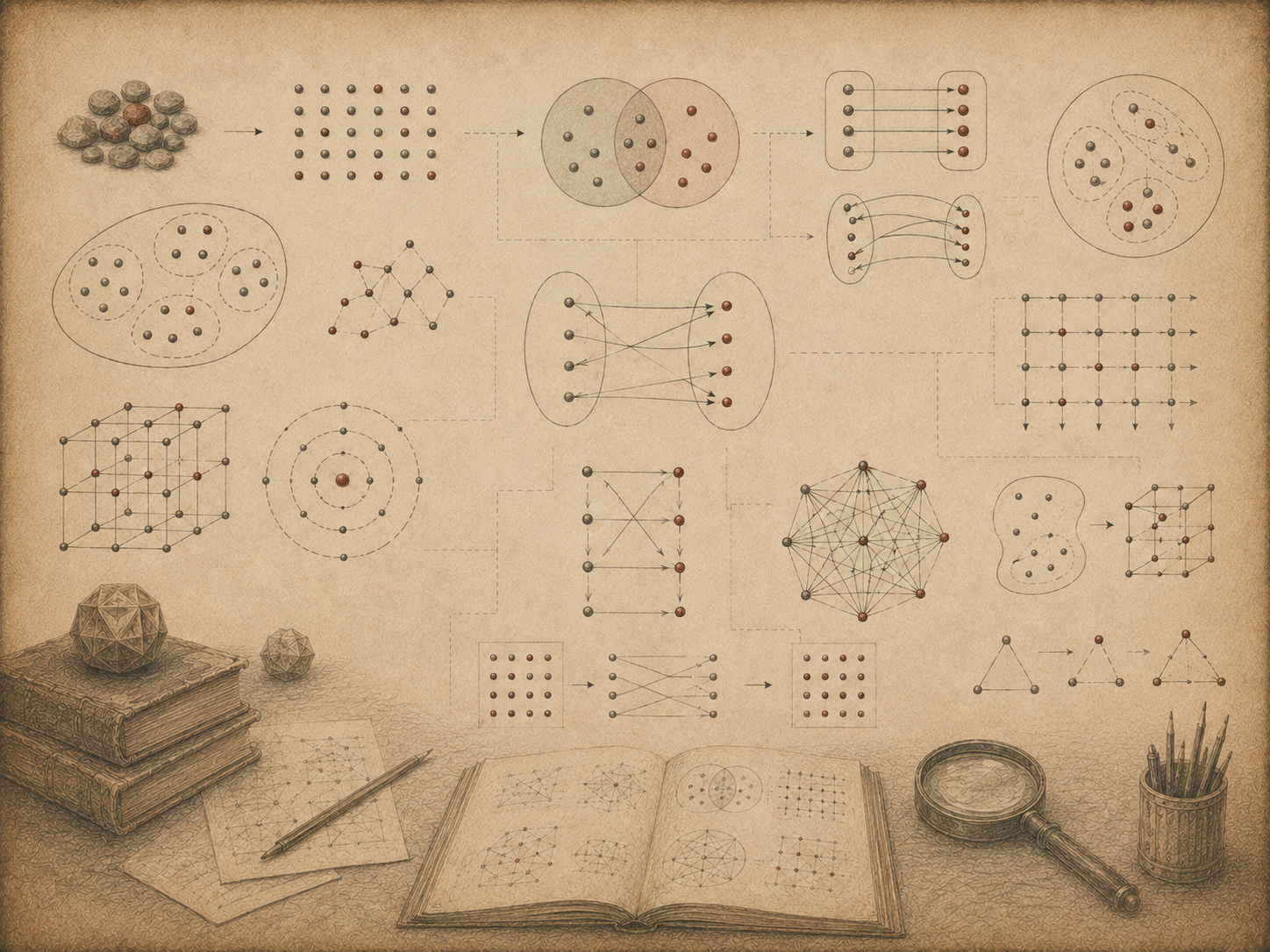
What Sets, Relations, and Functions Mean
Sets, relations, and functions are foundational because they provide a general language for organizing mathematical objects. A set identifies a collection. A relation describes how elements may be connected. A function describes a special kind of relation in which each input is assigned exactly one output. These ideas appear simple at first, but they underlie much of modern mathematics.
A=\{x\mid x\text{ satisfies a specified condition}\}
\]
Interpretation: A set can be defined by a rule: its members are precisely the objects satisfying the condition.
A set is not only a container. It is a way of drawing a mathematical boundary. A relation is not only a connection. It is a way of identifying structure among elements. A function is not only a formula. It is a disciplined mapping from one domain to another. These ideas are modes of thought because they teach the mind to ask:
- What belongs to the collection?
- What is excluded?
- How are elements related?
- When should two things count as the same for a purpose?
- What determines what?
- What structure is preserved under mapping?
| Concept | Core Question | Mode of Thought |
|---|---|---|
| Set | What belongs together? | Classification and boundary |
| Subset | What is contained within what? | Hierarchy and inclusion |
| Relation | How are elements connected? | Structure and comparison |
| Equivalence relation | When should different elements count as the same? | Abstraction and classification |
| Function | How does input determine output? | Dependence and transformation |
Sets, relations, and functions therefore form a conceptual bridge between elementary mathematics and advanced abstraction. They support arithmetic, algebra, geometry, topology, analysis, probability, logic, computer science, databases, modeling, machine learning, and formal systems.
Sets as the Mathematics of Belonging
Set thinking begins with belonging. An object either belongs to a set or it does not. This simple idea gives mathematics a way to define collections precisely. The set of even integers, the set of real numbers, the set of solutions to an equation, the set of points on a circle, the set of vertices in a graph, and the set of possible outcomes in a probability experiment are all examples of mathematical collections.
2\in \mathbb{Z},\qquad \frac{1}{2}\notin \mathbb{Z}
\]
Interpretation: Membership notation states whether an object belongs to a set. Here \(2\) is an integer, while \(\frac{1}{2}\) is not.
The power of sets is that they allow mathematics to talk about many things at once. Instead of reasoning about one number, one point, or one object, a set allows reasoning about all objects satisfying a condition. This supports generalization, abstraction, proof, and modeling.
Sets may be finite or infinite, concrete or abstract, explicitly listed or defined by a property. A set may contain numbers, points, functions, shapes, strings, graphs, events, data records, or other sets. This flexibility makes set theory a general language for mathematics.
| Set Type | Example | Mathematical Use |
|---|---|---|
| Finite set | \(\{1,2,3,4\}\) | Counting, enumeration, combinatorics |
| Infinite set | \(\mathbb{N}\) | Number systems, induction, sequences |
| Solution set | \(\{x\in\mathbb{R}\mid x^2=1\}\) | Equation solving and constraints |
| Geometric set | \(\{(x,y)\mid x^2+y^2=1\}\) | Coordinate geometry and shapes |
| Function set | \(\{f:\mathbb{R}\to\mathbb{R}\}\) | Analysis, algebra, modeling, computation |
Set thinking is distinct because it asks mathematics to become explicit about boundaries. What counts? What does not? What rule defines the collection? This is the beginning of disciplined abstraction.
Membership, Inclusion, and Boundary
Membership is the basic relation between an object and a set. Inclusion is the relation between sets. If every element of set \(A\) is also an element of set \(B\), then \(A\) is a subset of \(B\). Inclusion gives mathematics a way to express hierarchy, containment, refinement, and generality.
A\subseteq B \quad \Longleftrightarrow \quad \forall x\,(x\in A\Rightarrow x\in B)
\]
Interpretation: \(A\) is a subset of \(B\) precisely when every member of \(A\) is also a member of \(B\).
Subset thinking is powerful because it organizes mathematical domains. Natural numbers sit inside integers. Integers sit inside rational numbers. Rational numbers sit inside real numbers. Real numbers sit inside complex numbers, if embedded in the usual way. Each inclusion preserves some structure while extending what can be done.
Boundaries matter. If a theorem applies only to real numbers, it may fail for complex numbers. If a model applies only to a defined population, applying it outside that set is invalid. If a function is defined only on positive inputs, evaluating it at negative values may be meaningless. Set boundaries are not technical clutter; they are part of mathematical responsibility.
| Set Relation | Notation | Meaning | Thinking Skill |
|---|---|---|---|
| Membership | \(x\in A\) | Object \(x\) belongs to set \(A\) | Boundary recognition |
| Non-membership | \(x\notin A\) | Object \(x\) is excluded from set \(A\) | Exception awareness |
| Subset | \(A\subseteq B\) | All elements of \(A\) are in \(B\) | Hierarchy and generality |
| Proper subset | \(A\subset B\) | \(A\) is contained in \(B\), but not equal to \(B\) | Strict containment |
| Power set | \(\mathcal{P}(A)\) | Set of all subsets of \(A\) | Second-order collection thinking |
Membership and inclusion train the mind to reason with precision. They ask what is inside, what is outside, and what follows from belonging to a specified domain.
Classification, Categories, and the Power of Grouping
Sets make classification possible. To classify is to group objects according to a property, rule, purpose, or structure. Classification appears throughout mathematics: prime numbers, continuous functions, finite groups, compact spaces, equivalence classes, graph types, probability events, data categories, and solution families.
Classification is powerful because it reduces complexity. Instead of treating every object as isolated, mathematics groups objects that share relevant structure. This allows theorems to apply to entire classes. If all continuous functions on a compact interval have a certain property, the theorem applies to every function in that class.
C=\{x\in U\mid P(x)\}
\]
Interpretation: A class \(C\) can be formed by selecting all objects in a universe \(U\) that satisfy a property \(P\).
But classification is never neutral in applied settings. Mathematical categories may be precise, but real-world categories can be contested, incomplete, biased, or historically shaped. A set used in a model may depend on measurement choices, institutional definitions, missing data, or social assumptions. This matters in education, healthcare, economics, criminal justice, environmental modeling, and AI systems.
| Classification Context | Mathematical Role | Interpretive Risk |
|---|---|---|
| Number theory | Classify integers as prime or composite | Low risk when definitions are formal |
| Topology | Classify spaces by compactness or connectedness | Definitions must match theorem conditions |
| Data science | Classify records into categories | Categories may encode social bias |
| Machine learning | Predict class labels | Model categories may oversimplify persons or systems |
| Policy modeling | Define eligible populations | Boundary choices affect inclusion and exclusion |
Set thinking therefore has both mathematical and ethical force. To define a set is to draw a boundary. In pure mathematics, that boundary supports rigor. In applied systems, it may shape real consequences.
Relations as the Mathematics of Connection
A relation describes how elements of one set may be connected to elements of another set, or to elements of the same set. Relations can represent equality, inequality, order, adjacency, divisibility, similarity, dependency, implication, preference, causality, kinship, accessibility, or compatibility.
R\subseteq A\times B
\]
Interpretation: A relation from \(A\) to \(B\) can be represented as a subset of ordered pairs. If \((a,b)\in R\), then \(a\) is related to \(b\).
Relational thinking shifts attention from objects to connections among objects. A graph is a relation among vertices. A partial order is a relation that organizes elements by precedence or containment. An equivalence relation groups elements into classes. A database table may encode relations among entities. A social network is a relation among persons or institutions. A mathematical proof often depends on showing that one relation implies another.
| Relation Type | Example | What It Organizes |
|---|---|---|
| Equality | \(a=b\) | Identity or sameness under a definition |
| Order | \(a\leq b\) | Comparison, hierarchy, sequence |
| Divisibility | \(a\mid b\) | Number-theoretic structure |
| Adjacency | \((u,v)\in E\) | Graph or network connection |
| Similarity | \(x\sim y\) | Classification by shared structure |
Relations are fundamental because many mathematical objects are defined by their relational structure. A graph is not merely a set of vertices; it is a set of vertices together with an edge relation. A metric space is not merely a set of points; it is a set with a distance function. A partially ordered set is not merely a set; it is a set with an order relation.
Relational thinking teaches the mind to ask: not only what are the objects, but how are they connected?
Equivalence Relations and the Logic of Sameness
One of the most important kinds of relation is an equivalence relation. An equivalence relation tells mathematics when different objects should count as the same for a specified purpose. This is one of the central mechanisms of abstraction.
x\sim y
\]
Interpretation: The symbol \(\sim\) often denotes an equivalence relation: \(x\) and \(y\) are considered equivalent under a defined rule.
An equivalence relation must be reflexive, symmetric, and transitive. Reflexivity means every object is equivalent to itself. Symmetry means if \(x\) is equivalent to \(y\), then \(y\) is equivalent to \(x\). Transitivity means if \(x\) is equivalent to \(y\), and \(y\) is equivalent to \(z\), then \(x\) is equivalent to \(z\).
\begin{aligned}
&x\sim x &&\text{reflexive}\\
&x\sim y\Rightarrow y\sim x &&\text{symmetric}\\
&(x\sim y\land y\sim z)\Rightarrow x\sim z &&\text{transitive}
\end{aligned}
\]
Interpretation: These three properties allow an equivalence relation to divide a set into well-defined equivalence classes.
Equivalence relations appear everywhere. Fractions such as \(\frac{1}{2}\) and \(\frac{2}{4}\) are different symbolic expressions but represent the same rational number. Geometric figures may be equivalent up to congruence, similarity, or homeomorphism. Modular arithmetic groups integers by remainders. Graphs may be considered the same up to isomorphism.
| Equivalence Context | Rule | What Counts as the Same |
|---|---|---|
| Fractions | \(\frac{a}{b}\sim\frac{c}{d}\) if \(ad=bc\) | Same rational number |
| Modular arithmetic | \(a\equiv b\pmod n\) | Same remainder modulo \(n\) |
| Geometry | Congruence | Same shape and size |
| Topology | Homeomorphism | Same topological structure |
| Graph theory | Isomorphism | Same connection structure |
Equivalence relations teach a deep mathematical lesson: sameness is not always literal identity. Mathematics often defines sameness relative to the structure it wants to preserve.
Order Relations, Hierarchy, and Structure
Order relations organize elements by comparison, precedence, containment, size, rank, dependency, or hierarchy. The familiar relation \(\leq\) orders numbers. Subset inclusion orders sets. Divisibility orders positive integers in a partial way. Dependency relations order tasks, proofs, software modules, and institutional processes.
Unlike equivalence, order is often directional. If \(a\leq b\), it does not usually follow that \(b\leq a\). This directionality makes order relations useful for hierarchy, sequence, optimization, causality, and structure.
a\leq b
\]
Interpretation: An order relation expresses comparison. Depending on context, it may mean less than or equal, contained in, preceding, dividing, or being structurally below.
Partial orders are especially important because not all elements need to be comparable. For example, two sets may overlap without one containing the other. Two tasks may be independent. Two mathematical objects may not be naturally ranked. Partial order respects this complexity.
| Order Relation | Set | Meaning | Order Type |
|---|---|---|---|
| \(\leq\) | Real numbers | Numerical comparison | Total order |
| \(\subseteq\) | Power set | Inclusion | Partial order |
| \(\mid\) | Positive integers | Divisibility | Partial order |
| Prerequisite relation | Tasks or concepts | Dependency | Partial order |
| Reachability | Directed graph nodes | Path accessibility | Preorder or partial order under conditions |
Order relations are modes of thought because they help mathematics understand sequence, hierarchy, dependency, and constraint. They ask not only whether things are connected, but how structure flows among them.
Functions as the Mathematics of Dependence
A function is a relation with a special discipline: each input in the domain is assigned exactly one output in the codomain. This makes functions one of the most powerful ideas in mathematics. They express dependence, transformation, rule, process, model, and mapping.
f:A\to B
\]
Interpretation: A function \(f\) maps each element of domain \(A\) to exactly one element of codomain \(B\).
Functions are often introduced as formulas such as \(f(x)=2x+1\). But a function is not identical with a formula. A function may be defined by a formula, a table, a graph, a rule, an algorithm, a recurrence, a lookup structure, a geometric transformation, or an existence theorem. What matters is the mapping relationship.
Functional thinking asks: how does one thing determine another? If time determines position, there is a function. If input data determine a prediction, there is a function. If a geometric point is rotated to another point, there is a function. If a database key retrieves a record, there is a function-like mapping under constraints. If a program transforms input into output, it acts functionally when its behavior is deterministic under specified conditions.
| Function Representation | Example | What It Emphasizes |
|---|---|---|
| Formula | \(f(x)=2x+1\) | Symbolic rule |
| Table | \((1,3),(2,5),(3,7)\) | Input-output pairs |
| Graph | Line in coordinate plane | Shape and behavior |
| Algorithm | Program transforming input | Executable procedure |
| Transformation | Rotation of the plane | Geometric mapping |
Functions are distinct because they allow mathematics to reason about change and dependence with precision. They are central to algebra, calculus, analysis, probability, modeling, computer science, machine learning, and systems theory.
Domain, Codomain, and Responsible Mapping
A function is not fully specified by a formula alone. Domain and codomain matter. The same formula may define different functions depending on what inputs are allowed and what outputs are expected. For example, \(f(x)=x^2\) behaves differently as a function from \(\mathbb{R}\) to \(\mathbb{R}\), from \(\mathbb{R}_{\geq 0}\) to \(\mathbb{R}_{\geq 0}\), or from \(\mathbb{C}\) to \(\mathbb{C}\).
f:\mathbb{R}\to\mathbb{R},\qquad f(x)=x^2
\]
Interpretation: This function accepts real inputs and produces real outputs. Its domain and codomain are part of its mathematical definition.
Domain matters because a rule may fail outside its valid inputs. Codomain matters because it affects properties such as surjectivity, invertibility, and interpretation. A function may be one-to-one on one domain and not one-to-one on another. It may be onto one codomain and not another.
| Mapping Choice | Mathematical Effect | Example |
|---|---|---|
| Restrict domain | May make a function one-to-one | \(x^2\) on \(x\geq0\) |
| Change codomain | May change whether function is onto | \(x^2:\mathbb{R}\to\mathbb{R}_{\geq0}\) |
| Extend domain | May require new definitions or outputs | Square root from real to complex context |
| Use partial function | Some inputs may be undefined | \(1/x\) at \(x=0\) |
| Use multivalued relation | Not a function unless restricted or redefined | Inverse of \(x^2\) over all real inputs |
Responsible mathematical mapping requires specifying what the input set is, what the output set is, and what assumptions make the mapping valid. In applied systems, this is especially important. A prediction model trained on one population may not be valid on another. A formula calibrated for one context may fail in another. A classification function may produce outputs even when the input lies outside the meaningful domain.
Composition, Inverses, and Transformation
Functions become especially powerful when they are composed. If \(f:A\to B\) and \(g:B\to C\), then the composite \(g\circ f:A\to C\) maps an element of \(A\) first through \(f\), then through \(g\). Composition turns functions into chains of transformation.
(g\circ f)(x)=g(f(x))
\]
Interpretation: Function composition means applying \(f\) first and then applying \(g\) to the result.
Composition appears in algebra, calculus, geometry, computation, data pipelines, category theory, machine learning, and systems modeling. A coordinate transformation may be followed by a projection. A data cleaning function may be followed by a model. A proof may map assumptions through lemmas toward a conclusion. A program composes smaller functions into larger behavior.
Inverses express reversibility. A function has an inverse when each output corresponds to exactly one input and the mapping can be undone. Not every function has an inverse. Sometimes a domain restriction is needed. Sometimes information is lost, making reversal impossible.
| Function Idea | Meaning | Example |
|---|---|---|
| Composition | Combine mappings in sequence | Normalize data, then classify |
| Identity function | Leaves each element unchanged | \(\mathrm{id}_A(x)=x\) |
| Inverse | Reverses a mapping | \(\log\) and \(\exp\) under suitable domains |
| Injection | Different inputs have different outputs | Allows input recovery from output |
| Surjection | Every codomain element is reached | Ensures full output coverage |
Composition and inverse thinking help mathematics understand processes. What happens first? What happens next? What is preserved? What is lost? Can the process be reversed? These questions are central in both pure mathematics and applied systems.
Logic, Quantifiers, and Proof
Sets, relations, and functions are inseparable from logic. To define a set by a property, one must use logical conditions. To prove subset inclusion, one often begins by taking an arbitrary element of one set and showing it belongs to another. To prove a relation has a property, one checks reflexivity, symmetry, transitivity, antisymmetry, or other logical conditions. To prove a mapping is a function, one shows existence and uniqueness of output for each input.
\forall x\in A,\;\exists! y\in B\text{ such that }f(x)=y
\]
Interpretation: A function assigns each input \(x\) in \(A\) a unique output \(y\) in \(B\).
Quantifiers are central. Universal statements say something holds for every element. Existential statements say at least one element exists. Uniqueness statements say exactly one element exists. Set theory and function theory make these logical structures explicit.
| Proof Goal | Typical Strategy | Logical Structure |
|---|---|---|
| Show \(A\subseteq B\) | Take arbitrary \(x\in A\), prove \(x\in B\) | Universal implication |
| Show \(A=B\) | Prove \(A\subseteq B\) and \(B\subseteq A\) | Mutual inclusion |
| Show \(R\) is equivalence | Prove reflexive, symmetric, transitive | Relation properties |
| Show \(f\) is injective | Assume \(f(x)=f(y)\), prove \(x=y\) | Uniqueness of preimage |
| Show \(f\) is surjective | Take arbitrary \(b\in B\), find \(a\in A\) with \(f(a)=b\) | Existence |
These proof patterns are not merely technical exercises. They train the mind to reason with generality, boundary, relation, and mapping. They are part of the grammar of modern mathematical thought.
Sets, Relations, and Functions in Modeling
Mathematical modeling depends on sets, relations, and functions. A model identifies objects or states, defines relationships among them, and maps inputs to outputs. A population is a set. A network is a relation. A prediction is a function. A dynamical system is a function that evolves states over time. A database is built from entities, attributes, and relations. A simulation composes functions over structured state spaces.
\text{model}=(\text{objects},\text{relations},\text{mappings},\text{assumptions})
\]
Interpretation: A mathematical model organizes a domain by defining relevant objects, relations among them, mappings that transform them, and assumptions that make the representation valid.
Modeling requires choices. Which objects belong to the system? Which variables matter? Which relations are included? Which mappings are assumed deterministic? Which uncertainties are ignored? Which boundaries define the population, domain, or state space?
| Modeling Element | Set/Relation/Function Form | Example |
|---|---|---|
| Population | Set | All individuals included in a study |
| Network | Relation | Edges connecting nodes |
| State transition | Function | System state at time \(t\) maps to time \(t+1\) |
| Prediction model | Function | Features map to predicted outcome |
| Constraint system | Relation | Feasible combinations of variables |
Set, relation, and function thinking make modeling precise. But they also reveal why modeling is never merely mechanical. Every model boundary, relation, and mapping reflects a choice about what structure matters.
Computation, Data Structures, and Typed Systems
Sets, relations, and functions are central to computation. A database table stores records from a set of possible entities. A graph encodes a relation. A program function maps inputs to outputs. A type system constrains what values belong to what domains. A query selects subsets. A join combines relations. A machine learning model learns a function from feature space to output space.
In programming, set thinking appears in collections, types, schemas, validation rules, and membership checks. Relational thinking appears in databases, graphs, networks, dependency maps, and logic programming. Functional thinking appears in pure functions, transformations, pipelines, recursion, composition, and typed interfaces.
\text{input type}\rightarrow \text{function}\rightarrow \text{output type}
\]
Interpretation: Typed computation makes the domain and codomain of a function explicit, reducing ambiguity and supporting verification.
Haskell makes these ideas especially visible because its type system forces attention to data constructors, function signatures, composition, and pure transformations. A set-like collection can be modeled as a list or data structure. A relation can be modeled as pairs. A function has an explicit type. Algebraic data types can represent domains, categories, proof status, and structured mathematical objects.
| Mathematical Concept | Computational Form | Example Use |
|---|---|---|
| Set | Collection, type, table, class | Valid input domain |
| Subset | Filter, query, predicate | Select records satisfying conditions |
| Relation | Table of pairs, graph edges, foreign keys | Model connections among entities |
| Function | Procedure, mapping, transformation | Convert input to output |
| Composition | Pipeline | Chain transformations reproducibly |
Computation shows that sets, relations, and functions are not only abstract mathematical ideas. They are operating principles for data systems, programming languages, software architecture, databases, AI systems, and reproducible research workflows.
Learning Sets, Relations, and Functions
Students often encounter sets, relations, and functions as definitions to memorize. But the deeper learning goal is conceptual. Students should learn sets as boundaries of belonging, relations as structures of connection, and functions as disciplined mappings. This requires more than notation.
Common difficulties include treating sets as physical containers rather than defined collections, confusing membership with subset inclusion, assuming every relation is a function, treating functions as formulas only, ignoring domain and codomain, and failing to see equivalence relations as tools of abstraction.
| Common Difficulty | Underlying Issue | Instructional Response |
|---|---|---|
| Confusing \(x\in A\) with \(x\subseteq A\) | Membership versus inclusion | Contrast objects and sets explicitly |
| Assuming every relation is a function | Weak uniqueness condition | Use relation diagrams with multiple outputs |
| Treating functions only as formulas | Narrow representation | Use tables, graphs, algorithms, transformations, and mappings |
| Ignoring domain | Formula-centered reasoning | Require input-set and output-set statements |
| Missing equivalence-class thinking | Literal sameness only | Use fractions, modular arithmetic, congruence, and isomorphism |
Good teaching should ask students to build examples and nonexamples. What is a relation that is not a function? What is a function that is not one-to-one? What is an equivalence relation? What relation is reflexive but not symmetric? What changes when the domain changes?
Sets, relations, and functions become meaningful when students use them to organize thought, not merely to manipulate notation.
A Mathematical Lens: Belonging, Connection, Dependence, Transformation
A useful lens for sets, relations, and functions is the sequence: belonging, connection, dependence, transformation. Sets define belonging. Relations define connection. Functions define dependence. Composition defines transformation through structured mappings.
\text{Belonging}\rightarrow \text{Connection}\rightarrow \text{Dependence}\rightarrow \text{Transformation}
\]
Interpretation: Sets, relations, and functions organize thought by moving from membership to connection, from connection to dependence, and from dependence to transformation.
This lens helps show why these ideas are foundational. They are not isolated topics. They form a conceptual sequence that supports mathematical abstraction. First, define the objects. Then define the relations. Then identify mappings. Then compose mappings into systems.
| Lens Element | Mathematical Concept | Guiding Question |
|---|---|---|
| Belonging | Set | What objects are included? |
| Boundary | Subset and complement | What is inside, outside, or contained? |
| Connection | Relation | How are objects linked or compared? |
| Dependence | Function | How does input determine output? |
| Transformation | Composition | How do mappings combine into processes? |
This framework also supports responsible modeling. A system is not only a calculation. It is a defined set of objects, relations, mappings, assumptions, and interpretations.
Computational Companion Examples
The companion repository for this article should extend the Mathematical Thinking codebase with examples focused on set operations, relation properties, equivalence classes, partial orders, function audits, domain/codomain validation, composition, typed Haskell modeling, SQL relation schemas, and responsible mapping interpretation. The examples below are compact article-level previews; the repository can expand them into richer professional workflows.
Python: Sets, Relations, and Function Audits
from dataclasses import dataclass
from typing import Callable

A = {1, 2, 3, 4}
B = {2, 4, 6, 8}

def image(domain: set[int], f: Callable[[int], int]) -> set[int]:
    return {f(x) for x in domain}

def is_function(domain: set[int], relation: set[tuple[int, int]]) -> bool:
    outputs_by_input: dict[int, set[int]] = {x: set() for x in domain}
    for x, y in relation:
        if x in domain:
            outputs_by_input[x].add(y)
    return all(len(outputs_by_input[x]) == 1 for x in domain)

def is_reflexive(domain: set[int], relation: set[tuple[int, int]]) -> bool:
    return all((x, x) in relation for x in domain)

def is_symmetric(relation: set[tuple[int, int]]) -> bool:
    return all((y, x) in relation for x, y in relation)

def is_transitive(relation: set[tuple[int, int]]) -> bool:
    return all(
        (x, z) in relation
        for x, y in relation
        for y2, z in relation
        if y == y2
    )

f = lambda x: 2 * x
relation = {(1, 2), (2, 4), (3, 6), (4, 8)}
equivalence_mod_2 = {(x, y) for x in A for y in A if x % 2 == y % 2}

print("image:", image(A, f))
print("relation is function:", is_function(A, relation))
print("mod-2 relation reflexive:", is_reflexive(A, equivalence_mod_2))
print("mod-2 relation symmetric:", is_symmetric(equivalence_mod_2))
print("mod-2 relation transitive:", is_transitive(equivalence_mod_2))
R: Relation Matrix and Equivalence Classes
domain <- 1:8

relation_matrix <- outer(domain, domain, Vectorize(function(x, y) {
  x %% 3 == y %% 3
}))

rownames(relation_matrix) <- domain
colnames(relation_matrix) <- domain

equivalence_classes <- split(domain, domain %% 3)

print(relation_matrix)
print(equivalence_classes)

cat("Interpretation: modular equivalence partitions the domain into equivalence classes.\n")
Julia: Function Composition and Domain Validation
struct TypedFunction
    name::String
    domain::Vector{Int}
    codomain::Vector{Int}
    rule::Function
end

function apply_checked(f::TypedFunction, x::Int)
    if !(x in f.domain)
        error("Input outside domain")
    end
    y = f.rule(x)
    if !(y in f.codomain)
        error("Output outside codomain")
    end
    return y
end

double = TypedFunction("double", collect(1:5), collect(2:2:10), x -> 2x)

println(apply_checked(double, 3))
println("Interpretation: domain and codomain are part of the mapping, not optional decoration.")
Haskell: Sets, Relations, and Functions as Typed Structures
{-# OPTIONS_GHC -Wall #-}

type Relation a b = [(a, b)]

image :: Eq b => [a] -> (a -> b) -> [b]
image domain f =
  unique [f x | x <- domain]

unique :: Eq a => [a] -> [a]
unique [] = []
unique (x:xs)
  | x `elem` xs = unique xs
  | otherwise = x : unique xs

isFunction :: Eq a => [a] -> Relation a b -> Bool
isFunction domain relation =
  all hasOneOutput domain
  where
    hasOneOutput x =
      length [y | (x', y) <- relation, x' == x] == 1

isReflexive :: Eq a => [a] -> Relation a a -> Bool
isReflexive domain relation =
  all (\x -> (x, x) `elem` relation) domain

isSymmetric :: Eq a => Relation a a -> Bool
isSymmetric relation =
  all (\(x, y) -> (y, x) `elem` relation) relation

main :: IO ()
main = do
  let domain = [1,2,3,4]
  let relation = [(1,2),(2,4),(3,6),(4,8)]
  print (image domain (*2))
  print (isFunction domain relation)
  print (isReflexive domain [(1,1),(2,2),(3,3),(4,4)])
  print (isSymmetric [(1,1),(1,3),(3,1)])
SQL: Sets, Relations, Functions, and Mapping Metadata
CREATE TABLE mathematical_set (
  set_id TEXT PRIMARY KEY,
  name TEXT NOT NULL,
  definition_rule TEXT NOT NULL,
  domain_note TEXT NOT NULL
);

CREATE TABLE relation_record (
  relation_id TEXT PRIMARY KEY,
  name TEXT NOT NULL,
  source_set_id TEXT NOT NULL,
  target_set_id TEXT NOT NULL,
  relation_type TEXT NOT NULL,
  interpretation TEXT NOT NULL,
  FOREIGN KEY (source_set_id) REFERENCES mathematical_set(set_id),
  FOREIGN KEY (target_set_id) REFERENCES mathematical_set(set_id)
);

CREATE TABLE function_record (
  function_id TEXT PRIMARY KEY,
  name TEXT NOT NULL,
  domain_set_id TEXT NOT NULL,
  codomain_set_id TEXT NOT NULL,
  mapping_rule TEXT NOT NULL,
  validation_note TEXT NOT NULL,
  FOREIGN KEY (domain_set_id) REFERENCES mathematical_set(set_id),
  FOREIGN KEY (codomain_set_id) REFERENCES mathematical_set(set_id)
);

CREATE TABLE mapping_warning (
  warning_id TEXT PRIMARY KEY,
  function_id TEXT NOT NULL,
  warning TEXT NOT NULL,
  mitigation TEXT NOT NULL,
  FOREIGN KEY (function_id) REFERENCES function_record(function_id)
);
These examples treat sets, relations, and functions as executable structures. Membership can be checked, relations can be audited, equivalence can be partitioned, functions can be validated, and mapping assumptions can be documented. The goal is not to reduce mathematical thought to code, but to make its structure explicit and reproducible.
GitHub Repository
The companion repository for this article is designed as a reproducible mathematical-thinking workspace focused on set operations, relation properties, equivalence classes, partial orders, function audits, domain and codomain validation, composition, Haskell algebraic data types, SQL relation schemas, and responsible mapping interpretation.
Complete Code Repository
Companion article folder with Python, R, Julia, SQL, Haskell, Rust, Go, C++, Fortran, and C examples for professional mathematical exploration of sets, relations, functions, equivalence, order, mapping, composition, typed structures, data schemas, and modes of mathematical thought.
Ethics of Classification, Relation, and Mapping
Sets, relations, and functions are not only abstract tools. In applied systems, they shape how people, resources, risks, opportunities, and responsibilities are classified. A set may define who is included in a program. A relation may define who is connected, similar, eligible, ranked, or dependent. A function may map personal data to a score, recommendation, classification, or decision.
This makes the ethics of classification, relation, and mapping essential. Mathematical structure can make decisions more transparent, but it can also hide assumptions behind formal language. A category may erase complexity. A relation may imply similarity where there is none. A function may produce outputs for cases outside its valid domain. A model may classify people without accountability.
| Mathematical Structure | Applied Use | Risk | Responsible Habit |
|---|---|---|---|
| Set | Eligibility category | Exclusion through boundary design | Audit inclusion and exclusion criteria |
| Relation | Similarity or network connection | False equivalence or misleading association | Define relation meaning and evidence |
| Equivalence class | Grouping cases as “same type” | Loss of important differences | State what sameness preserves and ignores |
| Order relation | Ranking or priority | Unjustified hierarchy | Explain criteria and uncertainty |
| Function | Prediction or score | Output treated as objective truth | Validate domain, assumptions, and consequences |
Responsible use of sets, relations, and functions requires transparency about boundaries, definitions, data, assumptions, uncertainty, affected groups, and consequences. Mathematics can clarify structure, but it should not be used to disguise judgment as inevitability.
Why Sets, Relations, and Functions Matter
Sets, relations, and functions matter because they provide a foundation for organized thought. Sets define what belongs. Relations define how things connect. Functions define how one thing determines another. Together, they allow mathematics to move from objects to structures, from structures to mappings, and from mappings to systems.
They also connect pure mathematics to the modern world. Databases are relational. Programming languages use functions and types. AI systems map inputs to outputs. Networks encode relations. Models define state spaces and transformations. Proofs use quantifiers over sets. Scientific theories describe functions among variables. Social systems classify, connect, rank, and predict.
The deeper importance is cognitive. Set thinking trains boundary awareness. Relational thinking trains structural awareness. Functional thinking trains dependence awareness. Composition trains process awareness. Equivalence trains abstraction. Order trains hierarchy and constraint reasoning.
To learn sets, relations, and functions is therefore to learn more than notation. It is to learn how mathematics organizes the world: by defining domains, connecting objects, mapping dependencies, preserving structure, and asking what follows from the rules we choose.
Sets, relations, and functions are not only topics within mathematics. They are ways mathematics thinks.
Related Articles
- What Is Mathematical Thinking? Pattern, Proof, Architecture, and Reason
- Number, Pattern, and the Origins of Mathematical Thought
- Patterns, Structure, and the Mathematical Imagination
- Abstraction and the Power of Generalization
- Mathematics as the Science of Patterns
- Symbols, Language, and Mathematical Representation
- Logic and the Structure of Formal Inference
- What Makes Algebraic Thinking Distinct?
- Graphs, Networks, and Discrete Structure
- Mathematical Thinking for Computer Science
Further Reading
- Devlin, K. (2012) Introduction to Mathematical Thinking. Stanford University / Coursera course materials and related publications. Available at: https://web.stanford.edu/~kdevlin/
- Enderton, H.B. (1977) Elements of Set Theory. New York: Academic Press.
- Halmos, P.R. (1960) Naive Set Theory. Princeton: D. Van Nostrand.
- Jech, T. (2003) Set Theory. 3rd millennium edn. Berlin: Springer. Available at: https://link.springer.com/book/10.1007/3-540-44761-X
- Mac Lane, S. (1998) Categories for the Working Mathematician. 2nd edn. New York: Springer. Available at: https://link.springer.com/book/10.1007/978-1-4757-4721-8
- Rosen, K.H. (2019) Discrete Mathematics and Its Applications. 8th edn. New York: McGraw-Hill.
- Suppes, P. (1960) Axiomatic Set Theory. Princeton: D. Van Nostrand.
- Velleman, D.J. (2019) How to Prove It: A Structured Approach. 3rd edn. Cambridge: Cambridge University Press. Available at: https://www.cambridge.org/highereducation/books/how-to-prove-it/6D2965D625C6836CD4A785A2C843B3DA
References
- Devlin, K. (2012) Introduction to Mathematical Thinking. Stanford University / Coursera course materials and related publications. Available at: https://web.stanford.edu/~kdevlin/
- Enderton, H.B. (1977) Elements of Set Theory. New York: Academic Press.
- Halmos, P.R. (1960) Naive Set Theory. Princeton: D. Van Nostrand.
- Jech, T. (2003) Set Theory. 3rd millennium edn. Berlin: Springer. Available at: https://link.springer.com/book/10.1007/3-540-44761-X
- Mac Lane, S. (1998) Categories for the Working Mathematician. 2nd edn. New York: Springer. Available at: https://link.springer.com/book/10.1007/978-1-4757-4721-8
- Rosen, K.H. (2019) Discrete Mathematics and Its Applications. 8th edn. New York: McGraw-Hill.
- Suppes, P. (1960) Axiomatic Set Theory. Princeton: D. Van Nostrand.
- Velleman, D.J. (2019) How to Prove It: A Structured Approach. 3rd edn. Cambridge: Cambridge University Press. Available at: https://www.cambridge.org/highereducation/books/how-to-prove-it/6D2965D625C6836CD4A785A2C843B3DA