
Last Updated May 30, 2026
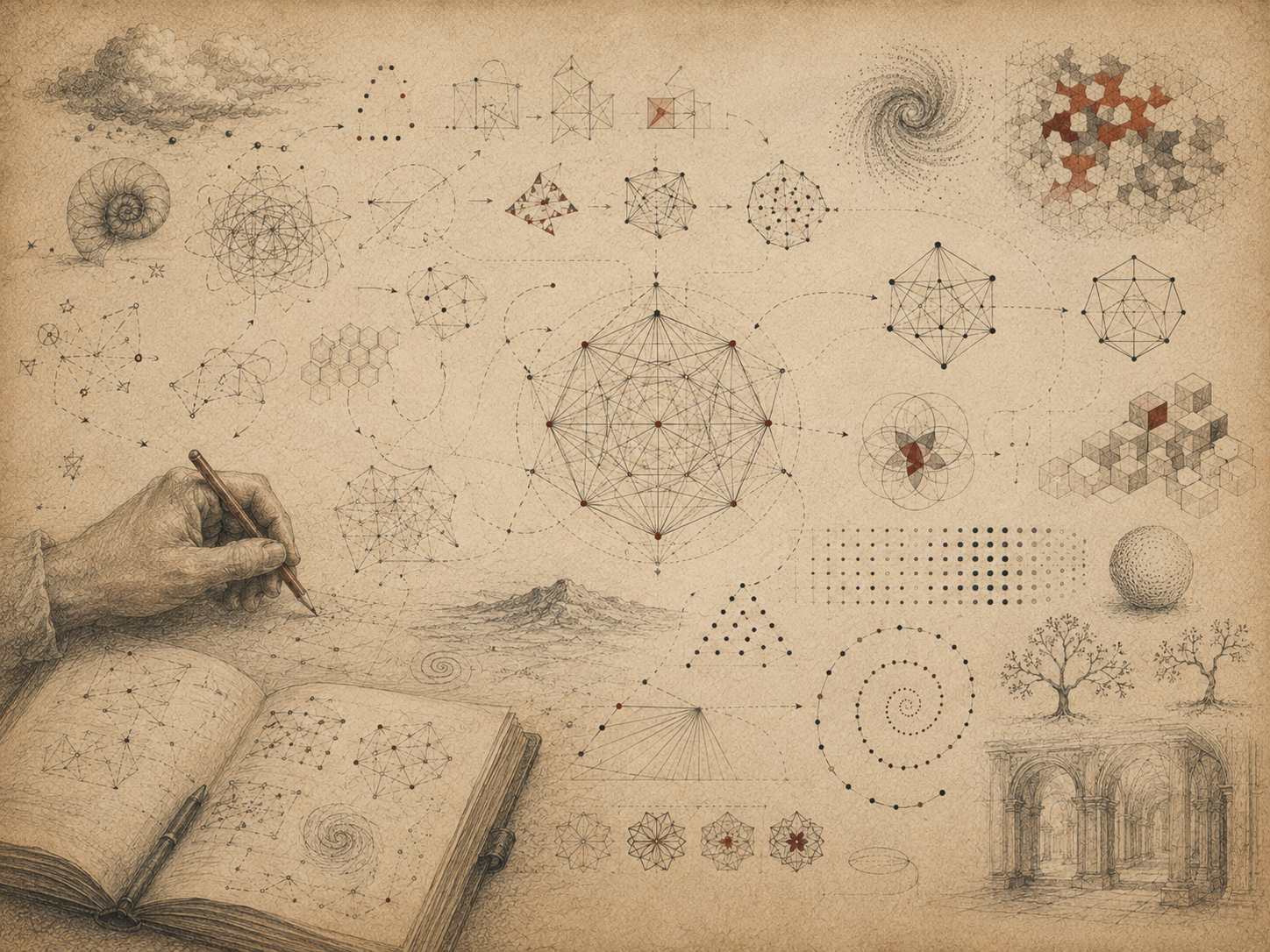
Mathematics is often remembered through its finished results: definitions, theorems, proofs, formulas, structures, and formal systems. But mathematical knowledge rarely begins in finished form. It often begins as a question, a pattern, a surprise, a diagram, a failed calculation, a special case, an analogy, a computational experiment, or an intuition that something deeper may be true. Before proof comes conjecture. Before theorem comes discovery.
A conjecture is a disciplined mathematical guess: a proposed statement that appears plausible because of examples, patterns, analogy, computation, geometric intuition, structural reasoning, or partial proof. Conjecture is not proof, but it is not random speculation either. It is one of the creative engines of mathematics. It gives inquiry a target.
This article examines conjecture, creativity, and mathematical discovery as central parts of mathematical thinking. It explores how conjectures arise, how examples and counterexamples shape them, how analogy and abstraction guide discovery, how diagrams and computation support exploration, how proof transforms conjecture into theorem, and why mathematical creativity depends on both imagination and discipline.
What a Mathematical Conjecture Is
A mathematical conjecture is a statement believed to be true but not yet proved. It is more than a guess, because it usually arises from evidence: examples, computation, analogy, known theorems, structural patterns, diagrams, or partial arguments. It is less than a theorem, because the required proof has not yet been established.
Conjectures occupy a vital middle ground in mathematics. They organize inquiry. They direct attention. They suggest what might be worth proving. They expose gaps in current understanding. They invite new definitions, methods, examples, and counterexamples. A field without conjectures would have no horizon of discovery.
\text{evidence}+\text{pattern}+\text{plausible structure}\;\Rightarrow\;\text{conjecture}
\]
Interpretation: A conjecture usually arises when evidence and structure suggest a claim that has not yet been proved.
A conjecture may be simple or profound. It may concern a sequence, a graph, a prime number pattern, a geometric configuration, an algebraic structure, a topological invariant, a probability distribution, or a computational system. Some conjectures are quickly proved. Others guide entire fields for decades or centuries. Some are eventually refuted by counterexamples. Some are modified into deeper theorems.
| Mathematical Status | Meaning | Example of Role |
|---|---|---|
| Observation | A noticed pattern or feature | The first terms of a sequence appear regular |
| Conjecture | A plausible unproved claim | The pattern may hold for all \(n\) |
| Lemma | A proved supporting result | A smaller claim used in a larger proof |
| Theorem | A proved mathematical statement | The conjecture has been justified under stated assumptions |
| Counterexample | A case that refutes a universal claim | The conjecture fails or must be revised |
The key distinction is proof. Evidence may be strong, extensive, computationally impressive, or visually compelling. But until a proof is given, the statement remains conjectural. This does not weaken conjecture; it defines its role. Conjecture is the disciplined imagination of mathematics before proof completes the work.
Mathematical Discovery Before Proof
Mathematical discovery is often messier than mathematical exposition. A finished proof may look inevitable, but the path toward it may involve failed attempts, misleading examples, incomplete analogies, exploratory computation, diagrams, conversations, and long periods of uncertainty. The clean theorem rarely shows the disorder that produced it.
This matters because students and readers can develop a distorted view of mathematics if they see only polished results. Mathematics is not simply a sequence of established facts. It is an active process of asking, searching, testing, revising, representing, proving, and generalizing. Discovery is the living movement behind the formal result.
A conjecture often begins with a question:
- Does this pattern continue?
- What property is being preserved?
- Can this example be generalized?
- Is there a hidden invariant?
- Can a counterexample exist?
- Why does this computation keep producing the same structure?
- Is this theorem a special case of something deeper?
These questions do not yet prove anything. But they create mathematical direction. They transform observation into inquiry.
\text{question}\rightarrow \text{examples}\rightarrow \text{pattern}\rightarrow \text{conjecture}\rightarrow \text{proof attempt}
\]
Interpretation: Discovery often moves through exploratory stages before a proof strategy becomes clear.
| Discovery Stage | Mathematical Activity | Typical Output |
|---|---|---|
| Exploration | Compute examples, draw diagrams, test cases | Observed regularities |
| Conjecture formation | State a possible general claim | Candidate theorem |
| Stress testing | Search for boundary cases and counterexamples | Refined conjecture |
| Structural analysis | Identify definitions, invariants, and dependencies | Proof strategy |
| Justification | Construct proof or formal verification | Theorem, refutation, or open problem |
Discovery before proof is not a lower form of mathematics. It is the creative phase that makes proof meaningful. Proof answers questions that discovery has learned how to ask.
Creativity in Mathematical Thinking
Mathematical creativity is the ability to see structure where none is obvious, invent useful representations, formulate productive conjectures, identify hidden assumptions, connect distant ideas, and find proof strategies that transform uncertainty into understanding. It is not opposed to rigor. In mathematics, creativity and rigor need each other.
Creativity appears in many mathematical acts: choosing the right definition, drawing the right diagram, inventing notation, transforming a problem into a different form, recognizing a known structure in a new setting, finding a counterexample, proving a theorem by an unexpected method, or generalizing a result without losing its essential meaning.
Mathematical creativity is often constrained creativity. The mathematician is not free to assert anything. The claim must survive logic, examples, definitions, and proof. This is why creativity in mathematics can be unusually intense: imagination operates inside strict conditions of justification.
\text{creativity}+\text{constraint}\rightarrow \text{mathematical discovery}
\]
Interpretation: Mathematical creativity is not unconstrained invention. It is disciplined imagination under logical and structural constraint.
| Creative Act | Mathematical Form | Why It Matters |
|---|---|---|
| Seeing a pattern | Conjecture formation | Creates a target for proof |
| Changing representation | Algebraic, geometric, graphical, or computational translation | Makes hidden structure visible |
| Finding an analogy | Structural transfer | Imports methods from one domain to another |
| Inventing a definition | Conceptual framing | Creates a new object of proof |
| Discovering a counterexample | Refutation and refinement | Sharpens the boundary of truth |
Mathematical creativity is therefore not only about solving problems. It is also about making problems visible in the right form. A creative mathematician may not immediately prove the theorem, but may ask the question that makes proof possible.
Pattern Recognition and the Birth of Conjecture
Many conjectures begin with pattern recognition. A sequence appears to follow a rule. A graph invariant seems stable across transformations. A geometric configuration seems to preserve an angle. A computational search produces repeated behavior. A proof method works in several cases and suggests a broader theorem.
Pattern recognition is essential, but it is also dangerous. A finite pattern may not continue. A visual pattern may depend on a special case. A computational regularity may reflect the search range rather than the mathematical object. A statistical pattern may be noise. A symbolic pattern may be an artifact of notation.
1,\;4,\;9,\;16,\;25,\ldots
\]
Interpretation: The visible pattern suggests square numbers, but the conjecture becomes mathematical only when the rule \(a_n=n^2\) and its domain are stated.
The movement from pattern to conjecture requires articulation. The mathematician must state what the pattern is, what domain it concerns, what assumptions are being made, and what would count as failure. A vague pattern becomes a mathematical conjecture only when it becomes a claim.
| Pattern Source | Possible Conjecture | Needed Discipline |
|---|---|---|
| Sequence terms | A closed formula or recurrence | Test beyond early terms and seek proof |
| Geometric drawing | A preserved angle, length, or relation | Identify which features are essential |
| Graph examples | An invariant or classification rule | Search for non-isomorphic counterexamples |
| Computation | A general law or structural regularity | Separate finite evidence from proof |
| Analogy | A theorem transferred to a new setting | Check whether the relevant structure is preserved |
Pattern recognition is the beginning of discovery, not its end. The creative moment is seeing the pattern. The mathematical moment is asking what structure makes the pattern true.
Examples, Special Cases, and Experimental Reasoning
Examples are the laboratory of mathematical thought. They help mathematicians understand definitions, test conjectures, discover patterns, identify boundary cases, and build intuition. A good example can clarify a concept. A strange example can challenge an assumption. A special case can reveal the mechanism of a general theorem.
Examples do not prove universal claims, but they are not secondary. They are often the starting point of proof. By studying examples, mathematicians learn which features are essential and which are accidental. A proof often succeeds only after the right examples have taught the mind what must be shown.
\text{examples}\;\not\Rightarrow\;\text{proof},\qquad \text{examples}\;\Rightarrow\;\text{insight}
\]
Interpretation: Examples do not establish universal truth, but they can guide conjecture, proof strategy, and conceptual understanding.
Special cases are especially valuable. A theorem about all groups may first be studied in cyclic groups, permutation groups, or matrix groups. A theorem about all graphs may first be tested on paths, cycles, complete graphs, trees, and bipartite graphs. A statement about functions may first be tested on polynomials, exponentials, trigonometric functions, or pathological examples.
Experimental reasoning in mathematics uses examples systematically. It may involve hand computation, symbolic manipulation, numerical simulation, computer search, randomized testing, visualization, or database exploration. The goal is not to replace proof but to reveal what proof should address.
| Example Type | Purpose | Mathematical Use |
|---|---|---|
| Typical example | Shows the concept in ordinary use | Builds intuition |
| Boundary case | Tests the edge of definitions | Reveals hidden assumptions |
| Pathological example | Violates naive intuition | Sharpens theorem statements |
| Computational example | Explores large or complex cases | Suggests conjectures and search directions |
| Counterexample | Refutes a claim | Forces revision or restriction |
Mathematical discovery often depends on choosing the right examples. A theorem may be hidden in a pattern, but the right example reveals where to look.
Counterexamples and the Refinement of Ideas
A counterexample is a discovery. It may seem negative because it refutes a conjecture, but it often advances mathematics by showing exactly where the conjecture fails. A counterexample can reveal that a condition is missing, a definition is too broad, an analogy is weak, or an invariant is incomplete.
To refute a universal conjecture, one valid counterexample is enough:
\forall x\,P(x)\quad\text{is refuted by}\quad \exists x\,\neg P(x)
\]
Interpretation: A universal claim fails when one object in the domain violates it.
Counterexamples also support creativity because they force reconstruction. If a conjecture fails, the mathematician asks why. Was the domain too broad? Was a hypothesis missing? Was the conclusion too strong? Should the theorem require compactness, continuity, monotonicity, finiteness, commutativity, connectedness, independence, or another structural condition?
For example, the claim “every bounded sequence converges” is false. The sequence \((-1)^n\) is bounded but does not converge. The failure suggests a refined theorem: every bounded monotone sequence of real numbers converges. The counterexample does not merely destroy the original conjecture; it helps identify the missing condition.
| Conjecture | Counterexample | Refinement |
|---|---|---|
| Every bounded sequence converges | \((-1)^n\) | Add monotonicity |
| Same degree sequence implies graph isomorphism | Non-isomorphic graphs with same degree sequence | Use stronger invariants |
| Every continuous function is differentiable | \(f(x)=|x|\) at \(0\) | Require stronger smoothness conditions |
| Every operation commutes | Matrix multiplication | Specify commutative structures |
Counterexample search is therefore a creative practice. It requires imagination to find the object that breaks the pattern. It requires discipline to learn from the failure rather than ignore it.
Analogy, Transfer, and Structural Imagination
Analogy is one of the most powerful tools of mathematical discovery. It allows insight from one domain to suggest possibilities in another. A theorem in finite-dimensional vector spaces may suggest a theorem in function spaces. A geometric idea may suggest an algebraic structure. A graph-theoretic invariant may suggest a topological invariant. A proof in one setting may inspire a proof in another.
But analogy is not identity. A successful analogy depends on preserved structure. If the relevant operations, relations, invariants, or assumptions are not preserved, the analogy may mislead. Mathematical creativity requires both the courage to transfer ideas and the discipline to test whether the transfer is valid.
\text{source structure}\;\sim\;\text{target structure}
\]
Interpretation: Analogy becomes mathematically useful when the source and target share enough structure for a concept, method, or conjecture to transfer.
Structural imagination is the ability to see a familiar pattern in an unfamiliar setting. This is why abstraction and analogy are closely connected. Abstraction identifies what matters; analogy transfers it.
| Source Domain | Target Domain | Transferred Idea | Risk |
|---|---|---|---|
| Finite-dimensional vectors | Function spaces | Linear structure | Infinite-dimensional subtleties |
| Geometry | Algebra | Symmetry and transformation | Visual intuition may not preserve algebraic detail |
| Graphs | Proof dependencies | Nodes, edges, paths, cycles | Logical support is not ordinary adjacency |
| Physical conservation | Combinatorial invariants | Preserved quantity | Invariant may be incomplete |
| Type systems | Proof systems | Proofs as structured terms | Formalization choices matter |
Analogy helps mathematics grow because it finds unity across difference. But every analogy must eventually answer to proof, counterexample, or precise structural comparison.
Abstraction as a Discovery Method
Abstraction is not only a way to present completed mathematics. It is also a method of discovery. By stripping away irrelevant detail, abstraction reveals structure that may have been hidden inside examples. Once the structure is visible, a conjecture can be stated more generally.
For example, a problem about moving through cities may become a graph problem. A problem about rotations may become a group-theoretic problem. A problem about repeated change may become a recurrence relation or dynamical system. A problem about proof dependencies may become a directed acyclic graph. The abstraction changes the object of thought.
\text{concrete cases}\rightarrow \text{shared structure}\rightarrow \text{abstract conjecture}
\]
Interpretation: Abstraction helps discovery by identifying the structure common to multiple examples.
Abstraction can also generate conjectures by changing the level of generality. A result about integers may suggest a result about rings. A result about Euclidean distance may suggest a result about metric spaces. A result about finite graphs may suggest a result about networks, categories, or relational systems. The question becomes: how much structure is really needed?
| Concrete Setting | Abstraction | Discovery Question |
|---|---|---|
| Road map | Graph | What paths, cycles, or cuts matter? |
| Rotating a square | Group action | What transformations preserve structure? |
| Repeated population update | Dynamical system | What long-run behavior emerges? |
| Table of values | Function | What rule or relation generates the data? |
| Proof outline | Dependency graph | Which lemmas carry the logical burden? |
Abstraction is creative because it chooses what to keep. It is rigorous because the choice must preserve enough structure for valid reasoning.
Diagrams, Visualization, and Geometric Intuition
Visualization plays a major role in mathematical discovery. A diagram may reveal symmetry, obstruction, continuity, adjacency, curvature, flow, or dependency before these features are expressed symbolically. Many conjectures begin as visual impressions that later become formal statements.
Geometric intuition is not limited to geometry. Graph drawings, proof trees, commutative diagrams, phase portraits, state-space plots, lattice diagrams, category diagrams, and network visualizations all help mathematicians see structure. Visual reasoning can suggest what should be true, what might fail, and what form a proof might take.
But diagrams must be handled with care. A picture may be a special case. It may encode assumptions not present in the theorem. It may hide degenerate cases. It may distort scale or relation. The creative use of diagrams must be followed by precise reasoning.
\text{diagram}\rightarrow \text{intuition}\rightarrow \text{formal claim}\rightarrow \text{proof}
\]
Interpretation: Visualization can guide discovery, but formal proof must establish the claim beyond the picture.
| Visual Tool | Discovery Value | Proof Risk |
|---|---|---|
| Geometric diagram | Shows spatial relation | May represent only a special case |
| Graph drawing | Shows connectivity and cycles | Layout may imply false distances |
| Proof tree | Shows dependency structure | May omit semantic explanation |
| Phase portrait | Shows dynamic behavior | May depend on numerical approximation |
| Commutative diagram | Shows map relationships | Requires precise object and arrow definitions |
Visualization is part of mathematical creativity because it expands what the mind can hold at once. Rigor is needed because the eye can see more than the theorem permits.
Computation, Search, and Experimental Mathematics
Computation has become a major instrument of mathematical discovery. Computers can generate examples, search large spaces, calculate invariants, test conjectures, visualize systems, manipulate symbolic expressions, simulate dynamics, find counterexamples, and assist with formal proof. This has expanded the scale and style of mathematical exploration.
Experimental mathematics uses computation to explore mathematical phenomena systematically. It may reveal patterns too large or subtle to see by hand. It may suggest conjectures. It may identify exceptional cases. It may guide proof attempts. It may generate data that demands explanation.
But computational evidence is not proof unless the computation is itself part of a rigorous finite verification or formal proof. Large-scale testing can make a conjecture plausible, but the universal claim still requires proof. Computation can help discover mathematics, but discovery and justification remain distinct.
\text{computation}\rightarrow \text{evidence}\rightarrow \text{conjecture}\rightarrow \text{proof or refutation}
\]
Interpretation: Computation can generate evidence and insight, but mathematical justification requires proof, exhaustive verification, or a clearly bounded finite argument.
Modern computation also changes how conjectures are represented. A conjecture may be stored as metadata. Examples may be stored in datasets. Counterexamples may be linked to failed claims. Proof dependencies may be represented as graphs. Formal proofs may be checked by proof assistants. Haskell and other functional languages can model propositions, proof trees, recursive structures, and symbolic expressions as algebraic data types.
| Computational Method | Discovery Use | Limitation |
|---|---|---|
| Case generation | Finds patterns and exceptions | Finite evidence may mislead |
| Symbolic computation | Manipulates formulas and expressions | May hide domain assumptions |
| Graph search | Finds structures and counterexamples | Search space may be incomplete |
| Simulation | Explores dynamic behavior | Depends on model and parameters |
| Proof assistant | Checks formal derivations | Requires correct formal statement |
Computation is now part of mathematical creativity. It extends the imagination by making new spaces of examples visible. But it also requires stronger habits of documentation, reproducibility, proof-status tracking, and interpretation.
From Conjecture to Proof
A conjecture becomes a theorem only through proof. The transition from conjecture to proof is one of the central movements of mathematics. It requires the claim to be stated precisely, the domain to be defined, assumptions to be named, examples to be understood, counterexamples to be ruled out, and inference to be organized.
Proof does not merely confirm the conjecture. It often explains it. A conjecture may say that a pattern holds. A proof reveals why it holds. Sometimes the proof changes the meaning of the conjecture by exposing the deeper structure behind it. The proved theorem may be more general, more limited, or more conceptually powerful than the original claim.
\text{conjecture}+\text{proof}\rightarrow \text{theorem}
\]
Interpretation: Proof transforms a plausible mathematical claim into a justified result under stated assumptions.
Different conjectures invite different proof methods. A statement about natural numbers may suggest induction. A statement about impossibility may suggest contradiction or invariant. An existence claim may require construction. A classification conjecture may require structural decomposition. A false conjecture may require a counterexample.
| Conjecture Type | Likely Proof Strategy | Key Question |
|---|---|---|
| Statement over natural numbers | Induction | Does the property pass from \(n\) to \(n+1\)? |
| Existence claim | Construction or nonconstructive proof | Can a witness be built or forced? |
| Universal claim | Arbitrary object proof | Can the argument use only stated assumptions? |
| Impossibility claim | Contradiction or invariant | What cannot change or cannot coexist? |
| Classification claim | Structural decomposition | What cases exhaust the domain? |
The proof stage is where creativity must become accountable. A beautiful conjecture is not enough. The theorem must earn its place in mathematics through justification.
Failure, Revision, and Mathematical Maturity
Failure is not outside mathematical discovery. It is part of it. A proof attempt may fail because the conjecture is false, because the method is weak, because an assumption is missing, because a definition is not sharp enough, or because the problem requires a different representation. Each kind of failure teaches something different.
Mathematical maturity includes learning how to interpret failure. A failed proof is not always evidence that the theorem is false. It may reveal that the proof strategy does not reach the structure. A counterexample is not merely defeat. It may point toward a better theorem. A confusing definition may signal that the concept has not yet been represented correctly.
Many important mathematical ideas emerge from revision:
- weakening a conclusion;
- strengthening a hypothesis;
- changing the domain;
- introducing a new definition;
- identifying an invariant;
- separating cases;
- changing representation;
- generalizing to a better structure.
| Failure Type | What It May Mean | Productive Response |
|---|---|---|
| Proof attempt stalls | Structure is not visible | Change representation or prove lemmas |
| Counterexample found | Conjecture is too broad | Refine assumptions or conclusion |
| Examples conflict | Definitions or domains differ | Clarify statement and context |
| Computation contradicts expectation | Pattern may be false or code may be wrong | Audit both mathematics and implementation |
| Analogy breaks | Structure was not preserved | Identify exactly what failed to transfer |
Mathematical discovery is therefore iterative. The path from question to theorem often passes through error, correction, and reformulation. Creativity without revision becomes fantasy. Rigor without creativity becomes sterile. Discovery requires both.
A Mathematical Lens: Observe, Conjecture, Test, Prove, Generalize
A useful lens for understanding mathematical discovery is the sequence: observe, conjecture, test, prove, generalize. This is not a rigid formula, but it captures a recurring movement in mathematical work.
\text{Observe}\rightarrow \text{Conjecture}\rightarrow \text{Test}\rightarrow \text{Prove}\rightarrow \text{Generalize}
\]
Interpretation: Mathematical discovery often moves from pattern recognition to a proposed claim, then through testing, proof, and broader structural understanding.
Observation notices a pattern. Conjecture states it. Testing searches for support, boundary cases, and counterexamples. Proof establishes the result under stated assumptions. Generalization asks whether the theorem is a special case of a deeper structure.
| Stage | Question | Artifact |
|---|---|---|
| Observe | What pattern or anomaly appears? | Examples, diagrams, computed cases |
| Conjecture | What general claim might be true? | Candidate statement |
| Test | Where could the claim fail? | Boundary cases, counterexamples, finite audits |
| Prove | Why must the claim hold? | Proof, formal derivation, verified theorem |
| Generalize | What structure does the theorem really use? | Sharper theorem, broader framework, new definition |
This lens also supports computational workflows. A repository can store conjecture metadata, generated examples, proof-status records, counterexamples, dependency graphs, Haskell data types, and reproducible scripts. Mathematical discovery can be documented as a structured process rather than a mysterious leap.
Computational Companion Examples
The companion repository for this article should extend the Mathematical Thinking codebase with examples focused on conjecture generation, finite evidence audits, counterexample search, sequence pattern discovery, graph invariant testing, proof-status metadata, Haskell algebraic data types for conjectures and evidence, and reproducible discovery workflows. The examples below are compact article-level previews; the repository can expand them into richer professional workflows.
Python: Conjecture Metadata and Counterexample Search
from dataclasses import dataclass
from typing import Callable

@dataclass(frozen=True)
class Conjecture:
    conjecture_id: str
    statement: str
    domain_description: str
    evidence_status: str
    proof_status: str

def is_even(n: int) -> bool:
    return n % 2 == 0

def even_square_conjecture(n: int) -> bool:
    return (not is_even(n)) or is_even(n * n)

def bounded_sequence_converges_candidate(sequence: list[int]) -> bool:
    bounded = all(abs(x) <= 1 for x in sequence)
    eventually_constant = len(set(sequence[-10:])) == 1
    return (not bounded) or eventually_constant

def search_counterexamples(domain, predicate: Callable):
    return [x for x in domain if not predicate(x)]

conjectures = [
    Conjecture(
        "conj_even_square",
        "If n is even, then n^2 is even.",
        "integers",
        "finite checks and direct proof available",
        "proved"
    ),
    Conjecture(
        "conj_bounded_converges",
        "Every bounded sequence converges.",
        "real sequences",
        "plausible from some examples",
        "refuted"
    )
]

counterexamples = search_counterexamples(range(-100, 101), even_square_conjecture)

print(conjectures)
print("Counterexamples to even-square conjecture in tested range:", counterexamples)

alternating = [(-1) ** n for n in range(40)]
print("Bounded alternating sequence test:", bounded_sequence_converges_candidate(alternating))
R: Finite Evidence Audit for Sequence Conjectures
sum_first_n <- function(n) {
  sum(seq_len(n))
}

formula_sum_first_n <- function(n) {
  n * (n + 1) / 2
}

audit_conjecture <- function(max_n) {
  n <- 1:max_n
  data.frame(
    n = n,
    computed_sum = sapply(n, sum_first_n),
    conjectured_formula = formula_sum_first_n(n),
    agrees = sapply(n, sum_first_n) == formula_sum_first_n(n),
    evidence_status = "finite evidence only",
    proof_note = "induction required for universal theorem"
  )
}

audit <- audit_conjecture(100)

print(head(audit, 10))
cat("All tested cases agree:", all(audit$agrees), "\n")
cat("Interpretation: finite agreement supports conjecture but does not replace proof.\n")
Julia: Dynamic Exploration and Conjecture Testing
function iterate_map(f, x0, steps)
    values = Vector{Float64}(undef, steps)
    values[1] = x0
    for i in 2:steps
        values[i] = f(values[i - 1])
    end
    return values
end

function appears_bounded(values; bound = 1.0)
    return all(abs.(values) .<= bound)
end

linear_update(x) = 0.8x + 0.1
logistic_update(r) = x -> r * x * (1 - x)

linear_values = iterate_map(linear_update, 0.2, 50)
logistic_values = iterate_map(logistic_update(3.7), 0.2, 50)

println("Linear system appears bounded: ", appears_bounded(linear_values))
println("Logistic system appears bounded: ", appears_bounded(logistic_values))
println("Interpretation: simulation suggests behavior; proof or rigorous analysis is needed.")
Haskell: Conjectures as Algebraic Data Types
{-# OPTIONS_GHC -Wall #-}

data ProofStatus
  = Observed
  | Conjectured
  | Refuted
  | Proved
  deriving (Eq, Show)

data Evidence
  = Example String
  | FiniteCheck Int
  | Counterexample String
  | ProofSketch String
  deriving (Eq, Show)

data Conjecture = Conjecture
  { conjectureId :: String
  , statement :: String
  , domain :: String
  , evidence :: [Evidence]
  , proofStatus :: ProofStatus
  } deriving (Eq, Show)

evenSquare :: Integer -> Bool
evenSquare n =
  odd n || even (n * n)

counterexamples :: [Integer] -> (Integer -> Bool) -> [Integer]
counterexamples xs predicate =
  [x | x <- xs, not (predicate x)]

main :: IO ()
main = do
  let c = Conjecture
        "conj_even_square"
        "If n is even, then n^2 is even."
        "integers"
        [FiniteCheck 100, ProofSketch "direct proof using n=2k"]
        Proved

  print c
  print (counterexamples [-100..100] evenSquare)
SQL: Conjecture, Evidence, and Proof-Status Metadata
CREATE TABLE conjecture (
  conjecture_id TEXT PRIMARY KEY,
  statement TEXT NOT NULL,
  domain_description TEXT NOT NULL,
  mathematical_area TEXT NOT NULL,
  proof_status TEXT NOT NULL
);

CREATE TABLE evidence_record (
  evidence_id TEXT PRIMARY KEY,
  conjecture_id TEXT NOT NULL,
  evidence_type TEXT NOT NULL,
  description TEXT NOT NULL,
  interpretation TEXT NOT NULL,
  FOREIGN KEY (conjecture_id) REFERENCES conjecture(conjecture_id)
);

CREATE TABLE counterexample (
  counterexample_id TEXT PRIMARY KEY,
  conjecture_id TEXT NOT NULL,
  object_description TEXT NOT NULL,
  failure_mode TEXT NOT NULL,
  revision_suggestion TEXT NOT NULL,
  FOREIGN KEY (conjecture_id) REFERENCES conjecture(conjecture_id)
);

CREATE TABLE proof_attempt (
  proof_attempt_id TEXT PRIMARY KEY,
  conjecture_id TEXT NOT NULL,
  method TEXT NOT NULL,
  status TEXT NOT NULL,
  lesson TEXT NOT NULL,
  FOREIGN KEY (conjecture_id) REFERENCES conjecture(conjecture_id)
);
These examples treat discovery as something that can be documented: conjectures, evidence, proof status, counterexamples, and failed proof attempts can be represented as structured artifacts. The goal is not to mechanize creativity, but to make mathematical exploration more inspectable and reproducible.
GitHub Repository
The companion repository for this article is designed as a reproducible mathematical-thinking workspace focused on conjecture generation, finite evidence audits, counterexample search, sequence discovery, graph invariant testing, proof-status metadata, Haskell algebraic data types, and computational workflows for mathematical exploration.
Complete Code Repository
Companion article folder with Python, R, Julia, SQL, Haskell, Rust, Go, C++, Fortran, and C examples for professional mathematical exploration of conjecture, creativity, discovery workflows, counterexample search, proof-status tracking, finite evidence, graph invariants, symbolic reasoning, and computational experimentation.
Conjecture, AI, and Responsible Mathematical Discovery
As computational tools and AI systems become more involved in mathematical exploration, the distinction between conjecture, evidence, and proof becomes even more important. AI systems may suggest patterns, generate possible conjectures, draft proof outlines, search examples, or propose formal code. These tools can accelerate discovery, but they can also produce plausible nonsense, hidden assumptions, false analogies, or incorrect proofs.
Responsible mathematical discovery requires proof-status discipline. A generated conjecture should be labeled as conjecture. A finite check should be labeled as finite evidence. A proof sketch should be labeled as incomplete until verified. A formal proof should be checked against the intended statement. A model should be audited for assumptions and domain limits.
This matters beyond pure mathematics. In applied settings, conjectural reasoning can influence models, algorithms, policies, institutional decisions, AI systems, and scientific claims. Treating an unproved pattern as established truth can cause real harm when the pattern is used for prediction, classification, ranking, allocation, or intervention.
| Discovery Tool | Possible Benefit | Risk | Responsible Practice |
|---|---|---|---|
| AI conjecture generation | Suggests new directions | Plausible but false claims | Label as conjecture and require verification |
| Computational search | Finds examples and counterexamples | Incomplete search space | Document range, assumptions, and limits |
| Simulation | Reveals dynamic behavior | Model-dependent patterns | Separate simulation evidence from proof |
| Formal proof assistant | Checks derivations | Formal statement may not match intent | Audit definitions and theorem statement |
| Applied model | Turns patterns into decisions | False certainty and social harm | Report uncertainty, assumptions, and consequences |
Creativity should not be confused with certainty. Discovery should not be confused with justification. The responsible use of AI and computation in mathematics depends on maintaining these distinctions with care.
Why Conjecture and Discovery Matter
Conjecture matters because it gives mathematics a future. Theorems preserve what has been proved, but conjectures point toward what is not yet understood. They create direction for inquiry. They invite new methods, definitions, examples, and collaborations. They keep mathematics alive as a creative discipline.
Discovery matters because mathematics is not only a body of knowledge but a practice of inquiry. To learn mathematics deeply is not only to learn results. It is to learn how results are found: by noticing patterns, asking questions, testing examples, searching for counterexamples, changing representations, inventing definitions, building proofs, and revising ideas.
Mathematical creativity is powerful because it joins imagination to proof. It allows the mind to go beyond what is already known while remaining accountable to structure, logic, and evidence. A conjecture begins as possibility. A proof turns possibility into knowledge. A counterexample turns failure into refinement. A generalization turns a result into a deeper structure.
This is why conjecture belongs at the center of mathematical thinking. It is the bridge between pattern and theorem, between imagination and proof, between exploration and knowledge. Without conjecture, mathematics would have no direction. Without proof, conjecture would have no discipline. Without creativity, mathematics would have no discovery.
Related Articles
- What Is Mathematical Thinking? Pattern, Proof, Architecture, and Reason
- Patterns, Structure, and the Mathematical Imagination
- Abstraction and the Power of Generalization
- Mathematics as the Science of Patterns
- Proof and the Logic of Mathematical Justification
- Logic and the Structure of Formal Inference
- Symbols, Language, and Mathematical Representation
- Non-Algorithmic Reasoning and the Future of Mathematics Learning
- Mathematical Thinking and AI-Assisted Discovery
- Mathematical Thinking and Proof Assistants
Further Reading
- Hadamard, J. (1945) The Psychology of Invention in the Mathematical Field. Princeton: Princeton University Press. Available at: https://press.princeton.edu/books/paperback/9780691029313/the-psychology-of-invention-in-the-mathematical-field
- Lakatos, I. (1976) Proofs and Refutations: The Logic of Mathematical Discovery. Cambridge: Cambridge University Press. Available at: https://www.cambridge.org/core/books/proofs-and-refutations/3B5BDF18C7A5F4E7D4B30F06E4E5A0F1
- Pólya, G. (1945) How to Solve It: A New Aspect of Mathematical Method. Princeton: Princeton University Press. Available at: https://press.princeton.edu/books/paperback/9780691164076/how-to-solve-it
- Borwein, J.M. and Bailey, D.H. (2004) Mathematics by Experiment: Plausible Reasoning in the 21st Century. 2nd edn. Boca Raton: A K Peters/CRC Press. Available at: https://www.routledge.com/Mathematics-by-Experiment-Plausible-Reasoning-in-the-21st-Century/Borwein-Bailey/p/book/9781568814421
- Devlin, K. (2012) Introduction to Mathematical Thinking. Stanford University / Coursera course materials and related publications. Available at: https://web.stanford.edu/~kdevlin/
- Velleman, D.J. (2019) How to Prove It: A Structured Approach. 3rd edn. Cambridge: Cambridge University Press. Available at: https://www.cambridge.org/highereducation/books/how-to-prove-it/6D2965D625C6836CD4A785A2C843B3DA
References
- Borwein, J.M. and Bailey, D.H. (2004) Mathematics by Experiment: Plausible Reasoning in the 21st Century. 2nd edn. Boca Raton: A K Peters/CRC Press. Available at: https://www.routledge.com/Mathematics-by-Experiment-Plausible-Reasoning-in-the-21st-Century/Borwein-Bailey/p/book/9781568814421
- Devlin, K. (2012) Introduction to Mathematical Thinking. Stanford University / Coursera course materials and related publications. Available at: https://web.stanford.edu/~kdevlin/
- Hadamard, J. (1945) The Psychology of Invention in the Mathematical Field. Princeton: Princeton University Press. Available at: https://press.princeton.edu/books/paperback/9780691029313/the-psychology-of-invention-in-the-mathematical-field
- Lakatos, I. (1976) Proofs and Refutations: The Logic of Mathematical Discovery. Cambridge: Cambridge University Press. Available at: https://www.cambridge.org/core/books/proofs-and-refutations/3B5BDF18C7A5F4E7D4B30F06E4E5A0F1
- Pólya, G. (1945) How to Solve It: A New Aspect of Mathematical Method. Princeton: Princeton University Press. Available at: https://press.princeton.edu/books/paperback/9780691164076/how-to-solve-it
- Velleman, D.J. (2019) How to Prove It: A Structured Approach. 3rd edn. Cambridge: Cambridge University Press. Available at: https://www.cambridge.org/highereducation/books/how-to-prove-it/6D2965D625C6836CD4A785A2C843B3DA