
Last Updated May 30, 2026
Mathematical thought begins long before formal proof, symbolic notation, algebraic systems, or written theorems. It begins in the human ability to notice quantity, difference, repetition, order, rhythm, symmetry, comparison, grouping, movement, and pattern. A child distinguishes one object from many. A shepherd counts animals. A craftsperson repeats a design. A builder compares lengths. A musician hears rhythm. A navigator reads cycles in the sky. A community marks time through seasons, moons, harvests, and ritual calendars. These are not yet mathematics in the formal sense, but they are the cognitive and cultural roots from which mathematics grows.
Number and pattern are among the oldest forms of human abstraction. Number allows the mind to detach quantity from particular objects: three stones, three birds, three steps, three days. Pattern allows the mind to see order across change: repeated marks, alternating colors, seasonal cycles, symmetrical forms, rhythmic structures, geometric designs, and recurring relations. Mathematical thought begins when the mind recognizes that different things can share the same structure.
This article examines number, pattern, and the origins of mathematical thought. It explores numerical cognition, counting, comparison, pattern recognition, rhythm, geometry, symbolic representation, cultural practice, early abstraction, proof, computation, Haskell-style structural modeling, and the continuing importance of number and pattern in modern mathematics, science, technology, and human understanding.
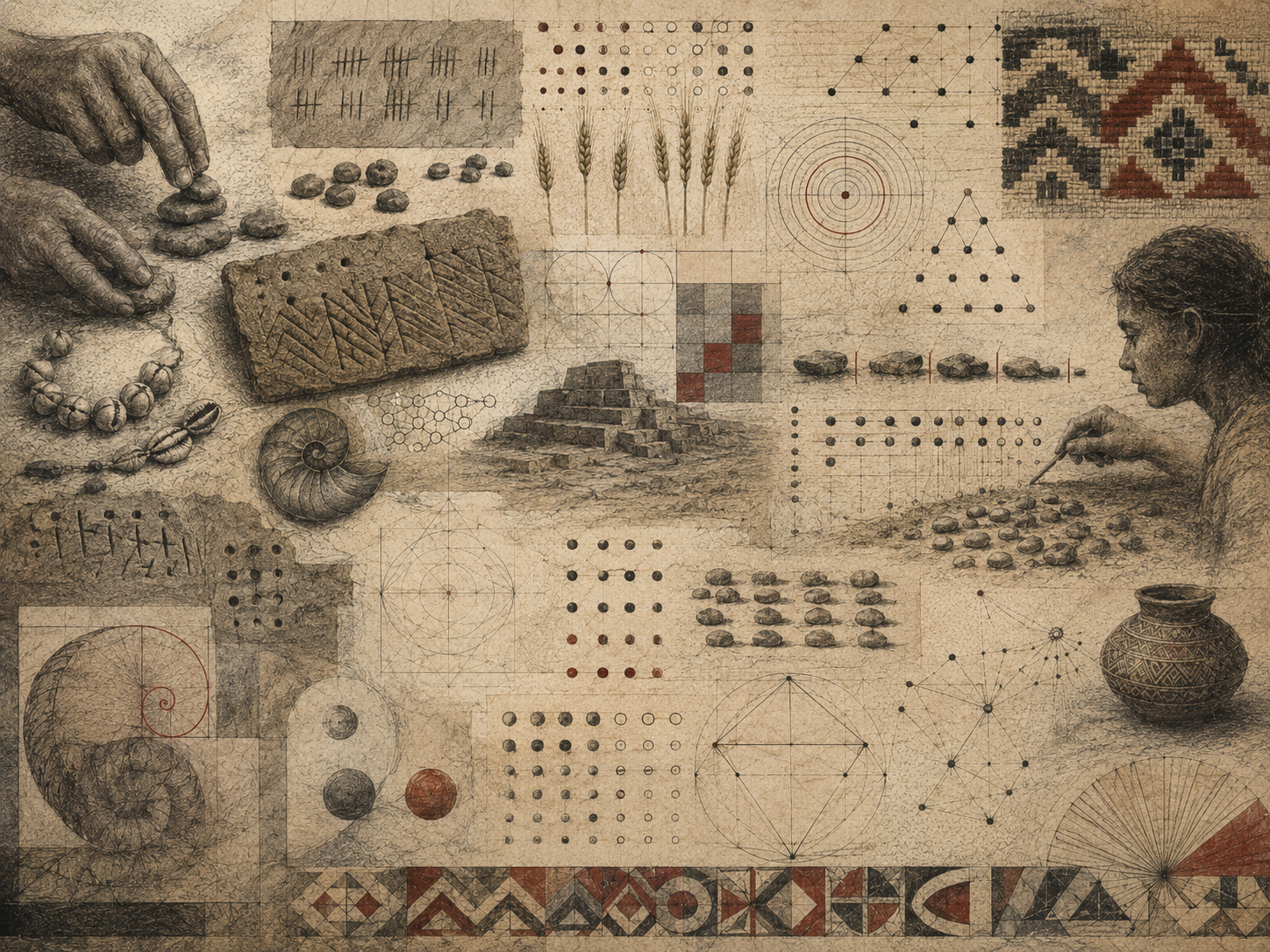
Why Number and Pattern Matter
Number and pattern are foundational because they allow the mind to move beyond immediate perception. Number abstracts quantity from objects. Pattern abstracts order from events. Together, they allow humans to compare, predict, remember, plan, measure, trade, build, compose, navigate, model, and reason.
To think numerically is to recognize that a collection has quantity. To think mathematically is to recognize that quantity can be represented, compared, transformed, generalized, and justified. To think through pattern is to recognize recurrence, relation, order, and structure across differences. A pattern may appear in marks on a bone, knots in a cord, steps in a dance, phases of the moon, growth of a plant, arrangement of stones, symmetry of a woven textile, or terms of a sequence.
\text{mathematical thought begins when difference is organized into relation}
\]
Interpretation: Mathematics begins when the mind recognizes that separate objects, events, or marks can share a common structure.
Number and pattern are not separate origins. Counting is already patterned: one, two, three, four. Repetition is often numerical: two beats, three steps, four seasons, seven days, twelve months. Geometry is patterned space. Arithmetic is patterned operation. Algebra is generalized pattern. Proof explains why a pattern must hold. Computation automates patterns of transformation.
| Origin Element | Mathematical Function | Example |
|---|---|---|
| Number | Represents quantity | Three animals, five stones, ten marks |
| Pattern | Represents order or recurrence | Alternating colors, repeated rhythm, seasonal cycle |
| Comparison | Relates quantities or forms | More, less, equal, longer, shorter |
| Measurement | Quantifies space, time, or magnitude | Length, area, volume, duration |
| Symbol | Stabilizes thought in external form | Marks, tokens, numerals, diagrams, formulas |
The origins of mathematical thought are therefore not found only in formal schools or written texts. They are found in perception, memory, action, culture, craft, survival, exchange, ritual, and imagination. Mathematics begins as a way of making order visible.
The Origins of Mathematical Thought
The origins of mathematical thought are both cognitive and cultural. Human beings have perceptual capacities that support quantity, space, comparison, pattern, and order. But these capacities become mathematics through cultural tools: language, symbols, counting systems, measurement practices, diagrams, records, calendars, architecture, trade, astronomy, music, craft, and teaching.
This means mathematics did not arise from a single source. It emerged from many human needs and experiences: keeping track of goods, marking time, sharing land, building structures, navigating space, recording debts, predicting seasons, organizing labor, designing patterns, and making sense of the world. Different cultures developed different numerical systems, measurement practices, geometries, calendars, and symbolic traditions. The history of mathematics is therefore plural, practical, intellectual, and deeply human.
\text{perception}+\text{culture}+\text{symbol}\rightarrow \text{mathematical thought}
\]
Interpretation: Mathematical thought grows from human cognitive capacities shaped by cultural practices and external symbolic systems.
Early mathematics likely developed through repeated acts of correspondence and comparison. One mark for one object. One token for one unit of grain. One knot for one obligation. One stone for one animal. These acts externalized number, making quantity durable, shareable, and checkable. Once quantity could be represented outside the mind, it could be compared, stored, transmitted, and transformed.
| Human Need | Mathematical Development | Example Practice |
|---|---|---|
| Tracking goods | Counting and record keeping | Tokens, tallies, account marks |
| Measuring land or building | Geometry and measurement | Lengths, angles, areas, layouts |
| Marking time | Cycles and calendars | Moon phases, seasons, ritual periods |
| Navigation | Spatial and astronomical reasoning | Stars, direction, distance, horizon |
| Design and craft | Pattern, symmetry, proportion | Weaving, pottery, architecture, ornament |
Mathematics emerges when these practices become generalized. A tally becomes number. A repeated design becomes pattern. A measured field becomes geometry. A seasonal cycle becomes calendar structure. A trade record becomes arithmetic. A diagram becomes proof. The origin of mathematics is the transformation of lived order into explicit structure.
Number Sense Before Formal Number
Before formal number systems, humans possess forms of number sense: the ability to distinguish small quantities, compare more and less, recognize approximate magnitude, and respond to changes in quantity. This does not yet amount to arithmetic or exact counting, but it provides a cognitive foundation for numerical thought.
Number sense includes subitizing small quantities, estimating approximate magnitude, comparing groups, and detecting quantity changes. A person may immediately see that two objects are different from three, or that one pile is larger than another, without counting each item exactly. This approximate sense of quantity supports survival, planning, and decision-making, but it is not the same as exact number.
\text{approximate quantity}\neq \text{exact number}
\]
Interpretation: Approximate number sense allows comparison, but exact counting requires symbolic or procedural structure.
The move from approximate quantity to exact number is one of the great transitions in mathematical thought. Exact number requires stable units, one-to-one correspondence, ordered count words or marks, and the understanding that the final count represents the cardinality of the collection.
| Numerical Capacity | Description | Mathematical Significance |
|---|---|---|
| Subitizing | Immediate recognition of small quantities | Supports early exact-number awareness |
| Approximate comparison | Judging more or less without exact count | Supports magnitude reasoning |
| One-to-one correspondence | Matching one object to one mark or word | Foundation of counting |
| Cardinality | Understanding the final count as total quantity | Foundation of exact number |
| Ordinality | Understanding order and position | Supports sequences, ranking, and indexing |
Number sense becomes mathematical when it is stabilized through representation. Marks, words, fingers, tokens, knots, and numerals make quantity external. External representation allows exactness, memory, correction, transmission, and abstraction. Number becomes an object of thought.
Counting, Correspondence, and the Invention of Exact Quantity
Counting is a foundational mathematical invention because it turns collections into exact quantities. It depends on one-to-one correspondence: each object is paired with one count word, mark, token, finger, bead, knot, or other unit. When the pairing is complete, the final count represents the total quantity.
This seems simple once learned, but it is a major abstraction. Counting requires the mind to coordinate objects, sequence, memory, and symbol. The objects may differ in size, color, type, or arrangement, yet they are treated as countable units. Counting abstracts away from many qualities in order to preserve quantity.
\text{one object}\leftrightarrow \text{one mark}
\]
Interpretation: One-to-one correspondence is the structural basis of exact counting and tally systems.
Counting also introduces order. Count words or marks must be arranged in a stable sequence. The sequence itself becomes a pattern. Once number words are ordered, they can support addition, subtraction, comparison, place value, measurement, and later algebraic generalization.
| Counting Principle | Meaning | Why It Matters |
|---|---|---|
| One-to-one correspondence | Each item receives one count unit | Prevents double-counting or omission |
| Stable order | Count words or marks follow a fixed sequence | Makes counting repeatable and shareable |
| Cardinality | The last count names the total | Connects sequence to quantity |
| Abstraction | Different objects can be counted as units | Allows number to detach from object type |
| Order irrelevance | Items can be counted in any order | Shows quantity is independent of arrangement |
The invention of exact quantity changed human cognition. It allowed communities to track resources, compare obligations, divide labor, record debts, build calendars, measure space, and preserve information across time. Counting is not merely a school skill. It is one of the foundational technologies of civilization.
Pattern Recognition as Mathematical Beginning
Pattern recognition is another origin of mathematical thought. The mind notices repetition, alternation, symmetry, growth, recurrence, proportion, rhythm, and regularity. A pattern is not merely a repeated appearance; it is a relation among parts across time, space, or sequence.
Patterns appear everywhere: shells, leaves, tracks, weaving, music, speech, stars, architecture, seasons, counting sequences, geometric ornament, and social ritual. Pattern recognition allows prediction. If a rhythm repeats, the next beat can be anticipated. If seasons cycle, future planting can be planned. If a numerical sequence grows regularly, a rule may be inferred.
2,\;4,\;6,\;8,\;10,\ldots
\]
Interpretation: The sequence suggests a pattern of even numbers. Mathematical thinking asks how the pattern can be represented, justified, and generalized.
Mathematical pattern recognition differs from ordinary pattern recognition because it seeks structure. It asks what rule, relation, transformation, or invariant generates the pattern. It also asks whether the pattern is real, accidental, finite, approximate, exact, general, or provable.
| Pattern Type | Example | Mathematical Development |
|---|---|---|
| Repetition | ABABAB | Sequence, periodicity, modular structure |
| Growth | 1, 3, 6, 10, 15 | Triangular numbers, finite sums |
| Symmetry | Mirror pattern | Reflection, group action, invariance |
| Cycle | Moon phases or seasons | Period, calendar, recurrence |
| Proportion | Scaled shape or recipe | Ratio, similarity, linear relation |
Pattern is the bridge from perception to abstraction. It allows the mind to see the same structure across different events. Mathematics begins when the mind asks not only “what comes next?” but “why does this pattern hold?”
Rhythm, Time, Cycles, and Repetition
Rhythm and cycle are among the earliest forms of pattern. Human life is organized by repeated processes: heartbeat, breath, walking, day and night, tides, lunar phases, seasons, migration, planting, harvest, ritual, music, and speech. These repetitions create temporal structure before formal mathematics names it.
Counting and rhythm are closely related. Beats can be counted. Cycles can be marked. Periods can be compared. A repeated sequence can be indexed. Once rhythm is counted, time becomes measurable. Once cycles are recorded, calendars and prediction become possible.
\text{cycle}=\text{repetition through time}
\]
Interpretation: Cyclical patterns provide one of the earliest routes from lived experience to mathematical structure.
Temporal pattern also supports modular reasoning. Days repeat in weeks, months in years, angles in rotations, residues in modular arithmetic, waves in periodic functions, and oscillations in physical systems. Modern mathematics still uses the logic of rhythm and cycle in trigonometry, Fourier analysis, dynamical systems, signal processing, music theory, astronomy, and computation.
| Temporal Pattern | Mathematical Idea | Modern Extension |
|---|---|---|
| Beat | Counting and subdivision | Music theory, signal processing |
| Day-night cycle | Periodicity | Timekeeping and cyclic models |
| Lunar phase | Calendar structure | Astronomical cycles |
| Season | Long-period recurrence | Climate and ecological modeling |
| Rotation | Angle and modular repetition | Trigonometry and circular functions |
Rhythm shows that mathematical thought is embodied. The body counts, moves, repeats, anticipates, and remembers. Mathematics grows from this patterned experience into abstract systems of number, time, frequency, period, and recurrence.
Space, Shape, and Early Geometric Thought
Mathematical thought also begins in spatial experience. Humans move through space, compare distances, recognize boundaries, build shelters, divide land, arrange objects, follow paths, and perceive shape. Geometry begins before formal geometry as practical spatial intelligence.
Early geometric thought appears in building, weaving, pottery, ornament, navigation, land division, toolmaking, body measurement, and ritual space. Lines, circles, spirals, grids, symmetries, angles, and repeated motifs emerge from practical and symbolic activity. These forms become mathematical when they are measured, classified, constructed, transformed, and justified.
\text{space}+\text{shape}+\text{comparison}\rightarrow \text{geometric thought}
\]
Interpretation: Geometry begins when spatial perception becomes organized through comparison, measurement, construction, and relation.
Spatial reasoning is closely connected to pattern. A woven textile may repeat a geometric motif. A building may use symmetry. A field may be divided into comparable areas. A path may be optimized. A circle may be drawn for ritual, construction, or measurement. In each case, visual and spatial patterns become mathematical possibilities.
| Spatial Practice | Mathematical Structure | Example |
|---|---|---|
| Building | Length, angle, symmetry, load | Walls, roofs, foundations, alignment |
| Weaving | Repetition, grid, symmetry | Alternating patterns and transformations |
| Land division | Area, boundary, proportion | Fields, plots, irrigation channels |
| Navigation | Direction, distance, angle | Stars, landmarks, routes |
| Toolmaking | Shape, fit, proportion | Blades, containers, handles, wheels |
Geometry is therefore not a late abstraction detached from life. It is one of the oldest ways humans organize experience. The visual mind becomes mathematical when it begins to compare, measure, repeat, transform, and prove spatial relations.
Marks, Tokens, Notation, and Symbolic Representation
Mathematics becomes more powerful when thought is externalized. Marks, tokens, knots, tally sticks, fingers, beads, diagrams, numerals, and written symbols allow quantity and pattern to be stored outside the mind. External representation makes memory durable, calculation repeatable, and reasoning shareable.
A tally mark is simple, but it performs a profound cognitive function: it turns an event or object into a visible unit. A token can stand for a quantity of grain, livestock, labor, or exchange. A knot can record obligation. A diagram can preserve spatial relation. A numeral can compress quantity into a symbolic system. A formula can represent infinitely many cases.
\text{object}\rightarrow \text{mark}\rightarrow \text{symbol}\rightarrow \text{system}
\]
Interpretation: Mathematical representation develops as marks and symbols become organized into stable systems of meaning.
Notation changes mathematical thought. It does not merely record ideas already formed. It creates new possibilities. Place value makes large numbers manageable. Algebraic notation makes general relationships manipulable. Coordinate notation turns geometry into algebra. Logical notation makes inference explicit. Programming languages make mathematical procedures executable.
| Representation Type | Function | Mathematical Consequence |
|---|---|---|
| Tally mark | Records one-to-one quantity | Supports counting and accounting |
| Token | Represents units or goods | Supports exchange and record keeping |
| Numeral | Names quantity symbolically | Supports arithmetic and calculation |
| Diagram | Represents spatial or relational structure | Supports geometric reasoning and proof planning |
| Formula | Represents general relation | Supports algebra, proof, modeling, and computation |
The symbolic origin of mathematics is not only about writing. It is about the ability to make thought visible, stable, transferable, and transformable. Once a pattern can be represented, it can be studied.
Culture, Labor, Trade, Ritual, and Mathematical Practice
Mathematics is often presented as universal and abstract, but its origins are embedded in culture. Counting systems, calendars, measurement units, architectural patterns, trade records, land divisions, musical rhythms, astronomical observations, and symbolic practices emerge within specific communities and ways of life.
This cultural grounding matters. Mathematical thought did not develop only through elite formal theory. It also developed through farmers, builders, merchants, navigators, artisans, scribes, astronomers, ritual specialists, musicians, and teachers. Many mathematical practices grew from embodied labor and collective memory.
Recognizing the cultural origins of mathematics does not weaken its universality. It deepens it. Mathematical structures may travel across cultures, but their discovery, notation, use, and teaching are historically situated. Different communities have found different ways to count, measure, design, compute, and represent order.
| Cultural Practice | Mathematical Form | Knowledge Embedded |
|---|---|---|
| Trade | Counting, arithmetic, accounting | Quantity, exchange, debt, equivalence |
| Craft | Pattern, symmetry, proportion | Material structure and design intelligence |
| Agriculture | Calendar, measurement, cycles | Seasonal timing and resource planning |
| Navigation | Geometry, astronomy, direction | Spatial and celestial pattern recognition |
| Ritual and music | Rhythm, repetition, grouping | Temporal structure and symbolic order |
This wider view helps resist the false idea that mathematical intelligence belongs only to formal institutions or written traditions. Mathematical thought has always lived in work, art, memory, environment, movement, and community. The origins of mathematics are broader than the history of formal mathematics alone.
Abstraction: Seeing the Same Structure in Different Things
Abstraction is the movement from particular things to general structure. It begins when the mind recognizes that different objects can share the same quantity, pattern, relation, or form. Three stones, three fish, three marks, and three steps differ materially, but they share threeness. A woven pattern, musical rhythm, and numerical sequence may differ in medium, but they share repetition.
\{ \text{stone},\text{stone},\text{stone} \}\sim \{ \text{mark},\text{mark},\text{mark} \}\sim 3
\]
Interpretation: Number abstracts a common quantity from different collections of objects.
This ability to see sameness across difference is one of the deepest origins of mathematical thought. It supports number, geometry, algebra, proof, modeling, and computation. The mind learns to ignore some features while preserving others. In counting, color and size may be ignored while unit quantity is preserved. In geometry, material may be ignored while shape is preserved. In topology, exact shape may be ignored while connectivity is preserved.
| Abstraction | What Is Ignored | What Is Preserved |
|---|---|---|
| Number | Object identity, color, material | Quantity |
| Shape | Material and use | Form and spatial relation |
| Pattern | Medium | Order and repetition |
| Function | Specific example values | Input-output relation |
| Structure | Surface appearance | Operations, relations, invariants |
Abstraction is not a rejection of the concrete. It grows from concrete experience. Mathematical thought becomes powerful when it can move back and forth between the particular and the general: from objects to number, from drawings to geometry, from examples to theorem, from data to model, from pattern to proof.
From Pattern to Explanation and Proof
Pattern recognition is not enough for mathematics. A pattern may suggest a truth, but proof explains why the truth holds. This transition from noticing to justifying is one of the defining developments of mathematical thought.
A child may notice that adding two even numbers produces an even number. A learner may test many examples:
2+4=6,\quad 6+8=14,\quad 10+12=22
\]
Interpretation: These examples support a pattern, but they do not prove the general statement.
Algebraic representation turns the pattern into proof:
2a+2b=2(a+b)
\]
Interpretation: Since the sum can be written as \(2\) times an integer, the sum of two even integers is even.
This is a major step in mathematical development. The mind moves from examples to structure, from observation to necessity, from pattern to theorem. Proof does not eliminate pattern; it explains it.
| Stage | Question | Mathematical Artifact |
|---|---|---|
| Observation | What appears to happen? | Examples |
| Conjecture | What might always be true? | Candidate statement |
| Representation | How can the structure be expressed? | Diagram, formula, symbolic statement |
| Justification | Why must it be true? | Proof |
| Generalization | Where else does the structure apply? | Theorem, framework, abstraction |
The origin of mathematical thought is therefore not only in counting or pattern recognition. It is also in the desire to explain why patterns hold. Mathematics becomes mature when it asks not only “what happens?” but “what must happen, and why?”
Modern Mathematics as the Expansion of Number and Pattern
Modern mathematics can be understood as an immense expansion of number and pattern. Number grows into arithmetic, algebra, number theory, real analysis, complex numbers, computation, probability, statistics, and abstract structures. Pattern grows into sequence, symmetry, function, geometry, topology, logic, category theory, dynamical systems, data science, and mathematical modeling.
This does not mean all mathematics is reducible to simple counting. Rather, the earliest forms of number and pattern become increasingly abstract, rigorous, and structurally rich. A number may become an element of a field. A pattern may become a group action. A shape may become a manifold. A process may become a function. A relationship may become a morphism. A repeated transformation may become an algorithm.
\text{number and pattern}\rightarrow \text{structure}
\]
Interpretation: Modern mathematics extends early numerical and pattern-based thought into increasingly abstract structures.
| Early Root | Mathematical Expansion | Modern Field |
|---|---|---|
| Counting | Discrete structures and enumeration | Combinatorics, computer science |
| Quantity | Number systems and operations | Number theory, algebra, analysis |
| Shape | Geometry and transformation | Differential geometry, topology |
| Repetition | Sequence, recurrence, periodicity | Dynamical systems, signal processing |
| Relation | Structure-preserving maps | Abstract algebra, category theory |
The origins of mathematics remain present in its most advanced forms. Number, pattern, relation, and structure continue to shape how mathematics discovers, represents, proves, computes, and models the world.
Number and Pattern in Mathematics Learning
Children often enter mathematics through number and pattern before they encounter formal procedures. They sort objects, compare sizes, count steps, notice repetition, build shapes, clap rhythms, arrange blocks, draw patterns, and ask what comes next. These activities are not preliminary distractions. They are early mathematical thinking.
Effective mathematics learning should strengthen the movement from perception to representation, from examples to generalization, and from pattern to explanation. Students need to count, but also to understand quantity. They need to recognize patterns, but also to express and justify them. They need to manipulate symbols, but also to know what the symbols represent.
\text{experience}\rightarrow \text{pattern}\rightarrow \text{representation}\rightarrow \text{reasoning}
\]
Interpretation: Mathematics learning develops when lived experience is transformed into visible structure and then into reasoning.
| Learning Activity | Mathematical Development | Reasoning Strengthened |
|---|---|---|
| Counting objects | Cardinality and correspondence | Exact quantity |
| Sorting and classifying | Attribute recognition | Set and category thinking |
| Repeating patterns | Order and sequence | Prediction and generalization |
| Building shapes | Spatial relation | Geometry and transformation |
| Explaining a rule | From pattern to structure | Algebraic and proof readiness |
Teaching mathematics through number and pattern should not mean keeping students at a simple level. It means using the deepest roots of mathematical thought to help students move toward abstraction, proof, modeling, and creativity.
Computation, Data, and Pattern in Contemporary Thought
Computation has transformed how number and pattern are studied. Computers can count at massive scale, search combinatorial spaces, detect patterns in data, generate sequences, simulate systems, visualize structure, and test conjectures. AI systems can identify statistical regularities, generate symbolic expressions, and assist with mathematical exploration.
But computation also creates new risks. Not every detected pattern is meaningful. A statistical correlation may be accidental, biased, unstable, or context-dependent. A model may fit past data while failing in new conditions. An AI-generated explanation may sound plausible but lack proof. Pattern detection without interpretation can become mathematical illusion.
\text{detected pattern}\neq \text{understood structure}
\]
Interpretation: Computational pattern recognition must be interpreted, validated, and connected to theory or context.
Modern mathematical thinking therefore requires both computational power and human judgment. Algorithms can search. Humans must ask what the search means. Software can detect regularity. Mathematicians and domain experts must ask whether the regularity is structural, causal, explanatory, ethical, or useful.
| Computational Practice | Mathematical Role | Risk | Responsible Response |
|---|---|---|---|
| Sequence generation | Explores numerical pattern | Finite pattern may mislead | Seek proof or counterexample |
| Data mining | Finds statistical regularity | Spurious correlation | Validate and contextualize |
| Simulation | Explores dynamic systems | Model or numerical artifact | Run sensitivity checks |
| Machine learning | Detects high-dimensional patterns | Opaque or biased pattern extraction | Audit data, model, and consequences |
| Symbolic computation | Manipulates formal expressions | Domain or proof-status error | Verify assumptions and transformations |
The future of mathematical thought will continue to depend on number and pattern. But the challenge is sharper than ever: to distinguish meaningful structure from mere regularity, proof from evidence, model from reality, and responsible interpretation from automated output.
A Mathematical Lens: Quantity, Order, Pattern, Structure
A useful lens for understanding the origins of mathematical thought is the sequence: quantity, order, pattern, structure. Quantity begins with more and less. Order organizes quantity into sequence. Pattern identifies recurrence and relation. Structure explains what remains stable across cases.
\text{Quantity}\rightarrow \text{Order}\rightarrow \text{Pattern}\rightarrow \text{Structure}
\]
Interpretation: Mathematical thought develops as the mind moves from quantity and order toward pattern and abstract structure.
This lens connects the earliest mathematical acts to advanced mathematics. Counting objects, recognizing a repeated motif, proving a theorem about even numbers, analyzing symmetry groups, modeling periodic behavior, and detecting structure in data all involve versions of the same movement from perceived order toward explicit relation.
| Lens Element | Guiding Question | Mathematical Expression |
|---|---|---|
| Quantity | How many? How much? | Number, measure, magnitude |
| Order | What comes before or after? | Sequence, ranking, position, index |
| Pattern | What repeats or varies regularly? | Rule, recurrence, symmetry, cycle |
| Structure | What relation explains the pattern? | Theorem, model, invariant, system |
| Representation | How is it made visible? | Mark, diagram, symbol, formula, code |
This framework shows why the origins of mathematics are still active. Every advanced mathematical structure carries traces of number, pattern, relation, and representation. Mathematics grows by making those traces explicit, general, and rigorous.
Computational Companion Examples
The companion repository for this article should extend the Mathematical Thinking codebase with examples focused on number sense, one-to-one correspondence, tally systems, sequence pattern detection, finite evidence audits, rhythmic cycles, geometric pattern representation, symbolic abstraction, Haskell algebraic data types, and responsible pattern interpretation. The examples below are compact article-level previews; the repository can expand them into richer professional workflows.
Python: Counting, Correspondence, and Pattern Detection
from dataclasses import dataclass

@dataclass(frozen=True)
class TallyRecord:
    object_id: str
    mark: str

def tally(objects: list[str]) -> list[TallyRecord]:
    return [TallyRecord(object_id=obj, mark="|") for obj in objects]

def finite_differences(values: list[int]) -> list[int]:
    return [b - a for a, b in zip(values, values[1:])]

def classify_sequence(values: list[int]) -> str:
    d1 = finite_differences(values)
    d2 = finite_differences(d1)

    if d1 and len(set(d1)) == 1:
        return "arithmetic pattern"
    if d2 and len(set(d2)) == 1:
        return "quadratic pattern"
    return "undetermined finite pattern"

objects = ["stone_a", "stone_b", "stone_c", "stone_d"]
sequence = [1, 3, 6, 10, 15, 21]

print(tally(objects))
print(finite_differences(sequence))
print(classify_sequence(sequence))
R: Sequence Pattern and Finite Evidence Audit
values <- c(1, 3, 6, 10, 15, 21, 28)

first_differences <- diff(values)
second_differences <- diff(first_differences)

audit <- data.frame(
  index = seq_along(values),
  value = values,
  conjectured_rule = "n(n+1)/2",
  formula_value = seq_along(values) * (seq_along(values) + 1) / 2,
  agrees_on_sample = values == seq_along(values) * (seq_along(values) + 1) / 2,
  interpretation = "finite agreement supports pattern recognition but proof establishes the general rule"
)

print(first_differences)
print(second_differences)
print(audit)
Julia: Rhythm, Cycles, and Modular Pattern
function cycle_position(t, period)
    return mod(t, period)
end

function rhythmic_pattern(length, period)
    return [cycle_position(t, period) for t in 0:(length - 1)]
end

pattern = rhythmic_pattern(16, 4)

println("Cyclic pattern: ", pattern)
println("Interpretation: modular arithmetic formalizes repeated temporal structure.")
Haskell: Number and Pattern as Algebraic Data Types
{-# OPTIONS_GHC -Wall #-}

data Unit
  = Stone String
  | Mark
  deriving (Eq, Show)

data Pattern
  = Repeat [String]
  | SequencePattern [Integer]
  | CyclePattern Integer [Integer]
  deriving (Eq, Show)

tally :: [Unit] -> [Unit]
tally units =
  [Mark | _ <- units]

differences :: [Integer] -> [Integer]
differences xs =
  zipWith (-) (tail xs) xs

isArithmetic :: [Integer] -> Bool
isArithmetic xs =
  case differences xs of
    [] -> False
    ds -> all (== head ds) ds

main :: IO ()
main = do
  let stones = [Stone "a", Stone "b", Stone "c"]
  let seq1 = [2,4,6,8,10]
  print (tally stones)
  print (differences seq1)
  print (isArithmetic seq1)
SQL: Number, Pattern, and Representation Metadata Schema
CREATE TABLE mathematical_origin (
  origin_id TEXT PRIMARY KEY,
  name TEXT NOT NULL,
  origin_type TEXT NOT NULL,
  description TEXT NOT NULL
);

CREATE TABLE representation_practice (
  practice_id TEXT PRIMARY KEY,
  origin_id TEXT NOT NULL,
  representation_type TEXT NOT NULL,
  example TEXT NOT NULL,
  preserved_structure TEXT NOT NULL,
  omitted_detail TEXT NOT NULL,
  FOREIGN KEY (origin_id) REFERENCES mathematical_origin(origin_id)
);

CREATE TABLE pattern_record (
  pattern_id TEXT PRIMARY KEY,
  pattern_type TEXT NOT NULL,
  example TEXT NOT NULL,
  possible_rule TEXT NOT NULL,
  proof_status TEXT NOT NULL
);

CREATE TABLE interpretation_warning (
  warning_id TEXT PRIMARY KEY,
  pattern_id TEXT NOT NULL,
  warning TEXT NOT NULL,
  mitigation TEXT NOT NULL,
  FOREIGN KEY (pattern_id) REFERENCES pattern_record(pattern_id)
);
These examples treat number and pattern as representable structures. Counting can be modeled through correspondence. Pattern can be detected through finite differences. Cycles can be represented through modular arithmetic. Haskell data types can make the structure of number, tally, sequence, and cycle explicit. But finite pattern recognition still requires proof-status discipline.
GitHub Repository
The companion repository for this article is designed as a reproducible mathematical-thinking workspace focused on number sense, counting, one-to-one correspondence, tally systems, sequence pattern detection, rhythm and cycle modeling, symbolic abstraction, finite evidence audits, Haskell algebraic data types, and responsible interpretation of numerical and patterned structure.
Complete Code Repository
Companion article folder with Python, R, Julia, SQL, Haskell, Rust, Go, C++, Fortran, and C examples for professional mathematical exploration of number, pattern, counting, correspondence, sequence structure, cyclic rhythm, symbolic representation, abstraction, and the origins of mathematical thought.
Number, Pattern, and Responsible Interpretation
Number and pattern are powerful because they compress reality. They make complexity manageable. But this same compression can distort. A number can erase context. A pattern can be mistaken for causation. A classification can hide variation. A model can make uncertainty appear precise. A data system can count what is easy to count while ignoring what matters most.
Responsible mathematical interpretation requires asking what number represents, what it omits, how it was produced, who defined the categories, what pattern is being claimed, what evidence supports it, and what consequences follow from using it. This is especially important in AI, data analytics, public policy, economics, education, policing, healthcare, environmental modeling, and institutional decision-making.
| Mathematical Practice | Possible Benefit | Risk | Responsible Habit |
|---|---|---|---|
| Counting | Makes quantity visible | May omit uncounted harms or values | Ask what is counted and what is excluded |
| Classification | Organizes complex information | May impose harmful categories | Review category design and affected communities |
| Pattern detection | Finds regularity | May identify spurious or biased patterns | Validate and contextualize evidence |
| Modeling | Supports prediction and planning | May confuse model with reality | Report assumptions, uncertainty, and limitations |
| AI pattern extraction | Scales analysis | May amplify hidden bias or false structure | Audit data, model, output, and consequences |
The earliest mathematical acts—counting, comparing, marking, and recognizing pattern—already involve choices about what matters. The ethics of mathematics begins there. Number and pattern should clarify reality without pretending to exhaust it.
Why the Origins of Mathematical Thought Still Matter
The origins of mathematical thought still matter because they remind us that mathematics is not merely a finished system of formulas. It is a human way of finding order, relation, and structure. It begins in perception, action, culture, memory, representation, and imagination. It grows into proof, abstraction, computation, and theory.
Number matters because it lets the mind stabilize quantity across changing objects. Pattern matters because it lets the mind recognize order across time, space, and variation. Together, they make generalization possible. They are the roots of arithmetic, algebra, geometry, modeling, proof, data science, and computation.
Understanding these origins also improves mathematics education. Students do not enter mathematics as empty vessels waiting for symbols. They already perceive quantity, pattern, space, rhythm, comparison, and relation. Good teaching develops these capacities into formal reasoning, symbolic fluency, proof, and responsible interpretation.
In a computational age, the origins of mathematical thought are not behind us. They are everywhere. AI systems detect patterns. Data systems count and classify. Models represent relations. Visualizations reveal and distort structure. Human judgment remains necessary because number and pattern are powerful but incomplete.
Mathematics begins when the mind sees order. It matures when the mind asks what that order means, how it can be represented, why it holds, and how it should be used.
Related Articles
- What Is Mathematical Thinking? Pattern, Proof, Architecture, and Reason
- Patterns, Structure, and the Mathematical Imagination
- Mathematics as the Science of Patterns
- Abstraction and the Power of Generalization
- Symbols, Language, and Mathematical Representation
- Conjecture, Creativity, and Mathematical Discovery
- What Makes Algebraic Thinking Distinct?
- Geometry and the Visual Mind in Mathematics
- Sets, Relations, and Functions as Modes of Thought
- Graphs, Networks, and Discrete Structure
Further Reading
- Dehaene, S. (2011) The Number Sense: How the Mind Creates Mathematics. Revised edn. Oxford: Oxford University Press. Available at: https://global.oup.com/academic/product/the-number-sense-9780199753871
- Ifrah, G. (2000) The Universal History of Numbers: From Prehistory to the Invention of the Computer. New York: Wiley.
- Lakoff, G. and Núñez, R.E. (2000) Where Mathematics Comes From: How the Embodied Mind Brings Mathematics into Being. New York: Basic Books. Available at: https://www.basicbooks.com/titles/george-lakoff/where-mathematics-comes-from/9780465037711/
- Menninger, K. (1992) Number Words and Number Symbols: A Cultural History of Numbers. New York: Dover Publications.
- National Research Council (2001) Adding It Up: Helping Children Learn Mathematics. Washington, DC: National Academies Press. Available at: https://nap.nationalacademies.org/catalog/9822/adding-it-up-helping-children-learn-mathematics
- Resnikoff, H.L. and Wells, R.O. (1984) Mathematics in Civilization. New York: Dover Publications.
- Stewart, I. (1995) Nature’s Numbers: The Unreal Reality of Mathematics. New York: Basic Books.
- Wilder, R.L. (1981) Mathematics as a Cultural System. Oxford: Pergamon Press.
References
- Dehaene, S. (2011) The Number Sense: How the Mind Creates Mathematics. Revised edn. Oxford: Oxford University Press. Available at: https://global.oup.com/academic/product/the-number-sense-9780199753871
- Ifrah, G. (2000) The Universal History of Numbers: From Prehistory to the Invention of the Computer. New York: Wiley.
- Lakoff, G. and Núñez, R.E. (2000) Where Mathematics Comes From: How the Embodied Mind Brings Mathematics into Being. New York: Basic Books. Available at: https://www.basicbooks.com/titles/george-lakoff/where-mathematics-comes-from/9780465037711/
- Menninger, K. (1992) Number Words and Number Symbols: A Cultural History of Numbers. New York: Dover Publications.
- National Research Council (2001) Adding It Up: Helping Children Learn Mathematics. Washington, DC: National Academies Press. Available at: https://nap.nationalacademies.org/catalog/9822/adding-it-up-helping-children-learn-mathematics
- Resnikoff, H.L. and Wells, R.O. (1984) Mathematics in Civilization. New York: Dover Publications.
- Stewart, I. (1995) Nature’s Numbers: The Unreal Reality of Mathematics. New York: Basic Books.
- Wilder, R.L. (1981) Mathematics as a Cultural System. Oxford: Pergamon Press.