
Last Updated May 30, 2026
Mathematics is often described as the study of number, quantity, structure, pattern, space, change, and logic. But mathematics also depends on something more basic: representation. Mathematical thought becomes durable because it can be written, symbolized, diagrammed, formalized, transformed, computed, and shared. Symbols are not decorative marks added after reasoning is complete. They are part of how mathematical reasoning is made possible.
A symbol can compress an idea. A variable can hold a place for arbitrary objects. An equation can state a relationship. A diagram can reveal structure. A graph can represent dependency. A formal language can remove ambiguity. A notation system can make certain operations easy and others difficult. Mathematical language is therefore not only a way of recording thought; it shapes the thought itself.
This article examines symbols, language, and mathematical representation as foundations of mathematical thinking. It explores notation, variables, equality, functions, diagrams, formal languages, abstraction, translation between representations, proof, computation, symbolic manipulation, and the ethical responsibility of representing complex realities through mathematical form.
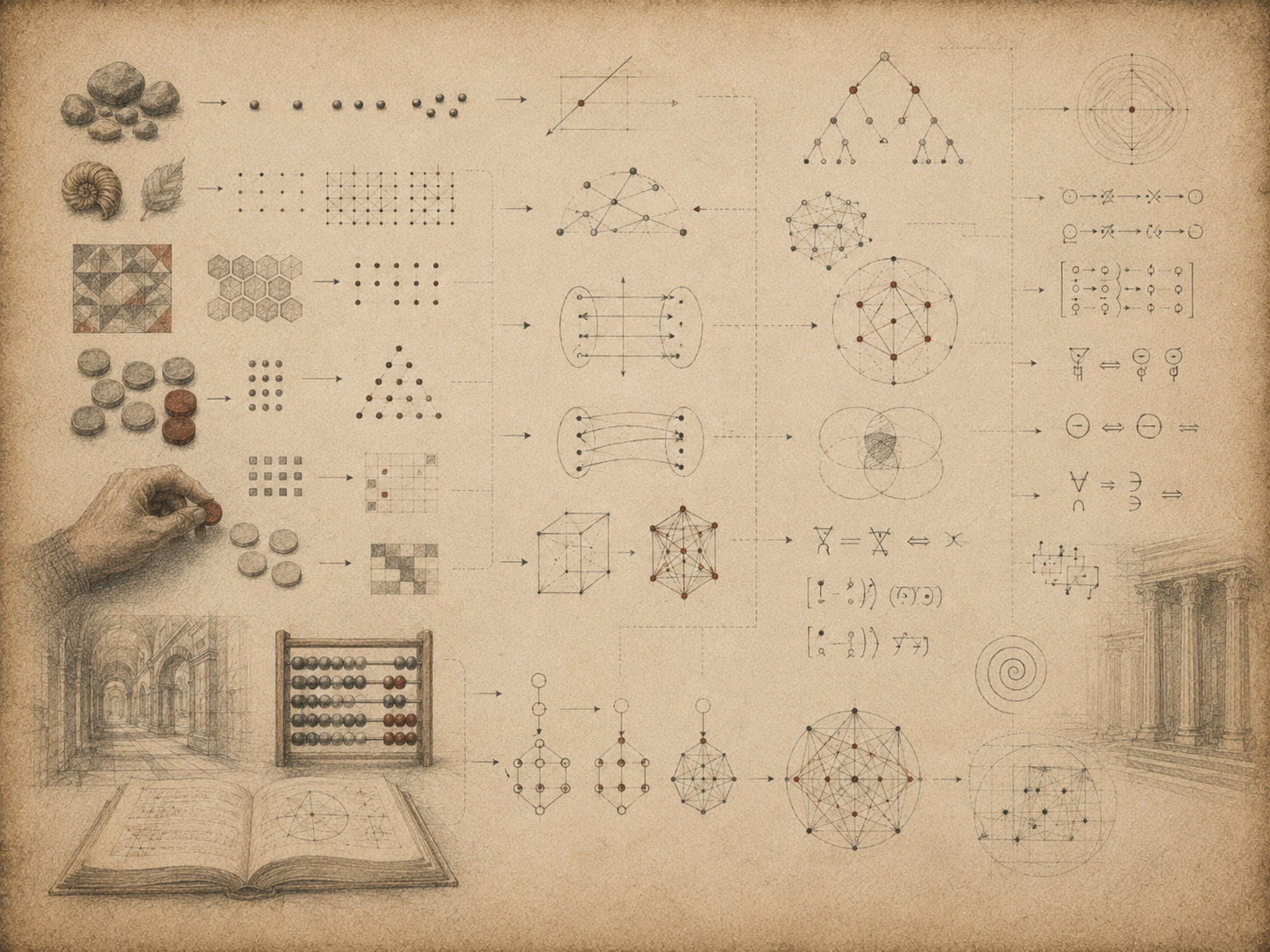
What Mathematical Representation Means
Mathematical representation is the practice of expressing mathematical objects, relationships, operations, structures, and arguments through symbols, diagrams, notations, formulas, graphs, tables, algorithms, formal languages, or models. A representation is not the object itself. It is a way of making the object available for reasoning.
The number five is not the written mark \(5\). A triangle is not the drawing of a triangle. A function is not merely its formula. A graph is not the visual picture of nodes and edges. A proof is not only the paragraph in which it is written. In each case, the representation gives access to structure while leaving out other features.
This distinction matters. Mathematical objects often have many representations. The same rational number can be written as \(1/2\), \(2/4\), \(0.5\), \(50\%\), or a point on the number line. The same linear relationship can be represented as an equation, a graph, a table, a matrix, a transformation, or a verbal rule. The same proof can be written in prose, formalized in a proof assistant, diagrammed as dependencies, or encoded as a sequence of logical steps.
\frac{1}{2}=0.5=50\%
\]
Interpretation: These are different symbolic representations of the same rational value. The representations emphasize different uses: fraction, decimal measurement, and proportion.
Mathematical representation therefore creates a relationship among three things: the object being studied, the sign system used to express it, and the interpretation that connects the sign to the object. A representation is useful when it preserves the structure needed for the reasoning task.
| Mathematical Object | Possible Representation | Structure Made Visible |
|---|---|---|
| Number | Numeral, fraction, decimal, number line | Quantity, order, ratio, magnitude |
| Function | Formula, table, graph, mapping diagram | Input-output relation, shape, rate of change |
| Network | Graph, adjacency matrix, edge list | Connectivity, dependency, relation |
| Proof | Prose, formal derivation, proof tree, dependency graph | Logical support and inference structure |
| System | Equation, simulation, diagram, state-space model | Interaction, feedback, change over time |
Mathematical thinking becomes powerful when it can move among representations. A problem that is difficult in one representation may become clear in another. Algebra may simplify what a diagram suggests. A graph may reveal what a table hides. A formal language may clarify what ordinary prose leaves ambiguous. A computational representation may make a large structure searchable, testable, and reproducible.
Symbols as Compressed Mathematical Thought
Symbols compress mathematical thought. The symbol \(+\) represents an operation. The symbol \(\forall\) represents universal quantification. The symbol \(\in\) represents membership. The symbol \(\Rightarrow\) represents implication. The expression \(f:X\to Y\) compresses the idea of a mapping from one set to another. The expression \(G=(V,E)\) compresses the structure of a graph into vertices and edges.
This compression is powerful because it allows complex reasoning to be manipulated with economy. A symbolic expression can carry more structure than ordinary language can easily hold. But symbolic compression also requires discipline. A symbol has meaning only within a convention, context, or formal system. The same mark can have different meanings in different settings. The letter \(i\) may represent an index, the imaginary unit, a current in electrical engineering, or an arbitrary variable depending on context.
G=(V,E)
\]
Interpretation: This compact notation represents a graph \(G\) as a pair consisting of a set of vertices \(V\) and a set of edges \(E\).
Symbols also allow mathematical thought to separate form from content. In logic, \(P\) and \(Q\) can stand for any propositions. In algebra, \(x\) can stand for an unknown or arbitrary quantity. In analysis, \(\varepsilon\) and \(\delta\) stand for controlled quantities in a proof. In category theory, arrows can represent structure-preserving maps across many different mathematical settings.
This abstraction makes mathematics reusable. Once a symbol system captures structure correctly, the same reasoning can apply across many cases. A proof about arbitrary \(x\) is not about a particular object named \(x\); it is about all objects satisfying the assumptions.
| Symbol | Typical Meaning | Mathematical Role |
|---|---|---|
| \(\forall\) | For all | States universal claims |
| \(\exists\) | There exists | States existence claims |
| \(\in\) | Is an element of | Expresses set membership |
| \(\Rightarrow\) | Implies | Connects premise and conclusion |
| \(\cong\) | Is congruent or structurally equivalent | Signals sameness under a chosen structure |
| \(\sum\) | Summation | Compresses repeated addition |
A symbol is therefore a tool of compression, but also a site of responsibility. The reader must know what it means. The writer must use it consistently. The proof must not rely on symbolic ambiguity.
Mathematical Language and Precision
Mathematical language is a hybrid of ordinary prose, technical vocabulary, symbolic notation, diagrams, and formal rules. It uses words such as “for all,” “there exists,” “if,” “only if,” “therefore,” “assume,” “let,” “arbitrary,” “unique,” “without loss of generality,” and “contradiction” in highly disciplined ways. These words are not casual. They carry logical force.
For example, “if” and “only if” are often confused in ordinary language, but they have distinct mathematical meanings. “\(P\) if \(Q\)” usually means \(Q\Rightarrow P\). “\(P\) only if \(Q\)” means \(P\Rightarrow Q\). “\(P\) if and only if \(Q\)” means both directions hold.
P\Leftrightarrow Q \quad \text{means} \quad (P\Rightarrow Q)\land(Q\Rightarrow P)
\]
Interpretation: An “if and only if” statement requires proof in both directions.
Mathematical precision also depends on definitions. A definition does not merely explain a word. It creates a usable object for reasoning. To define continuity, convergence, group, vector space, graph, metric, category, measurable function, or random variable is to create a disciplined language in which proofs can be written.
Mathematical language often looks compact because much of its meaning is carried by convention. A phrase such as “let \(x\in X\)” does several things at once: it introduces a variable, locates it in a domain, and makes it available for inference. A phrase such as “for arbitrary \(x\)” signals universal reasoning. A phrase such as “there exists” signals the need for a witness or existence argument.
| Mathematical Phrase | Logical Meaning | Proof Burden |
|---|---|---|
| Let \(x\in X\) | Introduce an object from domain \(X\) | Use only properties guaranteed by membership in \(X\) |
| For all \(x\) | Universal claim | Prove the statement for an arbitrary \(x\) |
| There exists \(x\) | Existence claim | Provide or justify a witness |
| Without loss of generality | Restriction justified by symmetry or equivalence | Show that excluded cases are genuinely covered |
| Assume for contradiction | Begin indirect proof | Derive a genuine contradiction from the negation |
Mathematical language is therefore not just descriptive. It is operational. It tells the proof what to do.
Variables, Quantifiers, and Generality
Variables are one of the great inventions of mathematical language. A variable can represent an unknown, an arbitrary object, a changing quantity, a bound placeholder, an index, a parameter, or a coordinate. The meaning depends on context. This flexibility is powerful, but it also creates risks when the role of the variable is unclear.
In algebra, \(x\) may represent an unknown to be solved for. In a proof, \(x\) may represent an arbitrary object in a domain. In calculus, \(x\) may be an independent variable. In a sequence, \(n\) may be an index. In a statistical model, \(X\) may be a random variable. In logic, \(x\) may be bound by a quantifier.
\forall x\in X,\;P(x)
\]
Interpretation: The variable \(x\) is bound by the universal quantifier. The claim says that every object in \(X\) has property \(P\).
The distinction between free and bound variables is essential. A free variable is not controlled by a quantifier or assignment. A bound variable is governed by a quantifier, summation, integral, lambda expression, or other binding structure. Confusing free and bound variables can change the meaning of a statement.
\sum_{i=1}^{n} i
\]
Interpretation: The variable \(i\) is bound by the summation. The variable \(n\) remains a parameter that determines the upper limit.
Quantifiers turn variable expressions into propositions. The expression \(x^2\geq 0\) contains a free variable. The statement \(\forall x\in\mathbb{R}, x^2\geq 0\) is a proposition. The statement \(\exists x\in\mathbb{R}, x^2=-1\) is a proposition, and it is false over the real numbers but true over the complex numbers if interpreted appropriately.
| Variable Role | Example | Meaning |
|---|---|---|
| Unknown | \(x+3=7\) | Value to be solved for |
| Arbitrary object | Let \(x\in X\) | Any object satisfying the assumptions |
| Index | \(a_n\) | Position in a sequence |
| Parameter | \(f_a(x)=ax\) | Controls a family of objects |
| Bound variable | \(\int_a^b f(x)\,dx\) | Local variable of integration |
| Random variable | \(X\sim N(\mu,\sigma^2)\) | Quantity with a probability distribution |
Variables make generality possible. They allow mathematics to reason about classes of objects rather than only about named instances. But generality requires discipline: the domain, binding structure, and assumptions must be clear.
Equality, Equivalence, and Identity
The symbol \(=\) is one of the most important and most easily misunderstood symbols in mathematics. In arithmetic, equality is often introduced as “the answer is.” But in mathematics, equality is a relation. It says that two expressions designate the same object, value, or structure within a given context.
Students often learn equations as commands to compute. Mathematical thinking treats equations as statements of relationship. The equation \(x+2=5\) is not merely asking for \(x\). It states a condition. The equation \(a+b=b+a\) states a structural property of an operation. The equation \(f(x)=g(x)\) may mean two functions agree at a point, or if stated for all \(x\), that they are the same function on a domain.
a+b=b+a
\]
Interpretation: This equation expresses commutativity. It is a structural statement about the operation, not a numerical calculation for one case.
Mathematics also uses weaker or more specialized notions of sameness. Congruence, isomorphism, equivalence, similarity, homeomorphism, homotopy equivalence, equality almost everywhere, and logical equivalence all express forms of sameness relative to a structure. The point is not that objects are identical in every respect, but that they are the same for the mathematical purpose at hand.
a\equiv b \pmod n
\]
Interpretation: The numbers \(a\) and \(b\) are congruent modulo \(n\) if they have the same remainder when divided by \(n\).
This is a central idea in representation. Two symbols may look different while representing the same object. Two objects may look different while being structurally equivalent. Two expressions may be algebraically equal but computationally different in efficiency. Two models may be mathematically equivalent but interpretively different.
| Sameness Relation | Symbol | Meaning | Example Use |
|---|---|---|---|
| Equality | \(=\) | Same value or object | \(2+3=5\) |
| Congruence | \(\equiv\) | Same residue or geometric relation | \(7\equiv 1\pmod 3\) |
| Isomorphism | \(\cong\) | Same structure up to relabeling | Groups, graphs, vector spaces |
| Logical equivalence | \(\Leftrightarrow\) | Same truth conditions | Implication and contrapositive |
| Approximation | \(\approx\) | Close enough under a chosen tolerance | Numerical analysis and modeling |
Mathematical representation depends on knowing which kind of sameness is being asserted. Equality is powerful because it permits substitution. Equivalence is powerful because it permits abstraction. Approximation is powerful because it permits computation and modeling. Each has a different logical burden.
Functions, Mappings, and Symbolic Structure
The concept of function is one of the great examples of mathematical representation evolving over time. A function may be introduced as a formula, such as \(f(x)=x^2\). But a function is more generally a mapping from a domain to a codomain: each input is assigned exactly one output.
f:X\to Y
\]
Interpretation: The function \(f\) maps each element of domain \(X\) to an element of codomain \(Y\).
This notation carries several pieces of information. It names the function, identifies the domain, identifies the codomain, and indicates direction. The formula alone may not provide all of this. For example, \(f(x)=x^2\) behaves differently depending on whether the domain is \(\mathbb{R}\), \(\mathbb{C}\), \(\mathbb{N}\), or a finite field. Representation must include domain and context.
Functions can be represented in many ways:
- as formulas;
- as tables of values;
- as graphs;
- as algorithms;
- as transformations;
- as mappings between sets;
- as arrows in a category;
- as data structures in computation.
Each representation emphasizes something different. A formula supports symbolic manipulation. A graph reveals shape. A table supports finite comparison. An algorithm shows computation. A categorical arrow emphasizes compositional structure.
(g\circ f)(x)=g(f(x))
\]
Interpretation: Function composition represents the operation of applying \(f\) first and then \(g\).
| Function Representation | Strength | Possible Limitation |
|---|---|---|
| Formula | Supports algebraic manipulation | May hide domain and interpretation |
| Graph | Shows shape, extrema, continuity, trend | May be visually misleading or incomplete |
| Table | Shows sampled input-output pairs | Finite data may not determine the function |
| Algorithm | Shows how outputs are computed | May obscure closed-form structure |
| Arrow | Highlights mapping and composition | May abstract away element-level behavior |
Functions show that mathematical language is not merely symbolic shorthand. It organizes entire ways of thinking about transformation, dependency, and relation.
Diagrams, Visual Representation, and Spatial Reasoning
Diagrams are among the oldest mathematical representations. Geometry, topology, graph theory, category theory, combinatorics, logic, and systems modeling all use visual representations. A diagram can reveal structure quickly. It can suggest a proof. It can expose symmetry, adjacency, flow, hierarchy, or transformation.
But diagrams are not automatically proofs. A drawing may be inaccurate, special, or misleading. A geometric diagram may hide a degenerate case. A graph layout may imply distances that are not part of the graph. A commutative diagram may clarify relationships, but the proof still depends on the maps and equalities it represents.
A \xrightarrow{f} B \xrightarrow{g} C
\]
Interpretation: Arrow notation represents mappings and composition. It makes relational structure visible without listing all elements.
Visual representation is powerful because it engages spatial reasoning. A graph drawing helps the mind see paths and cycles. A geometric diagram helps the mind see congruence or similarity. A proof tree helps the mind see dependency. A commutative diagram helps the mind see whether different paths through a structure lead to the same result.
Mathematical maturity involves using diagrams without being ruled by them. A diagram can guide intuition, but the proof must identify which features are essential and which are artifacts of the drawing.
| Diagram Type | What It Represents | Interpretive Risk |
|---|---|---|
| Geometric drawing | Shape, angle, side relation | Special case may look general |
| Graph diagram | Vertices and edges | Visual distances may not be meaningful |
| Proof tree | Logical dependencies | May omit explanatory motivation |
| Commutative diagram | Maps and equalities among compositions | Requires precise definition of objects and arrows |
| System diagram | Feedback, flow, interaction | May imply causality without evidence |
Diagrams are therefore neither merely illustrative nor automatically rigorous. They are representational tools whose mathematical value depends on how well they preserve relevant structure.
Notation as Mathematical Infrastructure
Notation is intellectual infrastructure. It determines what is easy to express, what is hard to express, what patterns become visible, and what operations become natural. A good notation can open a field. A poor notation can make simple ideas difficult to see.
Consider algebraic notation. The use of variables and symbolic equations made general manipulation possible in ways that purely verbal arithmetic could not. Calculus notation made rates of change and accumulation expressible. Set notation made membership, union, intersection, and mapping precise. Matrix notation made systems of linear equations, transformations, and data structures compact. Category-theoretic notation made relationships among structures central.
\frac{dy}{dx}
\]
Interpretation: Leibniz notation for derivatives emphasizes change in \(y\) relative to change in \(x\), making chain rules and differentials visually suggestive.
Notation carries intuition. The notation \(\sum\) suggests accumulation. The notation \(\int\) suggests continuous summation. The notation \(f:X\to Y\) suggests direction and mapping. The notation \(A\subseteq B\) suggests containment. These are not accidental. They are part of how notation shapes mathematical thought.
At the same time, notation can mislead. A notation may imply symmetry where none exists. It may hide domain restrictions. It may make equivalent objects look different or different objects look equivalent. It may become overloaded. It may preserve historical convention even when a concept has evolved beyond its original setting.
| Notation | What It Makes Easy | What It Can Hide |
|---|---|---|
| \(\sum_{i=1}^{n} a_i\) | Repeated addition over an index | Meaning of index and convergence issues in infinite sums |
| \(\int_a^b f(x)\,dx\) | Accumulation over a continuum | Measure-theoretic assumptions and integrability |
| \(f:X\to Y\) | Domain, codomain, direction | Internal rule if not specified |
| \(A^{-1}\) | Inverse operation or inverse image | Different meanings depending on context |
| \(X\sim D\) | Distributional statement | Modeling assumptions and empirical fit |
Notation is therefore not neutral. It is a designed environment for thought. Mathematical fluency includes not only knowing what symbols mean, but knowing what they make visible and what they may conceal.
Translation Between Representations
Mathematical understanding often depends on translation. A problem may be expressed verbally, then translated into an equation. A table may be translated into a graph. A graph may be translated into an adjacency matrix. A recurrence may be translated into a closed form. A geometric problem may be translated into algebra. A proof may be translated into a formal language.
Translation between representations is not mechanical. Each representation preserves some structure and omits other structure. The translation is valid only if the relevant relationships are preserved.
\text{word problem} \rightarrow \text{equation} \rightarrow \text{solution} \rightarrow \text{interpretation}
\]
Interpretation: Applied mathematical reasoning often requires translating a real or verbal situation into symbolic form, solving within the representation, and translating the result back into context.
In linear algebra, a system of equations can be represented as a matrix equation:
Ax=b
\]
Interpretation: A collection of linear equations is represented compactly as a matrix equation, making structural tools such as rank, inverse, null space, and factorization available.
In graph theory, a network can be represented visually, as an edge list, or as an adjacency matrix. Each form supports different operations. The visual graph helps intuition. The edge list is compact and data-friendly. The adjacency matrix supports algebraic computation.
| Original Form | Translated Form | New Tool Made Available |
|---|---|---|
| Word problem | Equation or inequality | Algebraic solution |
| System of equations | Matrix equation | Linear algebra |
| Network drawing | Adjacency matrix | Spectral and algorithmic analysis |
| Sequence of terms | Recurrence relation | Induction and dynamic analysis |
| Informal proof | Formal derivation | Machine checking and dependency audit |
Translation is one reason mathematics can unify fields. The same structure may appear in different languages. Recognizing that translation is possible can reveal hidden equivalence. Recognizing when translation fails can prevent false analogy.
Formal Languages and Proof Systems
A formal language specifies symbols, formation rules, and rules for constructing valid expressions. Formal languages are essential in logic, proof theory, computer science, programming language design, formal verification, and proof assistants. They make reasoning explicit enough to be checked.
Ordinary mathematical prose is powerful because it is flexible and explanatory. Formal language is powerful because it is precise and mechanically inspectable. The two are not enemies. Serious mathematics often moves between informal explanation and formal structure.
\Gamma \vdash \varphi
\]
Interpretation: This formal notation says that \(\varphi\) is derivable from the assumptions or context \(\Gamma\).
Formal proof systems define how conclusions may be derived from premises. Natural deduction, sequent calculus, Hilbert systems, type theory, and automated theorem proving systems each organize inference differently. Proof assistants such as Lean, Rocq/Coq, Isabelle, Agda, and related systems depend on formal languages to represent mathematical statements and verify proofs.
Formalization exposes assumptions. It forces definitions to be explicit. It prevents many hidden steps. It makes dependencies inspectable. But it can also be demanding because informal mathematical understanding often compresses many implicit conventions. Translating that understanding into formal language requires precision.
| Representation Level | Strength | Limitation |
|---|---|---|
| Informal prose | Explains motivation and intuition | May hide assumptions or gaps |
| Symbolic proof | Clarifies inference and structure | May be terse or opaque |
| Formal derivation | Enforces rule-governed inference | Can be lengthy and technical |
| Proof assistant code | Machine-checkable | Depends on libraries, definitions, and formal statement accuracy |
| Computational metadata | Supports search, dependency tracking, and reproducibility | Does not by itself prove the theorem |
Formal languages show that mathematical representation can become executable. A proof can be checked. A definition can be imported. A theorem can become part of a library. A dependency can be traced. This is one of the major developments in modern mathematical infrastructure.
Symbolic Computation and Machine Representation
Computation has changed the landscape of mathematical representation. Mathematical objects can now be represented as data structures, symbolic expressions, proof scripts, type definitions, graphs, arrays, tensors, databases, simulations, and executable models. This creates new possibilities for exploration, verification, visualization, and reproducibility.
Symbolic computation systems can manipulate algebraic expressions. Numerical systems can approximate solutions. Graph libraries can analyze networks. Databases can store theorem metadata. Proof assistants can verify formal arguments. Functional programming languages such as Haskell can represent propositions, proof trees, recursive structures, and algebraic abstractions as data types.
But machine representation introduces its own discipline. A computer representation must specify data types, operations, encodings, precision, assumptions, and failure modes. A floating-point number is not a real number. A graph layout is not the graph. A parsed expression is not automatically a meaningful theorem. A proof script is only as good as its formal statement and trusted kernel.
\text{mathematical object} \rightarrow \text{data structure} \rightarrow \text{algorithm} \rightarrow \text{output} \rightarrow \text{interpretation}
\]
Interpretation: Computational mathematics requires translating mathematical structure into machine representation and then interpreting computational output mathematically.
| Mathematical Idea | Machine Representation | Risk |
|---|---|---|
| Real number | Floating-point value | Rounding and precision error |
| Graph | Edge list or adjacency matrix | Missing edge semantics, weights, or direction |
| Function | Code or symbolic expression | Domain and discontinuities may be implicit |
| Proof | Formal proof script | Statement may not match intended theorem |
| Model | Simulation or optimization program | Assumptions may be hidden in implementation |
Computation extends mathematical representation, but it does not remove the need for interpretation. The central question remains: what structure is represented, what has been omitted, and what can responsibly be concluded?
Ambiguity, Misrepresentation, and Notational Failure
Representation is powerful because it selects. But selection can mislead. A symbol may be ambiguous. A diagram may suggest a false generalization. A notation may hide assumptions. A model may omit essential context. A graph may imply relationships that are not real. A metric may compress many dimensions into one number. A formal statement may fail to capture the intended idea.
Mathematical language tries to reduce ambiguity, but it never eliminates interpretation entirely. Even formal systems require choices: definitions, axioms, encoding strategies, libraries, and proof goals. In applied mathematics, representation is even more consequential because the represented object may be a physical system, social system, economy, ecosystem, institution, or human population.
\text{representation} \neq \text{reality}
\]
Interpretation: A mathematical representation preserves selected structure. It should not be mistaken for the full object or situation it represents.
Notational failure can occur when notation is overloaded, when domains are missing, when equality is used where approximation is intended, when variables are not defined, when diagrams are treated as proof, or when symbolic manipulation ignores assumptions.
| Failure Mode | Example | Better Practice |
|---|---|---|
| Undefined variable | Using \(x\) without domain or role | State whether \(x\) is arbitrary, unknown, bound, or a parameter |
| Hidden domain | \(f(x)=x^2\) without specifying \(X\) | Write \(f:X\to Y\) and define the rule |
| Overloaded symbol | \(A^{-1}\) as inverse matrix or inverse image | Clarify context and notation |
| Diagram as proof | Assuming a drawn case is general | Translate visual insight into formal argument |
| Metric as reality | Reducing complex wellbeing to one score | Report assumptions, limitations, and omitted dimensions |
Mathematical rigor is partly the discipline of representation. It asks whether the symbol, diagram, formula, model, or code actually means what the argument needs it to mean.
A Mathematical Lens: Object, Symbol, Structure, Interpretation
A useful lens for understanding mathematical representation is the sequence: object, symbol, structure, interpretation. The object is what is being studied. The symbol or representation is how it is expressed. The structure is what the representation preserves. The interpretation is how the representation is connected back to meaning.
\text{Object} \rightarrow \text{Symbol} \rightarrow \text{Structure} \rightarrow \text{Interpretation}
\]
Interpretation: Mathematical representation is a chain of meaning. A symbol matters because it preserves structure that can be interpreted.
This lens helps clarify why the same object can have many representations. A rational number can be a fraction, decimal, point, equivalence class, or pair of integers under a relation. A graph can be a drawing, matrix, edge list, adjacency map, or algebraic object. A proof can be prose, a derivation tree, a formal script, or a dependency graph. Each representation supports different reasoning.
The lens also helps identify errors. If the symbol does not preserve the needed structure, the representation is inadequate. If the structure is preserved but interpretation is wrong, the conclusion may be misapplied. If the object is poorly defined, the representation cannot rescue the argument.
| Lens Element | Question | Example |
|---|---|---|
| Object | What is being represented? | A function, graph, theorem, system, dataset |
| Symbol | How is it expressed? | Formula, diagram, table, code, proof script |
| Structure | What relationship is preserved? | Order, adjacency, equality, implication, transformation |
| Interpretation | What does the representation mean? | Mathematical theorem, model result, proof dependency |
| Limitation | What has been omitted? | Context, uncertainty, domain, scale, meaning |
Mathematical representation is not only about writing symbols correctly. It is about preserving meaning across transformations of form.
Computational Companion Examples
The companion repository for this article should extend the Mathematical Thinking codebase with examples focused on symbolic representation, expression parsing, translation between forms, graph and matrix representations, formal language scaffolds, Haskell algebraic data types, theorem metadata, and representation audits. The examples below are compact article-level previews; the repository can expand them into richer professional workflows.
Python: Expressions as Structured Objects
from dataclasses import dataclass
from typing import Union

@dataclass(frozen=True)
class Var:
    name: str

@dataclass(frozen=True)
class Const:
    value: float

@dataclass(frozen=True)
class Add:
    left: "Expr"
    right: "Expr"

@dataclass(frozen=True)
class Mul:
    left: "Expr"
    right: "Expr"

Expr = Union[Var, Const, Add, Mul]

def render(expr: Expr) -> str:
    if isinstance(expr, Var):
        return expr.name
    if isinstance(expr, Const):
        return str(expr.value)
    if isinstance(expr, Add):
        return f"({render(expr.left)} + {render(expr.right)})"
    if isinstance(expr, Mul):
        return f"({render(expr.left)} * {render(expr.right)})"
    raise TypeError(f"Unknown expression: {expr}")

def evaluate(expr: Expr, environment: dict[str, float]) -> float:
    if isinstance(expr, Var):
        return environment[expr.name]
    if isinstance(expr, Const):
        return expr.value
    if isinstance(expr, Add):
        return evaluate(expr.left, environment) + evaluate(expr.right, environment)
    if isinstance(expr, Mul):
        return evaluate(expr.left, environment) * evaluate(expr.right, environment)
    raise TypeError(f"Unknown expression: {expr}")

expr = Mul(Add(Var("x"), Const(2)), Var("y"))

print(render(expr))
print(evaluate(expr, {"x": 3, "y": 4}))
R: Representation Audit for Functions
domain <- seq(-3, 3, by = 1)

f <- function(x) x^2
g <- function(x) abs(x)^2

table_representation <- data.frame(
  x = domain,
  f_value = f(domain),
  g_value = g(domain),
  agree_on_sample = f(domain) == g(domain)
)

print(table_representation)

if (all(table_representation$agree_on_sample)) {
  cat("The sampled table shows agreement on this finite domain.\n")
  cat("A proof is needed to establish equality on the full intended domain.\n")
}
Julia: Graph as Edge List and Adjacency Matrix
vertices = ["a", "b", "c", "d"]
edges = [("a", "b"), ("b", "c"), ("c", "d"), ("d", "a")]

function adjacency_matrix(vertices, edges)
    index = Dict(v => i for (i, v) in enumerate(vertices))
    matrix = zeros(Int, length(vertices), length(vertices))

    for (u, v) in edges
        i = index[u]
        j = index[v]
        matrix[i, j] = 1
        matrix[j, i] = 1
    end

    return matrix
end

println(adjacency_matrix(vertices, edges))
println("The edge list and adjacency matrix represent the same graph structure.")
Haskell: Symbols as Algebraic Data Types
{-# OPTIONS_GHC -Wall #-}

data Expr
  = Var String
  | Const Double
  | Add Expr Expr
  | Mul Expr Expr
  deriving (Eq, Show)

type Environment = [(String, Double)]

lookupVar :: String -> Environment -> Double
lookupVar name env =
  case lookup name env of
    Just value -> value
    Nothing -> error ("unbound variable: " ++ name)

eval :: Environment -> Expr -> Double
eval env expr =
  case expr of
    Var name -> lookupVar name env
    Const value -> value
    Add left right -> eval env left + eval env right
    Mul left right -> eval env left * eval env right

render :: Expr -> String
render expr =
  case expr of
    Var name -> name
    Const value -> show value
    Add left right -> "(" ++ render left ++ " + " ++ render right ++ ")"
    Mul left right -> "(" ++ render left ++ " * " ++ render right ++ ")"

main :: IO ()
main = do
  let expr = Mul (Add (Var "x") (Const 2)) (Var "y")
  putStrLn (render expr)
  print (eval [("x", 3), ("y", 4)] expr)
SQL: Representation Metadata Schema
CREATE TABLE mathematical_object (
  object_id TEXT PRIMARY KEY,
  name TEXT NOT NULL,
  object_type TEXT NOT NULL,
  description TEXT NOT NULL
);

CREATE TABLE representation (
  representation_id TEXT PRIMARY KEY,
  object_id TEXT NOT NULL,
  representation_type TEXT NOT NULL,
  notation_or_format TEXT NOT NULL,
  preserved_structure TEXT NOT NULL,
  omitted_detail TEXT NOT NULL,
  FOREIGN KEY (object_id) REFERENCES mathematical_object(object_id)
);

CREATE TABLE translation (
  translation_id TEXT PRIMARY KEY,
  source_representation_id TEXT NOT NULL,
  target_representation_id TEXT NOT NULL,
  translation_rule TEXT NOT NULL,
  validity_condition TEXT NOT NULL,
  FOREIGN KEY (source_representation_id) REFERENCES representation(representation_id),
  FOREIGN KEY (target_representation_id) REFERENCES representation(representation_id)
);

CREATE TABLE representation_warning (
  warning_id TEXT PRIMARY KEY,
  representation_id TEXT NOT NULL,
  warning TEXT NOT NULL,
  mitigation TEXT NOT NULL,
  FOREIGN KEY (representation_id) REFERENCES representation(representation_id)
);
These examples treat representation as something that can itself be modeled. Expressions can be stored as trees. Graphs can be translated between edge lists and matrices. Functions can be compared through sampled tables and symbolic reasoning. Haskell can make symbolic structures explicit through algebraic data types. SQL can organize representation metadata for reproducible mathematical knowledge systems.
GitHub Repository
The companion repository for this article is designed as a reproducible mathematical-thinking workspace focused on symbolic representation, notation systems, expression trees, graph and matrix translations, formal language scaffolds, representation metadata, Haskell algebraic data types, and audits of what mathematical representations preserve or omit.
Complete Code Repository
Companion article folder with Python, R, Julia, SQL, Haskell, Rust, Go, C++, Fortran, and C examples for professional mathematical exploration of symbols, notation, expression trees, formal languages, graph representations, symbolic computation, representation metadata, and translation between mathematical forms.
Representation, Modeling, and Responsibility
Mathematical representation is not only a technical issue. In applied settings, representation can shape decisions that affect people, institutions, ecosystems, economies, and public life. A model represents selected features of reality. A metric represents selected dimensions of value. A dataset represents selected observations. An algorithm represents selected rules. A risk score represents selected variables. These representations can clarify, but they can also distort.
The ethical question is not whether representation should be avoided. Without representation, complex reasoning would be impossible. The question is whether the representation is honest about its assumptions, omissions, domain, uncertainty, and consequences.
A social system represented as a graph may preserve relationships while omitting power. A health model may preserve measurable risk factors while omitting access, environment, or lived experience. An economic equation may preserve selected incentives while omitting institutions, history, or distribution. An environmental metric may preserve measurable signals while omitting local knowledge or biodiversity complexity.
| Representation | What It May Preserve | What It May Omit | Responsible Practice |
|---|---|---|---|
| Metric | Comparable measurement | Plural values and context | Report limitations and use multiple indicators |
| Risk model | Selected predictors | Structural inequality and uncertainty | Audit variables, errors, and consequences |
| Graph model | Connections and dependencies | Meaning, intensity, power, history | Document edge semantics and missing dimensions |
| AI embedding | Statistical similarity | Meaning, causality, dignity, contestability | Use human review and transparent evaluation |
| Optimization model | Objective and constraints | Values not encoded in the objective | Examine tradeoffs and affected communities |
Representation should make reasoning more accountable, not less. The discipline of mathematical notation has an ethical analogue: define terms, state assumptions, clarify domains, identify omissions, and avoid pretending that the representation is the whole reality.
Why Mathematical Representation Matters
Mathematical representation matters because mathematics depends on forms that can carry structure. Without symbols, variables, diagrams, notation, equations, graphs, formal languages, and computational encodings, mathematical reasoning would remain local and fragile. Representation allows thought to be stored, shared, transformed, checked, generalized, and extended.
The history of mathematics is partly a history of representational breakthroughs: numerals, place value, algebraic notation, coordinate geometry, calculus notation, set notation, matrix notation, graph notation, formal logic, programming languages, and proof assistants. Each new representational system changes what mathematicians can see and do.
Representation also matters because it teaches humility. Every representation preserves some structure and omits other structure. No notation is the object itself. No diagram is the theorem itself. No model is the world itself. No formal proof script is meaningful unless its statement and definitions match the intended mathematics.
Mathematical thinking requires fluency in representation and judgment about representation. It asks which notation clarifies the problem, which diagram reveals structure, which formal language removes ambiguity, which computational encoding is faithful, and which omissions must be acknowledged.
Symbols make mathematics portable. Language makes it communicable. Representation makes it thinkable. The deepest mathematical work often begins when one learns to ask not only “what is the answer?” but “what is the right way to represent the structure?”
Related Articles
- What Is Mathematical Thinking? Pattern, Proof, Architecture, and Reason
- Patterns, Structure, and the Mathematical Imagination
- Abstraction and the Power of Generalization
- Mathematics as the Science of Patterns
- Proof and the Logic of Mathematical Justification
- Logic and the Structure of Formal Inference
- Conjecture, Creativity, and Mathematical Discovery
- Sets, Relations, and Functions as Modes of Thought
- Mathematical Thinking for Computer Science
- Mathematical Thinking and Proof Assistants
Further Reading
- Cajori, F. (1993) A History of Mathematical Notations. Mineola, NY: Dover Publications. Available at: https://store.doverpublications.com/products/9780486677668
- Devlin, K. (2012) Introduction to Mathematical Thinking. Stanford University / Coursera course materials and related publications. Available at: https://web.stanford.edu/~kdevlin/
- Goldin, G.A. and Kaput, J.J. (1996) ‘A joint perspective on the idea of representation in learning and doing mathematics’, in Steffe, L.P., Nesher, P., Cobb, P., Goldin, G.A. and Greer, B. (eds.) Theories of Mathematical Learning. Mahwah, NJ: Lawrence Erlbaum Associates.
- Núñez, R.E. and Lakoff, G. (2000) Where Mathematics Comes From: How the Embodied Mind Brings Mathematics into Being. New York: Basic Books. Available at: https://www.basicbooks.com/titles/george-lakoff/where-mathematics-comes-from/9780465037711/
- Peirce, C.S. (1931–1958) Collected Papers of Charles Sanders Peirce. Cambridge, MA: Harvard University Press. Available at: https://www.hup.harvard.edu/books/9780674138001
- Rotman, B. (2000) Mathematics as Sign: Writing, Imagining, Counting. Stanford: Stanford University Press. Available at: https://www.sup.org/books/title/?id=332
- Velleman, D.J. (2019) How to Prove It: A Structured Approach. 3rd edn. Cambridge: Cambridge University Press. Available at: https://www.cambridge.org/highereducation/books/how-to-prove-it/6D2965D625C6836CD4A785A2C843B3DA
References
- Cajori, F. (1993) A History of Mathematical Notations. Mineola, NY: Dover Publications. Available at: https://store.doverpublications.com/products/9780486677668
- Devlin, K. (2012) Introduction to Mathematical Thinking. Stanford University / Coursera course materials and related publications. Available at: https://web.stanford.edu/~kdevlin/
- Goldin, G.A. and Kaput, J.J. (1996) ‘A joint perspective on the idea of representation in learning and doing mathematics’, in Steffe, L.P., Nesher, P., Cobb, P., Goldin, G.A. and Greer, B. (eds.) Theories of Mathematical Learning. Mahwah, NJ: Lawrence Erlbaum Associates.
- Mac Lane, S. (1998) Categories for the Working Mathematician. 2nd edn. New York: Springer. Available at: https://link.springer.com/book/10.1007/978-1-4757-4721-8
- Núñez, R.E. and Lakoff, G. (2000) Where Mathematics Comes From: How the Embodied Mind Brings Mathematics into Being. New York: Basic Books. Available at: https://www.basicbooks.com/titles/george-lakoff/where-mathematics-comes-from/9780465037711/
- Peirce, C.S. (1931–1958) Collected Papers of Charles Sanders Peirce. Cambridge, MA: Harvard University Press. Available at: https://www.hup.harvard.edu/books/9780674138001
- Rotman, B. (2000) Mathematics as Sign: Writing, Imagining, Counting. Stanford: Stanford University Press. Available at: https://www.sup.org/books/title/?id=332
- Velleman, D.J. (2019) How to Prove It: A Structured Approach. 3rd edn. Cambridge: Cambridge University Press. Available at: https://www.cambridge.org/highereducation/books/how-to-prove-it/6D2965D625C6836CD4A785A2C843B3DA