Futures Thinking

Futures thinking explores structured methods for analyzing long-term uncertainty and anticipating potential transformations in technological, economic, and social systems. Rather than attempting to predict a single future, futures thinking investigates multiple plausible futures to help organizations prepare for emerging risks and opportunities.

The field includes a range of foresight methodologies, including scenario planning, horizon scanning, trend analysis, and strategic foresight modeling. These tools help decision-makers identify early signals of change and explore how current decisions may shape long-term outcomes.

Futures thinking plays an important role in strategic planning, innovation management, public policy development, and sustainability research. Many global challenges—including climate change, demographic transitions, and technological disruption—unfold over decades and require institutions to plan beyond short-term horizons.

By expanding the temporal scope of decision-making, futures thinking enables organizations to develop strategies that remain robust across a range of possible futures.

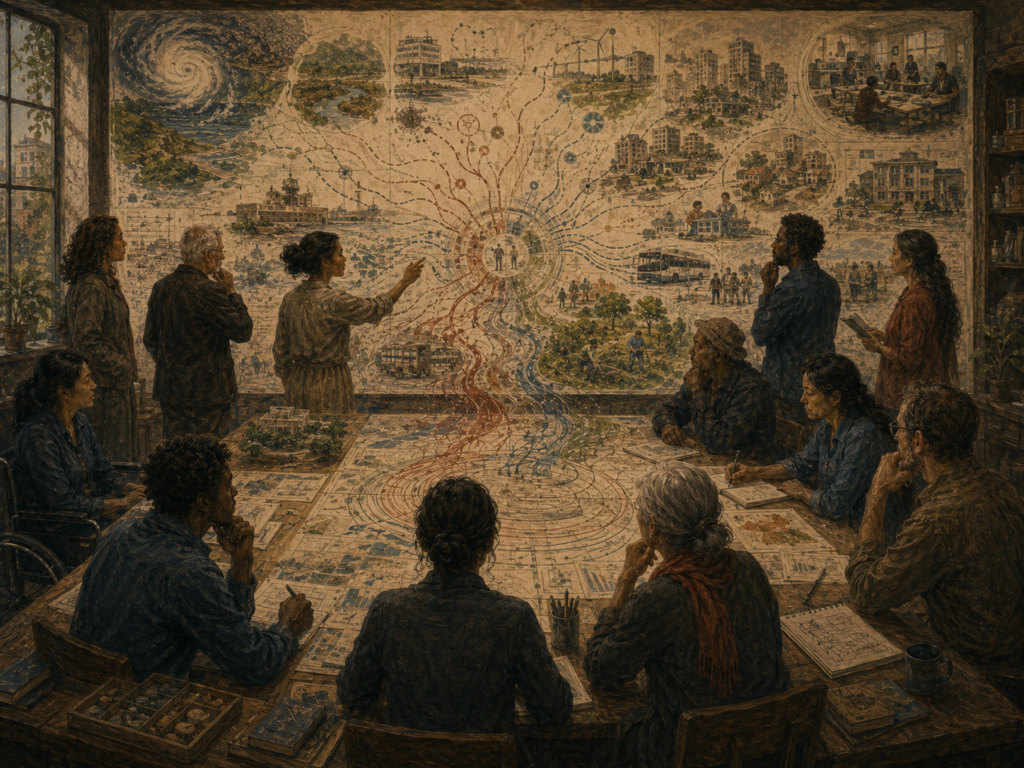
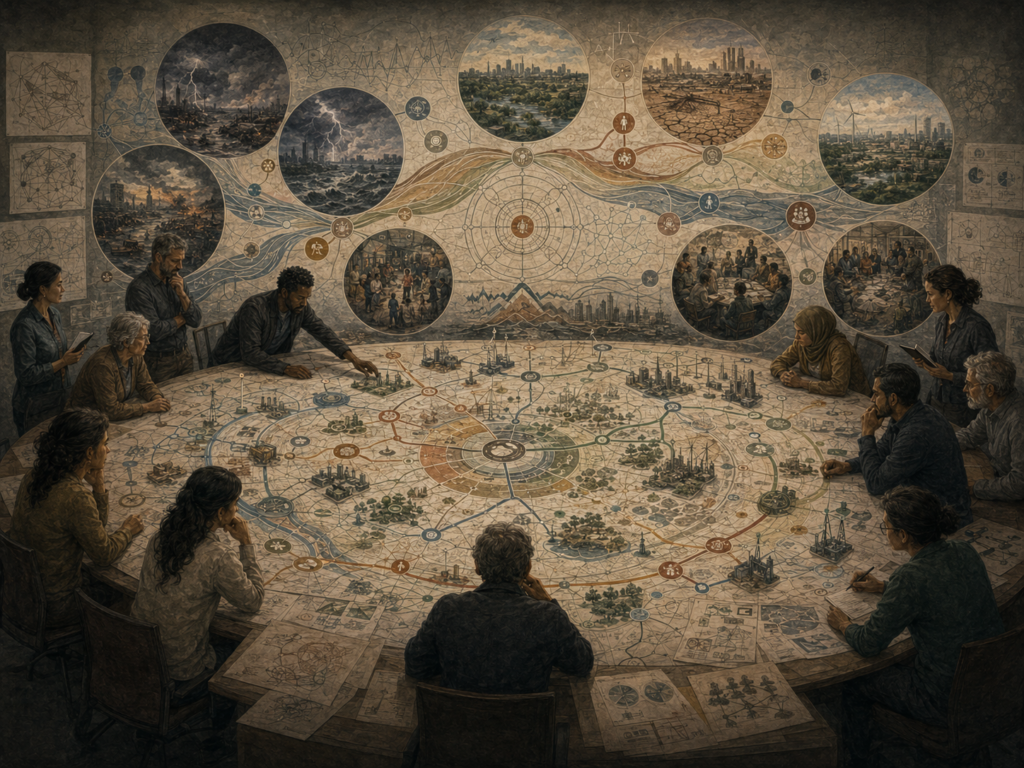
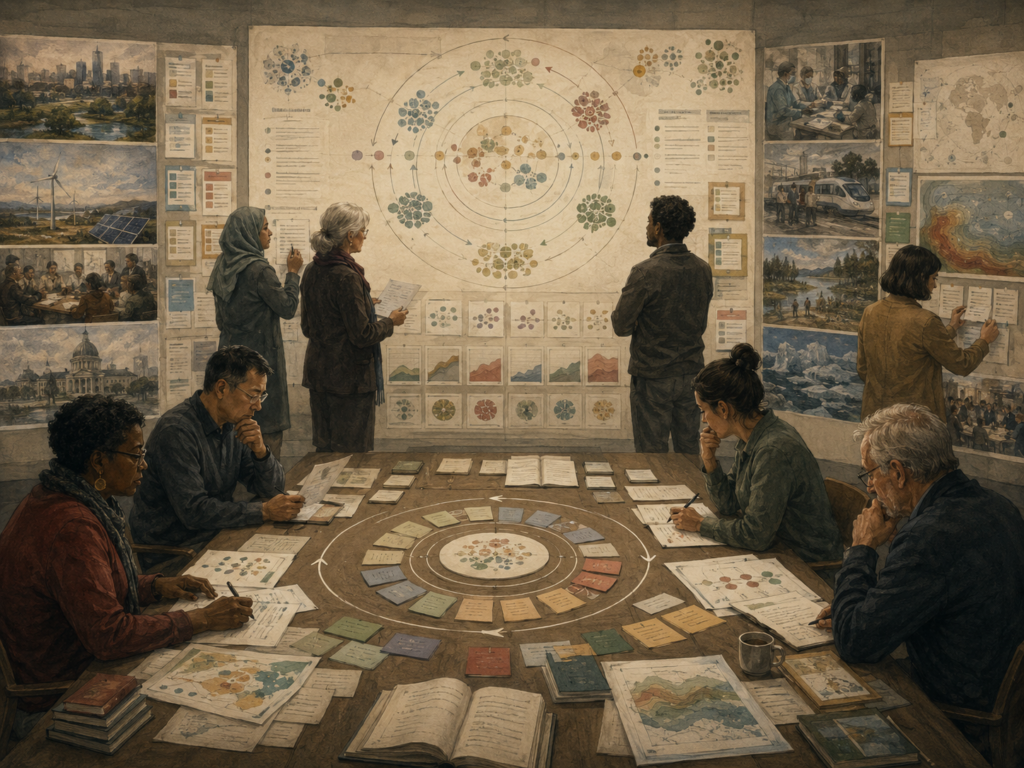
Experts review anonymous foresight inputs, consensus diagrams, and iterative judgments across civic, ecological, technological, and institutional systems.

Delphi Method and Expert Foresight

The Delphi Method and Expert Foresight examines how structured rounds of expert judgment can clarify uncertainty, compare assumptions, and support long-range decision-making when evidence is incomplete. The article explains how Delphi differs from ordinary surveys, panels, and forecasts by using anonymity, controlled feedback, iteration, statistical summaries, and qualitative reasoning to reveal both consensus and disagreement. It shows why expert foresight is valuable in technology governance, climate adaptation, public health, sustainability transitions, infrastructure planning, and institutional strategy, while also warning against false authority, narrow panels, and artificial consensus. By connecting Delphi to futures thinking, scenario planning, horizon scanning, weak signals, backcasting, and anticipatory governance, the article frames expert judgment as a disciplined, transparent, plural, and revisable practice for preparing institutions to act responsibly under deep uncertainty and contested future conditions across public, civic, scientific, and organizational systems facing rapid change.
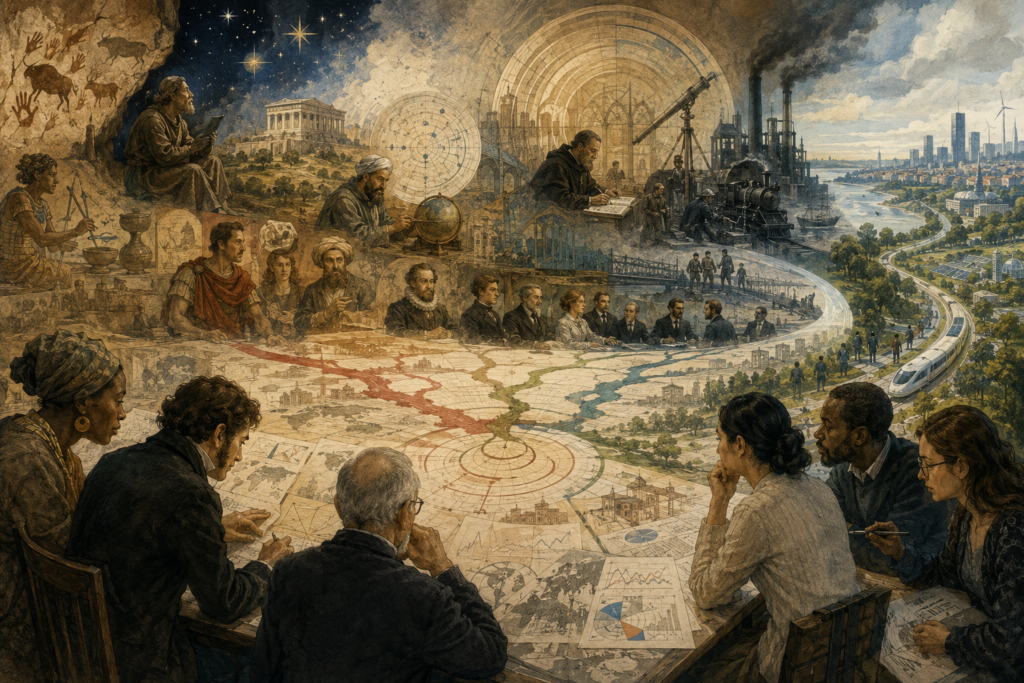
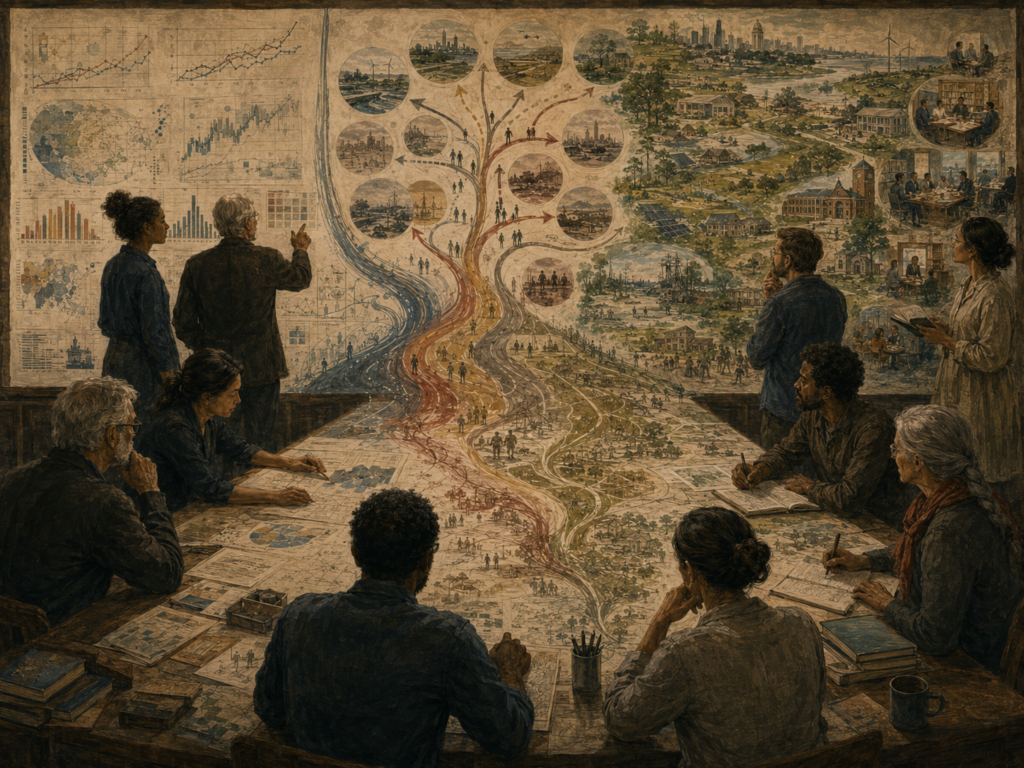
A historical futures-thinking scene showing scholars, planners, and communities studying time, uncertainty, technology, ecology, and social change.

The History of Futures Thinking: From Prophecy and Utopia to Strategic Foresight

The History of Futures Thinking examines how human beings and institutions have imagined, warned about, planned for, and contested the future across time. It traces futures thinking from prophecy, religious imagination, utopian writing, industrial progress, and scientific speculation through war planning, systems analysis, Cold War strategy, scenario planning, global modeling, environmental limits, corporate foresight, participatory futures, decolonial critique, futures literacy, and anticipatory governance. The article shows that futures thinking is never neutral: every method carries assumptions about power, evidence, time, responsibility, and who gets to define what is possible, plausible, probable, or preferable. By studying the field historically, readers can better understand both its practical value and its ethical risks. The history of futures thinking reveals a discipline shaped by imagination, strategy, institutional power, public learning, and long-term responsibility across generations, societies, ecological systems, technologies, and contested futures today.

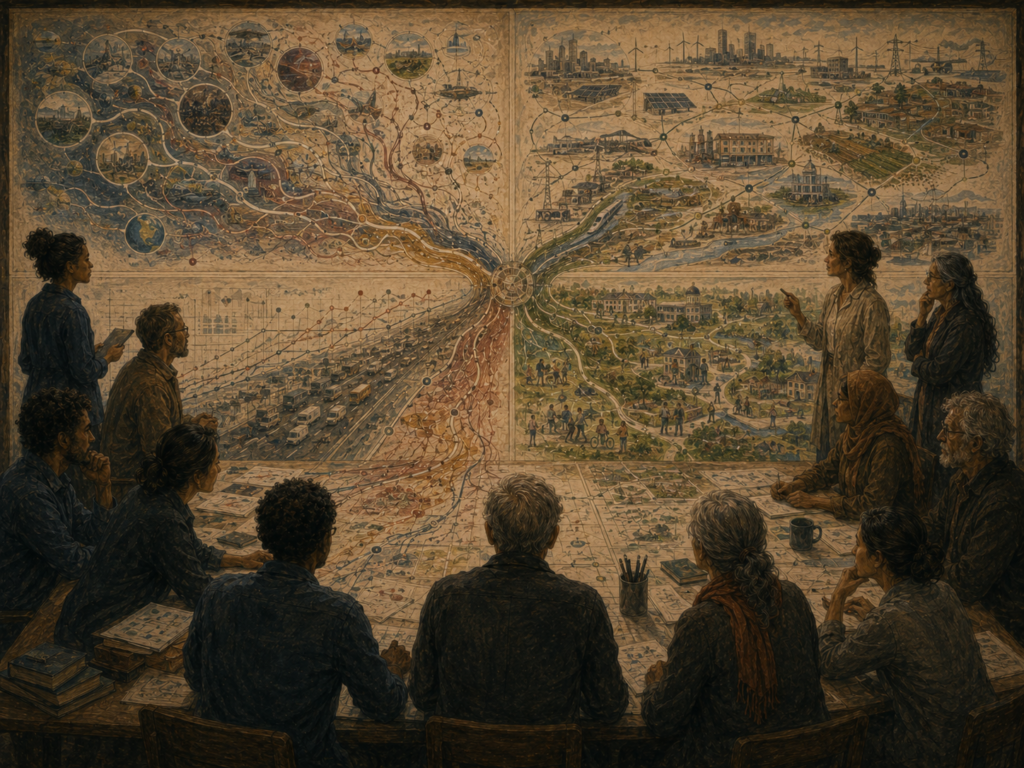
A diverse futures research group compares possible, plausible, probable, and preferable futures across branching social, ecological, and institutional pathways.

Possible, Plausible, Probable, and Preferable Futures

Possible, plausible, probable, and preferable futures are essential distinctions in futures thinking. They help clarify whether a future is being imagined as something that could exist, something that could reasonably emerge, something that appears likely, or something that should be pursued because it reflects ethical, social, ecological, or institutional values. This article explains how these categories strengthen foresight, scenario planning, public policy, sustainability, and strategic decision-making. It shows why possibility should not be confused with likelihood, why probability should not be mistaken for inevitability, and why preferable futures require explicit values, participation, and accountability. By separating imagination, plausibility, probability, and preference, futures thinking gives institutions and communities a more disciplined language for uncertainty, action, risk, transformation, and long-term responsibility in complex systems facing rapid change and contested choices.

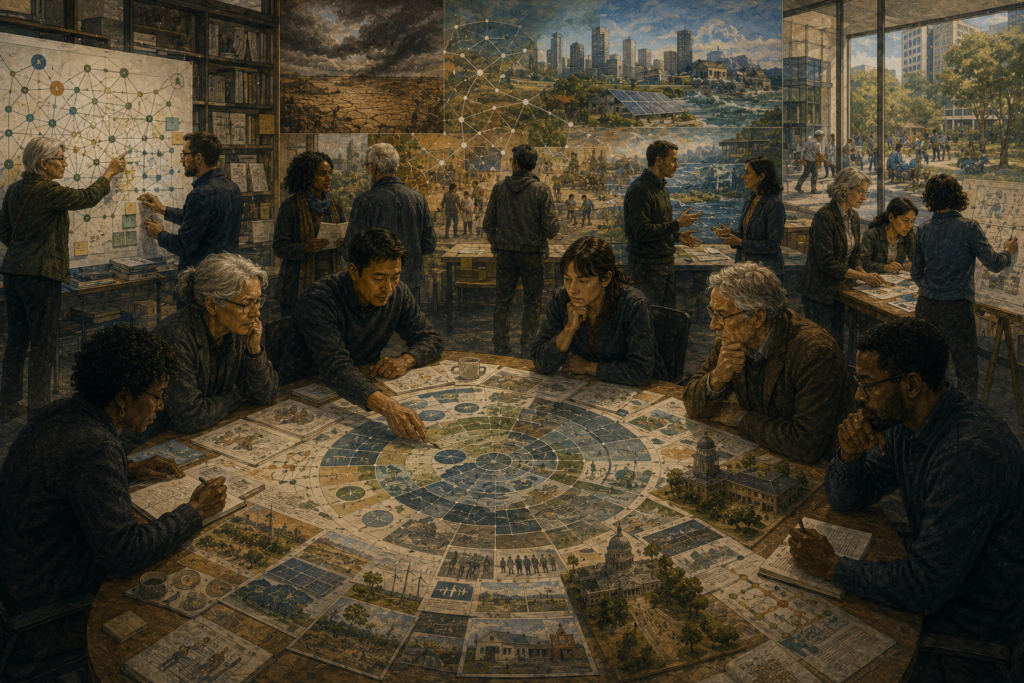
A diverse civic research group studies future signals, community systems, climate risks, and adaptive planning pathways.

Futures Literacy and Anticipatory Capacity: Using the Future to Improve Present Judgment

Futures literacy is the capacity to understand how people, institutions, and societies use ideas about the future to interpret the present and guide action. It is not prediction. It is a disciplined way of examining assumptions, expectations, hopes, fears, scenarios, forecasts, and imagined futures so they can be used more consciously and responsibly. This article explains how futures literacy strengthens anticipatory capacity: the ability to scan for signals, interpret uncertainty, surface hidden assumptions, test strategies, include public voices, and revise decisions as conditions change. It connects futures literacy to education, public participation, anticipatory governance, institutional learning, and long-term responsibility. The article shows why future-oriented work must move beyond expert prediction or inspirational futurism toward a more reflective, participatory, and accountable practice of using the future in present-day judgment across complex social and institutional systems under uncertainty and rapid change.

Researchers compare forecasting data, foresight scenarios, and broader futures studies across social, ecological, and institutional systems.

Forecasting, Foresight, and Futures Studies: Prediction, Scenarios, and Strategic Uncertainty

Forecasting, foresight, and futures studies are related ways of thinking about the future, but they are not interchangeable. Forecasting estimates likely developments from data, trends, and models. Foresight explores plausible futures so institutions can prepare for uncertainty, test assumptions, and strengthen strategic readiness. Futures studies provides the broader scholarly field for examining how futures are imagined, contested, governed, and made possible. This article distinguishes prediction, projection, anticipation, scenario work, and futures literacy, showing why future-oriented work must go beyond a single expected outcome. It explains where forecasting is useful, where it becomes fragile, how foresight supports strategy under deep uncertainty, and why futures studies matters for ethics, power, public participation, and long-term responsibility. The goal is not to abandon prediction, but to place it within a wider discipline of anticipatory judgment.

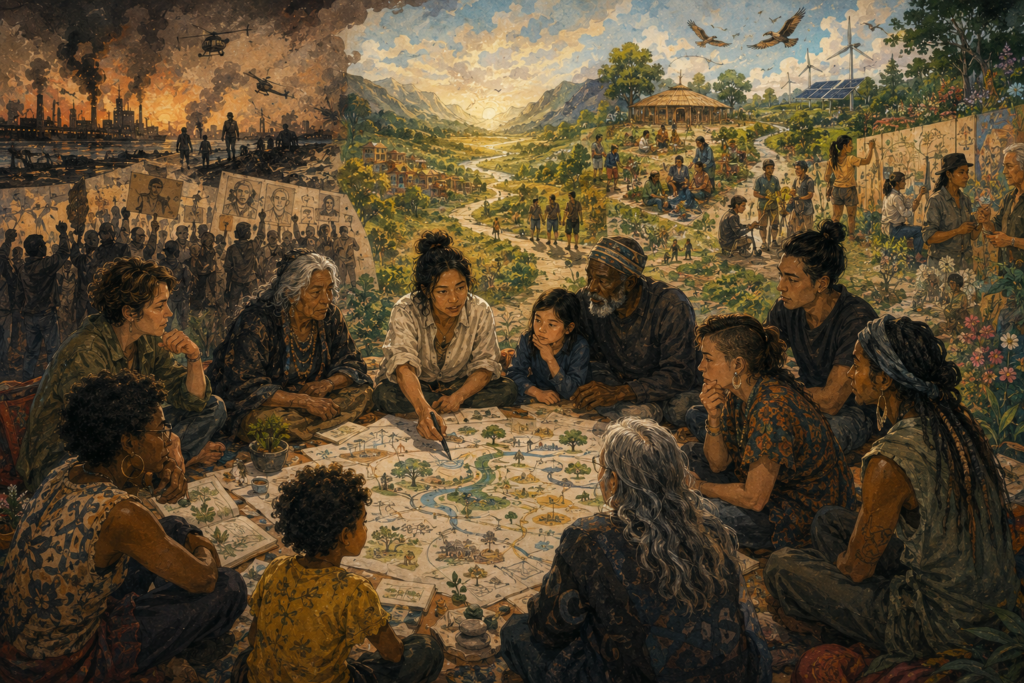
A diverse multigenerational group discusses future pathways amid images of ecological crisis, collective imagination, community repair, and long-term social transformation.

Future Directions in Strategic Foresight: Systems Integration, Decision Architectures, and the Evolution of Long-Term Strategy

Future Directions in Strategic Foresight examines how foresight is moving beyond periodic planning exercises and becoming an integrated component of continuous decision systems. The article argues that in environments shaped by nonlinear change, deep uncertainty, rapid feedback, and global interdependence, strategic foresight must evolve from isolated scenario work into a system-level capability linked to analytics, governance, institutional learning, and adaptive strategy. It explores the role of data, real-time monitoring, AI-assisted decision support, continuous scenario updating, institutionalization, global coordination, and ethical responsibility in shaping the next phase of foresight practice. The article emphasizes that the future of foresight is not prediction in a narrow sense, but the design of institutions capable of sensing change, updating assumptions, and preserving strategic options under uncertainty.

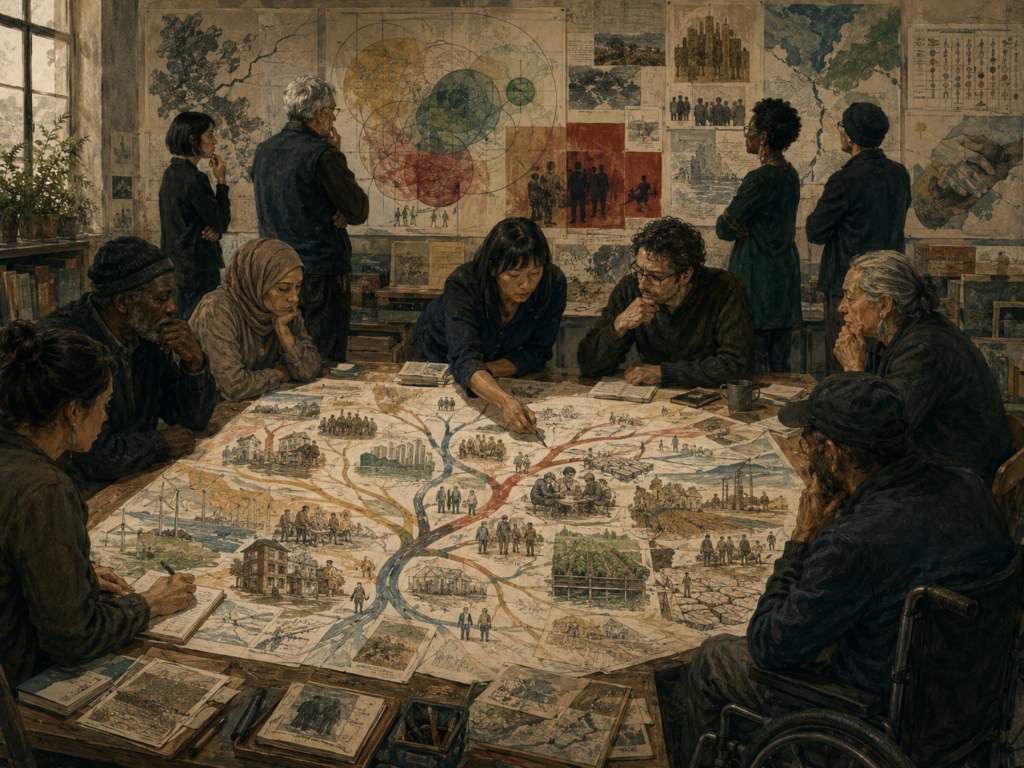
A diverse group examines ethical futures through community maps, justice concerns, ecological risk, public institutions, accessibility, and long-term responsibility.

Ethics of Futures Thinking: Responsibility, Power, and the Moral Boundaries of Anticipating the Future

The Ethics of Futures Thinking examines how anticipation, scenario design, and long-range planning are never value-neutral exercises, but practices that shape whose futures are protected, prioritized, or marginalized. The article argues that futures thinking does not merely describe possible futures; it actively helps produce them through choices about scenarios, risk frames, time horizons, and strategic action. It develops this argument through intergenerational responsibility, power over future narratives, uncertainty, unequal risk distribution, representation, technological governance, accountability, and the moral tradeoffs that emerge when institutions plan under deep uncertainty. The article emphasizes that ethical futures practice requires more than technical sophistication: it requires explicit values, inclusive participation, institutional accountability, and attention to justice across time.

Researchers model complex system scenarios across climate risks, infrastructure, communities, energy, ecology, and governance.

Scenario Modeling for Complex Systems: Structure, Uncertainty, and the Exploration of Alternative Futures

Scenario Modeling for Complex Systems examines how organizations and analysts can explore multiple plausible futures when linear forecasting breaks down under deep uncertainty, interdependence, and nonlinear change. The article argues that scenario modeling is not a tool for prediction, but a structured method for mapping the space of possible futures and designing decisions that remain viable across them. It develops this through the foundations of scenario work, the dynamics of complex systems, deep uncertainty, system structure, quantitative simulation, qualitative narrative logic, cross-system interdependence, and the relationship between scenario design, robustness, and resilience. The article also emphasizes the limits of models, the risks of false precision, and the need to treat scenario construction as disciplined exploration rather than speculative storytelling.

Researchers and institutional leaders study long-term adaptation across climate risk, governance, infrastructure, public services, and community resilience.

Institutional Adaptation to Long-Term Change: Governance, Learning Systems, and the Limits of Structural Transformation

Institutional Adaptation to Long-Term Change examines how governments, organizations, and governance systems respond to structural change under uncertainty, path dependency, and inherited constraint. The article argues that institutions are typically built for stability, coordination, and predictability, yet those same strengths often become barriers when technological, environmental, social, or geopolitical conditions shift. It develops this tension through path dependency, institutional inertia, feedback systems, learning, adaptive capacity, governance coordination, crisis-driven change, technological lag, and the difficulty of aligning institutions across global systems. The article emphasizes that institutional adaptation is not a one-time reform event but an ongoing process of learning under uncertainty, shaped by power, incentives, and the internal ability of institutions to revise their own rules.

Scroll to Top