Futures Thinking

Futures thinking explores structured methods for analyzing long-term uncertainty and anticipating potential transformations in technological, economic, and social systems. Rather than attempting to predict a single future, futures thinking investigates multiple plausible futures to help organizations prepare for emerging risks and opportunities.

The field includes a range of foresight methodologies, including scenario planning, horizon scanning, trend analysis, and strategic foresight modeling. These tools help decision-makers identify early signals of change and explore how current decisions may shape long-term outcomes.

Futures thinking plays an important role in strategic planning, innovation management, public policy development, and sustainability research. Many global challenges—including climate change, demographic transitions, and technological disruption—unfold over decades and require institutions to plan beyond short-term horizons.

By expanding the temporal scope of decision-making, futures thinking enables organizations to develop strategies that remain robust across a range of possible futures.

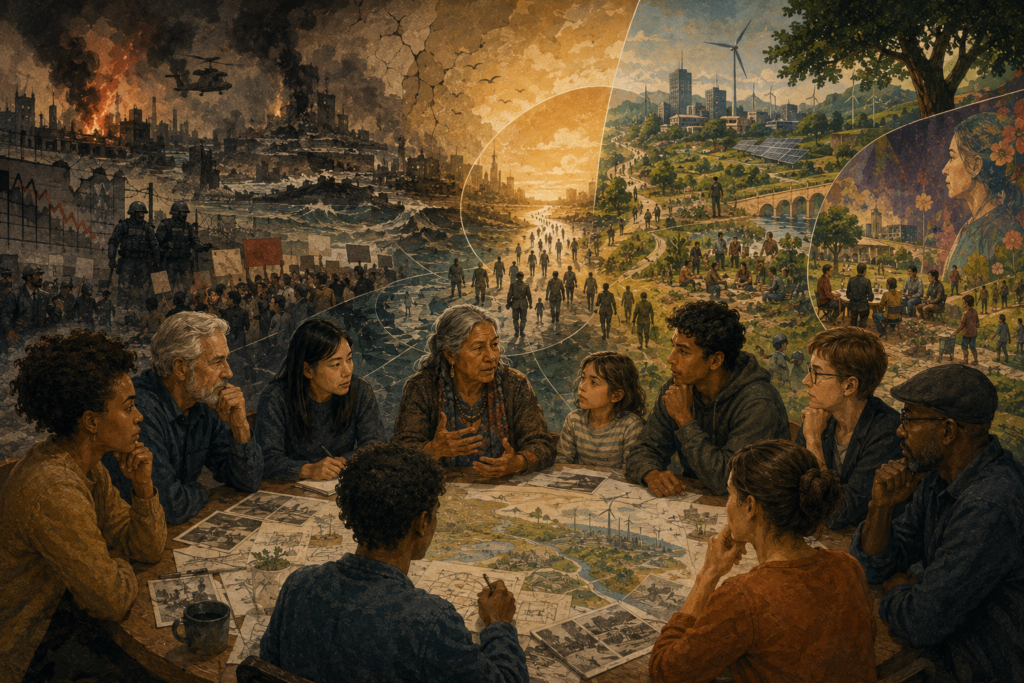
A multigenerational group discusses contested futures amid images of crisis, fear, ecological renewal, public imagination, and collective responsibility.

Hope, Dread, and the Politics of the Future: Disciplined Hope, Climate Anxiety, Collapse Narratives, and Democratic Imagination

Hope, dread, and the politics of the future examine how societies emotionally and politically relate to uncertainty, danger, and possibility. Futures thinking is never only analytical: people encounter the future through climate anxiety, ecological grief, democratic fear, technological promise, collapse narratives, exhaustion, faith, anger, and disciplined hope. This article explores how hope can sustain agency, solidarity, repair, and democratic imagination, while also becoming false reassurance, branding, or techno-solutionism. It also examines how dread can warn societies about real danger, but may become paralysis, authoritarian fear, scapegoating, or fatalism when disconnected from agency and trust. The central argument is that responsible futures work must tell the truth about risk while preserving credible pathways for action. Hope is not a mood or marketing device; it is a public responsibility grounded in evidence, institutions, repair, participation, collective courage, care, and democratic accountability.
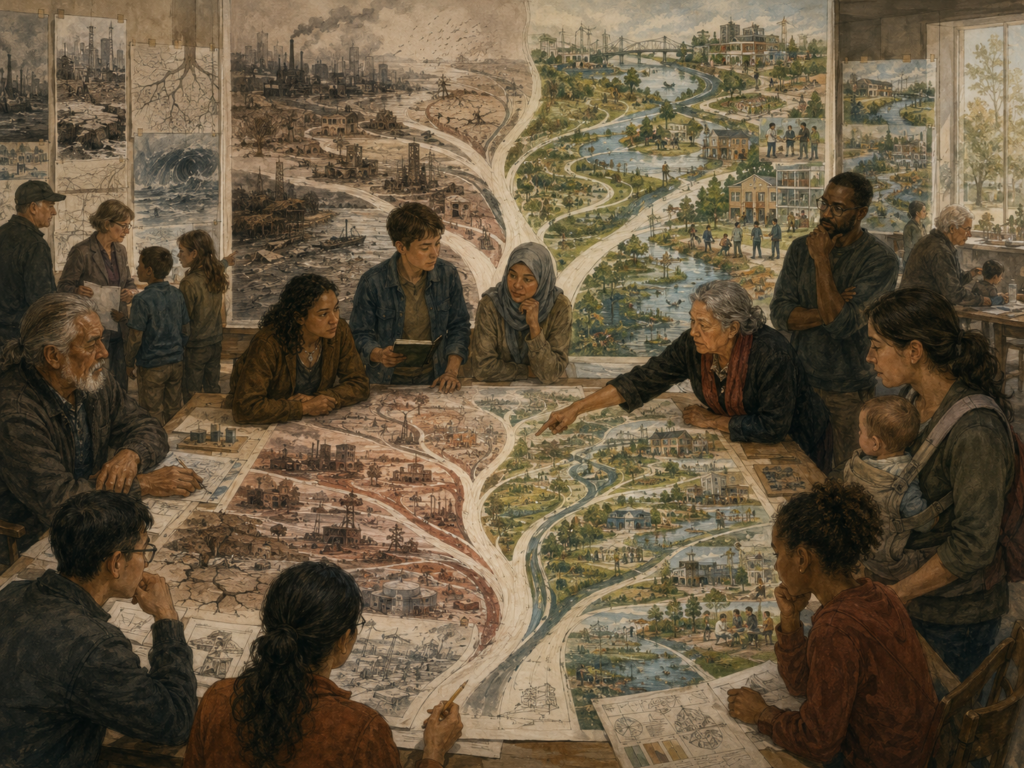
A multigenerational group examines future pathways across ecological restoration, industrial decline, public institutions, children, communities, and long-term responsibility.

Future Generations and Long-Term Responsibility: Intergenerational Justice, Stewardship, Climate, Technology, and Repair

Future generations and long-term responsibility examine how present decisions shape people who cannot yet vote, testify, organize, inherit, consent, or refuse. Climate policy, infrastructure, public debt, AI governance, biodiversity, education, health systems, housing, and public institutions all create conditions that future people must live inside. This article explores intergenerational justice, short-termism, ecological inheritance, technological lock-in, youth participation, Indigenous temporalities, reparative responsibility, precaution, reversibility, and adaptive governance. It argues that future responsibility cannot be separated from present justice: unresolved colonial harm, racial inequality, climate vulnerability, disability exclusion, poverty, and ecological damage become inherited burdens. The central question is how societies can govern as trustees rather than owners of the future, leaving future generations not only fewer harms, but stronger institutions, livable ecosystems, public capacity, democratic voice, and genuine freedom to repair and choose across uncertain decades of shared planetary life.

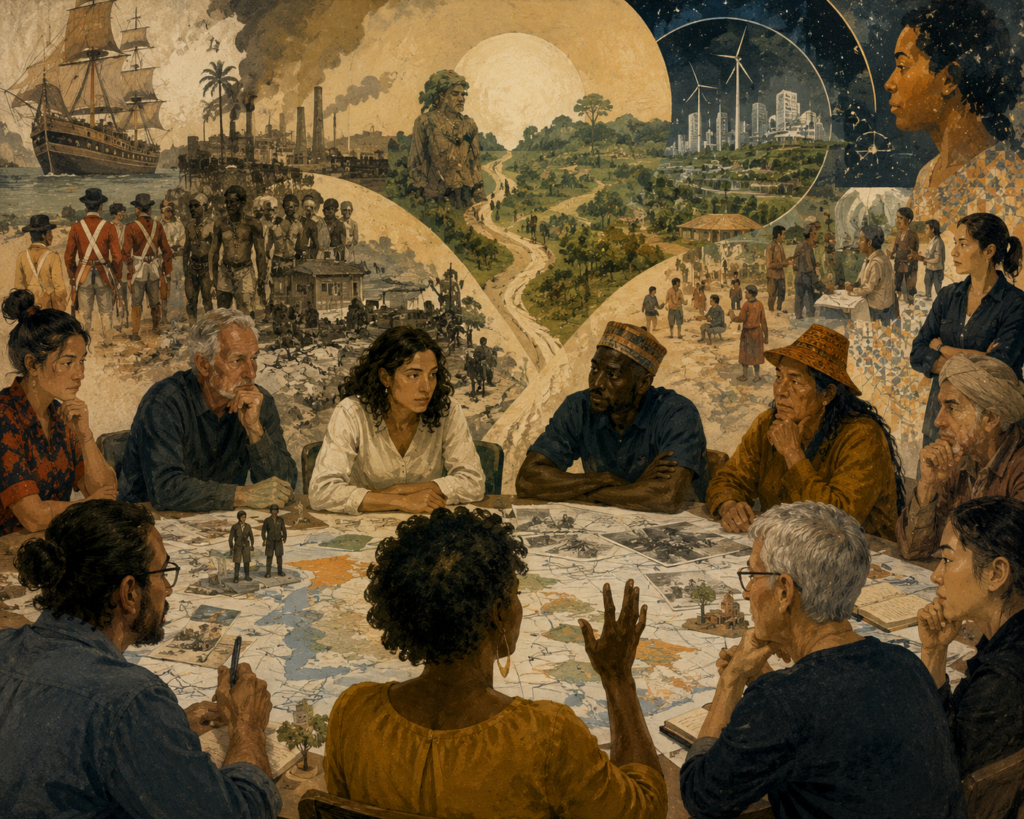
A diverse group examines colonial histories, contested futures, extraction, community self-determination, and alternative pathways of repair.

Colonial Futures and Contested Imagination: Power, Extraction, Repair, and the Politics of Future-Making

Colonial futures and contested imagination examine how power shapes what societies are allowed to imagine, plan, fund, and call realistic. Futures thinking is never detached from history: colonialism, extraction, land dispossession, racial hierarchy, border regimes, epistemic domination, and environmental sacrifice continue to shape which futures are treated as plausible and whose visions are dismissed. This article explores how development, climate transition, conservation, AI, data systems, infrastructure, migration, security planning, and resource extraction can reproduce colonial relations through modern language. It also examines reparative futures grounded in sovereignty, consent, land return, epistemic justice, community authority, ecological restoration, and structural repair. The central argument is that future-making must be contested, democratized, and historically accountable. A just future is not simply cleaner, smarter, or more resilient; it must change who has power to imagine, decide, refuse, repair, and belong across generations too.

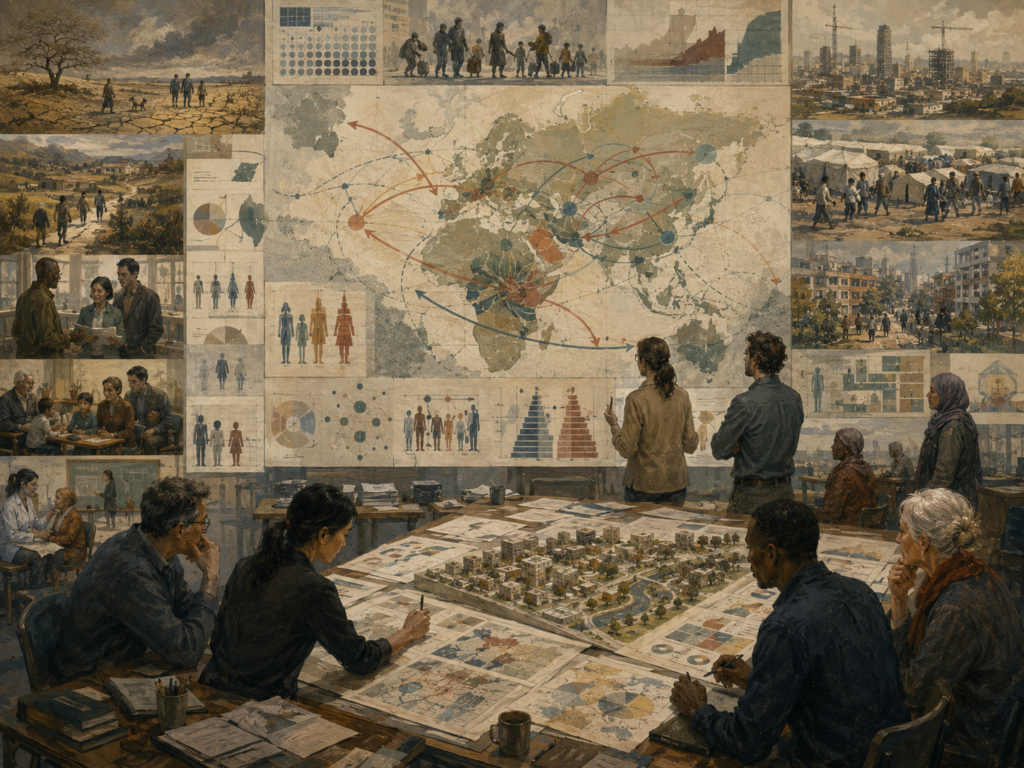
Researchers study migration, demographic change, settlement patterns, climate stress, public services, and future societies across a global systems map.

Migration, Demography, and Future Societies: Aging, Mobility, Climate Displacement, Care, Labor, and Belonging

Migration, demography, and future societies examine how population change, mobility, aging, youth cohorts, urbanization, fertility, labor markets, climate displacement, care systems, housing, public health, citizenship, and belonging will shape the decades ahead. Demography is often reduced to numbers, but population change becomes politically meaningful through institutions, inequality, gender, borders, work, family, and public narratives about who belongs. This article explores aging societies, youth opportunity, rights-based migration, climate mobility, care economies, diaspora life, urban absorption, reproductive freedom, and demographic fear politics. It argues that demography is not destiny: societies can turn population change into renewal when they invest in care, housing, health, labor dignity, gender equality, legal mobility, social cohesion, and humane governance. The central question is not only how populations change, but whether future societies remain livable, inclusive, and just for everyone across generations, borders, cities, households, and institutions.

A foresight group examines hybrid security risks across infrastructure, climate stress, migration, energy systems, cyber networks, and geopolitical instability.

Security Futures and Hybrid Risk: Cyber Systems, Infrastructure, Climate Stress, Information Warfare, and Resilience

Security futures and hybrid risk examine how conflict, cyber operations, infrastructure vulnerability, information warfare, climate stress, migration pressure, economic coercion, autonomous systems, and public trust may reshape security in the decades ahead. Security can no longer be understood only through armies, borders, weapons, alliances, and formal war. Many future threats will move through hospitals, energy grids, water systems, logistics corridors, financial networks, satellites, digital platforms, food systems, and public institutions. This article explores how gray-zone conflict, cyber-physical cascade, disinformation, resource pressure, climate-security shocks, AI-enabled escalation, and organized crime interact across civilian and strategic systems. It argues that resilience, legitimacy, civilian protection, public communication, infrastructure redundancy, and adaptive learning are not soft additions to security. They are core capabilities for societies facing hybrid disruption and compound uncertainty across fragile interdependent public systems and strategic infrastructures in an unstable century ahead.

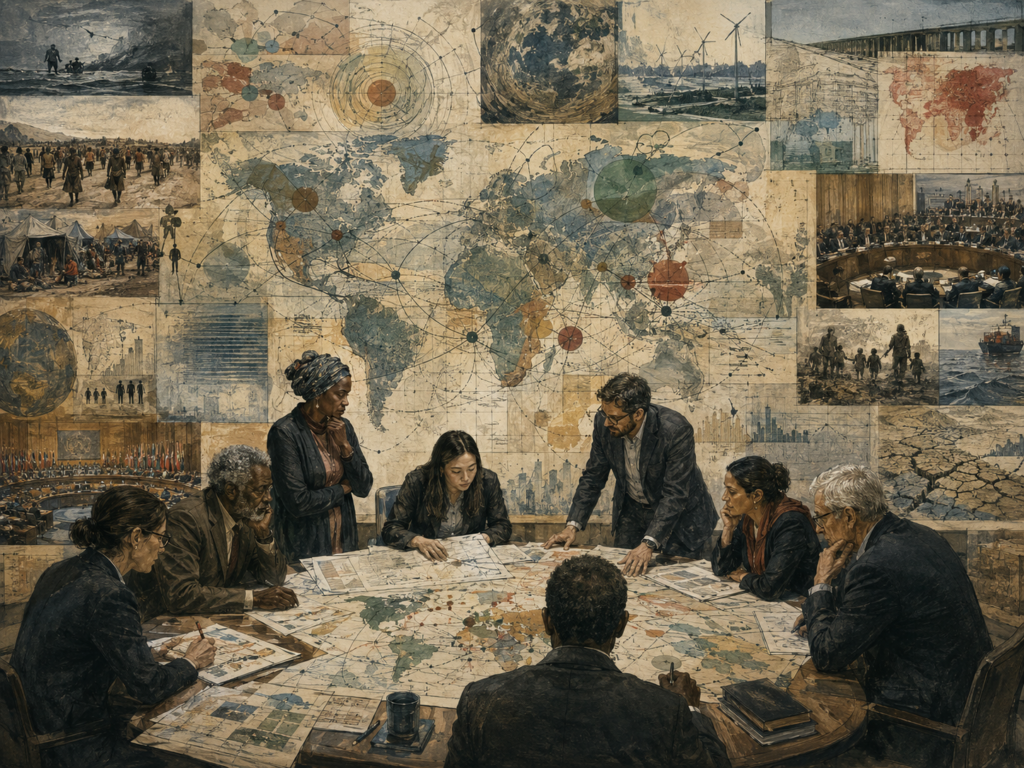
A diverse policy group examines global governance futures across world maps, institutions, climate risk, migration, trade, conflict, and shared public systems.

Global Governance Futures: Institutions, Law, Climate, Technology, Finance, and Planetary Risk

Global governance futures examine how societies coordinate law, institutions, finance, science, public health, climate action, technology governance, migration protection, development, and security in a world where major risks cross borders but authority remains fragmented. Climate change, pandemics, AI, cyber vulnerability, debt distress, food insecurity, conflict, biodiversity loss, and displacement cannot be managed by isolated national action alone. This article explores how multilateral institutions, international law, regional systems, civil society, scientific bodies, development finance, private platforms, and public accountability may evolve under uncertainty. It argues that effective global governance requires more than coordination. It requires legitimacy, representation, fair burden sharing, enforceable commitments, adaptive learning, and protection for those most affected by global decisions. The future choice is not sovereignty versus cooperation, but accountable cooperation versus unmanaged interdependence across an unstable century where power, survival, dignity, and justice are increasingly intertwined.

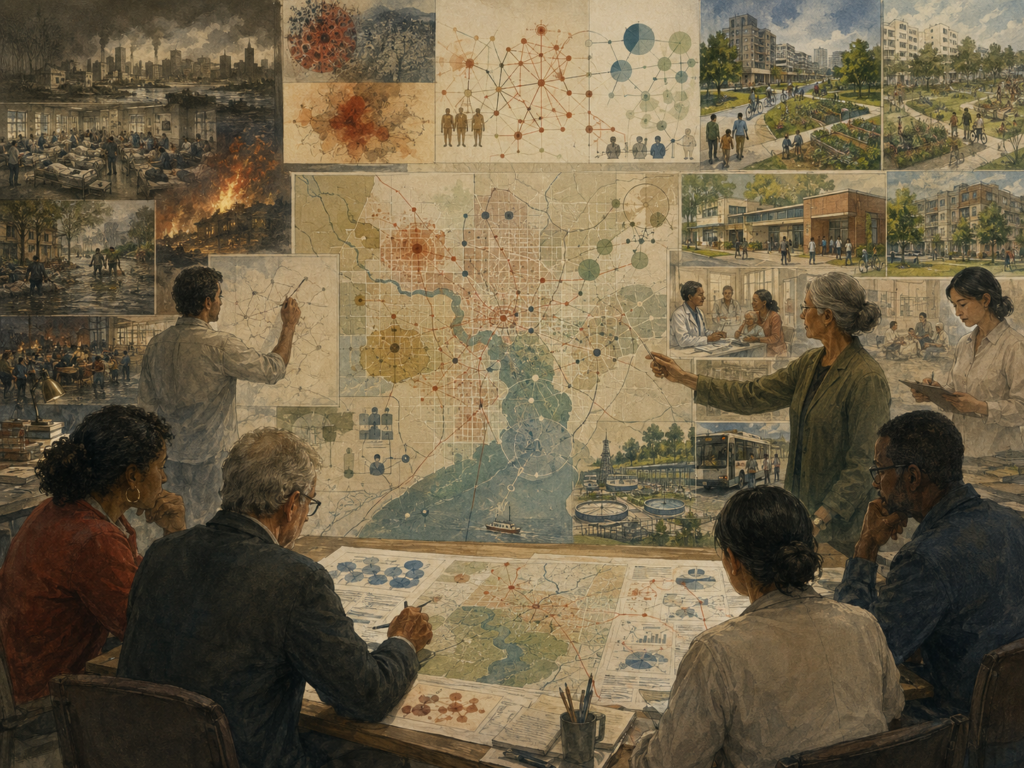
Public health researchers and civic planners examine future health systems across hospitals, housing, climate risk, transit, communities, and public infrastructure.

Health Futures and Public Systems: Public Health, Climate Risk, Care, Technology, and Equity

Health futures and public systems examine how societies can protect life, prevent disease, organize care, and sustain public health capacity under demographic change, climate stress, technological transformation, biological uncertainty, and unequal power. Health is not produced by medicine alone. It is shaped by housing, water, food, labor, sanitation, air quality, income, care infrastructure, public finance, environmental protection, social trust, and institutional design. This article examines population health, social determinants, public health infrastructure, climate health risk, pandemic preparedness, aging, chronic disease, mental health, antimicrobial resistance, biotechnology, AI, workforce resilience, care systems, health equity, and public legitimacy. It argues that healthy futures require prevention, accessible care, strong public systems, trustworthy institutions, ethical technology governance, environmental protection, and justice-centered planning that reduces preventable harm before crisis makes repair more costly and less humane.

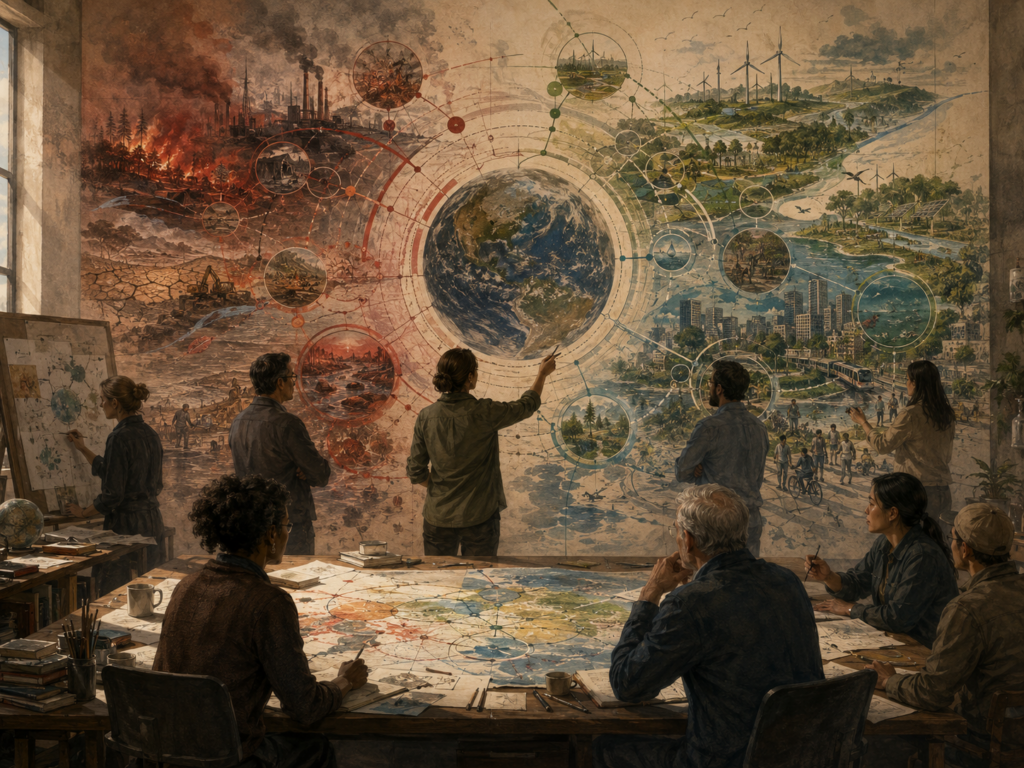
Researchers examine planetary boundaries and future pathways across climate stress, ecological degradation, renewable systems, cities, agriculture, and restored landscapes.

Planetary Boundaries and Future Pathways: Safe Operating Space, Earth-System Risk, and Just Transition

Planetary boundaries and future pathways examine whether human development can remain within the ecological conditions that make stable civilization, public health, food security, water security, and long-term wellbeing possible. The planetary-boundaries framework reframes sustainability as an Earth-system question, asking how climate change, biosphere integrity, land-system change, freshwater stress, nutrient loading, ocean acidification, atmospheric aerosols, novel entities, and ozone protection interact as guardrails for a viable future. This article connects those boundaries to practical pathway choices: energy transition, food systems, land governance, circular materials, infrastructure, social foundations, justice, public finance, and global cooperation. It argues that future pathways must reduce ecological pressure while protecting human dignity, rights, livelihoods, and democratic legitimacy. A safe future is not only low-carbon. It is regenerative, resilient, just, scientifically grounded, and institutionally capable across generations, before thresholds close off humane and publicly accountable future options.

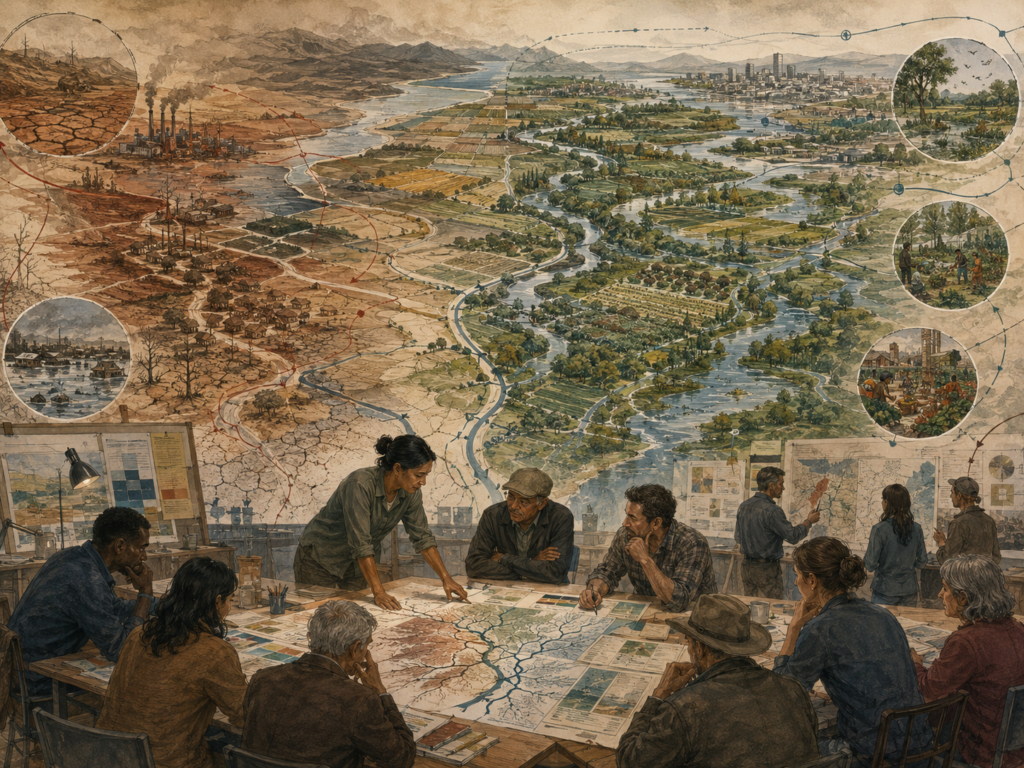
A planning group studies food, water, and land-use futures across drought, agriculture, watersheds, cities, ecological restoration, and community resilience.

Food, Water, and Land-Use Futures: Climate, Food Security, Water Stress, and Land Governance

Food, water, and land-use futures examine how societies can feed populations, govern freshwater systems, protect soils, steward ecosystems, and adapt to climate stress under deep uncertainty. These systems cannot be managed separately. Food production depends on water, soil, biodiversity, labor, energy, markets, infrastructure, and governance. Water security depends on watersheds, land cover, climate, pollution control, institutions, and rights. Land use shapes agriculture, cities, forests, carbon storage, biodiversity, migration, and conflict. This article examines food, water, and land as coupled social-ecological systems, emphasizing climate risk, groundwater depletion, soil health, supply-chain fragility, agricultural transition, land tenure, Indigenous and community rights, and justice-centered adaptation. It argues that resilient futures require ecological regeneration, public accountability, secure rights, adaptive governance, and systems thinking that links production, access, livelihoods, and long-term planetary limits together.

Scroll to Top