
Last Updated June 2, 2026
Possible, plausible, probable, and preferable futures are four of the most important distinctions in futures thinking. They help clarify whether a future is being imagined as something that could exist in principle, something that could reasonably emerge from known conditions, something that appears likely under current evidence, or something that should be pursued because it reflects ethical, social, ecological, political, or institutional values.
These distinctions matter because many arguments about the future fail before they begin. One person speaks about what is possible. Another responds as if the claim were a prediction. A planner presents a probability estimate. A community asks whether that future is desirable. A company promotes a preferred technological future. A public agency treats it as plausible without examining who benefits, who bears risk, or what assumptions are hidden beneath it. The result is confusion: possibility is mistaken for likelihood, probability is mistaken for inevitability, and preference is mistaken for neutrality.
Futures thinking becomes stronger when these categories are kept distinct. A possible future expands imagination. A plausible future disciplines imagination with evidence, drivers, constraints, and system logic. A probable future estimates what appears likely under current assumptions. A preferable future asks what ought to be pursued, avoided, protected, transformed, or made possible. Together, these categories give institutions and communities a more careful language for reasoning under uncertainty.
Main Library
Publications
Article Map
Futures Thinking
Related Topic
Systems Modeling
Related Topic
Resilience Thinking
Related Topic
Sustainable Development
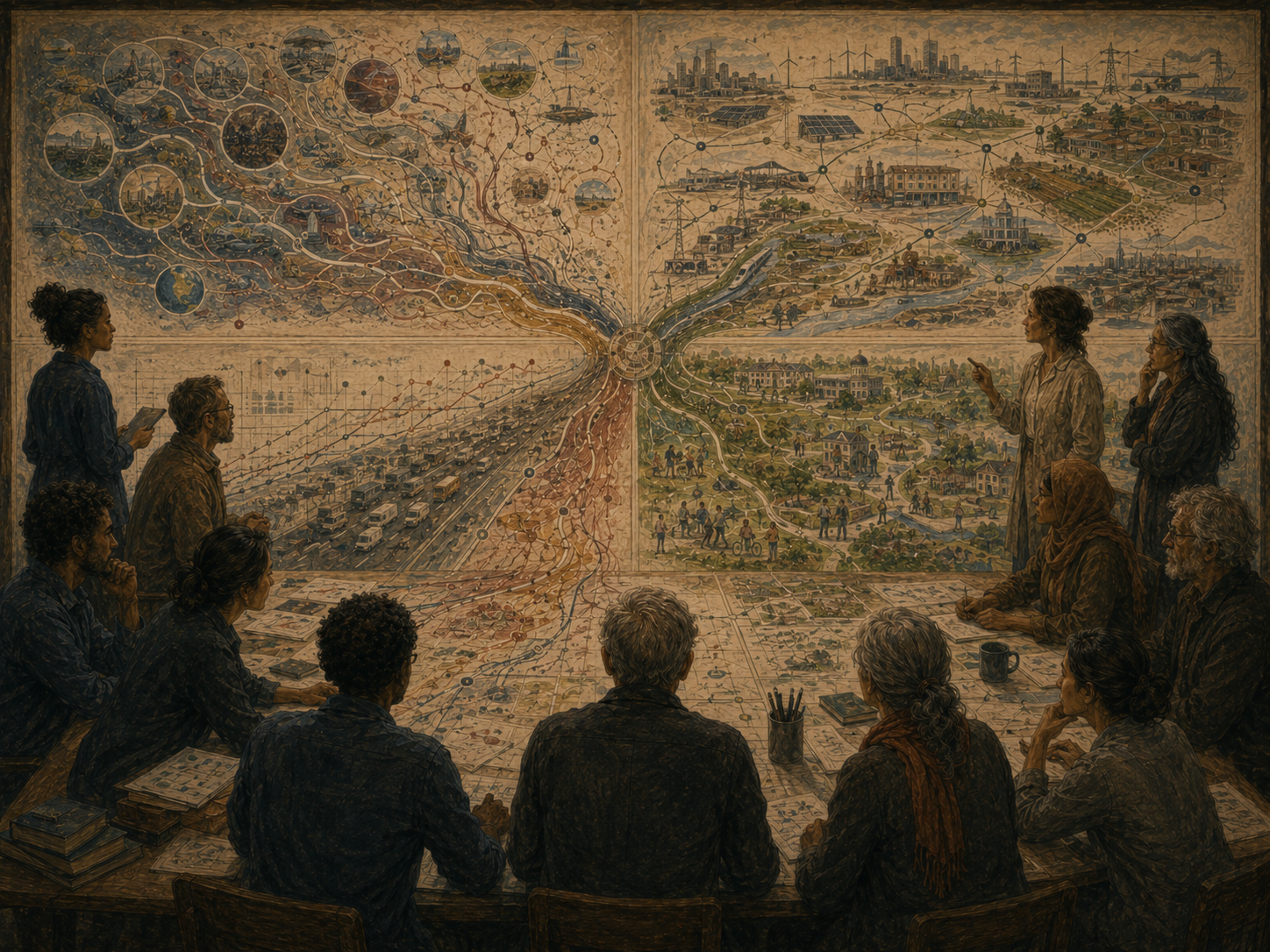
The purpose of this article is to distinguish these four categories and show how they are used in serious foresight, policy, strategy, sustainability, education, and public decision-making. The goal is not to create rigid boxes. It is to make future-oriented reasoning more transparent, disciplined, and accountable.
Why These Distinctions Matter
Possible, plausible, probable, and preferable futures matter because future-oriented decisions often fail when different kinds of future claims are collapsed into one another. A future can be imaginable but not plausible. It can be plausible but not probable. It can be probable but deeply undesirable. It can be preferable but institutionally difficult, politically contested, ecologically constrained, or currently unlikely. Each category answers a different question.
For example, it is possible to imagine a city with fully decarbonized transport, affordable housing, restored wetlands, low heat mortality, strong public participation, and resilient infrastructure. Whether that future is plausible depends on land use, finance, governance, technology, public trust, ecological conditions, political coalitions, and institutional capacity. Whether it is probable depends on current trends and policies. Whether it is preferable depends on ethical judgment, public values, distributional consequences, and the people affected by the transition.
Without these distinctions, strategy becomes confused. Institutions may dismiss preferable futures because they are not currently probable. They may overinvest in probable futures even when those futures are unjust or fragile. They may promote possible futures as if possibility itself were evidence. They may treat plausible scenarios as predictions. They may confuse what markets expect with what societies should pursue.
These distinctions are especially important under uncertainty. In stable conditions, forecasting may provide useful estimates. In complex systems, however, uncertainty, feedback, discontinuity, political conflict, ecological thresholds, and technological change can make a single expected pathway dangerously narrow. Futures thinking widens the analytical frame without abandoning discipline.
| Category | Primary Question | Strategic Function | Common Mistake |
|---|---|---|---|
| Possible futures | What could exist in principle? | Expands imagination and reveals alternatives. | Treating all imagined futures as equally relevant. |
| Plausible futures | What could reasonably emerge from known forces and uncertainties? | Supports scenario planning and strategic preparedness. | Treating scenarios as predictions. |
| Probable futures | What appears likely under current evidence and assumptions? | Supports forecasting, planning, and resource allocation. | Treating likelihood as inevitability or desirability. |
| Preferable futures | What future should be pursued or protected? | Supports visioning, ethics, public deliberation, and backcasting. | Treating preferred futures as neutral or universally shared. |
Futures thinking becomes more rigorous when people can say exactly which kind of future they are discussing.
Core Categories of Future Thinking
Possible, plausible, probable, and preferable futures are not merely vocabulary. They are analytical categories that structure how institutions reason about uncertainty, evidence, imagination, and values. Each category has a distinct role in futures work.
1. Possible Futures
Possible futures refer to futures that could exist in principle. They stretch imagination beyond current expectations and help people recognize that the future is not a single predetermined path. Possible futures are especially useful when dominant assumptions have become too narrow or when institutions need to escape inherited mental models.
2. Plausible Futures
Plausible futures are futures that could reasonably emerge from known drivers, constraints, uncertainties, system dynamics, institutional choices, and historical conditions. They are more disciplined than mere possibility. Plausibility asks whether a future has a credible pathway, not whether it is the most likely outcome.
3. Probable Futures
Probable futures are futures that appear likely under current evidence, trends, models, and assumptions. They are important for forecasting, budgeting, operational planning, and near-term resource allocation. But probability is conditional. It depends on what evidence is available, what assumptions are used, and whether system conditions remain stable.
4. Preferable Futures
Preferable futures are futures that people, communities, institutions, or societies judge to be desirable, just, sustainable, safe, meaningful, or worth pursuing. They are not simply fantasies. They can be disciplined through values, public deliberation, ethical analysis, feasibility assessment, and backcasting.
5. Robust Futures
Although not always included in the classic four-part distinction, robust futures are strategically important. A robust future-oriented strategy is one that remains useful across several plausible futures, even if no single future can be known in advance. Robustness shifts attention from prediction accuracy to preparedness and adaptability.
6. Contested Futures
Many futures are contested because people disagree about what is plausible, probable, or preferable. A future that appears desirable to one group may appear threatening to another. Serious futures thinking must therefore examine power, participation, evidence, and values rather than treating future categories as purely technical classifications.
| Future Category | Evidence Standard | Methodological Use | Ethical Question |
|---|---|---|---|
| Possible | Imaginable within broad constraints. | Creative exploration, horizon expansion, reframing. | What alternatives are being excluded? |
| Plausible | Credible pathway from drivers and uncertainties. | Scenario planning, cross-impact analysis, strategic foresight. | Who defines what counts as credible? |
| Probable | Supported by current evidence, models, and trends. | Forecasting, operational planning, resource allocation. | What harms may follow if the likely future is accepted passively? |
| Preferable | Supported by values, goals, ethics, and public judgment. | Visioning, backcasting, transformation strategy. | Whose preferred future is being prioritized? |
| Robust | Performs acceptably across multiple plausible futures. | Strategy testing, resilience planning, adaptive pathways. | Who is protected across futures, and who remains exposed? |
| Contested | Subject to disagreement over evidence, values, or legitimacy. | Public deliberation, participatory foresight, futures literacy. | Who has authority to imagine and decide? |
These categories overlap in practice, but distinguishing them prevents future-oriented work from sliding into confusion, hype, fatalism, or wishful thinking.
Possible Futures
Possible futures are the widest category. They include futures that could exist in principle, even if they are not currently likely or institutionally prepared for. The purpose of possible futures is to expand imagination. They interrupt the assumption that the future will simply continue from the present along familiar lines.
Possibility matters because institutions often become trapped in inherited expectations. A school system assumes education will remain organized around age cohorts, classrooms, standardized assessment, and credentials. A city assumes commuting patterns will resemble the past. A company assumes consumer behavior will continue to track familiar demographics. A government assumes institutional legitimacy will remain stable. A possible-futures exercise asks what else could exist.
Possible futures are not all equally useful. Some are too vague, too fantastical, too disconnected from material conditions, or too broad to guide strategy. But disciplined possibility is essential because present systems often define realism too narrowly. Many futures that later become ordinary were once treated as unlikely, impractical, or outside the dominant imagination.
Possible futures are especially important for marginalized communities and future generations. Dominant institutions often treat existing arrangements as natural. Possible futures help make visible alternatives that have been suppressed, dismissed, or excluded from official planning: community-owned infrastructure, restorative land governance, cooperative economic models, abolition of harmful systems, climate reparations, universal basic services, Indigenous stewardship, or public technology governance.
| Use of Possible Futures | Purpose | Example |
|---|---|---|
| Imagination expansion | Break narrow assumptions about what can exist. | Imagining cities designed around care, heat safety, and ecological restoration rather than car dependency. |
| Critical reframing | Question what dominant institutions call realistic. | Asking whether current housing markets are inevitable or politically constructed. |
| Innovation exploration | Open design space before selecting pathways. | Exploring alternative education futures beyond conventional credential systems. |
| Justice imagination | Recover futures excluded by unequal power. | Considering community-controlled energy, land, or data governance. |
| Long-range creativity | Explore possibilities beyond current constraints. | Imagining future public institutions built around intergenerational accountability. |
The danger of possible futures is that they can become ungrounded. Possibility alone does not establish credibility, likelihood, or desirability. It opens the field, but it does not complete the work. A possible future must be examined further: Is it plausible? Is it probable? Is it preferable? What pathway could lead to it? What harms might it produce? Who would benefit?
Possible futures widen imagination, but disciplined futures thinking must then ask what kind of possibility is being imagined and why.
Plausible Futures
Plausible futures are futures that could reasonably emerge from known drivers, uncertainties, constraints, and system dynamics. Plausibility is narrower than possibility but broader than probability. A plausible future does not have to be the most likely future. It must have a credible pathway.
This makes plausibility central to scenario planning. Scenarios are not predictions. They are structured accounts of plausible future contexts. A good scenario asks how different combinations of drivers and uncertainties could produce distinct conditions. For example, one climate future may involve strong international coordination and uneven local implementation. Another may involve rapid technological mitigation but weak adaptation. A third may involve political fragmentation, infrastructure failure, and high inequality. Each could be plausible if grounded in credible forces and pathways.
Plausibility requires discipline. It depends on evidence, history, expert judgment, system logic, and constraints. A plausible future should be internally coherent. Its assumptions should be visible. Its causal pathway should make sense. Its relationship to known drivers should be explainable.
At the same time, plausibility is not purely technical. Institutions often define plausibility through their own assumptions. What seems plausible to a finance ministry may differ from what seems plausible to a climate scientist, labor organizer, Indigenous community, youth assembly, public-health worker, or infrastructure engineer. Plausibility can be expanded or narrowed by power, culture, professional training, ideology, and lived experience.
| Criterion | Question for Plausibility | Weak Scenario Warning |
|---|---|---|
| Driver grounding | Which forces could push the system toward this future? | The scenario is based on arbitrary imagination. |
| Pathway logic | How could this future emerge over time? | The scenario jumps from today to a future state without explanation. |
| Internal coherence | Do the parts of the scenario fit together? | The scenario combines incompatible assumptions. |
| System interaction | How do social, technological, ecological, economic, and political forces interact? | The scenario treats each domain as isolated. |
| Stakeholder credibility | Would different knowledge holders recognize the pathway as credible? | The scenario reflects only one institutional viewpoint. |
| Strategic relevance | Does the scenario challenge real decisions? | The scenario is interesting but not useful. |
Plausible futures are valuable because they prepare institutions for conditions that may not be probable but would be consequential if they occurred. They help decision-makers avoid overfitting strategy to a single expected pathway. They also expose assumptions by asking what would need to be true for a given future to emerge.
Plausibility is the bridge between imagination and strategic discipline.
Probable Futures
Probable futures are futures that appear likely under current evidence, trends, models, and assumptions. They are important because institutions must make practical decisions. Budgets, staffing, infrastructure, energy demand, public services, supply chains, health systems, and education planning all require estimates about what is likely to happen.
Forecasting belongs primarily to the domain of probable futures. A forecast estimates future values or conditions based on data, models, and assumptions. A demographic projection estimates population change under fertility, mortality, and migration assumptions. An energy forecast estimates demand under economic, technological, behavioral, and policy assumptions. A public-health forecast estimates disease burden under epidemiological assumptions.
Probable futures are useful, but they are conditional. They depend on the stability of the system, the quality of the data, the validity of the model, and the assumptions used. When systems are stable and time horizons are short, probability estimates can be highly useful. When systems are complex, unstable, nonlinear, politically contested, or exposed to structural change, probability becomes more fragile.
There is also a deeper risk: probable futures can become self-confirming. If an institution believes a future is likely, it may invest in that future, making alternatives harder. A market forecast can shape investment. A policing forecast can shape surveillance. A climate forecast can shape adaptation priorities. A labor-market forecast can shape education funding. Probable futures are not passive descriptions. They can influence the systems they describe.
| Strength of Probable Futures | Strategic Use | Risk |
|---|---|---|
| Quantification | Supports budgeting, planning, and resource allocation. | Numerical outputs may imply more certainty than exists. |
| Operational usefulness | Helps institutions prepare for near-term expected conditions. | Near-term optimization can weaken long-term adaptability. |
| Model testing | Forecasts can be compared with observed outcomes. | Past accuracy may not survive structural change. |
| Evidence discipline | Requires data, assumptions, and transparent methods. | Excluded variables can reproduce blind spots. |
| Planning coordination | Creates shared expectations for action. | Shared expectations can become institutional lock-in. |
Probable futures should therefore be treated with respect but not submission. They are essential for planning, but they should be tested against plausible alternatives and evaluated against preferable futures. A probable future may be useful to estimate, but it may also be unjust, fragile, unsustainable, or politically unacceptable.
Probability is not destiny. It is a conditional estimate that must be interpreted alongside uncertainty, values, and strategic choice.
Preferable Futures
Preferable futures are futures that people judge to be desirable, ethical, sustainable, just, safe, meaningful, or worth pursuing. They are not defined only by likelihood. They are defined by value. A preferable future asks what should happen, not merely what could happen or what is likely to happen.
Preferable futures are central to public policy, sustainability, education, governance, urban planning, design, climate transition, public health, human rights, and institutional reform. They allow people to ask what kind of society is worth building. Should future cities prioritize ecological restoration, affordable housing, public transit, disability access, heat safety, and care infrastructure? Should technology futures prioritize efficiency, profit, public accountability, worker dignity, privacy, or democratic control? Should climate futures prioritize adaptation for the wealthy or protection for those most exposed?
Preferable futures are necessary because probability alone can reproduce the status quo. If present trends are unjust, then the probable future may be unjust. If current institutions are ecologically destructive, then the probable future may deepen ecological harm. If existing systems exclude marginalized communities, then a future based only on current trajectories may extend that exclusion. Preferable futures allow societies to ask how current trajectories should be changed.
But preferable futures also require discipline. A preferred future is not automatically good because someone prefers it. Preferences differ. Values conflict. Some futures are preferable to powerful institutions but harmful to vulnerable communities. A corporate future of frictionless automation may be preferable to investors but not to workers. A security future may be preferable to state agencies but not to civil liberties groups. A conservation future may be preferable to environmental planners but harmful if it displaces Indigenous or local communities.
| Preferable Future Question | Purpose | Why It Matters |
|---|---|---|
| Preferable for whom? | Identifies beneficiaries and excluded groups. | Prevents elite preferences from masquerading as universal values. |
| Preferable by what criteria? | Clarifies ethical, ecological, social, and institutional values. | Makes value judgments explicit. |
| Preferable at what time horizon? | Connects short-term gains to long-term consequences. | Prevents present benefits from shifting costs to future generations. |
| Preferable under what constraints? | Examines feasibility, tradeoffs, and institutional capacity. | Links vision to pathway and implementation. |
| Preferable with what participation? | Asks who has shaped the vision. | Improves legitimacy and public accountability. |
| Preferable with what risks? | Identifies unintended consequences. | Prevents utopian language from hiding harm. |
Preferable futures often require backcasting. Instead of asking what is likely if present trends continue, backcasting begins with a desired future and works backward to identify the actions, capacities, milestones, and institutional changes needed to make that future possible.
Preferable futures turn futures thinking into ethical and strategic responsibility.
Relationships Among the Categories
The categories of possible, plausible, probable, and preferable futures are related, but they do not form a simple hierarchy. A future may be possible but not plausible. A future may be plausible but not probable. A future may be probable but not preferable. A future may be preferable but currently improbable. A serious futures practice examines the relationship among these categories rather than assuming they naturally align.
In many cases, the most important strategic questions appear at the intersections. If a future is probable but not preferable, institutions must ask how to prevent, mitigate, or redirect it. If a future is preferable but not probable, they must ask what would make it more plausible. If a future is plausible but neglected, they must ask whether current strategy is too narrow. If a future is possible but not plausible, it may still be useful for imagination, design, education, or critical reflection.
| Combination | Meaning | Strategic Response |
|---|---|---|
| Probable and preferable | The likely trajectory aligns with desired values. | Support, monitor, and improve implementation. |
| Probable but not preferable | The likely trajectory produces harm, fragility, or injustice. | Intervene, redirect, regulate, adapt, or prevent. |
| Preferable but not probable | The desired future is unlikely under current conditions. | Backcast, identify barriers, build coalitions, change incentives. |
| Plausible but ignored | A credible future is not included in planning. | Add to scenario set and stress-test strategy. |
| Possible but not plausible | An imaginative future lacks a credible pathway. | Use for creativity or identify what would need to change. |
| Plausible and dangerous | A credible future would produce severe harm. | Develop early warning indicators and mitigation pathways. |
| Preferable and plausible | A desired future has a credible pathway. | Translate into strategy, milestones, investment, and governance. |
These relationships are especially important in strategy. An organization that focuses only on probable futures may miss plausible disruptions. An organization that focuses only on preferable futures may ignore constraints. An organization that focuses only on possible futures may lose discipline. A mature futures practice moves among all four categories.
How Future Categories Change Over Time
Futures do not remain fixed in one category. A future that begins as merely possible can become plausible as signals accumulate. A plausible future can become probable as trends strengthen. A preferable future can become more plausible as institutions build capacity, technologies mature, public coalitions form, or laws change. A probable future can become less probable if assumptions fail.
This dynamic quality is essential. Futures thinking is not a one-time classification exercise. It is a learning process. Institutions must revisit future categories as evidence changes. Signals, shocks, policy changes, public movements, scientific discoveries, technological breakthroughs, ecological thresholds, and geopolitical events can all shift the status of a future.
For example, remote work, mRNA vaccine platforms, large-scale renewable energy, AI-assisted knowledge work, climate migration, extreme heat planning, and public debates about future generations all moved through different categories over time. Some were once treated as marginal possibilities. Some became plausible. Some became probable. Some became preferable to certain groups and threatening to others.
| Shift | What It Means | What to Monitor |
|---|---|---|
| Possible → Plausible | A future gains credible pathways or supporting signals. | Weak signals, prototypes, policy experiments, social movements. |
| Plausible → Probable | Evidence strengthens and trajectory becomes more likely. | Trend acceleration, institutional adoption, investment flows. |
| Preferable → Plausible | A desired future becomes more feasible. | Coalitions, financing, law, public support, implementation capacity. |
| Probable → Less probable | Underlying assumptions weaken. | Forecast error, disruption, threshold events, legitimacy shifts. |
| Plausible → Dangerous | A credible future reveals severe harm. | Risk indicators, inequality effects, ecological stress, governance failure. |
| Possible → Reframed | An imaginative future changes how the present is understood. | New metaphors, narratives, public debate, design experiments. |
This is why futures literacy and anticipatory capacity matter. Institutions need the ability to update their understanding of what is possible, plausible, probable, and preferable as conditions change. A classification that never changes is not foresight. It is frozen imagination.
Future categories are not labels to assign once. They are judgments to revisit through learning.
Strategy and Policy Uses
In strategy and policy, possible, plausible, probable, and preferable futures serve different functions. Possible futures help expand the imagination of what could be done. Plausible futures help prepare for uncertainty. Probable futures support planning and forecasting. Preferable futures guide values, goals, and transformation.
A public agency might use probable futures to estimate service demand, plausible futures to stress-test policy, possible futures to imagine alternative institutional models, and preferable futures to define a long-term public-value direction. A business might use probability for demand forecasting, plausibility for scenario planning, possibility for innovation, and preference for mission, ethics, or sustainability strategy. A university might use probability to plan enrollment, plausibility to explore knowledge futures, possibility to redesign learning models, and preference to define its civic purpose.
Policy work becomes stronger when all four categories are integrated. Forecasting without scenario thinking can become brittle. Scenario thinking without preferred values can become directionless. Visioning without plausibility can become empty aspiration. Imagination without evidence can drift. Probability without ethics can normalize harmful futures.
| Policy or Strategy Task | Future Category Used | Example Output |
|---|---|---|
| Budget forecasting | Probable | Expected demand, cost, staffing, and capacity estimates. |
| Scenario planning | Plausible | Alternative future contexts and implications. |
| Innovation design | Possible | Expanded design space and alternative institutional models. |
| Public visioning | Preferable | Shared goals, values, and desired long-term outcomes. |
| Risk governance | Plausible and probable | Early warning indicators and mitigation pathways. |
| Transformation strategy | Preferable and plausible | Backcast pathways, milestones, investment priorities. |
| Adaptive management | All categories | Monitoring systems, triggers, revision cycles. |
A mature strategy does not ask only, “What is most likely?” It asks, “What is possible? What is plausible? What is probable? What is preferable? What remains robust if these categories shift?”
Sustainability and Long-Term Responsibility
The distinction among future categories is especially important in sustainability. Sustainability is not only a technical problem of forecasting emissions, resource use, or population growth. It is also a question of what futures are desirable, just, viable, and responsible across generations.
Climate change provides a clear example. A high-emissions future may be probable under current policies, but it is not preferable. A rapid decarbonization future may be preferable, but its plausibility depends on political will, technology, finance, infrastructure, public trust, international cooperation, and justice. A regenerative economy may be possible, but its plausibility requires deeper institutional and cultural transformation. A climate adaptation pathway may be plausible but unjust if it protects wealthy districts while abandoning vulnerable communities.
Sustainability work therefore requires all four categories. Possible futures expand imagination beyond current development models. Plausible futures discipline pathways through ecological constraints and institutional capacity. Probable futures reveal the likely consequences of current trajectories. Preferable futures define what societies should pursue to protect ecological systems, human dignity, public health, and future generations.
| Sustainability Question | Future Category | Strategic Use |
|---|---|---|
| What happens if current trajectories continue? | Probable | Forecast risk and identify likely harm. |
| What alternative pathways could emerge? | Plausible | Build scenarios and stress-test strategies. |
| What worlds could be imagined beyond existing systems? | Possible | Expand transformation thinking and challenge lock-in. |
| What future should be pursued for justice and ecological viability? | Preferable | Guide backcasting, policy design, and public deliberation. |
| What choices work under several climate and governance futures? | Robust | Design adaptive, resilient, and equitable strategies. |
Long-term responsibility also requires attention to future generations. People not yet born cannot participate directly in present decisions, but present decisions shape their climate, institutions, infrastructure, ecosystems, debt, technologies, and social possibilities. Preferable futures must therefore include intergenerational ethics, not only current preferences.
Sustainability asks not only what future is likely, but what futures present institutions have a duty to make possible.
Ethics, Power, and Participation
Future categories are never neutral. What counts as possible, plausible, probable, or preferable is shaped by power. Institutions with authority can make some futures seem realistic and others seem naïve. Markets can make profitable futures seem inevitable. Governments can make security futures seem necessary. Technology firms can make automated futures seem progressive. Media systems can make collapse or acceleration feel unavoidable.
This means futures thinking must ask who defines the categories. A future dismissed as implausible by a dominant institution may be entirely plausible from the perspective of a community experiencing harm. A preferred future for investors may be a dangerous future for workers. A probable future in a model may exclude informal labor, unpaid care, ecological loss, colonial history, or lived vulnerability. A possible future may be treated as fantasy because it challenges existing power.
Participation matters because different groups see different futures from different positions. Frontline communities may detect climate, health, housing, policing, labor, or infrastructure signals earlier than official systems. Youth may see long-term intergenerational consequences more clearly than short-term political institutions. Indigenous communities may understand ecological relationships that conventional planning ignores. Workers may understand technological futures differently than executives. Patients, caregivers, disabled people, migrants, and marginalized communities may reveal futures that expert-led processes overlook.
| Power Question | Why It Matters | Futures Practice Response |
|---|---|---|
| Who defines plausibility? | Plausibility can reflect institutional bias. | Use diverse knowledge sources and participatory scenario design. |
| Who benefits from the probable future? | Likely trajectories may reproduce unequal power. | Assess distributional consequences and exposed groups. |
| Whose preferred future dominates? | Preference can masquerade as universal good. | Make values explicit and publicly contestable. |
| Which possible futures are excluded? | Excluded futures may reveal suppressed alternatives. | Use critical futures methods and marginalized perspectives. |
| Who bears risk if assumptions fail? | Strategic errors are often unevenly distributed. | Use assumption vulnerability and equity analysis. |
| Who participates in future-making? | Legitimacy depends on meaningful involvement. | Connect participation to decisions, budgets, and accountability. |
Future categories are analytical tools, but they must be used with ethical and political awareness.
Common Misuses of Future Categories
The distinction among possible, plausible, probable, and preferable futures is useful only if it is used carefully. In practice, institutions often misuse these categories in ways that weaken strategy and accountability.
- Possibility inflation: presenting an imaginable future as if it were strategically credible without explaining the pathway.
- Plausibility theater: producing scenario narratives that sound credible but are not grounded in evidence, drivers, constraints, or system logic.
- Probability fatalism: treating the most likely future as inevitable and therefore not worth contesting.
- Preference laundering: presenting a preferred future as neutral, technical, or universally desirable.
- Scenario prediction: treating scenarios as forecasts rather than tools for learning and stress testing.
- Model authority bias: assuming quantified probable futures are more truthful than qualitative evidence or lived experience.
- Vision without pathway: naming a desirable future without identifying the institutional, political, financial, and social changes required.
- Participation without influence: inviting communities to imagine futures without allowing their input to affect decisions.
| Misuse | What Goes Wrong | Corrective Practice |
|---|---|---|
| Possibility inflation | Anything imaginable is treated as equally important. | Distinguish possibility from plausibility and probability. |
| Plausibility theater | Scenarios become polished stories without causal discipline. | Document drivers, assumptions, pathways, and uncertainties. |
| Probability fatalism | Likely futures are accepted as unavoidable. | Ask whether probable futures are preferable and how they can be changed. |
| Preference laundering | Values are hidden behind technical language. | Make beneficiaries, tradeoffs, and ethical commitments explicit. |
| Scenario prediction | Scenarios are judged by whether they come true. | Use scenarios to test strategy and reveal assumptions. |
| Vision without pathway | Preferred futures remain slogans. | Use backcasting, milestones, capacity analysis, and implementation planning. |
The solution is not to abandon these categories. It is to use them with precision. Every futures exercise should ask: Which category are we working with? What evidence supports it? What assumptions shape it? Who defines it? What decisions will it affect?
A Practical Workflow for Classifying Futures
A practical futures classification workflow helps teams move from imagination to decision. It can be used by policy teams, public agencies, universities, businesses, research groups, civic organizations, and community planning processes.
| Stage | Purpose | Guiding Questions | Outputs |
|---|---|---|---|
| 1. Define the focal issue | Clarify the system, decision, and time horizon. | What future-relevant question are we exploring? | Focal question, boundary, timeline. |
| 2. Generate possible futures | Expand imagination beyond the dominant expected path. | What could exist in principle? | Long list of possible futures. |
| 3. Assess plausibility | Identify credible pathways from drivers and uncertainties. | Which futures have coherent pathways? | Plausibility screen, pathway notes. |
| 4. Estimate probability | Use available evidence to assess likely trajectories. | What appears likely under current assumptions? | Forecasts, probability ranges, trend analysis. |
| 5. Evaluate preference | Assess values, ethics, justice, sustainability, and public legitimacy. | Which futures should be pursued or avoided? | Value criteria, preferred future statements. |
| 6. Stress-test strategy | Evaluate plans across plausible futures. | What remains useful if conditions change? | Robustness matrix, vulnerability map. |
| 7. Backcast from preferred futures | Translate values into pathways. | What must happen now to make preferred futures plausible? | Milestones, interventions, policy options. |
| 8. Monitor category shifts | Update judgments as signals change. | What futures are becoming more or less plausible or probable? | Signal dashboard, assumption register, review cycle. |
This workflow prevents futures work from remaining either too abstract or too narrow. It allows imagination, evidence, probability, values, and strategy to inform one another without collapsing into a single kind of claim.
Mathematical Lens: Possibility, Plausibility, Probability, and Preference
A set of possible futures can be represented as:
\Omega = \{F_1, F_2, \dots, F_n\}
\]
Interpretation: \(\Omega\) is the broad set of possible futures. Each \(F_i\) represents an imagined future state or pathway that could exist in principle.
A plausibility function can be represented as:
P_L(F_i) = g(D_i, C_i, H_i, S_i)
\]
Interpretation: \(P_L(F_i)\) is the plausibility of future \(F_i\), shaped by drivers \(D_i\), constraints \(C_i\), historical precedent \(H_i\), and system coherence \(S_i\). This is not the same as probability; it asks whether the future has a credible pathway.
A probability estimate can be represented as:
Pr(F_i \mid E, A, M)
\]
Interpretation: This is the probability of future \(F_i\) given evidence \(E\), assumptions \(A\), and model \(M\). Probability is conditional on what is known, assumed, and modeled.
A preference score can be represented as:
U(F_i) = w_1J_i + w_2S_i + w_3R_i + w_4L_i + w_5E_i
\]
Interpretation: \(U(F_i)\) is the preference or value score of future \(F_i\). It may combine justice \(J_i\), sustainability \(S_i\), resilience \(R_i\), legitimacy \(L_i\), and equity \(E_i\), with weights reflecting explicit value judgments.
A robust strategy can be evaluated across plausible futures:
R_k = \min_{F_i \in \Pi} V_{ki}
\]
Interpretation: \(R_k\) is the robustness of strategy \(k\), \(\Pi\) is the set of plausible futures, and \(V_{ki}\) is the value or performance of strategy \(k\) in future \(F_i\). The strategy is judged by its performance across plausible futures, not only by performance in the most probable one.
These equations are conceptual tools. They do not turn futures thinking into a purely quantitative exercise. Instead, they make the distinctions explicit: possibility defines the broad field, plausibility screens for credible pathways, probability estimates likelihood, preference evaluates value, and robustness tests strategy across uncertainty.
Computational Modeling for Future Categories
Computational modeling can help classify and compare futures when it is used carefully. A model can score plausibility, estimate probability, evaluate preference, and test strategy robustness. But the model should not hide its assumptions. It should make them visible.
A useful computational workflow for possible, plausible, probable, and preferable futures might include:
- Future inventory: a structured list of candidate futures.
- Driver mapping: variables shaping each future’s pathway.
- Plausibility scoring: pathway coherence, driver support, constraints, and system logic.
- Probability scoring: likelihood estimates based on evidence, trends, models, or expert judgment.
- Preference scoring: value criteria such as justice, sustainability, resilience, legitimacy, and equity.
- Strategy testing: performance of strategies across plausible futures.
- Category tracking: updating future classifications as signals and assumptions change.
The purpose is not to automate judgment. The purpose is to discipline judgment. A transparent scoring system helps teams see why one future is treated as plausible, why another is considered preferable, and why a probable future may still require intervention.
Advanced R Workflow: Classifying Future Categories
The R workflow below creates a stylized classification system for possible, plausible, probable, and preferable futures. It scores candidate futures across plausibility, probability, preference, and strategic priority.
# ------------------------------------------------------------
# R Workflow: Possible, Plausible, Probable, and Preferable Futures
# Purpose:
#   Classify candidate futures across plausibility, probability,
#   preference, and strategic priority.
#
# Optional dependency:
#   install.packages(c("tidyverse"))
# ------------------------------------------------------------

library(tidyverse)

futures <- tibble(
  future = c(
    "AI-Augmented Public Services",
    "Climate-Stressed Infrastructure",
    "Participatory Anticipatory Governance",
    "Fragmented Low-Trust Institutions",
    "Regenerative Urban Systems",
    "Efficiency-Optimized Automation"
  ),
  driver_support = c(0.82, 0.88, 0.62, 0.76, 0.58, 0.84),
  pathway_coherence = c(0.76, 0.84, 0.70, 0.78, 0.64, 0.80),
  constraint_fit = c(0.68, 0.82, 0.56, 0.72, 0.52, 0.74),
  current_trend_strength = c(0.80, 0.86, 0.42, 0.72, 0.36, 0.78),
  justice_value = c(0.58, 0.34, 0.86, 0.28, 0.90, 0.42),
  sustainability_value = c(0.52, 0.30, 0.78, 0.26, 0.94, 0.38),
  resilience_value = c(0.60, 0.36, 0.84, 0.34, 0.88, 0.44),
  legitimacy_value = c(0.54, 0.32, 0.90, 0.24, 0.82, 0.36)
)

classified <- futures %>%
  mutate(
    plausibility_score =
      0.40 * driver_support +
      0.35 * pathway_coherence +
      0.25 * constraint_fit,
    probability_score =
      0.70 * current_trend_strength +
      0.30 * driver_support,
    preference_score =
      0.30 * justice_value +
      0.25 * sustainability_value +
      0.25 * resilience_value +
      0.20 * legitimacy_value,
    strategic_priority =
      0.35 * plausibility_score +
      0.25 * probability_score +
      0.40 * preference_score,
    classification = case_when(
      plausibility_score >= 0.65 & probability_score >= 0.65 & preference_score >= 0.65 ~
        "Probable and Preferable",
      plausibility_score >= 0.65 & probability_score >= 0.65 & preference_score < 0.50 ~
        "Probable but Not Preferable",
      plausibility_score >= 0.65 & probability_score < 0.55 & preference_score >= 0.65 ~
        "Preferable but Not Yet Probable",
      plausibility_score >= 0.65 & probability_score < 0.65 ~
        "Plausible Strategic Scenario",
      TRUE ~ "Possible or Emerging"
    )
  ) %>%
  arrange(desc(strategic_priority))

print(classified)

ggplot(classified, aes(x = reorder(future, strategic_priority), y = strategic_priority)) +
  geom_col() +
  coord_flip() +
  labs(
    title = "Strategic Priority Across Candidate Futures",
    x = "Candidate future",
    y = "Strategic priority"
  ) +
  theme_minimal(base_size = 12)

classified_long <- classified %>%
  select(future, plausibility_score, probability_score, preference_score) %>%
  pivot_longer(
    cols = -future,
    names_to = "dimension",
    values_to = "score"
  )

ggplot(classified_long, aes(x = future, y = score, fill = dimension)) +
  geom_col(position = "dodge") +
  coord_flip() +
  labs(
    title = "Plausibility, Probability, and Preference Scores",
    x = "Candidate future",
    y = "Score",
    fill = "Dimension"
  ) +
  theme_minimal(base_size = 12)

dir.create("outputs", showWarnings = FALSE)
write_csv(classified, "outputs/future_category_classification.csv")
write_csv(classified_long, "outputs/future_category_scores_long.csv")
This workflow is not intended to replace deliberation. It provides a structured way to compare how futures differ across evidence, plausibility, likelihood, and value.
Advanced Python Workflow: Futures Classification and Strategy Fit
The Python workflow below classifies candidate futures and evaluates strategy fit across those futures. It shows how a probable future can be strategically important without being preferable, and how a preferable future may require work to become more plausible.
# ------------------------------------------------------------
# Python Workflow: Possible, Plausible, Probable, and Preferable Futures
# Purpose:
#   Classify candidate futures and evaluate strategy fit across
#   plausibility, probability, preference, and robustness.
#
# Optional dependencies:
#   pip install pandas numpy matplotlib
# ------------------------------------------------------------

from pathlib import Path

import numpy as np
import pandas as pd
import matplotlib.pyplot as plt

OUTPUT_DIR = Path("outputs")
OUTPUT_DIR.mkdir(exist_ok=True)

futures = pd.DataFrame([
    {
        "future": "AI-Augmented Public Services",
        "driver_support": 0.82,
        "pathway_coherence": 0.76,
        "constraint_fit": 0.68,
        "current_trend_strength": 0.80,
        "justice_value": 0.58,
        "sustainability_value": 0.52,
        "resilience_value": 0.60,
        "legitimacy_value": 0.54
    },
    {
        "future": "Climate-Stressed Infrastructure",
        "driver_support": 0.88,
        "pathway_coherence": 0.84,
        "constraint_fit": 0.82,
        "current_trend_strength": 0.86,
        "justice_value": 0.34,
        "sustainability_value": 0.30,
        "resilience_value": 0.36,
        "legitimacy_value": 0.32
    },
    {
        "future": "Participatory Anticipatory Governance",
        "driver_support": 0.62,
        "pathway_coherence": 0.70,
        "constraint_fit": 0.56,
        "current_trend_strength": 0.42,
        "justice_value": 0.86,
        "sustainability_value": 0.78,
        "resilience_value": 0.84,
        "legitimacy_value": 0.90
    },
    {
        "future": "Fragmented Low-Trust Institutions",
        "driver_support": 0.76,
        "pathway_coherence": 0.78,
        "constraint_fit": 0.72,
        "current_trend_strength": 0.72,
        "justice_value": 0.28,
        "sustainability_value": 0.26,
        "resilience_value": 0.34,
        "legitimacy_value": 0.24
    },
    {
        "future": "Regenerative Urban Systems",
        "driver_support": 0.58,
        "pathway_coherence": 0.64,
        "constraint_fit": 0.52,
        "current_trend_strength": 0.36,
        "justice_value": 0.90,
        "sustainability_value": 0.94,
        "resilience_value": 0.88,
        "legitimacy_value": 0.82
    },
    {
        "future": "Efficiency-Optimized Automation",
        "driver_support": 0.84,
        "pathway_coherence": 0.80,
        "constraint_fit": 0.74,
        "current_trend_strength": 0.78,
        "justice_value": 0.42,
        "sustainability_value": 0.38,
        "resilience_value": 0.44,
        "legitimacy_value": 0.36
    }
])

futures["plausibility_score"] = (
    0.40 * futures["driver_support"] +
    0.35 * futures["pathway_coherence"] +
    0.25 * futures["constraint_fit"]
)

futures["probability_score"] = (
    0.70 * futures["current_trend_strength"] +
    0.30 * futures["driver_support"]
)

futures["preference_score"] = (
    0.30 * futures["justice_value"] +
    0.25 * futures["sustainability_value"] +
    0.25 * futures["resilience_value"] +
    0.20 * futures["legitimacy_value"]
)

def classify_future(row):
    plausible = row["plausibility_score"] >= 0.65
    probable = row["probability_score"] >= 0.65
    preferable = row["preference_score"] >= 0.65

    if plausible and probable and preferable:
        return "Probable and Preferable"
    if plausible and probable and not preferable:
        return "Probable but Not Preferable"
    if plausible and not probable and preferable:
        return "Preferable but Not Yet Probable"
    if plausible and not probable:
        return "Plausible Strategic Scenario"
    if preferable and not plausible:
        return "Preferable but Needs Pathway"
    return "Possible or Emerging"

futures["classification"] = futures.apply(classify_future, axis=1)

futures["strategic_priority"] = (
    0.35 * futures["plausibility_score"] +
    0.25 * futures["probability_score"] +
    0.40 * futures["preference_score"]
)

futures = futures.sort_values("strategic_priority", ascending=False)

print("\nFuture classification:")
print(futures[[
    "future",
    "plausibility_score",
    "probability_score",
    "preference_score",
    "classification",
    "strategic_priority"
]])

strategies = pd.DataFrame([
    {
        "strategy": "Forecast-Optimized Planning",
        "probable_fit": 0.90,
        "plausible_fit": 0.48,
        "preferable_fit": 0.40,
        "adaptive_capacity": 0.36
    },
    {
        "strategy": "Scenario-Robust Strategy",
        "probable_fit": 0.72,
        "plausible_fit": 0.84,
        "preferable_fit": 0.66,
        "adaptive_capacity": 0.82
    },
    {
        "strategy": "Transformational Backcasting",
        "probable_fit": 0.52,
        "plausible_fit": 0.68,
        "preferable_fit": 0.92,
        "adaptive_capacity": 0.78
    },
    {
        "strategy": "Participatory Futures Governance",
        "probable_fit": 0.58,
        "plausible_fit": 0.74,
        "preferable_fit": 0.90,
        "adaptive_capacity": 0.86
    }
])

strategies["category_fit_score"] = (
    0.20 * strategies["probable_fit"] +
    0.30 * strategies["plausible_fit"] +
    0.30 * strategies["preferable_fit"] +
    0.20 * strategies["adaptive_capacity"]
)

strategies = strategies.sort_values("category_fit_score", ascending=False)

print("\nStrategy fit:")
print(strategies)

futures.to_csv(OUTPUT_DIR / "future_category_classification.csv", index=False)
strategies.to_csv(OUTPUT_DIR / "strategy_category_fit.csv", index=False)

plt.figure(figsize=(10, 6))
plt.barh(futures["future"], futures["strategic_priority"])
plt.xlabel("Strategic priority")
plt.title("Strategic Priority Across Candidate Futures")
plt.tight_layout()
plt.savefig(OUTPUT_DIR / "future_strategic_priority.png", dpi=150)
plt.close()

plt.figure(figsize=(10, 6))
plt.barh(strategies["strategy"], strategies["category_fit_score"])
plt.xlabel("Category fit score")
plt.title("Strategy Fit Across Future Categories")
plt.tight_layout()
plt.savefig(OUTPUT_DIR / "strategy_category_fit.png", dpi=150)
plt.close()

score_columns = [
    "plausibility_score",
    "probability_score",
    "preference_score"
]

futures_long = futures.melt(
    id_vars=["future"],
    value_vars=score_columns,
    var_name="dimension",
    value_name="score"
)

futures_long.to_csv(OUTPUT_DIR / "future_category_scores_long.csv", index=False)
This workflow makes the central distinction computationally explicit. A future can score high on probability and low on preference. Another can score high on preference and low on probability. The strategic task is not merely to rank futures, but to understand what kind of future each one is and what action it requires.
GitHub Repository
The companion repository for this article contains computational examples for classifying possible, plausible, probable, and preferable futures, scoring futures across plausibility, probability, and preference, and evaluating strategy fit across future categories.
Complete Code Repository
The companion code includes Python, R, Julia, SQL, Rust, Go, C++, Fortran, C, documentation, synthetic datasets, outputs, and notebook placeholders for applied futures classification workflows.
| Directory | Purpose |
|---|---|
python/ |
Future classification, plausibility scoring, probability scoring, preference scoring, and strategy-fit examples. |
r/ |
Future-category classification, weighted scoring, and comparison workflows. |
julia/ |
Dynamic classification and futures scoring examples. |
sql/ |
Schemas for candidate futures, drivers, plausibility scores, probability estimates, preference criteria, and strategy fit. |
rust/ |
Command-line diagnostics scaffold for future-category scoring. |
go/ |
Future-category and strategy-fit utility scaffold. |
cpp/ |
Efficient future-scoring examples. |
fortran/ |
Numerical scoring examples for plausibility, probability, and preference. |
c/ |
Low-level scoring utilities for future classification. |
docs/ |
Methodology notes, data dictionary, classification logic, and reproducibility guidance. |
data/ |
Synthetic datasets for future-category classification examples. |
outputs/ |
Generated summaries, diagnostics, tables, and figures. |
notebooks/ |
Notebook placeholders for exploratory workflows. |
Why This Matters
Possible, plausible, probable, and preferable futures matter because they protect futures thinking from confusion. They help people distinguish imagination from evidence, likelihood from desirability, and strategy from prediction. They make it easier to ask better questions about uncertainty, values, assumptions, and action.
In a world shaped by climate instability, artificial intelligence, public-health risk, institutional distrust, geopolitical volatility, demographic change, ecological limits, and social inequality, the future cannot be responsibly treated as one expected continuation. Yet neither can it be treated as limitless speculation. Futures thinking requires disciplined plurality.
Possible futures expand the field of imagination. Plausible futures discipline that imagination with pathways and system logic. Probable futures help institutions estimate likely conditions. Preferable futures force ethical and political questions into view. Robust strategies ask what remains useful when these categories shift.
The central lesson is simple: future-oriented judgment improves when people stop asking only “What will happen?” and begin asking “What is possible, what is plausible, what is probable, what is preferable, and what must we do now?”
Related Articles
- Futures Thinking
- What Is Futures Thinking?
- Forecasting, Foresight, and Futures Studies
- Futures Literacy and Anticipatory Capacity
- Scenario Planning
- Strategic Foresight Methods
- Backcasting and Strategic Planning
- Systems Modeling
- Resilience Thinking
Further Reading
- Bell, W. (1997) Foundations of Futures Studies: Human Science for a New Era. Volume 1: History, Purposes, and Knowledge. New Brunswick, NJ: Transaction Publishers.
- Dator, J. (2009) ‘Alternative futures at the Manoa School’, Journal of Futures Studies, 14(2), pp. 1–18. Available at: Journal of Futures Studies.
- Inayatullah, S. (2008) ‘Six pillars: futures thinking for transforming’, Foresight, 10(1), pp. 4–21. Available at: Emerald.
- Miller, R. (ed.) (2018) Transforming the Future: Anticipation in the 21st Century. Paris: UNESCO Publishing. Available at: UNESCO.
- Schwartz, P. (1991) The Art of the Long View. New York: Currency Doubleday.
- Slaughter, R.A. (2004) Futures Beyond Dystopia: Creating Social Foresight. London: Routledge.
- Voros, J. (2003) ‘A generic foresight process framework’, Foresight, 5(3), pp. 10–21. Available at: Emerald.
References
- Bell, W. (1997) Foundations of Futures Studies: Human Science for a New Era. Volume 1: History, Purposes, and Knowledge. New Brunswick, NJ: Transaction Publishers.
- Dator, J. (2009) ‘Alternative futures at the Manoa School’, Journal of Futures Studies, 14(2), pp. 1–18. Available at: Journal of Futures Studies.
- Inayatullah, S. (2008) ‘Six pillars: futures thinking for transforming’, Foresight, 10(1), pp. 4–21. Available at: Emerald.
- Miller, R. (ed.) (2018) Transforming the Future: Anticipation in the 21st Century. Paris: UNESCO Publishing. Available at: UNESCO.
- Organisation for Economic Co-operation and Development (OECD) (no date) Strategic Foresight. Available at: OECD.
- Organisation for Economic Co-operation and Development (OECD) (2025) Strategic Foresight Toolkit for Resilient Public Policy. Available at: OECD.
- Organisation for Economic Co-operation and Development Observatory of Public Sector Innovation (OECD OPSI) (no date) Futures & Foresight. Available at: OECD OPSI.
- Schwartz, P. (1991) The Art of the Long View. New York: Currency Doubleday.
- Slaughter, R.A. (2004) Futures Beyond Dystopia: Creating Social Foresight. London: Routledge.
- United Nations Educational, Scientific and Cultural Organization (UNESCO) (no date) Futures Literacy & Foresight. Available at: UNESCO.
- UK Government Office for Science (2025) A Brief Guide to Futures Thinking and Foresight. London: Government Office for Science. Available at: UK Government.
- UK Government Office for Science (2024) The Futures Toolkit. London: Government Office for Science. Available at: UK Government.
- Voros, J. (2003) ‘A generic foresight process framework’, Foresight, 5(3), pp. 10–21. Available at: Emerald.