
Last Updated June 2, 2026
Forecasting, foresight, and futures studies are related ways of thinking about the future, but they are not the same practice. Forecasting estimates likely developments from data, trends, and models. Foresight uses structured methods to explore plausible futures and improve present-day decisions. Futures studies is the broader intellectual field that examines how futures are imagined, contested, anticipated, governed, and made possible.
The distinction matters because institutions often treat all future-oriented work as prediction. That mistake weakens strategy. Some questions require near-term forecasts. Some require scenario thinking. Some require participatory foresight. Some require historical, ethical, political, and cultural analysis of how societies imagine the future itself. A climate model, a market forecast, a scenario exercise, a public deliberation process, and a critical futures study may all concern the future, but they operate with different assumptions, methods, evidence standards, and purposes.
This article clarifies those differences. It explains what forecasting can and cannot do, how strategic foresight extends beyond prediction, and why futures studies provides the deeper scholarly field in which forecasting, foresight, futures literacy, scenario planning, and anticipatory governance can be understood together.
Main Library
Publications
Article Map
Futures Thinking
Related Topic
Systems Modeling
Related Topic
Resilience Thinking
Related Topic
Sustainable Development
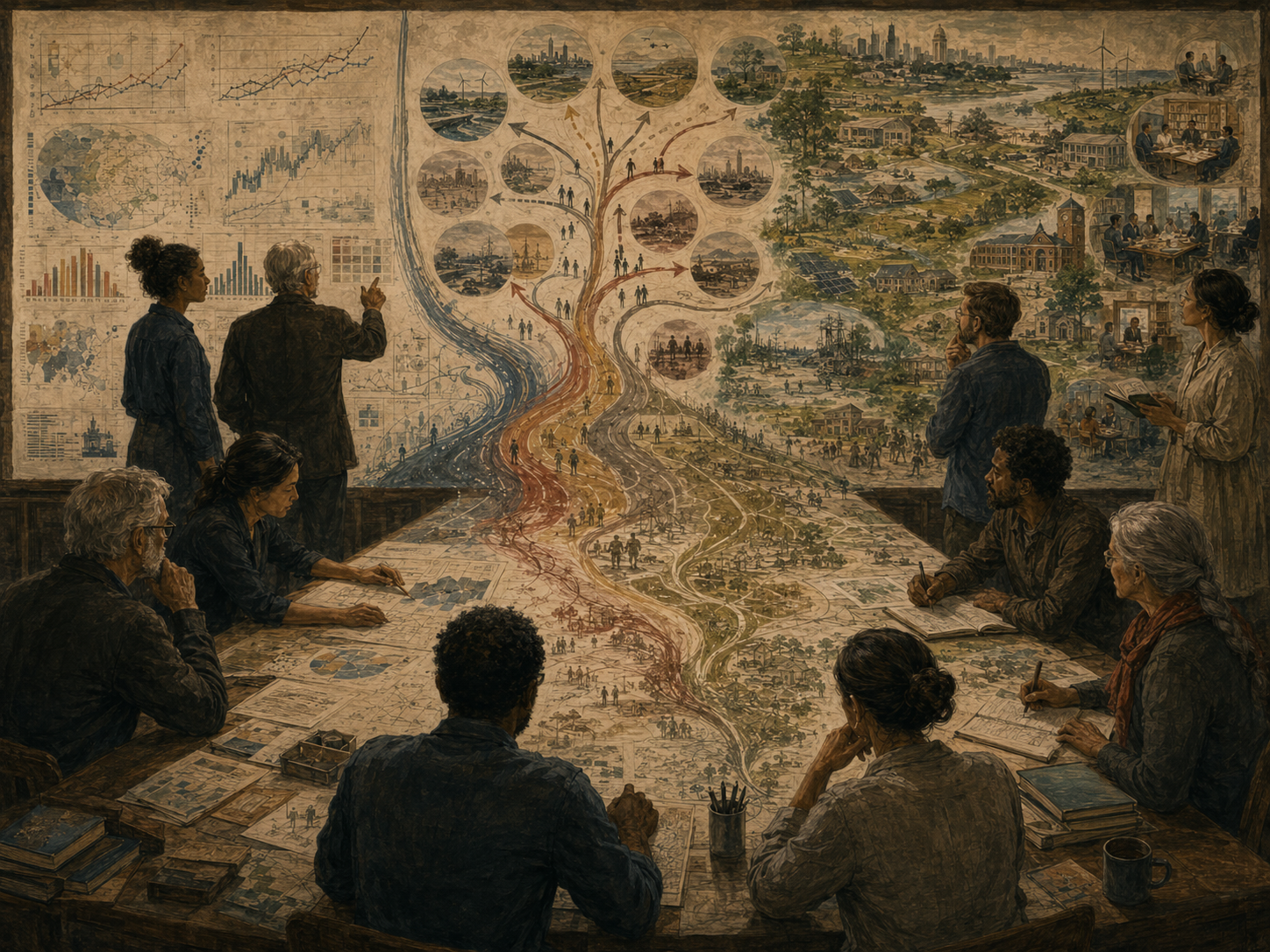
In practical terms, the difference between forecasting, foresight, and futures studies can be summarized this way: forecasting asks what is likely; foresight asks what could happen and how we should prepare; futures studies asks how societies imagine, produce, contest, and govern possible futures. Each is useful. Each becomes dangerous when mistaken for the others.
Why the Distinction Matters
The distinction between forecasting, foresight, and futures studies matters because different future-oriented problems require different forms of reasoning. A retail inventory problem may benefit from a short-term demand forecast. A national infrastructure strategy may require scenario planning across climate, demographic, technological, and fiscal uncertainty. A public debate about artificial intelligence, migration, energy transition, or future generations may require deeper reflection on ethics, power, imagination, and institutional legitimacy.
When these practices are confused, institutions often overestimate the reach of prediction. They ask forecasts to answer questions forecasts are not designed to answer. They treat uncertainty as a temporary lack of data rather than a structural feature of complex systems. They mistake projection for preparation. They assume that a quantified trend is more rigorous than a plural exploration of futures, even when the quantified trend depends on fragile assumptions.
This confusion can produce brittle strategy. An organization may optimize for the most likely future while becoming vulnerable to plausible alternatives. A public agency may invest in infrastructure based on historical climate patterns that no longer hold. A business may overcommit to one technology pathway. A university may design curricula around a narrow labor-market projection. A government may prepare for the last crisis rather than the next possible configuration of risk.
Futures work is strongest when each practice is used for its proper purpose. Forecasting supports estimation. Foresight supports preparedness. Futures studies supports deeper understanding of how futures are imagined, structured, contested, and acted upon.
| Practice | Primary Question | Best Used When | Risk If Misused |
|---|---|---|---|
| Forecasting | What is likely to happen? | Data are available, conditions are relatively stable, and the time horizon is limited. | False precision under uncertainty. |
| Foresight | What could happen, and how should we prepare? | Systems are complex, uncertainty is significant, and decisions have long-term consequences. | Scenario theater without strategic change. |
| Futures studies | How are futures imagined, shaped, governed, and contested? | Questions involve culture, ethics, power, institutions, history, knowledge, and public imagination. | Abstract critique detached from decision-making. |
The goal is not to choose one practice forever. The goal is to match the future-oriented question to the appropriate mode of inquiry.
Forecasting: Estimating Likely Futures
Forecasting is the practice of estimating future values, events, or conditions based on evidence, models, trends, and assumptions. Forecasts may be statistical, econometric, computational, judgment-based, or model-assisted. They are common in weather, finance, demography, logistics, epidemiology, energy demand, sales planning, transportation, and many other fields where decisions require estimates of future conditions.
Forecasting is not inherently simplistic. Good forecasting can be highly rigorous. It may involve time-series models, regression, simulation, machine learning, ensemble methods, uncertainty intervals, sensitivity testing, expert judgment, and careful validation against observed outcomes. Forecasting is essential when decisions require estimates: how much electricity may be needed next week, how many hospital beds may be required, how much demand a product may face, or how a population may change over a defined period.
But forecasting works best under certain conditions. It is most reliable when the relevant system is relatively stable, the time horizon is limited, historical data remain informative, causal structures are not changing too rapidly, and model assumptions are transparent. Forecasts become weaker when systems are nonlinear, unstable, politically contested, technologically disrupted, or exposed to threshold effects.
This is why forecasting should be treated as a disciplined estimate, not a prophecy. A forecast is a conditional statement: given a model, data, assumptions, and time horizon, this outcome appears more or less likely. If the assumptions change, the forecast changes. If the system changes, the forecast may fail.
| Forecasting Strength | Why It Matters | Example |
|---|---|---|
| Quantification | Forecasts can provide numerical estimates, intervals, and measurable expectations. | Projected electricity demand for the next quarter. |
| Short-term decision support | Forecasts help allocate resources under near-term uncertainty. | Hospital staffing projections during seasonal illness. |
| Model validation | Forecasts can often be compared against observed outcomes. | Checking forecast error after actual demand data arrive. |
| Operational planning | Forecasts support logistics, scheduling, procurement, and budgeting. | Inventory planning for expected sales volume. |
The limitation is not that forecasting is useless. The limitation is that forecasting answers only some future-oriented questions. It estimates likely outcomes. It does not, by itself, explore alternative futures, challenge institutional assumptions, examine ethical stakes, or prepare decision-makers for structural discontinuity.
Foresight: Preparing for Plausible Futures
Foresight is the structured use of futures methods to improve present-day judgment and decision-making under uncertainty. It does not begin from the assumption that the future can be predicted as one definitive outcome. Instead, foresight asks how different plausible futures could emerge, what they would imply, and how present choices might be made more robust, adaptive, and responsible.
Strategic foresight is especially important for institutions that must make long-term decisions under uncertain conditions. Governments use foresight to examine public risks, emerging technologies, demographic change, climate stress, infrastructure needs, and geopolitical uncertainty. Businesses use foresight to evaluate market disruption, regulatory change, supply chain fragility, technological change, and changing consumer expectations. Universities, foundations, civil society organizations, and international institutions use foresight to explore deeper transformations in knowledge, development, governance, and social life.
Unlike forecasting, foresight is not primarily concerned with identifying the most likely future. It is concerned with improving readiness across multiple plausible futures. It asks what signals should be monitored, what assumptions should be challenged, which strategies are brittle, which options are robust, and which futures should be pursued or avoided.
Foresight therefore combines analysis and imagination. It uses evidence, but it also uses scenario discipline, systems thinking, participatory inquiry, assumption testing, and strategic reflection. It treats uncertainty not as a failure of knowledge, but as a condition of responsible planning.
| Foresight Function | Purpose | Strategic Value |
|---|---|---|
| Horizon scanning | Detect early signs of change. | Reduces institutional surprise. |
| Driver mapping | Identify forces shaping future conditions. | Clarifies structural pressures and uncertainties. |
| Scenario planning | Explore multiple plausible future contexts. | Tests assumptions and expands strategic imagination. |
| Stress testing | Evaluate policies or strategies across scenarios. | Identifies brittle choices and robust options. |
| Backcasting | Work backward from a preferred future. | Links vision to near-term action. |
| Learning cycles | Update assumptions as new signals emerge. | Builds anticipatory institutional capacity. |
Foresight is not prediction with softer language. It is preparation under uncertainty.
Futures Studies: The Broader Field
Futures studies is the broader field that examines how futures are imagined, represented, anticipated, contested, and shaped. It includes practical foresight methods, but it also extends beyond organizational strategy. It draws on history, sociology, political theory, economics, philosophy, systems thinking, design, environmental studies, science and technology studies, public policy, education, and cultural analysis.
Where forecasting focuses on estimation and foresight focuses on preparation, futures studies asks deeper questions about future-making itself. How do societies imagine the future? Whose futures become official? Which communities are treated as beneficiaries, risks, labor sources, data sources, or sacrifice zones? How do technological narratives shape policy? How do colonial histories structure assumptions about development? How do climate futures differ across class, geography, race, nation, and generation? How do institutions use future scenarios to legitimize action or delay it?
Futures studies is therefore both practical and critical. It includes scenario methods, Delphi studies, horizon scanning, backcasting, and anticipatory governance, but it also examines the politics of imagination. It asks how futures are used in the present: to mobilize, warn, sell, discipline, inspire, obscure, delay, or transform.
This broader field matters because future-oriented work is never purely technical. Even a forecast carries assumptions. Even a scenario carries values. Even a strategic plan privileges some futures over others. Futures studies helps make those assumptions and values visible.
| Futures Studies Concern | Core Question | Why It Matters |
|---|---|---|
| Images of the future | What futures are imagined, feared, desired, or normalized? | Images of the future shape present behavior. |
| Power and exclusion | Whose futures count, and whose are ignored? | Future-making can reproduce inequality. |
| Anticipatory systems | How do institutions use future expectations? | Expectations shape policy, investment, and governance. |
| Ethics and responsibility | What obligations exist toward future people and vulnerable communities? | Long-term choices distribute risk across generations. |
| Transformation | How can societies move toward more just and viable futures? | Futures work can support systemic change, not only adaptation. |
Futures studies provides the intellectual field in which forecasting and foresight can be understood not only as tools, but as social practices.
Core Distinctions Among Forecasting, Foresight, and Futures Studies
Forecasting, foresight, and futures studies differ across purpose, evidence, time horizon, treatment of uncertainty, and relationship to decision-making. These differences are not rigid boundaries. In strong futures practice, they often interact. But the distinctions are important because each practice answers a different kind of question.
1. Purpose
Forecasting aims to estimate likely outcomes. Foresight aims to improve readiness under uncertainty. Futures studies aims to understand how futures are imagined, structured, contested, and shaped. The purpose determines the method. A demand forecast, a strategic scenario exercise, and a critical study of climate futures should not be evaluated by the same standard.
2. Evidence
Forecasting relies heavily on data, historical patterns, statistical models, and measurable variables. Foresight uses evidence as well, but also draws on drivers, weak signals, expert judgment, systems mapping, participatory knowledge, and scenario logic. Futures studies may use empirical evidence, archives, theory, discourse analysis, ethics, and critical interpretation.
3. Treatment of Uncertainty
Forecasting often treats uncertainty through probability, error ranges, confidence intervals, and model performance. Foresight treats uncertainty as a strategic condition requiring multiple plausible futures. Futures studies treats uncertainty as epistemic, social, political, cultural, and historical as well as technical.
4. Time Horizon
Forecasting is strongest over shorter or more stable horizons. Foresight often works across medium- and long-term horizons where complexity and uncertainty increase. Futures studies may examine past futures, present future imaginaries, near-term transitions, long-range transformations, or intergenerational questions.
5. Relationship to Decision-Making
Forecasting supports operational decisions and resource estimates. Foresight supports strategic decisions, policy design, institutional learning, and preparedness. Futures studies supports deeper reflection on meaning, power, ethics, and possible transformation. Each can inform action, but each does so differently.
6. Standard of Rigor
Forecasting is judged by model quality, error, calibration, validity, and usefulness. Foresight is judged by plausibility, transparency, strategic relevance, assumption testing, participation, and learning. Futures studies is judged by conceptual depth, historical awareness, ethical clarity, interpretive strength, and critical insight.
| Dimension | Forecasting | Foresight | Futures Studies |
|---|---|---|---|
| Main question | What is likely? | What could happen, and how should we prepare? | How are futures imagined, contested, and shaped? |
| Primary output | Projection, estimate, model, forecast interval | Scenarios, strategy tests, signal maps, readiness plans | Frameworks, critiques, histories, theories, interpretive analysis |
| Uncertainty frame | Quantified error or probability | Plural plausible futures | Epistemic, political, cultural, ethical, and historical uncertainty |
| Strength | Operational estimation | Strategic preparation | Critical and scholarly understanding |
| Failure mode | False precision | Scenario theater | Abstraction without practice |
The practices overlap, but they should not be collapsed into one another. Forecasting estimates. Foresight prepares. Futures studies interprets and critiques the whole field of future-making.
Prediction, Projection, and Anticipation
Future-oriented work often becomes confused because the terms prediction, projection, and anticipation are used loosely. They should be distinguished carefully.
Prediction claims that a particular event or outcome will occur. It is strongest when the system is governed by stable relationships, the time horizon is short, and uncertainty is limited. In complex social, political, technological, and ecological systems, prediction is often fragile.
Projection extends a trend or model forward under stated assumptions. Projection is conditional. It does not say, “This will happen no matter what.” It says, “If these assumptions hold, this is the projected pathway.” A climate emissions pathway, demographic projection, budget projection, or population model may be useful precisely because it reveals what current assumptions imply.
Anticipation is broader. It refers to the ways people and institutions use ideas about the future in the present. Anticipation includes prediction and projection, but also imagination, expectation, fear, hope, planning, preparedness, speculation, design, and governance. Futures literacy is closely connected to this broader understanding because it treats the future as something people use to make sense of the present.
| Term | Meaning | Example | Key Limitation |
|---|---|---|---|
| Prediction | A claim about what will happen. | A forecast that a recession will begin within a given period. | Can overstate certainty. |
| Projection | A conditional extension of current assumptions. | A population projection under fertility, mortality, and migration assumptions. | Can be mistaken for destiny. |
| Anticipation | The use of future ideas to shape present understanding and action. | A city using scenarios to prepare for heat, migration, and infrastructure stress. | Can remain vague unless disciplined by method and evidence. |
Futures thinking requires all three concepts, but it treats them differently. Prediction may help in limited contexts. Projection clarifies assumptions. Anticipation expands the capacity to act under uncertainty.
The Limits of Forecasting Under Deep Uncertainty
Forecasting becomes difficult when systems are affected by deep uncertainty. Deep uncertainty exists when decision-makers do not know, or cannot agree on, the correct model of the system, the probability of future conditions, the value of outcomes, or the full set of relevant consequences. This is common in climate risk, technological disruption, geopolitical change, demographic transformation, public trust, and institutional legitimacy.
In these settings, the problem is not merely that more data are needed. The problem is that the future may depend on interacting causes, social choices, political conflict, technological design, ecological thresholds, and events that do not fit the past. Historical data may remain important, but they may no longer be sufficient.
Forecasting also struggles when change is nonlinear. A system may appear stable until a threshold is crossed. Public trust may erode slowly and then collapse quickly. Climate stress may accumulate gradually before producing sudden infrastructure failure. A technology may develop slowly and then diffuse rapidly. Financial risk may remain hidden until contagion begins. Under these conditions, forecast accuracy can break down just when decisions become most consequential.
There is also a political problem. Forecasts often appear neutral because they are numerical. But forecasts still embed assumptions about variables, boundaries, time horizons, model structure, data quality, and values. A forecast can exclude informal labor, unpaid care, ecological damage, social trauma, or institutional distrust if those variables are not included. It can reproduce blind spots while appearing objective.
| Forecasting Limit | Why It Matters | Foresight Response |
|---|---|---|
| Structural change | Past data may no longer describe future conditions. | Use scenarios and assumption testing. |
| Nonlinearity | Small changes can produce disproportionate effects. | Map thresholds, feedback loops, and early warning indicators. |
| Model uncertainty | Different models may imply different futures. | Compare model families and explore plausible pathways. |
| Value disagreement | People may disagree on what outcomes matter. | Use participatory foresight and explicit value deliberation. |
| Hidden variables | Important factors may be excluded from the forecast. | Use systems mapping, stakeholder knowledge, and critical futures analysis. |
| False precision | Quantification may imply more certainty than exists. | Communicate uncertainty clearly and test robustness. |
Forecasting is valuable, but it should not be forced to carry questions of deep uncertainty that require foresight, systems thinking, and public judgment.
Foresight Methods and Strategic Practice
Foresight translates uncertainty into structured inquiry. It uses multiple methods because no single method can capture the full complexity of long-term change. Some methods identify signals. Some clarify drivers. Some organize uncertainty. Some construct scenarios. Some test strategy. Some support preferred futures and backcasting. Used together, they help institutions think beyond prediction without abandoning discipline.
Horizon Scanning
Horizon scanning identifies emerging issues, disruptions, signals, and early indicators of change. It looks beyond the dominant center of attention to detect developments that may be marginal now but strategically important later. Strong scanning is systematic, cross-domain, and repeated over time.
Driver Mapping
Driver mapping identifies the social, technological, economic, environmental, political, legal, cultural, and institutional forces that may shape future conditions. It helps distinguish structural pressures from short-term noise and clarifies which forces are relatively predictable and which remain uncertain.
Uncertainty Matrices
Uncertainty matrices rank drivers according to their potential impact and level of uncertainty. They help identify which uncertainties are most important for scenario development. A driver that is both highly uncertain and highly consequential often becomes central to scenario design.
Scenario Planning
Scenario planning constructs multiple plausible future contexts. Good scenarios are not predictions. They are disciplined narratives or models that explore how different combinations of drivers and uncertainties could reshape strategic conditions. They help decision-makers test assumptions and prepare for alternatives.
Backcasting
Backcasting begins with a preferred future and works backward to identify the steps, capacities, milestones, and decisions needed to make that future possible. It is especially useful for climate transition, sustainability strategy, public health, education, and long-term institutional reform.
Delphi Methods
Delphi methods use structured expert judgment across multiple rounds to explore uncertainty, disagreement, and possible long-range developments. They are useful when evidence is incomplete but informed judgment is necessary. Delphi work can clarify not only consensus, but also persistent disagreement.
Strategy Stress Testing
Strategy stress testing evaluates plans, policies, or investments across multiple scenarios. It asks which choices remain useful, which fail, and which require adaptation. This method shifts foresight from imagination to decision support.
Monitoring and Learning Cycles
Monitoring and learning cycles track signals, indicators, assumptions, and scenario-relevant changes over time. Foresight is strongest when it becomes a recurring institutional capability rather than a one-time workshop.
| Method | Primary Use | Typical Output |
|---|---|---|
| Horizon scanning | Detecting early signs of change | Signal register, scanning brief, emerging-issue map |
| Driver mapping | Understanding forces shaping futures | Driver inventory, STEEPLE map, systems map |
| Uncertainty matrix | Prioritizing critical uncertainties | Impact-uncertainty grid, scenario axes |
| Scenario planning | Exploring plausible futures | Scenario set, implications matrix, strategic questions |
| Backcasting | Moving from preferred future to present action | Pathway map, milestones, intervention sequence |
| Delphi method | Structuring expert judgment | Consensus ranges, disagreement map, expert interpretation |
| Stress testing | Testing strategy across futures | Robustness matrix, vulnerability map, adaptive options |
| Monitoring cycle | Updating assumptions over time | Indicators, learning dashboard, signal review process |
These methods are not merely creative exercises. They are disciplined ways of reasoning when prediction is insufficient.
Futures Literacy and the Use of the Future
Futures literacy refers to the capability to understand and use the future more consciously in the present. It does not mean knowing the future. It means recognizing how assumptions, expectations, hopes, fears, models, narratives, and images of the future shape present perception and action.
This is a crucial bridge between foresight practice and futures studies. Foresight may provide methods. Futures literacy develops the human and institutional capacity to use those methods well. A futures-literate person or organization is better able to distinguish projection from possibility, fear from evidence, hope from strategy, and assumption from analysis.
Futures literacy matters because people are always using the future, even when they do not notice it. A parent uses imagined futures when making decisions about education. A city uses imagined futures when zoning land or building infrastructure. A company uses imagined futures when investing in technology. A government uses imagined futures when designing policy. A society uses imagined futures when it decides what risks are tolerable, what sacrifices are acceptable, and whose lives are worth protecting.
Futures literacy asks people to become more reflective about those uses of the future. It strengthens imagination, but not in the sense of fantasy. It strengthens the ability to ask: What future am I assuming? Where did that image come from? Who benefits from it? What alternatives are being excluded? What evidence supports it? What choices does it make possible or impossible?
Futures literacy is not a technique added to foresight. It is a capability that makes foresight more reflective, democratic, and responsible.
Scenario Work and the Discipline of Plausibility
Scenario work is one of the most visible forms of foresight, but it is often misunderstood. A scenario is not a prediction. It is not a preferred vision. It is not a fantasy. It is a structured account of a plausible future context designed to test assumptions, explore uncertainty, and improve present decisions.
Good scenario work requires discipline. Scenarios should be plausible, distinct, relevant, challenging, and internally coherent. They should be grounded in drivers and uncertainties, not arbitrary imagination. They should stretch thinking without becoming implausible. They should create strategic insight, not merely interesting stories.
Scenario work often fails when scenarios are too generic, too optimistic, too dystopian, too similar to one another, too detached from decision points, or too polished to provoke difficult questions. A strong scenario should make decision-makers uncomfortable in a useful way. It should reveal assumptions they did not know they were making.
| Scenario Quality | Meaning | Failure Mode |
|---|---|---|
| Plausible | The scenario could reasonably emerge from known drivers and uncertainties. | Fantasy or speculation without discipline. |
| Distinct | Each scenario represents a meaningfully different future context. | Several versions of the same future. |
| Relevant | The scenario connects to real decisions, risks, and strategies. | Interesting story with no strategic use. |
| Challenging | The scenario tests assumptions and exposes vulnerabilities. | Comforting confirmation of existing plans. |
| Coherent | The scenario’s internal logic is credible and connected. | Loose collection of disconnected future events. |
Scenario work is valuable because it gives uncertainty a usable structure. It does not tell decision-makers which future will happen. It helps them see how different futures would challenge present assumptions.
Institutional Uses: Policy, Strategy, and Governance
Institutions need different future-oriented practices at different levels. Operational units may need forecasts. Strategy teams may need scenario planning. Public agencies may need anticipatory governance. Research centers may need futures studies. Community organizations may need participatory futures processes. Strong institutions do not reduce all future work to one method. They build a layered anticipatory system.
In policy, forecasting may estimate budget impacts, population shifts, infrastructure demand, or service needs. Foresight may explore alternative policy environments, emerging risks, technological change, and long-term public consequences. Futures studies may examine the values, narratives, and power structures embedded in policy futures.
In business strategy, forecasting may estimate sales, costs, demand, or market size. Foresight may explore disruption, regulation, supply chains, consumer change, and strategic options. Futures studies may examine the wider social implications of markets, technology, labor, consumption, and corporate influence on future imaginaries.
In sustainability, forecasting may project emissions, energy demand, population, or resource use. Foresight may explore transition pathways, climate risks, adaptation futures, and resilience strategies. Futures studies may ask whether dominant sustainability futures reproduce inequality, green colonialism, technological solutionism, or narrow measures of progress.
| Institutional Domain | Forecasting Role | Foresight Role | Futures Studies Role |
|---|---|---|---|
| Public policy | Estimate demand, costs, demographic change, and service needs. | Explore risks, scenarios, long-term policy options, and governance capacity. | Examine democratic legitimacy, public imagination, power, and future justice. |
| Business strategy | Project sales, demand, costs, and market conditions. | Test strategy under disruption, regulation, and market transformation. | Analyze corporate future-making, labor futures, and social consequences. |
| Sustainability | Model emissions, resource use, and environmental indicators. | Explore transition pathways, adaptation, resilience, and scenario stress. | Critique whose sustainability futures are prioritized or excluded. |
| Technology governance | Estimate adoption, capacity, and performance trends. | Explore social impacts, risks, regulation, and institutional adaptation. | Analyze technological imaginaries, ethics, power, and public accountability. |
| Education | Project enrollment, skills demand, and workforce needs. | Explore changing knowledge systems and future learning environments. | Examine human development, equity, civic purpose, and future citizenship. |
The strongest institutions connect forecasting, foresight, and futures studies without confusing their purposes.
Ethics, Power, and Contested Futures
Future-oriented work is never neutral. Even technical forecasts carry values through what they measure, what they exclude, what time horizons they use, and whose interests they serve. Foresight processes carry values through who participates, which scenarios are considered plausible, what risks are prioritized, and what futures are treated as desirable. Futures studies makes these ethical and political dimensions explicit.
This matters because futures can be used to justify power. A government may invoke a security future to expand surveillance. A company may invoke an innovation future to resist regulation. A development institution may invoke a modernization future that ignores local knowledge. A climate strategy may invoke a green future while displacing vulnerable communities. A technology firm may sell a future of efficiency while externalizing risk to workers, users, or public institutions.
Responsible futures work must therefore ask difficult questions:
- Who defines the future under discussion?
- Whose evidence is treated as credible?
- Whose risks are counted?
- Whose losses are treated as acceptable?
- Which futures are dismissed as unrealistic, and why?
- Which communities are asked to adapt to futures they had little role in shaping?
- Which future generations inherit the consequences of present decisions?
This is where futures studies becomes indispensable. Forecasting may estimate change. Foresight may prepare for change. Futures studies asks who has the authority to define change, who benefits from it, and who is harmed by the futures being built.
A serious futures practice must be analytically disciplined and morally awake.
Mathematical Lens: Forecast Error, Scenario Robustness, and Strategic Regret
A basic forecast can be represented as an estimate of a future value:
\hat{Y}_{t+h} = f(Y_t, X_t, \theta)
\]
Interpretation: \(\hat{Y}_{t+h}\) is the forecast value at horizon \(h\), based on current observations \(Y_t\), explanatory variables \(X_t\), and model parameters \(\theta\). Forecasting depends on the quality of the data, model, assumptions, and stability of the system.
Forecast error can be represented as the difference between observed and predicted values:
e_{t+h} = Y_{t+h} – \hat{Y}_{t+h}
\]
Interpretation: Forecast error \(e_{t+h}\) shows how far the forecast was from the observed outcome. Forecast evaluation is central to rigorous forecasting because it allows models to be tested against reality.
Foresight uses a different logic. Instead of one forecast future, it considers a set of plausible futures:
\Pi = \{F_1, F_2, \dots, F_n\}
\]
Interpretation: \(\Pi\) is the set of plausible futures. Each future \(F_i\) represents a different configuration of drivers, uncertainties, assumptions, and system conditions.
A strategy can then be evaluated across that futures set:
R_k = \min_{i \in \Pi} V_{ki}
\]
Interpretation: \(R_k\) represents the worst-case performance of strategy \(k\) across the plausible futures set. This is a robustness framing: a strategy is not judged only by how well it performs in the expected future, but by how it performs across several plausible futures.
Strategic regret can also be estimated:
G_{ki} = \max_j(V_{ji}) – V_{ki}
\]
Interpretation: \(G_{ki}\) is the regret of choosing strategy \(k\) in future \(F_i\), compared with the best-performing strategy in that future. Regret analysis is useful when decision-makers want to avoid choices that could fail severely under plausible conditions.
These equations show the difference between forecasting and foresight. Forecasting evaluates the accuracy of estimates. Foresight evaluates the robustness of decisions across uncertainty.
Computational Modeling for Forecasting and Foresight
Computational modeling can support both forecasting and foresight, but it should be used differently in each. In forecasting, models estimate likely values and are judged by predictive accuracy. In foresight, models explore alternative conditions, test assumptions, compare strategies, and support learning under uncertainty.
The same dataset may therefore support different analytical workflows. A forecasting workflow might estimate a trend and calculate forecast error. A foresight workflow might build several scenarios, stress-test strategies, and examine which choices remain robust when assumptions change. A futures studies workflow might then ask what the model excludes, whose futures are represented, and what social assumptions are hidden in the variables.
Useful computational workflows for this article include:
- Forecasting examples: trend projection, forecast error, uncertainty intervals, and model comparison.
- Foresight examples: scenario matrices, driver uncertainty, robustness scoring, and regret analysis.
- Futures studies examples: assumption registers, future-imaginary coding, participatory inputs, and ethical-risk notes.
- Reproducible workflows: structured storage of signals, drivers, scenarios, assumptions, strategies, outputs, and learning records.
Computational tools should make assumptions more visible, not less visible. A polished model that hides uncertainty can weaken judgment. A simpler model that clarifies assumptions, tests alternatives, and supports deliberation may be more useful for futures thinking.
Advanced R Workflow: Comparing Future-Oriented Practices
The R workflow below compares forecasting, foresight, and futures studies across several dimensions: predictive emphasis, uncertainty plurality, assumption visibility, participatory depth, strategic readiness, and critical reflection. The scores are stylized for teaching and demonstration, not empirical measurement of actual institutions.
# ------------------------------------------------------------
# R Workflow: Comparing Future-Oriented Practices
# Article: Forecasting, Foresight, and Futures Studies
#
# Purpose:
#   Compare forecasting, foresight, and futures studies across
#   predictive emphasis, uncertainty plurality, assumption visibility,
#   participatory depth, strategic readiness, and critical reflection.
#
# Optional dependency:
#   install.packages(c("tidyverse"))
# ------------------------------------------------------------

library(tidyverse)

practice_profiles <- tibble(
  practice = c("Forecasting", "Strategic Foresight", "Futures Studies"),
  predictive_emphasis = c(0.92, 0.42, 0.22),
  uncertainty_plurality = c(0.32, 0.88, 0.82),
  assumption_visibility = c(0.48, 0.84, 0.90),
  participatory_depth = c(0.24, 0.72, 0.86),
  strategic_readiness = c(0.58, 0.90, 0.70),
  critical_reflection = c(0.30, 0.66, 0.94)
)

weights <- tibble(
  dimension = c(
    "predictive_emphasis",
    "uncertainty_plurality",
    "assumption_visibility",
    "participatory_depth",
    "strategic_readiness",
    "critical_reflection"
  ),
  foresight_weight = c(0.05, 0.22, 0.18, 0.15, 0.25, 0.15)
)

practice_long <- practice_profiles %>%
  pivot_longer(
    cols = -practice,
    names_to = "dimension",
    values_to = "value"
  ) %>%
  left_join(weights, by = "dimension") %>%
  mutate(weighted_value = value * foresight_weight)

practice_scores <- practice_long %>%
  group_by(practice) %>%
  summarise(
    anticipatory_capacity_score = sum(weighted_value),
    strongest_dimension = dimension[which.max(value)],
    weakest_dimension = dimension[which.min(value)],
    .groups = "drop"
  ) %>%
  arrange(desc(anticipatory_capacity_score))

print(practice_scores)

ggplot(practice_long, aes(x = dimension, y = value, fill = practice)) +
  geom_col(position = "dodge") +
  coord_flip() +
  labs(
    title = "Comparing Forecasting, Foresight, and Futures Studies",
    subtitle = "Stylized profile across future-oriented capacities",
    x = "Dimension",
    y = "Relative emphasis",
    fill = "Practice"
  ) +
  theme_minimal(base_size = 12)

ggplot(practice_scores, aes(x = reorder(practice, anticipatory_capacity_score), y = anticipatory_capacity_score)) +
  geom_col() +
  coord_flip() +
  labs(
    title = "Stylized Anticipatory Capacity Score",
    x = "Practice",
    y = "Weighted score"
  ) +
  theme_minimal(base_size = 12)

dir.create("outputs", showWarnings = FALSE)
write_csv(practice_profiles, "outputs/future_oriented_practice_profiles.csv")
write_csv(practice_scores, "outputs/future_oriented_practice_scores.csv")
write_csv(practice_long, "outputs/future_oriented_practice_long.csv")
This workflow helps clarify that forecasting, foresight, and futures studies have different profiles. Forecasting scores highly on predictive emphasis. Foresight scores highly on uncertainty plurality and strategic readiness. Futures studies scores highly on critical reflection, assumption visibility, and participatory depth.
Advanced Python Workflow: Forecasting vs Scenario Robustness
The Python workflow below compares a forecast-optimized strategy with more robust strategies across multiple plausible future conditions. It illustrates a central distinction: forecasting may identify what performs best under the expected future, while foresight asks what remains viable across several futures.
# ------------------------------------------------------------
# Python Workflow: Forecasting vs Scenario Robustness
# Article: Forecasting, Foresight, and Futures Studies
#
# Purpose:
#   Compare strategies optimized for an expected forecast
#   against strategies evaluated across multiple plausible futures.
#
# Optional dependencies:
#   pip install pandas numpy matplotlib
# ------------------------------------------------------------

from pathlib import Path

import numpy as np
import pandas as pd
import matplotlib.pyplot as plt

OUTPUT_DIR = Path("outputs")
OUTPUT_DIR.mkdir(exist_ok=True)

futures = [
    "Expected Continuity",
    "Technology Disruption",
    "Climate Stress",
    "Institutional Fragmentation",
    "Supply Constraint",
    "Public Trust Shock"
]

strategies = {
    "Forecast-Optimized Strategy": [0.91, 0.42, 0.38, 0.36, 0.40, 0.34],
    "Flexible Foresight Strategy": [0.78, 0.75, 0.72, 0.70, 0.73, 0.69],
    "Transformational Strategy": [0.62, 0.81, 0.84, 0.76, 0.78, 0.74],
    "Defensive Continuity Strategy": [0.70, 0.52, 0.55, 0.58, 0.57, 0.60]
}

rows = []

for strategy, values in strategies.items():
    for future, performance in zip(futures, values):
        rows.append({
            "strategy": strategy,
            "future": future,
            "performance": performance
        })

df = pd.DataFrame(rows)

summary = (
    df.groupby("strategy")["performance"]
    .agg(
        mean_performance="mean",
        worst_case="min",
        best_case="max",
        volatility="std"
    )
    .reset_index()
)

summary["robustness_score"] = (
    0.45 * summary["worst_case"] +
    0.35 * summary["mean_performance"] -
    0.20 * summary["volatility"].fillna(0)
)

# Regret analysis: compare each strategy to the best strategy in each future.
best_by_future = (
    df.groupby("future")["performance"]
    .max()
    .reset_index()
    .rename(columns={"performance": "best_future_performance"})
)

regret_df = df.merge(best_by_future, on="future")
regret_df["regret"] = regret_df["best_future_performance"] - regret_df["performance"]

regret_summary = (
    regret_df.groupby("strategy")["regret"]
    .agg(
        mean_regret="mean",
        max_regret="max"
    )
    .reset_index()
)

summary = summary.merge(regret_summary, on="strategy")
summary = summary.sort_values("robustness_score", ascending=False)

print("\nScenario performance:")
print(df)

print("\nStrategy summary:")
print(summary)

plt.figure(figsize=(11, 6))
for strategy in df["strategy"].unique():
    subset = df[df["strategy"] == strategy]
    plt.plot(
        subset["future"],
        subset["performance"],
        marker="o",
        label=strategy
    )

plt.xticks(rotation=25, ha="right")
plt.ylabel("Performance")
plt.title("Strategy Performance Across Plausible Futures")
plt.legend()
plt.tight_layout()
plt.savefig(OUTPUT_DIR / "strategy_performance_across_futures.png", dpi=150)
plt.close()

plt.figure(figsize=(9, 5))
plt.barh(summary["strategy"], summary["robustness_score"])
plt.xlabel("Robustness score")
plt.title("Robustness-Oriented Strategy Comparison")
plt.tight_layout()
plt.savefig(OUTPUT_DIR / "robustness_strategy_comparison.png", dpi=150)
plt.close()

plt.figure(figsize=(9, 5))
plt.barh(summary["strategy"], summary["max_regret"])
plt.xlabel("Maximum regret")
plt.title("Maximum Strategic Regret Across Futures")
plt.tight_layout()
plt.savefig(OUTPUT_DIR / "maximum_strategic_regret.png", dpi=150)
plt.close()

df.to_csv(OUTPUT_DIR / "strategy_performance.csv", index=False)
summary.to_csv(OUTPUT_DIR / "strategy_summary.csv", index=False)
regret_df.to_csv(OUTPUT_DIR / "strategy_regret.csv", index=False)
This workflow shows why foresight matters even when forecasting is strong. A forecast-optimized strategy may perform best under expected continuity while becoming fragile under disruption. A foresight strategy may not maximize performance in one favored future, but it may reduce vulnerability across multiple plausible futures.
GitHub Repository
The companion repository for this article contains computational examples for comparing forecasting, strategic foresight, and futures studies. It includes workflows for forecast error, scenario robustness, regret analysis, assumption visibility, and future-oriented practice profiles.
Complete Code Repository
The companion code for this article is located in articles/forecasting-foresight-and-futures-studies/ and includes Python, R, Julia, SQL, Rust, Go, C++, Fortran, C, documentation, synthetic datasets, outputs, and notebook placeholders for applied forecasting and foresight workflows.
| Directory | Purpose |
|---|---|
python/ |
Forecast error, scenario robustness, regret analysis, and strategy comparison examples. |
r/ |
Future-oriented practice profiles, comparative scoring, and visualization workflows. |
julia/ |
Dynamic examples for uncertainty, robustness, and strategic performance. |
sql/ |
Schemas for forecasts, drivers, scenarios, assumptions, strategies, and evaluation results. |
rust/ |
Command-line diagnostics scaffold for future-oriented practice comparison. |
go/ |
Scenario and forecast utility scaffold. |
cpp/ |
Efficient strategy-performance and regret calculation examples. |
fortran/ |
Numerical readiness and robustness examples. |
c/ |
Low-level forecast and scenario scoring utilities. |
docs/ |
Article notes, modeling principles, assumptions, and reproducibility guidance. |
data/ |
Synthetic datasets for forecasting and foresight examples. |
outputs/ |
Generated tables, summaries, diagnostics, and figures. |
notebooks/ |
Notebook placeholders for exploratory workflows. |
Why This Matters
Forecasting, foresight, and futures studies matter because the future is not one problem. Some future-oriented questions require estimation. Some require preparation. Some require critique, public imagination, and ethical judgment. A society that treats every future question as a forecasting problem will repeatedly mistake uncertainty for ignorance and complexity for noise.
Forecasting remains indispensable. It helps institutions estimate demand, risk, cost, timing, and probable change. But forecasting is not enough for long-term strategy under deep uncertainty. Foresight is needed when decisions must remain useful across multiple plausible futures. Futures studies is needed when the future itself becomes a site of power, imagination, responsibility, and contestation.
The strongest future-oriented practice does not reject forecasting. It places forecasting inside a wider architecture of anticipation. It asks what can be estimated, what must be explored, what must be questioned, and what must be governed.
Forecasting helps us estimate what may happen. Foresight helps us prepare for what could happen. Futures studies helps us understand how futures are imagined, contested, and made.
Related Articles
- Futures Thinking
- What Is Futures Thinking?
- Scenario Planning
- Strategic Foresight Methods
- Horizon Scanning
- Systems Modeling
- Resilience Thinking
Further Reading
- Bell, W. (1997) Foundations of Futures Studies: Human Science for a New Era. Volume 1: History, Purposes, and Knowledge. New Brunswick, NJ: Transaction Publishers.
- de Jouvenel, B. (1967) The Art of Conjecture. New York: Basic Books.
- Inayatullah, S. (2008) ‘Six pillars: futures thinking for transforming’, Foresight, 10(1), pp. 4–21. Available at: Emerald.
- Miller, R. (ed.) (2018) Transforming the Future: Anticipation in the 21st Century. Paris: UNESCO Publishing. Available at: UNESCO.
- Schwartz, P. (1991) The Art of the Long View. New York: Currency Doubleday.
- Slaughter, R.A. (2004) Futures Beyond Dystopia: Creating Social Foresight. London: Routledge.
- Voros, J. (2003) ‘A generic foresight process framework’, Foresight, 5(3), pp. 10–21. Available at: Emerald.
References
- Bell, W. (1997) Foundations of Futures Studies: Human Science for a New Era. Volume 1: History, Purposes, and Knowledge. New Brunswick, NJ: Transaction Publishers.
- de Jouvenel, B. (1967) The Art of Conjecture. New York: Basic Books.
- Inayatullah, S. (2008) ‘Six pillars: futures thinking for transforming’, Foresight, 10(1), pp. 4–21. Available at: Emerald.
- Miller, R. (ed.) (2018) Transforming the Future: Anticipation in the 21st Century. Paris: UNESCO Publishing. Available at: UNESCO.
- Organisation for Economic Co-operation and Development (OECD) (no date) Strategic Foresight. Available at: OECD.
- Organisation for Economic Co-operation and Development (OECD) (2025) Strategic Foresight Toolkit for Resilient Public Policy. Available at: OECD.
- Organisation for Economic Co-operation and Development Observatory of Public Sector Innovation (OECD OPSI) (2023) Supporting Decision Making with Strategic Foresight. Available at: OECD OPSI.
- Schwartz, P. (1991) The Art of the Long View. New York: Currency Doubleday.
- Slaughter, R.A. (2004) Futures Beyond Dystopia: Creating Social Foresight. London: Routledge.
- United Nations Educational, Scientific and Cultural Organization (UNESCO) (no date) Futures Literacy & Foresight. Available at: UNESCO.
- UK Government Office for Science (2025) A Brief Guide to Futures Thinking and Foresight. London: Government Office for Science. Available at: UK Government.
- UK Government Office for Science (2024) The Futures Toolkit. London: Government Office for Science. Available at: UK Government.
- Voros, J. (2003) ‘A generic foresight process framework’, Foresight, 5(3), pp. 10–21. Available at: Emerald.