
Last Updated June 3, 2026
The ethics of futures thinking examines how anticipation, modeling, scenario design, strategic foresight, technological roadmapping, and long-term planning involve moral responsibility, distributional consequences, and power over possible futures. Futures thinking is often presented as a neutral analytical exercise: a disciplined way to explore uncertainty, compare scenarios, prepare institutions, and improve decision-making. Yet the act of imagining, modeling, selecting, and planning for futures is never neutral. It shapes which futures are considered plausible, desirable, avoidable, inevitable, impossible, or worth fighting for.
Every futures process makes choices. It chooses a time horizon. It chooses a stakeholder frame. It chooses which risks matter. It chooses which communities are consulted. It chooses which data count as evidence. It chooses which harms are visible. It chooses which futures are named, which are excluded, and which are treated as acceptable losses. Even when these choices appear technical, they carry ethical meaning.
Futures thinking does not merely describe possible futures. It helps produce them. Scenario modeling, strategic foresight, climate planning, AI governance, infrastructure design, security planning, demographic projection, and anticipatory regulation all influence present decisions that shape long-term trajectories. Because of this, futures thinking carries ethical implications related to responsibility, justice, legitimacy, inclusion, risk distribution, intergenerational obligation, institutional accountability, and the politics of imagination.
At its strongest, ethical futures thinking is not an optional moral supplement added after technical analysis is complete. It is part of the analysis itself. The choice of model boundary, risk threshold, scenario narrative, discount rate, stakeholder category, feasibility criterion, and success metric already encodes values. To think seriously about futures is therefore to think seriously about power, responsibility, and the moral consequences of anticipation.
Main Library
Publications
Article Map
Futures Thinking
Related Topic
Institutions & Governance
Related Topic
Risk & Resilience
Related Topic
Artificial Intelligence
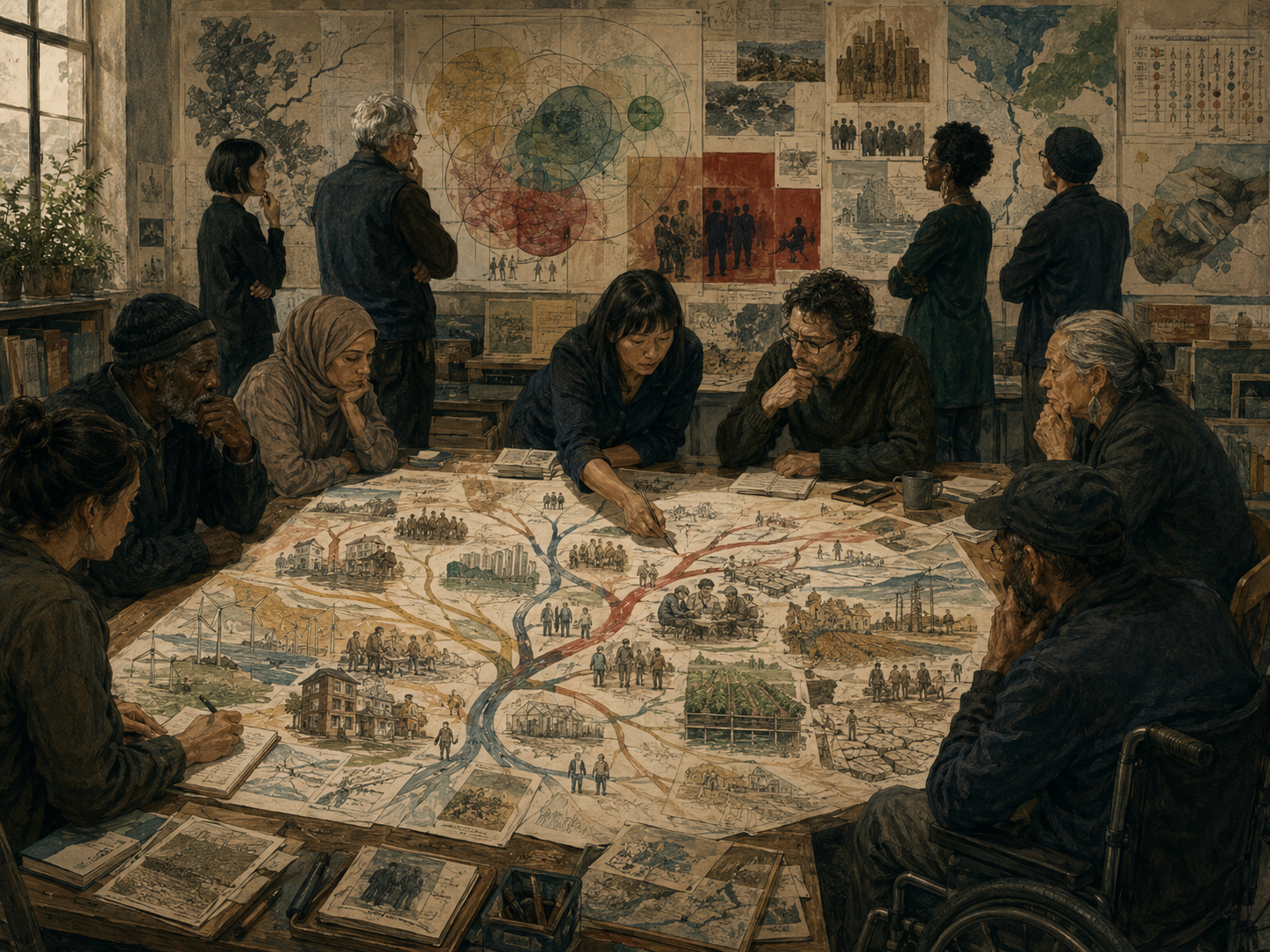
What the Ethics of Futures Thinking Means
The ethics of futures thinking concerns the moral dimensions of anticipation. It asks how people, institutions, governments, firms, researchers, communities, and technical systems imagine possible futures; how those imagined futures influence present choices; and how benefits, burdens, risks, rights, and responsibilities are distributed across time.
Futures thinking is often associated with strategy, planning, resilience, innovation, policy design, scenario development, horizon scanning, trend analysis, risk analysis, and institutional learning. These are practical activities, but they are also ethical activities because they shape real decisions. A scenario can redirect public investment. A risk model can justify emergency powers. A technological roadmap can privilege one form of innovation over another. A demographic projection can support humane planning or fuel exclusionary politics. A climate pathway can reveal future harm or obscure who will be sacrificed.
Ethical futures thinking begins from the recognition that futures are not just objects of prediction. They are objects of responsibility.
| Futures Practice | Technical Question | Ethical Question |
|---|---|---|
| Scenario planning | Which futures are plausible? | Whose futures are included, excluded, feared, or normalized? |
| Risk analysis | Which risks are likely or severe? | Who bears the risk, who benefits from the risk, and who receives protection? |
| Strategic foresight | How should institutions prepare? | Which values guide preparation, and who has authority to decide? |
| Technology roadmapping | Which technologies may emerge? | Who controls the pathway, who is harmed, and who can contest deployment? |
| Climate modeling | Which pathways are physically or economically possible? | Which communities are protected, displaced, compensated, or abandoned? |
| Public policy foresight | How can government anticipate change? | How can anticipation remain legitimate, accountable, participatory, and just? |
| AI-enabled prediction | What patterns can models detect? | Whose data, assumptions, classifications, and futures are encoded at scale? |
The ethics of futures thinking therefore operates at two levels. First, it evaluates the consequences of future-oriented decisions. Second, it evaluates the process by which futures are imagined, modeled, narrated, and governed. A future-oriented decision can be harmful even when it is analytically sophisticated. A scenario process can be illegitimate even when it is methodologically polished. Ethics is not decoration. It is part of the architecture of responsible foresight.
The Normative Nature of Futures Thinking
Futures thinking is inherently normative because it involves selecting which futures to explore, which drivers to emphasize, which risks to foreground, which stakeholders to include, which outcomes to prioritize, and which tradeoffs to accept. These choices are shaped by values, assumptions, institutional cultures, political interests, historical memory, and power relations, even when presented as neutral analysis.
Scenario modeling does not simply map possible futures. It frames them. The selection of variables, drivers, time horizons, narratives, thresholds, and outcome categories reflects judgments about what matters, who matters, and what counts as success, failure, crisis, opportunity, disruption, or progress. Those judgments influence how decision-makers interpret risk and allocate attention.
Every model of the future encodes values, whether explicitly or implicitly. Ethical futures thinking therefore requires making those values visible, contestable, and accountable rather than hiding them behind technical language.
| Futures Design Choice | Hidden Ethical Content | Practical Consequence |
|---|---|---|
| Time horizon | How strongly future people and long-term harm are considered. | Short horizons can erase climate, infrastructure, ecological, and intergenerational consequences. |
| Stakeholder definition | Who counts as affected, relevant, or legitimate. | Narrow definitions can exclude frontline communities, youth, migrants, workers, nonhuman life, or future generations. |
| Scenario boundaries | Which systems are treated as inside or outside the problem. | Boundaries can hide colonial history, supply-chain harm, ecological damage, or cross-border impacts. |
| Success metric | What counts as improvement. | Growth, efficiency, resilience, stability, security, and innovation can conflict with justice or dignity. |
| Risk threshold | How much harm is considered tolerable. | Acceptable risk for one group may be catastrophic risk for another. |
| Evidence standard | Which forms of knowledge are recognized. | Quantitative models may displace lived experience, Indigenous knowledge, worker knowledge, or local memory. |
| Feasibility judgment | Which futures are considered realistic. | Powerful institutions may define justice-oriented futures as unrealistic while treating harmful continuity as pragmatic. |
The normative nature of futures thinking does not make it invalid. It makes ethical transparency necessary. The point is not to eliminate values from futures work. That is impossible. The point is to name the values, examine them, make them accountable, and allow affected people to contest them.
Anticipation as Power
Anticipation is a form of power because those who define the future often influence the present. Governments, corporations, militaries, investors, foundations, international organizations, technology firms, consulting firms, and research institutions usually have greater capacity to commission scenarios, model risks, produce forecasts, shape narratives, and influence long-horizon investment than marginalized communities, workers, displaced populations, Indigenous peoples, youth, or less powerful states.
This asymmetry matters because foresight capacity can become agenda-setting capacity. Actors with resources can define which futures are considered credible, investable, urgent, or inevitable. They can shape research priorities, infrastructure pathways, defense planning, climate adaptation, urban design, technological deployment, and public imagination. Futures work can therefore become a tool of domination if its politics remain unexamined.
The ability to shape the future is also the ability to shape the terms on which others must live within it.
| Form of Anticipatory Power | How It Works | Ethical Risk |
|---|---|---|
| Agenda-setting power | Defines which future risks and opportunities receive attention. | Marginalized harms may be treated as secondary or invisible. |
| Modeling power | Controls assumptions, variables, scenarios, thresholds, and data. | Technical systems can encode institutional bias while appearing objective. |
| Investment power | Directs capital toward some futures and away from others. | Marketable futures may displace socially necessary futures. |
| Narrative power | Shapes public imagination about inevitability, progress, crisis, and threat. | People may accept harmful futures as unavoidable. |
| Security power | Frames certain populations, technologies, or movements as risks. | Preparedness can become surveillance, militarization, or exclusion. |
| Institutional power | Translates foresight into policy, regulation, procurement, and public systems. | Decisions may become locked in before public contestation occurs. |
Ethical futures thinking must therefore ask who gets to anticipate, who gets to decide, whose uncertainty counts, whose evidence is recognized, whose future is optimized, and who has the power to refuse a future designed by others.
Responsibility Across Time and Generations
Futures thinking extends decision-making across time. It raises questions about responsibility to people who are not present, not yet born, or not represented in current institutions. Decisions about climate policy, biodiversity, infrastructure, artificial intelligence, debt, public health, land use, energy systems, nuclear risk, water governance, and urban design can create consequences lasting decades or centuries.
Present institutions often privilege immediacy. Electoral cycles, quarterly earnings, annual budgets, short grant windows, emergency response, and political media cycles all reward short-term thinking. Ethical futures thinking pushes against this temporal bias by asking whether present decisions impose avoidable harm, loss, risk, debt, ecological damage, institutional weakness, or technological lock-in on future populations.
Responsibility in futures thinking extends beyond present stakeholders to future populations. This does not eliminate the moral urgency of present needs. It requires balancing urgent present claims with long-term viability, stewardship, repair, and justice.
| Long-Term Decision Area | Present Choice | Future Ethical Consequence |
|---|---|---|
| Climate policy | Mitigation, adaptation, fossil fuel dependence, land use, finance. | Future exposure to heat, disaster, displacement, food stress, and ecosystem loss. |
| Infrastructure | Roads, grids, water systems, housing, ports, broadband, public facilities. | Lock-in of resilience, inequality, emissions, access, and maintenance burdens. |
| AI governance | Deployment standards, data systems, automation, procurement, oversight. | Future accountability, labor displacement, surveillance capacity, and decision rights. |
| Public debt and finance | Borrowing, austerity, taxation, social investment, climate finance. | Future capacity to govern, care, repair, adapt, and invest. |
| Education and youth policy | School systems, training, civic education, public health, opportunity. | Future democratic capacity, labor dignity, social trust, and intergenerational mobility. |
| Biodiversity and land | Conservation, extraction, agriculture, restoration, development. | Future ecological function, cultural survival, food systems, and planetary stability. |
Future generations cannot vote in present elections, testify at planning hearings, negotiate contracts, review environmental impact statements, or refuse harmful technological lock-ins. Ethical futures thinking asks institutions to develop mechanisms of representation for those absent from present decision-making.
Uncertainty, Ignorance, and Humility
Futures thinking operates under uncertainty, and often under deep uncertainty, where probabilities cannot be assigned confidently and structural changes remain unknown. This creates ethical challenges because consequential decisions must still be made without complete information. Waiting for certainty can produce avoidable harm. Acting with overconfidence can also produce harm.
Ethical reasoning under uncertainty must account for ignorance, surprise, unintended consequences, model error, irreversible damage, and unequal vulnerability. This is why humility, precaution, reversibility, monitoring, and adaptive governance become ethically important. Overconfidence is not merely an analytical weakness. It can become a moral failure when it exposes others to avoidable risk.
Ethical decision-making under uncertainty requires humility without paralysis and precaution without authoritarianism.
| Uncertainty Condition | Ethical Risk | Responsible Practice |
|---|---|---|
| Model uncertainty | False precision hides fragile assumptions. | Document assumptions, test sensitivity, compare models, communicate limits. |
| Deep uncertainty | Institutions cannot assign reliable probabilities. | Use robust strategies, scenario diversity, adaptive pathways, and precaution. |
| Irreversibility | Some harms cannot easily be undone. | Use higher standards before irreversible ecological, social, or technological lock-in. |
| Unequal vulnerability | Some groups suffer first and worst from wrong assumptions. | Prioritize distributional analysis and frontline knowledge. |
| Surprise | Unexpected events overwhelm static plans. | Build monitoring, feedback, redundancy, and learning systems. |
| Strategic ambiguity | Actors may manipulate uncertainty for advantage. | Separate honest uncertainty from deliberate obfuscation or delay. |
Humility in futures thinking does not mean refusing to act. It means acting with awareness of uncertainty, building systems that can learn, and avoiding policies that require impossible confidence to justify avoidable harm.
Risk Distribution and Systemic Inequality
Future-oriented decisions often involve the distribution of risk. Certain populations may bear greater exposure to climate hazards, displacement, automation, pollution, infrastructure neglect, policing, surveillance, public health vulnerability, technological disruption, or economic transition, while others capture disproportionate benefits from innovation, extraction, finance, land appreciation, or strategic investment.
This creates a central ethical problem: aggregate improvement can hide unequal harm. A policy can increase total welfare while sacrificing a marginalized community. A transition can lower emissions while displacing workers without support. A security system can reduce one kind of risk while expanding surveillance of racialized or migrant populations. A technological system can improve efficiency while embedding bias, exclusion, or unaccountable control.
The future is not experienced equally. Risk is unevenly distributed across systems.
| Future Risk | Unequal Exposure | Ethical Requirement |
|---|---|---|
| Climate disruption | Low-income communities, small island states, Indigenous peoples, outdoor workers, informal settlements. | Adaptation finance, loss and damage support, rights protection, relocation justice. |
| Automation | Workers in routine, low-wage, precarious, or poorly protected jobs. | Labor transition, income security, training, collective bargaining, job quality standards. |
| Infrastructure failure | Communities facing disinvestment, aging systems, heat exposure, flood risk, or poor maintenance. | Equitable maintenance, resilience investment, public accountability. |
| AI decision systems | People classified by opaque systems in welfare, hiring, policing, education, credit, or migration. | Auditability, appeal rights, transparency, bias testing, human accountability. |
| Energy transition | Workers, regions, households, and communities dependent on fossil systems. | Just transition planning, local investment, worker protection, public participation. |
| Migration pressure | Displaced people, asylum seekers, stateless people, migrant workers, border communities. | Legal pathways, protection, due process, labor rights, receiving-community support. |
Ethical futures thinking must therefore examine not only what happens on average, but who benefits, who pays, who is exposed, who is protected, who is silenced, and who is treated as expendable. Equity is not a secondary social concern. It is a central analytical dimension.
Representation, Inclusion, and Voice
Futures thinking must include diverse perspectives if it is to avoid bias, blind spots, and elite tunnel vision. Different communities experience time, vulnerability, aspiration, memory, and risk differently. Exclusion narrows legitimacy and weakens analytical quality. Scenarios that ignore local knowledge, youth perspectives, Indigenous knowledge, worker experience, disability perspectives, migrant communities, rural communities, or historically marginalized groups often miss important dynamics altogether.
Inclusion is therefore not only a democratic virtue. It is epistemically important. Broader participation improves the ability of futures work to detect overlooked risks, challenge hidden assumptions, understand lived consequences, and generate more robust strategic imagination.
Voice must shape the process, not merely decorate it. Token consultation is not the same as participatory futures practice. People are not “stakeholders” only after powerful actors have already defined the future. They should help define the questions, the assumptions, the scenarios, the evaluation criteria, and the acceptable tradeoffs.
| Participation Level | What It Looks Like | Ethical Quality |
|---|---|---|
| Information extraction | Institutions gather stories, data, or testimony but retain all framing power. | Weak. Communities become sources, not co-authors. |
| Consultation | Affected groups comment on scenarios already designed by others. | Limited. Feedback may not alter core assumptions. |
| Deliberation | Participants debate futures, risks, values, and tradeoffs. | Stronger. Contestation becomes part of the process. |
| Co-design | Affected communities help define questions, scenarios, criteria, and outputs. | Strong. Knowledge and power are more meaningfully shared. |
| Shared governance | Participants have authority over implementation, revision, and accountability. | Strongest. Foresight becomes institutionally accountable to those affected. |
Inclusive futures thinking does not guarantee agreement. It may surface conflict, grief, distrust, or competing visions of justice. That is not a weakness. It is part of honest future-making. A future that cannot survive public contestation is not ethically strong.
Epistemic Justice and Local Knowledge
Epistemic justice concerns whose knowledge is recognized as credible. Futures thinking often privileges formal expertise, quantitative modeling, institutional reports, technical forecasts, and elite policy language. These forms of knowledge are valuable, but they are incomplete. Communities living with risk often possess forms of knowledge that cannot be captured by dashboards alone: memory of flood patterns, experience of policing, knowledge of informal economies, care networks, environmental change, cultural survival, or institutional neglect.
When futures processes ignore lived experience, they may become analytically weaker and morally narrower. A model may identify infrastructure exposure while missing why residents distrust relocation plans. A demographic forecast may show care demand while ignoring unpaid family burdens. A climate scenario may estimate displacement while failing to understand land attachment, sacred sites, or community continuity. An AI roadmap may forecast productivity while ignoring workers’ experience of surveillance and deskilling.
Ethical futures thinking requires epistemic humility: the recognition that no single institution, model, discipline, or dataset owns the future.
| Knowledge Form | What It Adds | Risk if Excluded |
|---|---|---|
| Quantitative modeling | Patterns, projections, sensitivity analysis, comparison, scale. | Futures work may lack structure or analytical discipline. |
| Local knowledge | Place-specific memory, informal systems, lived risk, trust dynamics. | Plans may fail because they misunderstand reality on the ground. |
| Indigenous knowledge | Relational ecology, stewardship, cultural continuity, long memory. | Futures may reproduce extraction, erasure, or ecological simplification. |
| Worker knowledge | Operational realities, hidden risks, implementation constraints. | Strategies may ignore labor, maintenance, safety, and practical feasibility. |
| Youth perspectives | Longer temporal stake, emerging values, future legitimacy. | Long-term decisions may be made without those who will inherit them. |
| Disability knowledge | Access, care, design, interdependence, vulnerability, adaptation. | Futures may reproduce exclusion through inaccessible systems. |
| Migrant and diaspora knowledge | Mobility systems, transnational life, border harm, labor exploitation. | Migration futures may be governed through fear rather than reality. |
Epistemic justice does not mean abandoning rigor. It means broadening rigor. The strongest futures work integrates models, evidence, lived experience, historical analysis, participatory deliberation, and moral reflection.
Technology, AI, and Ethical Foresight
Technological systems, especially AI, introduce major ethical challenges into futures thinking. AI can accelerate modeling, detect patterns across large datasets, classify risk, generate scenarios, support simulation, and shape decision pipelines through prediction and optimization. But it can also amplify flawed assumptions, biased data, opaque models, institutional prejudice, surveillance capacity, and unaccountable governance.
When predictive systems are integrated into futures work, ethical concerns include bias, transparency, explainability, accountability, contestability, data governance, power concentration, and the scaling of institutional assumptions. The issue is not only whether AI can model possible futures. The issue is whose assumptions it embeds, whose categories it reproduces, whose harms it misses, and whose values it scales.
Technology amplifies both capability and ethical responsibility.
| AI Foresight Use | Potential Value | Ethical Risk |
|---|---|---|
| Scenario generation | Expands possible narratives and explores combinations quickly. | May reproduce dominant assumptions, stereotypes, or shallow plausibility. |
| Risk scoring | Prioritizes attention across complex systems. | Can obscure political judgments behind technical scores. |
| Predictive analytics | Identifies patterns in health, climate, infrastructure, migration, finance, or labor. | May classify vulnerable people as risks rather than rights-bearing persons. |
| Decision support | Helps institutions compare options under uncertainty. | Can create automation bias and reduce public accountability. |
| Simulation | Tests dynamic interactions across systems. | Can project confidence beyond model validity. |
| Strategic planning | Supports long-range analysis across sectors. | Can concentrate anticipatory power in technical elites or private vendors. |
Ethical AI foresight requires human accountability, public-interest governance, auditability, documentation, participatory review, rights protection, transparency where possible, and meaningful contestability. The future should not be optimized by systems that affected people cannot question.
Climate, Planetary Risk, and Moral Time
Climate change, biodiversity loss, ocean degradation, freshwater stress, soil decline, pollution, and planetary instability make the ethics of futures thinking unavoidable. These crises unfold across long time horizons, but they are already harming people now. They connect present injustice with future risk. They expose the moral failure of short-term systems that treat ecological stability as an externality.
Planetary futures raise questions of responsibility across geography and time. Those least responsible for ecological damage often face the greatest exposure. Future generations inherit atmospheric, ecological, infrastructural, and institutional conditions they did not choose. Nonhuman life, ecosystems, and more-than-human relations are often excluded from futures work focused only on human institutions and economic metrics.
Climate futures are ethical futures because they involve preventable harm, unequal exposure, historical responsibility, and irreversible loss.
| Planetary Futures Issue | Ethical Question | Foresight Requirement |
|---|---|---|
| Climate mitigation | Who must reduce emissions, how fast, and with what support? | Equity, historical responsibility, transition planning, public finance. |
| Adaptation | Who receives protection as hazards intensify? | Vulnerability mapping, local participation, climate justice, infrastructure resilience. |
| Loss and damage | Who compensates communities for harms that cannot be adapted away? | International responsibility, finance, legal frameworks, dignity-centered repair. |
| Biodiversity loss | How should institutions value life beyond immediate economic use? | Ecological limits, stewardship, Indigenous rights, habitat protection. |
| Managed retreat | Who moves, who decides, who pays, and what is preserved? | Consent, compensation, cultural continuity, receiving-community support. |
| Geoengineering | Who has authority to intervene in planetary systems? | Global governance, precaution, public legitimacy, justice, risk distribution. |
Planetary risk requires futures thinking that is both analytical and morally serious. The question is not only which pathways are technically feasible. It is which pathways are fair, legitimate, reparative, survivable, and respectful of the living systems that make human futures possible.
Coloniality, Contested Imagination, and Future-Making
Futures thinking can reproduce colonial patterns when powerful actors define development, progress, modernization, security, sustainability, and innovation for others. Colonial futures are not only old imperial fantasies. They appear whenever external institutions impose future pathways without accountability to the people whose land, labor, knowledge, culture, or ecology are affected.
Many communities have already experienced imposed futures: extraction projects, forced relocation, development schemes, assimilation policies, border regimes, debt conditionality, surveillance systems, and infrastructure designed for outside benefit. Ethical futures thinking must therefore ask not only what future is imagined, but whose imagination dominates and whose possibilities are erased.
The politics of the future is also the politics of memory. Futures work that ignores historical injustice may reproduce it under new language: resilience, innovation, modernization, security, transition, or development.
| Colonial Pattern in Futures Work | How It Appears | Ethical Correction |
|---|---|---|
| External agenda-setting | Powerful institutions define the future for communities without consent. | Community-led foresight, consent, local authority, participatory governance. |
| Extraction disguised as innovation | Land, data, minerals, labor, or knowledge are appropriated for future industries. | Benefit sharing, rights protection, accountability, anti-extractive design. |
| Erasure of memory | Historical harm is treated as irrelevant to future planning. | Reparative analysis, historical context, truth-telling, institutional memory. |
| Development hierarchy | Some societies are framed as behind, deficient, or needing external modernization. | Plural futures, local knowledge, dignity, self-determination. |
| Security framing | Mobility, protest, or cultural difference are treated as future threats. | Human security, rights, democratic participation, anti-racist governance. |
| Technocratic universalism | One model of progress is imposed across different histories and ecologies. | Context-sensitive futures, cultural humility, ecological and social pluralism. |
Ethical futures thinking must make space for contested imagination. There is no single future, no single theory of progress, and no single institutional actor entitled to decide what tomorrow should mean for everyone else.
Security, Risk, and the Ethics of Preparedness
Security foresight raises difficult ethical questions because preparedness can protect people, but it can also justify surveillance, militarization, secrecy, border violence, emergency powers, and the framing of vulnerable populations as threats. Future-oriented security analysis often deals with uncertainty, worst-case scenarios, hybrid risk, cyber disruption, climate-security stress, migration pressure, technological escalation, and infrastructure vulnerability.
The ethical challenge is to prepare without surrendering accountability. Societies need resilience, emergency planning, cyber protection, infrastructure redundancy, public communication, and violence prevention. But security futures become dangerous when they treat fear as permission to weaken rights, target marginalized communities, or normalize exceptional powers.
Ethical preparedness protects people without turning them into objects of suspicion.
| Security Futures Practice | Protective Function | Ethical Risk |
|---|---|---|
| Scenario stress testing | Prepares institutions for disruption. | Can normalize extreme measures without democratic review. |
| Critical infrastructure protection | Reduces cascade risk and protects essential services. | Can obscure public dependence on private infrastructure and weak accountability. |
| Cyber monitoring | Detects threats and protects systems. | Can expand surveillance or data abuse. |
| Migration-security analysis | Plans for displacement and border stress. | Can dehumanize migrants or justify deterrence and exclusion. |
| Climate-security planning | Anticipates disaster, food stress, displacement, and instability. | Can militarize climate vulnerability instead of funding adaptation and protection. |
| AI security tools | Support detection, triage, and decision-making. | Can automate coercion, targeting, bias, or opaque risk classification. |
Security futures should be grounded in human security, civilian protection, public legitimacy, due process, rights, and democratic oversight. Resilience without rights can become control. Preparedness without justice can become abandonment by another name.
Governance, Accountability, and Public Legitimacy
Ethical futures thinking requires governance. It cannot depend only on individual virtue or good intentions. Institutions need standards for transparency, documentation, participation, oversight, contestation, revision, and accountability. Futures work should explain its assumptions, methods, evidence, values, uncertainties, and limitations. It should be open to challenge from affected communities and independent review.
Without governance, futures thinking can become a justification machine. It can be used to legitimate predetermined strategies, shield powerful interests, naturalize austerity, market private solutions, or present political choices as technical inevitabilities. Ethical governance helps ensure that foresight remains a democratic and public-interest capability rather than a tool of unaccountable power.
Ethical futures thinking requires institutional accountability.
| Governance Requirement | Purpose | Example Practice |
|---|---|---|
| Assumption documentation | Makes hidden values, boundaries, and uncertainties visible. | Scenario assumptions register, model cards, risk threshold documentation. |
| Stakeholder participation | Ensures affected communities shape the process. | Participatory scenario design, deliberative workshops, community review panels. |
| Distributional assessment | Examines who benefits and who bears harm. | Equity impact analysis, vulnerability mapping, burden-benefit review. |
| Independent review | Reduces institutional self-confirmation. | External ethics review, academic review, civil society oversight. |
| Revision mechanisms | Allows futures work to change as evidence and conditions change. | Adaptive pathways, periodic reassessment, trigger-based policy updates. |
| Public communication | Builds legitimacy and trust. | Accessible reports, plain-language explanation, open data where appropriate. |
| Appeal and contestation | Allows affected groups to challenge decisions. | Public hearings, complaint systems, judicial review, participatory governance. |
Governance is not external to foresight. It is part of what determines whether foresight becomes a democratic capability, a public-interest practice, or an instrument of technocratic control.
Long-Termism and Intergenerational Ethics
Long-termism emphasizes the importance of considering long-horizon consequences in present decision-making. In futures thinking, this perspective is valuable because many major risks unfold across decades or longer: climate destabilization, biodiversity loss, technological lock-in, nuclear risk, infrastructure path dependence, public debt, institutional erosion, and ecosystem collapse.
At the same time, long-termism raises difficult ethical questions. How should present suffering be weighed against future harm? How should institutions balance urgent needs now with uncertain but potentially catastrophic consequences later? What obligations do present actors owe to future people whose identities and conditions remain unknown? How can future generations be represented without allowing present elites to speak for them in self-serving ways?
Ethical futures thinking must avoid both short-term myopia and abstract long-termism that erases immediate injustice.
| Temporal Ethical Problem | Failure Mode | Balanced Practice |
|---|---|---|
| Short-termism | Present institutions ignore long-term harm. | Use long-horizon assessment, future-generation review, and adaptive planning. |
| Abstract long-termism | Distant future claims are used to minimize present suffering. | Integrate present justice with long-term stewardship. |
| Discounting | Future harms are treated as less important because they occur later. | Make ethical discount assumptions explicit and contestable. |
| Lock-in | Present choices constrain future freedom. | Prefer flexible, reversible, modular, and adaptive designs where possible. |
| Representation gap | Future people cannot participate directly. | Create future-generation institutions, youth councils, ombuds roles, and legal duties. |
| Uncertainty over identity | Future populations are unknown. | Protect basic capabilities, ecological foundations, institutional capacity, and dignity. |
Intergenerational ethics is not only about distant future people. It is also about children alive now, young people inheriting decisions they did not make, communities facing long-lived pollution, and populations whose land, water, climate, and institutions are shaped by choices made elsewhere.
Tradeoffs, Dilemmas, and Moral Complexity
Futures thinking often involves tradeoffs between competing values: efficiency and equity, innovation and precaution, resilience and liberty, speed and participation, adaptation and preservation, security and rights, growth and ecological limits, present needs and future obligations. These tradeoffs create real dilemmas rather than tidy optimization problems.
Ethical futures thinking does not pretend that every conflict can be resolved easily. It requires institutions to make judgments under uncertainty, plural values, incomplete knowledge, and contested priorities. Moral seriousness depends not on eliminating tradeoffs, but on naming them clearly, reasoning through them publicly, and making the values behind them visible.
Moral complexity is not a flaw in futures work. It is part of its substance.
| Tradeoff | Ethical Tension | Responsible Practice |
|---|---|---|
| Efficiency vs equity | The most efficient pathway may distribute harm unfairly. | Use distributional analysis and justice-sensitive evaluation. |
| Innovation vs precaution | New technologies can solve problems while creating new risks. | Use staged deployment, oversight, reversibility, and public review. |
| Speed vs participation | Urgent decisions may reduce deliberation. | Build participation before crisis and preserve accountability during emergency. |
| Security vs liberty | Preparedness can expand coercive power. | Use rights safeguards, necessity tests, proportionality, and oversight. |
| Adaptation vs preservation | Change may be necessary but can threaten culture, place, or memory. | Use consent, compensation, community-led design, and cultural continuity. |
| Present needs vs future harms | Urgent present suffering and long-term risk both matter. | Use integrated time horizons rather than sacrificing one for the other. |
Ethical futures thinking requires public reasoning. Tradeoffs should not be hidden inside technical models, consulting frameworks, algorithmic scores, or executive decisions. The harder the dilemma, the more important transparency becomes.
Core Dimensions of Ethical Futures Thinking
Ethical futures thinking can be evaluated through several interacting dimensions. These dimensions should not be treated as a checklist added at the end of a technical process. They should shape the design of the futures process from the beginning: framing, evidence, participation, modeling, scenario development, evaluation, implementation, monitoring, and revision.
1. Value Transparency
Value transparency means making assumptions, priorities, tradeoffs, and success criteria explicit. Futures work should not hide ethical judgments behind technical language, probability scores, or institutional branding.
2. Intergenerational Responsibility
Intergenerational responsibility evaluates whether decisions protect future populations from avoidable harm, irreversible loss, institutional weakness, ecological damage, and technological lock-in.
3. Distributional Justice
Distributional justice asks who benefits, who bears risk, who is protected, who is displaced, who is excluded, and whether aggregate gains hide unequal harm.
4. Participation and Voice
Participation and voice assess whether affected communities help define the questions, scenarios, assumptions, criteria, tradeoffs, and implementation pathways.
5. Epistemic Pluralism
Epistemic pluralism recognizes that rigorous futures work requires multiple knowledge forms: quantitative models, lived experience, local knowledge, Indigenous knowledge, worker knowledge, youth perspectives, and institutional evidence.
6. Precaution and Humility
Precaution and humility evaluate whether futures work acknowledges uncertainty, model limits, ignorance, irreversibility, and the possibility of unintended consequences.
7. Accountability and Contestation
Accountability and contestation require that futures work can be reviewed, challenged, revised, and corrected by affected publics, oversight bodies, and independent institutions.
8. Adaptive Learning
Adaptive learning asks whether institutions can update assumptions, revise strategies, learn from failure, monitor consequences, and change course when futures work proves incomplete or wrong.
| Dimension | Core Question | Failure if Ignored |
|---|---|---|
| Value transparency | Are ethical assumptions visible and contestable? | Technical language hides political and moral choices. |
| Intergenerational responsibility | Are future people protected from avoidable harm? | Short-term interests impose long-term damage. |
| Distributional justice | Who benefits and who bears the risk? | Aggregate gains hide unequal harm. |
| Participation and voice | Do affected people shape the process? | Futures work becomes elite agenda-setting. |
| Epistemic pluralism | Which forms of knowledge count? | Models miss lived realities and historical harm. |
| Precaution and humility | Are uncertainty and irreversibility taken seriously? | Overconfidence exposes others to avoidable risk. |
| Accountability and contestation | Can futures work be challenged and revised? | Anticipation becomes unaccountable power. |
| Adaptive learning | Can institutions learn ethically over time? | Plans remain static while consequences change. |
Ethical futures thinking is strongest when it treats values, evidence, participation, accountability, uncertainty, and justice as part of the core method rather than as an afterthought.
Integrating Ethics into Futures Practice
Ethics should be integrated directly into scenario modeling, strategic planning, technological roadmapping, anticipatory governance, policy design, risk analysis, climate planning, security foresight, and infrastructure futures. This means making values explicit, documenting assumptions, broadening participation, examining distributional effects, and evaluating long-term impacts alongside feasibility, cost, and technical performance.
It also means designing foresight processes that can learn ethically as well as analytically. Institutions should ask not only whether a scenario is plausible, but whose interests it privileges, who bears the harms, which futures are excluded, which historical injustices are reproduced, and whether present decisions deepen or reduce structural vulnerability.
Ethics is not an add-on. It is a core component of futures thinking.
| Futures Stage | Ethical Integration Practice | Output |
|---|---|---|
| Framing | Define affected groups, time horizons, values, historical context, and decision authority. | Ethical problem frame and stakeholder map. |
| Evidence gathering | Combine data, lived experience, local knowledge, historical analysis, and technical research. | Plural evidence base. |
| Scenario design | Include justice-oriented, failure, contested, and marginalized-perspective scenarios. | Scenario set that avoids elite tunnel vision. |
| Impact analysis | Evaluate distributional effects, rights implications, ecological harm, and intergenerational risk. | Burden-benefit and vulnerability assessment. |
| Strategy development | Compare options by legitimacy, reversibility, equity, resilience, and accountability. | Justice-sensitive strategy portfolio. |
| Decision-making | Make tradeoffs public and subject to review. | Documented decision rationale. |
| Implementation | Use safeguards, participation, grievance mechanisms, and adaptive triggers. | Accountable implementation pathway. |
| Learning | Monitor consequences, revise assumptions, and correct harms. | Ethical feedback and revision cycle. |
Ethical integration does not make futures work slower in a simplistic sense. It makes it less brittle. Decisions that ignore legitimacy, justice, and participation often fail later through resistance, harm, litigation, distrust, or implementation breakdown. Ethical foresight is a resilience practice.
Ethical Futures Scenarios
Ethical futures thinking can unfold across multiple pathways. These scenarios are not predictions. They are structured contexts for testing whether foresight systems become democratic capabilities, technical rituals, tools of elite agenda-setting, or mechanisms for justice-centered transformation.
| Scenario | Description | Ethical Risk | Strategic Opportunity |
|---|---|---|---|
| Ethical Foresight as Public Capacity | Governments and institutions build transparent, participatory, accountable foresight systems. | Requires sustained investment and political will. | Improves legitimacy, preparedness, public trust, and long-term responsibility. |
| Technocratic Futures Without Accountability | Models, dashboards, and expert systems shape decisions with limited participation. | Foresight becomes opaque, elite-driven, and difficult to contest. | Creates pressure for transparency and oversight reforms. |
| Corporate Future Capture | Private actors define technology, labor, infrastructure, and market futures around profit and control. | Public values are displaced by proprietary systems and investment narratives. | Public-interest regulation and open alternatives become more urgent. |
| Climate Justice Foresight | Climate futures integrate historical responsibility, adaptation, loss and damage, Indigenous rights, and intergenerational ethics. | May face resistance from powerful emitters and extractive interests. | Links planetary survival with justice, repair, and democratic legitimacy. |
| Security Foresight Drift | Hybrid risk, migration pressure, cyber threats, and climate instability expand security-oriented futures work. | Preparedness becomes militarization, surveillance, or border control. | Human security and rights-based resilience can redirect security planning. |
| AI-Accelerated Anticipation | AI systems rapidly generate forecasts, classifications, and scenarios for institutions. | Bias, opacity, automation pressure, and vendor concentration increase. | Auditability, public governance, and participatory AI foresight become central. |
| Contested Futures and Democratic Imagination | Communities, youth, workers, Indigenous peoples, migrants, and civil society challenge dominant future narratives. | Conflict over legitimacy, authority, and values intensifies. | Futures thinking becomes more plural, democratic, and grounded. |
| Ethical Collapse Through Short-Termism | Institutions continue to prioritize immediate political, financial, or strategic incentives. | Long-term harm, inequality, ecological degradation, and distrust deepen. | Failure may trigger demand for stronger future-generation institutions. |
Scenario analysis shows that the ethics of futures thinking is not only about better values. It is about institutional design, public power, and who has the authority to shape tomorrow.
Strategic Questions
Ethical futures thinking should guide strategic questions for governments, research institutions, firms, cities, civil society organizations, universities, international bodies, technology teams, funders, and public agencies. These questions reveal whether futures work is accountable, participatory, justice-aware, and capable of learning.
| Strategic Question | What It Reveals | Why It Matters |
|---|---|---|
| Who defined the future problem? | Agenda-setting power and excluded perspectives. | The framing determines what solutions become thinkable. |
| Whose knowledge shaped the scenarios? | Epistemic inclusion or exclusion. | Weak knowledge diversity creates blind spots. |
| Who benefits under each scenario? | Distribution of opportunity, protection, and investment. | Aggregate benefit can hide unequal advantage. |
| Who bears the risk? | Exposure, vulnerability, abandonment, and sacrifice zones. | Justice requires seeing harm before it is normalized. |
| Which future people are affected? | Intergenerational consequences and temporal responsibility. | Present choices can impose long-term harm. |
| What assumptions are hidden in the model? | Value judgments embedded in technical systems. | Unexamined assumptions become silent governance. |
| Can affected people contest the process? | Legitimacy, accountability, and democratic control. | Futures work without contestation can become domination. |
| What happens if the analysis is wrong? | Reversibility, safeguards, and adaptive learning. | Ethical foresight plans for error and correction. |
The purpose of these questions is to move futures thinking from expert projection toward accountable future-making.
Limitations and Failure Modes
Ethical futures thinking can fail in several ways. It can become vague moral language without institutional consequence. It can become performative consultation that does not shift power. It can become technocratic ethics, where values are converted into scores without genuine deliberation. It can become elite long-termism that uses future generations to minimize present injustice. It can become risk governance that protects institutions more than people.
Ethical language can also be captured. Corporations can use “responsible innovation” to soften harmful business models. Governments can use “future generations” language while continuing extractive policy. Security institutions can use “resilience” to normalize surveillance. Technology firms can use “ethics principles” while avoiding enforceable accountability. Ethical futures thinking must therefore remain vigilant about power.
| Failure Mode | Problem | Corrective Practice |
|---|---|---|
| Ethics washing | Uses ethical language without changing decisions or accountability. | Require enforceable standards, documentation, review, and consequences. |
| Token participation | Includes affected groups symbolically but not substantively. | Give participants framing power, decision influence, and feedback rights. |
| Technocratic moral scoring | Reduces complex moral tradeoffs to simplified metrics. | Use metrics as prompts for deliberation, not substitutes for judgment. |
| Elite long-termism | Future claims are used to downplay present suffering. | Integrate immediate justice with long-term stewardship. |
| Scenario narrowing | Only institutionally comfortable futures are explored. | Include contested, justice-centered, failure, and marginalized-perspective scenarios. |
| Model authority bias | Quantitative outputs are treated as more legitimate than lived experience. | Use epistemic pluralism and community review. |
| Security drift | Futures work becomes surveillance, control, or threat management. | Center human security, rights, proportionality, and public accountability. |
| Accountability gap | Foresight influences decisions but no one is answerable for harm. | Create review bodies, grievance systems, audits, and revision mechanisms. |
Ethical futures thinking must be judged not by the elegance of its language, but by whether it changes who has power, who is protected, who is heard, and who can contest the future being built.
Mathematical Lens: Weighting Present and Future Claims
Ethical futures thinking can be represented as a problem of weighting consequences across time, populations, uncertainty, and distribution. These equations are not moral machines. They are conceptual tools for making hidden ethical choices visible.
A basic stakeholder consequence model can be written as:
E_t = \sum_{i=1}^{n} w_i \cdot C_i(t)
\]
Interpretation: \(E_t\) is the ethical evaluation at time \(t\), \(C_i(t)\) is the consequence borne by stakeholder group \(i\), and \(w_i\) is the moral weight assigned to that group. Futures decisions always imply weighting, even when those weights remain implicit.
Intergenerational evaluation can be represented in simplified form as:
V = \sum_{t=0}^{T} \delta_t \cdot B_t
\]
Interpretation: \(V\) is the value assigned to a pathway, \(B_t\) is benefit or harm at time \(t\), and \(\delta_t\) is the ethical weight assigned to that period. Debates about discounting, future generations, and long-termism often turn on how strongly distant future consequences should count relative to present claims.
A justice-sensitive risk-distribution lens can be written as:
J = \frac{\sum_{i=1}^{n} R_i}{n} – \lambda \sigma_R
\]
Interpretation: \(J\) is a justice-sensitive evaluation, \(R_i\) is the burden or risk borne by group \(i\), \(\sigma_R\) is dispersion in risk exposure, and \(\lambda\) is the ethical penalty assigned to inequality. The expression highlights that aggregate outcomes are insufficient if risk is profoundly unequal.
A reversibility and precaution expression can be represented as:
P = H \cdot I \cdot U \cdot (1 – R)
\]
Interpretation: \(P\) is precautionary concern, \(H\) is potential harm, \(I\) is irreversibility, \(U\) is uncertainty, and \(R\) is reversibility. The more severe, irreversible, and uncertain a pathway is, the stronger the ethical case for precaution, safeguards, and public review.
A participation-adjusted legitimacy score can be represented as:
L = T + A + Q + C – X
\]
Interpretation: \(L\) is legitimacy, \(T\) is transparency, \(A\) is accountability, \(Q\) is quality of participation, \(C\) is contestability, and \(X\) is exclusion. This shows why a technically sophisticated futures process can still be ethically weak if affected people cannot understand, challenge, or shape it.
These equations should not be treated as final moral answers. Their value lies in exposing hidden assumptions: whose consequences count, how future time is weighted, how inequality is penalized, how uncertainty changes responsibility, and how legitimacy depends on more than technical competence.
Computational Modeling for Ethical Futures Thinking
Computational modeling can support ethical futures thinking by making assumptions explicit, comparing distributions of harm and benefit, identifying vulnerable groups, stress-testing scenarios, tracking intergenerational effects, and evaluating whether strategies improve justice as well as aggregate performance. It should not replace moral reasoning. It should support more accountable deliberation.
A responsible ethical futures workflow may include:
- Ethical profiles: intergenerational responsibility, inclusion, accountability, risk equity, transparency, contestability, precaution, and adaptive learning.
- Scenario records: technocratic futures, participatory futures, corporate capture, climate justice pathways, AI-accelerated anticipation, security drift, and democratic imagination.
- Risk indicators: exclusion, unequal risk exposure, irreversibility, model opacity, participation gaps, future-generation burden, and accountability weakness.
- Strategy options: participatory design, assumption documentation, equity impact assessment, future-generation review, model audit, grievance systems, and adaptive governance.
- Outputs: ethical futures profiles, distributional burden tables, justice-adjusted scores, scenario comparisons, institutional accountability scores, and reproducibility reports.
Computational ethics should make moral assumptions more visible, not pretend to solve moral life by calculation.
Advanced R Workflow: Comparing Ethical Futures Profiles Across Institutions
The R workflow below compares several stylized institutions across intergenerational responsibility, inclusion, accountability, risk equity, transparency, contestability, precaution, and adaptive learning. It treats ethical futures practice as a multidimensional institutional capability rather than a vague aspiration.
# ------------------------------------------------------------
# R Workflow: Comparing Ethical Futures Profiles Across Institutions
# Purpose:
#   Build stylized ethical futures profiles across institutional
#   settings using intergenerational responsibility, inclusion,
#   accountability, risk equity, transparency, contestability,
#   precaution, and adaptive learning.
#
# Optional dependency:
#   install.packages(c("tidyverse"))
# ------------------------------------------------------------

library(tidyverse)

institutions <- tibble(
  institution_type = c(
    "Government Agency",
    "Technology Firm",
    "International Organization",
    "City Administration",
    "Research Institute",
    "Civil Society Coalition",
    "Infrastructure Authority"
  ),
  intergenerational_responsibility = c(0.68, 0.46, 0.74, 0.59, 0.66, 0.72, 0.61),
  inclusion = c(0.56, 0.41, 0.72, 0.63, 0.58, 0.84, 0.52),
  accountability = c(0.64, 0.38, 0.71, 0.60, 0.55, 0.76, 0.58),
  risk_equity = c(0.52, 0.35, 0.69, 0.57, 0.49, 0.82, 0.50),
  transparency = c(0.61, 0.33, 0.67, 0.55, 0.62, 0.78, 0.54),
  contestability = c(0.58, 0.30, 0.62, 0.56, 0.50, 0.80, 0.48),
  precaution = c(0.62, 0.42, 0.70, 0.60, 0.64, 0.74, 0.66),
  adaptive_learning = c(0.60, 0.52, 0.68, 0.62, 0.70, 0.72, 0.58)
)

institutions <- institutions %>%
  mutate(
    ethical_futures_profile =
      0.16 * intergenerational_responsibility +
      0.15 * inclusion +
      0.14 * accountability +
      0.14 * risk_equity +
      0.12 * transparency +
      0.11 * contestability +
      0.10 * precaution +
      0.08 * adaptive_learning,

    ethical_gap =
      1 - ethical_futures_profile,

    profile_class = case_when(
      ethical_futures_profile >= 0.70 ~ "Stronger ethical futures capacity",
      ethical_futures_profile >= 0.55 ~ "Moderate ethical futures capacity",
      TRUE ~ "Weak ethical futures capacity"
    )
  ) %>%
  arrange(desc(ethical_futures_profile))

print(institutions)

institutions_long <- institutions %>%
  select(
    institution_type,
    intergenerational_responsibility,
    inclusion,
    accountability,
    risk_equity,
    transparency,
    contestability,
    precaution,
    adaptive_learning
  ) %>%
  pivot_longer(
    cols = -institution_type,
    names_to = "dimension",
    values_to = "value"
  )

ggplot(institutions_long, aes(x = dimension, y = value, fill = institution_type)) +
  geom_col(position = "dodge") +
  coord_flip() +
  labs(
    title = "Stylized Ethical Futures Dimensions Across Institutions",
    x = "Dimension",
    y = "Value",
    fill = "Institution Type"
  ) +
  theme_minimal(base_size = 12)

ggplot(institutions, aes(x = reorder(institution_type, ethical_futures_profile), y = ethical_futures_profile)) +
  geom_col() +
  coord_flip() +
  labs(
    title = "Stylized Ethical Futures Profile by Institution Type",
    x = "Institution Type",
    y = "Ethical Futures Profile"
  ) +
  theme_minimal(base_size = 12)

ggplot(institutions, aes(x = risk_equity, y = accountability, label = institution_type)) +
  geom_point(size = 3) +
  geom_text(nudge_y = 0.02, size = 3) +
  labs(
    title = "Risk Equity vs Accountability",
    x = "Risk Equity",
    y = "Accountability"
  ) +
  theme_minimal(base_size = 12)

dir.create("outputs", showWarnings = FALSE)
write_csv(institutions, "outputs/ethical_futures_profiles.csv")
This workflow is intentionally stylized. It does not “solve” ethical evaluation. It creates a structured way to compare institutional patterns and ask sharper questions: Which institutions are strong on technical capacity but weak on accountability? Which are inclusive but under-resourced? Which can anticipate long-term risk but fail to distribute protection fairly?
Advanced Python Workflow: Simulating Distributional Futures Tradeoffs
The Python workflow below simulates a simple futures decision in which benefits and burdens are distributed unevenly across groups and across time. It demonstrates why ethically preferable futures cannot be judged only by aggregate performance.
# ------------------------------------------------------------
# Python Workflow: Simulating Distributional Futures Tradeoffs
# Purpose:
#   Compare aggregate benefit with distribution-sensitive,
#   intergenerational, and risk-adjusted outcomes across
#   stakeholder groups and time periods.
#
# Optional dependencies:
#   pip install pandas numpy matplotlib
# ------------------------------------------------------------

from pathlib import Path

import numpy as np
import pandas as pd
import matplotlib.pyplot as plt

OUTPUT_DIR = Path("outputs")
OUTPUT_DIR.mkdir(exist_ok=True)

time_steps = np.arange(1, 31)

groups = [
    "High-Income Group",
    "Middle-Income Group",
    "Low-Income Group",
    "Frontline Community",
    "Future Generation"
]

benefit_paths = {
    "High-Income Group": np.linspace(0.80, 0.95, len(time_steps)),
    "Middle-Income Group": np.linspace(0.60, 0.78, len(time_steps)),
    "Low-Income Group": np.linspace(0.35, 0.52, len(time_steps)),
    "Frontline Community": np.linspace(0.30, 0.56, len(time_steps)),
    "Future Generation": np.linspace(0.40, 0.88, len(time_steps))
}

risk_paths = {
    "High-Income Group": np.linspace(0.18, 0.12, len(time_steps)),
    "Middle-Income Group": np.linspace(0.28, 0.20, len(time_steps)),
    "Low-Income Group": np.linspace(0.55, 0.44, len(time_steps)),
    "Frontline Community": np.linspace(0.70, 0.50, len(time_steps)),
    "Future Generation": np.linspace(0.62, 0.30, len(time_steps))
}

rows = []

for group in groups:
    for t, benefit, risk in zip(time_steps, benefit_paths[group], risk_paths[group]):
        rows.append({
            "group": group,
            "time": t,
            "benefit": benefit,
            "risk": risk,
            "net_welfare": benefit - risk
        })

df = pd.DataFrame(rows)

summary = (
    df.groupby("time")
    .agg(
        mean_benefit=("benefit", "mean"),
        mean_risk=("risk", "mean"),
        mean_net_welfare=("net_welfare", "mean"),
        benefit_dispersion=("benefit", "std"),
        risk_dispersion=("risk", "std")
    )
    .reset_index()
)

summary["justice_adjusted_score"] = (
    summary["mean_net_welfare"]
    - 0.40 * summary["risk_dispersion"]
    - 0.30 * summary["benefit_dispersion"]
)

summary["future_sensitive_score"] = summary["justice_adjusted_score"] * (
    1 + 0.01 * summary["time"]
)

print(summary.head())

plt.figure(figsize=(10, 6))
for group in df["group"].unique():
    subset = df[df["group"] == group]
    plt.plot(subset["time"], subset["benefit"], label=group)

plt.xlabel("Time Step")
plt.ylabel("Benefit")
plt.title("Distributional Benefit Paths Across Groups and Time")
plt.legend()
plt.tight_layout()
plt.savefig(OUTPUT_DIR / "distributional_benefit_paths.png", dpi=150)
plt.close()

plt.figure(figsize=(10, 6))
for group in df["group"].unique():
    subset = df[df["group"] == group]
    plt.plot(subset["time"], subset["risk"], label=group)

plt.xlabel("Time Step")
plt.ylabel("Risk")
plt.title("Distributional Risk Paths Across Groups and Time")
plt.legend()
plt.tight_layout()
plt.savefig(OUTPUT_DIR / "distributional_risk_paths.png", dpi=150)
plt.close()

plt.figure(figsize=(10, 6))
plt.plot(summary["time"], summary["mean_net_welfare"], label="Mean Net Welfare")
plt.plot(summary["time"], summary["justice_adjusted_score"], label="Justice-Adjusted Score")
plt.plot(summary["time"], summary["future_sensitive_score"], label="Future-Sensitive Score")
plt.xlabel("Time Step")
plt.ylabel("Score")
plt.title("Aggregate vs Distribution-Sensitive Futures Evaluation")
plt.legend()
plt.tight_layout()
plt.savefig(OUTPUT_DIR / "ethical_futures_summary_scores.png", dpi=150)
plt.close()

df.to_csv(OUTPUT_DIR / "ethical_futures_distribution_paths.csv", index=False)
summary.to_csv(OUTPUT_DIR / "ethical_futures_summary.csv", index=False)
This workflow illustrates a core principle: an aggregate improvement can still be ethically weak if risk remains concentrated among already vulnerable groups or if future generations receive benefits only after long periods of preventable harm.
GitHub Repository
The companion repository for this article contains computational examples for ethical futures thinking, intergenerational responsibility, distributional justice, risk equity, inclusion, accountability, contestability, precaution, adaptive learning, institutional ethics profiles, justice-adjusted scoring, and reproducible ethical foresight workflows.
Complete Code Repository
The companion code includes Python, R, Julia, SQL, Rust, Go, C++, Fortran, C, documentation, synthetic datasets, outputs, and notebook placeholders for applied ethics of futures thinking workflows.
Why This Matters
The ethics of futures thinking matters because the future is not only predicted. It is governed, designed, funded, narrated, automated, secured, delayed, contested, and sometimes imposed. Every futures practice carries moral weight because it influences what institutions do now: where they invest, whom they protect, what they ignore, which risks they accept, which technologies they deploy, which populations they classify, and which pathways they treat as realistic.
Without ethics, futures thinking can become technically sophisticated but morally shallow. It can produce elegant scenarios that ignore power. It can generate forecasts that erase historical injustice. It can define resilience in ways that protect institutions while abandoning people. It can frame migrants, youth, workers, disabled people, poor communities, or climate-exposed populations as risks rather than as rights-bearing human beings. It can treat future generations as abstractions while failing people already living with long-term harm.
The future is not just a technical problem. It is a moral and political field.
Ethical futures thinking demands more. It requires explicit values, accountable institutions, inclusive participation, epistemic humility, distributional analysis, precaution under uncertainty, intergenerational responsibility, and the willingness to confront power. It asks whose futures are being imagined, whose risks are being normalized, whose knowledge is being ignored, whose lives are being optimized around, and who has the right to refuse a future designed by others.
In the broader architecture of futures thinking, ethics is what prevents anticipation from collapsing into technocracy. It makes futures work answerable not only to plausibility, but to legitimacy, fairness, dignity, and the long-term consequences of present choice. The goal is not to predict a perfect future. The goal is to make future-making more just, more accountable, more participatory, and more careful with the lives it affects.
Ethical futures thinking is the discipline of remembering that every future belongs to someone—and that those someones are never equally positioned in relation to power, risk, voice, or time.
Related Articles
- Futures Thinking
- Migration, Demography, and Future Societies
- Colonial Futures and Contested Imagination
- Future Generations and Long-Term Responsibility
- Hope, Dread, and the Politics of the Future
- Future Directions in Strategic Foresight
- Global Governance Futures
- Security Futures and Hybrid Risk
- Futures Thinking and Risk Analysis
- Anticipatory Governance
- Democratic Futures and Public Participation
- Law, Regulation, and Emerging Futures
Further Reading
- Parfit, D. (1984) Reasons and Persons. Oxford: Oxford University Press.
- Rawls, J. (1971) A Theory of Justice. Cambridge, MA: Harvard University Press.
- Sandel, M.J. (2009) Justice: What’s the Right Thing to Do? New York: Farrar, Straus and Giroux.
- Jonas, H. (1984) The Imperative of Responsibility: In Search of an Ethics for the Technological Age. Chicago: University of Chicago Press.
- Sen, A. (2009) The Idea of Justice. Cambridge, MA: Harvard University Press.
- Nussbaum, M.C. (2011) Creating Capabilities: The Human Development Approach. Cambridge, MA: Harvard University Press.
- United Nations (2021) Our Common Agenda. Available at: https://www.un.org/en/common-agenda.
- United Nations (2024) Declaration on Future Generations. Available at: https://www.un.org/en/summit-of-the-future/declaration-on-future-generations.
- UNESCO (no date) Futures Literacy and Foresight. Available at: https://www.unesco.org/en/futures-literacy.
- Organisation for Economic Co-operation and Development (OECD) (2025) Building Anticipatory Capacity with Strategic Foresight in Government. Available at: https://www.oecd.org/en/publications/building-anticipatory-capacity-with-strategic-foresight-in-government_d7eb0bb6-en.html.
References
- Jonas, H. (1984) The Imperative of Responsibility: In Search of an Ethics for the Technological Age. Chicago: University of Chicago Press.
- Nussbaum, M.C. (2011) Creating Capabilities: The Human Development Approach. Cambridge, MA: Harvard University Press.
- Organisation for Economic Co-operation and Development (OECD) (2025) Building Anticipatory Capacity with Strategic Foresight in Government. Available at: https://www.oecd.org/en/publications/building-anticipatory-capacity-with-strategic-foresight-in-government_d7eb0bb6-en.html.
- Parfit, D. (1984) Reasons and Persons. Oxford: Oxford University Press.
- Rawls, J. (1971) A Theory of Justice. Cambridge, MA: Harvard University Press.
- Sandel, M.J. (2009) Justice: What’s the Right Thing to Do? New York: Farrar, Straus and Giroux.
- Sen, A. (2009) The Idea of Justice. Cambridge, MA: Harvard University Press.
- United Nations (2021) Our Common Agenda. Available at: https://www.un.org/en/common-agenda.
- United Nations (2024) Declaration on Future Generations. Available at: https://www.un.org/en/summit-of-the-future/declaration-on-future-generations.
- United Nations Educational, Scientific and Cultural Organization (UNESCO) (no date) Futures Literacy and Foresight. Available at: https://www.unesco.org/en/futures-literacy.