
Futures Thinking

Futures thinking explores structured methods for analyzing long-term uncertainty and anticipating potential transformations in technological, economic, and social systems. Rather than attempting to predict a single future, futures thinking investigates multiple plausible futures to help organizations prepare for emerging risks and opportunities.

The field includes a range of foresight methodologies, including scenario planning, horizon scanning, trend analysis, and strategic foresight modeling. These tools help decision-makers identify early signals of change and explore how current decisions may shape long-term outcomes.

Futures thinking plays an important role in strategic planning, innovation management, public policy development, and sustainability research. Many global challenges—including climate change, demographic transitions, and technological disruption—unfold over decades and require institutions to plan beyond short-term horizons.

By expanding the temporal scope of decision-making, futures thinking enables organizations to develop strategies that remain robust across a range of possible futures.

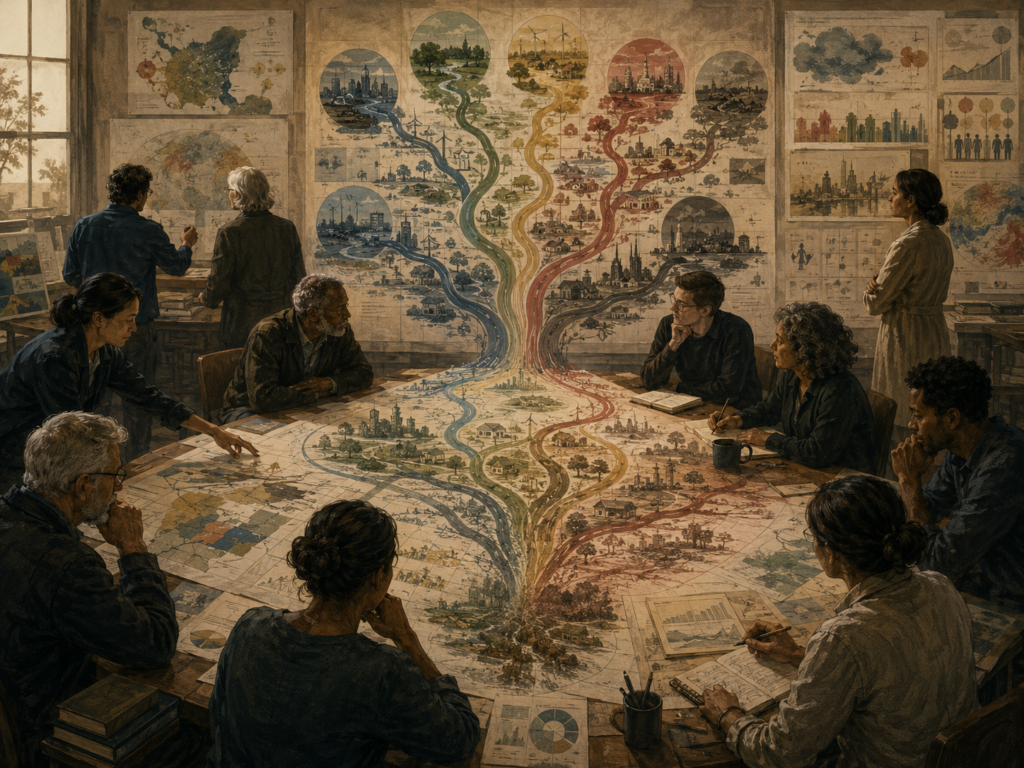
Researchers study branching future scenarios across maps, civic systems, infrastructure, ecology, and social change.

What Is Futures Thinking? Strategic Foresight and Long-Term Change

Futures Thinking is the disciplined practice of exploring multiple possible futures in order to improve present-day judgment, strategy, and decision-making under uncertainty. The article argues that the future is not singular or fully predictable, but open, contingent, and shaped by both structural forces and human choices. It develops this through the practical importance of long-term thinking, the distinction between futures thinking and prediction, the role of assumptions, major foresight methods, its relationship to foresight and forecasting, and its relevance for strategy, policy, complex systems, and sustainability. The article emphasizes that futures thinking is not about being right about the future, but about becoming more anticipatory, resilient, and strategically prepared before change becomes unavoidable.
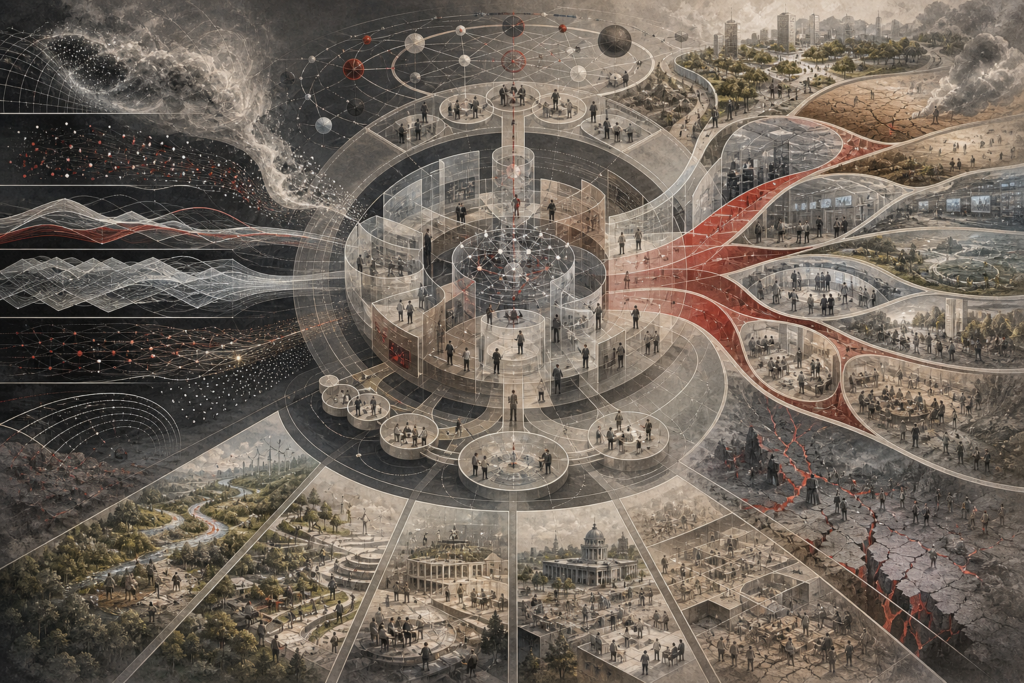
Editorial scientific illustration of futures thinking as an anticipatory reasoning systems architecture, showing branching future pathways, scenario planning, strategic foresight, horizon scanning, weak signals, uncertainty, backcasting, decision readiness, technology foresight, climate futures, institutional adaptation, sustainability transitions, and long-horizon responsibility.

Futures Thinking: Strategic Foresight for Complex Systems

Futures Thinking explores how individuals, organizations, and societies prepare for uncertainty by examining multiple possible futures rather than relying on a single forecast. The article argues that the future is not fixed or singular, but shaped by the interaction of human choices, institutions, technologies, ecological systems, and geopolitical forces. It develops this through the practical importance of long-range thinking, the distinction between prediction and preparation, the role of assumptions, major foresight methods, and the relationship between futures thinking, strategy, sustainability, and complex systems. The article also serves as the central architecture page for the wider knowledge series, organizing its methods, applications, governance themes, and strategic synthesis.

Scroll to Top