
Last Updated June 2, 2026
Futures literacy is the capacity to understand how people, institutions, and societies use ideas about the future to interpret the present and guide action. It is not the ability to predict what will happen. It is the ability to recognize how expectations, fears, hopes, scenarios, forecasts, assumptions, and imagined futures shape what people notice, value, plan, and choose today.
Anticipatory capacity is the broader ability to perceive emerging change, make sense of uncertainty, test assumptions, imagine alternatives, prepare for plausible futures, and revise action as conditions evolve. A futures-literate person or institution does not simply ask, “What will happen?” A futures-literate actor asks, “What future am I assuming? Where did that image come from? Who benefits from it? What alternatives are being excluded? What signals should I be watching? What choices remain responsible under uncertainty?”
This distinction matters because the future is never only a technical object. It is also a social, institutional, ethical, political, and imaginative field. Governments, firms, communities, schools, universities, media systems, investors, scientists, designers, and citizens all act on implicit futures. Some of those futures are explicit in plans, forecasts, models, and strategies. Others are hidden in habits, incentives, cultural narratives, procurement systems, infrastructure choices, and assumptions about what is possible.
Futures literacy gives those hidden futures a language. Anticipatory capacity turns that language into practice.
Main Library
Publications
Article Map
Futures Thinking
Related Topic
Systems Modeling
Related Topic
Resilience Thinking
Related Topic
Sustainable Development
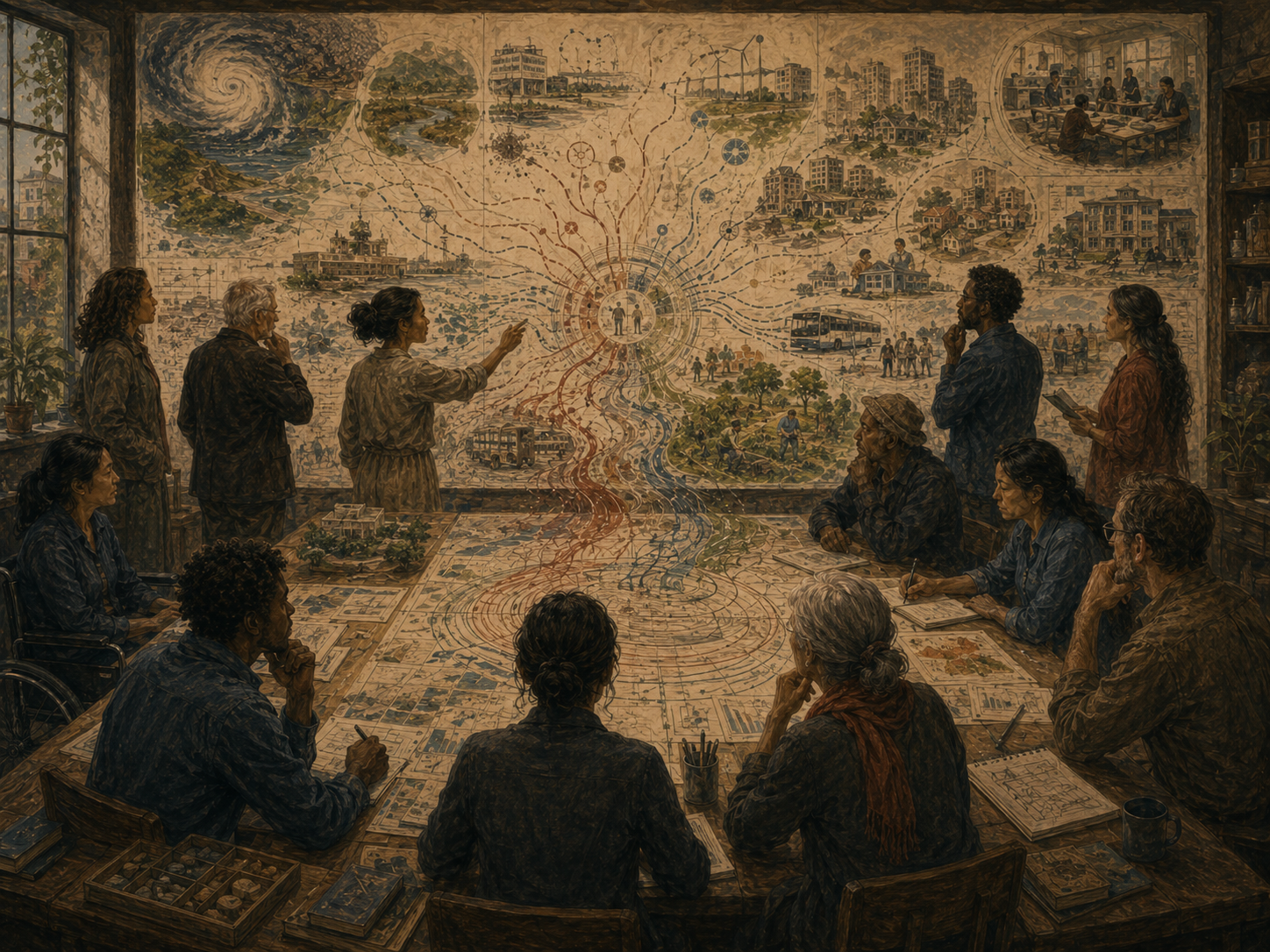
Futures literacy is therefore not a specialized skill reserved for professional futurists. It is a public, institutional, educational, and civic capability. It helps people understand how futures are used to justify present decisions, how anticipatory assumptions influence behavior, and how alternative futures can be explored without collapsing uncertainty into prediction or fantasy.
Why Futures Literacy Matters
Futures literacy matters because people are always using the future, even when they are not aware of doing so. A parent imagines possible futures when choosing a school. A city imagines future mobility when approving transportation infrastructure. A university imagines future knowledge needs when designing curricula. A company imagines future markets when investing in technology. A government imagines future risks when designing policy. A society imagines future obligations when deciding how much it owes to children, future generations, ecosystems, and vulnerable communities.
The problem is not that people imagine futures. They must. The problem is that many future images remain unconscious, inherited, narrow, or politically convenient. Some futures appear natural because institutions repeat them often enough. Some futures become dominant because they serve powerful interests. Some futures are treated as unrealistic because they come from marginalized communities, younger generations, Indigenous knowledge traditions, local experience, or people harmed by existing systems.
Futures literacy helps people ask more disciplined questions about these future images. It asks how a future is being used, what assumptions it carries, what evidence supports it, what emotions it mobilizes, what choices it justifies, and what alternatives it excludes. It makes the future less mysterious by showing that future images are part of present-day reasoning.
This is especially important in a world shaped by climate disruption, artificial intelligence, demographic change, ecological limits, institutional distrust, public-health risk, geopolitical uncertainty, and rapid technological transformation. In such conditions, people need more than forecasts. They need the ability to reason with uncertainty, prepare for multiple possibilities, and recognize when a single expected future has become too narrow to guide responsible action.
Futures literacy strengthens the quality of present judgment by making the use of the future more visible, reflective, and accountable.
What Futures Literacy Means
Futures literacy is the ability to understand the role of the future in present perception and action. It is not a talent for prediction. It is not optimism. It is not pessimism. It is not simply creativity. It is a form of reflective capacity: the ability to notice how assumptions about the future shape what people see, ignore, fear, desire, and decide.
UNESCO has framed Futures Literacy as a capability that helps people better understand the role of the future in what they see and do. That wording is important because it shifts attention away from the future as an object to be known and toward the future as a resource people use. A futures-literate person asks not only “What future is likely?” but also “How is this future being used in the present?”
For example, a forecast may be used to allocate resources. A scenario may be used to test strategy. A dystopian narrative may be used to warn, mobilize, or control. A technological vision may be used to attract investment. A collapse narrative may be used to justify withdrawal. A sustainability vision may be used to build cooperation, but it may also hide unequal burdens. Futures literacy helps distinguish these uses.
This makes futures literacy both analytical and ethical. It improves reasoning, but it also asks who has authority to imagine the future. It helps institutions prepare for change, but it also questions whether their imagined futures are inclusive, legitimate, and publicly contestable.
| Futures Literacy Is | Futures Literacy Is Not |
|---|---|
| A capability for understanding how the future shapes present perception and action. | A claim that the future can be known with certainty. |
| A way to surface assumptions, expectations, hopes, fears, and mental models. | A motivational exercise in optimism. |
| A discipline for exploring multiple possible, plausible, and preferable futures. | A license for vague speculation. |
| A public and institutional capacity that can be developed through practice. | A skill reserved only for futurists or forecasting experts. |
| A method for strengthening judgment under uncertainty. | A replacement for evidence, domain expertise, or analysis. |
Futures literacy therefore belongs alongside forecasting, foresight, systems thinking, resilience thinking, design, education, public policy, and civic imagination. It is the capability that helps people use all of these practices more consciously.
Anticipatory Capacity: From Awareness to Practice
Anticipatory capacity is the ability to perceive, interpret, prepare for, and respond to emerging futures. If futures literacy is the ability to understand how the future is being used, anticipatory capacity is the ability to turn that understanding into practice.
This capacity has several dimensions. It includes scanning for signals, recognizing patterns, identifying drivers of change, distinguishing uncertainty from ignorance, surfacing assumptions, creating scenarios, evaluating strategies, building adaptive options, learning from weak signals, and revising plans as conditions change. It also includes the institutional ability to make these practices routine rather than occasional.
An individual can have anticipatory capacity. So can a research team, school, business, city, ministry, civil society organization, university, or public agency. The scale differs, but the underlying problem is similar: how can present action remain intelligent when future conditions cannot be known in advance?
Anticipatory capacity does not eliminate uncertainty. It improves the ability to work with uncertainty. A city with strong anticipatory capacity does not know exactly how climate, migration, housing, heat, infrastructure, and public finance will interact over the next twenty years. But it can monitor key signals, test policies against scenarios, engage affected communities, revise assumptions, and avoid locking itself into brittle decisions.
A business with anticipatory capacity does not know exactly how technology, regulation, labor, markets, supply chains, and consumer behavior will evolve. But it can test strategy across alternative futures, maintain options, avoid overdependence on one expected pathway, and recognize early when assumptions are failing.
Anticipatory capacity is not the power to see the future. It is the discipline of becoming less fragile in relation to the future.
Core Capabilities of Futures Literacy
Futures literacy is not one skill. It is a cluster of capabilities that help people and institutions use the future more consciously. These capabilities can be taught, practiced, institutionalized, and evaluated. They are strongest when they combine imagination, evidence, critical reflection, participation, and strategic action.
1. Noticing Hidden Futures
Futures literacy begins with the ability to notice that future assumptions are already present. Policies, investments, curricula, product roadmaps, infrastructure plans, algorithms, budgets, and public narratives all contain implicit futures. The first capability is learning to see those futures rather than treating them as neutral background assumptions.
2. Distinguishing Prediction, Projection, Scenario, and Possibility
A futures-literate person can distinguish between a prediction, a projection, a scenario, a vision, a risk warning, a preferred future, and a speculative possibility. This matters because each mode has a different evidentiary status. Confusing them leads to false certainty, weak strategy, and poor public communication.
3. Surfacing Assumptions
Futures literacy requires making assumptions explicit. What is being assumed about technology, climate, institutions, markets, human behavior, public trust, ecological limits, or social stability? Which assumptions are evidence-based? Which are inherited habits? Which are convenient because they protect existing strategies?
4. Imagining Alternatives Without Losing Discipline
Futures literacy strengthens imagination, but not in the sense of free-floating fantasy. It supports disciplined imagination: the ability to explore multiple plausible futures grounded in drivers, uncertainties, signals, constraints, histories, and system dynamics. The point is not to imagine anything at all, but to avoid premature closure around one expected future.
5. Interpreting Signals and Weak Signals
Futures-literate actors learn to monitor early indicators of change. A weak signal is not proof of a future. It is a clue that a system may be shifting. Interpreting signals requires pattern recognition, humility, documentation, and repeated review rather than reactive overinterpretation.
6. Testing Strategy Across Futures
Futures literacy becomes strategic when it asks how present choices perform across different plausible futures. A strategy that works only under one expected pathway may be fragile. A strategy that remains useful across several futures may be more robust, even if it is less optimized for a single forecast.
7. Expanding Public Deliberation
Futures literacy has a democratic dimension. It asks whose futures are being imagined, who participates in future-making, and whose risks are ignored. Public participation, local knowledge, youth perspectives, marginalized voices, and affected communities are not decorative additions. They often reveal futures that dominant institutions fail to see.
8. Learning and Revision
Futures literacy requires revision. As signals change, assumptions weaken, and evidence evolves, future images must be revisited. A futures-literate institution builds learning cycles rather than treating a scenario exercise as a one-time event.
| Capability | Practical Question | Failure If Absent |
|---|---|---|
| Noticing hidden futures | What future is already embedded in this plan? | Assumptions remain invisible until they fail. |
| Distinguishing future modes | Is this a prediction, projection, scenario, vision, or warning? | Speculation and evidence are confused. |
| Surfacing assumptions | What must be true for this strategy to work? | Strategies become brittle under changed conditions. |
| Imagining alternatives | What plausible futures are being excluded? | Planning collapses into one expected pathway. |
| Interpreting signals | What early indicators suggest change may be emerging? | Institutions remain reactive. |
| Testing strategy | What works across multiple futures? | Plans optimize for one fragile forecast. |
| Public deliberation | Whose futures are included or excluded? | Future-making reproduces unequal power. |
| Learning and revision | How should assumptions be updated? | Foresight becomes static and ceremonial. |
These capabilities are mutually reinforcing. Futures literacy is strongest when people can move from awareness to imagination, from imagination to strategy, and from strategy to learning.
Different Uses of the Future
One of the most useful ideas in futures literacy is that the future is not only something people think about. It is something people use. Different futures are used for different purposes. Some futures are used to plan. Some are used to warn. Some are used to inspire. Some are used to sell. Some are used to govern. Some are used to delay action. Some are used to make alternatives seem impossible.
A forecast may be used to allocate resources. A scenario may be used to test strategy. A sustainability vision may be used to mobilize institutions around long-term transformation. A collapse narrative may be used to provoke action, but it may also produce paralysis. A techno-optimistic future may attract investment, but it may also obscure social risk. A national security future may support preparedness, but it may also justify secrecy or surveillance.
Futures literacy helps people ask how a future image functions in the present. What does it make visible? What does it hide? What emotions does it activate? What institutions does it empower? What actions does it justify? What actions does it delay?
| Use of the Future | Purpose | Example | Risk |
|---|---|---|---|
| Forecasting | Estimate likely values or trends. | Projecting future infrastructure demand. | False precision under structural uncertainty. |
| Planning | Coordinate action around expected conditions. | Budgeting for service needs. | Overcommitment to continuity. |
| Scenario exploration | Test assumptions across plausible futures. | Climate, technology, and governance scenarios. | Scenario theater if disconnected from decisions. |
| Warning | Identify severe risk or potential harm. | Public-health or climate-risk warnings. | Fear without actionable pathways. |
| Visioning | Clarify preferred futures. | Just transition, sustainable cities, resilient public systems. | Utopian language without institutional commitment. |
| Mobilization | Build collective action. | Youth climate movements, public futures assemblies. | Narrative simplification or exclusion. |
| Legitimation | Justify policy, investment, or institutional authority. | Innovation futures used to justify deregulation. | Future rhetoric masking present interests. |
| Delay | Postpone difficult action by invoking future solutions. | Waiting for hypothetical technology instead of reducing current risk. | Responsibility shifted to an imagined future. |
To become futures literate is to ask not only what future is being described, but what that future is doing.
Mental Models, Assumptions, and Future Images
Futures literacy is closely tied to mental models. A mental model is an internal representation of how a system works. People use mental models to interpret evidence, make predictions, evaluate risk, and decide what actions seem reasonable. Institutions also have mental models, embedded in rules, budgets, procurement systems, performance metrics, technologies, planning cycles, and professional cultures.
Future images often reveal these mental models. An institution that assumes continuous growth will imagine different futures than one that assumes ecological constraint. A technology firm that assumes innovation is inherently beneficial will imagine different futures than a community concerned about surveillance, displacement, and algorithmic harm. A city that assumes climate adaptation can be handled through engineering alone will imagine different futures than one that treats housing, health, inequality, infrastructure, and ecosystem restoration as linked problems.
Assumptions are powerful because they define what counts as realistic. They also define what is dismissed. Futures literacy makes assumptions discussable. It asks what beliefs support a plan, what evidence sustains those beliefs, what would indicate they are failing, and what groups experience the consequences if they are wrong.
| Assumption Type | Example | Futures Literacy Question |
|---|---|---|
| Continuity assumption | Past trends will remain useful guides. | What would change if historical relationships no longer held? |
| Technology assumption | New tools will increase efficiency and improve outcomes. | Who controls the technology, who benefits, and who bears risk? |
| Institutional assumption | Existing agencies will retain legitimacy and capacity. | What if trust, compliance, or coordination declines? |
| Behavioral assumption | People will respond rationally to incentives and information. | How might fear, identity, trauma, distrust, or inequality shape behavior? |
| Ecological assumption | Environmental conditions remain within manageable ranges. | What if slow variables cross thresholds? |
| Ethical assumption | The preferred future is broadly shared. | Whose preferences are being treated as universal? |
Futures literacy therefore works as an epistemic discipline. It teaches people to examine the assumptions behind their own futures before treating those futures as obvious, inevitable, or neutral.
Futures Literacy as a Learning Process
Futures literacy is learned through practice. It is not gained by memorizing one set of scenarios or reading one forecast. It develops when people repeatedly examine future assumptions, compare alternative possibilities, reflect on how expectations shape perception, and revise their thinking in response to new evidence and experience.
In educational and institutional settings, futures literacy can be developed through workshops, scenario labs, public deliberation, horizon scanning routines, assumption audits, futures games, backcasting exercises, systems mapping, speculative design, policy stress testing, and reflective writing. These practices are valuable when they help people become more conscious of how they use the future.
A futures literacy process usually includes three types of learning. First, participants make existing assumptions visible. Second, they encounter alternative futures that challenge those assumptions. Third, they reflect on how their perception of the present changes after engaging with those alternatives.
This learning process is often more important than the scenario outputs themselves. A scenario can be forgotten. A changed capacity for questioning assumptions can remain. The deeper goal is not to produce a perfect future map, but to strengthen the ability to use futures more intelligently in changing conditions.
| Learning Stage | Purpose | Typical Practice |
|---|---|---|
| Reveal | Make existing future assumptions visible. | Assumption audit, future-image mapping, expectation inventory. |
| Reframe | Introduce alternative plausible futures. | Scenario building, weak-signal interpretation, futures wheel. |
| Reflect | Examine how perception changes. | Dialogue, journaling, systems mapping, public deliberation. |
| Translate | Connect insight to action. | Backcasting, strategy testing, policy options, monitoring indicators. |
| Revise | Update assumptions over time. | Signal review, learning cycle, assumption register. |
Futures literacy is not only about imagining futures. It is about learning how imagination changes judgment.
Building Institutional Anticipatory Capacity
Institutions often struggle with the future because their routines are designed around current obligations, legacy systems, budget cycles, short-term metrics, political constraints, and inherited assumptions. Even when leaders recognize long-term risk, the institution may lack the structures needed to act on that recognition.
Building anticipatory capacity requires more than a foresight workshop. It requires routines, roles, data systems, governance processes, public engagement, leadership support, and institutional memory. It also requires the ability to connect future-oriented insight to real decisions: budgets, policies, infrastructure choices, curriculum design, technology governance, procurement, staffing, risk management, and accountability.
An institution with anticipatory capacity does several things well. It scans the environment. It documents signals. It tracks assumptions. It builds scenarios. It tests strategies. It listens to affected communities. It revises plans. It preserves learning across leadership changes. It does not treat futures work as a one-time exercise performed for symbolic legitimacy.
| Institutional Capacity | What It Requires | Observable Evidence |
|---|---|---|
| Scanning capacity | Routine monitoring of signals, drivers, and emerging issues. | Signal registers, horizon scans, domain watchlists. |
| Interpretive capacity | Ability to make sense of change across systems. | Driver maps, systems maps, cross-impact analysis. |
| Assumption capacity | Ability to identify and review hidden beliefs. | Assumption registers, vulnerability scores, review cycles. |
| Scenario capacity | Ability to explore multiple plausible futures. | Scenario sets, implications matrices, stress tests. |
| Decision capacity | Ability to connect futures work to strategy and policy. | Budget changes, adaptive plans, option portfolios. |
| Participation capacity | Ability to include affected communities and diverse knowledge systems. | Public workshops, community evidence, participatory foresight. |
| Learning capacity | Ability to update and preserve anticipatory knowledge. | Monitoring dashboards, after-action reviews, institutional memory. |
The most important test is whether futures work changes decisions. An institution may produce elegant scenarios while continuing to allocate resources exactly as before. That is not anticipatory capacity. It is performance. Real capacity appears when future-oriented learning changes what the institution monitors, funds, designs, postpones, accelerates, or stops doing.
Public Participation and Democratic Futures
Futures literacy has a public dimension because futures are not only expert objects. They are shared social and political questions. Public policy, climate adaptation, technology governance, migration, education, public health, infrastructure, and urban planning all involve futures that affect people who may not have formal authority over decision-making.
Democratic futures work asks who gets to participate in imagining and shaping future conditions. It challenges the idea that experts alone should define the future. Expert knowledge is important, but it is incomplete without lived experience, community knowledge, frontline practice, historical memory, and attention to unequal power.
Public participation can reveal risks that formal models miss. Residents may understand flooding patterns, heat exposure, transit barriers, local health vulnerabilities, informal care systems, police-community relations, labor precarity, or digital exclusion in ways that institutional datasets do not. Youth may identify long-term concerns that short election cycles ignore. Marginalized communities may reveal how official futures reproduce patterns of extraction, neglect, displacement, or surveillance.
Participatory futures work should not be symbolic. It should influence choices. Public workshops, civic assemblies, community foresight labs, scenario dialogues, participatory mapping, and youth futures processes are strongest when they connect to governance, budgets, design, planning, and accountability.
The democratic question is not simply “What future should we prepare for?” It is “Who has the power to define, contest, and shape the futures we are preparing for?”
Futures Literacy in Education and Research
Futures literacy belongs in education because students are already living inside contested futures. Climate change, artificial intelligence, democratic institutions, labor markets, biodiversity, public health, migration, inequality, and knowledge systems will shape their lives. Education that treats the future only as career preparation is too narrow. Students also need the capacity to understand uncertainty, examine assumptions, imagine alternatives, and participate responsibly in future-making.
In schools and universities, futures literacy can be integrated into social studies, science, environmental studies, economics, philosophy, design, engineering, public policy, literature, history, and civic education. It is especially powerful when it connects technical knowledge with ethical reasoning. For example, climate education can combine emissions pathways with adaptation scenarios and environmental justice. Technology education can combine AI capabilities with governance, labor, privacy, and public accountability. Economics can combine growth projections with ecological limits, inequality, and alternative development models.
Research institutions also need futures literacy. Scientific and technical research often shapes future possibilities, but researchers may not always examine the social assumptions embedded in their work. Futures literacy can help research teams ask how their models, prototypes, methods, and funding priorities participate in future-making.
| Educational Setting | Futures Literacy Practice | Learning Outcome |
|---|---|---|
| High school civics | Community futures mapping. | Students connect public decisions to long-term consequences. |
| Environmental science | Climate scenarios and adaptation pathways. | Students distinguish projection, scenario, and policy choice. |
| Technology studies | AI futures and governance debates. | Students examine technological assumptions and public accountability. |
| Urban planning | Participatory scenario workshops. | Students learn how futures differ across communities. |
| Business education | Strategy stress testing. | Students evaluate robustness rather than only forecast optimization. |
| Research methods | Assumption registers and uncertainty documentation. | Researchers make model limits more explicit. |
Futures literacy in education should not train students to predict the future. It should train them to ask better questions about the futures they inherit, imagine, contest, and help create.
Anticipatory Governance
Anticipatory governance connects futures literacy to public institutions. It asks how governments and organizations can use foresight, learning, innovation, participation, and adaptive policy to govern emerging risks and opportunities before consequences become irreversible.
Traditional governance often reacts after harms become visible. Anticipatory governance tries to detect signals earlier, involve relevant publics sooner, examine uncertainty more explicitly, and build adaptive mechanisms into policy. This is especially important for climate change, artificial intelligence, biotechnology, infrastructure, public health, financial risk, migration, and ecological degradation.
Anticipatory governance requires institutional humility. It recognizes that public institutions cannot know the future fully. But they can build better routines for learning. They can monitor signals, test strategies, consult affected communities, revise policies, and avoid locking society into fragile or unjust pathways.
It also requires accountability. Anticipation can be used to justify secrecy, security expansion, technocratic control, or elite planning. Responsible anticipatory governance must therefore be transparent, publicly contestable, evidence-informed, participatory, and attentive to unequal risk.
| Governance Function | Anticipatory Practice | Public Value |
|---|---|---|
| Risk identification | Horizon scanning and early warning systems. | Public institutions detect emerging harms sooner. |
| Policy design | Scenario testing and adaptive pathways. | Policies remain useful under changing conditions. |
| Public legitimacy | Participatory foresight and public deliberation. | Communities help shape futures that affect them. |
| Learning | Assumption review and signal monitoring. | Institutions update policy as evidence changes. |
| Accountability | Transparent documentation of assumptions and tradeoffs. | Future-oriented decisions can be contested and reviewed. |
Anticipatory governance is the institutional expression of futures literacy: it turns the ability to use the future more consciously into public practice.
Risks and Misuse of Futures Literacy
Futures literacy can be misused. Because it deals with imagination, uncertainty, and possibility, it can become vague, decorative, manipulative, or detached from material conditions. It can also be captured by powerful institutions that invite participation without transferring influence.
One common misuse is inspirational futurism: workshops that encourage people to imagine futures but do not connect those futures to decisions, constraints, accountability, or implementation. Another is corporate future-washing: using future-oriented language to present ordinary strategy as visionary while avoiding difficult questions about labor, ecology, inequality, or governance. A third is technocratic anticipation: treating futures work as a specialist exercise that excludes the public from decisions made in their name.
Futures literacy also risks becoming too individualistic if it is framed only as a personal mindset. The future is not shaped only by individual imagination. It is shaped by institutions, law, capital, infrastructure, technology, colonial histories, ecological systems, and political power. A serious futures literacy practice must therefore connect individual capacity to collective and institutional conditions.
| Failure Mode | Description | Corrective Practice |
|---|---|---|
| Inspirational futurism | Future imagination without decision consequences. | Connect futures work to strategy, budgets, governance, and action. |
| Future-washing | Using future language to legitimize existing interests. | Document assumptions, beneficiaries, risks, and tradeoffs. |
| Technocratic capture | Experts define futures without public participation. | Use participatory and publicly contestable processes. |
| False inclusivity | Communities are consulted but not influential. | Give affected groups visible influence over decisions. |
| Speculative drift | Imagination loses connection to evidence and constraints. | Ground scenarios in drivers, signals, history, and systems analysis. |
| Paralysis by possibility | Too many futures prevent action. | Translate scenarios into robust options, indicators, and next steps. |
Good futures literacy does not merely widen imagination. It disciplines imagination so that present action becomes more responsible.
A Practical Futures Literacy Workflow
A practical futures literacy workflow helps people move from hidden assumptions to reflective action. The workflow below can be used in classrooms, research groups, public agencies, civic organizations, strategy teams, or community planning processes.
| Stage | Purpose | Guiding Questions | Outputs |
|---|---|---|---|
| 1. Identify the focal issue | Clarify the decision, system, or public question. | What future-relevant issue are we examining? | Focal question, scope, time horizon. |
| 2. Map existing future images | Reveal implicit expectations, hopes, fears, and assumptions. | What future do we already assume? | Future-image map, assumption list. |
| 3. Scan for signals and drivers | Identify emerging change and structural forces. | What is changing? What weak signals matter? | Signal register, driver map. |
| 4. Explore alternative futures | Challenge the dominant expected future. | What plausible futures could emerge if key uncertainties unfold differently? | Scenario set, future narratives, implications matrix. |
| 5. Reflect on perception change | Examine how alternative futures reshape present understanding. | What do we see differently now? | Learning notes, revised assumptions. |
| 6. Translate into action | Connect futures literacy to decisions. | What should we monitor, change, stop, protect, or begin? | Action options, indicators, adaptive strategy. |
| 7. Review and revise | Build a learning cycle. | What signals suggest our assumptions need updating? | Monitoring plan, review schedule, updated register. |
The workflow is deliberately cyclical. Futures literacy is not completed once a workshop ends. It deepens as people revisit assumptions, learn from signals, and connect imagination to responsibility.
Mathematical Lens: Anticipatory Capacity and Assumption Vulnerability
Futures literacy can be represented conceptually as a relationship among perception, assumptions, imagination, and action. Let an actor’s present decision be represented as:
D_t = f(E_t, A_t, I_t, C_t)
\]
Interpretation: \(D_t\) is the decision at time \(t\), \(E_t\) is available evidence, \(A_t\) is the set of assumptions, \(I_t\) is the imagined future or future image, and \(C_t\) represents constraints such as institutions, resources, law, politics, and capacity.
Futures literacy improves decision quality by making \(A_t\) and \(I_t\) more visible. Instead of treating assumptions and future images as hidden background conditions, it subjects them to reflection and revision.
Anticipatory capacity can be represented as a composite capability:
AC = w_sS + w_iI + w_aA + w_pP + w_lL
\]
Interpretation: \(AC\) is anticipatory capacity. \(S\) is scanning capacity, \(I\) is interpretive capacity, \(A\) is assumption visibility, \(P\) is participatory depth, and \(L\) is learning capacity. The weights \(w\) express the relative importance of each dimension in a specific institutional context.
Assumption vulnerability can be expressed as:
V_j = E_j(1 – C_j)(1 + (1 – R_j))
\]
Interpretation: \(V_j\) is the vulnerability of assumption \(j\), \(E_j\) is exposure if the assumption fails, \(C_j\) is confidence in the assumption, and \(R_j\) is reversibility. An assumption is more dangerous when exposure is high, confidence is low, and reversal is difficult.
Signal priority can be represented as:
W_m = \alpha U_m + \beta I_m + \gamma N_m
\]
Interpretation: \(W_m\) is the watch score for signal \(m\), \(U_m\) is uncertainty, \(I_m\) is potential impact, and \(N_m\) is novelty. The coefficients \(\alpha\), \(\beta\), and \(\gamma\) can be adjusted depending on whether the institution is prioritizing uncertainty, impact, or early novelty.
These formulas do not reduce futures literacy to mathematics. They make its logic explicit: better anticipation requires scanning, interpretation, assumption review, participation, and learning.
Computational Modeling for Futures Literacy
Computational modeling can support futures literacy when it makes assumptions, signals, and learning cycles more visible. It should not pretend to predict the future. Its purpose is to help people document future images, compare assumptions, prioritize signals, evaluate vulnerabilities, and track how strategic thinking changes over time.
A useful computational workflow for futures literacy might include:
- Future-image registers: structured records of the futures assumed by different stakeholders.
- Assumption registers: documentation of key assumptions, confidence, exposure, reversibility, and monitoring signals.
- Signal databases: ongoing records of weak signals, emerging issues, and early indicators.
- Anticipatory capacity profiles: scoring across scanning, interpretation, assumption visibility, participation, and learning.
- Scenario learning logs: records of how scenarios changed participants’ understanding of the present.
- Strategy translation tables: links between futures insight and concrete actions, indicators, and review cycles.
The goal is not to create an illusion of precision. The goal is to give futures literacy a durable memory. Without documentation, future-oriented learning often disappears after a workshop. With reproducible systems, institutions can track assumptions, update signals, compare learning cycles, and connect anticipatory insight to decisions.
Advanced R Workflow: Futures Literacy Profiles
The R workflow below creates a stylized comparison of futures literacy profiles across different organizational orientations. It uses scanning capacity, assumption visibility, imagination range, participatory depth, learning capacity, and action translation as core dimensions.
# ------------------------------------------------------------
# R Workflow: Futures Literacy and Anticipatory Capacity
# Purpose:
#   Compare organizational futures-literacy profiles across
#   scanning, assumptions, imagination, participation, learning,
#   and translation into action.
#
# Optional dependency:
#   install.packages(c("tidyverse"))
# ------------------------------------------------------------

library(tidyverse)

profiles <- tibble(
  orientation = c(
    "Forecast-Dependent Organization",
    "Scenario-Aware Organization",
    "Futures-Literate Organization",
    "Participatory Anticipatory Institution"
  ),
  scanning_capacity = c(0.32, 0.64, 0.82, 0.86),
  assumption_visibility = c(0.28, 0.61, 0.88, 0.84),
  imagination_range = c(0.24, 0.70, 0.90, 0.88),
  participatory_depth = c(0.18, 0.46, 0.72, 0.94),
  learning_capacity = c(0.30, 0.58, 0.84, 0.88),
  action_translation = c(0.42, 0.66, 0.80, 0.82)
)

weights <- tibble(
  dimension = c(
    "scanning_capacity",
    "assumption_visibility",
    "imagination_range",
    "participatory_depth",
    "learning_capacity",
    "action_translation"
  ),
  weight = c(0.16, 0.18, 0.16, 0.18, 0.17, 0.15)
)

profiles_long <- profiles %>%
  pivot_longer(
    cols = -orientation,
    names_to = "dimension",
    values_to = "value"
  ) %>%
  left_join(weights, by = "dimension") %>%
  mutate(weighted_value = value * weight)

capacity_scores <- profiles_long %>%
  group_by(orientation) %>%
  summarise(
    anticipatory_capacity_score = sum(weighted_value),
    weakest_dimension = dimension[which.min(value)],
    strongest_dimension = dimension[which.max(value)],
    .groups = "drop"
  ) %>%
  arrange(desc(anticipatory_capacity_score))

print(capacity_scores)

ggplot(profiles_long, aes(x = dimension, y = value, fill = orientation)) +
  geom_col(position = "dodge") +
  coord_flip() +
  labs(
    title = "Futures Literacy Profiles",
    subtitle = "Stylized comparison of anticipatory capacity dimensions",
    x = "Dimension",
    y = "Relative capacity",
    fill = "Orientation"
  ) +
  theme_minimal(base_size = 12)

ggplot(capacity_scores, aes(x = reorder(orientation, anticipatory_capacity_score), y = anticipatory_capacity_score)) +
  geom_col() +
  coord_flip() +
  labs(
    title = "Anticipatory Capacity Score",
    x = "Orientation",
    y = "Weighted score"
  ) +
  theme_minimal(base_size = 12)

dir.create("outputs", showWarnings = FALSE)
write_csv(capacity_scores, "outputs/futures_literacy_capacity_scores.csv")
write_csv(profiles_long, "outputs/futures_literacy_profiles_long.csv")
This workflow is a teaching and diagnostic tool. It does not measure an actual institution without real data. Its purpose is to show how futures literacy can be translated into dimensions that support reflection, comparison, and institutional learning.
Advanced Python Workflow: Anticipatory Capacity and Signal Learning
The Python workflow below creates a simplified anticipatory-capacity model. It scores assumptions by vulnerability, signals by watch priority, and organizations by their capacity to scan, interpret, participate, learn, and translate futures work into action.
# ------------------------------------------------------------
# Python Workflow: Futures Literacy and Anticipatory Capacity
# Purpose:
#   Model assumption vulnerability, signal watch scores, and
#   anticipatory capacity across organizational orientations.
#
# Optional dependencies:
#   pip install pandas numpy matplotlib
# ------------------------------------------------------------

from pathlib import Path

import numpy as np
import pandas as pd
import matplotlib.pyplot as plt

OUTPUT_DIR = Path("outputs")
OUTPUT_DIR.mkdir(exist_ok=True)

assumptions = pd.DataFrame([
    {
        "assumption": "Historical trends remain reliable guides",
        "domain": "forecasting",
        "confidence": 0.52,
        "exposure": 0.86,
        "reversibility": 0.40
    },
    {
        "assumption": "Technology adoption will improve institutional capacity",
        "domain": "technology",
        "confidence": 0.48,
        "exposure": 0.82,
        "reversibility": 0.38
    },
    {
        "assumption": "Public trust remains sufficient for coordinated response",
        "domain": "governance",
        "confidence": 0.50,
        "exposure": 0.88,
        "reversibility": 0.42
    },
    {
        "assumption": "Climate stress remains within planned adaptation ranges",
        "domain": "climate",
        "confidence": 0.42,
        "exposure": 0.92,
        "reversibility": 0.30
    },
    {
        "assumption": "Public participation slows decisions more than it improves legitimacy",
        "domain": "participation",
        "confidence": 0.44,
        "exposure": 0.64,
        "reversibility": 0.62
    }
])

assumptions["vulnerability_score"] = (
    assumptions["exposure"] *
    (1 - assumptions["confidence"]) *
    (1 + (1 - assumptions["reversibility"]))
)

signals = pd.DataFrame([
    {
        "signal": "AI decision systems moving into public services",
        "domain": "technology",
        "uncertainty": 0.76,
        "impact": 0.88,
        "novelty": 0.74
    },
    {
        "signal": "Compound heat and infrastructure stress events increasing",
        "domain": "climate",
        "uncertainty": 0.68,
        "impact": 0.92,
        "novelty": 0.66
    },
    {
        "signal": "Declining public trust in administrative institutions",
        "domain": "governance",
        "uncertainty": 0.82,
        "impact": 0.86,
        "novelty": 0.70
    },
    {
        "signal": "Youth-led public futures assemblies expanding",
        "domain": "participation",
        "uncertainty": 0.72,
        "impact": 0.70,
        "novelty": 0.82
    }
])

signals["watch_score"] = (
    0.35 * signals["uncertainty"] +
    0.40 * signals["impact"] +
    0.25 * signals["novelty"]
)

profiles = pd.DataFrame([
    {
        "orientation": "Forecast-Dependent Organization",
        "scanning_capacity": 0.32,
        "interpretive_capacity": 0.38,
        "assumption_visibility": 0.28,
        "participatory_depth": 0.18,
        "learning_capacity": 0.30,
        "action_translation": 0.42
    },
    {
        "orientation": "Scenario-Aware Organization",
        "scanning_capacity": 0.64,
        "interpretive_capacity": 0.68,
        "assumption_visibility": 0.61,
        "participatory_depth": 0.46,
        "learning_capacity": 0.58,
        "action_translation": 0.66
    },
    {
        "orientation": "Futures-Literate Organization",
        "scanning_capacity": 0.82,
        "interpretive_capacity": 0.84,
        "assumption_visibility": 0.88,
        "participatory_depth": 0.72,
        "learning_capacity": 0.84,
        "action_translation": 0.80
    },
    {
        "orientation": "Participatory Anticipatory Institution",
        "scanning_capacity": 0.86,
        "interpretive_capacity": 0.82,
        "assumption_visibility": 0.84,
        "participatory_depth": 0.94,
        "learning_capacity": 0.88,
        "action_translation": 0.82
    }
])

weights = {
    "scanning_capacity": 0.16,
    "interpretive_capacity": 0.16,
    "assumption_visibility": 0.18,
    "participatory_depth": 0.18,
    "learning_capacity": 0.17,
    "action_translation": 0.15
}

profiles["anticipatory_capacity_score"] = sum(
    profiles[column] * weight for column, weight in weights.items()
)

assumptions = assumptions.sort_values("vulnerability_score", ascending=False)
signals = signals.sort_values("watch_score", ascending=False)
profiles = profiles.sort_values("anticipatory_capacity_score", ascending=False)

print("\nMost vulnerable assumptions:")
print(assumptions[["domain", "assumption", "vulnerability_score"]])

print("\nHighest-priority signals:")
print(signals[["domain", "signal", "watch_score"]])

print("\nAnticipatory capacity profiles:")
print(profiles[["orientation", "anticipatory_capacity_score"]])

assumptions.to_csv(OUTPUT_DIR / "assumption_vulnerability_scores.csv", index=False)
signals.to_csv(OUTPUT_DIR / "signal_watch_scores.csv", index=False)
profiles.to_csv(OUTPUT_DIR / "anticipatory_capacity_profiles.csv", index=False)

plt.figure(figsize=(10, 6))
plt.barh(assumptions["assumption"], assumptions["vulnerability_score"])
plt.xlabel("Vulnerability score")
plt.title("Assumption Vulnerability Scores")
plt.tight_layout()
plt.savefig(OUTPUT_DIR / "assumption_vulnerability_scores.png", dpi=150)
plt.close()

plt.figure(figsize=(10, 6))
plt.barh(signals["signal"], signals["watch_score"])
plt.xlabel("Watch score")
plt.title("Signal Watch Scores")
plt.tight_layout()
plt.savefig(OUTPUT_DIR / "signal_watch_scores.png", dpi=150)
plt.close()

plt.figure(figsize=(10, 6))
plt.barh(profiles["orientation"], profiles["anticipatory_capacity_score"])
plt.xlabel("Anticipatory capacity score")
plt.title("Anticipatory Capacity Profiles")
plt.tight_layout()
plt.savefig(OUTPUT_DIR / "anticipatory_capacity_profiles.png", dpi=150)
plt.close()
This workflow demonstrates how futures literacy can be operationalized without pretending to predict the future. It helps identify vulnerable assumptions, high-priority signals, and the institutional capacities needed to learn from uncertainty.
GitHub Repository
The companion repository for this article contains computational examples for futures literacy, anticipatory capacity, signal learning, assumption vulnerability, participatory foresight, and institutional readiness.
Complete Code Repository
The companion code for this article is located in articles/futures-literacy-and-anticipatory-capacity/ and includes Python, R, Julia, SQL, Rust, Go, C++, Fortran, C, documentation, synthetic datasets, outputs, and notebook placeholders for applied futures literacy workflows.
| Directory | Purpose |
|---|---|
python/ |
Assumption vulnerability, signal watch scoring, anticipatory capacity profiles, and institutional learning examples. |
r/ |
Futures literacy profiles, weighted capacity scoring, and comparison workflows. |
julia/ |
Dynamic anticipatory-capacity and uncertainty examples. |
sql/ |
Schemas for future images, assumptions, signals, learning cycles, participants, and strategy translation. |
rust/ |
Command-line diagnostics scaffold for assumption and signal scoring. |
go/ |
Signal and anticipatory-capacity utility scaffold. |
cpp/ |
Efficient capacity-scoring and scenario-comparison examples. |
fortran/ |
Numerical readiness and capacity examples. |
c/ |
Low-level scoring utilities for assumption vulnerability and signal priority. |
docs/ |
Methodology notes, data dictionary, assumption register, and reproducibility guidance. |
data/ |
Synthetic datasets for futures literacy and anticipatory capacity examples. |
outputs/ |
Generated summaries, diagnostics, tables, and figures. |
notebooks/ |
Notebook placeholders for exploratory workflows. |
Why This Matters
Futures literacy matters because the future is not only something that happens later. It is a force already operating in the present. Expectations shape investment. Fear shapes policy. Hope shapes movements. Forecasts shape budgets. Scenarios shape strategy. Narratives shape legitimacy. Assumptions shape what institutions notice and ignore.
Anticipatory capacity matters because uncertainty cannot be eliminated. Societies need ways to prepare, adapt, deliberate, and learn without pretending that the future is fully knowable. This is especially important for climate change, artificial intelligence, public health, infrastructure, education, governance, and social-ecological systems, where decisions made today may shape conditions for decades.
Futures literacy does not ask people to become prophets. It asks them to become more responsible users of the future. It strengthens imagination, but it also disciplines imagination with evidence, participation, ethics, and learning. It helps institutions move beyond passive reaction and beyond false certainty.
The central question of futures literacy is not “Can we know the future?” It is “Can we become more conscious, capable, and accountable in how we use the future to act in the present?”
Related Articles
- Futures Thinking
- What Is Futures Thinking?
- Forecasting, Foresight, and Futures Studies
- Possible, Plausible, Probable, and Preferable Futures
- Scenario Planning
- Strategic Foresight Methods
- Anticipatory Governance
- Systems Modeling
- Resilience Thinking
Further Reading
- Bell, W. (1997) Foundations of Futures Studies: Human Science for a New Era. Volume 1: History, Purposes, and Knowledge. New Brunswick, NJ: Transaction Publishers.
- Inayatullah, S. (2008) ‘Six pillars: futures thinking for transforming’, Foresight, 10(1), pp. 4–21. Available at: Emerald.
- Karlsen, J.E. (2021) ‘Futures literacy in the loop’, European Journal of Futures Research, 9(17). Available at: Springer Nature.
- Miller, R. (ed.) (2018) Transforming the Future: Anticipation in the 21st Century. Paris: UNESCO Publishing. Available at: UNESCO.
- Miller, R. (2018) Futures Literacy: Transforming the Future. Paris: UNESCO. Available at: UNESCO Digital Library.
- Organisation for Economic Co-operation and Development (OECD) (2025) Building Anticipatory Capacity with Strategic Foresight in Government. Available at: OECD.
- Slaughter, R.A. (2004) Futures Beyond Dystopia: Creating Social Foresight. London: Routledge.
- Voros, J. (2003) ‘A generic foresight process framework’, Foresight, 5(3), pp. 10–21. Available at: Emerald.
References
- Bell, W. (1997) Foundations of Futures Studies: Human Science for a New Era. Volume 1: History, Purposes, and Knowledge. New Brunswick, NJ: Transaction Publishers.
- Inayatullah, S. (2008) ‘Six pillars: futures thinking for transforming’, Foresight, 10(1), pp. 4–21. Available at: Emerald.
- Karlsen, J.E. (2021) ‘Futures literacy in the loop’, European Journal of Futures Research, 9(17). Available at: Springer Nature.
- Miller, R. (ed.) (2018) Transforming the Future: Anticipation in the 21st Century. Paris: UNESCO Publishing. Available at: UNESCO.
- Organisation for Economic Co-operation and Development (OECD) (no date) Anticipatory Governance. Available at: OECD.
- Organisation for Economic Co-operation and Development (OECD) (2025) Building Anticipatory Capacity with Strategic Foresight in Government. Available at: OECD.
- Organisation for Economic Co-operation and Development Observatory of Public Sector Innovation (OECD OPSI) (no date) Futures & Foresight. Available at: OECD OPSI.
- Slaughter, R.A. (2004) Futures Beyond Dystopia: Creating Social Foresight. London: Routledge.
- United Nations Educational, Scientific and Cultural Organization (UNESCO) (no date) Futures Literacy & Foresight. Available at: UNESCO.
- United Nations Educational, Scientific and Cultural Organization (UNESCO) (no date) About Futures Literacy. Available at: UNESCO.
- UK Government Office for Science (2025) A Brief Guide to Futures Thinking and Foresight. London: Government Office for Science. Available at: UK Government.
- UK Government Office for Science (2024) The Futures Toolkit. London: Government Office for Science. Available at: UK Government.
- Voros, J. (2003) ‘A generic foresight process framework’, Foresight, 5(3), pp. 10–21. Available at: Emerald.