Futures Thinking

Futures thinking explores structured methods for analyzing long-term uncertainty and anticipating potential transformations in technological, economic, and social systems. Rather than attempting to predict a single future, futures thinking investigates multiple plausible futures to help organizations prepare for emerging risks and opportunities.

The field includes a range of foresight methodologies, including scenario planning, horizon scanning, trend analysis, and strategic foresight modeling. These tools help decision-makers identify early signals of change and explore how current decisions may shape long-term outcomes.

Futures thinking plays an important role in strategic planning, innovation management, public policy development, and sustainability research. Many global challenges—including climate change, demographic transitions, and technological disruption—unfold over decades and require institutions to plan beyond short-term horizons.

By expanding the temporal scope of decision-making, futures thinking enables organizations to develop strategies that remain robust across a range of possible futures.

Scientists study biotechnology futures through laboratory research, plant systems, ecological monitoring, agriculture, and community health planning.

Biotechnology Futures: Gene Editing, Synthetic Biology, Biosecurity, and Justice

Biotechnology futures concern humanity’s growing power to read, edit, design, synthesize, manufacture, and govern living systems. This article examines biotechnology as a long-term transformation across medicine, agriculture, food systems, public health, ecosystems, manufacturing, climate adaptation, biosecurity, and ethics. It explores genomics, gene editing, synthetic biology, biomanufacturing, precision medicine, agricultural biotechnology, environmental biotechnology, AI-enabled biological design, and dual-use governance. The central issue is not only what biotechnology can make possible, but how societies decide what should be developed, who benefits, who bears risk, and how living systems should be protected. A responsible biotechnology future requires public legitimacy, ecological humility, equitable access, community consent, biosafety, biosecurity, democratic oversight, and justice for communities historically exposed to medical exploitation, environmental harm, biological extraction, and exclusion from scientific benefit. It frames biology as public infrastructure, ethical frontier, ecological responsibility, and intergenerational planetary governance challenge.
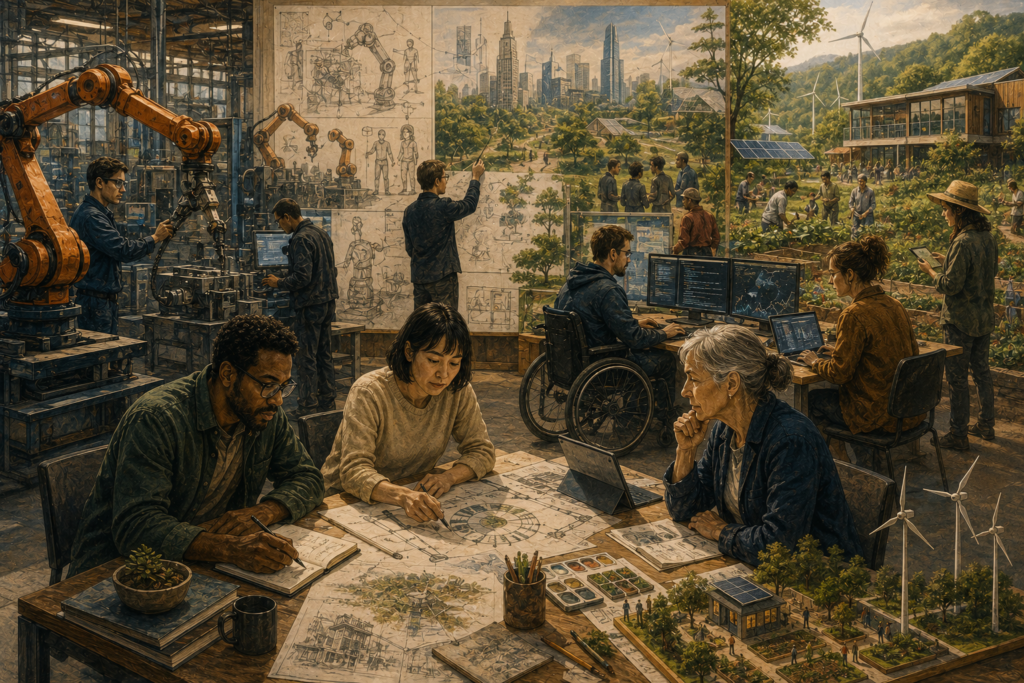

People collaborate across automated manufacturing, digital work, research planning, renewable infrastructure, and community-based labor systems.

The Future of Work and Automation: AI, Jobs, Skills, and Worker Power

Automation is reshaping work not only by replacing tasks, but by reorganizing jobs, skills, management, wages, worker power, and social protection. The future of work depends on how societies govern AI, robotics, algorithmic management, platform labor, care work, productivity gains, and transition risk. This article examines automation as a social and institutional transformation rather than a purely technical process. It explains why occupations should be analyzed as task bundles, how augmentation differs from substitution, why reskilling alone is insufficient, and how worker voice, collective bargaining, job quality, privacy, and public policy shape technological outcomes. A just automation future requires more than productivity growth. It requires shared gains, dignified work, care infrastructure, social protection, training access, and democratic control over the systems that redesign labor. It also foregrounds surveillance, inequality, platform precarity, skill mobility, and care as essential public infrastructure.

Researchers organize foresight data, maps, models, workflows, and reproducible analysis pipelines across civic, ecological, and institutional systems.

Foresight Data Systems and Reproducible Workflows

Foresight Data Systems and Reproducible Workflows examines how futures thinking can become durable knowledge infrastructure rather than a one-time workshop, report, or strategy exercise. The article explains how drivers, weak signals, scenarios, assumptions, indicators, strategy tests, evidence records, metadata, provenance, lineage, validation rules, workflow logs, and learning records can be organized so future-facing analysis remains traceable, reviewable, and reusable. It shows why reproducibility matters when foresight informs public policy, climate adaptation, AI governance, infrastructure planning, health preparedness, institutional strategy, and long-term investment. By connecting schema design, version control, data quality, scenario traceability, assumption fragility, workflow automation, dashboard design, privacy, ethics, and institutional memory, the article frames reproducible foresight as both a technical practice and a public accountability discipline for making uncertain futures work transparent, revisable, and responsible over time.

Researchers monitor global early warning signals across climate, health, food, water, infrastructure, governance, and ecological systems.

Early Warning Systems and Futures Intelligence: Detecting Signals Before Crisis

Early Warning Systems and Futures Intelligence examines how institutions detect weak signals, monitor thresholds, test assumptions, and translate emerging risks into timely action before disruption becomes crisis. The article explains why warning systems are more than alerts, dashboards, or forecasts: they require risk knowledge, data quality, interpretation, communication, authority, trust, response protocols, and learning loops. It connects climate-health stress, AI accountability failures, care workforce strain, infrastructure fragility, energy burden, ecological conflict, public finance pressure, and institutional trust decline to broader futures intelligence practices. By distinguishing signals, indicators, thresholds, triggers, scenarios, assumptions, and response pathways, the article shows how organizations can build warning systems that are actionable, equitable, and accountable. It frames early warning as a public learning system for protecting people, preserving options, and adapting strategy under uncertainty across complex social, ecological, technological, fiscal, and institutional systems over time.

A foresight group evaluates robust strategies across multiple future scenarios involving climate disruption, infrastructure stress, governance, technology, and ecological change.

Strategic Robustness Across Futures: Stress-Testing Strategy Under Deep Uncertainty

Strategic Robustness Across Futures examines how institutions, policymakers, researchers, and organizations can design strategies that remain viable across multiple plausible futures rather than depending on one forecast. The article explains why optimization can become brittle under deep uncertainty, especially when climate shocks, fiscal constraint, public mistrust, technological acceleration, ecological stress, geopolitical disruption, and institutional fragmentation interact. It shows how scenario testing, stress testing, regret analysis, vulnerability diagnosis, adaptive pathways, monitoring triggers, and multi-criteria performance assessment help identify strategies that preserve purpose, legitimacy, equity, resilience, and future options. By comparing effectiveness, feasibility, affordability, public trust, distributional burden, adaptability, and transformability across different futures, the article frames robustness as a disciplined approach to uncertainty: not prediction, not caution, but strategic preparation for futures that may challenge assumptions, expose failure modes, and require timely adaptation.

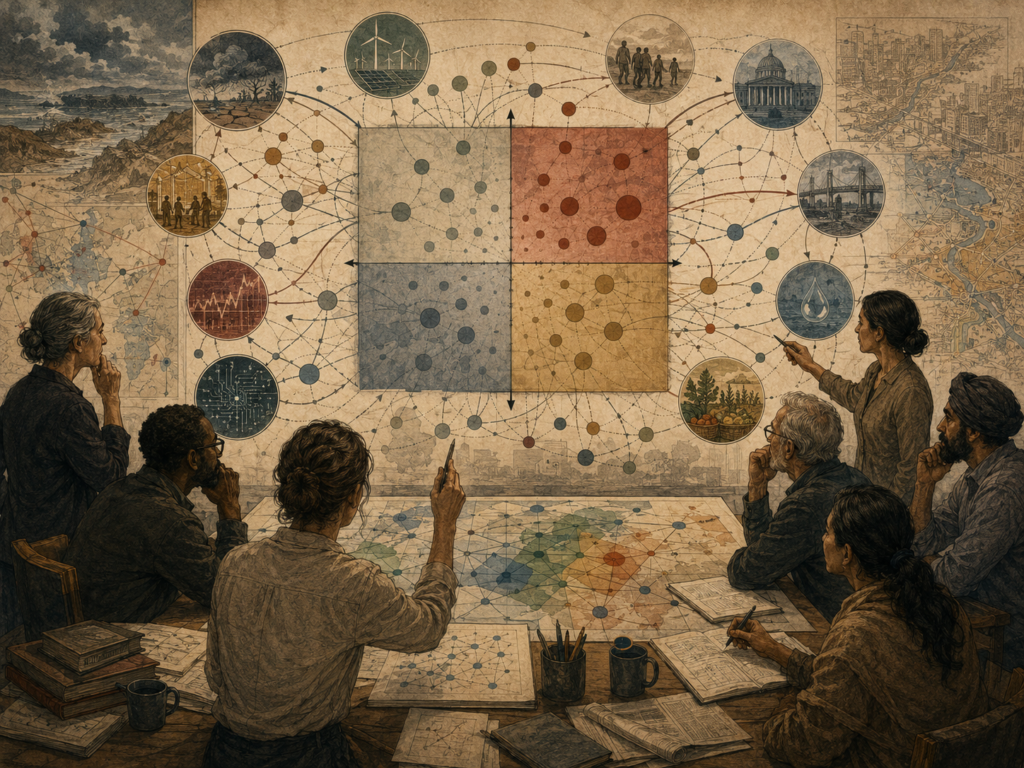
A diverse foresight group maps key drivers of change across an uncertainty matrix with interconnected social, ecological, technological, and institutional systems.

Uncertainty Matrices and Driver Mapping: How to Rank Drivers, Risks, and Critical Futures

Uncertainty Matrices and Driver Mapping examines how foresight practitioners identify the forces shaping possible futures, distinguish structural drivers from critical uncertainties, and translate complexity into scenarios, monitoring systems, and strategic decisions. The article explains how impact-uncertainty matrices classify drivers as baseline assumptions, critical uncertainties, watchlist issues, or lower-priority factors, while driver mapping reveals relationships among climate exposure, public trust, AI governance, energy affordability, care capacity, infrastructure, food-water systems, fiscal capacity, and geopolitical disruption. It shows why future-oriented strategy depends not only on naming trends, but on understanding interaction, cascade risk, distributional burden, assumption failure, and monitoring triggers. By connecting drivers to scenario axes, strategic stress tests, adaptive governance, and institutional learning, the article frames uncertainty as something that cannot be eliminated, but can be mapped, debated, tracked, and acted on responsibly over time.

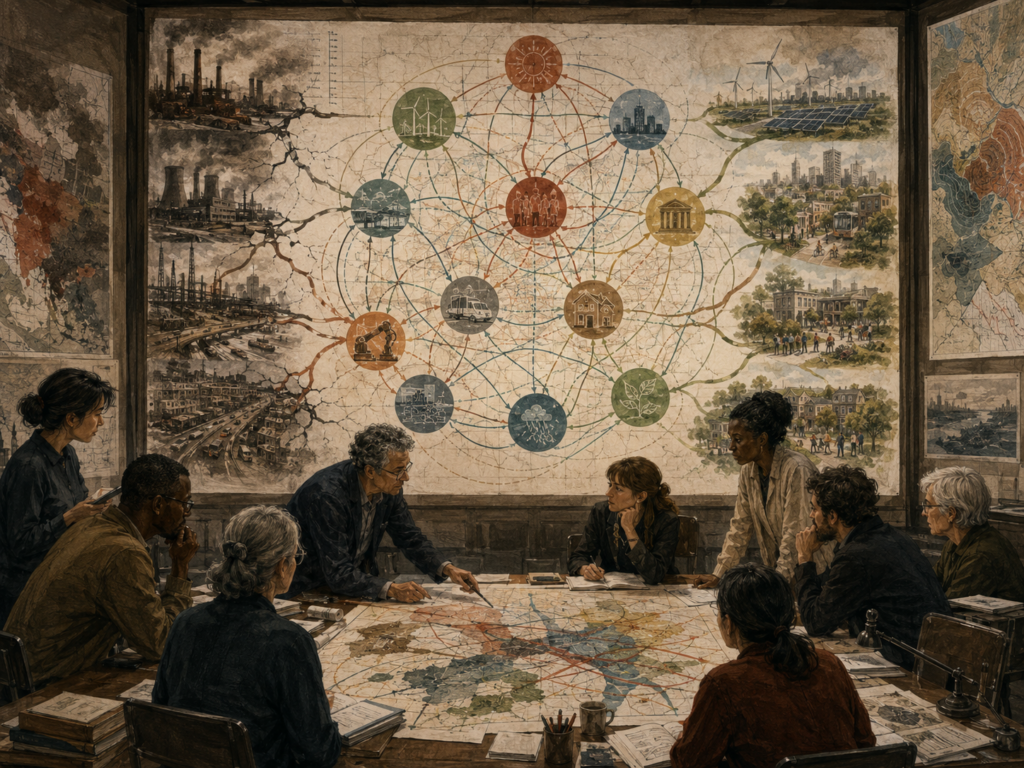
A diverse foresight group studies structural change across industrial decline, renewable systems, public institutions, communities, and ecological transition.

Systems Foresight and Structural Change: Feedback, Leverage, and Future Strategy

Systems Foresight and Structural Change examines how complex systems generate future pathways through feedback loops, institutions, infrastructure, power, incentives, trust, and adaptive capacity. The article explains why many reforms fail when they manage symptoms while leaving system structure unchanged, then shows how systems foresight combines scenario analysis, systems thinking, leverage-point reasoning, horizon scanning, and adaptive governance. It explores structural pressure, feedback persistence, regime shifts, institutional resistance, public legitimacy, and the difference between shallow intervention and deeper transformation. By connecting foresight to rules, incentives, authority, infrastructure, learning systems, and distributional justice, the article helps institutions ask what must change for different futures to become possible. It frames structural change as a disciplined, ethical, and systems-aware practice for climate adaptation, AI governance, care systems, energy transition, ecological resilience, public trust, infrastructure stewardship, and long-term strategy.

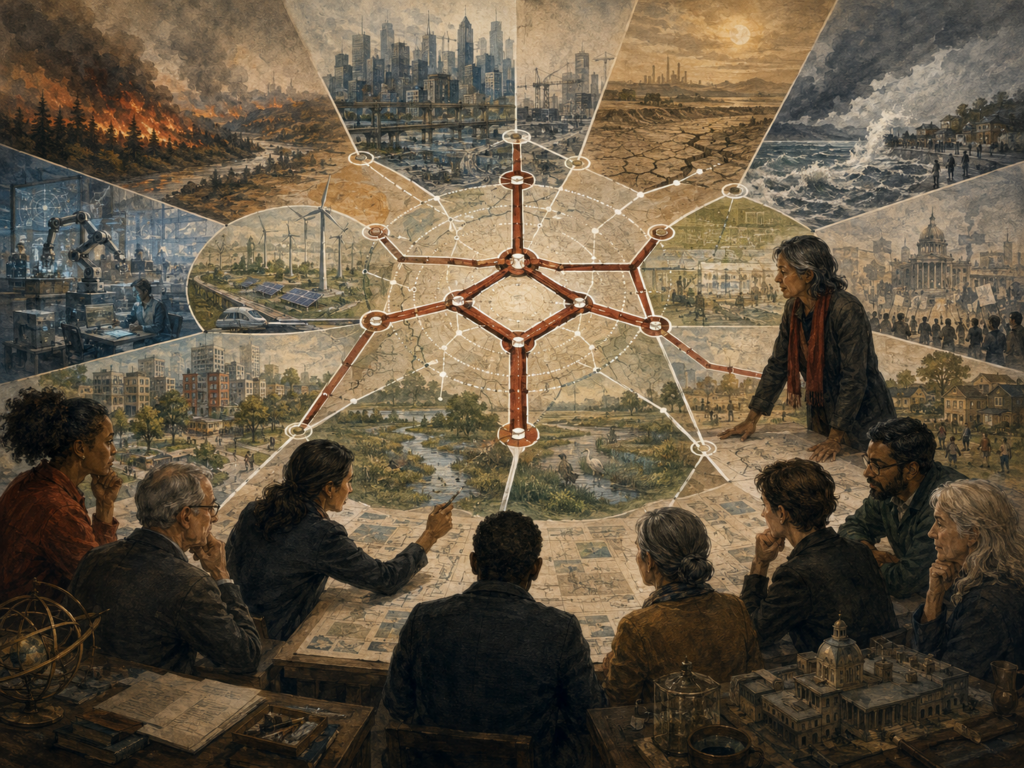
A diverse foresight group maps cascading impacts from a central future change across social, ecological, technological, and institutional systems.

Futures Wheel and Impact Mapping: From Cascading Consequences to Strategy

Futures Wheel and Impact Mapping examines how foresight practitioners trace the cascading consequences of change and translate those consequences into accountable strategy. The article explains how the Futures Wheel maps first-, second-, and third-order effects of trends, disruptions, technologies, policies, and emerging signals, while Impact Mapping connects goals to actors, desired impacts, deliverables, and monitoring indicators. It shows why these methods matter for climate adaptation, technology governance, public health, infrastructure, education, sustainability transitions, organizational strategy, and community resilience. By linking consequence cascades to actor behavior, distributional burden, intervention design, and outcome traceability, the article helps institutions avoid shallow workshops, activity without impact, and narrow first-order thinking. It frames future-oriented strategy as disciplined consequence reasoning: a practical way to identify ripple effects, clarify who must act, protect affected communities, and test whether interventions change real conditions responsibly over time together.

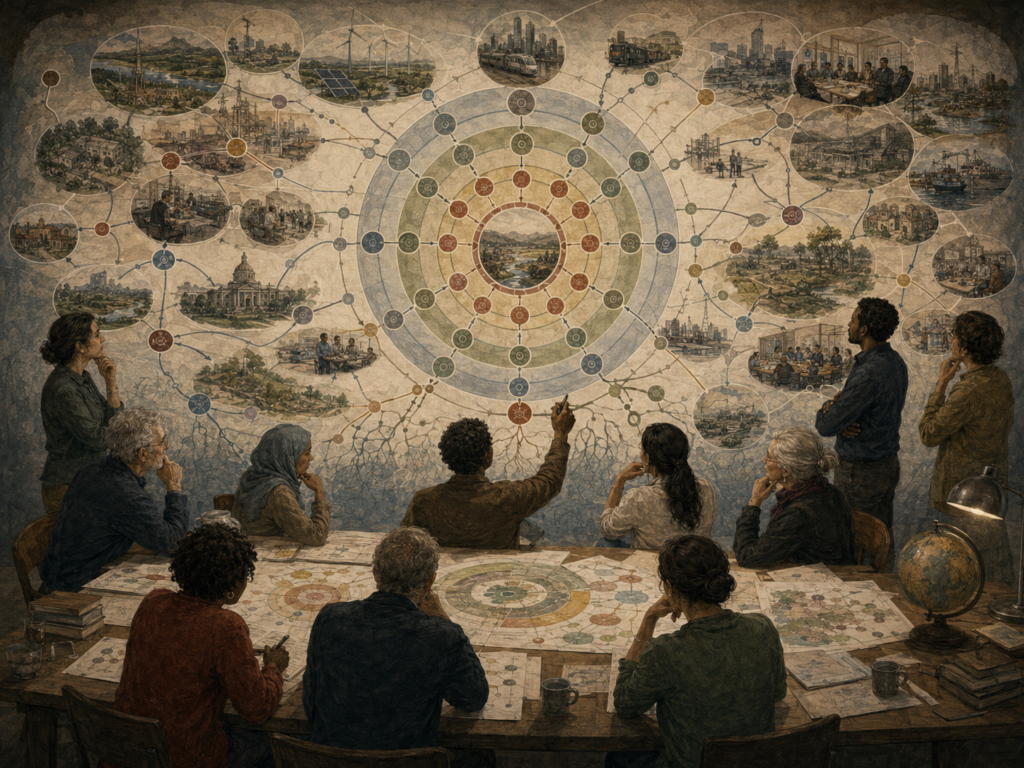
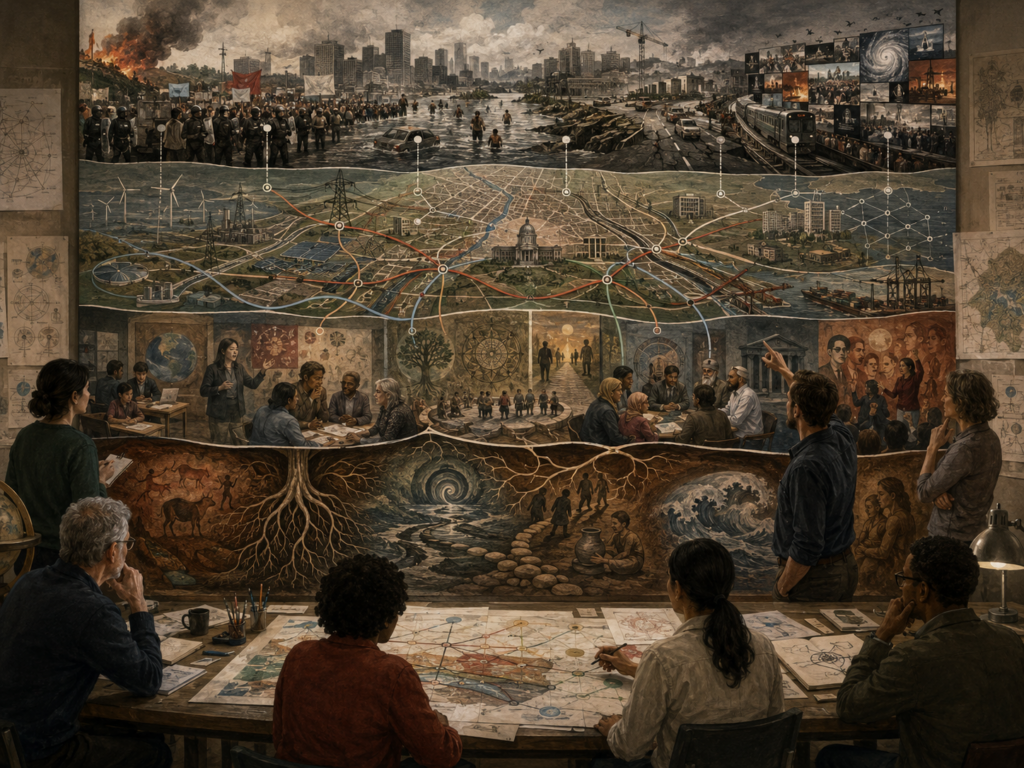
A futures research group studies layered causes beneath visible crises, from surface events to systems, worldviews, and deeper myths.

Causal Layered Analysis: Four Layers of Futures Thinking and Strategic Reframing

Causal Layered Analysis examines how futures are shaped through visible events, systemic causes, worldviews, and deeper myths or metaphors. The article explains Sohail Inayatullah’s four-layer method—litany, social causes, worldview and discourse, and myth/metaphor—and shows why surface-level problem solving often fails when deeper assumptions remain unchanged. It applies CLA to technology governance, climate adaptation, public health, education, infrastructure, sustainability transitions, institutional trust, and community planning. By connecting layered diagnosis to narrative reframing, power analysis, scenario planning, backcasting, and futures literacy, the article shows how institutions can move beyond headlines, metrics, and shallow reform toward deeper strategic imagination. It also foregrounds marginalized voices, suppressed stories, and alternative metaphors as essential sources of future possibility, justice, legitimacy, and long-term public responsibility in complex systems facing uncertainty, disruption, ecological stress, technological acceleration, and contested social change.

Scroll to Top