Artificial Intelligence in Environmental Monitoring
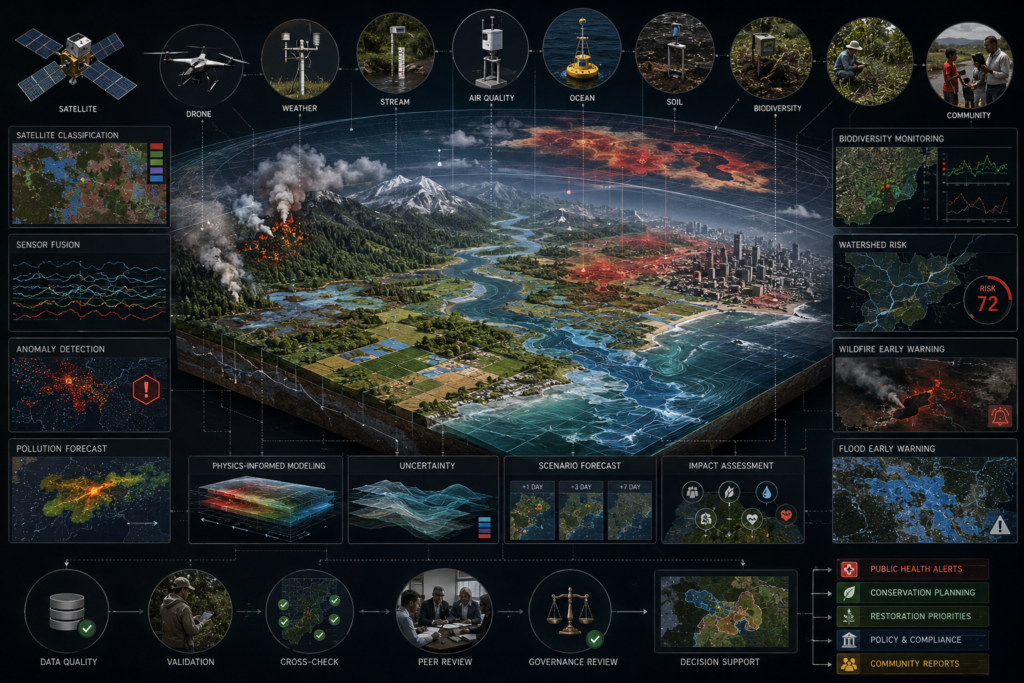
Artificial intelligence in environmental monitoring integrates sensing systems, Earth observation data, machine learning, scientific modeling, and governance workflows to observe and interpret complex environmental change. By combining in-situ sensors, satellite imagery, field surveys, climate records, and administrative data, AI systems can detect anomalies, forecast risks, classify land cover, monitor pollution, track ecosystem stress, and support early warning systems. This article explains how environmental AI works across sensor fusion, remote sensing, representation learning, spatiotemporal forecasting, physics-informed modeling, uncertainty analysis, and decision integration. It also emphasizes the risks of uneven monitoring coverage, weak validation, opaque models, retrieval uncertainty, and environmental injustice. The central argument is that AI-enabled monitoring should not become surveillance for its own sake; it should function as public-interest knowledge infrastructure for stewardship, accountability, ecological resilience, and sustainability.