Artificial Intelligence Systems

Artificial intelligence systems examine how computational models learn from data, identify patterns, and support decision-making across complex environments. Modern AI combines statistical learning, neural networks, optimization methods, and large-scale data infrastructure to perform tasks such as pattern recognition, language processing, prediction, and strategic reasoning.

The study of AI systems also extends beyond technical performance to include architecture, evaluation, explainability, governance, and risk management. As AI becomes embedded in economic, institutional, scientific, and technological systems, it must be understood both as an analytical tool and as a system requiring accountability, transparency, and ethical design.

Editorial scientific illustration showing AI as a governed media-system architecture with synthetic media pathways, provenance chains, verification gates, recommender flows, disinformation-risk signals, correction loops, public trust, and accountability structures.

AI, Information Integrity, and Media Systems

AI, information integrity, and media systems examine how artificial intelligence reshapes the production, distribution, verification, personalization, ranking, and public understanding of information. As AI systems become embedded in journalism, search, social platforms, synthetic media tools, recommender systems, and automated content pipelines, they increasingly influence what people see, trust, question, and share. This article explains how AI affects journalism, provenance, disinformation, source credibility, algorithmic amplification, personalization, public trust, and democratic accountability. It distinguishes information integrity from information control, arguing that healthy media systems do not require centralized censorship but stronger evidence practices, plural sources, transparent ranking, correction mechanisms, provenance standards, editorial accountability, and public contestability.


Editorial scientific illustration showing AI as a governed labor-system architecture with task exposure, automation, augmentation, job redesign, reskilling, worker voice, job quality, oversight, and public accountability.

AI, Labor, Automation, and the Future of Work

AI, labor, automation, and the future of work examine how artificial intelligence systems reorganize tasks, skills, occupations, workplace power, productivity, surveillance, job quality, and economic security. This article explains why AI does not affect labor only by replacing workers, but by reshaping how work is divided, measured, managed, evaluated, delegated, and rewarded. It explores automation, augmentation, task exposure, job redesign, reskilling, deskilling, algorithmic management, workplace surveillance, worker voice, inequality, bargaining power, and the distribution of productivity gains. Through mathematical framing and practical Python and R workflows, the article shows how AI labor governance can support dignity, autonomy, job quality, and shared prosperity.

Editorial illustration showing an AI governance documentation architecture with risk registers, model cards, audit trails, monitoring dashboards, data pipelines, review workflows, and accountability controls connected through a central evidence infrastructure.

AI Risk Registers, Model Cards, and Audit Documentation

AI risk registers, model cards, and audit documentation explain how artificial intelligence systems become governable, reviewable, and accountable through structured evidence. This article examines risk registers, model cards, system cards, audit trails, lifecycle traceability, documentation completeness, monitoring records, incident documentation, corrective action, and governance ownership. It shows why documentation is not merely administrative paperwork, but a core control surface for responsible AI. Through mathematical framing and practical Python and R workflows, the article demonstrates how documentation can support risk prioritization, model transparency, audit readiness, institutional memory, and accountable AI operations.

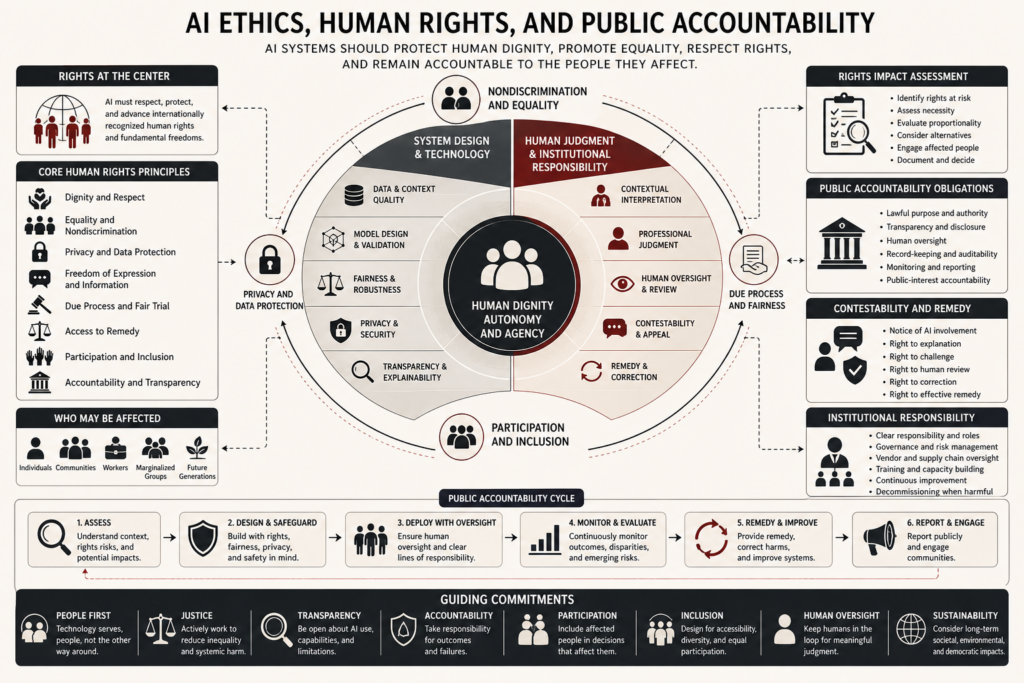
Editorial scientific illustration showing AI ethics and human rights as a public accountability architecture with dignity, equality, privacy, due process, participation, remedy, oversight, monitoring, and institutional responsibility.

AI Ethics, Human Rights, and Public Accountability

AI ethics, human rights, and public accountability examine how artificial intelligence systems should be governed when they affect dignity, equality, privacy, due process, public services, labor, education, healthcare, speech, and democratic life. This article explains why responsible AI cannot be reduced to technical performance or voluntary principles. It explores rights-based AI governance, human dignity, autonomy, nondiscrimination, structural inequality, privacy, contestability, remedy, public accountability, human rights impact assessment, and institutional responsibility. Through mathematical framing and practical Python and R workflows, the article shows how AI systems can be evaluated, monitored, challenged, corrected, and publicly justified.

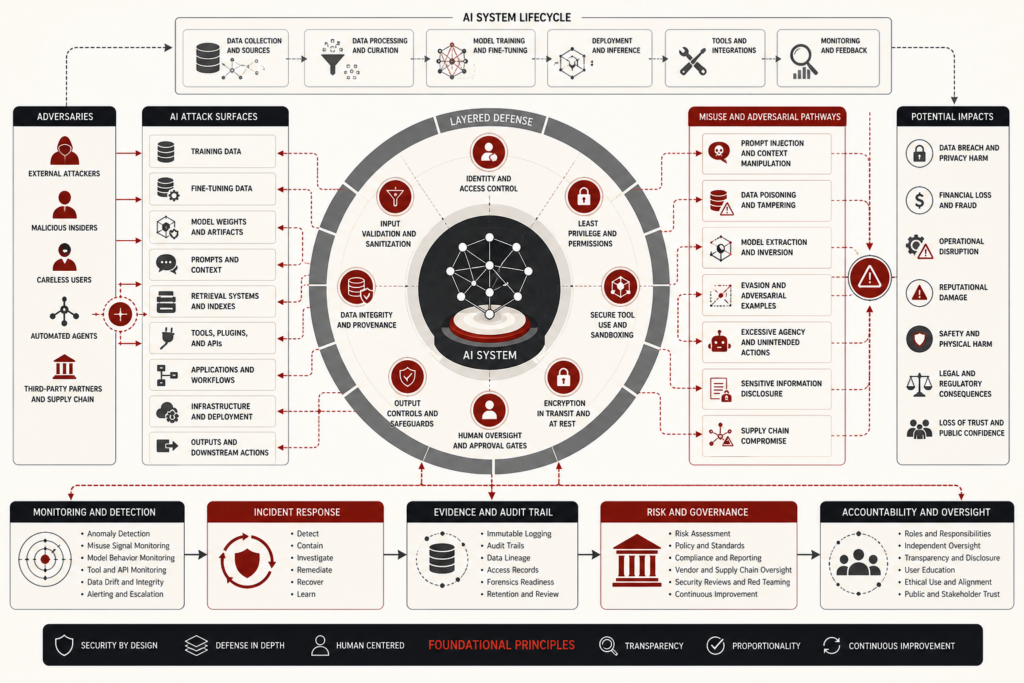
Editorial scientific illustration of AI security as a layered governance architecture with protected model systems, attack surfaces, misuse pathways, monitoring, incident response, audit trails, and oversight controls.

AI Security, Misuse, and Adversarial Threats

AI security, misuse, and adversarial threats examine how artificial intelligence systems can be attacked, manipulated, exploited, or repurposed in harmful ways. This article explains why AI security extends beyond conventional cybersecurity to include training data, model behavior, prompts, retrieval systems, tool permissions, supply chains, generated outputs, monitoring, and governance. It covers adversarial machine learning, prompt injection, data poisoning, model extraction, misuse pathways, excessive agency, incident response, red teaming, and secure-by-design architecture. Through mathematical framing and defensive Python and R workflows, the article shows how AI systems can be protected through threat modeling, layered controls, residual-risk scoring, monitoring, and accountable governance.

Abstract editorial illustration showing AI as a decision-support architecture that works alongside expert judgment, contextual interpretation, uncertainty management, review pathways, and accountable institutional oversight.

AI, Expertise, and Human Judgment

AI, expertise, and human judgment examine how artificial intelligence systems support, reshape, or weaken expert reasoning in high-stakes domains. This article explains why expertise is more than information processing: it includes tacit knowledge, contextual interpretation, uncertainty management, professional responsibility, and ethical judgment. It explores AI as expert augmentation, automation bias, epistemic dependence, expert disagreement, decision architecture, monitoring, and governance. Through mathematical framing and practical Python and R workflows, the article shows how human-AI systems should preserve expert agency, make uncertainty visible, support disagreement, document rationale, and strengthen accountability rather than quietly replacing professional judgment with automated plausibility.

Abstract editorial illustration of AI accountability as a governed decision architecture with evidence trails, human review checkpoints, appeal pathways, correction loops, monitoring layers, and institutional oversight.

Human Oversight, Contestability, and AI Accountability

Human oversight, contestability, and AI accountability determine whether artificial intelligence systems remain subject to human judgment, institutional responsibility, and public challenge. Oversight is not meaningful when people merely approve automated outputs without time, authority, context, or power to intervene. Contestability requires that affected people can question, appeal, correct, or refuse AI-mediated decisions, especially in high-stakes domains such as healthcare, education, finance, employment, public administration, infrastructure, and law. Accountability connects technical design to governance: model documentation, audit trails, escalation paths, impact review, incident response, and clear responsibility for harms. Responsible AI is therefore not only a matter of accuracy or efficiency. It depends on systems that can be explained, challenged, corrected, paused, and governed in the public interest.

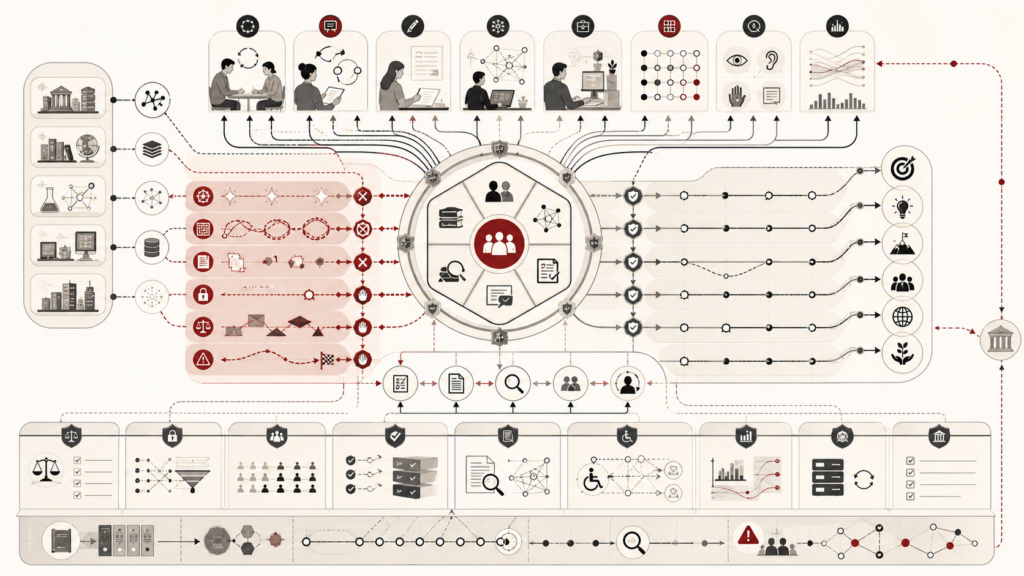
Wide editorial infographic showing AI in education and knowledge work as a governed learning system connecting teaching, tutoring, feedback, assessment, research, accessibility, privacy, equity, monitoring, and institutional governance.

AI in Education, Knowledge Work, and Learning Systems

AI in education, knowledge work, and learning systems refers to the use of artificial intelligence to support teaching, learning, assessment, research, writing, tutoring, feedback, accessibility, curriculum design, institutional operations, professional development, and workplace knowledge production. These systems can summarize documents, generate practice questions, provide feedback, adapt instruction, support language learning, analyze learning data, recommend resources, automate administrative work, retrieve institutional knowledge, and assist workers in drafting, coding, researching, designing, and deciding. This article explains AI tutoring, adaptive feedback, assessment redesign, academic integrity, writing support, learning analytics, workplace knowledge systems, teacher agency, student agency, AI literacy, privacy, accessibility, bias, equity, monitoring, and governance. It argues that AI in education should be governed as a learning system, not merely as a productivity tool.

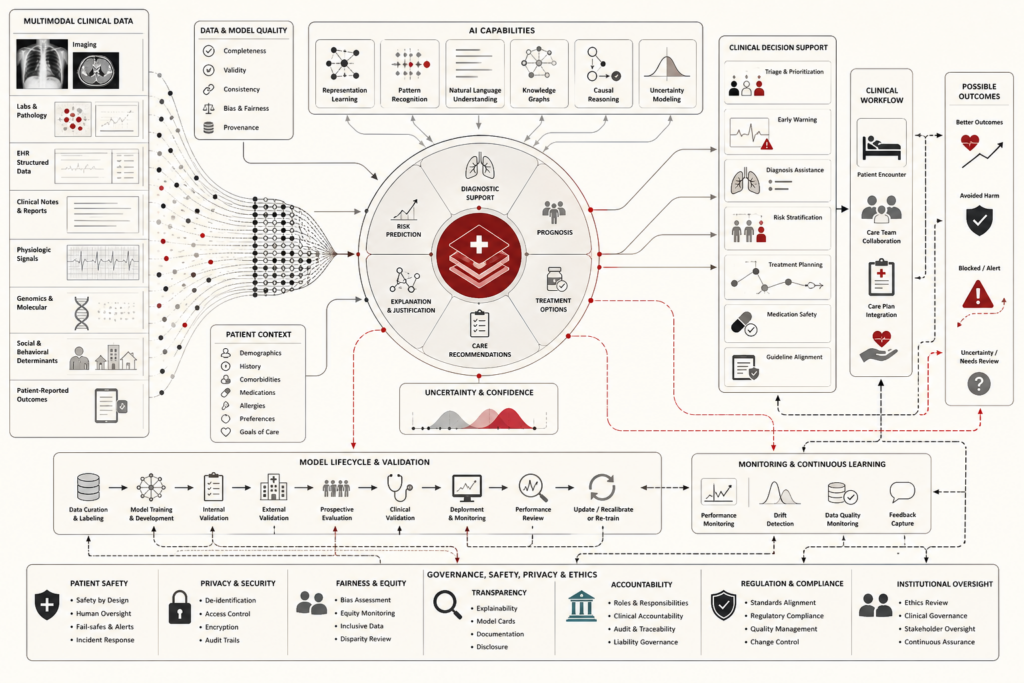
Wide editorial infographic showing AI in healthcare as a clinical decision support system connecting multimodal patient data, model capabilities, diagnostic support, risk prediction, treatment recommendations, clinical workflow, monitoring, validation, patient safety, privacy, fairness, regulation, and institutional governance.

AI in Health, Medicine, and Clinical Decision Support

AI in health, medicine, and clinical decision support refers to the use of artificial intelligence systems to assist clinical reasoning, diagnosis, triage, imaging interpretation, risk prediction, treatment planning, documentation, workflow coordination, population health, biomedical research, and patient-facing health services. These systems can identify patterns in images, laboratory data, electronic health records, waveforms, genomics, clinical notes, sensor streams, and patient histories. This article explains clinical decision support, diagnostic AI, imaging systems, risk prediction, early warning models, large language models in clinical workflows, privacy, security, bias, equity, regulation, validation, monitoring, drift, change control, and governance. It argues that clinical AI should be treated as a medical, technical, organizational, ethical, and regulatory system because patient safety, professional responsibility, and institutional trust are central to responsible deployment.

Scroll to Top