
Last Updated August 5, 2026
Biogeochemical flows are among the most profoundly transgressed boundaries in the planetary boundaries framework because human societies have radically altered the global cycles of nitrogen and phosphorus. These elements are indispensable to life. They are fundamental building blocks of proteins, DNA, RNA, cell membranes, energy transfer, chlorophyll, metabolism, and biological growth. Yet the modern industrial and agricultural transformation of nitrogen and phosphorus has shifted them from life-supporting nutrients into major drivers of ecological destabilization. The problem is not that nitrogen and phosphorus exist, nor that societies use them. The problem is that humanity has accelerated their mobilization, redistribution, concentration, leakage, and atmospheric release at scales that disrupt soils, rivers, lakes, aquifers, estuaries, coastal systems, oceans, the atmosphere, and the Earth system more broadly.
This is why the planetary boundaries framework treats biogeochemical flows as more than a pollution issue in the narrow sense. The nitrogen and phosphorus cycles are not merely local resource-management concerns. They are planetary processes whose large-scale perturbation can push ecosystems across thresholds, generate nonlinear change, degrade freshwater and coastal systems, alter atmospheric chemistry, weaken biosphere integrity, and reduce the resilience of the living systems on which human development depends. In the 2015 framework update, altered biogeochemical flows were identified as one of the boundaries already crossed. In the 2023 global assessment, they remained among the most strongly transgressed boundaries. The 2025 Planetary Health Check continues to classify modification of biogeochemical flows as a breached planetary boundary.
Main Library
Publications
Article Map
Planetary Boundaries
Related Article
Freshwater Change
Related Article
Land-System Change
Related Topic
Environmental Monitoring
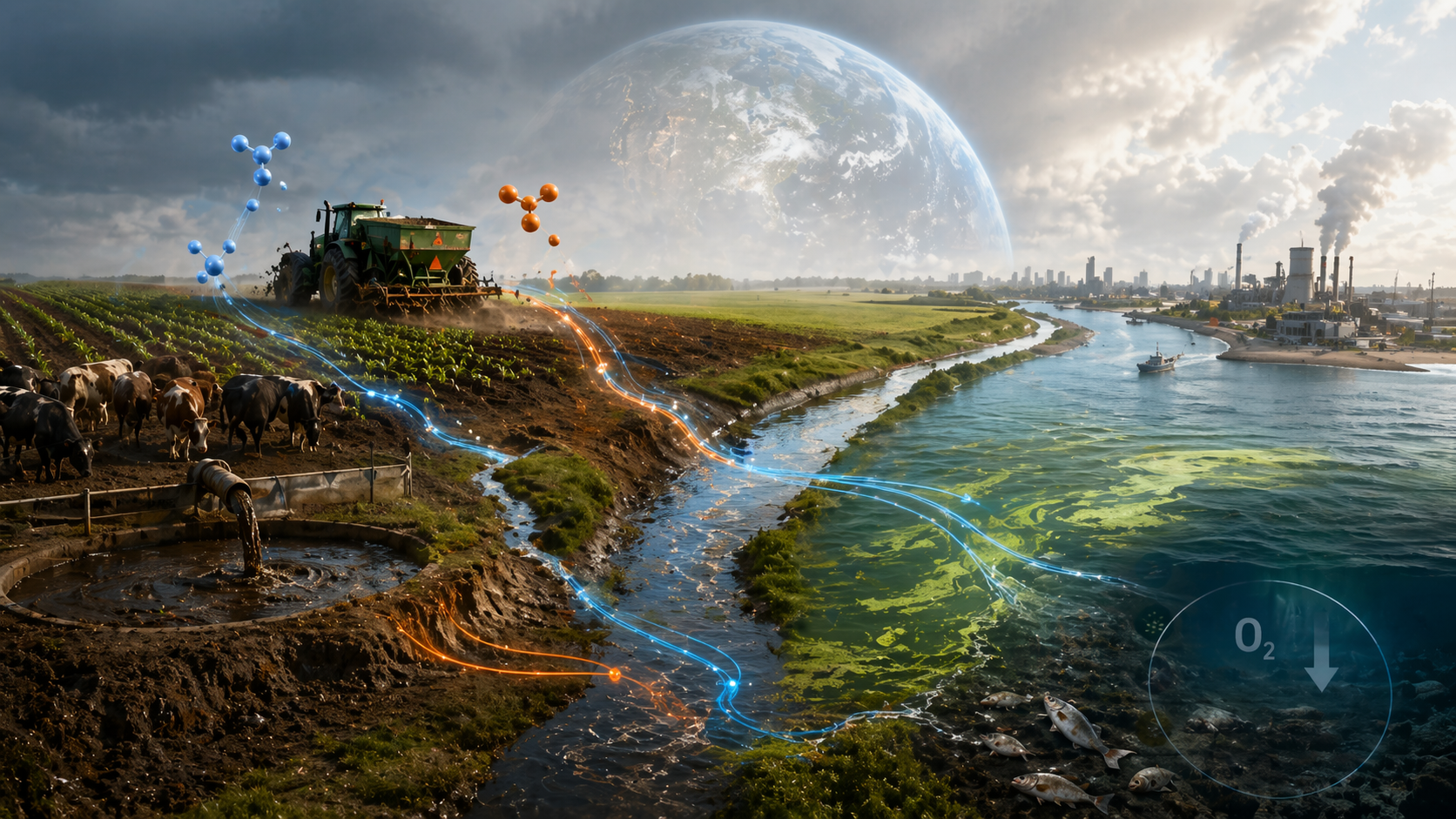
The Earth-system implications are severe because nutrient overload affects water quality, ecosystem structure, biodiversity, food webs, soil systems, atmospheric chemistry, freshwater resilience, coastal hypoxia, marine productivity, greenhouse gas emissions, and the wider capacity of the planet to sustain stable and productive life systems. Excess nutrients may begin as agricultural inputs, manure, wastewater, industrial emissions, combustion byproducts, or eroded soil particles, but they do not remain confined to the field, facility, feedlot, city, or watershed where they originate. They move through soils, aquifers, rivers, lakes, estuaries, coastal seas, atmospheric pathways, and ecological networks. This makes nitrogen and phosphorus governance a systems problem rather than a narrow fertilizer-management problem.
This article examines biogeochemical flows as a planetary boundary by explaining why nitrogen and phosphorus matter at Earth-system scale, how the boundary is defined, why modern agriculture and industry have destabilized these cycles, how nutrient overload interacts with freshwater change, biosphere integrity, land-system change, climate change, ocean acidification, atmospheric aerosol loading, novel entities, food systems, environmental justice, and governance, and why altered biogeochemical flows have become one of the clearest examples of planetary destabilization in the Anthropocene.
Why Biogeochemical Flows Matter
Biogeochemical flows matter because nitrogen and phosphorus are foundational to how life functions, grows, reproduces, and cycles through ecosystems. Under relatively stable Earth-system conditions, these elements circulate through soils, water, organisms, sediments, rocks, and the atmosphere in ways that support ecological productivity without overwhelming ecosystems. The planetary boundaries framework treats these cycles as critical because their large-scale disruption can propagate through terrestrial, freshwater, atmospheric, and marine systems, generating systemic instability rather than isolated contamination.
This is an especially important boundary because altered nitrogen and phosphorus cycles reveal how modern societies can destabilize the planet through inputs originally meant to increase productivity. Fertilizers, industrial fixation, livestock intensification, large-scale monocropping, manure concentration, wastewater discharge, combustion, mining, erosion-prone land management, and concentrated food-processing systems have been central to modern agricultural and industrial development. Yet these same processes release nutrients into rivers, soils, groundwater, lakes, estuaries, coastal waters, and the atmosphere at volumes and rates far beyond preindustrial variation. The result is not simply more fertility. It is ecological oversaturation, biochemical imbalance, and the erosion of the conditions that once made nutrient cycling resilient.
In that sense, biogeochemical flows are a paradigmatic case of Anthropocene destabilization. They show how interventions designed to increase yield and secure human flourishing can, when scaled globally and governed poorly, undermine the ecological buffering capacities on which flourishing depends. The boundary does not ask whether nitrogen and phosphorus are good or bad in isolation. It asks whether the scale, location, timing, chemical form, and governance of nutrient mobilization remain compatible with Earth-system resilience.
This distinction is essential. Nutrient scarcity can constrain food production, especially in impoverished regions, degraded soils, and farming systems without adequate fertility support. Nutrient excess can damage waters, air, biodiversity, climate, fisheries, drinking water, and public health. The governance challenge is therefore not simply “less fertilizer everywhere.” It is better nutrient balance, more efficient cycling, reduced losses, improved equity, circular recovery, restored ecosystems, and food systems that produce nourishment without destabilizing the biogeochemical foundations of life.
The boundary also matters because nutrients move. Nitrogen and phosphorus may be applied on a farm, concentrated in a feedlot, released from wastewater, or mobilized from eroded soils, but their consequences can travel downstream, downwind, underground, and across ecosystems. A nutrient decision in one field can become an algal bloom in a lake, nitrate contamination in groundwater, hypoxia in an estuary, nitrous oxide in the atmosphere, or a long-term legacy burden in sediments. Biogeochemical flows therefore expose the false separation between production systems and receiving ecosystems.
To understand this boundary is to understand that life-supporting chemistry becomes destabilizing when cycling is broken. Nitrogen and phosphorus sustain life when they move through ecosystems in balanced, recoverable, and biologically useful ways. They degrade life when they are mobilized faster than ecosystems can absorb, transform, retain, or safely redistribute them.
What the Boundary Covers
In the planetary boundaries framework, biogeochemical flows refer above all to the anthropogenic perturbation of the nitrogen and phosphorus cycles. The 2009 framework treated these cycles as a combined concern because both elements are essential nutrients whose overuse can drive abrupt ecological change. The 2015 update proposed a broader framing of biogeochemical flows in principle, while continuing to operationalize the boundary primarily through nitrogen and phosphorus because these are among the most extensively altered cycles and the most central to agriculture, ecosystem function, downstream water-system disruption, and atmospheric effects.
The logic of the boundary is that nitrogen and phosphorus are not destabilizing simply because they are present in excess somewhere. They become destabilizing when human activity mobilizes them at scales large enough to alter ecosystem function, overwhelm absorptive capacities, and propagate imbalance across freshwater, terrestrial, atmospheric, and marine systems. This is why the boundary is defined not simply by local contamination levels but by systemic human interference in the cycling of these two nutrients.
This framing is analytically important because it moves the discussion beyond environmental symptoms toward cycle-level disruption. Eutrophication, oxygen depletion, harmful algal blooms, dead zones, soil imbalance, nitrate contamination, nitrous oxide emissions, ammonia volatilization, particulate air pollution, groundwater contamination, and biodiversity loss are not isolated phenomena. They are expressions of a deeper breakdown in the regulation of nutrient flows. The planetary-boundary perspective therefore treats the nutrient problem as a structural feature of modern agriculture and industry, not merely as an accidental side effect.
It also clarifies why both nitrogen and phosphorus must be considered together. Nitrogen and phosphorus have different sources, cycling pathways, mobility, chemical behavior, and governance challenges, but ecosystems experience their interaction. Ratios between nitrogen and phosphorus can shape algal communities, species composition, trophic dynamics, oxygen demand, and ecological outcomes. The boundary is therefore not only about the total amount of each nutrient, but about the way their relative availability reorganizes living systems.
| Boundary component | Core concern | Earth-system significance |
|---|---|---|
| Nitrogen cycle | Industrial fixation, fertilizer use, manure concentration, combustion, nitrate leaching, ammonia volatilization, nitrous oxide emissions. | Connects food systems to water pollution, air pollution, climate change, ozone chemistry, soil change, and ecosystem disruption. |
| Phosphorus cycle | Phosphate mining, fertilizer use, erosion, runoff, manure and wastewater losses, sediment accumulation, limited circular recovery. | Connects finite mined resources to eutrophication, biodiversity loss, food-system dependence, and long-term legacy pollution. |
| Nutrient ratios | Relative availability of nitrogen and phosphorus in ecosystems. | Can alter species composition, algal communities, food webs, and ecological thresholds. |
| Legacy nutrients | Nutrients stored in soils, sediments, groundwater, or landscapes after past applications. | Can continue driving pollution and eutrophication even after current inputs decline. |
| Governance capacity | Monitoring, regulation, circularity, nutrient-use efficiency, manure management, wastewater recovery, and watershed restoration. | Determines whether nutrient cycles can be brought back toward safer operating conditions. |
The boundary therefore covers more than fertilizer quantity. It covers the reorganization of nutrient cycling across production, waste, ecosystems, atmosphere, and water systems. That is why biogeochemical flows belong in Earth-system analysis rather than only in agronomy or water-quality management.
Nitrogen, Phosphorus, and the Living Earth
Nitrogen and phosphorus are indispensable to life. Nitrogen is a core component of amino acids, proteins, nucleic acids, chlorophyll, enzymes, and many biological compounds. Phosphorus is central to DNA, RNA, cell membranes, ATP, cellular signaling, bone and tooth formation in animals, and biological energy transfer. Without them, there is no productivity, no metabolism, no growth, and no reproduction. In this sense, the biogeochemical flows boundary is not about eliminating nutrients. It is about preserving the ecological conditions under which nutrients remain supportive rather than destabilizing.
Under less disrupted conditions, ecosystems evolved with feedbacks, storage processes, and biological pathways that help cycle these elements in relatively stable ways. Soils, plants, fungi, microbes, aquatic systems, sediments, weathering processes, geological pathways, and food webs all contribute to that balance. The difficulty in the modern era is that human industry and agriculture have accelerated nutrient mobilization far beyond the pace at which many ecosystems can absorb, transform, retain, or safely redistribute them. What should function as a life-supporting cycle becomes, under those conditions, a destabilizing overflow.
The nitrogen cycle is especially dynamic because atmospheric nitrogen is abundant but biologically unavailable to most organisms until converted into reactive forms. Biological nitrogen fixation and lightning historically supplied reactive nitrogen, but industrial fixation changed the scale of the cycle. The Haber–Bosch process made it possible to convert atmospheric nitrogen into ammonia at industrial scale, supporting enormous increases in fertilizer production and crop yield. It also dramatically increased the amount of reactive nitrogen moving through soils, waters, and the atmosphere.
Phosphorus has a different structure. It has no major atmospheric reservoir and is mobilized mainly through weathering, mining, erosion, and biological cycling. Modern agriculture depends heavily on phosphate rock extraction, but much of the phosphorus applied to fields does not remain in productive circulation. It can accumulate in soils, attach to eroded particles, move into water systems, or enter sediments where it becomes a long-term source of ecological pressure. This difference matters because nitrogen governance involves gaseous pathways as well as water pathways, while phosphorus governance involves mined resources, runoff, erosion, sediment accumulation, and circular recovery.
This is part of what makes the boundary conceptually powerful. It does not oppose productivity as such. It asks when the chemistry of productivity becomes ecologically corrosive. It asks when the nutrients that sustain crops, forests, wetlands, plankton, and soils are mobilized so intensely that they overwhelm the living systems they are meant to support.
Nitrogen and phosphorus therefore reveal a central truth of planetary-boundary thinking: life depends not only on the presence of matter, but on the regulated movement of matter. Too little nutrient availability can constrain life. Too much nutrient leakage can destabilize life. Earth-system resilience depends on cycling, balance, timing, location, retention, and recovery.
How Human Societies Disrupted the Cycles
The disruption of the nitrogen and phosphorus cycles is tightly bound to industrial modernity and the agricultural transformations of the twentieth century. Nitrogen disruption is especially associated with the Haber–Bosch process and the large-scale industrial fixation of atmospheric nitrogen into reactive forms used in fertilizers and other applications. That innovation underwrote enormous increases in crop yields and population support, but it also accelerated the introduction of reactive nitrogen into soils, waterways, and the atmosphere at unprecedented rates.
Phosphorus disruption has a somewhat different character because phosphorus is mined rather than fixed from the atmosphere. Large-scale extraction of phosphate rock, concentration into fertilizers, and redistribution through agricultural systems have dramatically altered where and how phosphorus moves. Much of that phosphorus does not remain where intended. It is transported through erosion, runoff, manure concentration, waste streams, and water systems into lakes, rivers, wetlands, estuaries, and coastal environments. In both cases, the result is a human-driven intensification of nutrient mobilization that breaks the former ecological rhythm of the cycles.
Livestock systems intensify the problem because they concentrate nutrients in particular places. Feed may be grown in one region, transported to another, consumed by animals in concentrated operations, and returned to the environment through manure in quantities that exceed local absorptive capacity. Wastewater systems also matter because human nutrients are often treated as waste rather than recovered as part of circular nutrient management. These systems create a planetary paradox: some regions face nutrient scarcity, while others face nutrient overload.
The broader lesson is that industrial agriculture did not merely intensify food production. It re-engineered nutrient cycling itself, creating a profound mismatch between ecological buffering capacity and anthropogenic throughput. Crops may absorb part of the nitrogen and phosphorus applied to fields, but the remainder can leak into air, water, soil, and sediments. The leakages are not marginal. They are structural features of food systems designed around high input, high throughput, and insufficient recovery.
Urbanization and sanitation systems also altered nutrient cycles. Human waste once returned to local landscapes in many societies, sometimes beneficially and sometimes hazardously. Modern wastewater systems improved public health by removing waste from cities, but they often displaced nutrients into rivers, coasts, sludge systems, or treatment infrastructure that was not designed for full nutrient recovery. A future nutrient system must therefore be sanitary and circular at the same time.
Combustion and industry add another layer. Nitrogen oxides from vehicles, power plants, industry, and combustion contribute to air pollution and atmospheric deposition. Nutrient disruption is therefore not only an agricultural problem. It is a food-energy-urban-industrial problem with hydrological, atmospheric, and ecological consequences.
Why Nutrient Overload Is Destabilizing
Nutrient overload is destabilizing because ecosystems do not respond indefinitely or proportionally to excess nutrient inputs. Lakes, rivers, wetlands, estuaries, and marine systems can absorb additional nitrogen and phosphorus only up to a point. Beyond that, eutrophication, harmful algal blooms, oxygen depletion, food-web simplification, toxic conditions, and dead zones can emerge. These are not merely aesthetic or local water-quality problems. They are threshold responses that alter ecosystem structure and function, sometimes persistently.
The 2009 planetary boundaries paper already stressed that anthropogenic interference with nitrogen and phosphorus flows had induced abrupt shifts in lakes and marine ecosystems, and that eutrophication could push aquatic systems across thresholds, generating nonlinear change. This is one of the strongest reasons the boundary belongs in the planetary framework. It illustrates clearly how cumulative human pressure on nutrient cycles can trigger abrupt and difficult-to-reverse ecological transformations.
The destabilization is not confined to water bodies alone. Excess reactive nitrogen can affect atmospheric chemistry, contribute to particulate pollution, acid deposition, ozone formation, and nitrous oxide emissions. Phosphorus accumulation in erodible soils can intensify downstream disruption long after application. Nutrient imbalance can alter plant communities, reduce biodiversity, change soil chemistry, and favor fast-growing or opportunistic species. In both cases, what begins as a productivity-enhancing intervention becomes a cross-system destabilization mechanism.
There is also a resilience problem. Nutrient overload can shift ecosystems into alternative states that are hard to reverse. A clear lake can become turbid and algal-dominated. A coastal system can become seasonally hypoxic. A river basin can accumulate legacy nutrients that continue to flow downstream even after fertilizer practices improve. A landscape can become dependent on high inputs while losing soil biological function. The boundary therefore concerns not only present nutrient inputs, but the persistence of altered nutrient regimes over time.
Nutrient overload also degrades information. A water body affected by nutrient enrichment may appear productive because algal biomass increases, but that productivity can represent ecological simplification rather than ecosystem health. A farm may show high yield while leaking nutrients into groundwater and rivers. A livestock system may produce cheap protein while concentrating manure beyond local absorption. The boundary forces a broader accounting: what looks efficient in one part of the system may be destabilizing for the whole.
In planetary-boundary terms, nutrient overload is dangerous because it converts life-supporting cycles into cross-system pressure. Nitrogen and phosphorus do not simply disappear after use. They continue moving through air, water, soil, and living systems. Governance must therefore manage the whole cycle, not only the moment of application.
The Boundary and Its Current Status
Biogeochemical flows are among the most strongly transgressed boundaries in the planetary boundaries framework. The 2015 update identified altered biogeochemical cycles as one of the boundaries already crossed, the 2023 assessment confirmed that transgression remains severe, and the 2025 Planetary Health Check continues to classify modification of biogeochemical flows as breached. Stockholm Resilience Centre’s current overview describes both nitrogen and phosphorus as beyond safe levels, with excess nutrient release creating consequences for ecosystems, climate, and human wellbeing.
The 2025 Planetary Health Check reports anthropogenic nitrogen fixation of approximately 190 teragrams of nitrogen per year against a planetary boundary of 62 teragrams per year. It reports global application of mined phosphorus to cropland of approximately 18.2 teragrams of phosphorus per year against the more limiting regional boundary of 6.2 teragrams per year. These control variables confirm substantial transgression while regional risk maps show strong spatial variation in agricultural surplus and loss.
This matters because the problem is not marginal, emerging, or scientifically ambiguous in the framework. It is one of the clearest cases of planetary overshoot. The control variables have been refined over time, but the central conclusion has only strengthened: anthropogenic perturbation of nitrogen and phosphorus cycles has moved well beyond the safe operating space for humanity.
In this respect, biogeochemical flows are analytically revealing. They show how a boundary can be deeply transgressed even when many of its most visible symptoms appear regionally distributed rather than immediately global in visual form. The planet does not experience nutrient overshoot as one single event. It experiences it through thousands of rivers, fields, estuaries, aquifers, lakes, soils, coastal waters, atmospheric pathways, and food systems that collectively reveal a global reorganization of nutrient cycling.
Boundary status should therefore be interpreted as a systems warning. It does not mean nitrogen and phosphorus must disappear from agriculture. It means present patterns of fixation, mining, application, leakage, runoff, volatilization, atmospheric release, and downstream accumulation are no longer compatible with Earth-system resilience.
| Boundary signal | Current interpretation | Why it matters |
|---|---|---|
| Nitrogen cycle | Beyond safe operating conditions. | Industrial fixation and reactive nitrogen losses connect food production to water pollution, air pollution, climate forcing, and ecosystem change. |
| Phosphorus cycle | Beyond safe operating conditions. | Phosphorus runoff, erosion, wastewater losses, and flows to water bodies contribute to eutrophication and long-term legacy pollution. |
| Boundary status | Breached / strongly transgressed. | Shows that nutrient-cycle disruption is a core planetary-risk domain, not only a local water-quality issue. |
| Governance challenge | Requires food-system, watershed, wastewater, air-quality, and circular-economy integration. | Single-sector fertilizer management is insufficient for a planetary-scale nutrient problem. |
The current status should not be read as fatalism. Nutrient cycles can be improved. Losses can be reduced. Wastewater can recover nutrients. Manure can be redistributed and treated. Fertilizer can be applied more precisely. Wetlands and riparian buffers can intercept runoff. Food systems can be redesigned. But the boundary’s breached status means these changes must be understood as Earth-system risk reduction, not merely environmental optimization.
Nitrogen, Phosphorus, and Food-System Dependence
Modern food systems depend heavily on nitrogen and phosphorus inputs. This dependence is one reason the boundary is so difficult to govern. Fertilizers support yields, reduce some forms of land pressure, and help feed billions of people. But when nutrient application is inefficient, poorly timed, spatially concentrated, or disconnected from soil and crop needs, a large share of nitrogen and phosphorus escapes into the wider environment. The result is a food system that both depends on nutrients and wastes them at damaging scale.
This creates a central governance tension. Reducing nutrient pollution must not become an argument for reducing food security or denying nutrients to regions where soils are depleted and yields are constrained. The planetary-boundary challenge is instead to redesign nutrient use so that nutrients are applied where needed, retained more effectively, recycled more intelligently, and lost less frequently. Precision agriculture, soil testing, crop rotation, cover crops, perennial systems, agroecology, manure management, wastewater nutrient recovery, circular phosphorus strategies, and better livestock integration all become important parts of the response.
Food-system dependence also reveals why a purely downstream approach is inadequate. Treating polluted water after nutrients have escaped is necessary in some places, but it cannot solve the boundary by itself. The deeper problem is throughput: the scale of nutrient mobilization relative to ecological absorption and recovery capacity. Governance must therefore move upstream into fertilizer production, application practices, livestock density, diet patterns, supply chains, wastewater systems, and land management.
This is why biogeochemical flows are not only an environmental issue. They are a food-system design issue. A durable food system must supply nutrients to crops without turning rivers, lakes, coasts, soils, and the atmosphere into unmanaged waste pathways.
The food-system dimension also forces attention to distribution. Some agricultural regions overapply nutrients because fertilizer is cheap, risk aversion favors excess application, livestock manure is concentrated, or regulations are weak. Other regions face depleted soils and inadequate access to nutrients, credit, extension services, or soil-testing systems. A just nutrient transition must address both problems. It should reduce excess and leakage where nutrient pressure is high while improving soil fertility and food security where nutrient access is insufficient.
The goal is nutrient sufficiency without nutrient overload. That requires a shift from linear nutrient throughput to circular nutrient stewardship: produce, apply, absorb, recover, reuse, and monitor nutrients in ways that serve food security while protecting water, air, soil, climate, and biodiversity.
Eutrophication, Dead Zones, and Aquatic Thresholds
Eutrophication is one of the most visible ecological expressions of altered biogeochemical flows. When nitrogen and phosphorus enter aquatic systems in excess, they can stimulate rapid algal and plant growth. When that organic matter decomposes, oxygen can be depleted, sometimes producing hypoxic or anoxic conditions. These low-oxygen conditions can kill fish, reduce biodiversity, alter food webs, and create dead zones where many organisms cannot survive.
The dynamics are often nonlinear. A lake or estuary may absorb increasing nutrient loads for some time, then shift abruptly into a degraded state. Once that shift occurs, recovery may be slow because sediments, altered food webs, reduced plant cover, internal nutrient recycling, or repeated seasonal loading can reinforce the degraded condition. This is why nutrient overload is a threshold problem. It is not only the amount of nitrogen and phosphorus that matters, but whether ecosystem feedbacks have been pushed into a new regime.
Coastal systems illustrate the scale of the issue. Nutrients applied on land can move through watersheds into rivers and eventually into estuaries and seas. A farm field far from the coast can contribute to downstream hypoxia through the cumulative flow of nutrients across the landscape. This watershed-to-ocean pathway is one reason biogeochemical flows are central to Earth-system thinking. Nutrient decisions in one place become ecological consequences elsewhere.
Aquatic thresholds also show why monitoring must include both pressure and response variables. Nutrient concentration alone is not enough. Dissolved oxygen, chlorophyll-a, harmful algal blooms, water clarity, sediment nutrient release, aquatic vegetation, species composition, temperature, hydrological residence time, and seasonal dynamics all matter for understanding whether a system is approaching or crossing a threshold.
Dead zones are also social and economic events. They can damage fisheries, tourism, drinking-water systems, cultural relationships with water, and coastal livelihoods. They may be caused by cumulative upstream decisions, while costs are borne downstream. This makes eutrophication a governance and justice problem, not only an ecological one.
A serious nutrient strategy must therefore prevent eutrophication at the source, intercept nutrient flows in the landscape, restore wetlands and riparian buffers, improve wastewater treatment, reduce legacy loading, and monitor ecosystem response. Once a water body crosses a threshold, recovery is often harder than prevention.
Nitrous Oxide, Air Pollution, and Atmospheric Effects
The nitrogen boundary is not only a water-quality problem. Reactive nitrogen also has atmospheric consequences. Nitrous oxide is a powerful greenhouse gas and an ozone-depleting substance. Ammonia emissions can contribute to fine particulate matter formation. Nitrogen oxides contribute to ozone chemistry and air pollution. Acid deposition can alter soils, forests, lakes, and plant communities. These pathways mean nitrogen disruption connects food systems to climate, air quality, human health, and atmospheric chemistry.
This atmospheric dimension is important because nutrient governance is often framed through runoff alone. Runoff is crucial, but it is not the whole story. Nitrogen losses occur through leaching, volatilization, denitrification, combustion, manure handling, and fertilizer application. These pathways differ in their environmental consequences and require different interventions. For example, reducing nitrate leaching may require cover crops, improved timing, drainage management, and soil practices, while reducing ammonia emissions may require improved manure storage, application methods, and livestock-system changes.
The atmospheric effects of reactive nitrogen also complicate accounting. A farm or food system may appear efficient if judged only by crop yield, but become far less efficient when nitrous oxide emissions, ammonia losses, nitrate leaching, soil degradation, and downstream eutrophication are included. A planetary-boundary perspective widens the accounting frame.
This is why nitrogen governance must be integrated with climate and air-pollution policy. Reducing reactive nitrogen losses can improve water quality, reduce greenhouse gas emissions, reduce particulate air pollution, protect ecosystems, and improve nutrient efficiency at the same time. The co-benefits are large, but only if nutrient flows are treated as a connected system.
Nitrous oxide is especially important because it links agriculture to long-lived atmospheric change. Fertilizer use, manure management, and soil microbial processes can generate emissions that persist and contribute to warming. This means nutrient management belongs inside climate mitigation strategies, not outside them. A food system cannot be considered climate-aligned if it reduces carbon dioxide while ignoring nitrogen-related greenhouse gas emissions.
The atmospheric dimension also links this boundary to environmental justice. Air pollution from ammonia and nitrogen oxides can affect communities near concentrated livestock operations, industrial facilities, roadways, and agricultural regions. Nutrient governance must therefore track both water pathways and air pathways, because both shape human wellbeing and Earth-system risk.
Phosphorus Scarcity and Phosphorus Pollution
Phosphorus presents a distinctive double problem: it is both a pollution risk and a finite mined resource. Unlike nitrogen, phosphorus cannot be fixed from the atmosphere. It is extracted from phosphate rock, processed into fertilizers, and redistributed through agricultural and industrial systems. This makes phosphorus governance simultaneously a question of ecological protection, resource security, waste prevention, geopolitical vulnerability, and circular economy design.
Phosphorus pollution is severe because excess phosphorus drives eutrophication in freshwater and coastal systems. But phosphorus scarcity and geopolitical concentration also matter because agriculture depends on continued access to phosphorus. Wasting phosphorus into waterways is therefore irrational in two directions: it damages ecosystems while depleting a resource that food systems need.
This is why circular phosphorus management is especially important. Recovering phosphorus from wastewater, manure, food waste, biosolids, and other waste streams can reduce both pollution and dependence on mined phosphate. Better erosion control, soil conservation, precision application, and phosphorus budgeting can reduce losses from fields. The goal is not simply to use less phosphorus everywhere, but to keep phosphorus in productive biological cycles rather than allowing it to accumulate in damaging places.
Phosphorus also creates legacy problems. Once phosphorus accumulates in soils or sediments, it can continue to contribute to runoff and internal loading for years or decades. This means recovery may lag behind policy improvements. Governance must account for legacy phosphorus rather than assuming that immediate reductions in application will instantly restore downstream ecosystems.
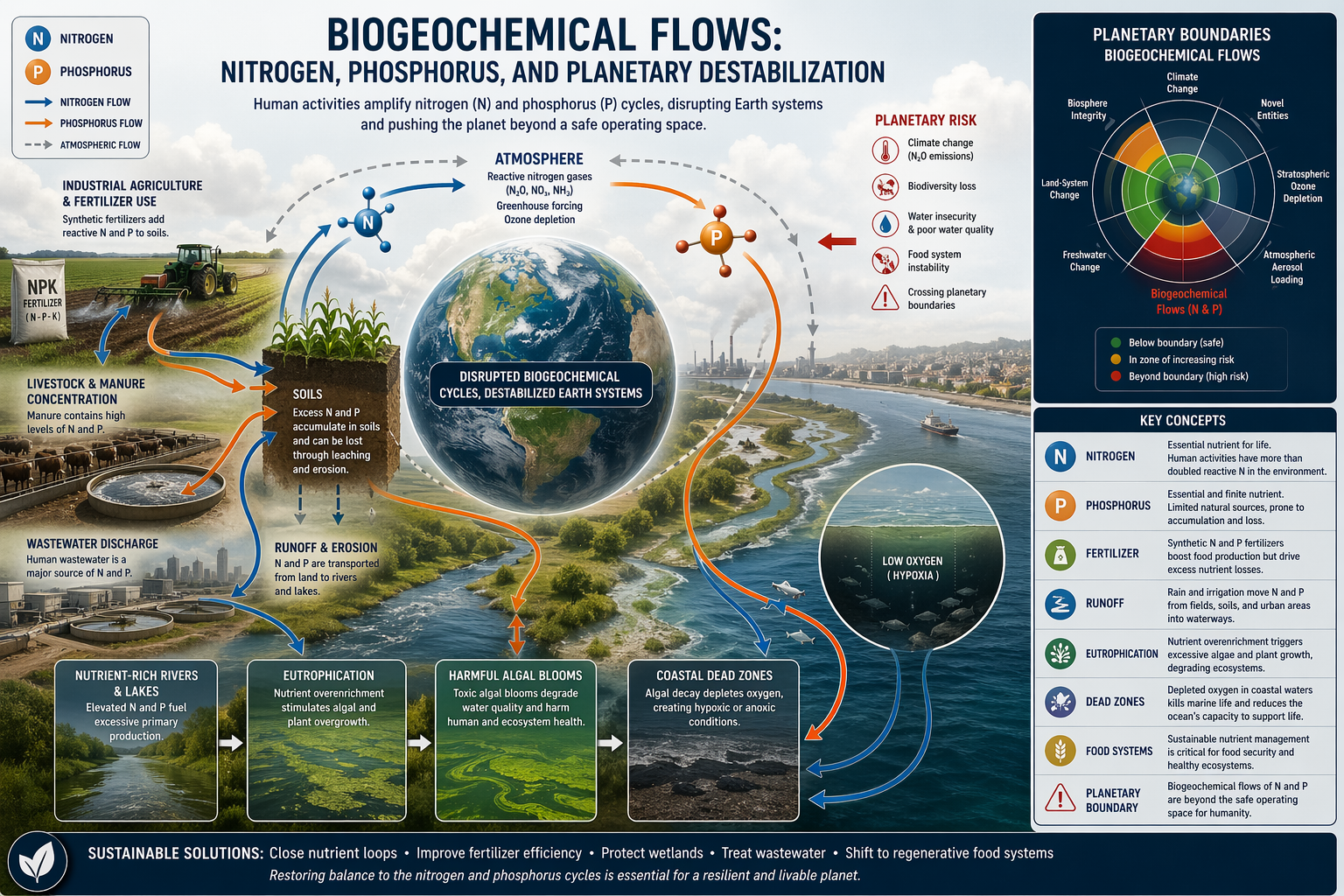
The phosphorus problem therefore requires a long time horizon. Mining, fertilizer production, field application, soil accumulation, erosion, runoff, sediment loading, wastewater discharge, and recovery systems all belong to the same cycle. A society that treats phosphorus as cheap input and downstream waste will face both ecological damage and resource inefficiency. A society that treats phosphorus as a critical circular nutrient can reduce pollution while improving food-system resilience.
Phosphorus also reveals why circularity must be governed carefully. Recycling nutrients from waste streams can be beneficial, but only if contaminants, pathogens, metals, pharmaceuticals, microplastics, and other novel entities are managed. Circular nutrient systems must be safe, transparent, and monitored. Otherwise, one environmental problem may be shifted into another.
Nutrient Justice and Unequal Risk
Biogeochemical flows are also a justice issue. Nutrient benefits and nutrient harms are unevenly distributed. Some farmers and regions lack sufficient nutrients to sustain yields, restore degraded soils, and support food security. Other regions face chronic over-application, manure surplus, nitrate-contaminated drinking water, polluted rivers, harmful algal blooms, fishery losses, air pollution, and downstream ecological damage. The planetary-boundary response must therefore distinguish between nutrient need and nutrient excess.
This matters because a simplistic “less fertilizer” message can reproduce inequality. In nutrient-poor regions, improved access to balanced soil fertility, organic amendments, agroecological practices, extension support, and appropriate fertilizers may be necessary for food security and land resilience. In nutrient-saturated regions, major reductions in losses, livestock concentration, fertilizer overuse, wastewater discharge, and runoff are necessary. Justice requires doing both: increasing nutrient sufficiency where deprivation is real and reducing nutrient overload where excess is causing harm.
Water justice is also central. Downstream communities may bear the consequences of upstream nutrient decisions through unsafe drinking water, degraded fisheries, cultural loss, algal toxins, and damaged ecosystems. Rural communities near concentrated animal feeding operations may face air and water burdens tied to manure concentration. Coastal communities may suffer when upstream nutrient flows create hypoxia that harms fisheries and livelihoods. These harms are often externalized onto people with less political and economic power.
Nutrient justice also has a global dimension. Wealthy food systems often externalize nutrient pressure through feed imports, meat consumption, commodity supply chains, fertilizer-intensive production, and wastewater systems that displace ecological costs. At the same time, farmers in poorer regions may be asked to conserve ecosystems while lacking access to the resources needed for soil fertility, storage, irrigation, or resilient livelihoods. A just nutrient transition must therefore address trade, finance, technology access, knowledge systems, and local rights.
Indigenous and local stewardship also matters. Many communities have long managed soil fertility, water quality, fisheries, wetlands, floodplains, and agroecological landscapes through practices that integrate nutrient cycling with place-based knowledge. Planetary nutrient governance should not treat such knowledge as marginal. It should recognize that durable nutrient cycling is ecological, cultural, and institutional as well as technical.
Biogeochemical justice therefore means aligning nutrient flows with human dignity and ecological resilience. It asks who benefits from nutrient mobilization, who bears the harms, whose knowledge counts, whose water is polluted, whose soils are depleted, and whose future is made more fragile by the current structure of food and industrial systems.
Interactions with Other Boundaries
Biogeochemical flows interact strongly with several other planetary boundaries. They are tightly linked to freshwater change because runoff, nutrient loading, groundwater movement, wastewater discharge, and altered water flows carry nitrogen and phosphorus into rivers, lakes, aquifers, wetlands, estuaries, and coastal systems. They interact with biosphere integrity because nutrient overload can simplify ecosystems, reduce oxygen availability, alter species composition, favor opportunistic organisms, and weaken ecological resilience. They are tied to land-system change because fertilizer-intensive agriculture, monocultures, livestock density, deforestation, drainage, soil disturbance, and erosion-prone landscapes are key drivers of nutrient redistribution.
There are also important links with climate. Nitrogen fertilizers and manure systems contribute to nitrous oxide emissions, and nutrient-driven ecological degradation can reduce the resilience of ecosystems that might otherwise buffer climatic stress. Ocean acidification interacts with nutrient pollution in coastal systems where warming, acidification, deoxygenation, and eutrophication can reinforce one another. Novel entities also matter because pesticides, pharmaceuticals, plastics, industrial chemicals, and heavy metals can stress ecosystems already destabilized by nutrient overload.
Atmospheric aerosol loading intersects with nitrogen through ammonia, nitrogen oxides, particulate formation, acid deposition, and combustion-related pathways. Nutrient pollution also interacts with atmospheric processes when airborne deposition carries reactive nitrogen into terrestrial and aquatic ecosystems. Stratospheric ozone depletion is linked indirectly through nitrous oxide, which is both a greenhouse gas and an ozone-depleting substance. These connections show that nutrient-cycle disruption does not remain within one environmental compartment.
The biogeochemical flows boundary therefore does not stand alone. It is embedded in a larger matrix of land, water, biosphere, atmosphere, ocean, and food-system interactions. This is one reason it is so consequential in the planetary boundaries framework: it captures a form of human pressure that radiates across multiple Earth-system processes at once.
For companion essays, see Freshwater Change and Earth System Risk, Biosphere Integrity and the Stability of Life Systems, Land-System Change and Ecological Transformation, Climate Change as a Planetary Boundary, Ocean Acidification and the Chemistry of Planetary Change, and Novel Entities and the Problem of Synthetic Overload.
Regional Disruption and Planetary Risk
One of the analytically important features of this boundary is that its most visible damages often occur at local or regional scale, while its significance is planetary. Dead zones, eutrophic lakes, downstream oxygen loss, harmful algal blooms, contaminated groundwater, polluted wells, fish kills, and agricultural runoff are often observed in specific places. Yet the framework insists that these are not merely isolated local failures. They are manifestations of a globally altered nutrient regime.
This is an important point in the logic of planetary boundaries more broadly. A process can be regional in its most immediate effects and still be planetary in its aggregate significance. Biogeochemical flows exemplify that pattern. When nutrient mobilization is intensified globally through industry and agriculture, local disruptions accumulate into a planetary destabilization of the nutrient cycles themselves. That is why the framework treats this boundary as globally relevant even though many of its ecological symptoms are regionally distributed.
The same logic applies to justice. Nutrient benefits and nutrient harms are not evenly distributed. Some farmers and regions lack sufficient nutrients to sustain yields, while others face chronic over-application, manure surplus, polluted drinking water, fishery losses, or downstream ecological damage. Communities that did not profit from upstream nutrient decisions may bear the costs through degraded water, health risks, or collapsed local fisheries.
This scaling logic is also why governance that focuses only on local remediation, while ignoring the global structure of nutrient throughput, will remain inadequate. The boundary is breached not only because of where nutrients accumulate, but because of how the cycles have been collectively reorganized.
Regional disruption also matters because nutrient systems have memory. Legacy phosphorus in soils and sediments, nitrate in groundwater, and altered aquatic food webs can continue driving risk after current inputs change. This means local restoration may require years or decades of sustained action. Planetary nutrient recovery will not be achieved through one-year reporting cycles or isolated best-management practices. It requires long-term transformation of nutrient flows across production, consumption, waste, water, and land systems.
The planetary-boundary framing therefore helps connect the local to the global without erasing either. A lake, estuary, river, aquifer, or coastal fishery matters in its own right. It also helps reveal the condition of a wider nutrient regime that has exceeded safe operating space.
Governance Implications
If altered biogeochemical flows are a planetary boundary, then governance cannot treat nitrogen and phosphorus only as farm-input issues or local pollution-management questions. Their governance must connect agriculture, land management, livestock systems, food systems, wastewater treatment, watershed planning, ecosystem protection, public health, air quality, climate strategy, circular economy design, and long-term resilience. The problem is not simply one of technical efficiency, although efficiency matters. It is one of systemic nutrient imbalance produced by the structure of modern food and industrial systems.
This makes governance especially difficult because the benefits and harms are distributed unevenly. Fertilizer use can increase yields and food supply in the short term, while ecological damage often appears downstream, later in time, or outside the immediate zone of decision. That mismatch between short-run gain and system-wide consequence is characteristic of planetary-boundary transgressions. It means governance must be capable of addressing cumulative risk, delayed effects, and cross-scale externalization rather than only immediate visible damage.
Governance should therefore combine several strategies: improving nutrient-use efficiency, reducing nutrient losses, recovering nutrients from waste streams, regulating high-risk runoff pathways, restoring wetlands and riparian buffers, redesigning livestock density and manure management, improving wastewater infrastructure, protecting drinking water, reducing nitrous oxide and ammonia emissions, strengthening monitoring systems, and supporting nutrient access where soils are depleted. Food-system transition also matters because diet patterns, supply chains, crop choices, concentrated animal production, and food waste shape nutrient demand and nutrient losses.
Monitoring and provenance are essential. Nutrient governance requires data on fertilizer application, manure flows, crop uptake, soil nutrient status, runoff, wastewater discharge, groundwater nitrate, surface-water quality, harmful algal blooms, dissolved oxygen, nitrous oxide emissions, ammonia emissions, and legacy nutrient stores. Without measurement, nutrient cycles remain politically invisible. Without provenance, the responsibility for nutrient leakage is easily displaced.
Finance and procurement matter as well. Food companies, retailers, investors, insurers, public institutions, and commodity traders shape the nutrient footprint of agriculture and livestock systems. A nutrient-responsible economy would evaluate supply chains not only by yield, cost, or carbon, but by nutrient balance, water quality, manure management, soil health, and downstream ecological risk.
This is why nutrient governance increasingly belongs in debates about food-system transition, ecological restoration, wastewater circularity, environmental justice, public health, climate mitigation, and Earth-system resilience rather than only in discussions of agricultural best practice. For adjacent essays, see Earth System Governance in an Age of Limits, Business Strategy Within Planetary Boundaries, Finance, Disclosure, and Systemic Environmental Risk, and Environmental Monitoring Systems.
Why This Matters for Planetary Boundaries
Biogeochemical flows matter for planetary boundaries because they reveal that Earth-system destabilization can arise from the disruption of life-supporting chemistry. Nitrogen and phosphorus are not marginal pollutants. They are elemental foundations of biological productivity. When their cycles are mobilized beyond ecological buffering capacity, the very chemistry that supports life can become a driver of ecological degradation.
The boundary also matters because it connects food systems to planetary stability. Agriculture, livestock, wastewater, fertilizer production, phosphorus mining, combustion, land management, and trade all reshape nutrient flows. Food-system design is therefore Earth-system design. A food system that produces calories while degrading rivers, aquifers, lakes, coasts, soils, air, climate, and biodiversity is not durable development. It is productivity purchased by ecological debt.
This boundary also shows why planetary risk is often distributed through ordinary systems. Nutrient overshoot does not require a single catastrophic event. It emerges through repeated decisions: fertilizer applied slightly in excess, manure concentrated in the wrong place, wetlands drained, buffers removed, wastewater nutrients discharged, soils eroded, feed imported, and downstream harms externalized. The planetary scale is built from countless local flows.
Finally, biogeochemical flows matter because they force a more mature idea of sustainability. The question is not whether nutrients should be used. The question is whether nutrient cycles can be governed so that food systems nourish people while ecosystems remain resilient. That requires science, justice, circularity, monitoring, and institutional courage.
To understand biogeochemical flows as a planetary boundary is to understand that civilization depends not only on energy, climate, land, and water, but on the regulated circulation of the elements of life. Nutrients sustain life, but only when their cycles remain within ecological limits.
Nutrient Budgets and Mass Balance
A nutrient budget accounts for the nitrogen and phosphorus entering, leaving, accumulating within, and being lost from a defined system. The system may be a field, farm, livestock operation, wastewater plant, city, watershed, food supply chain, or national economy. The boundary must be stated because a nutrient that leaves one subsystem as a product may enter another subsystem as waste or pollution.
S_N = I_N – O_N – \Delta N_{\mathrm{stock}}
\]
Interpretation: A nitrogen surplus \(S_N\) is the portion of inputs \(I_N\) not exported in useful outputs \(O_N\) or retained in a documented stock change.
Inputs can include synthetic fertilizer, biological fixation, manure, feed, deposition, irrigation water, wastewater, and imported food. Outputs can include harvested crops, animals, milk, exported manure, recovered fertilizer, and treated products. Loss pathways include nitrate leaching, runoff, erosion, ammonia volatilization, nitrous oxide, nitrogen oxides, dissolved nutrients, and sediment transport.
A balanced budget does not automatically demonstrate safety. Losses may remain high while imports and exports are both large. Stock accumulation can create future risk, especially for phosphorus in soils and sediments or nitrate in groundwater. Budgets should therefore be paired with pathway-specific monitoring, ecological thresholds, and uncertainty.
Nitrogen Forms, Pathways, and the Nitrogen Cascade
Reactive nitrogen moves among ammonia, ammonium, nitrate, nitrite, nitrogen oxides, organic nitrogen, and nitrous oxide. Microbial processes including fixation, mineralization, nitrification, immobilization, denitrification, and anammox continually transform these forms. Management that reduces one loss pathway can increase another when the whole cycle is not considered.
The nitrogen cascade describes how one atom of reactive nitrogen can contribute sequentially to several effects before returning to molecular nitrogen. It may support crop growth, volatilize as ammonia, form fine particulate pollution, deposit on an ecosystem, leach as nitrate, stimulate eutrophication, and eventually be emitted as nitrous oxide.
This creates a pollution-swapping risk. Incorporating manure can reduce ammonia loss but increase nitrate leaching if timing and crop demand are poorly matched. Drainage controls can reduce nitrate export while increasing nitrous oxide under some conditions. Combustion controls can alter the balance among nitrogen compounds.
Integrated nitrogen management should therefore track forms, pathways, location, timing, and final fate rather than reporting total nitrogen alone.
Phosphorus Budgets, Soil Legacy, and Resource Criticality
Phosphorus has no large atmospheric reservoir comparable with nitrogen. Modern food systems depend on mined phosphate rock, while phosphorus can accumulate in agricultural soils, manure-surplus regions, wastewater solids, sediments, and food waste. This creates simultaneous scarcity, dependency, and pollution.
A phosphorus budget should distinguish immediately available phosphorus, strongly sorbed forms, organic pools, particulate transport, dissolved loss, harvested output, and long-term soil accumulation. Soil-test phosphorus can help guide application but does not capture every erosion, hydrological, or ecological risk.
Legacy phosphorus can continue moving into water after current applications decline. Streambanks, floodplains, sediments, drained soils, and accumulated field stores can delay recovery for years or decades. Internal loading from lake sediments can reinforce eutrophication after external loading is reduced.
Resource criticality adds geopolitical and affordability concerns. Circular recovery from wastewater, manure, food waste, and industrial byproducts can reduce loss and dependence, but contaminant control, energy, logistics, farmer acceptance, regulation, and product quality determine whether recovery is safe and useful.
Nutrient-Use Efficiency and the Limits of Ratios
Nitrogen-use efficiency and phosphorus-use efficiency compare useful nutrient outputs with inputs. They can reveal waste and support benchmarking, but ratios must be interpreted with yield, soil stocks, system boundary, food quality, and environmental loss.
NUE = \frac{N_{\mathrm{output}}}{N_{\mathrm{input}}}
\]
Interpretation: Nutrient-use efficiency rises when a greater share of nutrient input is captured in useful output.
A high ratio can reflect efficient production, but it can also result from mining soil fertility when inputs are too low. A low ratio can indicate overapplication, manure concentration, poor timing, crop failure, or a deliberate rebuilding of depleted soil stocks. The appropriate range is context-dependent.
Absolute surplus and loss should be reported beside efficiency. A very large production system can improve its ratio while total nutrient loss continues rising. Efficiency gains can also create rebound when lower cost encourages expansion.
Good performance therefore combines adequate yield and nutrition, stable or improving soil fertility, declining absolute loss, and protection of receiving ecosystems.
Field-to-Watershed Scale Translation
Field management affects nutrient loss, but watershed outcomes depend on where fields, drainage networks, soils, wetlands, groundwater, streams, reservoirs, and receiving waters are located. The same nutrient surplus can produce different downstream effects depending on transport and retention.
Critical source areas combine high nutrient availability with strong hydrological connectivity. Targeting these areas can improve effectiveness, but it should not excuse chronic surplus elsewhere. Conservation practices can become saturated, fail during extreme events, or shift loss between surface and subsurface pathways.
Travel time matters. Nitrate can take years or decades to move through groundwater. Phosphorus can be stored in soil and sediment. Watershed recovery may therefore lag behind farm-level practice adoption, creating political pressure to declare programs ineffective too early or successful before legacy stores respond.
Monitoring should connect field budgets, edge-of-field loss, tributaries, groundwater, main-stem rivers, lakes, estuaries, and ecological response. Scale translation is a causal chain, not a simple multiplication of farm averages.
Eutrophication, Limitation, and Nutrient Ratios
Aquatic production can be limited by nitrogen, phosphorus, both nutrients, light, temperature, silica, grazing, or hydrological residence time. Freshwater management has often emphasized phosphorus, while many estuarine and coastal systems are strongly affected by nitrogen. The relevant limiting factor can change across seasons and locations.
Nitrogen-to-phosphorus ratios influence species composition, but a single ratio does not diagnose ecological condition. Absolute loads, bioavailability, mixing, temperature, residence time, food webs, and sediment processes also matter. Reducing one nutrient alone can sometimes favor organisms capable of exploiting the remaining imbalance.
Harmful algal blooms are not one phenomenon. Species differ in nutrient use, toxicity, buoyancy, temperature response, and ability to fix nitrogen. Bloom risk should therefore be monitored through nutrients, chlorophyll, species, toxins, oxygen, temperature, flow, and food-web context.
Adaptive nutrient management should test whether the targeted nutrient and pathway actually control the receiving-system response rather than assuming a universal rule.
Hypoxia, Anoxia, and Oxygen Debt
Excess nutrient inputs stimulate organic production. When organic matter sinks and decomposes, microorganisms consume oxygen. Stratification can prevent oxygen replenishment, producing hypoxia or anoxia in bottom waters, reservoirs, lakes, estuaries, and coastal seas.
Oxygen depletion affects fish, shellfish, benthic organisms, nutrient cycling, and habitat availability. Mobile species may leave, while less mobile organisms die or experience chronic stress. Low oxygen can also change sediment chemistry and release phosphorus, reinforcing eutrophication.
Temperature matters because warm water holds less oxygen and can strengthen stratification. Climate change can therefore amplify nutrient-driven oxygen loss even if nutrient loading remains stable. Altered flow, dams, drought, and sea-level change can further modify residence time and mixing.
An oxygen strategy should distinguish nutrient load, organic load, thermal structure, flow, sediment demand, and ecosystem recovery. Dissolved oxygen is a response indicator, while nutrient and organic-matter sources remain pressure indicators.
Groundwater Nitrate and Drinking-Water Risk
Nitrate is highly mobile in many soils and can move below the root zone into groundwater. Aquifers can retain a long memory of historical fertilizer, manure, septic systems, and land use. This makes drinking-water risk both a current management problem and a legacy problem.
Private wells and small water systems may have limited monitoring and treatment capacity. Rural households can bear costs created by wider agricultural systems through testing, bottled water, treatment equipment, health concern, and declining property value.
Groundwater pathways are difficult to manage because travel times, denitrification, geology, well depth, recharge, and pumping vary spatially. Apparent improvement at the field edge may not appear in wells or streams for years.
Protection should include source reduction, wellhead management, septic controls, manure and fertilizer planning, groundwater monitoring, support for affected households, and accountability for long-term contamination. Safe drinking water cannot depend on household purchasing power alone.
Livestock, Manure, Feed, and Spatial Concentration
Livestock systems move nutrients across regions. Crops and fertilizer may be used to produce feed in one place, animals may be concentrated elsewhere, and manure may exceed nearby crop demand. The result is a spatial separation between nutrient extraction, feed production, animal production, consumption, and waste.
Manure contains valuable nitrogen, phosphorus, organic matter, and micronutrients, but storage, timing, transport, pathogen control, odor, ammonia, methane, nitrous oxide, and field saturation affect its value. A nutrient cannot be considered recycled merely because manure is applied to land.
Processing technologies can separate solids, recover nutrients, produce biogas, or concentrate fertilizer products. These systems require energy, capital, maintenance, markets, and contaminant safeguards. They do not remove the need to align animal numbers with regional nutrient capacity.
Diet, feed conversion, animal health, housing, grazing, stocking density, and regional planning all shape nutrient loss. Livestock nutrient governance is therefore a production-system and spatial-planning issue, not only a manure-storage issue.
Urban Wastewater, Sanitation, and Nutrient Recovery
Cities import nutrients in food and discharge them through wastewater, sludge, food waste, stormwater, and solid waste. Conventional sanitation protects public health by separating people from waste, but many systems release nitrogen and phosphorus to rivers, coasts, air, landfills, or inadequately managed biosolids.
Wastewater treatment can remove nitrogen through biological processes and recover phosphorus through precipitation, sludge treatment, source separation, or other technologies. Recovery should be assessed against energy use, greenhouse gases, pathogens, metals, pharmaceuticals, microplastics, salinity, product quality, and local fertilizer demand.
Centralized and decentralized systems have different advantages. Source separation can create concentrated nutrient streams, while large plants can support advanced treatment and quality control. Informal settlements and underfunded utilities require solutions that expand sanitation rather than imposing circularity only where infrastructure is already strong.
The objective is sanitary nutrient cycling: protect health, prevent aquatic loading, recover safe resources where feasible, and ensure that service costs and benefits are distributed fairly.
Nitrous Oxide Mitigation and Pollution Swapping
Nitrous oxide is produced through microbial transformations in soils, manure, wastewater, industry, and combustion-related systems. The 2024 Global Nitrous Oxide Assessment identifies synthetic fertilizers and manure in agriculture as dominant sources and concludes that available measures could reduce emissions by more than forty percent, with deeper reductions through food-system transformation.
Mitigation includes matching nitrogen supply with crop demand, improved timing and placement, inhibitors where appropriate, crop rotations, manure management, dietary and livestock-system change, industrial controls, and wastewater optimization. Effectiveness varies with soil, climate, crop, and management.
Pollution swapping must be tested. A practice can reduce nitrous oxide while increasing ammonia, nitrate, methane, energy demand, or water pollution. Emission factors and models should be validated with local measurement where decisions are consequential.
Nitrous oxide management belongs within integrated nitrogen governance because climate, ozone, air, water, biodiversity, and food security are connected through the same reactive-nitrogen cycle.
Fertilizer Production, Energy, and Industrial Decarbonization
Nitrogen fertilizer production depends on ammonia, traditionally made from hydrogen derived from fossil fuels. Decarbonizing ammonia can reduce production emissions, but it does not solve downstream overapplication, ammonia loss, nitrate leaching, or nitrous oxide.
Low-carbon hydrogen, renewable electricity, carbon capture, process efficiency, and alternative production pathways can change industrial emissions. Their benefits depend on lifecycle energy, methane leakage, capture performance, water, infrastructure, and additional renewable supply.
Ammonia is also being considered as an energy carrier and shipping fuel. New uses could expand production and create additional nitrogen leakage or nitrous oxide if combustion and handling are poorly controlled. Decarbonization technologies should therefore be evaluated for their effects on the nitrogen cycle, not only carbon dioxide.
A sustainable fertilizer system combines industrial decarbonization with appropriate demand, nutrient efficiency, circular recovery, farmer access, and environmental safeguards.
Food Trade, Virtual Nutrients, and Externalization
Food and feed trade move the benefits of nutrient use while often leaving pollution in production regions. Consumers may be geographically separated from fertilizer application, manure concentration, groundwater contamination, air pollution, and coastal hypoxia.
Virtual nutrient accounting estimates nutrients mobilized or lost to produce traded commodities. Such accounts can reveal externalization, but results depend on production data, allocation among co-products, loss factors, and supply-chain traceability.
Importing countries and firms can reduce pressure through procurement standards, dietary change, waste reduction, supplier support, and investment in regional nutrient recovery. Standards should avoid excluding small producers who lack data or capital without providing transition support.
A nutrient-responsible supply chain reports absolute nutrient surplus and loss, high-risk watersheds, livestock concentration, wastewater performance, nitrous oxide, and recovery—not only fertilizer intensity per unit of product.
Monitoring, Sensors, Models, and Data Provenance
Nutrient monitoring combines fertilizer and manure records, soil tests, crop harvest, stream sampling, groundwater wells, atmospheric measurement, wastewater data, remote sensing, sensors, models, and ecological indicators. Each observes a different part of the cycle.
High-frequency sensors can reveal storm pulses, daily oxygen dynamics, and treatment performance, but require calibration, maintenance, drift control, and laboratory reference. Remote sensing can detect some bloom and land-cover patterns while missing subsurface nitrate, dissolved phosphorus, or species-specific toxins.
Models are necessary for unmonitored flows and scenario analysis. They should disclose structure, calibration, validation, input uncertainty, spatial resolution, and whether outputs are observations, estimates, or forecasts.
Data provenance is also institutional. Nutrient records can affect regulation, land value, permits, and liability. Governance should define access, privacy, quality assurance, versioning, correction, and the rights of communities and producers represented in the data.
Governance Targets and Policy Coherence
UN Environment Assembly resolutions on sustainable nitrogen management call for accelerated action to reduce nitrogen waste globally by 2030. The Kunming–Montreal Global Biodiversity Framework includes a target to reduce excess nutrients lost to the environment by at least half while avoiding disproportionate harm to food production and livelihoods.
Targets require coherent policy across fertilizer, livestock, wastewater, air quality, climate, water, biodiversity, food, trade, and public health. A regulation that reduces runoff but increases ammonia, or a subsidy that rewards yield while ignoring nutrient surplus, can shift rather than solve the problem.
National nutrient action plans can establish inventories, sector responsibilities, goals, monitoring, and review. Watershed and regional plans translate those goals into place-specific interventions. Farm and facility plans create operational controls.
Policy coherence also requires correcting harmful incentives and providing alternatives. Farmers, utilities, and communities need finance, infrastructure, extension, markets, and technical capacity to change nutrient systems without absorbing all transition costs.
Adaptive Pathways, Thresholds, and Uncertainty
Nutrient outcomes depend on weather, hydrology, temperature, crop response, markets, technology, legacy stores, and ecological feedbacks. Climate change can intensify heavy runoff, drought concentration, stratification, harmful blooms, and oxygen loss.
Adaptive pathways identify measures useful across several futures and define triggers for stronger action. Triggers can include rising surplus, groundwater nitrate, phosphorus saturation, ammonia, nitrous oxide, bloom toxins, chlorophyll, oxygen loss, fish mortality, or failure to meet load reductions.
Thresholds should be tied to accountable institutions and response protocols. A dashboard that turns red without changing permits, finance, treatment, source controls, or public protection is not an early-warning system.
Uncertainty should widen precaution where harm is severe, persistent, or irreversible. It should not be used to deny nutrient access where deficiency undermines food security. The task is differentiated action: sufficiency where nutrients are lacking and rapid loss reduction where systems are overloaded.
Worked Diagnostic: An Agricultural Watershed and Coastal Dead Zone
Consider a river basin containing maize and soybean farms, concentrated livestock, tile drainage, towns, wastewater plants, drinking-water wells, wetlands, reservoirs, an estuary, and a seasonal coastal hypoxic zone.
Step 1: Define the nutrient system boundary
The assessment includes fertilizer, biological fixation, feed imports, manure, wastewater, atmospheric deposition, crop exports, groundwater, river transport, estuarine response, and coastal oxygen.
Step 2: Build nitrogen and phosphorus budgets
Inputs, useful outputs, soil and sediment stock changes, gaseous losses, runoff, leaching, and recovered nutrients are documented with uncertainty.
Step 3: Locate critical pathways and legacy stores
Tile drainage, erodible phosphorus soils, manure-surplus areas, septic systems, wastewater discharges, groundwater travel times, and reservoir sediments are mapped.
Step 4: Diagnose receiving-system sensitivity
Residence time, temperature, stratification, oxygen, algal communities, toxins, fisheries, and internal loading are assessed rather than inferring response from load alone.
Step 5: Examine food security and unequal burden
Farm viability, nutrient access, private wells, downstream communities, fishers, utility costs, environmental justice, and transition capacity are made explicit.
Step 6: Compare intervention portfolios
Precision application, rotations, wetlands, drainage controls, manure redistribution, livestock change, wastewater recovery, diet, procurement, and source reduction are tested together.
Step 7: Apply safeguards against pollution swapping
Each pathway is checked for nitrate, phosphorus, ammonia, nitrous oxide, methane, contaminants, energy, land, and livelihood effects.
Step 8: Establish triggers, finance, and review
Load, concentration, oxygen, bloom, drinking-water, and emissions thresholds activate funded responses, public reporting, and periodic portfolio revision.
| Pathway | Immediate result | Systems limitation |
|---|---|---|
| Voluntary efficiency only | Some farms reduce input per unit of output. | Absolute surplus, livestock concentration, wastewater, legacy nutrients, and unequal burden may persist. |
| Downstream treatment only | Selected drinking-water or wastewater risks decline. | Source pressure, nitrous oxide, ammonia, groundwater, and coastal loading continue. |
| Integrated nutrient pathway | Balances sufficiency, source reduction, circular recovery, watershed retention, public protection, and food-system change. | Requires cross-sector governance, durable finance, monitoring, and distributional support. |
The diagnostic shows why fertilizer application alone cannot represent nutrient-system performance. Inputs, useful capture, losses, legacy stores, receiving ecosystems, food needs, and governance must be interpreted together.
Mathematical Lens: Nutrient Loading, Boundary Pressure, and Eutrophication Risk
Biogeochemical-flow risk can be represented through nutrient inputs, crop uptake, losses, boundary values, hydrological connectivity, ecosystem sensitivity, and governance capacity. Let \(N_{in}\) represent nitrogen input to an agricultural or watershed system, and let \(N_{uptake}\) represent nitrogen taken up by crops or retained in productive biological cycling. A simple nitrogen surplus is:
N_{surplus} = N_{in} – N_{uptake}
\]
Interpretation: Nitrogen surplus represents nitrogen input that is not productively retained and may become available for loss pathways.
Similarly, for phosphorus:
P_{surplus} = P_{in} – P_{uptake}
\]
Interpretation: Phosphorus surplus represents phosphorus input that is not productively retained and may accumulate in soils, sediments, or water systems.
Nutrient-use efficiency metrics can be written as:
NUE_N = \frac{N_{uptake}}{N_{in}}
\]
Interpretation: Nitrogen-use efficiency compares productive nitrogen uptake with nitrogen input.
NUE_P = \frac{P_{uptake}}{P_{in}}
\]
Interpretation: Phosphorus-use efficiency compares productive phosphorus uptake with phosphorus input.
A boundary pressure ratio can compare anthropogenic nutrient flow to a boundary reference:
R_N = \frac{F_N}{B_N}
\]
Interpretation: Nitrogen boundary pressure compares nitrogen flow with a nitrogen boundary reference.
R_P = \frac{F_P}{B_P}
\]
Interpretation: Phosphorus boundary pressure compares phosphorus flow with a phosphorus boundary reference.
Because eutrophication depends on both nutrient load and ecosystem sensitivity, a regional eutrophication risk score can be represented as:
E_r = \alpha R_{N,r} + \beta R_{P,r} + \gamma H_r + \delta S_r
\]
Interpretation: Eutrophication risk rises with nitrogen pressure, phosphorus pressure, hydrological connectivity, and ecosystem sensitivity.
A resilience-adjusted nutrient risk score can include governance and recovery capacity:
Q_r = E_r(1 – A_r)
\]
Interpretation: Risk is amplified when nutrient pressure is high and adaptive or governance capacity is weak.
| Term | Meaning | Interpretive role |
|---|---|---|
| \(N_{in}\) | Nitrogen input | Represents fertilizer, manure, fixation, deposition, or other nitrogen entering the system. |
| \(N_{uptake}\) | Nitrogen uptake | Represents nitrogen retained productively by crops or biological cycling. |
| \(P_{in}\) | Phosphorus input | Represents fertilizer, manure, wastewater, or other phosphorus entering the system. |
| \(P_{uptake}\) | Phosphorus uptake | Represents phosphorus retained productively by crops or biological cycling. |
| \(R_N\) | Nitrogen boundary pressure | Compares nitrogen flow with a boundary reference. |
| \(R_P\) | Phosphorus boundary pressure | Compares phosphorus flow with a boundary reference. |
| \(H_r\) | Hydrological connectivity | Represents the ease with which nutrients move through runoff, rivers, groundwater, or drainage pathways. |
| \(S_r\) | Ecosystem sensitivity | Represents vulnerability of receiving ecosystems to nutrient loading. |
| \(A_r\) | Adaptive and governance capacity | Represents monitoring, regulation, recovery, circularity, stewardship, and enforcement capacity. |
This simplified formulation captures the boundary’s systems logic: nutrient risk rises when inputs exceed ecological uptake, losses move through connected watersheds, ecosystems are sensitive, legacy nutrients persist, and governance capacity is weak. It is not a substitute for biogeochemistry, hydrology, or agronomy. It is a transparent way to connect nutrient-boundary thinking with reproducible diagnostics.
Advanced Python Workflow: Nitrogen–Phosphorus Boundary Diagnostics
The following Python workflow models biogeochemical flows as a nutrient-surplus, watershed-connectivity, ecosystem-risk, legacy-pressure, and governance-capacity problem. It separates nitrogen input, phosphorus input, crop uptake, nutrient-use efficiency, surplus, runoff sensitivity, hydrological connectivity, ecosystem sensitivity, governance capacity, monitoring capacity, and boundary pressure. The values are illustrative, but the structure can be adapted for watershed analytics, agricultural nutrient planning, food-system modeling, environmental monitoring, wastewater recovery, and reproducible reporting.
from __future__ import annotations

import csv
from collections import defaultdict
from pathlib import Path
from statistics import mean

ARTICLE_ROOT = Path(__file__).resolve().parents[1]
DATA_FILE = ARTICLE_ROOT / "data" / "nutrient_system_profiles.csv"
TABLES = ARTICLE_ROOT / "outputs" / "tables"

PRESSURE_COLUMNS = [
    "runoff_connectivity",
    "groundwater_connectivity",
    "atmospheric_loss_pressure",
    "legacy_nutrient_pressure",
    "receiving_system_sensitivity",
    "climate_amplification",
]

CAPACITY_COLUMNS = [
    "monitoring_capacity",
    "governance_capacity",
    "recovery_infrastructure",
    "farmer_transition_capacity",
    "public_health_capacity",
]

def clamp(value: float, low: float = 0.0, high: float = 1.0) -> float:
    return max(low, min(high, value))

def load_profiles(path: Path = DATA_FILE) -> list[dict[str, object]]:
    with path.open(newline="", encoding="utf-8") as handle:
        rows = list(csv.DictReader(handle))

    numeric = [
        "nitrogen_input_index",
        "nitrogen_output_index",
        "phosphorus_input_index",
        "phosphorus_output_index",
        "nitrogen_boundary_reference",
        "phosphorus_boundary_reference",
        "food_security_need",
        "livelihood_exposure",
        "justice_burden",
        "data_completeness",
        *PRESSURE_COLUMNS,
        *CAPACITY_COLUMNS,
    ]
    for row in rows:
        for column in numeric:
            value = float(row[column])
            if value < 0:
                raise ValueError(f"{column} cannot be negative.")
            row[column] = value
    return rows

def weighted_average(row: dict[str, object], weights: dict[str, float]) -> float:
    total = sum(weights.values())
    return sum(float(row[key]) * weight for key, weight in weights.items()) / total

def score_profile(row: dict[str, object]) -> dict[str, object]:
    n_input = float(row["nitrogen_input_index"])
    n_output = float(row["nitrogen_output_index"])
    p_input = float(row["phosphorus_input_index"])
    p_output = float(row["phosphorus_output_index"])

    n_surplus = max(0.0, n_input - n_output)
    p_surplus = max(0.0, p_input - p_output)
    n_efficiency = n_output / n_input if n_input > 0 else 0.0
    p_efficiency = p_output / p_input if p_input > 0 else 0.0
    n_boundary_pressure = n_input / max(
        float(row["nitrogen_boundary_reference"]), 0.01
    )
    p_boundary_pressure = p_input / max(
        float(row["phosphorus_boundary_reference"]), 0.01
    )

    transport_pressure = weighted_average(
        row,
        {
            "runoff_connectivity": 0.25,
            "groundwater_connectivity": 0.18,
            "atmospheric_loss_pressure": 0.18,
            "legacy_nutrient_pressure": 0.18,
            "receiving_system_sensitivity": 0.14,
            "climate_amplification": 0.07,
        },
    )
    implementation_capacity = weighted_average(
        row,
        {
            "monitoring_capacity": 0.18,
            "governance_capacity": 0.24,
            "recovery_infrastructure": 0.20,
            "farmer_transition_capacity": 0.20,
            "public_health_capacity": 0.18,
        },
    )

    surplus_pressure = clamp(0.52 * n_surplus + 0.48 * p_surplus)
    boundary_pressure = clamp(
        0.52 * min(n_boundary_pressure / 2.5, 1.0)
        + 0.48 * min(p_boundary_pressure / 2.5, 1.0)
    )
    pollution_pressure = clamp(
        surplus_pressure
        * (0.55 + 0.45 * transport_pressure)
        * (0.70 + 0.30 * float(row["receiving_system_sensitivity"]))
    )
    nutrient_deprivation = clamp(
        float(row["food_security_need"])
        * (
            0.50 * max(0.0, 0.75 - n_input)
            + 0.50 * max(0.0, 0.75 - p_input)
        )
        / 0.75
    )
    social_burden = clamp(
        0.42 * float(row["justice_burden"])
        + 0.33 * float(row["livelihood_exposure"])
        + 0.25 * (1.0 - min(implementation_capacity, 1.0))
    )
    circularity_score = clamp(
        float(row["recovery_infrastructure"])
        * float(row["governance_capacity"])
        * float(row["data_completeness"])
    )
    nutrient_system_risk = clamp(
        (
            0.28 * boundary_pressure
            + 0.28 * pollution_pressure
            + 0.14 * transport_pressure
            + 0.10 * social_burden
            + 0.10 * nutrient_deprivation
            + 0.10 * (1.0 - min(implementation_capacity, 1.0))
        )
        * (1.08 - 0.14 * circularity_score)
    )

    if nutrient_system_risk >= 0.72:
        risk_band = "Severe synthetic risk"
    elif nutrient_system_risk >= 0.56:
        risk_band = "High synthetic risk"
    elif nutrient_system_risk >= 0.38:
        risk_band = "Moderate synthetic risk"
    else:
        risk_band = "Lower synthetic risk"

    priorities = {
        "nitrogen surplus and air-water losses": n_surplus
        + 0.35 * float(row["atmospheric_loss_pressure"]),
        "phosphorus surplus and legacy stores": p_surplus
        + 0.35 * float(row["legacy_nutrient_pressure"]),
        "receiving-system protection": transport_pressure
        + 0.35 * float(row["receiving_system_sensitivity"]),
        "nutrient access and soil fertility": nutrient_deprivation
        + 0.25 * float(row["food_security_need"]),
        "governance and circular recovery": 1.0
        - min(implementation_capacity, 1.0),
    }
    priority = max(priorities, key=priorities.get)

    return {
        **row,
        "nitrogen_surplus": round(n_surplus, 4),
        "phosphorus_surplus": round(p_surplus, 4),
        "nitrogen_use_efficiency": round(n_efficiency, 4),
        "phosphorus_use_efficiency": round(p_efficiency, 4),
        "nitrogen_boundary_pressure": round(n_boundary_pressure, 4),
        "phosphorus_boundary_pressure": round(p_boundary_pressure, 4),
        "transport_pressure": round(transport_pressure, 4),
        "pollution_pressure": round(pollution_pressure, 4),
        "nutrient_deprivation": round(nutrient_deprivation, 4),
        "implementation_capacity": round(implementation_capacity, 4),
        "social_burden": round(social_burden, 4),
        "circularity_score": round(circularity_score, 4),
        "nutrient_system_risk": round(nutrient_system_risk, 4),
        "risk_band": risk_band,
        "priority": priority,
    }

def system_summary(scored: list[dict[str, object]]) -> list[dict[str, object]]:
    groups: dict[str, list[dict[str, object]]] = defaultdict(list)
    for row in scored:
        groups[str(row["system_type"])].append(row)

    output = []
    for system_type, rows in sorted(groups.items()):
        output.append({
            "system_type": system_type,
            "regions": len(rows),
            "mean_nutrient_system_risk": round(mean(float(r["nutrient_system_risk"]) for r in rows), 4),
            "mean_nitrogen_surplus": round(mean(float(r["nitrogen_surplus"]) for r in rows), 4),
            "mean_phosphorus_surplus": round(mean(float(r["phosphorus_surplus"]) for r in rows), 4),
            "mean_transport_pressure": round(mean(float(r["transport_pressure"]) for r in rows), 4),
            "mean_implementation_capacity": round(mean(float(r["implementation_capacity"]) for r in rows), 4),
        })
    return output

def dimension_summary(rows: list[dict[str, object]]) -> list[dict[str, object]]:
    dimensions = [
        "nitrogen_input_index",
        "nitrogen_output_index",
        "phosphorus_input_index",
        "phosphorus_output_index",
        "food_security_need",
        "livelihood_exposure",
        "justice_burden",
        *PRESSURE_COLUMNS,
        *CAPACITY_COLUMNS,
    ]
    output = []
    for column in dimensions:
        values = [float(row[column]) for row in rows]
        output.append({
            "dimension": column,
            "mean": round(mean(values), 4),
            "minimum": round(min(values), 4),
            "maximum": round(max(values), 4),
            "range": round(max(values) - min(values), 4),
        })
    return output

def policy_scenarios(profiles: list[dict[str, object]]) -> list[dict[str, object]]:
    scenarios = {
        "Baseline trajectory": {
            "input_reduction": 0.00,
            "output_gain": 0.00,
            "pressure_reduction": 0.00,
            "capacity_gain": 0.00,
            "access_gain": 0.00,
        },
        "Precision efficiency": {
            "input_reduction": 0.08,
            "output_gain": 0.04,
            "pressure_reduction": 0.04,
            "capacity_gain": 0.05,
            "access_gain": 0.01,
        },
        "Wastewater and manure recovery": {
            "input_reduction": 0.05,
            "output_gain": 0.03,
            "pressure_reduction": 0.08,
            "capacity_gain": 0.12,
            "access_gain": 0.03,
        },
        "Watershed source reduction": {
            "input_reduction": 0.13,
            "output_gain": 0.03,
            "pressure_reduction": 0.14,
            "capacity_gain": 0.08,
            "access_gain": 0.02,
        },
        "Integrated just nutrient pathway": {
            "input_reduction": 0.15,
            "output_gain": 0.08,
            "pressure_reduction": 0.16,
            "capacity_gain": 0.15,
            "access_gain": 0.10,
        },
    }

    records = []
    for scenario_name, settings in scenarios.items():
        for base in profiles:
            row = dict(base)
            need = float(row["food_security_need"])
            excess_factor = 1.0 - 0.70 * need

            row["nitrogen_input_index"] = max(
                0.05,
                float(row["nitrogen_input_index"])
                - settings["input_reduction"] * excess_factor
                + settings["access_gain"] * need,
            )
            row["phosphorus_input_index"] = max(
                0.05,
                float(row["phosphorus_input_index"])
                - settings["input_reduction"] * excess_factor
                + settings["access_gain"] * need,
            )
            row["nitrogen_output_index"] = min(
                row["nitrogen_input_index"],
                float(row["nitrogen_output_index"]) + settings["output_gain"],
            )
            row["phosphorus_output_index"] = min(
                row["phosphorus_input_index"],
                float(row["phosphorus_output_index"]) + settings["output_gain"],
            )

            for column in PRESSURE_COLUMNS:
                row[column] = clamp(
                    float(row[column]) - settings["pressure_reduction"]
                )
            for column in CAPACITY_COLUMNS:
                row[column] = clamp(
                    float(row[column]) + settings["capacity_gain"]
                )

            scored = score_profile(row)
            records.append({
                "scenario": scenario_name,
                "region": scored["region"],
                "nutrient_system_risk": scored["nutrient_system_risk"],
                "nitrogen_surplus": scored["nitrogen_surplus"],
                "phosphorus_surplus": scored["phosphorus_surplus"],
                "pollution_pressure": scored["pollution_pressure"],
                "nutrient_deprivation": scored["nutrient_deprivation"],
                "implementation_capacity": scored["implementation_capacity"],
                "risk_band": scored["risk_band"],
                "priority": scored["priority"],
            })
    return records

def write_csv(path: Path, rows: list[dict[str, object]]) -> None:
    path.parent.mkdir(parents=True, exist_ok=True)
    if not rows:
        raise ValueError(f"No rows for {path}")
    with path.open("w", newline="", encoding="utf-8") as handle:
        writer = csv.DictWriter(handle, fieldnames=list(rows[0].keys()))
        writer.writeheader()
        writer.writerows(rows)

def main() -> None:
    profiles = load_profiles()
    scored = [score_profile(row) for row in profiles]
    scored.sort(key=lambda row: float(row["nutrient_system_risk"]), reverse=True)

    write_csv(TABLES / "nutrient_region_diagnostics.csv", scored)
    write_csv(TABLES / "nutrient_system_summary.csv", system_summary(scored))
    write_csv(TABLES / "nutrient_dimension_summary.csv", dimension_summary(profiles))
    write_csv(TABLES / "nutrient_policy_scenarios.csv", policy_scenarios(profiles))

    print("Biogeochemical-flows workflow complete.")
    print(TABLES / "nutrient_region_diagnostics.csv")

if __name__ == "__main__":
    main()
This workflow is useful because it separates nutrient availability from nutrient leakage. A region with low nutrient input may need soil fertility investment, while a region with high nutrient surplus may need runoff reduction, uptake improvement, manure redistribution, wastewater recovery, phosphorus remediation, or stronger governance. The model also makes monitoring and governance capacity visible, which matters because nutrient flows cannot be governed well if they are not measured across farms, watersheds, wastewater systems, soils, air pathways, and receiving waters.
The scenario section also makes the strategic logic visible. Precision nutrient management improves uptake and reduces excess. Wetland and buffer restoration reduces nutrient movement through connected water systems. Nutrient recovery and circularity reduce dependence on mined phosphorus and unmanaged waste streams. Integrated food-system transition is strongest because it treats nutrient pressure as a food, water, land, waste, climate, and governance problem at the same time.
Advanced R Workflow: Nutrient Boundary Dashboarding
The following R workflow prepares dashboard-ready outputs for biogeochemical-flow analysis. It is designed for researchers, engineers, sustainability analysts, agricultural planners, watershed managers, wastewater teams, environmental-monitoring groups, and governance practitioners who need to compare nitrogen and phosphorus pressure across regions, scenarios, and management strategies.
# Base R biogeochemical-flows diagnostic cross-check.
args <- commandArgs(trailingOnly = FALSE)
file_arg <- grep("^--file=", args, value = TRUE)

if (length(file_arg) > 0) {
  script_path <- normalizePath(sub("^--file=", "", file_arg[1]), mustWork = TRUE)
  article_root <- normalizePath(file.path(dirname(script_path), ".."), mustWork = TRUE)
} else {
  article_root <- getwd()
}

input_file <- file.path(article_root, "data", "nutrient_system_profiles.csv")
output_file <- file.path(article_root, "outputs", "tables", "nutrient_diagnostics_r.csv")

nutrients <- read.csv(input_file, stringsAsFactors = FALSE)

nutrients$nitrogen_surplus <- pmax(
  0,
  nutrients$nitrogen_input_index - nutrients$nitrogen_output_index
)
nutrients$phosphorus_surplus <- pmax(
  0,
  nutrients$phosphorus_input_index - nutrients$phosphorus_output_index
)
nutrients$nitrogen_use_efficiency <- (
  nutrients$nitrogen_output_index / nutrients$nitrogen_input_index
)
nutrients$phosphorus_use_efficiency <- (
  nutrients$phosphorus_output_index / nutrients$phosphorus_input_index
)

nutrients$transport_pressure <- rowMeans(
  nutrients[, c(
    "runoff_connectivity",
    "groundwater_connectivity",
    "atmospheric_loss_pressure",
    "legacy_nutrient_pressure",
    "receiving_system_sensitivity",
    "climate_amplification"
  )]
)

nutrients$implementation_capacity <- rowMeans(
  nutrients[, c(
    "monitoring_capacity",
    "governance_capacity",
    "recovery_infrastructure",
    "farmer_transition_capacity",
    "public_health_capacity"
  )]
)

nutrients$nutrient_system_risk <- pmin(
  1,
  pmax(
    0,
    0.28 * pmin(1, nutrients$nitrogen_input_index / 2.5) +
    0.24 * pmin(1, nutrients$phosphorus_input_index / 2.5) +
    0.22 * nutrients$transport_pressure +
    0.14 * nutrients$justice_burden +
    0.12 * (1 - nutrients$implementation_capacity)
  )
)

dir.create(dirname(output_file), recursive = TRUE, showWarnings = FALSE)
write.csv(nutrients, output_file, row.names = FALSE)

cat("Base R nutrient diagnostics complete.\n")
cat(output_file, "\n")
This R workflow is designed for transparent interpretation rather than false precision. It separates nitrogen pressure, phosphorus pressure, nutrient-use efficiency, nutrient surplus, runoff sensitivity, hydrological connectivity, ecosystem sensitivity, legacy nutrient pressure, monitoring capacity, and governance capacity. That distinction matters because nutrient governance is not one intervention everywhere. A eutrophic lake watershed, a livestock-manure concentration zone, a coastal dead-zone drainage basin, an urban wastewater corridor, and a nutrient-limited smallholder region require different strategies.
The scenario outputs are especially useful for governance because they show how different interventions affect different dimensions of risk. Precision nutrient management improves uptake and reduces excess input. Wetland and buffer restoration reduces loss pressure. Nutrient recovery and circularity reduce waste and dependence on mined inputs. Integrated food-system transition is strongest because it treats nutrient cycling as a system that spans farms, livestock, wastewater, food demand, watersheds, and governance.
Advanced Go Workflow: Lightweight Nutrient-Boundary Scoring Service
The following Go workflow translates nutrient-boundary diagnostics into a lightweight scoring service. Go is useful for command-line tools, APIs, monitoring systems, and operational scoring engines. This example reads nutrient profiles from a CSV file and reports nutrient-use efficiency, boundary pressure, eutrophication pressure, planetary nutrient risk score, risk class, and priority.
package main

import (
	"encoding/csv"
	"fmt"
	"math"
	"os"
	"path/filepath"
	"strconv"
)

func parse(record map[string]string, key string) float64 {
	value, err := strconv.ParseFloat(record[key], 64)
	if err != nil {
		panic(fmt.Errorf("%s: %w", key, err))
	}
	return value
}

func clamp(value float64) float64 {
	return math.Max(0, math.Min(1, value))
}

func average(values ...float64) float64 {
	total := 0.0
	for _, value := range values {
		total += value
	}
	return total / float64(len(values))
}

func main() {
	input := filepath.Join("..", "data", "nutrient_system_profiles.csv")
	output := filepath.Join("..", "outputs", "tables", "nutrient_scores_go.csv")

	file, err := os.Open(input)
	if err != nil {
		panic(err)
	}
	defer file.Close()

	reader := csv.NewReader(file)
	rows, err := reader.ReadAll()
	if err != nil {
		panic(err)
	}
	headers := rows[0]

	out, err := os.Create(output)
	if err != nil {
		panic(err)
	}
	defer out.Close()

	writer := csv.NewWriter(out)
	defer writer.Flush()
	writer.Write([]string{
		"region",
		"nitrogen_surplus",
		"phosphorus_surplus",
		"transport_pressure",
		"implementation_capacity",
		"nutrient_system_risk",
	})

	for _, row := range rows[1:] {
		record := map[string]string{}
		for index, header := range headers {
			record[header] = row[index]
		}

		nitrogenSurplus := math.Max(
			0,
			parse(record, "nitrogen_input_index")-
				parse(record, "nitrogen_output_index"),
		)
		phosphorusSurplus := math.Max(
			0,
			parse(record, "phosphorus_input_index")-
				parse(record, "phosphorus_output_index"),
		)
		transport := average(
			parse(record, "runoff_connectivity"),
			parse(record, "groundwater_connectivity"),
			parse(record, "atmospheric_loss_pressure"),
			parse(record, "legacy_nutrient_pressure"),
			parse(record, "receiving_system_sensitivity"),
			parse(record, "climate_amplification"),
		)
		capacity := average(
			parse(record, "monitoring_capacity"),
			parse(record, "governance_capacity"),
			parse(record, "recovery_infrastructure"),
			parse(record, "farmer_transition_capacity"),
			parse(record, "public_health_capacity"),
		)
		risk := clamp(
			0.26*clamp(nitrogenSurplus) +
				0.24*clamp(phosphorusSurplus) +
				0.24*transport +
				0.14*parse(record, "justice_burden") +
				0.12*(1-capacity),
		)

		writer.Write([]string{
			record["region"],
			fmt.Sprintf("%.4f", nitrogenSurplus),
			fmt.Sprintf("%.4f", phosphorusSurplus),
			fmt.Sprintf("%.4f", transport),
			fmt.Sprintf("%.4f", capacity),
			fmt.Sprintf("%.4f", risk),
		})
	}

	fmt.Println("Go nutrient scoring complete.")
	fmt.Println(output)
}
The Go workflow shows how nutrient diagnostics can move from article-level explanation into operational systems. A lightweight scoring service could support watershed dashboards, farm advisory tools, wastewater planning, nutrient-recovery programs, environmental monitoring APIs, or food-system risk registers.
A production implementation should include schema validation, unit checking, source metadata, uncertainty intervals, versioned boundary definitions, structured logging, test coverage, watershed metadata, source-provenance fields, air-emissions pathways, manure and wastewater modules, and audit trails. Nutrient-boundary scoring should not hide biogeochemical complexity behind a single score. It should make nutrient input, uptake, surplus, loss pressure, hydrological connectivity, ecosystem sensitivity, legacy pressure, and governance capacity visible enough to support better decisions.
Engineering Extensions in the GitHub Repository
The accompanying GitHub repository extends the article workflow beyond Python, R, and Go into a broader engineering scaffold. The article body keeps Python and R visible because they are accessible tools for analytics, dashboard preparation, scenario testing, and reproducible reporting. Go provides a compact service layer. The repository, however, is structured for readers who want to translate nutrient-boundary analysis into more technical systems: auditable databases, scoring engines, APIs, embedded monitoring, scenario simulation, edge anomaly detection, and accelerator-aware environmental data pipelines.
The SQL scaffold is intended for regions, nutrient inputs, crop uptake, manure estimates, wastewater nutrient loads, nutrient-use efficiency, runoff sensitivity, hydrological connectivity, ecosystem sensitivity, legacy nutrient pressure, air-emissions pathways, monitoring capacity, governance capacity, scenario runs, source provenance, and audit trails. Rust can support reliable scoring engines or command-line tools where type safety and reproducibility matter. Go can support lightweight diagnostic APIs. C and C++ can support embedded threshold monitoring, local sensor processing, or scenario simulation. TinyML can support low-power anomaly detection at the edge, while PYNQ-oriented scaffolding can support accelerated preprocessing of nutrient sensor streams, watershed telemetry, wastewater data, or environmental monitoring platforms.
This engineering layer matters because nutrient governance is fundamentally a measurement and integration problem as well as an agricultural problem. Nitrogen and phosphorus move through farms, soils, livestock systems, wastewater systems, rivers, lakes, aquifers, estuaries, coasts, and the atmosphere. A serious technical architecture should make nutrient flows inspectable across that whole chain rather than hiding them behind a single aggregate score.
A mature implementation should also include documentation for indicator selection, unit conventions, uncertainty handling, spatial resolution, nutrient-source attribution, watershed boundaries, air-emissions pathways, crop and soil assumptions, manure accounting, wastewater recovery assumptions, legacy nutrient treatment, environmental justice fields, and review workflows. Without that layer, nutrient analytics can become decorative. With it, the technical system becomes accountable biogeochemical knowledge infrastructure.
GitHub Repository
The full code distribution for this article, including Python, R, and Go workflows plus extended engineering scaffolding for SQL, Rust, C, C++, TinyML, and PYNQ-oriented nutrient-boundary diagnostics, is available on GitHub.
Common Misunderstandings
A common misunderstanding is that biogeochemical flows are simply a technical fertilizer-management issue. The boundary is broader than that. It concerns the human restructuring of two major nutrient cycles at planetary scale. Fertilizer management matters, but so do livestock systems, manure, wastewater, phosphorus mining, food demand, atmospheric emissions, land use, and watershed connectivity.
Another misunderstanding is that nitrogen and phosphorus are inherently pollutants. They are not. They are indispensable nutrients, which is precisely why their destabilization is so serious. The problem is not their existence, but their excessive mobilization and redistribution through industrial and agricultural systems.
A third misunderstanding is that because many nutrient harms appear locally, the issue is not planetary. The planetary boundaries framework makes the opposite argument. It is precisely the cumulative global alteration of nitrogen and phosphorus cycling that gives rise to widespread local and regional ecological disruption. The local manifestations are evidence of a planetary-scale problem, not a reason to downgrade it.
A further misunderstanding is that higher nutrient input automatically means greater long-run productivity. In reality, productivity purchased through chronic nutrient overload can erode the ecological conditions that make productivity durable in the first place. Excess nutrients can reduce water quality, simplify ecosystems, increase greenhouse gas emissions, damage fisheries, create legacy pollution, and impose long-term remediation burdens.
Another misunderstanding is that phosphorus is only a pollution problem. Phosphorus is also a finite mined resource. Wasting it into waterways damages ecosystems while weakening future resource security. This is why phosphorus recovery and circularity are central to serious nutrient governance.
A final misunderstanding is that the solution is simply “less fertilizer.” In some over-enriched regions, major reductions are necessary. In nutrient-poor regions, however, the challenge may be better nutrient access. The planetary-boundary response is not uniform deprivation. It is nutrient balance, efficient use, circular recovery, reduced losses, ecological restoration, and food-system redesign.
A Practical Method for Assessing Biogeochemical Flows
1. Define the decision and system boundary
Specify the field, farm, facility, watershed, food chain, airshed, groundwater system, receiving water, and time horizon.
2. Build separate nitrogen and phosphorus budgets
Document fertilizer, fixation, feed, manure, wastewater, deposition, harvest, exports, stock changes, recovery, and losses.
3. Identify chemical forms and pathways
Separate nitrate, ammonia, ammonium, nitrous oxide, nitrogen oxides, dissolved phosphorus, particulate phosphorus, and organic forms.
4. Assess nutrient sufficiency and soil condition
Protect food security and soil fertility where nutrients are deficient while avoiding chronic accumulation and mining.
5. Map hydrological and atmospheric connectivity
Trace runoff, drainage, groundwater, rivers, reservoirs, deposition, volatilization, and transport to receiving ecosystems.
6. Assess receiving-system sensitivity
Include residence time, temperature, stratification, oxygen, sediments, ecology, drinking water, and human exposure.
7. Quantify legacy stores and recovery lag
Estimate soil phosphorus, sediment loading, groundwater nitrate, manure accumulation, and the time required for response.
8. Examine distribution and justice
Identify who benefits from nutrient use, who bears water and air harms, who lacks nutrient access, and who can finance change.
9. Compare complete intervention portfolios
Combine source reduction, efficiency, crop and livestock redesign, wastewater recovery, buffers, wetlands, diet, trade, and public protection.
10. Test pollution swapping and rebound
Check whether one intervention increases another nitrogen form, phosphorus loss, greenhouse gas, contaminant, energy, or land burden.
11. Define thresholds, owners, and finance
Connect indicators to regulatory action, investment, extension, treatment, compensation, and public reporting.
12. Monitor outcomes and revise
Compare modeled and observed change, preserve decision history, update uncertainty, and redirect the portfolio when ecosystems do not respond.
Common Pitfalls in Nutrient-System Assessment
- Treating total nitrogen or phosphorus as one pathway: chemical form, timing, transport, and receiving system determine harm.
- Using efficiency without absolute surplus: a better ratio can coexist with rising total nutrient loss.
- Interpreting low input as sustainable everywhere: nutrient mining can degrade soils and food security.
- Measuring fertilizer but omitting feed, manure, fixation, wastewater, and deposition: partial budgets misallocate responsibility.
- Assuming field practice predicts watershed recovery: groundwater travel, sediments, hydrology, and legacy stores create long lags.
- Managing one nutrient universally: limitation and ecological response vary across freshwater, estuarine, coastal, and seasonal conditions.
- Reducing runoff while ignoring air and climate pathways: ammonia and nitrous oxide remain part of the same nitrogen cycle.
- Calling manure or wastewater application circular by default: contaminants, saturation, transport, pathogen control, and crop demand remain essential.
- Counting recovered nutrients without product use: recovery is incomplete when materials lack safe markets or displace no virgin input.
- Ignoring unequal access and burden: nutrient deficiency and nutrient pollution require different but coordinated responses.
- Publishing precise model scores without provenance: observations, assumptions, calibration, resolution, and uncertainty must remain visible.
- Ending with voluntary best practices: systemic change requires markets, infrastructure, regulation, finance, monitoring, and accountability.
The central mistake is to manage nitrogen and phosphorus as isolated inputs instead of connected cycles that move through food, waste, air, water, soils, ecosystems, institutions, and unequal social systems.
Related Articles
- What Are Planetary Boundaries?
- The Origins of the Planetary Boundaries Framework
- Safe Operating Space and the Logic of Thresholds
- How Planetary Boundaries Are Measured
- Uncertainty, Precaution, and Scientific Debate in Boundary Setting
- Climate Change as a Planetary Boundary
- Biosphere Integrity and the Stability of Life Systems
- Land-System Change and Ecological Transformation
- Freshwater Change and Earth System Risk
- Ocean Acidification and the Chemistry of Planetary Change
- Stratospheric Ozone Depletion and Global Environmental Governance
- Atmospheric Aerosol Loading and Regional Planetary Risk
- Novel Entities and the Problem of Synthetic Overload
- Planetary Boundaries and Earth System Resilience
- Tipping Points, Feedback Loops, and Cascading Ecological Change
- Sustainable Development Goals Within Planetary Boundaries
- Planetary Boundaries, Justice, and Global Inequality
- Earth System Governance in an Age of Limits
- Business Strategy Within Planetary Boundaries
- Finance, Disclosure, and Systemic Environmental Risk
- Critiques of the Planetary Boundaries Framework
- Planetary Boundaries and Doughnut Economics
- The Future of Planetary Stewardship
Further Reading
- United Nations Environment Programme (2025) Facts about Sustainable Phosphorus Management. Available at: https://www.unep.org/facts-about-sustainable-phosphorus-management
- United Nations Environment Programme (2026) UNEP Working Group on Nitrogen. Available at: https://www.unep.org/nitrogen-management-WG
- United Nations Environment Programme (2025) Sustainable Nutrient Management. Available at: https://www.unep.org/topics/ocean-seas-and-coasts/ecosystem-degradation-pollution/nutrient-management
- United Nations Environment Programme and Food and Agriculture Organization of the United Nations (2024) Global Nitrous Oxide Assessment. Available at: https://www.unep.org/resources/report/global-nitrous-oxide-assessment
- Food and Agriculture Organization of the United Nations (2025) Sustainable Nitrogen Management in Agrifood Systems. Available at: https://www.fao.org/science-technology-and-innovation/resources/publications/sustainable-nitrogen-management-in-agrifood-systems/en
- Carpenter, S.R. and Bennett, E.M. (2011) ‘Reconsideration of the planetary boundary for phosphorus’, Environmental Research Letters, 6(1), 014009. Available at: https://iopscience.iop.org/article/10.1088/1748-9326/6/1/014009.
- de Vries, W., Kros, J., Kroeze, C. and Seitzinger, S.P. (2013) ‘Assessing planetary and regional nitrogen boundaries related to food security and adverse environmental impacts’, Current Opinion in Environmental Sustainability, 5(3–4), pp. 392–402. Available at: https://www.sciencedirect.com/science/article/abs/pii/S1877343513001504.
- Erisman, J.W., Sutton, M.A., Galloway, J., Klimont, Z. and Winiwarter, W. (2008) ‘How a century of ammonia synthesis changed the world’, Nature Geoscience, 1, pp. 636–639. Available at: https://www.nature.com/articles/ngeo325.
- Galloway, J.N. et al. (2008) ‘Transformation of the nitrogen cycle: Recent trends, questions, and potential solutions’, Science, 320(5878), pp. 889–892. Available at: https://pubmed.ncbi.nlm.nih.gov/18487183/.
- Planetary Health Check (2025) Modification of Biogeochemical Flows. Potsdam: Potsdam Institute for Climate Impact Research. Available at: https://www.planetaryhealthcheck.org/boundary/modification-of-biogeochemical-flows/.
- Richardson, K. et al. (2023) ‘Earth beyond six of nine planetary boundaries’, Science Advances, 9(37), eadh2458. Available at: https://www.science.org/doi/10.1126/sciadv.adh2458.
- Steffen, W. et al. (2015) ‘Planetary boundaries: Guiding human development on a changing planet’, Science, 347(6223), 1259855. Available at: https://www.science.org/doi/10.1126/science.1259855.
- Stockholm Resilience Centre (n.d.) Biogeochemical Flows. Stockholm: Stockholm Resilience Centre. Available at: https://www.stockholmresilience.org/research/planetary-boundaries/the-nine-planetary-boundaries/biogeochemical-flows.html.
- UNEP (2024) Nutrient Management: The Issue. Nairobi: United Nations Environment Programme. Available at: https://www.unep.org/explore-topics/oceans-seas/global-partnership-nutrient-management/nutrient-management-issue.
- UNEP (2025) UNEP’s Nutrient Brief. Nairobi: United Nations Environment Programme. Available at: https://www.unep.org/topics/ocean-seas-and-coasts/ecosystem-degradation-pollution/nutrient-management/nutrients/uneps.
- UNEP (2025) Phosphorus. Nairobi: United Nations Environment Programme. Available at: https://www.unep.org/topics/ocean-seas-and-coasts/ecosystem-degradation-pollution/nutrient-management/nutrients-1.
- U.S. Environmental Protection Agency (2026) Nutrient Pollution. Washington, DC: U.S. Environmental Protection Agency. Available at: https://www.epa.gov/nutrientpollution.
References
- United Nations Environment Programme (2025) Facts about Sustainable Phosphorus Management. Available at: https://www.unep.org/facts-about-sustainable-phosphorus-management
- United Nations Environment Programme (2026) UNEP Working Group on Nitrogen. Available at: https://www.unep.org/nitrogen-management-WG
- United Nations Environment Programme (2025) Sustainable Nutrient Management. Available at: https://www.unep.org/topics/ocean-seas-and-coasts/ecosystem-degradation-pollution/nutrient-management
- United Nations Environment Programme and Food and Agriculture Organization of the United Nations (2024) Global Nitrous Oxide Assessment. Available at: https://www.unep.org/resources/report/global-nitrous-oxide-assessment
- Food and Agriculture Organization of the United Nations (2025) Sustainable Nitrogen Management in Agrifood Systems. Available at: https://www.fao.org/science-technology-and-innovation/resources/publications/sustainable-nitrogen-management-in-agrifood-systems/en
- Carpenter, S.R. and Bennett, E.M. (2011) ‘Reconsideration of the planetary boundary for phosphorus’, Environmental Research Letters, 6(1), 014009. Available at: https://iopscience.iop.org/article/10.1088/1748-9326/6/1/014009.
- de Vries, W., Kros, J., Kroeze, C. and Seitzinger, S.P. (2013) ‘Assessing planetary and regional nitrogen boundaries related to food security and adverse environmental impacts’, Current Opinion in Environmental Sustainability, 5(3–4), pp. 392–402. Available at: https://www.sciencedirect.com/science/article/abs/pii/S1877343513001504.
- Erisman, J.W., Sutton, M.A., Galloway, J., Klimont, Z. and Winiwarter, W. (2008) ‘How a century of ammonia synthesis changed the world’, Nature Geoscience, 1, pp. 636–639. Available at: https://www.nature.com/articles/ngeo325.
- Galloway, J.N. et al. (2008) ‘Transformation of the nitrogen cycle: Recent trends, questions, and potential solutions’, Science, 320(5878), pp. 889–892. Available at: https://pubmed.ncbi.nlm.nih.gov/18487183/.
- Kitzmann, N. et al. (2025) Planetary Health Check 2025: A Scientific Assessment of the State of the Planet. Potsdam: Potsdam Institute for Climate Impact Research. Available at: https://www.planetaryhealthcheck.org/.
- Planetary Health Check (2025) Modification of Biogeochemical Flows. Available at: https://www.planetaryhealthcheck.org/boundary/modification-of-biogeochemical-flows/.
- Richardson, K., Steffen, W., Lucht, W., Bendtsen, J., Cornell, S.E., Donges, J.F., Drüke, M., Fetzer, I., Bala, G., von Bloh, W., Feulner, G., Fiedler, S., Gerten, D., Gleeson, T., Hofmann, M., Huiskamp, W., Jakobsson, C., Jürgensen, J.H., Kummu, M., Mohan, C., Nogués-Bravo, D., Petri, S., Porkka, M., Rahmstorf, S., Schaphoff, S., Schulte-Uebbing, L., Staal, A., Sun, Z., Sakschewski, B. and Wang-Erlandsson, L. (2023) ‘Earth beyond six of nine planetary boundaries’, Science Advances, 9(37), eadh2458. Available at: https://www.science.org/doi/10.1126/sciadv.adh2458.
- Rockström, J., Steffen, W., Noone, K., Persson, Å., Chapin, F.S. III, Lambin, E.F., Lenton, T.M., Scheffer, M., Folke, C., Schellnhuber, H.J., Nykvist, B., de Wit, C.A., Hughes, T., van der Leeuw, S., Rodhe, H., Sörlin, S., Snyder, P.K., Costanza, R., Svedin, U., Falkenmark, M., Karlberg, L., Corell, R.W., Fabry, V.J., Hansen, J., Walker, B., Liverman, D., Richardson, K., Crutzen, P. and Foley, J.A. (2009a) ‘A safe operating space for humanity’, Nature, 461, pp. 472–475. Available at: https://www.nature.com/articles/461472a.
- Rockström, J., Steffen, W., Noone, K., Persson, Å., Chapin, F.S. III, Lambin, E.F., Lenton, T.M., Scheffer, M., Folke, C., Schellnhuber, H.J., Nykvist, B., de Wit, C.A., Hughes, T., van der Leeuw, S., Rodhe, H., Sörlin, S., Snyder, P.K., Costanza, R., Svedin, U., Falkenmark, M., Karlberg, L., Corell, R.W., Fabry, V.J., Hansen, J., Walker, B., Liverman, D., Richardson, K., Crutzen, P. and Foley, J.A. (2009b) ‘Planetary boundaries: Exploring the safe operating space for humanity’, Ecology and Society, 14(2), 32. Available at: https://www.ecologyandsociety.org/vol14/iss2/art32/.
- Rockström, J. et al. (2024) ‘Planetary boundaries guide humanity’s future on Earth’, Nature Reviews Earth & Environment, 5, pp. 773–788. Available at: https://www.nature.com/articles/s43017-024-00597-z.
- Steffen, W., Richardson, K., Rockström, J., Cornell, S.E., Fetzer, I., Bennett, E.M., Biggs, R., Carpenter, S.R., de Vries, W., de Wit, C.A., Folke, C., Gerten, D., Heinke, J., Mace, G.M., Persson, L.M., Ramanathan, V., Reyers, B. and Sörlin, S. (2015) ‘Planetary boundaries: Guiding human development on a changing planet’, Science, 347(6223), 1259855. Available at: https://www.science.org/doi/10.1126/science.1259855.
- Stockholm Resilience Centre (n.d.) Biogeochemical flows. Available at: https://www.stockholmresilience.org/research/planetary-boundaries/the-nine-planetary-boundaries/biogeochemical-flows.html.
- Stockholm Resilience Centre (n.d.) Planetary boundaries. Available at: https://www.stockholmresilience.org/research/planetary-boundaries.html.
- UNEP (2024) Nutrient management: the issue. Available at: https://www.unep.org/explore-topics/oceans-seas/global-partnership-nutrient-management/nutrient-management-issue.
- UNEP (2024) Facts about sustainable nutrient management and the triple planetary crisis. Available at: https://www.unep.org/facts-about-sustainable-nutrient-management-and-triple-planetary-crisis.
- UNEP (2025) UNEP’s Nutrient Brief. Available at: https://www.unep.org/topics/ocean-seas-and-coasts/ecosystem-degradation-pollution/nutrient-management/nutrients/uneps.
- UNEP (2025) Phosphorus. Available at: https://www.unep.org/topics/ocean-seas-and-coasts/ecosystem-degradation-pollution/nutrient-management/nutrients-1.
- U.S. Environmental Protection Agency (2026) Nutrient Pollution. Available at: https://www.epa.gov/nutrientpollution.