
Last Updated May 7, 2026
Novel entities occupy one of the most conceptually revealing positions in the planetary boundaries framework because they expose a defining feature of industrial modernity: human societies are creating substances, materials, compounds, particles, residues, and engineered agents faster than they can adequately assess, monitor, regulate, or govern their long-term effects. The boundary refers to entities that are novel in a geological sense and capable of producing large-scale disruptive effects on Earth-system processes. These include synthetic chemicals, plastics, pesticides, industrial compounds, PFAS and other highly persistent substances, radioactive materials, antibiotic residues, pharmaceutical residues, engineered materials, microplastics, nanomaterials, and other human-made or human-modified agents released into the environment at rising speed and scale.
What makes this boundary so important is that it is not defined mainly by one single pollutant, one single toxic effect, or one single exposure pathway. It concerns the widening gap between the pace of technological and industrial production and the slower capacities of science, regulation, monitoring, public institutions, and ecosystems to evaluate and absorb what is being introduced. In the most influential 2022 assessment of the boundary, researchers argued that the safe operating space for novel entities had already been exceeded because annual production and releases were increasing at a pace that outstrips global capacity for assessment and monitoring. In the 2023 planetary-boundaries update and the 2025 Planetary Health Check, novel entities remain among the breached planetary boundaries.
Main Library
Publications
Article Map
Planetary Boundaries
Related Article
Biogeochemical Flows
Related Article
Freshwater Change
Related Topic
Chemistry
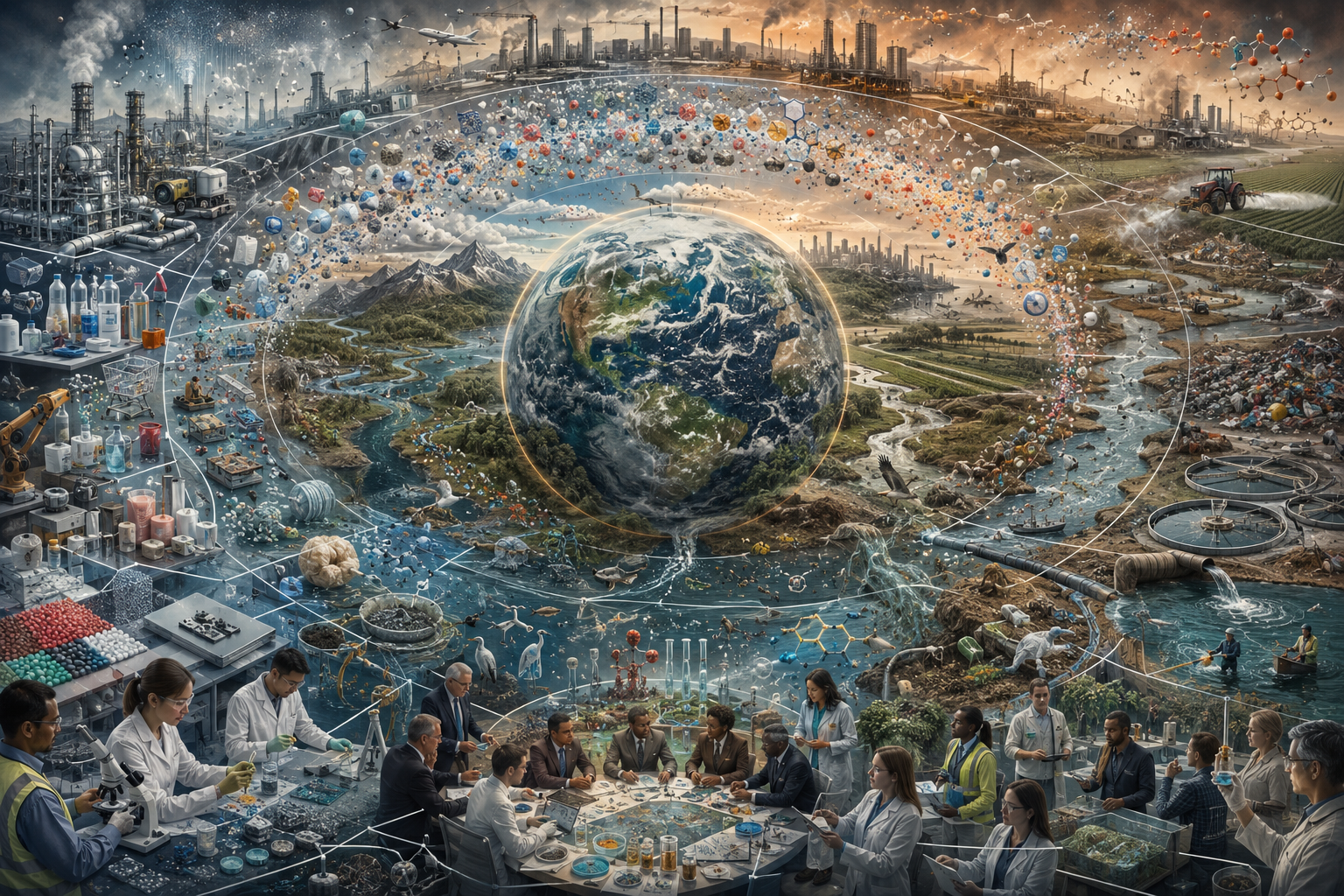
The concept of novel entities therefore changes the way chemical and material pollution should be understood. It is not only a downstream problem of contamination, cleanup, waste, or toxic exposure. It is an upstream problem of synthetic expansion: the human-made material world is growing in volume, diversity, persistence, and mobility faster than the systems designed to evaluate it. This is why the boundary is best understood as a problem of synthetic overload. Modern societies have become extraordinarily good at creating, scaling, distributing, and embedding new substances in products, agriculture, infrastructure, medicine, electronics, logistics, packaging, military systems, textiles, coatings, construction materials, energy systems, and consumer life. They have not become equally capable of understanding cumulative mixture effects, long-term persistence, ecological interactions, global dispersal, or the full burden imposed on bodies, soils, waters, air, sediments, food webs, and future generations.
This article examines novel entities as a planetary boundary by explaining what the category covers, why synthetic overload is treated as an Earth-system problem rather than only a toxicology or waste issue, how the boundary is defined, why modern societies struggle to govern expanding chemical and material complexity, how persistence, mobility, and mixture effects complicate risk assessment, why plastics and PFAS have become emblematic cases, how novel entities interact with other planetary boundaries, and why this boundary has become one of the clearest expressions of the mismatch between innovation and planetary stewardship.
Why Novel Entities Matter
Novel entities matter because the Earth system did not evolve with the scale, novelty, persistence, mobility, and combinatorial complexity of many modern synthetic substances. Carbon emissions, nutrient overload, land conversion, and freshwater disruption alter existing Earth-system processes, but novel entities add something different: substances, compounds, particles, materials, and modified agents whose behavior may exceed the adaptive and assimilative capacities of ecosystems and governance systems alike. The problem is not only toxicity in the narrow sense. It is proliferation, persistence, mobility, interaction, and the possibility of widespread effects that remain poorly characterized when deployment is already underway.
Within the planetary boundaries framework, this makes novel entities a boundary of systemic overload. It concerns whether the volume, diversity, and release of synthetic substances and modified agents are surpassing the ability of societies to test, regulate, track, and contain them before harm spreads through ecological and social systems. This is why the boundary is especially relevant to the contemporary condition: it captures the widening imbalance between innovation capacity and stewardship capacity.
What the boundary reveals, in other words, is not merely the danger of a few obviously harmful substances. It reveals a deeper structural problem in modernity itself. Industrial capacity to generate novel material complexity has grown faster than the institutional capacity to understand and govern its planetary consequences. Synthetic substances are created inside laboratories, factories, supply chains, agricultural systems, consumer markets, military-industrial systems, medical systems, and infrastructure networks, but their effects disperse through rivers, soils, food webs, oceans, atmosphere, waste streams, bodies, sediments, and future generations.
This is also why novel entities are not a secondary environmental issue. They are part of the architecture of planetary risk. Chemicals and materials can weaken ecosystems, disrupt endocrine and immune systems, alter microbial processes, contaminate freshwater, degrade soils, accumulate in organisms, complicate waste systems, and interact with climate, biodiversity, food, and water pressures. The boundary matters because synthetic overload can erode the resilience of multiple Earth-system processes at once.
The danger is not that all novel entities are equally harmful or that human invention is inherently destructive. The danger is that societies often scale production before adequate lifecycle assessment, ecological testing, mixture analysis, monitoring infrastructure, and governance capacity are in place. The boundary therefore asks a disciplined question: can a civilization continue creating and dispersing synthetic complexity faster than it can understand, track, and control it without eventually undermining the conditions of its own security?
That question is central to planetary-boundary thinking because it links material innovation to Earth-system responsibility. Novel entities are not only environmental contaminants. They are evidence of a broader institutional challenge: technological power has outpaced planetary stewardship.
What Counts as a Novel Entity
The category of novel entities includes a wide range of human-made or human-modified substances and materials. In the core planetary-boundaries literature and Stockholm Resilience Centre overview, it includes synthetic organic pollutants, plastics, pesticides, industrial chemicals, antibiotic residues, radioactive materials, and other substances or agents that are novel in a geological sense and capable of producing disruptive Earth-system effects. The category is intentionally broad because the challenge is not limited to one chemical class. It arises from the cumulative expansion of human-made materials whose environmental behavior and long-term consequences cannot be governed comprehensively at the pace at which they are produced and dispersed.
This breadth matters conceptually. If the boundary referred only to one pollutant family, the problem might be approached as an ordinary regulatory issue. But novel entities are better understood as a proliferating universe of substances and material forms, many of them persistent, mobile, bioaccumulative, toxic, reactive, poorly monitored, or difficult to track once released. The boundary therefore concerns not only dangerous objects but the growth of an entire synthetic domain whose scale and complexity increasingly exceed planetary governance.
The term also includes entities that may not look conventionally toxic at first. Microplastics and nanoplastics, for example, raise questions of physical persistence, transport, ingestion, chemical additives, surface interactions, and ecological exposure. Some engineered materials may have properties that differ from their bulk forms. Some chemical mixtures may produce effects not predictable from single-substance testing. Some substances may become problematic not because each unit is immediately catastrophic, but because cumulative release, persistence, and global dispersal make them effectively impossible to recall.
| Novel-entity category | Examples | Planetary-boundary concern |
|---|---|---|
| Synthetic chemicals | Industrial solvents, additives, surfactants, flame retardants, persistent organic pollutants. | Can persist, accumulate, move through ecosystems, and produce chronic or poorly understood effects. |
| Plastics and microplastics | Packaging polymers, fibers, fragments, microbeads, tire-wear particles, nanoplastics. | High production volume, persistence, fragmentation, additive complexity, global dispersal, and waste-system failure. |
| PFAS and highly persistent substances | Per- and polyfluoroalkyl substances used in coatings, firefighting foams, textiles, packaging, and industrial processes. | Extreme persistence, mobility, long-lived exposure pathways, and difficulty of remediation after release. |
| Pesticides and biocides | Herbicides, insecticides, fungicides, antimicrobial compounds, pest-control products. | Intentional biological activity, ecosystem exposure, mixture effects, resistance dynamics, and impacts on non-target species. |
| Pharmaceutical and antibiotic residues | Human and veterinary medicines, antibiotics, hormones, wastewater residues. | Chronic aquatic exposure, microbial disruption, resistance pressure, and biological activity at low concentrations. |
| Engineered materials | Nanomaterials, advanced coatings, novel composites, engineered particles. | Potentially distinctive behavior, uncertain long-term fate, and monitoring difficulty. |
| Radioactive materials | Radioisotopes, nuclear waste, mining residues, contaminated materials. | Long-lived hazard, containment requirements, intergenerational stewardship, and severe failure consequences. |
This is why the literature increasingly treats the boundary less as a list of problematic substances and more as a systemic condition of synthetic overload. The issue is not just what one compound does in isolation, but what happens when a rapidly expanding synthetic environment exceeds the capacities of assessment, monitoring, and control.
From Chemical Pollution to Synthetic Overload
Earlier environmental language often spoke of chemical pollution. That phrase remains useful, but it can understate what is distinctive about the novel entities boundary. Pollution suggests a familiar model in which harmful substances are emitted into the environment and must be reduced or cleaned up. The newer boundary language emphasizes something broader: synthetic overload. The challenge is not only that harmful chemicals leak into ecosystems, but that the total mass, diversity, persistence, mobility, and novelty of human-made substances have expanded to the point that assessment and control lag structurally behind production.
This shift in framing is important because it moves the discussion beyond local contamination toward systemic escalation. Plastics, PFAS and other highly persistent chemicals, pesticides, industrial additives, pharmaceuticals, flame retardants, solvents, surfactants, engineered particles, and mixed waste streams do not remain neatly separated. They travel, fragment, accumulate, transform, and interact. In many cases their effects are chronic, delayed, low-dose, cumulative, or difficult to isolate experimentally, yet their production and release continue to expand. Synthetic overload therefore captures the cumulative character of the problem better than a narrower pollution frame alone.
The distinction also changes where responsibility is located. A pollution frame often focuses on downstream treatment: disposal, cleanup, remediation, wastewater treatment, recycling, or product end-of-life. A synthetic-overload frame shifts attention upstream toward design, production volume, chemical class substitution, persistence, essential use, transparency, monitoring, supply-chain responsibility, and precaution before release. The problem is not only that waste is mismanaged. It is that material systems are designed in ways that generate persistent burdens faster than ecosystems and institutions can absorb them.
This is why the boundary matters at Earth-system scale. Pollution can sound like a downstream problem of disposal. Synthetic overload points instead to an upstream and system-wide dynamic in which production, diffusion, persistence, and ignorance interact to create planetary risk.
Synthetic overload also captures the way modern material systems distribute responsibility across many actors. A chemical may be designed by one company, manufactured by another, embedded in a product by another, sold through global supply chains, used by consumers who do not know it is present, discarded into waste systems, transformed through recycling or incineration, and eventually detected in water, dust, soil, wildlife, or human bodies. A governance system focused only on end-of-pipe control cannot keep up with that complexity.
The boundary therefore reframes innovation itself. Innovation is not merely the creation of new products, materials, or efficiencies. It is also the creation of new obligations. A synthetic substance becomes part of the Earth system when it is produced at scale, released, dispersed, and allowed to persist. If the obligations are not understood before release, innovation becomes a form of ecological debt.
Why the Boundary Is About Capacity Mismatch
One of the most important contributions of the novel entities literature is its argument that the boundary is fundamentally about a mismatch in capacity. The 2022 assessment emphasized that annual production and releases are increasing faster than the global capacity for assessment and monitoring. In other words, societies are generating novel entities more rapidly than they can evaluate their safety, persistence, interactions, and systemic consequences.
This makes the boundary unusually revealing from a governance perspective. Many environmental problems arise because actors knowingly overshoot ecological limits. Novel entities also reflect something else: epistemic overload. The pace of innovation, commercialization, and diffusion has outstripped the institutional ability to know what is being released, what it does in combination with other substances, how long it persists, where it ends up, and which harms may emerge across ecological, physiological, and generational timescales. The result is not only ecological strain but a structural loss of control.
Capacity mismatch is visible across the entire lifecycle. New substances may enter production before long-term effects are fully assessed. Chemical inventories may be incomplete or opaque. Supply chains may obscure which additives, intermediates, coatings, or processing chemicals are present in products. Waste streams may mix substances in ways never tested together. Environmental monitoring often focuses on known substances rather than unknown or emerging ones. Regulatory systems may require strong evidence of harm after exposure has already spread. This creates a pattern in which knowledge follows release rather than preceding it.
That capacity mismatch is one reason this boundary feels so contemporary. It describes a civilization that can engineer, synthesize, scale, and distribute faster than it can evaluate. In that sense, the novel entities boundary is not only about chemical risk. It is also about the governance limits of accelerated technological modernity.
The mismatch is also informational. Many regulatory systems depend on disclosure, but product and supply-chain data are often incomplete, proprietary, fragmented, or inaccessible. Even when data exist, they may not capture transformation products, degradation products, impurities, additives, processing aids, recycled-content contamination, or environmental mixtures. The synthetic world is therefore not only materially complex; it is informationally opaque.
This opacity creates a democratic problem. Communities cannot consent to exposures they cannot see. Workers cannot protect themselves from substances they are not told about. Regulators cannot govern substances they cannot identify. Scientists cannot monitor what is not inventoried. The boundary is therefore a problem of public knowledge as well as environmental chemistry.
How the Boundary Is Defined
The novel entities boundary has always been more difficult to operationalize than some other planetary boundaries because it does not lend itself to one simple Earth-system control variable like atmospheric carbon dioxide concentration. The 2022 landmark paper argued that the boundary could nevertheless be assessed by examining whether production, release, and the diversity of novel entities were outpacing society’s capacity to conduct safety-related assessment and monitoring before widespread release. This shifts the boundary logic away from one threshold concentration and toward a systemic guardrail based on production volume, release, persistence, and governance incapacity.
This is part of why the boundary is so conceptually important. It expands the planetary-boundaries framework beyond cases where physical thresholds are comparatively easier to identify. Novel entities show that planetary destabilization can also arise from combinatorial complexity, governance lag, and systemic ignorance under accelerating technological production. The challenge is not only what a substance does individually, but what happens when thousands of substances, additives, mixtures, particles, and material flows enter Earth systems faster than they can be collectively understood.
The boundary therefore operates through a different measurement logic. It asks whether the rate and scale of synthetic production and release remain within the assessment, monitoring, and governance capacity needed to avoid planetary harm. This is a demanding standard because it treats ignorance itself as part of the risk. A substance class can become dangerous not only because its harms are fully known, but because it is persistent, mobile, widespread, and inadequately assessed before global diffusion occurs.
In this sense, the boundary introduces a more reflexive form of Earth-system reasoning. It asks not only whether the planet can absorb synthetic materials, but whether society can responsibly know what it is doing before global release has already occurred.
That shift also matters for precaution. If the boundary depended only on demonstrated harm from known substances, governance would remain reactive. By the time harm is conclusively documented, persistent and mobile substances may already be dispersed through groundwater, soils, oceans, food webs, sediments, household dust, or human bodies. A boundary built around assessment capacity recognizes that uncertainty under conditions of irreversible dispersal is itself dangerous.
The most mature interpretation of the boundary therefore combines several dimensions: production volume, release rate, diversity, persistence, mobility, hazard, exposure, mixture complexity, monitoring coverage, assessment status, and governance capacity. The boundary is not one number because the problem is not one-dimensional. It is a systems problem in which scale, novelty, uncertainty, and control failure interact.
The Boundary and Its Current Status
The current status of the novel entities boundary is transgressed. The 2022 assessment concluded that the safe operating space had been exceeded. The 2023 planetary-boundaries update counted novel entities among the six transgressed boundaries. The 2025 Planetary Health Check continues to list novel entities among the breached boundaries, alongside climate change, biosphere integrity, land-system change, freshwater change, biogeochemical flows, and ocean acidification.
This matters because the boundary is not in a condition of mere emerging concern. It is already classified as beyond the safe operating space. The challenge is therefore no longer whether synthetic overload might become planetary in significance. The challenge is how to govern a boundary that has already been crossed while production, diffusion, and environmental release continue to expand.
The status of the boundary also matters rhetorically. It clarifies that chemical and material proliferation should not be treated as a secondary environmental issue that can be deferred until more visible crises are solved. In the framework itself, it is already part of the planetary overshoot condition.
That does not mean the boundary is irreversible in the same way across all substance classes. Some substances can be phased out. Some uses can be redesigned. Some emissions can be reduced. Some materials can be restricted, substituted, or captured. But for highly persistent, mobile, globally dispersed substances, delay makes reversal much harder. Once synthetic materials are dispersed through soils, sediments, groundwater, oceans, bodies, food webs, and waste systems, governance shifts from prevention to damage limitation.
| Boundary dimension | Current interpretation | Why it matters |
|---|---|---|
| Boundary status | Transgressed / outside safe operating space. | Novel entities are already part of the wider planetary overshoot condition. |
| Core mechanism | Production and release outpace assessment and monitoring capacity. | Risk arises not only from known toxicity but from systemic governance overload. |
| Key properties | Persistence, mobility, bioaccumulation, toxicity, mixture complexity, and global dispersal. | These properties make containment, attribution, and remediation difficult after release. |
| Emblematic cases | Plastics, microplastics, PFAS, pesticides, industrial chemicals, pharmaceuticals, engineered materials. | Different cases reveal different dimensions of synthetic overload. |
| Governance priority | Upstream precaution, transparency, class-based controls, essential-use frameworks, monitoring, and lifecycle responsibility. | Downstream cleanup alone cannot solve a boundary driven by expanding production and release. |
The current status therefore calls for an upstream response. The boundary cannot be brought back toward safety only by cleaning up contamination after it appears. It requires reducing unnecessary production and release, redesigning materials, prioritizing essential uses, improving monitoring, closing data gaps, and making synthetic systems accountable before dispersal becomes irreversible.
Persistence, Mobility, and Mixture Effects
Persistence is one of the most important properties in the novel entities boundary because it changes the timescale of harm. A substance that degrades quickly may still be dangerous under intense exposure, but a persistent substance creates a different kind of risk. It can remain in circulation long after production decisions have been made, accumulate across environmental compartments, and impose burdens on future generations. Persistence turns a production decision into a long-term planetary commitment.
Mobility also matters. Substances that move through air, water, organisms, products, dust, wastewater, sediments, and trade networks can spread far beyond the site of production or use. This weakens the effectiveness of local governance and makes exposure more difficult to contain. A substance released in one place may become a regional, transboundary, or global problem. The more persistent and mobile a substance is, the more precaution becomes necessary before release.
Mixture effects make the boundary even harder to govern. Regulatory systems often test substances individually, but organisms and ecosystems experience mixtures. Chemicals may interact additively, synergistically, antagonistically, or through pathways that are poorly understood. Plastics can carry additives and adsorbed pollutants. Agricultural chemicals can interact with nutrient loads and hydrological stress. Waste streams can combine substances not designed to be assessed together. The result is a synthetic environment that cannot be understood adequately through single-substance logic alone.
These properties explain why novel entities are a planetary-boundary problem rather than simply a toxicology problem. Persistence, mobility, and mixture complexity create conditions under which uncertainty expands as exposure spreads. By the time evidence is complete, containment may no longer be possible.
Low-dose and chronic effects add another layer of complexity. Some substances may not produce obvious acute toxicity but may affect endocrine systems, reproduction, development, immune function, microbial communities, behavior, or ecological interactions over longer periods. Effects may vary by life stage, species, co-exposure, nutrition, stress, temperature, disease, or habitat condition. This makes it difficult to rely on simple thresholds or short-term tests as the only basis for safety.
The boundary therefore calls for a shift from proof-after-harm to precaution-before-dispersal. If a substance is persistent, mobile, widely used, and poorly assessed, society should not wait for complete causal certainty before limiting release. The burden of proof must move upstream, especially for substances that are difficult or impossible to recall once dispersed.
Plastics, PFAS, and Emblematic Cases
Plastics and PFAS have become emblematic cases because they reveal different dimensions of synthetic overload. Plastics illustrate volume, durability, fragmentation, waste-system failure, additive complexity, fossil-feedstock dependence, and global dispersal. Plastic materials can fragment into microplastics and nanoplastics, move through rivers and oceans, enter food webs, accumulate in sediments, travel through atmospheric pathways, and persist as legacy pollution. They also connect to packaging systems, petrochemical expansion, consumer culture, waste exports, recycling limitations, incineration, and environmental justice.
PFAS illustrate extreme persistence, mobility, and the difficulty of governing highly useful but highly durable chemical classes after widespread diffusion. These substances have been used in firefighting foams, coatings, textiles, packaging, industrial processes, electronics, and other applications. Because many PFAS are resistant to degradation, they raise a distinctive governance challenge: once released, they can become part of long-lived environmental and bodily exposure pathways. The 2022 PFAS planetary-boundary paper argued that environmental contamination by selected PFAS is globally widespread enough to exceed guideline levels across rainwater, surface waters, and soils.
These cases are important, but they should not narrow the boundary. Novel entities are broader than plastics and PFAS. The category includes pesticides, industrial chemicals, pharmaceuticals, persistent organic pollutants, heavy industrial compounds, radioactive materials, engineered particles, and other synthetic or human-modified agents. Plastics and PFAS are instructive because they show the kind of governance failure the boundary warns against: global release first, comprehensive understanding later.
The central lesson is not that all synthetic materials are equally harmful. It is that material innovation without lifecycle stewardship can create planetary commitments that are hard to undo. The more persistent, mobile, widely used, and poorly assessed an entity is, the more it belongs at the center of precautionary governance.
Plastics also reveal the limits of end-of-life thinking. Recycling can help in some contexts, but it cannot solve a problem driven by production growth, chemical additives, polymer diversity, contamination, downcycling, export, leakage, and fragmentation. The plastic problem must therefore be addressed upstream through material reduction, reuse systems, safer design, producer responsibility, chemical simplification, and restrictions on unnecessary uses.
PFAS similarly reveal the limits of substance-by-substance control. Because PFAS are a large chemical class, regulating one compound at a time can lead to regrettable substitution, where one persistent substance is replaced by another with similar concerns. Class-based approaches, essential-use frameworks, transparent inventories, and strict limits on nonessential uses become especially important.
Pesticides, Pharmaceuticals, and Industrial Chemicals
Pesticides, pharmaceuticals, and industrial chemicals show that novel entities are not only about long-lived materials or visible waste. They also concern biologically active substances that can move through fields, watersheds, wastewater systems, soils, organisms, and food webs. Many of these substances are designed to produce biological effects. That design can be beneficial in a controlled context, but it becomes risky when biologically active compounds disperse into ecosystems not intended to receive them.
Pesticides and biocides are especially important because they are intentionally toxic to target organisms. Their effects may extend to non-target insects, aquatic organisms, soil microbes, birds, amphibians, pollinators, and ecological communities. Pesticide exposure can interact with habitat loss, climate stress, nutrient loading, disease, and other pollutants. This makes chemical exposure part of broader biosphere-integrity risk rather than an isolated agricultural input issue.
Pharmaceutical residues raise a different kind of concern. Human and veterinary medicines can enter wastewater, rivers, sediments, soils, and aquatic ecosystems. Antibiotics can contribute to antimicrobial resistance pressures. Hormonal compounds can affect endocrine systems. Painkillers, antidepressants, antiparasitic drugs, and other pharmaceuticals may have ecological effects at concentrations that are difficult to interpret through conventional toxicology alone. Wastewater treatment can reduce some residues but does not eliminate the broader need for source control, prescribing stewardship, veterinary oversight, and monitoring.
Industrial chemicals and additives create another layer of complexity because they are often embedded in products rather than released as obvious emissions. Flame retardants, plasticizers, surfactants, coatings, stabilizers, dyes, solvents, processing aids, and performance chemicals may move through manufacturing, consumer use, household dust, washing, abrasion, recycling, landfill leachate, incineration, wastewater, and environmental dispersal. Many are invisible to the user but persistent in the material system.
These cases reveal a central governance problem: modern societies have built chemical dependency into ordinary life. The goal cannot be an unrealistic rejection of all chemistry. The goal must be safer chemistry, chemical simplification, better disclosure, essential-use prioritization, and an end to the assumption that release is acceptable until harm is proven beyond dispute.
Microplastics, Nanoplastics, and Material Fragmentation
Microplastics and nanoplastics are especially important because they show how a material can become more difficult to govern after release. Plastic items may begin as recognizable products, packaging, fibers, films, coatings, or components. Over time, they fragment through sunlight, abrasion, weathering, washing, mechanical stress, and environmental processes. The resulting particles can move through rivers, oceans, soils, air, sediments, organisms, and food systems. Fragmentation turns waste into exposure.
This matters because microplastics are not simply tiny versions of larger plastic objects. Their small size changes transport, ingestion, surface area, chemical interaction, and monitoring difficulty. They may carry additives, adsorb other contaminants, interact with microbes, move through trophic pathways, or accumulate in environmental compartments. Nanoplastics raise additional questions because they may behave differently from larger particles and may be harder to detect reliably.
Material fragmentation also exposes the weakness of product-centered governance. A product can be regulated, labeled, sold, discarded, recycled, exported, or banned. A dispersed particle field is much harder to control. Once plastic fragments enter sediments, soils, oceans, atmospheric dust, wastewater sludge, or biological tissues, governance becomes monitoring and mitigation rather than prevention. This is why upstream reduction and safer design are so important.
The microplastic problem also illustrates the mixture dimension of novel entities. Plastic particles can contain residual monomers, additives, stabilizers, flame retardants, pigments, plasticizers, processing chemicals, and adsorbed pollutants. They may interact with biological membranes, gut systems, sediments, microbial communities, and food webs. Risk cannot be understood by mass alone.
Microplastics therefore function as a warning about material irreversibility. A society that produces persistent materials at massive scale without closed-loop control creates particles that future generations must inherit. The boundary asks whether such production remains compatible with safe operating space when release, fragmentation, and exposure are difficult to reverse.
Novel Entities, Justice, and Unequal Exposure
Novel entities are also a justice issue. Exposure is not evenly distributed. Workers in chemical manufacturing, agriculture, waste management, recycling, firefighting, mining, electronics production, textile production, construction, healthcare, and industrial maintenance may face higher risks than consumers who encounter the finished product. Communities near factories, refineries, incinerators, landfills, waste sites, military bases, industrial farms, contaminated waterways, or poorly regulated recycling facilities may bear burdens created by production and consumption systems from which they receive little benefit.
Environmental injustice is often embedded in the lifecycle of novel entities. Extraction communities may face contamination from raw-material supply chains. Manufacturing communities may face emissions and occupational exposures. Consumer communities may face household dust, food packaging, drinking-water contamination, or product exposure. Waste-receiving communities may face landfill leachate, incinerator emissions, informal recycling hazards, exported waste, or contaminated water. No single exposure point captures the whole injustice.
PFAS contamination around firefighting sites, industrial facilities, military bases, and water systems illustrates how occupational, community, and environmental exposure can overlap. Plastic waste exports illustrate how wealthy consumption systems can externalize material burdens to poorer regions. Pesticide exposure illustrates how farmworkers and rural communities may bear risks associated with food systems serving distant consumers. Pharmaceutical residues and industrial compounds illustrate how wastewater and monitoring gaps can shift burdens into aquatic ecosystems and downstream communities.
Justice also includes intergenerational responsibility. Persistent substances create exposure pathways that can outlive the decisions that produced them. Future generations may inherit contaminated groundwater, sediments, soils, wildlife, bodies, and waste sites without having participated in the original benefits. This is one of the strongest moral arguments for precaution: irreversible exposure should not be imposed on people who cannot consent.
Data justice is equally important. Communities cannot demand protection if contamination is not measured, disclosed, or acknowledged. Monitoring gaps often coincide with political marginalization. The absence of data should not be mistaken for the absence of harm. A safe-and-just approach to novel entities requires open inventories, transparent monitoring, community right-to-know, worker protection, and meaningful participation in decisions about production, use, and remediation.
In this sense, the novel entities boundary is not only a scientific boundary. It is a moral boundary between innovation that accepts responsibility and innovation that externalizes uncertainty onto the vulnerable, the unseen, and the unborn.
Interactions with Other Boundaries
Novel entities interact with multiple other planetary boundaries. They can weaken biosphere integrity through toxicity, habitat contamination, bioaccumulation, endocrine disruption, reproductive effects, microbial disturbance, and chronic ecosystem stress. They can compound freshwater change by degrading water quality, altering aquatic ecosystems, increasing treatment burdens, and adding persistent contamination to already stressed watersheds. They can reinforce biogeochemical stress where agricultural chemicals, industrial runoff, and mixed pollutant loads interact with nitrogen, phosphorus, eutrophication, and oxygen depletion. Land-system change can also intensify exposure pathways by fragmenting habitats, concentrating waste, accelerating runoff, and disturbing contaminated soils.
The boundary also interacts with climate and energy systems. Many synthetic materials and chemicals are produced through fossil-based industrial systems, and waste-management responses can themselves generate emissions or secondary contamination. Plastics are deeply linked to petrochemical systems. Some substitutes may reduce one pressure while shifting burdens elsewhere. Climate change can mobilize contamination through flooding, wildfire, permafrost thaw, stormwater surges, erosion, sea-level rise, and changing hydrological patterns. This means novel entities do not unfold apart from climate, land, water, and biosphere dynamics. They are woven into them.
These interactions are one reason the boundary is so consequential. It does not simply add another line item to the list of planetary pressures. It amplifies and complicates the management of several other boundaries at once. A lake under nutrient stress may also face pesticide exposure, microplastic contamination, industrial runoff, and altered hydrology. A forest under climate stress may also face atmospheric deposition, fire-retardant residues, mining contamination, and land-use chemicals. A coastal system may face warming, acidification, nutrient overload, plastics, and toxic substances simultaneously.
Cross-boundary interaction also means that governance cannot solve novel entities through isolated chemical-by-chemical regulation alone. Synthetic overload must be treated as part of the broader planetary-boundary condition: a set of interacting pressures that can erode resilience across ecosystems, watersheds, soils, oceans, food systems, and public health.
For companion essays, see Biosphere Integrity and the Stability of Life Systems, Freshwater Change and Earth System Risk, Biogeochemical Flows: Nitrogen, Phosphorus, and Planetary Destabilization, Land-System Change and Ecological Transformation, Ocean Acidification and the Chemistry of Planetary Change, and Atmospheric Aerosol Loading and Regional Planetary Risk.
Novel Entities and Earth-System Risk
The planetary-boundary framing changes how chemical and material pollution is understood. It is no longer enough to ask whether particular substances are locally toxic or whether individual regulatory thresholds have been exceeded. The deeper question is whether the cumulative growth of synthetic materials and substances is reshaping the Earth system faster than science and governance can respond. Once posed that way, novel entities become a matter of Earth-system risk rather than only product safety or waste management.
This is why the boundary is so closely associated with the idea of synthetic overload. The problem is not just the existence of dangerous substances. It is the accelerating multiplication of materials, compounds, mixtures, particles, additives, residues, and release pathways whose aggregate effects are difficult to trace yet increasingly hard to avoid. In Earth-system terms, this means the biosphere and human institutions are being asked to absorb and govern a synthetic environment of expanding scale and novelty.
Earth-system risk also emerges because novelty and uncertainty interact. The more novel an entity is, the less historical experience exists to guide understanding. The more persistent and mobile it is, the more widely uncertainty is distributed. The more it interacts with other substances and stressors, the harder causal attribution becomes. This produces a dangerous pattern: society may not know enough to regulate effectively until exposure is already widespread.
The boundary therefore exposes a deeper civilizational issue. A society that cannot keep pace with the consequences of what it creates may destabilize the very ecological conditions that support its technological and economic achievements.
Novel entities also raise the problem of planetary irreversibility. Climate change can be mitigated and some carbon can be removed, though not easily. Nutrient flows can be reduced and ecosystems restored, though legacy effects persist. But some synthetic substances, once globally dispersed, may be extraordinarily difficult to remove from groundwater, oceans, sediments, soils, and living bodies. This makes prevention especially important.
In that sense, the novel entities boundary is one of the strongest arguments for upstream planetary governance. The most effective moment to prevent synthetic overload is before production scales, before substances become embedded in supply chains, before waste streams multiply, and before exposure becomes normal. The boundary asks societies to govern the front end of innovation, not only the back end of contamination.
Monitoring Novel Entities
Monitoring novel entities is difficult because the category is vast, diverse, and constantly changing. A serious monitoring system must track substances, materials, mixtures, transformation products, degradation products, production volumes, release pathways, environmental concentrations, waste flows, exposure routes, health signals, ecological responses, and geographic distribution. It must also track what is not known: unassessed substances, confidential chemicals, poorly disclosed additives, emerging material classes, and gaps in monitoring coverage.
Traditional monitoring often focuses on known contaminants. That is necessary but insufficient. Novel entities require both targeted monitoring and non-target screening. Targeted monitoring looks for known substances of concern. Non-target screening uses analytical chemistry to identify unexpected or unknown compounds in environmental samples. Together, these approaches can improve the visibility of synthetic complexity, but they require laboratory capacity, standard methods, open data, and long-term funding.
Monitoring must also connect products to environments. Chemical inventories should be linked to production volumes, uses, supply chains, product categories, waste systems, wastewater streams, landfill leachate, incineration outputs, agricultural runoff, industrial emissions, and environmental samples. Without this linkage, society may detect contamination without understanding its source. Source attribution is essential for accountability.
Environmental compartments matter as well. Novel entities can move through air, drinking water, groundwater, surface water, oceans, soils, sediments, food, dust, wildlife, and human tissues. Monitoring only one compartment can miss the system. PFAS, microplastics, pesticides, pharmaceuticals, and industrial chemicals may require different sampling strategies. A one-size-fits-all monitoring architecture will fail.
Monitoring must also support justice. Communities near industrial sites, waste facilities, contaminated water systems, agricultural exposure zones, military bases, informal recycling sites, and chemical-disaster areas need data that are timely, understandable, and actionable. Workers need exposure data. Regulators need supply-chain disclosure. Scientists need open inventories. Public health agencies need early warning. Monitoring is not only a technical exercise; it is a condition of democratic accountability.
A mature novel-entities monitoring system would therefore include open chemical inventories, production-volume reporting, product ingredient disclosure, environmental sampling, biomonitoring, non-target screening, supply-chain traceability, community right-to-know, and transparent uncertainty reporting. Without that infrastructure, synthetic overload remains partly invisible until harm becomes difficult to reverse.
Governance Implications
If novel entities are a transgressed planetary boundary, then governance cannot remain organized around slow, substance-by-substance regulation alone. That model is too reactive for a system in which production expands faster than assessment capacity. The boundary implies a need for stronger precaution, earlier intervention, better monitoring, more transparent supply chains, mandatory data disclosure, stronger lifecycle responsibility, and governance approaches capable of addressing classes of substances, persistent materials, and cumulative mixtures rather than waiting for harm to be conclusively demonstrated one case at a time.
The challenge is political as well as scientific. Novel entities are embedded in industrial strategy, agriculture, health systems, electronics, construction, textiles, packaging, logistics, consumer products, waste systems, military systems, and global trade. That means the governance problem is not just how to ban a few harmful chemicals. It is how to realign innovation with stewardship so that societies do not continue to expand the synthetic burden faster than they can understand or contain it. This is one reason the novel entities boundary may be one of the most difficult to reverse once transgressed.
Governance therefore needs to move upstream. Safer-by-design chemistry, essential-use frameworks, class-based restrictions, chemical simplification, material passports, product transparency, extended producer responsibility, global monitoring systems, open inventories, substitution assessment, and precautionary release rules all become more important. The point is not to halt all innovation. It is to prevent innovation from externalizing uncertainty onto ecosystems, workers, consumers, communities, and future generations.
In that sense, the boundary pushes governance thinking beyond compliance and toward redesign. It implies that precaution cannot remain an afterthought to innovation. It has to become part of the architecture of innovation itself.
Essential-use frameworks are especially important. Some substances may be necessary for health, safety, critical infrastructure, or essential technologies where safer alternatives are not yet available. Other uses may be convenience-driven, decorative, disposable, or easily substituted. A planetary-boundary approach should distinguish between them. Persistent and hazardous substances should not be used casually when their benefits are minor and their long-term burdens are large.
Class-based governance also matters. Regulating one substance at a time can encourage regrettable substitution, where a restricted chemical is replaced by a closely related chemical with similar persistence or toxicity. Class-based approaches can reduce this pattern by evaluating chemical families according to shared properties such as persistence, mobility, bioaccumulation, toxicity, or degradation resistance.
For adjacent essays, see Earth System Governance in an Age of Limits, Business Strategy Within Planetary Boundaries, Finance, Disclosure, and Systemic Environmental Risk, and Environmental Monitoring Systems.
Why This Matters for Planetary Boundaries
Novel entities matter for planetary boundaries because they show that Earth-system destabilization is not only caused by overusing familiar natural cycles. It can also be caused by creating new material realities faster than the planet and society can safely absorb them. Synthetic overload is a distinct mode of planetary pressure: it expands the artificial chemical and material domain while leaving science, law, monitoring, and ecosystems to catch up after release.
The boundary also matters because it makes uncertainty visible as a planetary risk. In many environmental debates, uncertainty is used as a reason to delay action. The novel entities boundary reverses that logic. When substances are persistent, mobile, widely dispersed, and poorly assessed, uncertainty strengthens the case for precaution. Ignorance is not a neutral condition when release is difficult to reverse.
Novel entities also connect planetary science to ethics. The people most exposed to chemical and material burdens are often workers, poor communities, Indigenous communities, downstream communities, waste-receiving regions, and future generations. The benefits of synthetic production and the burdens of synthetic exposure are not evenly distributed. A safe operating space must therefore also be a just operating space.
Finally, the boundary matters because it challenges the meaning of progress. Innovation that creates long-lived burdens without the capacity to monitor, control, or remediate them is not fully rational. A more mature form of innovation would measure success not only by performance, profit, convenience, or scale, but by persistence, mobility, toxicity, lifecycle responsibility, transparency, and compatibility with planetary resilience.
To understand novel entities as a planetary boundary is to understand that synthetic capacity without stewardship capacity is not progress. It is overload. The boundary warns that a civilization cannot safely create faster than it can know, govern, and repair.
Mathematical Lens: Synthetic Overload, Assessment Capacity, and Boundary Pressure
The novel entities boundary can be represented as a relationship between production, release, persistence, hazard, monitoring capacity, and assessment capacity. Let \(N_t\) represent the number or diversity of novel entities in commercial or environmental circulation at time \(t\), and let \(P_t\) represent total production volume. Let \(L_t\) represent releases to the environment, and let \(A_t\) represent society’s assessment and monitoring capacity. A simplified overload ratio can be written as:
O_t = \frac{P_t + L_t + \eta N_t}{A_t}
\]
Interpretation: If \(O_t > 1\), synthetic production, release, and diversity exceed the capacity to assess and monitor them. This does not measure toxicity directly. It measures governance overload.
A more risk-sensitive formulation can include persistence \(S_i\), mobility \(M_i\), hazard \(H_i\), and exposure \(E_i\) for substance or material class \(i\):
R_i = S_i \times M_i \times H_i \times E_i
\]
Interpretation: Risk rises when a substance class is persistent, mobile, hazardous, and widely encountered through exposure pathways.
The cumulative risk burden across \(n\) substance classes can be written as:
C = \sum_{i=1}^{n} w_i R_i
\]
Interpretation: Cumulative burden aggregates risk across substance classes, weighted by production scale, release rate, or strategic importance.
The assessment gap can be represented as:
G = 1 – \frac{A}{N}
\]
Interpretation: The assessment gap grows as the number of adequately assessed entities becomes small relative to the number of entities in circulation.
A synthetic overload score can then combine cumulative risk and assessment gap:
S = C(1 + G)
\]
Interpretation: Synthetic overload rises when cumulative risk is high and assessment capacity is weak.
| Term | Meaning | Interpretive role |
|---|---|---|
| \(P_t\) | Production volume | Represents the scale of synthetic material entering commerce or use. |
| \(L_t\) | Environmental release | Represents leakage, emissions, disposal, runoff, volatilization, fragmentation, and other release pathways. |
| \(N_t\) | Diversity of novel entities | Represents the number or complexity of substances, materials, additives, or mixtures in circulation. |
| \(A_t\) | Assessment and monitoring capacity | Represents scientific, regulatory, analytical, and institutional capacity to evaluate and track novel entities. |
| \(S_i\) | Persistence | Represents the tendency of a substance or material class to resist degradation. |
| \(M_i\) | Mobility | Represents capacity to move through air, water, soils, organisms, products, and waste streams. |
| \(H_i\) | Hazard | Represents toxicological or ecological harm potential. |
| \(E_i\) | Exposure | Represents the degree of contact with organisms, ecosystems, workers, consumers, or communities. |
This formulation captures the boundary’s central logic: risk rises not only because substances are hazardous, persistent, mobile, or widely released, but because the number and complexity of entities outpace the capacity to assess them. In the novel entities boundary, ignorance is not outside the model. It is part of the risk structure.
Advanced Python Workflow: Synthetic Overload and Assessment-Capacity Scoring
The following Python workflow models the novel entities boundary as a synthetic-overload problem. It scores substance classes by production volume, release fraction, persistence, mobility, hazard, exposure, monitoring coverage, assessment status, substitution feasibility, essentiality, and governance capacity. The data are illustrative, but the structure can be adapted for chemical inventories, product registries, industrial monitoring, lifecycle assessment, environmental data platforms, or supply-chain risk dashboards.
"""
Novel entities synthetic overload workflow.

This workflow models the novel entities boundary using:
- production volume
- environmental release fraction
- persistence
- mobility
- hazard
- exposure
- monitoring coverage
- assessment status
- substitution feasibility
- essentiality
- governance capacity
- scenario testing

The values are illustrative. Replace them with documented chemical
inventories, production data, release estimates, monitoring records,
hazard data, exposure models, and transparent assumptions before applied use.
"""

from __future__ import annotations

from dataclasses import dataclass
from pathlib import Path
from typing import Literal

import numpy as np
import pandas as pd


AssessmentStatus = Literal[
    "adequately_assessed",
    "partially_assessed",
    "poorly_assessed",
    "not_assessed",
]


PriorityClass = Literal[
    "urgent_pressure_reduction",
    "assessment_and_monitoring_priority",
    "persistence_precaution_priority",
    "essential_use_review_priority",
    "standard_control_priority",
]


@dataclass(frozen=True)
class NovelEntityClass:
    """Profile for a class of novel entities."""

    entity_class: str
    annual_production_index: float
    environmental_release_fraction: float
    persistence: float
    mobility: float
    hazard: float
    exposure: float
    monitoring_coverage: float
    assessment_status: AssessmentStatus
    substitution_feasibility: float
    essentiality: float
    governance_capacity: float
    justice_burden: float


ASSESSMENT_GAP_WEIGHTS: dict[AssessmentStatus, float] = {
    "adequately_assessed": 0.00,
    "partially_assessed": 0.35,
    "poorly_assessed": 0.70,
    "not_assessed": 1.00,
}


def build_entity_profiles() -> pd.DataFrame:
    """
    Create illustrative novel-entity class data.

    All values are scaled 0-1 except annual_production_index.
    These are not official estimates.
    """
    profiles = [
        NovelEntityClass(
            entity_class="plastics_and_microplastics",
            annual_production_index=1.00,
            environmental_release_fraction=0.32,
            persistence=0.86,
            mobility=0.62,
            hazard=0.54,
            exposure=0.72,
            monitoring_coverage=0.46,
            assessment_status="partially_assessed",
            substitution_feasibility=0.58,
            essentiality=0.42,
            governance_capacity=0.44,
            justice_burden=0.70,
        ),
        NovelEntityClass(
            entity_class="pfas_forever_chemicals",
            annual_production_index=0.42,
            environmental_release_fraction=0.28,
            persistence=0.98,
            mobility=0.88,
            hazard=0.82,
            exposure=0.78,
            monitoring_coverage=0.34,
            assessment_status="poorly_assessed",
            substitution_feasibility=0.44,
            essentiality=0.36,
            governance_capacity=0.36,
            justice_burden=0.78,
        ),
        NovelEntityClass(
            entity_class="pesticides_and_biocides",
            annual_production_index=0.68,
            environmental_release_fraction=0.40,
            persistence=0.54,
            mobility=0.48,
            hazard=0.76,
            exposure=0.70,
            monitoring_coverage=0.52,
            assessment_status="partially_assessed",
            substitution_feasibility=0.50,
            essentiality=0.58,
            governance_capacity=0.48,
            justice_burden=0.72,
        ),
        NovelEntityClass(
            entity_class="industrial_additives",
            annual_production_index=0.74,
            environmental_release_fraction=0.22,
            persistence=0.68,
            mobility=0.46,
            hazard=0.62,
            exposure=0.56,
            monitoring_coverage=0.38,
            assessment_status="poorly_assessed",
            substitution_feasibility=0.48,
            essentiality=0.50,
            governance_capacity=0.40,
            justice_burden=0.60,
        ),
        NovelEntityClass(
            entity_class="pharmaceutical_residues",
            annual_production_index=0.38,
            environmental_release_fraction=0.36,
            persistence=0.42,
            mobility=0.58,
            hazard=0.52,
            exposure=0.64,
            monitoring_coverage=0.44,
            assessment_status="partially_assessed",
            substitution_feasibility=0.36,
            essentiality=0.76,
            governance_capacity=0.46,
            justice_burden=0.54,
        ),
        NovelEntityClass(
            entity_class="flame_retardants",
            annual_production_index=0.30,
            environmental_release_fraction=0.18,
            persistence=0.74,
            mobility=0.42,
            hazard=0.70,
            exposure=0.50,
            monitoring_coverage=0.40,
            assessment_status="partially_assessed",
            substitution_feasibility=0.52,
            essentiality=0.46,
            governance_capacity=0.42,
            justice_burden=0.56,
        ),
        NovelEntityClass(
            entity_class="engineered_nanomaterials",
            annual_production_index=0.24,
            environmental_release_fraction=0.20,
            persistence=0.60,
            mobility=0.64,
            hazard=0.50,
            exposure=0.46,
            monitoring_coverage=0.28,
            assessment_status="poorly_assessed",
            substitution_feasibility=0.42,
            essentiality=0.44,
            governance_capacity=0.34,
            justice_burden=0.48,
        ),
        NovelEntityClass(
            entity_class="radioactive_materials",
            annual_production_index=0.18,
            environmental_release_fraction=0.08,
            persistence=0.92,
            mobility=0.30,
            hazard=0.95,
            exposure=0.32,
            monitoring_coverage=0.68,
            assessment_status="partially_assessed",
            substitution_feasibility=0.22,
            essentiality=0.70,
            governance_capacity=0.64,
            justice_burden=0.66,
        ),
        NovelEntityClass(
            entity_class="unknown_or_unregistered_entities",
            annual_production_index=0.55,
            environmental_release_fraction=0.30,
            persistence=0.70,
            mobility=0.65,
            hazard=0.60,
            exposure=0.62,
            monitoring_coverage=0.12,
            assessment_status="not_assessed",
            substitution_feasibility=0.30,
            essentiality=0.40,
            governance_capacity=0.22,
            justice_burden=0.74,
        ),
    ]

    return pd.DataFrame([profile.__dict__ for profile in profiles])


def classify_priority(row: pd.Series) -> PriorityClass:
    """Assign a governance priority class."""
    if row["synthetic_overload_score"] >= 0.22:
        return "urgent_pressure_reduction"
    if row["governance_gap"] >= 0.65:
        return "assessment_and_monitoring_priority"
    if row["persistence"] >= 0.85:
        return "persistence_precaution_priority"
    if row["essential_use_pressure"] >= 0.40:
        return "essential_use_review_priority"
    return "standard_control_priority"


def score_synthetic_overload(data: pd.DataFrame) -> pd.DataFrame:
    """Score synthetic overload risk by entity class."""
    scored = data.copy()

    if (scored["annual_production_index"] < 0).any():
        raise ValueError("Annual production index must be non-negative.")

    scored["release_index"] = (
        scored["annual_production_index"]
        * scored["environmental_release_fraction"]
    )

    scored["intrinsic_risk"] = (
        scored["persistence"]
        * scored["mobility"]
        * scored["hazard"]
        * scored["exposure"]
    )

    scored["assessment_gap"] = scored["assessment_status"].map(
        ASSESSMENT_GAP_WEIGHTS
    )

    scored["monitoring_gap"] = 1 - scored["monitoring_coverage"]
    scored["institutional_gap"] = 1 - scored["governance_capacity"]

    scored["governance_gap"] = (
        0.40 * scored["assessment_gap"]
        + 0.30 * scored["monitoring_gap"]
        + 0.30 * scored["institutional_gap"]
    )

    scored["essential_use_pressure"] = (
        scored["essentiality"]
        * (1 - scored["substitution_feasibility"])
    )

    scored["justice_adjustment"] = 1 + 0.35 * scored["justice_burden"]

    scored["synthetic_overload_score"] = (
        scored["release_index"]
        * scored["intrinsic_risk"]
        * (1 + scored["governance_gap"])
        * (1 + scored["essential_use_pressure"])
        * scored["justice_adjustment"]
    )

    scored["priority_class"] = scored.apply(classify_priority, axis=1)

    return scored.sort_values(
        "synthetic_overload_score",
        ascending=False,
    ).reset_index(drop=True)


def summarize_boundary_status(scored: pd.DataFrame) -> pd.DataFrame:
    """Create boundary-level summary metrics."""
    total_production = scored["annual_production_index"].sum()
    total_release = scored["release_index"].sum()

    weighted_risk = (
        scored["synthetic_overload_score"]
        * scored["annual_production_index"]
    ).sum() / total_production

    average_assessment_gap = scored["assessment_gap"].mean()
    average_monitoring_gap = scored["monitoring_gap"].mean()
    average_governance_gap = scored["governance_gap"].mean()
    average_justice_burden = scored["justice_burden"].mean()

    synthetic_overload_ratio = (
        total_release
        * (1 + average_assessment_gap + average_monitoring_gap)
        * (1 + average_governance_gap)
        * (1 + 0.25 * average_justice_burden)
    )

    return pd.DataFrame(
        {
            "total_production_index": [total_production],
            "total_release_index": [total_release],
            "weighted_synthetic_overload_risk": [weighted_risk],
            "average_assessment_gap": [average_assessment_gap],
            "average_monitoring_gap": [average_monitoring_gap],
            "average_governance_gap": [average_governance_gap],
            "average_justice_burden": [average_justice_burden],
            "synthetic_overload_ratio": [synthetic_overload_ratio],
            "diagnostic": [
                "outside_safe_operating_space"
                if synthetic_overload_ratio >= 1
                else "inside_or_near_safe_operating_space"
            ],
        }
    )


def run_precaution_scenarios(data: pd.DataFrame) -> pd.DataFrame:
    """
    Test how risk changes when release rates or governance capacity change.

    This is useful for comparing upstream reduction, monitoring investment,
    assessment expansion, class-based restriction, and substitution strategies.
    """
    scenarios = {
        "baseline": {
            "release_multiplier": 1.00,
            "monitoring_gain": 0.00,
            "governance_gain": 0.00,
            "substitution_gain": 0.00,
        },
        "improved_monitoring": {
            "release_multiplier": 1.00,
            "monitoring_gain": 0.20,
            "governance_gain": 0.08,
            "substitution_gain": 0.00,
        },
        "release_reduction": {
            "release_multiplier": 0.65,
            "monitoring_gain": 0.00,
            "governance_gain": 0.08,
            "substitution_gain": 0.05,
        },
        "class_based_precaution": {
            "release_multiplier": 0.58,
            "monitoring_gain": 0.15,
            "governance_gain": 0.18,
            "substitution_gain": 0.12,
        },
        "combined_precaution": {
            "release_multiplier": 0.48,
            "monitoring_gain": 0.25,
            "governance_gain": 0.25,
            "substitution_gain": 0.18,
        },
    }

    frames = []

    for scenario_name, params in scenarios.items():
        scenario_data = data.copy()

        scenario_data["environmental_release_fraction"] = (
            scenario_data["environmental_release_fraction"]
            * params["release_multiplier"]
        )

        scenario_data["monitoring_coverage"] = np.minimum(
            1.0,
            scenario_data["monitoring_coverage"] + params["monitoring_gain"],
        )

        scenario_data["governance_capacity"] = np.minimum(
            1.0,
            scenario_data["governance_capacity"] + params["governance_gain"],
        )

        scenario_data["substitution_feasibility"] = np.minimum(
            1.0,
            scenario_data["substitution_feasibility"] + params["substitution_gain"],
        )

        scenario = score_synthetic_overload(scenario_data)
        scenario["scenario"] = scenario_name
        scenario["rank"] = scenario["synthetic_overload_score"].rank(
            ascending=False,
            method="dense",
        )
        frames.append(scenario)

    return pd.concat(frames, ignore_index=True)


def main() -> None:
    """Run the novel entities synthetic overload workflow."""
    output_dir = Path(
        "articles/novel-entities-and-the-problem-of-synthetic-overload/outputs"
    )
    output_dir.mkdir(parents=True, exist_ok=True)

    data = build_entity_profiles()
    scored = score_synthetic_overload(data)
    summary = summarize_boundary_status(scored)
    scenarios = run_precaution_scenarios(data)

    scored.to_csv(output_dir / "novel_entities_overload_scores.csv", index=False)
    summary.to_csv(output_dir / "boundary_status_summary.csv", index=False)
    scenarios.to_csv(output_dir / "precaution_scenarios.csv", index=False)

    display_columns = [
        "entity_class",
        "release_index",
        "intrinsic_risk",
        "assessment_gap",
        "monitoring_gap",
        "governance_gap",
        "essential_use_pressure",
        "synthetic_overload_score",
        "priority_class",
    ]

    print("\nNovel entities overload scores:")
    print(scored[display_columns].round(3).to_string(index=False))

    print("\nBoundary status summary:")
    print(summary.round(3).to_string(index=False))

    print("\nScenario comparison:")
    print(
        scenarios[
            [
                "scenario",
                "entity_class",
                "synthetic_overload_score",
                "priority_class",
                "rank",
            ]
        ].round(3).to_string(index=False)
    )


if __name__ == "__main__":
    main()
This workflow is useful because it refuses to treat novel entities as a single pollutant. It separates production volume, release fraction, persistence, mobility, hazard, exposure, monitoring coverage, assessment status, substitution feasibility, essentiality, justice burden, and governance capacity. It also makes the governance gap explicit. A substance class may be dangerous because it is persistent, because release volumes are high, because monitoring is weak, because assessment is incomplete, because substitution is difficult, because exposure is unjustly distributed, or because all of these conditions occur together.
The scenario section makes the strategic logic visible. Improved monitoring helps, but it does not automatically reduce release. Release reduction matters because it lowers environmental loading. Class-based precaution is stronger because it acts before individual harm is fully demonstrated. Combined precaution performs best because it pairs upstream reduction with monitoring, governance capacity, and safer substitution.
Advanced R Workflow: Novel-Entities Boundary Dashboarding
The following R workflow prepares dashboard-ready outputs for the novel entities boundary. It is designed for researchers, engineers, sustainability analysts, chemical-risk teams, governance practitioners, product-stewardship groups, and environmental-justice analysts that need to compare synthetic overload risk across substance classes, release pathways, monitoring gaps, assessment gaps, essential-use pressure, substitution feasibility, and governance scenarios.
# Novel entities boundary dashboard
#
# This workflow scores synthetic overload across entity classes using:
# - production volume
# - environmental release fraction
# - persistence
# - mobility
# - hazard
# - exposure
# - monitoring coverage
# - assessment status
# - substitution feasibility
# - essentiality
# - governance capacity
# - justice burden
#
# Values are illustrative and should be replaced with documented
# chemical inventories, production records, monitoring datasets,
# hazard data, exposure models, and transparent assumptions before applied use.

library(readr)
library(dplyr)
library(tidyr)

entity_profiles <- tibble::tibble(
  entity_class = c(
    "plastics_and_microplastics",
    "pfas_forever_chemicals",
    "pesticides_and_biocides",
    "industrial_additives",
    "pharmaceutical_residues",
    "flame_retardants",
    "engineered_nanomaterials",
    "radioactive_materials",
    "unknown_or_unregistered_entities"
  ),
  annual_production_index = c(1.00, 0.42, 0.68, 0.74, 0.38, 0.30, 0.24, 0.18, 0.55),
  environmental_release_fraction = c(0.32, 0.28, 0.40, 0.22, 0.36, 0.18, 0.20, 0.08, 0.30),
  persistence = c(0.86, 0.98, 0.54, 0.68, 0.42, 0.74, 0.60, 0.92, 0.70),
  mobility = c(0.62, 0.88, 0.48, 0.46, 0.58, 0.42, 0.64, 0.30, 0.65),
  hazard = c(0.54, 0.82, 0.76, 0.62, 0.52, 0.70, 0.50, 0.95, 0.60),
  exposure = c(0.72, 0.78, 0.70, 0.56, 0.64, 0.50, 0.46, 0.32, 0.62),
  monitoring_coverage = c(0.46, 0.34, 0.52, 0.38, 0.44, 0.40, 0.28, 0.68, 0.12),
  assessment_status = c(
    "partially_assessed",
    "poorly_assessed",
    "partially_assessed",
    "poorly_assessed",
    "partially_assessed",
    "partially_assessed",
    "poorly_assessed",
    "partially_assessed",
    "not_assessed"
  ),
  substitution_feasibility = c(0.58, 0.44, 0.50, 0.48, 0.36, 0.52, 0.42, 0.22, 0.30),
  essentiality = c(0.42, 0.36, 0.58, 0.50, 0.76, 0.46, 0.44, 0.70, 0.40),
  governance_capacity = c(0.44, 0.36, 0.48, 0.40, 0.46, 0.42, 0.34, 0.64, 0.22),
  justice_burden = c(0.70, 0.78, 0.72, 0.60, 0.54, 0.56, 0.48, 0.66, 0.74)
)

assessment_weights <- tibble::tibble(
  assessment_status = c(
    "adequately_assessed",
    "partially_assessed",
    "poorly_assessed",
    "not_assessed"
  ),
  assessment_gap = c(0.00, 0.35, 0.70, 1.00)
)

scored <- entity_profiles %>%
  left_join(assessment_weights, by = "assessment_status") %>%
  mutate(
    release_index =
      annual_production_index * environmental_release_fraction,

    intrinsic_risk =
      persistence * mobility * hazard * exposure,

    monitoring_gap = 1 - monitoring_coverage,
    institutional_gap = 1 - governance_capacity,

    governance_gap =
      0.40 * assessment_gap +
      0.30 * monitoring_gap +
      0.30 * institutional_gap,

    essential_use_pressure =
      essentiality * (1 - substitution_feasibility),

    justice_adjustment =
      1 + 0.35 * justice_burden,

    synthetic_overload_score =
      release_index *
      intrinsic_risk *
      (1 + governance_gap) *
      (1 + essential_use_pressure) *
      justice_adjustment,

    priority_class = case_when(
      synthetic_overload_score >= 0.22 ~ "urgent_pressure_reduction",
      governance_gap >= 0.65 ~ "assessment_and_monitoring_priority",
      persistence >= 0.85 ~ "persistence_precaution_priority",
      essential_use_pressure >= 0.40 ~ "essential_use_review_priority",
      TRUE ~ "standard_control_priority"
    )
  ) %>%
  arrange(desc(synthetic_overload_score))

dashboard_long <- scored %>%
  select(
    entity_class,
    release_index,
    intrinsic_risk,
    assessment_gap,
    monitoring_gap,
    governance_gap,
    essential_use_pressure,
    justice_burden,
    synthetic_overload_score
  ) %>%
  pivot_longer(
    cols = -entity_class,
    names_to = "metric",
    values_to = "value"
  )

boundary_summary <- scored %>%
  summarise(
    total_production_index = sum(annual_production_index),
    total_release_index = sum(release_index),
    weighted_synthetic_overload_risk =
      sum(synthetic_overload_score * annual_production_index) /
      sum(annual_production_index),
    average_assessment_gap = mean(assessment_gap),
    average_monitoring_gap = mean(monitoring_gap),
    average_governance_gap = mean(governance_gap),
    average_justice_burden = mean(justice_burden),
    synthetic_overload_ratio =
      total_release_index *
      (1 + average_assessment_gap + average_monitoring_gap) *
      (1 + average_governance_gap) *
      (1 + 0.25 * average_justice_burden),
    diagnostic = if_else(
      synthetic_overload_ratio >= 1,
      "outside_safe_operating_space",
      "inside_or_near_safe_operating_space"
    )
  )

scenario_grid <- tibble::tibble(
  scenario = c(
    "baseline",
    "improved_monitoring",
    "release_reduction",
    "class_based_precaution",
    "combined_precaution"
  ),
  release_multiplier = c(1.00, 1.00, 0.65, 0.58, 0.48),
  monitoring_gain = c(0.00, 0.20, 0.00, 0.15, 0.25),
  governance_gain = c(0.00, 0.08, 0.08, 0.18, 0.25),
  substitution_gain = c(0.00, 0.00, 0.05, 0.12, 0.18)
)

scenario_scores <- entity_profiles %>%
  crossing(scenario_grid) %>%
  mutate(
    environmental_release_fraction =
      environmental_release_fraction * release_multiplier,

    monitoring_coverage =
      pmin(1, monitoring_coverage + monitoring_gain),

    governance_capacity =
      pmin(1, governance_capacity + governance_gain),

    substitution_feasibility =
      pmin(1, substitution_feasibility + substitution_gain)
  ) %>%
  left_join(assessment_weights, by = "assessment_status") %>%
  mutate(
    release_index =
      annual_production_index * environmental_release_fraction,

    intrinsic_risk =
      persistence * mobility * hazard * exposure,

    monitoring_gap = 1 - monitoring_coverage,
    institutional_gap = 1 - governance_capacity,

    governance_gap =
      0.40 * assessment_gap +
      0.30 * monitoring_gap +
      0.30 * institutional_gap,

    essential_use_pressure =
      essentiality * (1 - substitution_feasibility),

    justice_adjustment =
      1 + 0.35 * justice_burden,

    synthetic_overload_score =
      release_index *
      intrinsic_risk *
      (1 + governance_gap) *
      (1 + essential_use_pressure) *
      justice_adjustment,

    priority_class = case_when(
      synthetic_overload_score >= 0.22 ~ "urgent_pressure_reduction",
      governance_gap >= 0.65 ~ "assessment_and_monitoring_priority",
      persistence >= 0.85 ~ "persistence_precaution_priority",
      essential_use_pressure >= 0.40 ~ "essential_use_review_priority",
      TRUE ~ "standard_control_priority"
    )
  ) %>%
  group_by(scenario) %>%
  mutate(rank = dense_rank(desc(synthetic_overload_score))) %>%
  ungroup()

output_dir <- "articles/novel-entities-and-the-problem-of-synthetic-overload/outputs"

dir.create(
  output_dir,
  recursive = TRUE,
  showWarnings = FALSE
)

write_csv(
  scored,
  file.path(output_dir, "r_novel_entities_scores.csv")
)

write_csv(
  dashboard_long,
  file.path(output_dir, "r_dashboard_long.csv")
)

write_csv(
  boundary_summary,
  file.path(output_dir, "r_boundary_summary.csv")
)

write_csv(
  scenario_scores,
  file.path(output_dir, "r_precaution_scenarios.csv")
)

print(scored)
print(boundary_summary)
This R workflow is designed for transparent interpretation rather than false precision. It separates synthetic production, release, intrinsic risk, assessment gaps, monitoring gaps, essential-use pressure, substitution feasibility, justice burden, and governance capacity. That distinction matters because different classes of novel entities require different responses. A persistent and mobile substance class may require precautionary restriction; a high-volume material stream may require production and release reduction; a poorly assessed class may require data disclosure and monitoring before further expansion; and an essential-use class may require careful substitution rather than simplistic elimination.
The dashboard structure also helps prevent a common mistake: treating novel entities as a single pollution category. The boundary is better understood as a portfolio of synthetic pressures, each with different release pathways, risks, knowledge gaps, and governance needs.
Advanced Go Workflow: Lightweight Novel-Entities Scoring Service
The following Go workflow translates synthetic-overload diagnostics into a lightweight scoring service. Go is useful for command-line tools, APIs, monitoring systems, and operational scoring engines. This example reads novel-entity class profiles from a CSV file and reports release index, intrinsic risk, governance gap, essential-use pressure, synthetic-overload score, and priority class.
package main

import (
	"encoding/csv"
	"errors"
	"fmt"
	"os"
	"strconv"
)

type EntityProfile struct {
	EntityClass                  string
	AnnualProductionIndex       float64
	EnvironmentalReleaseFraction float64
	Persistence                 float64
	Mobility                    float64
	Hazard                      float64
	Exposure                    float64
	MonitoringCoverage          float64
	AssessmentStatus            string
	SubstitutionFeasibility     float64
	Essentiality                float64
	GovernanceCapacity          float64
	JusticeBurden               float64
}

func parseFloat(value string) (float64, error) {
	parsed, err := strconv.ParseFloat(value, 64)
	if err != nil {
		return 0, fmt.Errorf("invalid numeric value %q: %w", value, err)
	}
	return parsed, nil
}

func parseProfile(row []string) (EntityProfile, error) {
	if len(row) < 13 {
		return EntityProfile{}, errors.New("expected at least 13 columns")
	}

	values := make([]float64, 11)
	for i := 1; i < 8; i++ {
		parsed, err := parseFloat(row[i])
		if err != nil {
			return EntityProfile{}, err
		}
		values[i-1] = parsed
	}

	for i := 9; i < 13; i++ {
		parsed, err := parseFloat(row[i])
		if err != nil {
			return EntityProfile{}, err
		}
		values[i-2] = parsed
	}

	return EntityProfile{
		EntityClass:                   row[0],
		AnnualProductionIndex:         values[0],
		EnvironmentalReleaseFraction:  values[1],
		Persistence:                   values[2],
		Mobility:                      values[3],
		Hazard:                        values[4],
		Exposure:                      values[5],
		MonitoringCoverage:            values[6],
		AssessmentStatus:              row[8],
		SubstitutionFeasibility:       values[7],
		Essentiality:                  values[8],
		GovernanceCapacity:            values[9],
		JusticeBurden:                 values[10],
	}, nil
}

func assessmentGap(status string) float64 {
	switch status {
	case "adequately_assessed":
		return 0.00
	case "partially_assessed":
		return 0.35
	case "poorly_assessed":
		return 0.70
	case "not_assessed":
		return 1.00
	default:
		return 0.80
	}
}

func releaseIndex(profile EntityProfile) float64 {
	return profile.AnnualProductionIndex *
		profile.EnvironmentalReleaseFraction
}

func intrinsicRisk(profile EntityProfile) float64 {
	return profile.Persistence *
		profile.Mobility *
		profile.Hazard *
		profile.Exposure
}

func monitoringGap(profile EntityProfile) float64 {
	return 1 - profile.MonitoringCoverage
}

func institutionalGap(profile EntityProfile) float64 {
	return 1 - profile.GovernanceCapacity
}

func governanceGap(profile EntityProfile) float64 {
	return 0.40*assessmentGap(profile.AssessmentStatus) +
		0.30*monitoringGap(profile) +
		0.30*institutionalGap(profile)
}

func essentialUsePressure(profile EntityProfile) float64 {
	return profile.Essentiality * (1 - profile.SubstitutionFeasibility)
}

func justiceAdjustment(profile EntityProfile) float64 {
	return 1 + 0.35*profile.JusticeBurden
}

func syntheticOverloadScore(profile EntityProfile) float64 {
	return releaseIndex(profile) *
		intrinsicRisk(profile) *
		(1 + governanceGap(profile)) *
		(1 + essentialUsePressure(profile)) *
		justiceAdjustment(profile)
}

func priorityClass(profile EntityProfile) string {
	score := syntheticOverloadScore(profile)

	switch {
	case score >= 0.22:
		return "urgent_pressure_reduction"
	case governanceGap(profile) >= 0.65:
		return "assessment_and_monitoring_priority"
	case profile.Persistence >= 0.85:
		return "persistence_precaution_priority"
	case essentialUsePressure(profile) >= 0.40:
		return "essential_use_review_priority"
	default:
		return "standard_control_priority"
	}
}

func main() {
	if len(os.Args) < 2 {
		fmt.Println("usage: novel-entities-score entity_profiles.csv")
		os.Exit(1)
	}

	file, err := os.Open(os.Args[1])
	if err != nil {
		fmt.Println("error opening file:", err)
		os.Exit(1)
	}
	defer file.Close()

	reader := csv.NewReader(file)
	rows, err := reader.ReadAll()
	if err != nil {
		fmt.Println("error reading CSV:", err)
		os.Exit(1)
	}

	for i, row := range rows {
		if i == 0 {
			continue
		}

		profile, err := parseProfile(row)
		if err != nil {
			fmt.Println("parse error:", err)
			continue
		}

		fmt.Printf(
			"entity_class=%s release=%.3f intrinsic_risk=%.3f governance_gap=%.3f essential_use=%.3f overload_score=%.3f priority=%s\n",
			profile.EntityClass,
			releaseIndex(profile),
			intrinsicRisk(profile),
			governanceGap(profile),
			essentialUsePressure(profile),
			syntheticOverloadScore(profile),
			priorityClass(profile),
		)
	}
}
The Go workflow shows how novel-entities diagnostics can move from article-level explanation into operational systems. A lightweight scoring service could support product-stewardship dashboards, chemical-inventory review, supply-chain transparency systems, environmental-monitoring APIs, class-based restriction tools, or policy-support systems.
A production implementation should include schema validation, unit checking, chemical identifiers, CAS numbers where applicable, source metadata, uncertainty intervals, versioned assessment categories, structured logging, test coverage, provenance fields, worker-exposure fields, environmental-justice fields, product-use categories, release-pathway fields, and audit trails. Novel-entities scoring should not hide uncertainty behind a single score. It should make production, release, persistence, mobility, hazard, exposure, monitoring gaps, assessment gaps, and governance capacity visible enough to support precautionary decisions.
Engineering Extensions in the GitHub Repository
The accompanying GitHub repository extends the article workflow beyond Python, R, and Go into a broader engineering scaffold. The article body keeps Python and R visible because they are accessible tools for analytics, dashboard preparation, scenario testing, and reproducible reporting. Go provides a compact service layer. The repository, however, is structured for readers who want to translate synthetic-overload analysis into more technical systems: auditable databases, scoring engines, APIs, embedded monitoring, scenario simulation, edge anomaly detection, and accelerator-aware environmental data pipelines.
The SQL scaffold is intended for entity classes, substances, chemical identifiers, production volumes, release fractions, persistence, mobility, hazard, exposure, assessment status, monitoring coverage, substitution feasibility, essentiality, governance capacity, justice burden, scenario runs, source provenance, and audit trails. Rust can support reliable scoring engines or command-line tools where type safety and reproducibility matter. Go can support lightweight diagnostic APIs. C and C++ can support embedded threshold monitoring, local signal processing, or scenario simulation. TinyML can support low-power anomaly detection at the edge, while PYNQ-oriented scaffolding can support accelerated preprocessing of sensor or monitoring streams.
This engineering layer matters because novel entities are fundamentally a data-infrastructure problem as well as an environmental problem. If substances are not inventoried, production volumes are opaque, release pathways are undocumented, monitoring is inconsistent, and assessment status is not traceable, then governance operates in the dark. A serious technical architecture should make synthetic overload inspectable before harm becomes irreversible.
A mature implementation should also include documentation for indicator selection, unit conventions, exposure assumptions, assessment-status definitions, monitoring limitations, supply-chain traceability, product-category mapping, worker-exposure fields, environmental-justice fields, uncertainty handling, class-based grouping rules, and review workflows. Without that layer, novel-entities analytics can become decorative. With it, the technical system becomes accountable synthetic-stewardship knowledge infrastructure.
GitHub Repository
Complete Code Repository
The full code distribution for this article, including Python, R, and Go workflows plus extended engineering scaffolding for SQL, Rust, C, C++, TinyML, and PYNQ-oriented novel-entities and synthetic-overload diagnostics, is available on GitHub.
Common Misunderstandings
A common misunderstanding is that novel entities refers only to plastics. Plastics are a major and symbolically powerful part of the problem, but the boundary is broader and includes synthetic chemicals, pesticides, industrial compounds, pharmaceutical residues, radioactive materials, engineered materials, and other human-made or human-modified agents with large-scale Earth-system implications.
Another misunderstanding is that the issue is simply toxicity. Toxicity matters, but the core literature stresses scale, persistence, diversity, mobility, release, and the inability of assessment and monitoring systems to keep pace. A substance can become planetary-boundary-relevant not only because it is acutely toxic, but because it is persistent, mobile, widely released, poorly assessed, or difficult to recall once dispersed.
A third misunderstanding is that because the boundary is difficult to quantify with one simple global variable, it is too speculative to be credible. The literature argues the opposite: the difficulty of reducing the problem to a single metric reflects the complexity of the challenge, not its irrelevance. Novel entities matter precisely because they create systemic uncertainty under conditions of accelerating production and release.
A further misunderstanding is that better downstream waste management alone can solve the problem. Waste control is important, but the boundary logic is broader: it concerns the overall pace and structure of synthetic expansion, not only what happens after products become waste. Recycling, treatment, and cleanup can reduce some burdens, but they do not eliminate the need for upstream design, transparency, precaution, and production governance.
Another misunderstanding is that substitution automatically solves the problem. Substitution can help, but poorly assessed substitutes can create new risks. Safer substitution requires lifecycle assessment, persistence screening, mobility analysis, hazard evaluation, exposure analysis, and transparency. Otherwise, substitution becomes a way to move risk rather than reduce it.
A final misunderstanding is that precaution means rejecting technology. The stronger interpretation is different: precaution asks technology to internalize stewardship earlier. Innovation remains possible, but it must be designed around persistence, mobility, lifecycle effects, cumulative exposure, substitution risks, justice, and the capacity of institutions to monitor what is released.
Related Articles
- What Are Planetary Boundaries?
- The Origins of the Planetary Boundaries Framework
- Safe Operating Space and the Logic of Thresholds
- How Planetary Boundaries Are Measured
- Uncertainty, Precaution, and Scientific Debate in Boundary Setting
- Climate Change as a Planetary Boundary
- Ocean Acidification and the Chemistry of Planetary Change
- Stratospheric Ozone Depletion and Global Environmental Governance
- Atmospheric Aerosol Loading and Regional Planetary Risk
- Biosphere Integrity and the Stability of Life Systems
- Freshwater Change and Earth System Risk
- Biogeochemical Flows: Nitrogen, Phosphorus, and Planetary Destabilization
- Land-System Change and Ecological Transformation
- Planetary Boundaries and Earth System Resilience
- Tipping Points, Feedback Loops, and Cascading Ecological Change
- Sustainable Development Goals Within Planetary Boundaries
- Planetary Boundaries, Justice, and Global Inequality
- Earth System Governance in an Age of Limits
- Business Strategy Within Planetary Boundaries
- Finance, Disclosure, and Systemic Environmental Risk
- Critiques of the Planetary Boundaries Framework
- Planetary Boundaries and Doughnut Economics
- The Future of Planetary Stewardship
Further Reading
- Cousins, I.T., Johansson, J.H., Salter, M.E., Sha, B. and Scheringer, M. (2022) ‘Outside the safe operating space of a new planetary boundary for per- and polyfluoroalkyl substances (PFAS)’, Environmental Science & Technology, 56(16), pp. 11172–11179. Available at: https://pubs.acs.org/doi/10.1021/acs.est.2c02765.
- Diamond, M.L. et al. (2024) ‘Safe and just Earth system boundaries for novel entities’, Environmental Science & Technology Letters, 11(9), pp. 757–765. Available at: https://pubs.acs.org/doi/10.1021/acs.estlett.4c00517.
- European Environment Agency (2024) PFAS pollution in European waters. Copenhagen: European Environment Agency. Available at: https://www.eea.europa.eu/en/analysis/publications/pfas-pollution-in-european-waters.
- OECD (2022) Global Plastics Outlook: Policy Scenarios to 2060. Paris: OECD Publishing. Available at: https://www.oecd.org/content/dam/oecd/en/publications/reports/2022/06/global-plastics-outlook_f065ef59/aa1edf33-en.pdf.
- Persson, L. et al. (2022) ‘Outside the safe operating space of the planetary boundary for novel entities’, Environmental Science & Technology, 56(3), pp. 1510–1521. Available at: https://pubs.acs.org/doi/10.1021/acs.est.1c04158.
- Planetary Health Check (2025) Introduction of Novel Entities. Potsdam: Potsdam Institute for Climate Impact Research. Available at: https://www.planetaryhealthcheck.org/boundary/introduction-of-novel-entities/.
- Richardson, K. et al. (2023) ‘Earth beyond six of nine planetary boundaries’, Science Advances, 9(37), eadh2458. Available at: https://www.science.org/doi/10.1126/sciadv.adh2458.
- UNEP (2019) Global Chemicals Outlook II: From Legacies to Innovative Solutions. Nairobi: United Nations Environment Programme. Available at: https://www.unep.org/resources/report/global-chemicals-outlook-ii-legacies-innovative-solutions.
- UNEP (2023) Global Framework on Chemicals: For a Planet Free of Harm from Chemicals and Waste. Nairobi: United Nations Environment Programme. Available at: https://www.unep.org/global-framework-chemicals.
- UNEP (2023) Turning off the Tap: How the World Can End Plastic Pollution and Create a Circular Economy. Nairobi: United Nations Environment Programme. Available at: https://www.unep.org/resources/turning-off-tap-end-plastic-pollution-create-circular-economy.
- Villarrubia-Gómez, P., Cornell, S.E. and Fabres, J. (2018) ‘Marine plastic pollution as a planetary boundary threat: The drifting piece in the sustainability puzzle’, Marine Policy, 96, pp. 213–220. Available at: https://doi.org/10.1016/j.marpol.2017.11.035.
- Wang, Z., Walker, G.W., Muir, D.C.G. and Nagatani-Yoshida, K. (2020) ‘Toward a global understanding of chemical pollution: A first comprehensive analysis of national and regional chemical inventories’, Environmental Science & Technology, 54(5), pp. 2575–2584. Available at: https://pubs.acs.org/doi/10.1021/acs.est.9b06379.
References
- Cousins, I.T., Johansson, J.H., Salter, M.E., Sha, B. and Scheringer, M. (2022) ‘Outside the safe operating space of a new planetary boundary for per- and polyfluoroalkyl substances (PFAS)’, Environmental Science & Technology, 56(16), pp. 11172–11179. Available at: https://pubs.acs.org/doi/10.1021/acs.est.2c02765.
- Diamond, M.L., Wang, Z., Persson, L., Cousins, I.T., Carney Almroth, B.M., Collins, C.D., Cornell, S., de Wit, C.A., Fantke, P., Hassellöv, M., MacLeod, M., Ryberg, M.W. and Søgaard Jørgensen, P. (2024) ‘Safe and just Earth system boundaries for novel entities’, Environmental Science & Technology Letters, 11(9), pp. 757–765. Available at: https://pubs.acs.org/doi/10.1021/acs.estlett.4c00517.
- OECD (2022) Global Plastics Outlook: Policy Scenarios to 2060. Paris: OECD Publishing. Available at: https://www.oecd.org/content/dam/oecd/en/publications/reports/2022/06/global-plastics-outlook_f065ef59/aa1edf33-en.pdf.
- Persson, L., Carney Almroth, B.M., Collins, C.D., Cornell, S., de Wit, C.A., Diamond, M.L., Fantke, P., Hassellöv, M., MacLeod, M., Ryberg, M.W., Søgaard Jørgensen, P., Villarrubia-Gómez, P. and Wang, Z. (2022) ‘Outside the safe operating space of the planetary boundary for novel entities’, Environmental Science & Technology, 56(3), pp. 1510–1521. Available at: https://pubs.acs.org/doi/10.1021/acs.est.1c04158.
- Planetary Health Check (2025) Introduction of Novel Entities. Potsdam: Potsdam Institute for Climate Impact Research. Available at: https://www.planetaryhealthcheck.org/boundary/introduction-of-novel-entities/.
- Richardson, K., Steffen, W., Lucht, W., Bendtsen, J., Cornell, S.E., Donges, J.F., Drüke, M., Fetzer, I., Bala, G., von Bloh, W., Feulner, G., Fiedler, S., Gerten, D., Gleeson, T., Hofmann, M., Huiskamp, W., Jakobsson, C., Jürgensen, J.H., Kummu, M., Mohan, C., Nogués-Bravo, D., Petri, S., Porkka, M., Rahmstorf, S., Schaphoff, S., Schulte-Uebbing, L., Staal, A., Sun, Z., Sakschewski, B. and Wang-Erlandsson, L. (2023) ‘Earth beyond six of nine planetary boundaries’, Science Advances, 9(37), eadh2458. Available at: https://www.science.org/doi/10.1126/sciadv.adh2458.
- Rockström, J., Steffen, W., Noone, K., Persson, Å., Chapin, F.S. III, Lambin, E.F., Lenton, T.M., Scheffer, M., Folke, C., Schellnhuber, H.J., Nykvist, B., de Wit, C.A., Hughes, T., van der Leeuw, S., Rodhe, H., Sörlin, S., Snyder, P.K., Costanza, R., Svedin, U., Falkenmark, M., Karlberg, L., Corell, R.W., Fabry, V.J., Hansen, J., Walker, B., Liverman, D., Richardson, K., Crutzen, P. and Foley, J.A. (2009a) ‘A safe operating space for humanity’, Nature, 461, pp. 472–475. Available at: https://www.nature.com/articles/461472a.
- Rockström, J., Steffen, W., Noone, K., Persson, Å., Chapin, F.S. III, Lambin, E.F., Lenton, T.M., Scheffer, M., Folke, C., Schellnhuber, H.J., Nykvist, B., de Wit, C.A., Hughes, T., van der Leeuw, S., Rodhe, H., Sörlin, S., Snyder, P.K., Costanza, R., Svedin, U., Falkenmark, M., Karlberg, L., Corell, R.W., Fabry, V.J., Hansen, J., Walker, B., Liverman, D., Richardson, K., Crutzen, P. and Foley, J.A. (2009b) ‘Planetary boundaries: Exploring the safe operating space for humanity’, Ecology and Society, 14(2), 32. Available at: https://www.ecologyandsociety.org/vol14/iss2/art32/.
- Steffen, W., Richardson, K., Rockström, J., Cornell, S.E., Fetzer, I., Bennett, E.M., Biggs, R., Carpenter, S.R., de Vries, W., de Wit, C.A., Folke, C., Gerten, D., Heinke, J., Mace, G.M., Persson, L.M., Ramanathan, V., Reyers, B. and Sörlin, S. (2015) ‘Planetary boundaries: Guiding human development on a changing planet’, Science, 347(6223), 1259855. Available at: https://www.science.org/doi/10.1126/science.1259855.
- Stockholm Resilience Centre (2022) ‘Safe planetary boundary for pollutants, including plastics, exceeded, say researchers’. Stockholm: Stockholm Resilience Centre. Available at: https://www.stockholmresilience.org/research/research-news/2022-01-18-safe-planetary-boundary-for-pollutants-including-plastics-exceeded-say-researchers.html.
- Stockholm Resilience Centre (2025) ‘Seven of nine planetary boundaries now breached’. Stockholm: Stockholm Resilience Centre. Available at: https://www.stockholmresilience.org/news–events/general-news/2025-09-24-seven-of-nine-planetary-boundaries-now-breached.html.
- UNEP (2019) Global Chemicals Outlook II: From Legacies to Innovative Solutions. Nairobi: United Nations Environment Programme. Available at: https://www.unep.org/resources/report/global-chemicals-outlook-ii-legacies-innovative-solutions.
- UNEP (2023) Global Framework on Chemicals: For a Planet Free of Harm from Chemicals and Waste. Nairobi: United Nations Environment Programme. Available at: https://www.unep.org/global-framework-chemicals.
- UNEP (2023) Turning off the Tap: How the World Can End Plastic Pollution and Create a Circular Economy. Nairobi: United Nations Environment Programme. Available at: https://www.unep.org/resources/turning-off-tap-end-plastic-pollution-create-circular-economy.
- Villarrubia-Gómez, P., Cornell, S.E. and Fabres, J. (2018) ‘Marine plastic pollution as a planetary boundary threat: The drifting piece in the sustainability puzzle’, Marine Policy, 96, pp. 213–220. Available at: https://doi.org/10.1016/j.marpol.2017.11.035.
- Wang, Z., Walker, G.W., Muir, D.C.G. and Nagatani-Yoshida, K. (2020) ‘Toward a global understanding of chemical pollution: A first comprehensive analysis of national and regional chemical inventories’, Environmental Science & Technology, 54(5), pp. 2575–2584. Available at: https://pubs.acs.org/doi/10.1021/acs.est.9b06379.